Summary
Artificial intelligence (AI) in healthcare transforms modern medical systems through diagnostics, treatment planning, predictive analytics, patient monitoring, and administrative automation. Hospitals, clinics, and research institutions increasingly rely on AI systems to improve accuracy, reduce costs, enhance patient outcomes, and streamline workflows across modern medical ecosystems.
Quick Overview
- AI in healthcare improves diagnostic accuracy across imaging and clinical data systems
- Predictive analytics helps identify diseases before symptoms worsen
- Automation reduces administrative workload in hospitals and clinics
- AI supports personalized treatment planning for better patient outcomes
- Robotics enhances precision in surgical procedures and interventions
- AI healthcare systems become more efficient and data-driven with AI adoption
Could a doctor detect a disease before a patient even feels the symptoms? Is it possible? If we talk about a decade ago, that’s impossible. But, in 2026, this is no longer a futuristic idea in healthcare. Artificial intelligence in healthcare is already doing exactly that, quietly transforming hospitals, clinics, diagnostics, and even patient care outside hospital walls.
From analyzing medical images in seconds to predicting health risks, automating hospital workflows, and assisting in surgeries, AI in healthcare is no longer just “supporting” healthcare systems. It is becoming part of how care is delivered every day. And the speed of this shift is only increasing as hospitals face more patients, more data, and less time.
In this guide, we will break down 25 real, practical use cases of AI in healthcare that are already reshaping modern medicine and changing how doctors, patients, and healthcare systems operate in 2026.
25 Use Cases of AI in Healthcare Every Leader Should Know in 2026 🏥
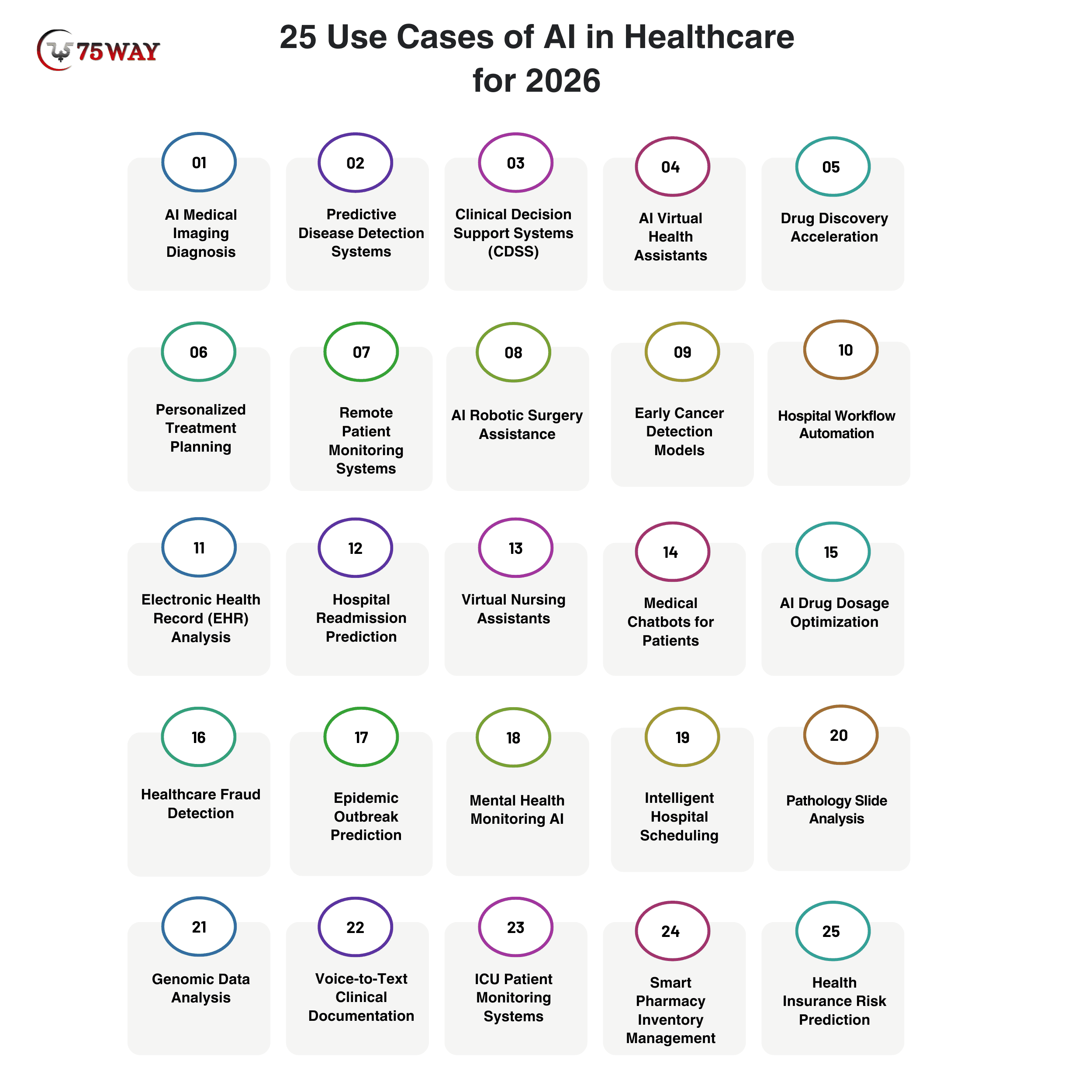
Artificial intelligence is transforming healthcare by enabling faster diagnosis, improving clinical accuracy, automating hospital workflows, and enhancing patient outcomes. Below are 25 real-world AI use cases actively shaping modern healthcare systems, hospitals, diagnostics, and medical research globally.
1. AI Medical Imaging Diagnosis
Artificial intelligence is transforming medical imaging by helping doctors detect diseases faster and with higher precision. AI-powered medical imaging software analyzes complex scan data such as MRI, CT, and X-rays. AI highlights abnormalities that may not be visible during manual review. This improves diagnostic confidence significantly. Hospitals increasingly rely on imaging AI systems.
- Analyzes MRI, CT, and X-ray scans using deep learning models
- Detects tumors, fractures, infections, and internal abnormalities
- Reduces reliance on manual radiology interpretation
- Assists in early detection of serious medical conditions
Impact: Faster diagnosis, improved accuracy, reduced human error, early disease detection
2. Predictive Disease Detection Systems
AI predictive analytics in healthcare are designed to identify potential diseases before symptoms appear. They analyze patient records, lifestyle data, and genetic history. These systems help healthcare providers move from reactive to preventive care. Early risk detection improves treatment planning. This reduces long-term healthcare complications.
- Uses machine learning to analyze patient health data
- Identifies risk patterns for chronic diseases
- Predicts likelihood of future medical conditions
- Supports preventive healthcare strategies
Impact: Early intervention, reduced disease severity, improved survival rates
3. Clinical Decision Support Systems (CDSS)
Clinical decision support systems assist doctors in making evidence-based medical decisions. AI compares patient data with vast medical databases. It provides diagnostic suggestions and treatment recommendations. This reduces uncertainty in complex medical conditions. It enhances the overall quality of healthcare delivery.
- Matches patient data with global medical knowledge
- Suggests probable diagnoses based on symptoms
- Recommends evidence-based treatment options
- Supports faster clinical decision-making
Impact: Higher diagnostic accuracy, improved treatment speed, reduced medical errors
4. AI Virtual Health Assistants
AI virtual health assistants provide continuous digital healthcare support to patients. They interact through chat or voice-based systems. These AI assistants for healthcare help users access basic medical guidance anytime. They reduce unnecessary hospital visits. They also support healthcare staff in managing routine queries.
- Handles appointment scheduling and reminders
- Provides symptom checking and basic medical guidance
- Offers 24/7 patient communication support
- Works across mobile and voice platforms
Impact: Improved accessibility, reduced hospital load, enhanced patient engagement
5. Drug Discovery Acceleration
AI healthcare speeds up pharmaceutical research and drug development processes. It analyzes biological data and molecular structures. This helps identify potential drug candidates faster than traditional research methods. It reduces cost and development time. Pharmaceutical companies increasingly depend on AI-driven discovery systems.
- Analyzes chemical and molecular structures
- Identifies potential drug compounds
- Simulates drug interactions and effectiveness
- Accelerates research and clinical trials
Impact: Faster drug development, reduced research cost, improved innovation speed
6. Personalized Treatment Planning
AI-powered healthcare apps enable highly personalized treatment strategies for individual patients. It analyzes genetics, medical history, and lifestyle factors. This ensures treatments are tailored rather than generalized. Personalized medicine improves recovery rates. It also reduces treatment risks and complications.
- Uses patient-specific genetic data
- Analyzes medical and lifestyle history
- Creates customized treatment recommendations
- Supports precision medicine approaches
Impact: Better treatment outcomes, improved recovery rates, reduced side effects
7. Remote Patient Monitoring Systems
AI remote patient monitoring systems and wearable devices track patient health continuously. These systems transmit real-time health data to doctors. They are widely used for chronic disease patients. This reduces hospital dependency. It enables proactive medical intervention when needed.
- Tracks vital signs like heart rate and oxygen levels
- Uses wearable health monitoring devices
- Sends real-time alerts to healthcare providers
- Enables continuous patient monitoring outside hospitals
Impact: Early emergency detection, reduced hospital visits, improved chronic care
8. AI Robotic Surgery Assistance
AI-powered robotic systems assist surgeons in performing highly precise medical procedures. These systems improve stability and control during surgery. They reduce human error in complex operations. Robotic assistance is widely used in minimally invasive surgeries. It improves patient recovery outcomes.
- Assists surgeons with precision-based movements
- Enhances accuracy in complex procedures
- Reduces surgical risks and complications
- Supports minimally invasive surgery techniques
Impact: Higher surgical precision, faster recovery, reduced operational risk
9. Early Cancer Detection Models
AI automation in healthcare helps detect early signs of cancer through advanced data analysis. It processes medical imaging and genetic information. These systems identify abnormal cell patterns at early stages. Early detection significantly increases treatment success rates. It is widely used in oncology diagnostics.
- Analyzes imaging and pathology reports
- Detects abnormal or cancerous cell structures
- Identifies high-risk patients early
- Supports preventive cancer treatment
Impact: Higher survival rates, early diagnosis, improved treatment effectiveness
10. Hospital Workflow Automation
Hospital management software with AI integration automates repetitive hospital administrative tasks. It reduces manual workload and improves operational efficiency. Tasks like billing and scheduling become faster and more accurate. This allows healthcare staff to focus on patient care. It improves hospital productivity overall.
- Automates patient registration processes
- Manages billing and appointment scheduling
- Maintains digital health records
- Reduces manual administrative workload
Impact: Improved efficiency, reduced operational cost, faster hospital workflows
11. Electronic Health Record (EHR) Analysis
Electronic Health Records contain large volumes of patient data that can be difficult to analyze manually. AI for EHR systems processes this structured and unstructured data to identify patterns and clinical insights. This helps doctors make faster and more informed decisions. It improves overall healthcare quality and reduces documentation complexity.
- Extracts insights from structured and unstructured medical records
- Identifies patterns in patient history and treatments
- Supports clinical decision-making with data intelligence
- Reduces manual effort in record analysis
Impact: Better clinical insights, improved decision accuracy, reduced documentation errors
12. Hospital Readmission Prediction
AI-driven healthcare systems predict the likelihood of patient readmission after discharge. They analyze recovery progress, medical history, and risk indicators. This helps hospitals provide better post-treatment care. It also reduces unnecessary hospital load. Preventive follow-ups improve patient recovery outcomes significantly.
- Analyzes post-discharge recovery patterns
- Identifies high-risk patients for readmission
- Supports preventive care planning
- Improves follow-up treatment strategies
Impact: Reduced readmission rates, improved recovery outcomes, lower hospital burden
13. Virtual Nursing Assistants
Virtual nursing assistants support patients during recovery using AI-driven guidance systems. They provide reminders, monitor symptoms, and offer basic care instructions. These assistants reduce dependency on human nurses for routine tasks. They improve continuity of care outside hospital settings.
- Provides medication and treatment reminders
- Monitors patient recovery progress
- Offers basic post-treatment care guidance
- Assists patients through digital communication
Impact: Better patient recovery, reduced nursing workload, improved care continuity
14. Medical Chatbots for Patient Support
Medical chatbots offer instant responses to patient queries without human intervention. They handle basic health questions, symptom checks, and appointment guidance. These systems are widely used in hospitals and clinics. AI chatbots in healthcare improve patient communication efficiency and reduce support delays.
- Answers patient queries in real time
- Performs basic symptom assessment
- Assists with appointment scheduling
- Provides initial medical guidance
Impact: Faster response time, improved patient engagement, reduced support workload
15. AI-Based Drug Dosage Optimization
AI helps determine accurate medication dosage based on patient-specific factors. It analyzes medical history, body response, and condition severity. This reduces risks associated with incorrect dosage. It ensures safer and more effective treatment outcomes. It is widely used in precision medicine.
- Evaluates patient medical and biological data
- Determines optimal drug dosage levels
- Reduces risk of medication side effects
- Supports personalized medication plans
Impact: Improved medication safety, reduced side effects, higher treatment precision
16. Healthcare Fraud Detection
Healthcare systems use AI to detect fraudulent activities in insurance claims and billing. It identifies unusual patterns and inconsistencies in medical transactions. This protects hospitals and insurers from financial losses. It also improves transparency in healthcare systems.
- Detects anomalies in billing and claims
- Identifies suspicious financial patterns
- Prevents insurance fraud and abuse
- Monitors healthcare transaction integrity
Impact: Reduced financial fraud, improved system transparency, cost savings
17. Epidemic Outbreak Prediction
AI-based healthcare software analyzes global health data to predict disease outbreaks. They monitor infection patterns, travel data, and environmental factors. This helps governments and health organizations prepare in advance. Early prediction supports faster response to public health threats.
- Analyzes global infection and health datasets
- Tracks disease spread patterns
- Predicts outbreak probabilities
- Supports public health planning
Impact: Better epidemic preparedness, faster response, reduced disease spread
18. Mental Health Monitoring Systems
AI for mental health monitors behavioral and emotional patterns to detect mental health conditions. It analyzes speech, activity, and interaction data. This helps identify early signs of stress, anxiety, or depression. Early detection improves mental health support and intervention.
- Analyzes behavioral and speech patterns
- Detects emotional distress indicators
- Identifies early mental health risks
- Supports psychological intervention strategies
Impact: Early mental health detection, improved emotional support, better intervention timing
19. Intelligent Hospital Scheduling Systems
AI optimizes hospital scheduling systems for doctors, staff, and patients. It reduces waiting times and improves resource allocation. These systems ensure smoother hospital operations. They also reduce administrative conflicts and inefficiencies in scheduling workflows.
- Optimizes doctor and staff schedules
- Manages patient appointment allocation
- Reduces waiting times in hospitals
- Improves resource utilization efficiency
Impact: Reduced waiting time, improved efficiency, better hospital resource management
20. Pathology Slide Analysis
AI analyzes microscopic pathology slides to detect diseases. It identifies abnormal tissue patterns with high precision. This supports faster diagnosis in laboratories. It reduces dependency on manual microscopic analysis. It is widely used in diagnostic pathology.
- Examines digital pathology slide images
- Detects abnormal tissue structures
- Supports disease classification and diagnosis
- Reduces manual lab analysis workload
Impact: Faster diagnosis, improved accuracy, reduced pathology workload
21. Genomic Data Analysis
AI processes genetic data to identify disease risks and treatment compatibility. It helps in understanding patient DNA patterns. This supports personalized medicine approaches. It also improves disease prediction accuracy. It is widely used in advanced research and oncology.
- Analyzes genetic and DNA data
- Identifies disease-related genetic markers
- Supports personalized treatment planning
- Enhances precision medicine research
Impact: Improved genetic insights, personalized care, better disease prediction
22. Voice-to-Text Clinical Documentation
AI converts spoken doctor-patient conversations into structured medical records. It reduces manual documentation workload for healthcare professionals. This improves efficiency in hospitals. It also ensures accurate record-keeping. It is widely used in clinical environments.
- Converts speech into structured text records
- Automates medical documentation process
- Reduces manual typing workload
- Improves record accuracy
Impact: Reduced administrative burden, improved documentation speed, higher accuracy
23. ICU Patient Monitoring Systems
AI continuously monitors ICU patients using real-time data analysis. It tracks critical health indicators and alerts doctors during emergencies. This improves survival chances in critical care units. It enhances response speed in life-threatening situations.
- Monitors vital ICU patient data continuously
- Detects abnormal health patterns
- Sends real-time emergency alerts
- Supports critical care decision-making
Impact: Faster emergency response, improved ICU care, higher survival rates
24. Smart Pharmacy Inventory Management
Pharmacy apps and platforms powered by AI manage medicine inventory efficiently. It predicts demand patterns and prevents shortages. This ensures continuous availability of essential medicines. It also reduces waste from overstocking. It improves supply chain efficiency in healthcare.
- Predicts medicine demand trends
- Manages inventory levels automatically
- Prevents stock shortages and wastage
- Optimizes pharmacy supply chain
Impact: Efficient inventory control, reduced shortages, improved supply chain management
25. Health Insurance Risk Prediction
AI-based healthcare insurance apps and platform evaluates patient data to assess insurance risk levels. It helps insurers determine premium pricing and coverage decisions. This improves underwriting accuracy. It also reduces financial risks for insurance companies. It ensures fair risk assessment systems.
- Analyzes patient medical and lifestyle data
- Predicts insurance risk levels
- Supports premium calculation decisions
- Improves underwriting accuracy
Impact: Smarter risk assessment, improved insurance accuracy, reduced financial losses
Use Cases of Artificial Intelligence by Healthcare Department
Artificial intelligence is not used in healthcare as a single system. Instead, it is deployed across different hospital departments, each solving specific clinical and operational challenges. Organizing AI use cases by department helps understand how deeply it is integrated into real medical workflows, from diagnosis to treatment and hospital administration.
1. Radiology Department (Imaging & Diagnosis) 🧠
Radiology is one of the earliest and most advanced adopters of AI in healthcare. It focuses on interpreting medical images where speed and accuracy are critical. AI supports radiologists by detecting patterns in scans that may be difficult to identify manually.
- AI analyzes MRI, CT scans, and X-rays for abnormalities
- Detects tumors, fractures, infections, and organ damage
- Highlights suspicious regions for radiologist review
- Prioritizes urgent cases for faster diagnosis
2. Cardiology Department (Heart Health & Monitoring) ❤️
AI in cardiology focuses on detecting and predicting heart-related conditions using patient data and real-time monitoring systems. It helps identify risks before severe cardiac events occur.
- Analyzes ECG and heart rhythm data for irregularities
- Predicts risk of heart attacks and cardiac failure
- Monitors patient vitals through wearable devices
- Supports early intervention in high-risk patients
3. Oncology Department (Cancer Detection & Treatment) 🧬
AI plays a major role in cancer detection, diagnosis, and treatment planning. It helps oncologists identify cancer at early stages and personalize treatment strategies.
- Detects cancer cells in imaging and pathology reports
- Analyzes genetic data for cancer risk assessment
- Supports treatment planning based on tumor behavior
- Tracks patient response to cancer therapies
4. Neurology Department (Brain & Nervous System) 🧠
Neurology uses AI to study brain activity, detect neurological disorders, and support treatment planning for conditions affecting the nervous system.
- Analyzes brain scans for neurological abnormalities
- Detects early signs of Alzheimer’s and Parkinson’s disease
- Monitors seizure patterns in epilepsy patients
- Supports stroke prediction and diagnosis
5. Emergency Care Department (Critical Response) 🏥
Emergency departments rely on AI to improve patient triage and response speed during critical situations. AI systems assess patient conditions in real time and prioritize cases based on severity. This helps medical staff focus on life-threatening emergencies first.
- Triage systems classify patients based on urgency
- Predicts patient deterioration in real time
- Analyzes vital signs for emergency alerts
- Supports faster decision-making in trauma cases
6. Hospital Administration Department 🏨
Hospital administration uses AI to streamline non-clinical operations and reduce manual workload. These systems automate repetitive tasks such as patient registration, billing, and appointment scheduling. This improves overall hospital efficiency and reduces operational delays.
- Automates patient registration and scheduling
- Manages billing and insurance processing
- Optimizes hospital staff allocation
- Maintains electronic health records efficiently
7. Pathology & Laboratory Department 🧪
AI enhances laboratory diagnostics by analyzing medical samples with high precision. It helps pathologists detect diseases from blood, tissue, and fluid samples. This reduces manual errors and improves the speed of diagnosis.
- Analyzes blood, tissue, and fluid samples
- Detects abnormal cells and infection markers
- Automates lab report generation
- Reduces manual diagnostic errors
8. Pharmacy Department 💊
AI improves pharmacy operations by optimizing medicine inventory and ensuring safe medication usage. It predicts demand patterns and helps prevent medicine shortages. It also detects prescription errors and drug interaction risks.
- Predicts medicine demand and stock requirements
- Detects prescription errors and drug interactions
- Automates inventory management systems
- Optimizes drug supply chains
9. Intensive Care Unit (ICU) 🧑⚕️
Automation plays a life-saving role in ICU environments by continuously monitoring critical patients. It tracks real-time health data and identifies early signs of organ failure or deterioration. This allows medical teams to respond immediately to emergencies.
- Continuously monitors patient vital signs
- Sends real-time alerts to medical staff
- Supports life-support system decision-making
10. Insurance & Billing Department 🧾
AI improves accuracy and transparency in healthcare insurance and billing systems. It detects fraudulent claims and ensures proper verification of medical transactions. This reduces financial risks for healthcare providers and insurers.
- Detects fraudulent insurance claims
- Automates claim verification processes
- Predicts patient insurance risk levels
- Streamlines billing accuracy and approvals
Final Thoughts
Artificial intelligence is rapidly becoming a foundational layer of modern healthcare systems. Its applications span diagnostics, treatment planning, hospital operations, drug discovery, and patient monitoring, creating a more efficient and data-driven medical ecosystem. As adoption increases, AI will continue to redefine how healthcare is delivered, managed, and experienced globally. If you are looking to build intelligent healthcare solutions powered by AI? Partner with a leading AI development agency to design scalable healthcare applications that improve diagnostics, automate hospital workflows, and deliver smarter patient care experiences using advanced machine learning and automation technologies.
Frequently Asked Questions (FAQs)
How Is Artificial Intelligence Improving Medical Diagnosis Accuracy?
Medical systems are becoming more precise by analyzing imaging data, patient records, and clinical patterns. This helps doctors identify conditions earlier and reduces the chances of human error during diagnosis and treatment planning.
Can AI Be Used In Emergency Healthcare Situations?
Emergency departments increasingly rely on intelligent systems to prioritize critical patients and analyze symptoms quickly. This allows faster decision-making and helps medical teams respond more during high-pressure situations.
What Role Does AI Play In Medical Research?
Medical research benefits from faster data analysis, pattern recognition, and clinical trial optimization. Researchers can process large datasets more efficiently, leading to quicker discoveries and improved treatment innovations.
Is Artificial Intelligence Reliable For Clinical Decision Making?
Yes, when trained on high-quality medical datasets, AI systems provide highly reliable insights that support clinical decisions. However, final judgment still remains with healthcare professionals who interpret and validate results.
How Does AI Improve Patient Safety In Hospitals?
Patient safety improves through continuous monitoring systems that detect early warning signs and alert medical staff instantly. This reduces response time and helps prevent complications during treatment.
Can AI Be Used In Rural Healthcare Systems?
Yes, rural healthcare delivery improves through remote diagnostics, telemedicine platforms, and automated monitoring tools. These systems help bridge accessibility gaps and provide better medical support in underserved regions.