Summary
AI applications are becoming essential across industries, driving smarter and more personalized digital experiences. Businesses that adopt advanced AI features gain stronger user engagement and competitive advantages. This guide highlights 20 must-have capabilities shaping successful AI app development in 2026. These features help improve scalability, automation, customer satisfaction, and long-term business growth.
Quick Overview
- AI personalization drives stronger engagement through highly relevant user experiences.
- Predictive analytics transforms business decisions using actionable future-focused intelligence.
- Conversational interfaces simplify interactions while reducing customer support workloads.
- Security-focused AI features strengthen trust across modern digital ecosystems.
- Multimodal intelligence enables richer interactions across text, voice, images, and videos.
Building an AI app in 2026 is easier than it was a few years ago. But, the developing an app that users actually keep using is the real challenge. Every week, new AI applications enter the market promising smarter experiences, better automation, and faster results. Yet many struggle to gain traction because they focus on AI itself rather than the features that create real value for users.
Think about the AI apps you use most often. Whether it is an AI chatbot, productivity assistant, healthcare app or platform, or ecommerce solution, users stay because the experience feels seamless, personalized, and reliable. The underlying AI matters, but features such as intelligent recommendations, natural conversations, real-time insights, automation, and security are what truly shape user satisfaction and long-term engagement.
So, if you are planning to build an AI-powered application, one question becomes critical: which features are no longer optional in 2026? In this guide, we will explore the 20 must-have features that successful AI apps are using to improve user experience, increase retention, drive business growth, and stay competitive in an increasingly crowded AI landscape.
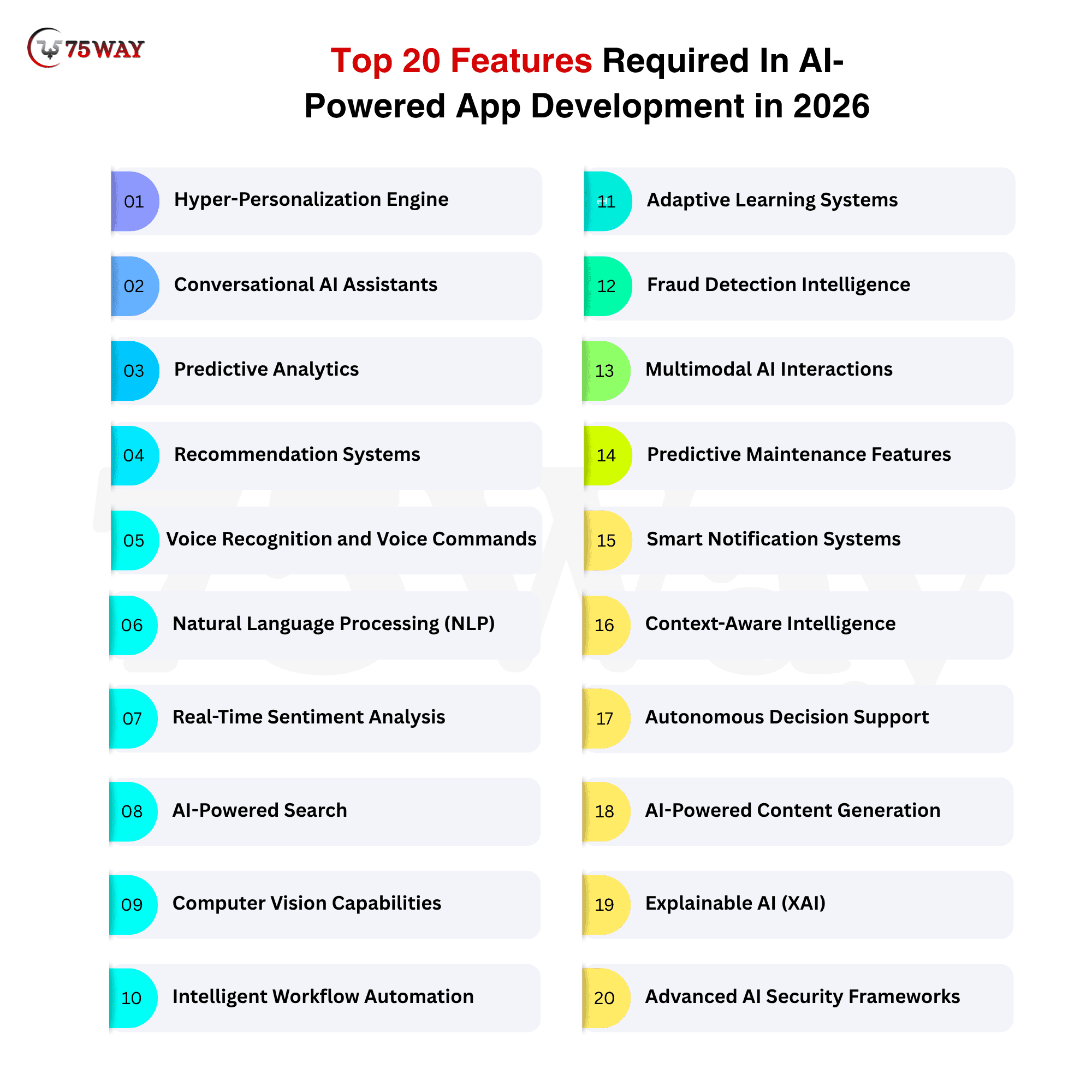
Top 20 Features Required In AI-Powered App Development in 2026
The features defining successful AI applications in 2026 are outlined below. Each capability addresses specific business challenges while contributing to stronger engagement, smarter decision-making, and enhanced user experiences.
1. Hyper-Personalization Engine
Modern users expect applications to recognize their preferences and deliver experiences tailored to their individual needs. Hyper-personalization goes beyond traditional recommendation systems by analyzing behavioral patterns, browsing habits, purchase history, interaction frequency, device usage, and contextual signals. This allows AI applications to create highly relevant experiences for every user.
Instead of offering a one-size-fits-all interface, AI dynamically adjusts content, recommendations, notifications, product suggestions, and workflows based on user behavior. As customer expectations continue to evolve, hyper-personalization is becoming one of the strongest drivers of engagement and retention.
Key advantages include:
- Higher engagement through tailored experiences
- Improved retention across digital platforms
- Stronger customer loyalty and trust
- Better conversion rates and revenue
- Enhanced satisfaction through relevance
2. Conversational AI Assistants
Conversational AI agents have become an essential component of modern digital products. They help users navigate applications, answer questions, schedule appointments, resolve issues, and complete transactions through natural conversations. Unlike traditional rule-based chatbots, these assistants understand context and intent.
Advanced conversational AI assistants maintain conversation history, recognize user preferences, and generate responses that feel natural and helpful. Their ability to provide instant support makes them valuable across healthcare, finance, retail, education, and enterprise applications.
Business benefits often include:
- Faster support response for users
- Lower customer service operating costs
- Better accessibility across digital channels
- Improved engagement throughout customer journeys
- Twenty-four-hour assistance without interruptions
3. Predictive Analytics
Predictive analytics helps organizations identify future trends before they occur. By processing historical and real-time data, AI models uncover hidden patterns and generate forecasts that support business planning and strategic decision-making.
Applications use predictive and advanced analytics to anticipate customer churn, estimate demand fluctuations, forecast sales performance, detect fraud risks, and optimize inventory management. These insights enable organizations to act proactively rather than react after problems emerge.
Major advantages can include:
- Smarter decisions based on future insights
- Reduced risks across business operations
- Better allocation of organizational resources
- Increased profitability through forecasting accuracy
- Enhanced competitiveness within target market
4. Recommendation Systems
Recommendation engines remain among the most valuable AI features across digital ecosystems. They help users discover products, content, services, courses, media, and opportunities that align with their interests and behavioral patterns.
Modern recommendation systems leverage machine learning algorithms, demographic information, contextual data, and user interactions to generate highly relevant suggestions. This personalization contributes significantly to engagement, retention, and revenue generation.
Core benefits may include:
- Increased engagement through relevant recommendations
- Higher revenue from personalized suggestions
- Better user experiences across platforms
- Longer sessions and repeat visits
- Improved content and product discovery
5. Voice Recognition And Voice Commands
Voice interactions are becoming increasingly popular as users seek faster and more convenient ways to interact with applications. AI-powered voice recognition allows users to perform actions without typing or navigating complex menus.
From searching for information and creating content to controlling smart devices and completing transactions, voice-enabled applications offer a seamless and intuitive experience. This capability is particularly valuable for accessibility-focused products and mobile-first platforms.
Organizations benefit through:
- Improved accessibility for diverse audiences
- Faster navigation across application interfaces
- Greater convenience during daily interactions
- Enhanced user experience and usability
- Increased adoption among mobile users
6. Natural Language Processing (NLP)
Natural Language Processing enables applications to understand and interpret human language. It powers many AI capabilities, including conversational interfaces, sentiment analysis, intelligent search, translation tools, and content generation systems.
As language models become more sophisticated, NLP helps applications process conversations, documents, emails, reviews, and support requests with remarkable accuracy. This capability bridges the communication gap between humans and machines.
Notable benefits include:
- Improved communication between users and applications
- Better support through language understanding
- Enhanced search and content discovery
- Increased automation of language tasks
- Expanded reach across global markets
7. Real-Time Sentiment Analysis
Customer emotions influence purchasing decisions, loyalty, and engagement. Real-time sentiment analysis helps applications understand emotional context by evaluating reviews, messages, feedback, conversations, and social interactions.
Organizations can identify positive sentiment, dissatisfaction, frustration, excitement, and buying intent as interactions occur. These insights support faster interventions and more personalized customer experiences.
Potential benefits include:
- Better understanding of customer emotions
- Faster identification of emerging concerns
- Improved customer support interactions
- Personalized experiences based on sentiment
- Stronger relationships with target audiences
8. AI-Powered Search
Traditional search systems rely heavily on exact keyword matching. AI-powered search uses semantic understanding, contextual awareness, and user intent recognition to deliver more accurate and meaningful results.
Modern search experiences allow users to ask questions naturally, use voice queries, and discover information faster. This significantly improves usability within content-heavy applications and enterprise platforms.
Valuable outcomes include:
- Faster access to relevant information
- Better search experiences for users
- Improved content visibility and discovery
- Higher engagement across digital properties
- Reduced frustration during information searches
9. Computer Vision Capabilities
Computer vision enables AI applications to interpret visual data from images, videos, and live camera feeds. This technology powers facial recognition, visual search, medical diagnostics, quality inspections, and identity verification solutions.
As visual data becomes increasingly important, computer vision allows organizations to automate processes that previously required human observation and manual analysis.
Common benefits include:
- Improved accuracy in visual analysis
- Faster processing of image data
- Enhanced security and authentication measures
- Greater automation across operational workflows
- Better experiences through visual intelligence
10. Intelligent Workflow Automation
Workflow automation helps organizations reduce manual workloads while improving operational productivity. AI systems can automate document handling, approvals, onboarding processes, scheduling, reporting, and repetitive administrative activities.
By minimizing routine tasks, businesses can focus resources on strategic initiatives, innovation, and customer-focused activities that contribute greater value.
Key advantages include:
- Reduced manual effort across departments
- Higher productivity within business processes
- Lower operational and administrative costs
- Better scalability during business growth
- Faster completion of routine workflows
11. Adaptive Learning Systems
Adaptive learning systems enable enterprise AI applications to evolve based on user interactions, behavioral feedback, and changing usage patterns. Rather than relying on fixed rules established during development, these systems continuously analyze new data and refine their outputs over time.
This capability allows applications to improve recommendations, automate decision-making, personalize experiences, and optimize workflows without extensive manual intervention. As more users engage with the platform, the intelligence layer becomes increasingly accurate and valuable.
Organizations gain advantages such as:
- Better personalization across user experiences
- Improved accuracy through ongoing learning
- Smarter recommendations based on behavior
- Higher engagement from relevant interactions
- Greater value delivered over time
12. Fraud Detection Intelligence
As digital transactions continue growing, fraud attempts are becoming more sophisticated. AI-powered fraud detection systems analyze massive datasets in real time to identify suspicious activities, unusual patterns, and potentially malicious behavior before significant damage occurs.
Unlike traditional security rules that rely on predefined conditions, AI continuously learns from emerging threats and adapts to changing attack methods. This proactive approach strengthens security while reducing false positives.
Important benefits often include:
- Stronger protection against financial fraud
- Faster detection of suspicious activities
- Reduced losses from security incidents
- Higher customer confidence and trust
- Better visibility into threat patterns
13. Multimodal AI Interactions
Users increasingly communicate through multiple formats including text, voice, images, videos, and documents. Multimodal AI enables applications to understand and process information from several input sources simultaneously.
This capability creates richer user experiences because the system can combine different forms of data to generate more accurate insights and responses. Applications become more intuitive and capable of supporting diverse communication preferences.
Business value can include:
- Richer interactions across communication channels
- Better accessibility for diverse user groups
- More accurate understanding of requests
- Enhanced experiences through multiple formats
- Greater flexibility in user interactions
- Improved insights from combined datasets
14. Predictive Maintenance Features
Industries that depend on machinery, vehicles, equipment, or infrastructure increasingly rely on predictive maintenance capabilities. AI systems monitor operational data and identify warning signs before failures occur.
Instead of waiting for equipment breakdowns, organizations can schedule maintenance proactively. This approach minimizes disruptions, reduces repair expenses, and improves overall operational performance.
Key outcomes frequently include:
- Reduced downtime across critical operations
- Lower maintenance and repair expenses
- Longer lifespan for valuable equipment
- Improved reliability throughout business processes
- Higher productivity across operational environments
15. Smart Notification Systems
Modern users receive countless notifications every day. Generic alerts often result in disengagement and notification fatigue. AI-powered notification systems analyze behavior, preferences, engagement history, and contextual signals to determine the most relevant communication strategy.
These systems identify the right message, channel, timing, and frequency for each user. As a result, notifications become more valuable and less intrusive.
Organizations commonly experience:
- Higher engagement from targeted notifications
- Reduced fatigue from excessive messaging
- Better retention across digital platforms
- Improved customer interactions and responses
- Stronger communication through personalized delivery
16. Context-Aware Intelligence
Context-aware intelligence enables applications to evaluate environmental and behavioral factors before generating recommendations or taking actions. These factors may include location, device type, browsing behavior, historical interactions, and user preferences.
By understanding situational context, AI systems can deliver more relevant responses and experiences. This capability significantly improves decision quality and user satisfaction across digital platforms.
Major advantages can include:
- More relevant interactions in real time
- Better personalization through contextual awareness
- Higher engagement across user journeys
- Improved satisfaction from relevant experiences
- Smarter decisions based on environmental factors
17. Autonomous Decision Support
Modern organizations process enormous amounts of data every day. Autonomous decision support systems help leaders, employees, and customers make informed choices by analyzing information and generating intelligent recommendations.
These systems assist with investment planning, healthcare assessments, workforce management, supply chain optimization, and resource allocation. Human expertise remains essential, while AI provides data-driven guidance that improves outcomes.
Business benefits frequently include:
- Faster decisions across critical operations
- Improved accuracy in strategic planning
- Reduced uncertainty during complex scenarios
- Better outcomes through data insights
- Increased productivity among decision-makers
18. AI-Powered Content Generation
Content creation remains a major challenge for businesses seeking to maintain consistent communication across multiple channels. AI-powered content generation helps organizations produce articles, reports, summaries, emails, marketing materials, and product descriptions at scale.
Modern content generation tools support human creativity rather than replacing it. Teams can accelerate production while maintaining quality, relevance, and consistency across campaigns and communication efforts.
Significant benefits often include:
- Faster creation of business content
- Improved productivity across content teams
- Lower costs for content production
- Consistent messaging across communication channels
- Better scalability for growing businesses
- Quicker response to market demands
19. Explainable AI (XAI)
As AI becomes increasingly involved in business operations and customer interactions, transparency is becoming a critical requirement. Explainable AI helps users understand the reasoning behind recommendations, predictions, classifications, and automated decisions.
This transparency supports trust, accountability, and regulatory compliance. Organizations can confidently deploy AI solutions while providing users with greater visibility into system behavior.
Valuable outcomes may include:
- Increased trust in AI recommendations
- Better transparency across automated processes
- Stronger compliance with industry regulations
- Improved adoption among business users
- Greater accountability for AI decisions
20. Advanced AI Security Frameworks
AI applications often process sensitive customer information, financial records, business data, and operational insights. Security frameworks play a critical role in protecting these assets from evolving cyber threats.
Modern AI security architectures incorporate threat detection, behavioral monitoring, identity verification, access controls, encryption technologies, and compliance mechanisms. These measures strengthen protection while supporting business growth.
Critical benefits can include:
- Stronger protection for sensitive information
- Better readiness for compliance requirements
- Improved trust among platform users
- Reduced risks from cyber threats
- Enhanced resilience against security incidents
- Greater confidence in digital operations
Why Combining These Features Matters in AI Apps?
The most successful AI-powered applications in 2026 will not rely on a single intelligent capability. Instead, they will integrate multiple AI features that work together to create seamless, personalized, and value-driven experiences. For example, conversational AI becomes significantly more powerful when combined with NLP, sentiment analysis, personalization engines, and context-aware intelligence.
1. Delivers More Personalized User Experiences
Individual AI features can improve specific interactions, but combining multiple capabilities creates a deeper understanding of user behavior. When personalization engines, predictive analytics, sentiment analysis, and recommendation systems work together, applications can deliver highly relevant experiences tailored to each user's preferences, goals, and actions.
2. Improves Decision-Making Accuracy
AI systems produce better outcomes when they analyze information from multiple sources. Predictive analytics, adaptive learning, context-aware intelligence, and autonomous decision support collectively provide richer insights, helping businesses and users make more informed decisions with greater confidence.
3. Increases User Engagement And Retention
Users are more likely to remain active when applications consistently provide value. Features such as conversational AI, smart notifications, recommendation engines, and voice interactions create engaging experiences that encourage longer sessions, repeat usage, and stronger customer loyalty.
4. Strengthens Operational Efficiency
Combining workflow automation, predictive analytics, fraud detection, and AI-powered content generation helps organizations reduce manual workloads while improving productivity. Businesses can automate routine activities, identify opportunities faster, and allocate resources more effectively across departments.
5. Creates A Sustainable Competitive Advantage
Applications that integrate multiple AI capabilities are often more difficult for competitors to replicate. Advanced personalization, intelligent automation, predictive insights, security frameworks, and multimodal interactions work together to create differentiated products that attract users, increase satisfaction, and support long-term business growth.
How To Prioritize AI Features For Your App Development Project In 2026?
One of the biggest mistakes businesses make is attempting to implement every AI feature at once. While the capabilities discussed in this guide can create powerful digital experiences, successful AI products are typically developed in phases based on business goals, user needs, available data, and budget considerations. Thus, a structured prioritization framework helps organizations focus on features that generate the highest business value while reducing development risks. The following steps can help define the right AI roadmap for your application.
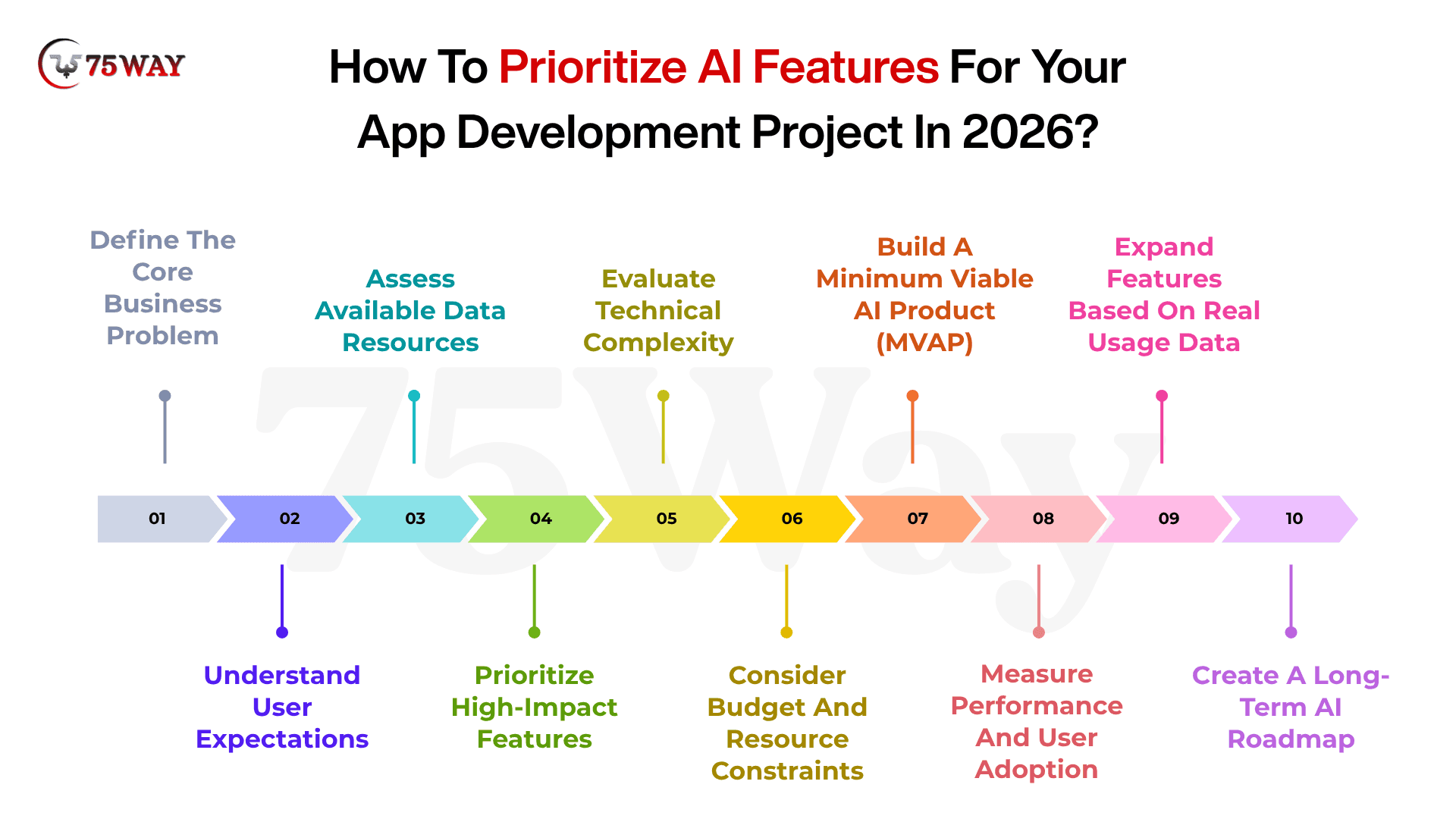
Step 1: Define The Core Business Problem
Before selecting AI features, identify the primary challenge your application is solving. Whether the goal is improving customer engagement, reducing operational costs, increasing sales, or automating workflows, every feature should align with a measurable business objective.
Without a clearly defined problem, businesses often invest in advanced AI capabilities that add complexity without delivering meaningful value.
Step 2: Understand User Expectations
Successful AI applications are built around user needs rather than technology trends. Analyze customer pain points, behavior patterns, support requests, and feature expectations to determine which AI capabilities will create the greatest impact.
For example, users seeking faster support may benefit most from conversational AI, while content-heavy platforms may require intelligent search and recommendation systems.
Step 3: Assess Available Data Resources
Data serves as the foundation of every AI system. Evaluate the quality, quantity, structure, and accessibility of available datasets before prioritizing advanced AI features.
Capabilities such as predictive analytics, adaptive learning, and autonomous decision support typically require large volumes of historical data. Organizations with limited datasets may achieve faster results by implementing workflow automation, content generation, or conversational AI first.
Step 4: Prioritize High-Impact Features
Not every AI feature delivers the same business value. Identify capabilities that can generate immediate improvements in customer experience, operational performance, or revenue growth.
For many applications, personalization, conversational AI, recommendation engines, and intelligent search often provide faster returns than more complex AI implementations.
Step 5: Evaluate Technical Complexity
Each AI capability introduces different development requirements, infrastructure needs, integration challenges, and maintenance considerations.
Assess technical feasibility before finalizing priorities. Features with lower implementation complexity and higher business impact are often ideal starting points for initial product releases.
Step 6: Consider Budget And Resource Constraints
AI development investments should align with available budgets and organizational resources. Some capabilities require extensive model training, data preparation, infrastructure scaling, and ongoing optimization.
Prioritizing features strategically helps maximize ROI while preventing unnecessary spending during early development stages.
Step 7: Build A Minimum Viable AI Product (MVAP)
Rather than launching with every planned capability, focus on a core set of three to five AI features that directly address your primary business objectives.
This approach accelerates time-to-market, reduces development risks, and provides valuable user feedback before expanding the platform.
Step 8: Measure Performance And User Adoption
After launch, track key performance indicators such as engagement rates, retention, conversion metrics, user satisfaction, and operational efficiency improvements.
Performance data helps determine which features are generating value and which areas require optimization or expansion.
Step 9: Expand Features Based On Real Usage Data
Once core AI capabilities demonstrate success, gradually introduce additional features based on user behavior and business priorities.
This phased approach allows organizations to build stronger products while minimizing risk and maintaining development flexibility.
Step 10: Create A Long-Term AI Roadmap
AI adoption is an ongoing journey rather than a one-time implementation. Develop a long-term roadmap that outlines future enhancements, scalability plans, emerging technologies, and evolving customer expectations.
Organizations that continuously refine and expand their AI capabilities are better positioned to maintain competitive advantages and adapt to changing market demands.
Recommended AI Feature Prioritization Framework
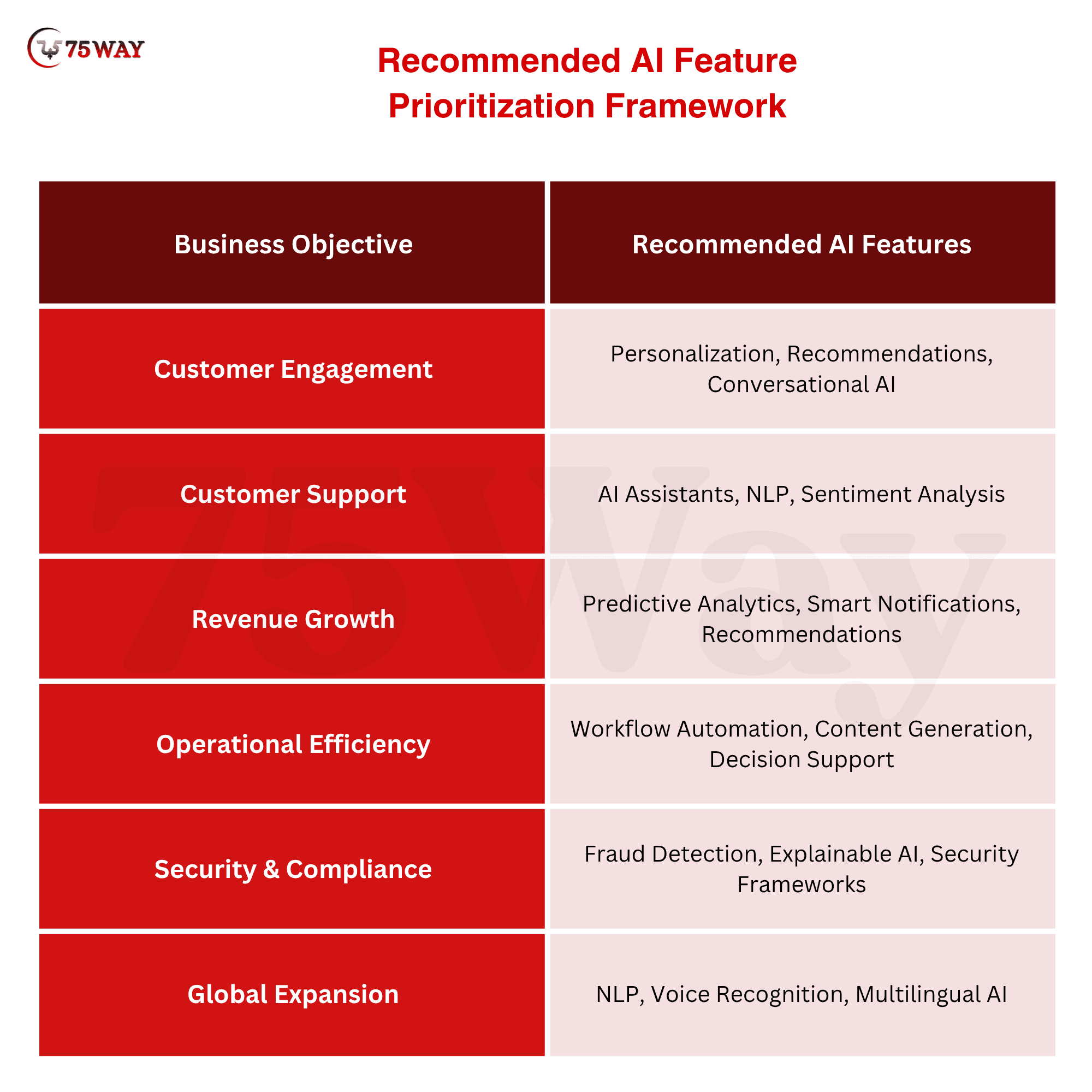
The highest-performing AI applications in 2026 are not necessarily those with the most features. They are the products that implement the right features at the right stage of growth. Businesses that align AI investments with measurable outcomes often achieve stronger adoption, faster ROI, and better long-term scalability.
Final Remarks
AI-powered applications in 2026 are expected to deliver far more than basic automation or chatbot functionality. Users demand intelligent experiences that understand context, provide personalized interactions, anticipate needs, automate repetitive processes, and maintain high levels of security. Businesses that integrate these capabilities can create stronger customer relationships, improve operational performance, and unlock new revenue opportunities. The most successful AI applications combine multiple features rather than relying on a single capability. If you want to integrate AI features in your existing apps, hire a trusted AI development company that specializes in building revenue-focused applications. Schedule your free AI consultation today and discover the fastest path from concept to a successful AI product.
Frequently Asked Questions (FAQs)
Which AI Feature Delivers The Fastest Return on Investment (ROI)?
Workflow automation and conversational AI often generate quick returns by reducing manual workloads. Businesses frequently see measurable improvements in productivity, support costs, and customer satisfaction.
Do All AI-Powered Apps Need Personalization Features?
Not all, but most modern AI applications benefit from personalization because users expect relevant experiences. Personalized content, recommendations, and interactions can significantly improve engagement and retention rates.
Why Are Recommendation Engines Important In AI Applications?
Recommendation engines help users discover relevant products, content, and services faster. Better recommendations often increase engagement, conversions, session duration, and overall customer satisfaction.
What Makes Multimodal AI Important In 2026?
Users increasingly interact through text, voice, images, and videos simultaneously. Multimodal AI processes multiple input formats, creating richer and more natural digital experiences.
How Does Sentiment Analysis Improve Customer Experiences?
Sentiment analysis identifies emotions within customer interactions, reviews, and feedback. Businesses can respond proactively to concerns and create more personalized engagement strategies.
Which AI Features Should Startups Prioritize First?
Startups should focus on features aligned with immediate business goals and user needs. Conversational AI, personalization, intelligent search, and automation often provide strong early value.