AI Summary
Shopify clone app development can create a scalable commerce SaaS platform for modern merchants. This guide covers features, technology, development stages, costs, monetization, security, and scaling. It also explains practical ways to differentiate your platform.
Key Takeaways
- A Shopify clone creates scalable infrastructure for multiple independent online merchants.
- MVP development validates merchant demand before larger platform investments begin.
- Core features should simplify storefront, product, order, payment, and merchant operations.
- Multi-tenant architecture supports multiple merchants while maintaining secure data isolation.
- AI can differentiate platforms through recommendations, automation, analytics, and customer assistance.
- Shopify clone development can cost $50,000–$300,000+, depending on complexity.
- The global property management software market will reach $61.41 billion by 2034.
A Shopify-like app can give merchants a place to create online stores, manage products, accept payments, track orders, and grow their businesses without building ecommerce software infrastructure from scratch.
For founders and businesses, Shopify clone development is not about copying another company's product; it is about creating a customizable eCommerce platform with similar core capabilities and a differentiated business model.
The opportunity becomes more interesting when the platform targets a specific market, merchant segment, region, or commerce workflow. This guide explains how to build a Shopify-like platform, which features matter, what technology it requires, how much development can cost, and how to create a product merchants have a reason to choose.
What Is A Shopify Clone?
A Shopify clone is a custom eCommerce platform that provides merchants with tools to create and operate their own online stores from a centralized system.
Instead of building one store for one business, the platform can use a multi-tenant architecture to allow multiple merchants to operate independent storefronts while sharing the underlying infrastructure.
A Shopify-like platform can include merchant dashboards, product management, inventory, order processing, payment integration, themes, analytics, customer management, shipping, marketing tools, and subscription management.
The exact functionality depends on the target audience and business model. The goal should be functional inspiration rather than a direct copy. Your platform should have its own branding, interface, architecture, workflows, and differentiating features.
Why Develop A Multi-Vendor E-Commerce Platform Like Shopify?
Shopify showed that the bigger opportunity in e-commerce is not always selling products yourself. It can be providing the infrastructure that helps other businesses sell online. A multi-vendor platform can create recurring revenue while building a growing network of sellers and buyers. Here’s why businesses are considering this model and what makes it commercially attractive.
- SaaS Revenue Opportunity
A Shopify-like product can operate on a recurring subscription model where merchants pay monthly or annually for access to platform capabilities. Multiple pricing tiers can support different merchant sizes and feature requirements.
- Multi-Merchant Business Model
A multi-tenant platform can support numerous merchants from one technology foundation. This creates an opportunity to build a scalable SaaS business rather than generating revenue from individual software projects.
- Industry-Specific Commerce
A general-purpose platform may not address the unique needs of every industry. A specialized solution for fashion, wholesale, food, beauty, electronics, or another vertical can introduce workflows designed around that industry's selling process.
- Greater Product Control
A custom platform gives businesses control over the product roadmap, integrations, pricing structure, merchant experience, and future feature development. This can be valuable when existing platforms create limitations around customization or business strategy.
Multi-Vendor Ecommerce App Like Shopify Market Growth & Opportunities
Every new merchant looking for better ways to sell online represents potential demand for the technology behind the storefront. This creates an opportunity for businesses to build multi-vendor e-commerce platforms that earn from merchant subscriptions, transactions, premium tools, and related services. The market growth and commercial opportunities for Shopify-like platforms are discussed in detail below.
- Shopify achieved 34% revenue growth, with 33% growth in constant currency and an 18% free cash flow margin.
- The Shopify App Store features more than 11,900 apps, creating one of the largest ecommerce app ecosystems.
- Shopify Inbox is among the most widely installed apps, with over 388,000 stores using it, according to Store Leads.
- Global ecommerce revenue is projected to reach $1.22 trillion in 2026, growing at a 5.51% CAGR to approximately $1.51 trillion by 2030 as stated by Statista
- The global ecommerce market is expected to reach 336.1 million users by 2030.
- Ecommerce user penetration is projected to rise from 87.5% in 2026 to 96.4% by 2030.
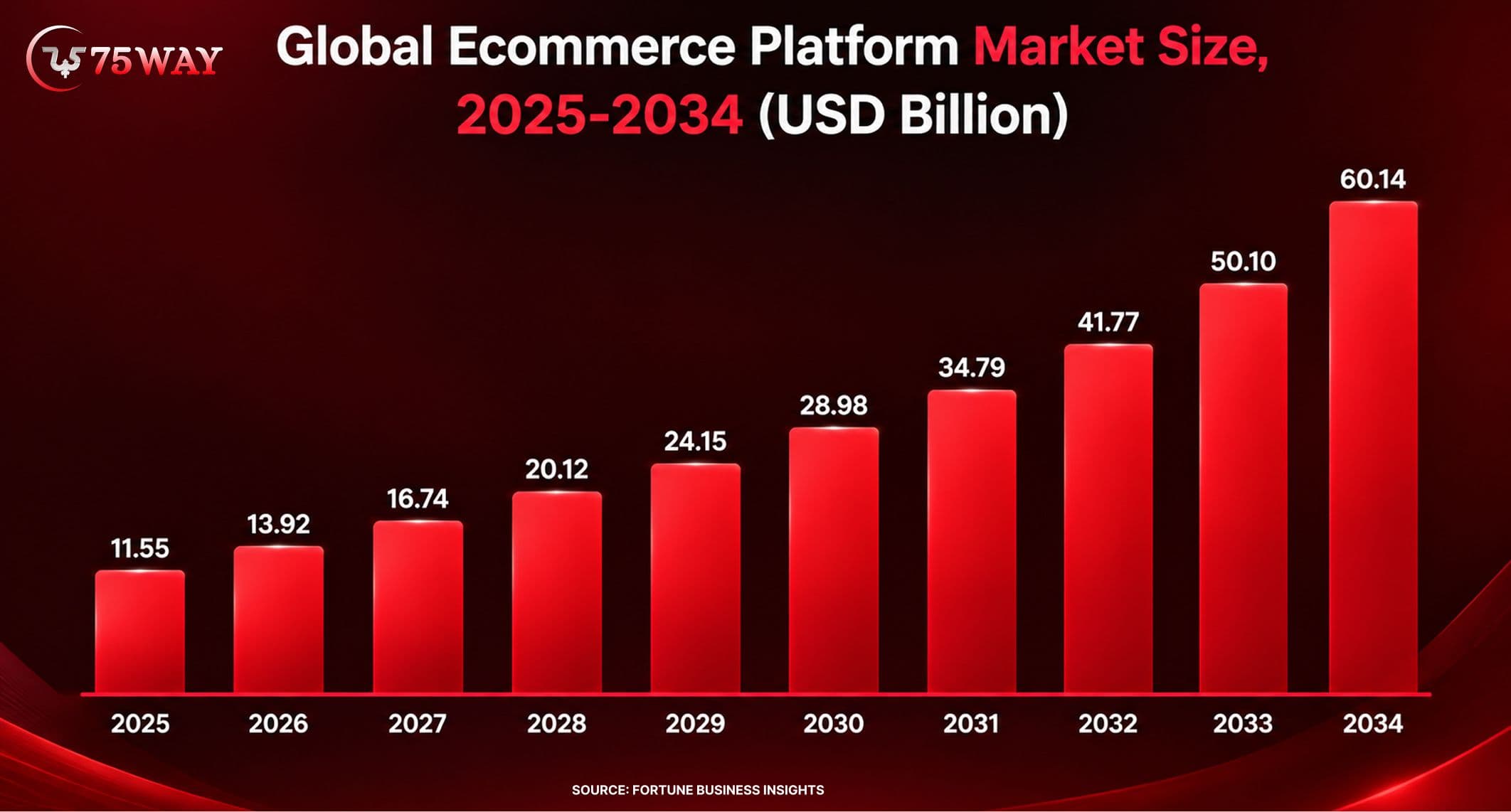
- The global ecommerce platform market is projected to grow from $13.92 billion in 2026 to $61.83 billion by 2034, at a CAGR of 20.49%.
- North America dominated the ecommerce platform market with a 34% revenue share in 2025.
Who Can Develop A Custom Shopify Clone App?
Your choice of development team can shape how well a Shopify-like platform performs once real merchants start using it. You can work with freelancers, an in-house team, or a specialized e-commerce development company depending on the product’s complexity and your available resources. Let’s look at who can build a custom Shopify clone and when each option makes sense.
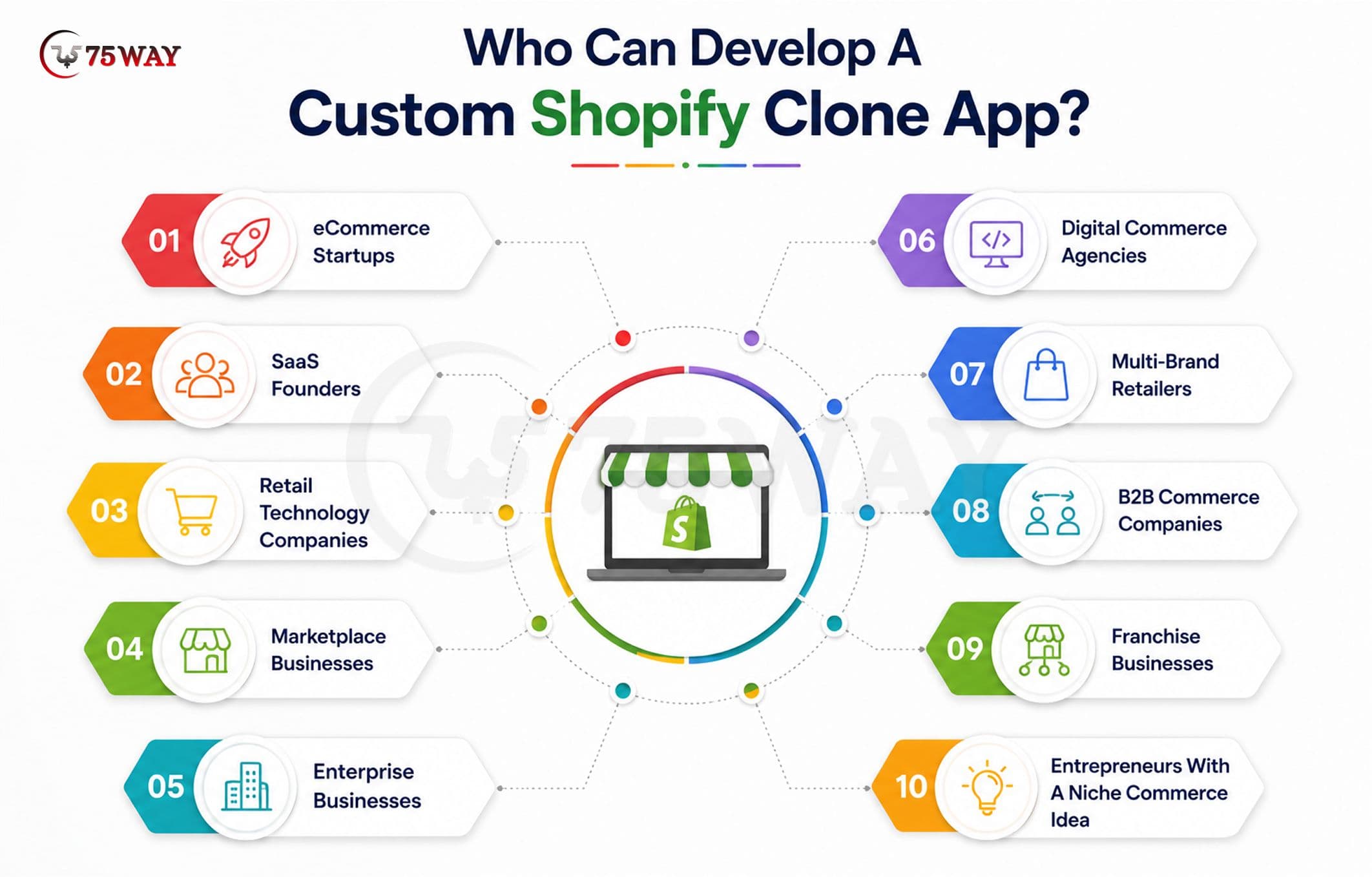
- eCommerce Startups: Early-stage commerce ventures can use a custom Shopify clone to launch a differentiated platform without being restricted by existing SaaS limitations. A focused MVP can validate the concept before broader feature expansion.
- SaaS Founder: Commerce-focused SaaS founders can build a subscription-based platform offering storefront creation, catalog management, payments, analytics, automation, and other tools.
Custom Shopify-like platform development allows the product to support a distinct pricing and feature strategy.
- Retail Technology Companies: Retail technology providers can extend their existing solutions with a commerce platform tailored to merchants, brands, or retailers.
Custom functionality can connect storefronts with inventory, POS, customer data, analytics, and operational systems.
- Marketplace Businesses: Marketplace operators can develop Shopify-like capabilities alongside seller onboarding, product management, commissions, order processing, and multi-vendor administration.
This approach works well when merchants need storefront tools within a broader marketplace ecosystem.
- Enterprise Businesses: Large enterprises may require commerce infrastructure aligned with complex organizational structures, approval workflows, catalogs, permissions, integrations, and regional operations.
A custom platform provides greater control over architecture, data, and business-specific functionality.
- Digital Commerce Agencies: Commerce agencies can develop their own reusable platform or white-label commerce solution for clients across different industries.
Custom architecture can support configurable storefronts, integrations, branding, and merchant-specific functionality.
- Multi-Brand Retailers: Retail groups managing multiple brands can create centralized commerce infrastructure while giving individual brands control over catalogs, storefront experiences, pricing, promotions, and customer journeys.
Shared backend capabilities can reduce duplicated technology efforts.
- B2B Commerce Companies: B2B sellers and distributors can build commerce platforms around bulk purchasing, negotiated pricing, account hierarchies, purchase approvals, recurring orders, credit terms, and customer-specific catalogs.
These workflows often require functionality beyond standard consumer ecommerce.
- Franchise Businesses: Franchise networks can use custom commerce software to connect centralized brand management with location-level operations.
The platform can support individual catalogs, permissions, inventory, pricing, orders, and reporting while maintaining brand standards.
- Entrepreneurs With A Niche Commerce Idea: Niche-focused entrepreneurs can turn a specific commerce concept into a purpose-built Shopify-like platform for a defined audience.
Custom development makes it possible to prioritize specialized workflows, integrations, monetization models, and customer experiences.
Must-Have Features of A Shopify Clone App Development
A Shopify-like platform needs more than a storefront and shopping cart. Its real value comes from connecting merchant operations, customer experiences, payments, fulfillment, analytics, and administration within one system.
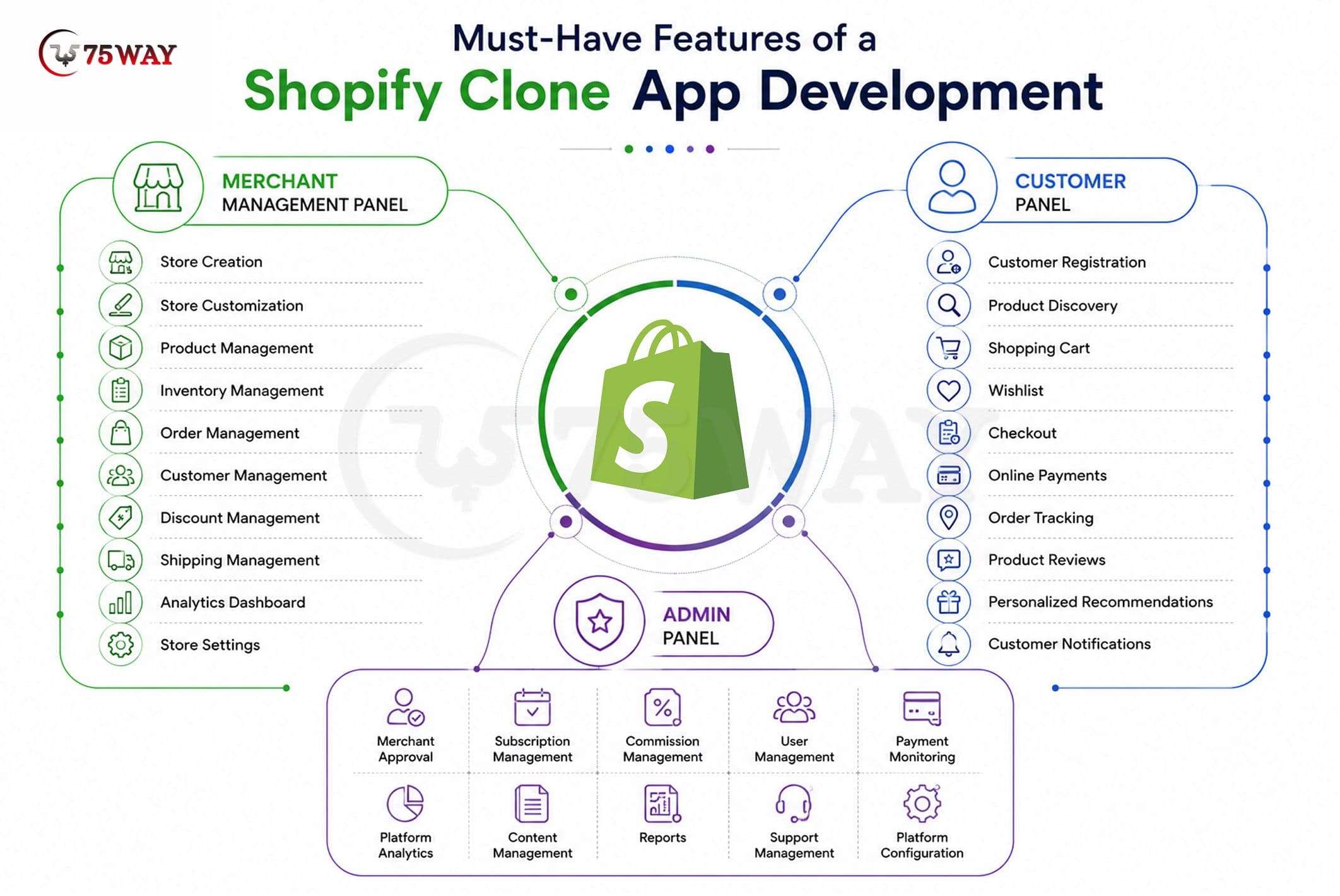
Module 1: Merchant Management Panel
- Store Creation: Merchants can create their online stores, configure essential settings, and establish their storefront without requiring extensive technical knowledge.
- Store Customization: Theme, layout, branding, navigation, and storefront settings allow merchants to create experiences aligned with their brand identity.
- Product Management: Merchants can add products, descriptions, images, variants, pricing, SKUs, and other catalog information from their dashboard.
- Inventory Management: Stock quantities, product availability, low-stock alerts, and inventory updates help merchants maintain accurate product information.
- Order Management: Order dashboards give merchants visibility into new, processing, fulfilled, canceled, and completed orders.
- Customer Management: Customer profiles can consolidate contact details, order history, preferences, and relevant interactions.
- Discount Management: Merchants can create promotional codes, percentage discounts, fixed discounts, and other promotional rules.
- Shipping Management: Shipping methods, delivery zones, rates, and fulfillment preferences can be configured according to merchant requirements.
- Analytics Dashboard: Sales, orders, customers, conversion data, and product performance can be presented through merchant-facing reports.
- Store Settings: Business details, domains, notifications, taxes, payment preferences, and other operational settings can be managed from one location.
Module 2: Customer App Panel
- Customer Registration: Shoppers can create accounts to save information, review orders, manage addresses, and receive personalized experiences.
- Product Discovery: Search, categories, filters, recommendations, and navigation help customers find products without unnecessary friction.
- Shopping Cart: Customers can review products, adjust quantities, apply discounts, and prepare orders before checkout.
- Wishlist: Wishlist functionality allows shoppers to save products they may want to purchase later.
- Checkout: A streamlined checkout can collect shipping information, payment details, promotional codes, and order preferences in a structured flow.
- Online Payments: Payment integrations allow customers to complete purchases through supported payment methods.
- Order Tracking: Customers can view order status, shipping updates, and delivery information after completing purchases.
- Product Reviews: Ratings and reviews can provide shoppers with additional information when evaluating products.
- Personalized Recommendations: Recommendation engines can suggest products based on browsing behavior, purchase history, product relationships, or other available signals.
- Customer Notifications: Email, SMS, or push notifications can provide updates about orders, payments, shipping, promotions, and account activity.
Module 3: Admin Panel
- Merchant Approval: Administrators can review merchant registrations and control access to the platform.
- Subscription Management: Platform owners can create plans, manage subscriptions, monitor upgrades, and handle account status.
- Commission Management: Transaction-based business models can calculate and track commissions according to defined rules.
- User Management: Administrators can manage merchants, customers, employees, permissions, and account activity.
- Payment Monitoring: Transaction dashboards can help administrators monitor payment activity, refunds, failures, and other financial events.
- Platform Analytics: Business owners can monitor merchant growth, sales activity, subscriptions, transactions, and platform-level performance.
- Content Management: Administrative controls can manage banners, announcements, promotional content, categories, and other platform information.
- Reports: Custom reports can provide visibility into merchants, transactions, subscriptions, customers, and operational activity.
- Support Management: Support workflows can organize merchant issues, requests, tickets, and communications.
- Platform Configuration: Administrators can manage global settings, integrations, policies, notifications, and other system-level configurations.
Advanced Features For Building An App Like Shopify
Once the basic storefront and merchant workflows are in place, the real differentiation comes from what your platform can do that simpler e-commerce solutions cannot. AI-powered tools, advanced analytics, automation, personalization, integrations, and flexible merchant controls can turn a basic Shopify clone into a stronger commercial product. These advanced features can help take the platform to the next level.
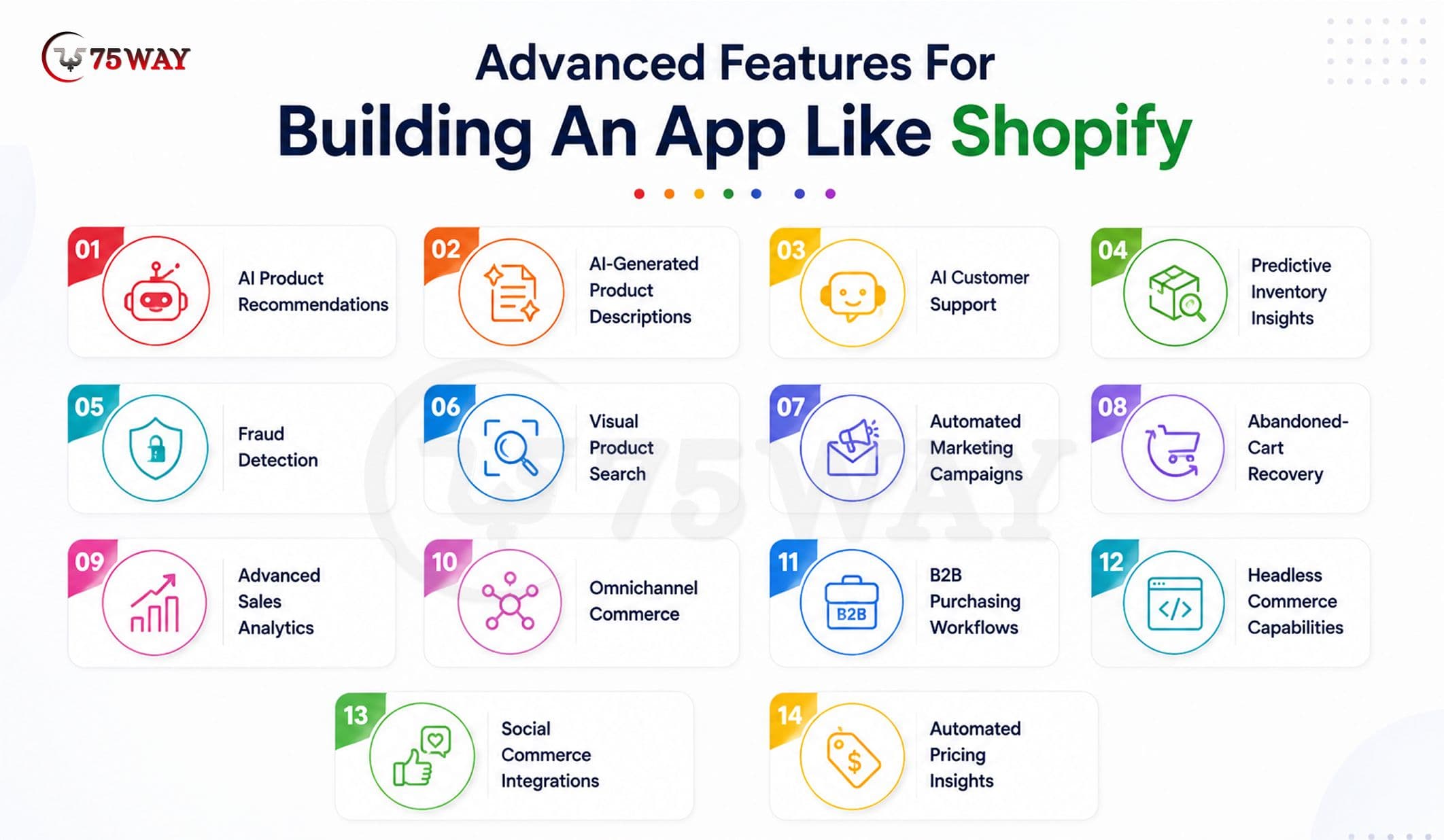
- AI Product Recommendations: Personalized product suggestions based on browsing behavior, purchase history, preferences, and real-time shopping activity to increase product discovery and conversion opportunities.
- AI-Generated Product Descriptions: Automatically creates product copy from specifications, attributes, and catalog data while maintaining consistent messaging across large and frequently changing inventories.
- AI Customer Support: AI-powered assistants handle common customer questions, order inquiries, product searches, and basic service requests while escalating complex issues to human agents.
- Predictive Inventory Insights: Analyzes historical sales, seasonal patterns, demand signals, and inventory movement to identify potential stock shortages and support smarter replenishment decisions.
- Fraud Detection: Identifies unusual purchasing patterns, suspicious transactions, account behavior, and payment signals to help businesses flag potentially fraudulent activity before losses occur.
- Visual Product Search: Allows shoppers to upload or capture an image and discover visually similar products, reducing dependence on text-based searches.
- Automated Marketing Campaigns: Uses customer behavior, purchase history, and segmentation data to trigger personalized promotions, product recommendations, email campaigns, and other marketing activities.
- Abandoned-Cart Recovery: Detects incomplete purchases and automatically sends timely reminders, personalized offers, or product messages designed to encourage shoppers to return and complete checkout.
- Advanced Sales Analytics: Provides deeper visibility into revenue, customer behavior, product performance, conversion rates, order trends, and other metrics needed for data-driven commerce decisions.
- Omnichannel Commerce: Connects websites, mobile apps, physical stores, marketplaces, and social channels so customers can discover, purchase, and interact with products across multiple touchpoints.
- B2B Purchasing Workflows: Supports business-specific buying requirements such as bulk orders, negotiated pricing, purchase approvals, company accounts, credit terms, and role-based purchasing permissions.
- Headless Commerce Capabilities: Separates the commerce backend from customer-facing experiences, giving businesses greater flexibility to deliver shopping experiences across websites, applications, kiosks, and emerging digital channels.
- Social Commerce Integrations: Connects product catalogs and purchasing experiences with social platforms, allowing businesses to showcase products, reach audiences, and generate sales directly through social interactions.
- Automated Pricing Insights: Evaluates demand, product performance, market signals, inventory conditions, and historical pricing data to identify pricing opportunities and support more informed pricing decisions.
The right approach is to introduce these capabilities according to merchant demand rather than loading the first release with every possible feature.
How To Build A Shopify Clone App: A Comprehensive Development Process
A Shopify-like platform has to work for two audiences at once: the businesses using it and the customers shopping through those businesses. That means your development decisions need to account for merchant tools, storefront experiences, payments, subscriptions, integrations, security, and scalability from the beginning. Here’s a practical look at how to build a Shopify clone app step by step.
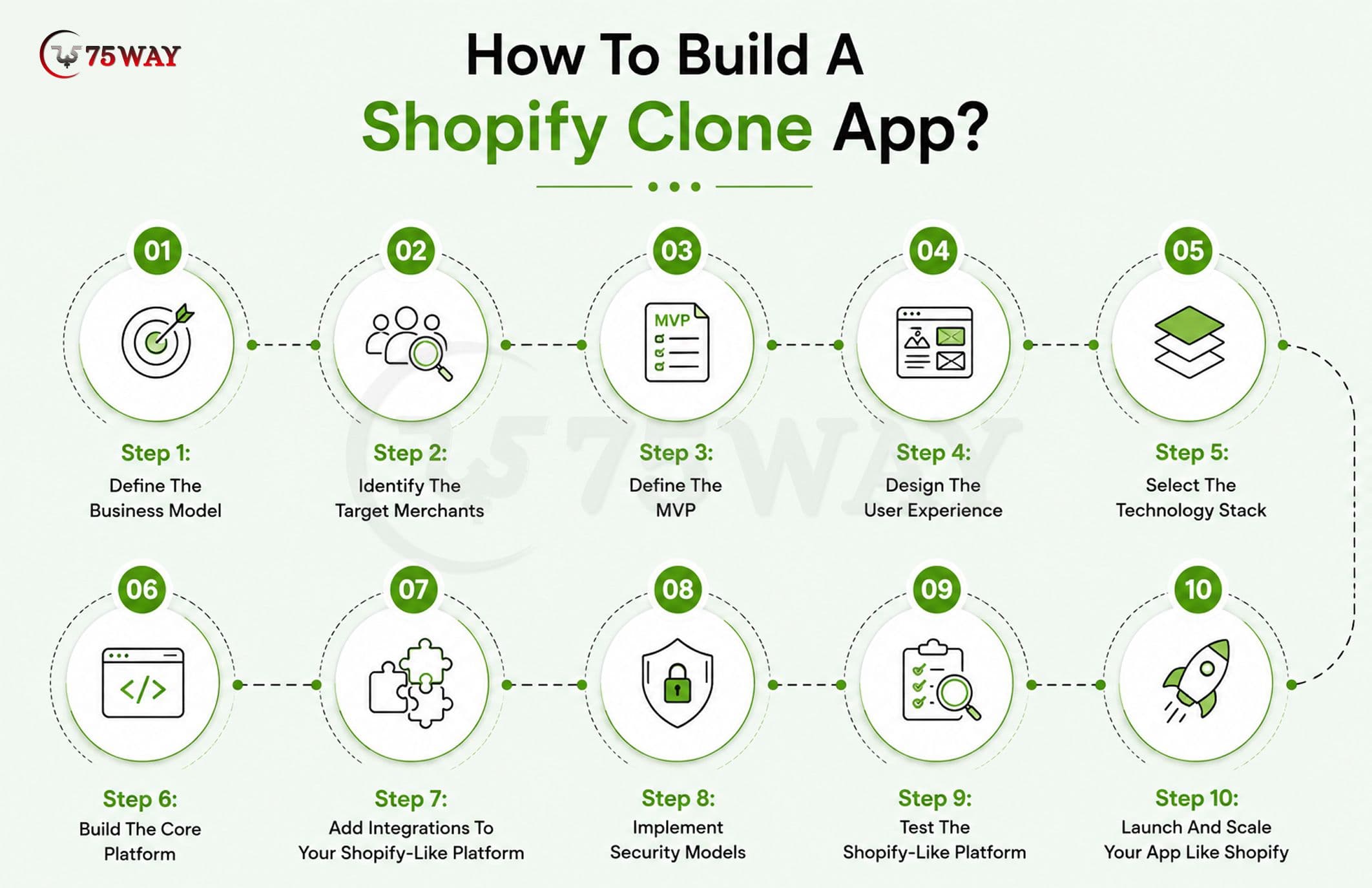
Step 1: Define The Business Model
The first decision is not technical. Determine how the platform will make money and which merchants it intends to serve. Subscription plans, transaction fees, premium features, enterprise packages, app marketplace commissions, and paid themes can support different revenue strategies.
Step 2: Identify The Target Merchants
A clear target audience makes feature prioritization easier. A platform designed for independent retailers may need a different experience from one serving enterprise brands, wholesalers, or specialized online sellers.
Step 3: Define The MVP
Select the smallest feature set capable of solving the target merchant's primary problem. Store creation, product management, inventory, orders, checkout, payments, customer management, and basic analytics can form a practical foundation.
Step 4: Design The User Experience
Create separate experiences for merchants, shoppers, and administrators. Dashboards should surface the information each user needs instead of forcing everyone through the same interface.
Step 5: Select The Technology Stack
Choose technologies according to expected traffic, integrations, development resources, security requirements, and future scalability. A typical architecture may combine React or Next.js for the frontend, Node.js or Python for backend services, PostgreSQL for structured data, and cloud infrastructure such as AWS.
Step 6: Build The Core Platform
Development can begin with authentication, merchant onboarding, store creation, product management, inventory, orders, payments, and customer workflows. These core components establish the foundation for later automation and advanced capabilities.
Step 7: Add Integrations To Your Shopify-Like App
Payment gateways, shipping providers, tax services, email platforms, analytics tools, CRM systems, marketplaces, and other external services can be connected through APIs. Integration requirements should be planned early because they can affect architecture and development timelines.
Step 8: Implement Security Models
Commerce platforms handle customer accounts, payment-related information, business data, and transactions. Strong authentication, role-based access, encryption, secure APIs, audit logging, vulnerability testing, and appropriate payment-security practices should be incorporated throughout development.
Step 9: Test The Shopify-Like Platform
Testing should cover merchant workflows, customer journeys, payments, orders, inventory, APIs, permissions, integrations, performance, and security. Real users should also evaluate the platform before a broader launch.
Step 10: Launch And Scale Your App Like Shopify
A controlled launch can expose usability and technical issues before the platform reaches a larger merchant base. Usage analytics, error monitoring, customer feedback, and infrastructure metrics can then guide future releases.
Tools & Tech Stack You Can Leverage To Clone Shopify Store
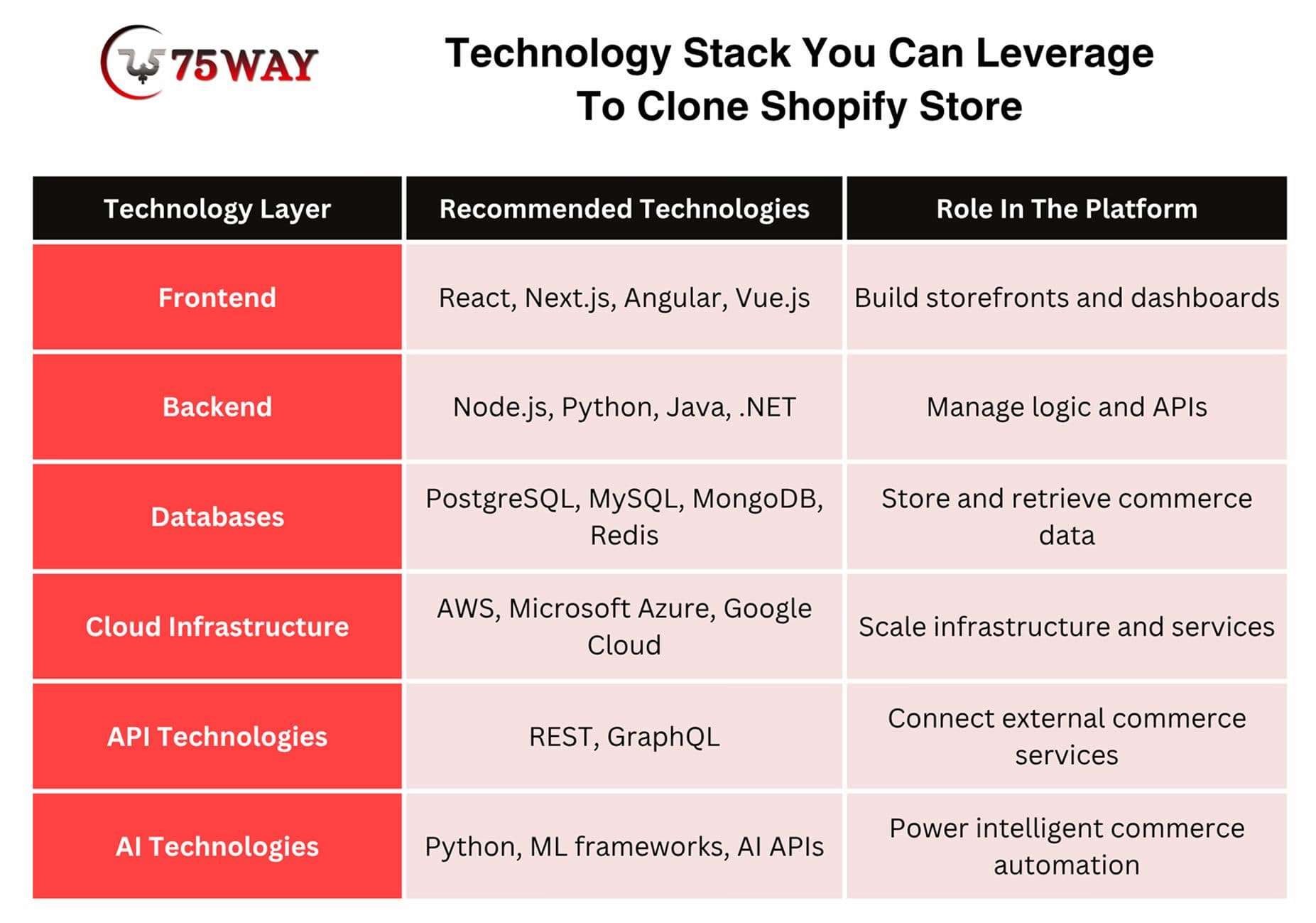
A Shopify clone may look like a storefront on the surface, but its technology stack has to support far more underneath. Merchant dashboards, product catalogs, payments, inventory, orders, integrations, and customer traffic all need to work together without creating bottlenecks. The following technology stack can help you build a Shopify-like platform that is ready to grow.
- Frontend Technologies: React, Next.js, Angular, and Vue.js can support responsive storefronts, merchant dashboards, customer portals, and administrative interfaces.
- Backend Technologies: Node.js, Python, Java, and .NET can handle business logic, APIs, authentication, payment workflows, integrations, and data processing.
- Databases: PostgreSQL, MySQL, MongoDB, and Redis can support structured commerce data, flexible records, caching, sessions, and high-speed application operations.
- Cloud Infrastructure: AWS, Microsoft Azure, and Google Cloud can provide computing, storage, databases, monitoring, security, backups, and scalable infrastructure.
- API Technologies: REST and GraphQL can connect storefronts, mobile applications, payment services, shipping providers, analytics tools, and other external systems.
- AI Technologies: Python-based machine-learning tools and third-party AI services can support recommendations, customer assistance, content generation, search, analytics, and automation.
Which Technology Stack Is Cost-Effective To Duplicate Shopify Store?
For a commerce SaaS MVP, React or Next.js + Node.js + PostgreSQL + AWS can provide a practical balance between development speed, ecosystem support, scalability, and long-term maintenance.
A Python-based backend can become particularly useful when AI, machine learning, advanced analytics, or data-heavy functionality forms an important part of the product roadmap.
The most cost-effective stack is not necessarily the cheapest technology combination. A suitable architecture can reduce future rework, scalability problems, integration difficulties, and technical debt as the merchant base expands.
How Much Does Shopify Clone App Development Cost?
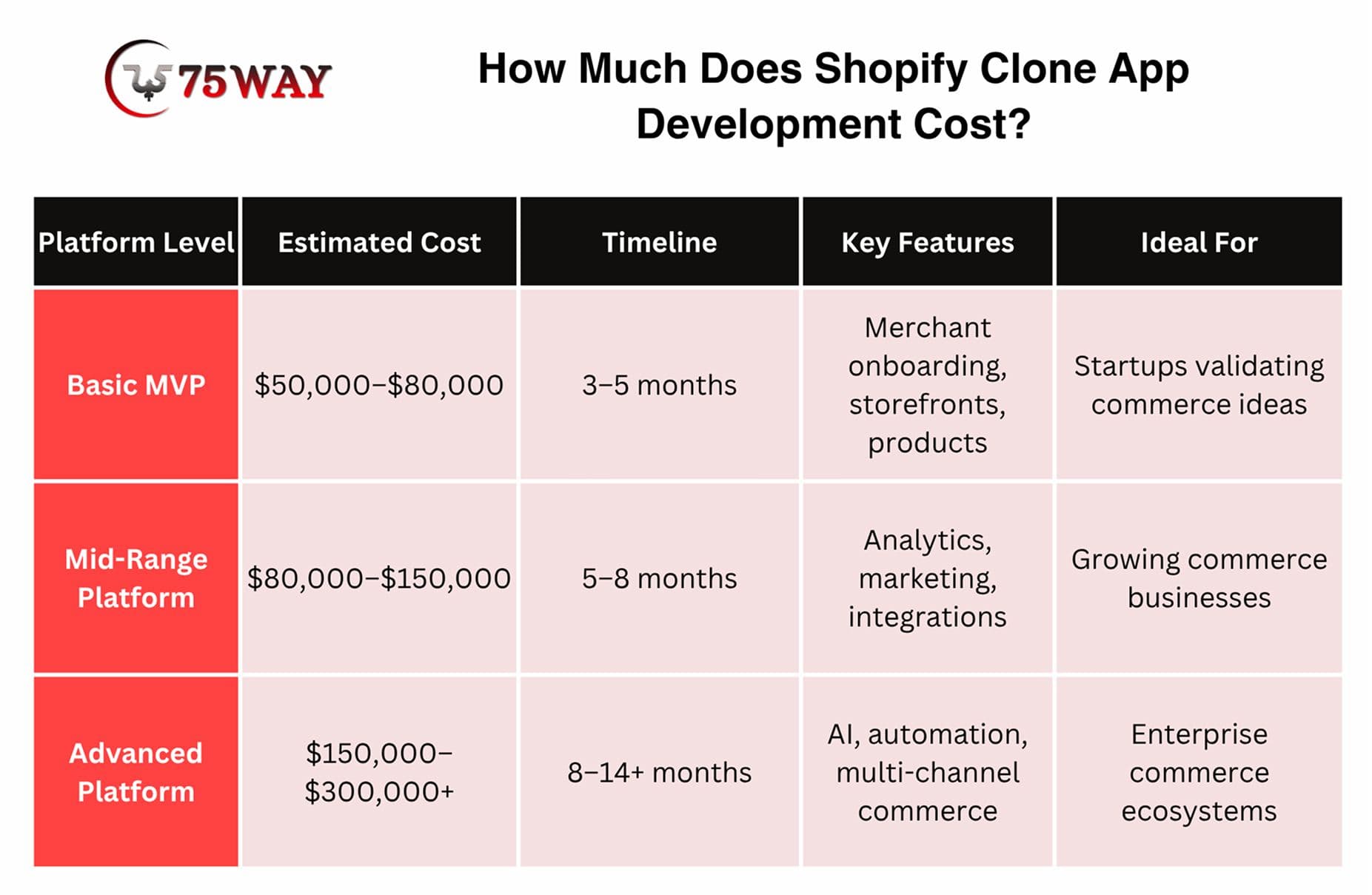
The Shopify clone app development cost can range from approximately $50,000 to $300,000+, depending on the platform's complexity, features, integrations, design requirements, security, mobile applications, AI functionality, and expected scale.
- Basic MVP: $50,000–$80,000
A focused product with merchant onboarding, storefront creation, product management, inventory, orders, checkout, payments, and basic administration.
- Mid-Range Platform: $80,000–$150,000
A broader platform with advanced merchant tools, analytics, marketing, customer management, multiple integrations, subscription management, and improved automation.
- Advanced Platform: $150,000–$300,000+
A sophisticated commerce ecosystem with AI capabilities, advanced analytics, mobile applications, headless commerce, extensive integrations, complex permissions, and enterprise-scale infrastructure.
What Influences The Development Cost of Shopify Store-Like Marketplace?
The final development budget depends on how closely the platform needs to replicate Shopify's ecosystem and which capabilities are unique to your business model. The major cost drivers include:
- Feature Complexity: Advanced storefront management, subscriptions, automation, analytics, promotions, and merchant tools require more development effort than a focused MVP.
- User Roles: Multiple roles such as merchants, customers, administrators, vendors, and support teams require different permissions, dashboards, workflows, and access controls.
- Third-Party Integrations: Payment gateways, shipping providers, accounting tools, CRMs, tax services, marketing platforms, and external APIs can increase development and testing requirements.
- Payment Workflows: Multiple payment methods, recurring billing, refunds, settlements, commissions, payouts, and transaction tracking introduce additional technical and compliance considerations.
- UI/UX Customization: Unique storefront experiences, merchant dashboards, checkout flows, mobile responsiveness, and branded interfaces require additional design and development work.
- Mobile Applications: Native or cross-platform apps for merchants and shoppers expand the development scope by introducing additional interfaces, APIs, testing, notifications, and maintenance requirements.
- AI Capabilities: Recommendations, intelligent search, content generation, customer support, pricing insights, and predictive analytics can increase both development complexity and ongoing service costs.
- Security Requirements: Account protection, payment security, encryption, permissions, fraud prevention, monitoring, and security testing become increasingly important as transaction and user volumes grow.
How Long Does It Take To Build Shopify Clone?
A focused Shopify-like MVP can take around 3–6 months to build, while a feature-rich platform may require 6–12 months or longer. The timeline depends on the number of modules, integrations, design complexity, team size, testing requirements, and technical architecture.
A typical project may allocate time across discovery, UI/UX design, core development, integrations, testing, deployment, and post-launch refinement.
Monetization Models To Earn Profit From AI-Powered Shopify-Like Platform Development
A Shopify-like platform does not have to depend on a single revenue stream. You can charge merchants for access, take a percentage from transactions, offer premium features, or create paid services around the platform as adoption grows. Here are the monetization models worth considering for building a profitable Shopify-like business.
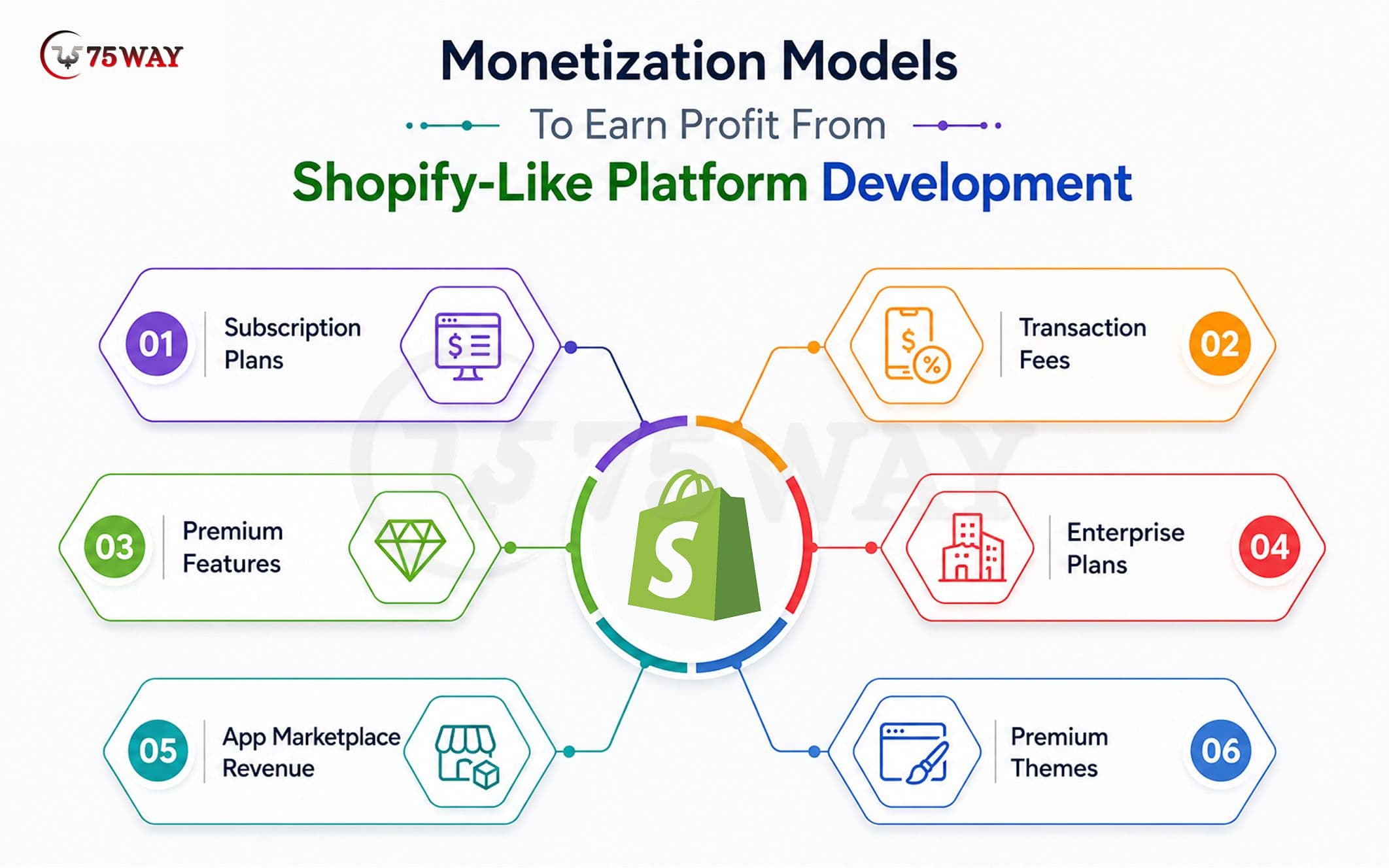
1. Subscription Plans
Merchants pay recurring monthly or annual fees to access different feature tiers, allowing the platform to generate predictable recurring revenue as its merchant base grows. A platform could offer $39/month for basic storefront tools, $99/month for advanced features, and $299/month for enterprise capabilities.
Ideal For: SaaS commerce platforms
Advantages: Creates predictable recurring revenue and supports long-term customer relationships.
Disadvantages: Requires continuous feature development to justify subscription renewals.
2. Transaction Fees
The platform earns a fixed fee or percentage from eligible merchant transactions processed through its commerce ecosystem, creating revenue that grows alongside merchant sales. A platform could charge merchants 1% of eligible transactions processed through its integrated payment infrastructure.
Ideal For: High-volume commerce platforms
Advantages: Revenue increases naturally as merchants generate more transactions.
Disadvantages: Higher transaction costs can discourage large merchants with substantial sales volumes.
3. Premium Features
Advanced capabilities such as AI tools, automation, detailed analytics, marketing features, additional storage, and enhanced reporting can be packaged as paid upgrades. Basic merchants could access standard analytics, while advanced AI forecasting and automated marketing could require a $49/month add-on.
Ideal For: Feature-rich commerce platforms
Advantages: Increases revenue from merchants willing to pay for specialized capabilities.
Disadvantages: Poorly selected premium features can limit adoption and create pricing complexity.
4. Enterprise Plans
Large merchants can receive customized pricing based on their operational scale, infrastructure requirements, integrations, security needs, permissions, and support expectations. An enterprise retailer managing thousands of products and multiple storefronts could receive a customized annual contract with dedicated infrastructure and integrations.
Ideal For: Large-scale merchants
Advantages: Generates higher-value contracts with stronger revenue potential per customer.
Disadvantages: Enterprise sales cycles are typically longer and require greater service commitments.
5. App Marketplace Revenue
Third-party developers can create extensions, applications, and integrations for merchants, while the platform earns a commission from eligible application sales or subscriptions. A developer could sell an inventory forecasting app for $29/month, with the platform retaining an agreed percentage of the subscription revenue.
Ideal For: Extensible commerce ecosystems
Advantages: Expands platform functionality without building every application internally.
Disadvantages: Marketplace quality, developer relationships, and application governance require ongoing management.
6. Premium Themes
Merchants can purchase professionally designed storefront themes, layouts, customization packages, and industry-specific designs to create differentiated shopping experiences. A fashion retailer could purchase a $180 premium theme with advanced product galleries, promotional sections, and customizable storefront components.
Ideal For: Design-focused commerce platforms
Advantages: Adds another monetization channel while giving merchants greater storefront flexibility.
Disadvantages: Theme compatibility and ongoing design updates can increase maintenance requirements.
The strongest monetization strategy often combines recurring subscriptions with optional premium capabilities rather than relying on one revenue source.
How To Make A Shopify Clone Different From Shopify?
A new commerce platform needs a reason to exist beyond reproducing familiar features. Competing feature-for-feature with an established platform can make customer acquisition difficult, particularly when merchants already have mature alternatives.
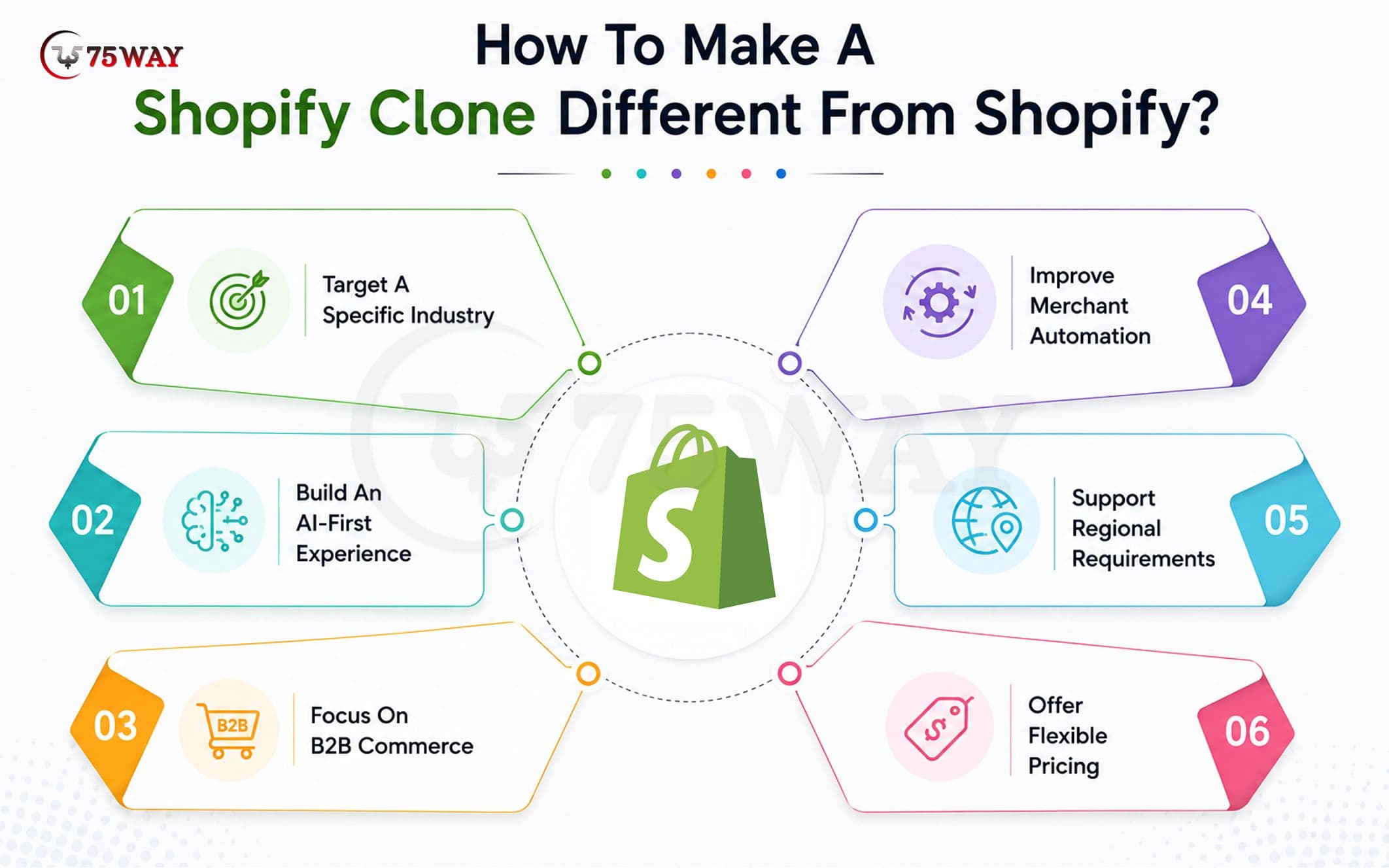
- Target A Specific Industry
A platform designed around the workflows of one industry can provide deeper functionality than a general-purpose commerce product.
- Build An AI-First Experience
AI can become part of the merchant experience through automated content creation, product recommendations, customer support, analytics, inventory insights, and operational assistance.
- Focus On B2B Commerce
Wholesale buyers often need account-based pricing, bulk ordering, purchase approvals, quotes, invoices, and customized catalogs. These workflows can create a strong differentiation opportunity.
- Improve Merchant Automation
Automating repetitive catalog, order, customer, marketing, and support activities can make the platform more valuable to small teams.
- Support Regional Requirements
Local payment methods, tax structures, currencies, languages, shipping providers, and marketplace integrations can create advantages within specific markets.
- Offer Flexible Pricing
A transparent pricing structure with plans aligned to merchant size, sales volume, or feature requirements can become a meaningful differentiator.
Security Requirements While Creating a Duplicate of Shopify App
When one platform serves multiple merchants, security problems can quickly become platform-wide problems. Your Shopify-like app needs to protect customer information, merchant data, payment workflows, accounts, APIs, and store-level access without creating friction for everyday users. Here are the key security requirements to address during development.
- OWASP Practices: OWASP guidance can help development teams address application risks such as broken access control, injection, authentication weaknesses, and security misconfiguration.
- PCI DSS: Payment-card workflows should be designed around applicable PCI DSS requirements, with payment providers used appropriately to reduce unnecessary handling of sensitive card information.
- Multi-Factor Authentication: MFA can provide stronger protection for merchant and administrator accounts.
- Role-Based Access Control: Permissions can restrict access according to whether the user is a merchant, employee, administrator, customer, or other platform participant.
- Encryption: Sensitive information should be protected during transmission and while stored using appropriate cryptographic controls.
- Security Testing: Vulnerability scanning and penetration testing can identify weaknesses across applications, APIs, infrastructure, and authentication systems.
- Audit Logging: Important activities such as logins, permission changes, payment events, and administrative actions can be recorded for monitoring and investigation.
How To Scale Your Ecommerce Platform Similar To Shopify?
An e-commerce platform can perform perfectly with a few hundred stores and struggle once merchant activity multiplies. Scaling a Shopify-like platform means preparing for heavier traffic, larger catalogs, more transactions, and more third-party integrations without slowing down the customer or merchant experience. The key strategies for handling that growth are covered below.
- Multi-Tenant Architecture: Shared infrastructure with properly isolated tenant data can allow multiple merchants to use the platform while supporting centralized administration.
- Database Optimization: Indexing, query optimization, partitioning strategies, and appropriate data architecture can help maintain performance as records increase.
- Caching: Caching frequently accessed information can reduce unnecessary database operations and improve response times.
- Load Balancing: Traffic can be distributed across application instances to support higher request volumes and improve availability.
- CDN Integration: A content delivery network can serve static storefront assets closer to shoppers, helping improve page delivery across different locations.
- Queue-Based Processing: Background queues can handle resource-intensive activities such as emails, notifications, imports, exports, and other asynchronous tasks without blocking user-facing workflows.
- Continuous Monitoring: Application performance, infrastructure health, API errors, traffic patterns, and resource utilization should be monitored as the platform grows.
Common Mistakes To Avoid When Duplicating A Shopify Store
A Shopify-like platform can fail long before launch if the development team focuses too heavily on copying visible features and overlooks what happens underneath. Poor architecture, weak security, limited scalability, and an unclear merchant experience can turn a promising clone into an expensive rebuild. Here are the common mistakes to watch for when duplicating a Shopify store.
1. Building Everything At Once
Problem: A massive first release increases development costs, creates longer timelines, and delays the opportunity to test whether merchants actually want the product.
Solution: Start with a focused MVP covering the workflows that directly support your core merchant segment. Use early usage and feedback to decide which advanced capabilities deserve investment next.
2. Copying Instead of Differentiating
Problem: Replicating another platform's features does not automatically give merchants a compelling reason to switch or pay for another solution.
Solution: Identify an underserved merchant segment, operational pain point, or industry-specific requirement and build capabilities that address it better than generic commerce platforms.
3. Ignoring Merchant Research
Problem: Assumptions about merchant priorities can lead to expensive features that receive little adoption after launch.
Solution: Interview target merchants before development and validate their workflows, frustrations, purchasing decisions, integrations, and willingness to pay before finalizing the product roadmap.
4. Underestimating Integrations
Problem: Payment gateways, shipping providers, tax systems, accounting platforms, marketing tools, and other APIs can introduce unexpected development and testing complexity.
Solution: Identify critical integrations during discovery, evaluate their API limitations and data requirements, and allocate dedicated development and testing time for each connection.
5. Weak Multi-Tenant Architecture
Problem: Poor tenant isolation can expose merchant data and create performance problems when multiple stores operate on the same infrastructure.
Solution: Design multi-tenancy into the architecture from the beginning, with appropriate data isolation, access controls, resource management, monitoring, and scalability strategies.
6. Treating Mobile As An Afterthought
Problem: Merchants and shoppers may access the platform primarily through smartphones, making desktop-first experiences frustrating for everyday commerce tasks.
Solution: Establish responsive design requirements during initial UX planning and prioritize mobile workflows such as order management, notifications, product updates, checkout, and customer communication.
7. Skipping Performance Testing
Problem: A platform can perform well with limited test data but experience slowdowns when thousands of stores, products, orders, and shoppers generate concurrent activity.
Solution: Introduce load and performance testing before launch using realistic traffic patterns, transaction volumes, catalog sizes, and concurrent-user scenarios.
8. Neglecting Post-Launch Development
Problem: Launching the platform does not eliminate the need for product work as merchants request improvements, integrations change, and new commerce requirements emerge.
Solution: Establish an ongoing roadmap covering merchant feedback, security updates, API maintenance, performance optimization, analytics, new integrations, and feature enhancements.
How 75way Supports Your Shopify Clone Development From Idea To Launch
75way Technologies helps businesses turn Shopify-like platform concepts into custom eCommerce products built around specific merchant requirements. The development scope can cover storefronts, merchant dashboards, product and inventory management, payments, orders, subscriptions, integrations, analytics, AI capabilities, and other workflows required by the business model.
A phased approach gives startups and established businesses room to validate the core product before expanding into more advanced capabilities. 75way can support the product journey across planning, UI/UX design, development, API integrations, testing, deployment, and post-launch enhancements.
Final Remarks
A Shopify-like platform can become more than an online store builder when its technology, business model, and merchant experience are designed around a clear market opportunity. The right approach starts with a focused MVP, establishes secure multi-tenant architecture, connects essential commerce workflows, and expands through integrations, automation, analytics, and AI as merchant demand grows.
Development cost can range from $50,000 to $300,000+, making feature prioritization important from the beginning. A differentiated platform also needs a clear reason for merchants to choose it over established alternatives. If you are planning a scalable commerce platform, partnering with a renowned eCommerce app development company can help turn the concept into a market-ready product.
Frequently Asked Questions (FAQs)
Can A Shopify Clone Support Multiple Merchants?
Yes, a multi-tenant architecture can support numerous merchants through one platform. Proper tenant isolation keeps merchant data, storefronts, users, and configurations separated securely.
Can A Shopify Clone Support Multiple Storefronts?
Yes, merchants can operate multiple storefronts when the platform supports multi-store management. Each storefront can have separate branding, catalogs, domains, settings, and customer experiences.
Can Merchants Connect Their Existing Domains?
Custom domain functionality can allow merchants to connect existing domains to their storefronts. DNS configuration, SSL certificates, domain verification, and routing need appropriate technical implementation.
Can A Shopify Clone Support Headless Commerce?
Yes, headless architecture can separate the commerce backend from storefront experiences. APIs can then support websites, mobile applications, kiosks, and other customer-facing interfaces.
Can Merchants Import Products From Another Platform?
Yes, product-import functionality can transfer catalogs, variants, images, pricing, inventory, and related information. CSV imports or APIs can support different migration requirements.
Can A Shopify Clone Support Offline Retail Sales?
Yes, POS capabilities can connect physical retail transactions with online merchant operations. Inventory synchronization, product data, payments, receipts, and customer records can be shared across channels.
Can A Shopify Clone Support International Expansion?
International functionality can support multiple currencies, languages, tax rules, payment methods, domains, and regional storefront configurations. The required capabilities depend on the markets being targeted.
Can A Shopify Clone Become A SaaS Product?
Yes, the platform can be structured as multi-tenant SaaS with recurring subscriptions and configurable merchant accounts. Billing, plan limits, onboarding, permissions, and tenant isolation become important components.