AI Summary
A Zillow-like real estate app brings property discovery, listings, search, communication, and transactions into one digital platform. This guide covers essential features, development stages, technology, monetization, and costs. It also explains what businesses need to plan before development begins.
Key Takeaways
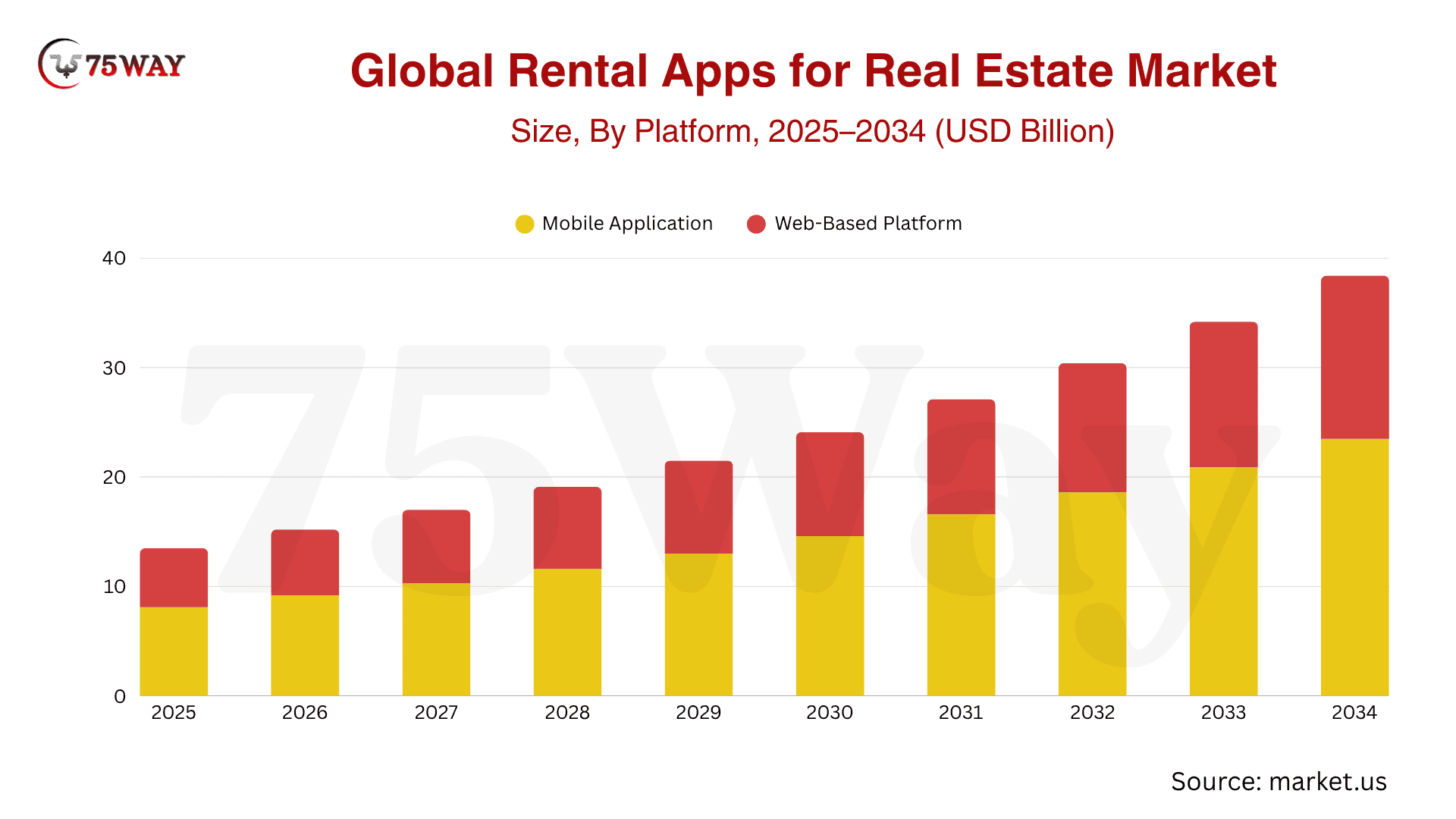
- The global rental apps for real estate market could reach $38.4 billion by 2034.
- Building a real estate app like Zillow can cost $55,000–$250,000+.
- Property search, listings, maps, filters, and alerts form the core user experience.
- Advanced features can add AI recommendations, virtual tours, valuations, and personalized property discovery.
- The right technology stack helps real estate apps support growth, security, and integrations.
A property marketplace can attract users with thousands of listings, but long-term business value comes from what happens after someone finds a property. A Zillow-like app needs to turn searches into meaningful interactions while creating a strong digital ecosystem for the businesses and professionals operating within it.
That makes real estate app development a larger business decision than simply creating a mobile interface. Zillow’s current product ecosystem connects consumers with listings, agents, financing, tours, rentals, and other services, illustrating how a real estate platform can expand across multiple stages of the customer journey.
This guide covers how to build a real estate app like Zillow from the ground up, including planning, core functionality, advanced capabilities, technology choices, monetization, security, development cost, and the key considerations for taking the app from concept to launch.
What Is Zillow Clone Development?
Zillow clone development means building a real estate marketplace inspired by the core functionality of Zillow, while tailoring the platform to your own market, audience, and business model.
Zillow was founded in 2006 by Rich Barton and Lloyd Frink, who had previously helped build Expedia, with Spencer Rascoff, David Beitel, and Kristin Acker also among the early founding team.
The platform was created to make property information easier to discover online, bringing listings, home values, market information, and real estate services into one digital experience.
Today, Zillow serves millions of people who use its platforms to search for homes, rentals, property information, and real estate services.
Rather than treating Zillow as a simple property-listing website, businesses can view its model as a broader real estate technology marketplace that connects consumers and industry professionals.
Market Size & Revenue Growth of Real Estate App Like Zillow
A Zillow-style real estate platform operates within a property market where digital search has become an important part of the home-buying and rental journey. For businesses, the scale of this market can reveal whether investing in a real estate app has enough room for sustainable growth. The latest market size, revenue trends, and important statistics are covered below.
What Makes Zillow a Strong Real Estate App Model?
Zillow is more than a property listing directory. Its platform brings together property discovery, search, market information, rentals, buying and selling journeys, and connections with real estate professionals.
Its current experience also shows where the category is heading. Zillow supports millions of listings, detailed filters, saved searches, notifications, virtual tours, and agent connections. More recently, the platform has introduced AI-powered experiences that let people search for homes using conversational queries and receive guidance throughout their housing journey.
For a new business, however, the goal should not be to reproduce every Zillow feature on day one. A better approach is to identify the audience you want to serve and build the features that solve their biggest property-search problems.
How To Build A Real Estate App Like Zillow: Complete Process
A real estate app can look simple from the user’s side, while its development involves a much larger business and technology operation behind the scenes. A well-planned approach helps turn the initial idea into a platform that can support real estate activity as the business grows. The complete process of developing an app like Zillow is covered below.
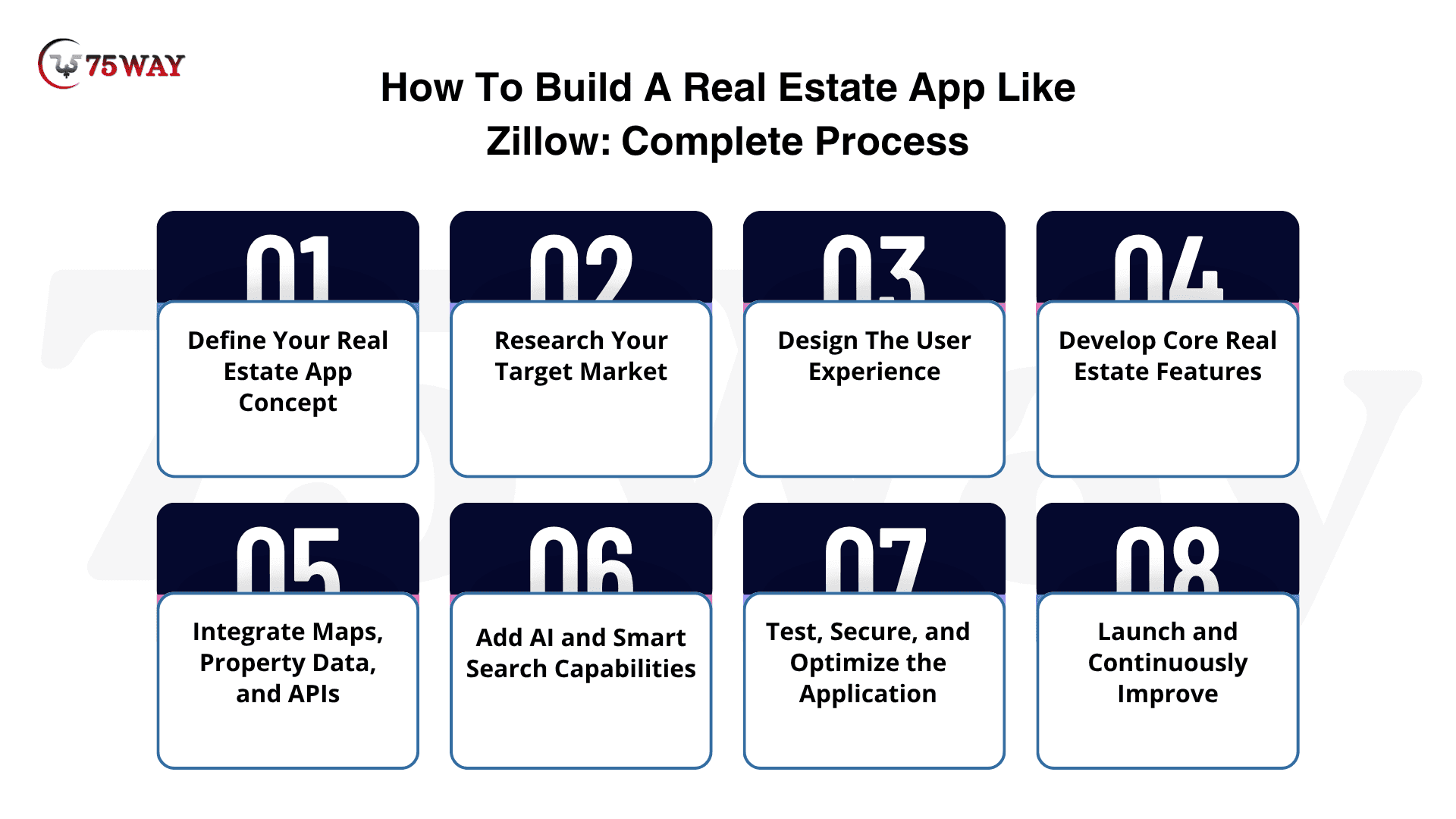
1. Define Your Real Estate App Concept
Start by deciding what your platform will actually offer.
Will it focus on:
- Property buying
- Property rentals
- Property selling
- Commercial real estate
- New developments
- Agent-to-client connections
- Property management
- A combination of these services
Your answer will influence the user roles, listing structure, search experience, integrations, and monetization strategy.
For example, a rental marketplace may prioritize applications, tenant communication, availability, and rent payments. A property-buying platform may need mortgage tools, affordability calculations, valuation information, agent connections, and detailed property research.
2. Research Your Target Market
Before writing code, study the people who will use your application.
A typical real estate marketplace may have several user groups:
- Buyers: Search for properties, compare options, save favorites, and contact agents.
- Renters: Find available properties, review rental details, communicate with landlords, and submit applications.
- Sellers: Create listings, upload property information, respond to inquiries, and track leads.
- Agents: Manage listings, communicate with prospects, and generate qualified property leads.
- Administrators: Manage users, listings, payments, reports, content, and platform activity.
Understanding these users helps you avoid building a complicated application filled with features that your audience may never use.
3. Design The User Experience
Real estate users often browse multiple properties before making a decision. Your interface therefore needs to make comparison and discovery simple.
Start with a clean search screen where users can quickly enter a location, price range, property type, bedrooms, bathrooms, and other important preferences.
Map-based browsing is particularly valuable. A Zillow-like platform can combine location-based discovery with saved searches, favorites, notifications, and custom search areas.
Your design should reduce unnecessary steps between:
Search → Discover → Compare → Contact → Visit → Decide
That journey should remain easy whether someone is using a mobile application or a web platform.
4. Develop Core Real Estate Features
Once the experience is mapped out, begin developing the features that form the foundation of the marketplace.
Essential capabilities can include:
- Property listings and detailed descriptions
- Advanced property search and filters
- Map and location-based search
- Property photos and videos
- Favorites and saved properties
- Saved searches and alerts
- Agent and owner profiles
- Property comparison
- Inquiry and lead forms
- Push notifications
- Mortgage or affordability calculators
- Property recommendations
- Admin dashboard
The exact feature set should reflect your target market rather than attempting to replicate every feature offered by a mature platform.
5. Integrate Maps, Property Data, and APIs
A real estate application depends heavily on accurate location and property information. Integrate mapping and location services to support property discovery, nearby amenities, directions, boundaries, and location-based searches.
Depending on your market, you may also need integrations for property databases, listing feeds, mortgage information, valuation data, identity verification, payment processing, communication, and third-party real estate services.
These integrations can reduce manual data entry while giving users richer property information.
6. Add AI and Smart Search Capabilities
AI can make a real estate marketplace more personalized and useful. Instead of relying only on basic filters, your platform can analyze user behavior, preferences, searches, and saved properties to deliver more relevant recommendations.
You can also introduce AI-powered capabilities such as:
- Personalized property recommendations
- Natural-language property search
- Automated property descriptions
- Lead qualification
- AI chat assistants
- Property price insights
- Image-based property search
- Predictive search suggestions
These capabilities can help your platform stand apart from a standard property listing application.
7. Test, Secure, and Optimize the Application
Before launch, test the application across different devices, screen sizes, user roles, and network conditions. Verify property searches, listing uploads, map functionality, messaging, notifications, payments, and other critical workflows.
Security should also be addressed throughout development. Protect user accounts, property information, payment data, communications, and administrative functions using appropriate authentication, authorization, encryption, monitoring, and data-protection practices.
Performance testing is equally important because property marketplaces may handle large numbers of listings, images, searches, and concurrent users.
8. Launch and Continuously Improve
After testing, publish the application through the appropriate channels and launch your web platform. However, development should not stop at launch.
Monitor user behavior, search patterns, listing performance, conversion rates, technical issues, and customer feedback. Use these insights to improve search relevance, introduce valuable features, optimize the interface, and expand your marketplace.
A successful Zillow-like application is not simply a collection of property listings. It is a continuously improving digital marketplace that helps users move from property discovery to meaningful action.
Essential Features For A Zillow-Like Real Estate App Development
A Zillow-like real estate app needs separate experiences for customers, property agents, and administrators. Each module should provide relevant tools that simplify property discovery, listing management, communication, transactions, and overall marketplace operations.
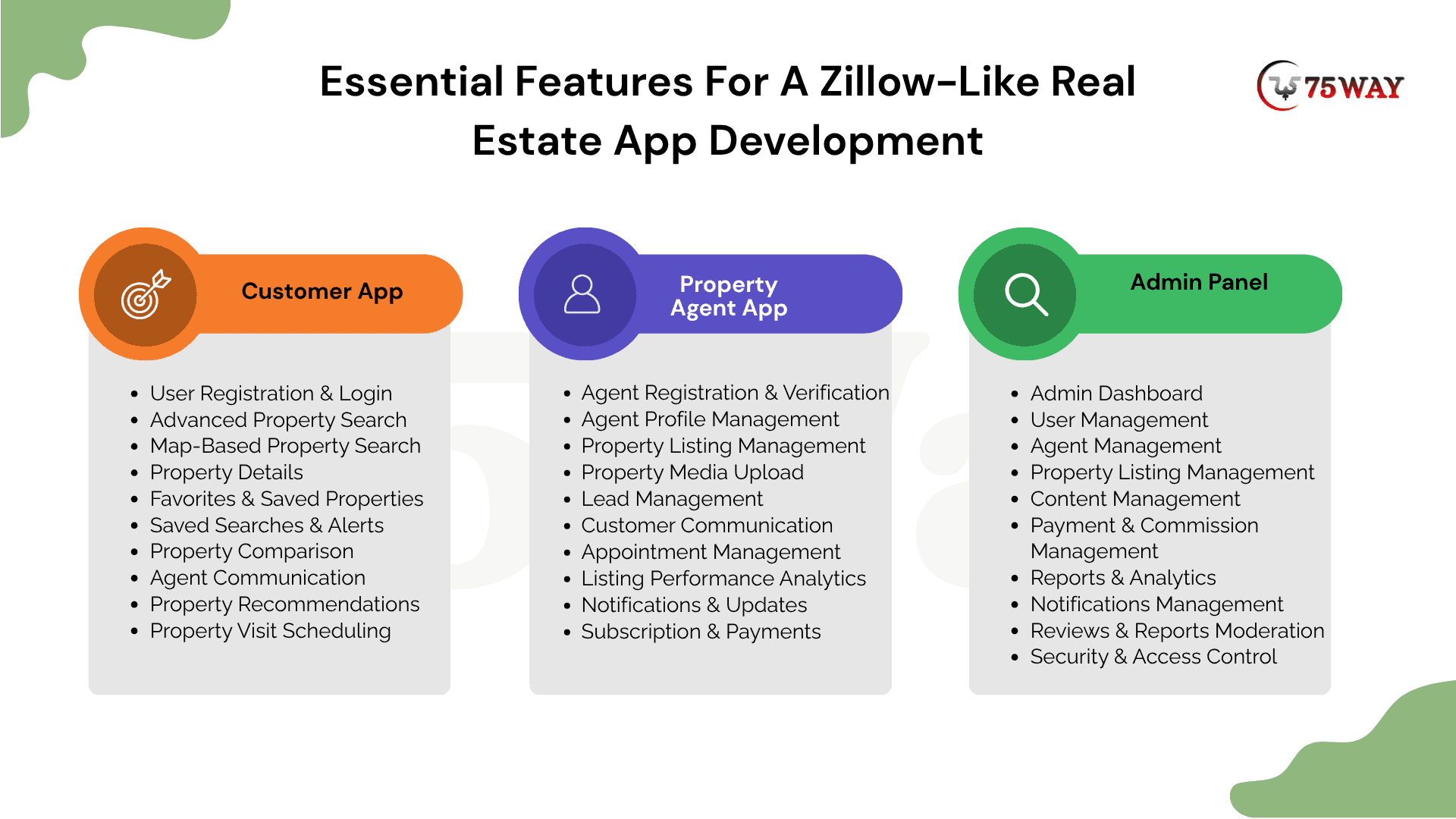
1. Customer App Module
The customer module should make property discovery convenient while helping buyers and renters evaluate options confidently. From advanced searches to personalized recommendations, these features can guide users from initial browsing toward meaningful property inquiries.
- User Registration & Login
Customers can create accounts using email, phone numbers, or supported social credentials. Secure authentication protects personal information and provides access to saved properties, searches, preferences, inquiries, and personalized recommendations across devices.
- Advanced Property Search
Users can search properties using location, price, property type, bedrooms, bathrooms, amenities, and other preferences. Advanced filters help narrow large property inventories quickly, making it easier to discover suitable homes or commercial spaces.
- Map-Based Property Search
An interactive map lets customers explore available properties by geographic location. Users can move across neighborhoods, identify nearby listings, and understand surrounding areas before opening individual property pages for detailed information and comparisons.
- Property Details
Each listing can present photographs, videos, descriptions, pricing, specifications, amenities, location details, and agent information. A comprehensive property page helps customers evaluate listings without repeatedly searching for essential information elsewhere.
- Favorites & Saved Properties
Customers can save properties they find interesting for later consideration. A dedicated favorites area makes it easier to compare shortlisted homes, revisit promising listings, and continue their search without starting again.
- Saved Searches & Alerts
Users can save preferred search criteria and receive notifications when matching properties become available. This feature keeps customers informed about new listings, price changes, availability updates, and other developments relevant to their requirements.
- Property Comparison
Customers can compare multiple properties using important factors such as price, size, bedrooms, amenities, location, and property type. Side-by-side comparisons make differences easier to understand and support more informed purchasing or rental decisions.
- Agent Communication
Customers can contact property agents directly through calls, messages, inquiry forms, or integrated communication tools. This creates a convenient channel for asking questions, requesting additional information, scheduling discussions, and expressing interest in properties.
- Property Recommendations
The application can recommend properties based on customer searches, saved listings, preferences, location, and browsing behavior. Personalized recommendations reduce search effort while helping users discover relevant properties they might otherwise overlook.
- Property Visit Scheduling
Customers can request or schedule property visits directly through the application. Available appointment slots can simplify coordination between customers and agents while reducing unnecessary communication and helping both parties manage viewing schedules more conveniently.
2. Property Agent App Module
The property agent module gives professionals the tools needed to manage listings, respond to customers, generate leads, and monitor their real estate activities. A well-designed dashboard can simplify everyday property management and communication.
- Agent Registration & Verification
Agents can register their professional accounts and submit required business or identity information.
Verification workflows help administrators validate agent profiles before granting access to listing, communication, lead management, and other marketplace capabilities.
- Agent Profile Management
Agents can create detailed professional profiles containing biographies, contact information, service areas, experience, specialties, and other relevant details.
Customers can review these profiles before deciding whether to contact an agent.
- Property Listing Management
Agents can create, edit, publish, pause, or remove property listings through their dashboard.
Listing tools should support essential information such as pricing, descriptions, images, videos, amenities, availability, and location.
- Property Media Upload
Agents can upload multiple property photographs, videos, floor plans, and other visual assets.
Organized media management helps listings present properties clearly and gives customers a stronger understanding of spaces before scheduling physical visits.
- Lead Management
Agents can view and organize customer inquiries generated through their listings.
Lead management tools can include contact details, property interests, inquiry history, lead status, follow-up reminders, and communication records for better prospect management.
- Customer Communication
Agents can communicate with interested customers through integrated messaging, calls, notifications, or inquiry responses.
Centralized communication helps agents answer questions, provide additional property details, coordinate visits, and maintain conversations with prospective clients.
- Appointment Management
Agents can manage property viewing requests and scheduled appointments through a centralized calendar.
They can review upcoming visits, confirm or reschedule appointments, and maintain better visibility over their daily customer meetings.
- Listing Performance Analytics
Agents can monitor listing views, searches, favorites, inquiries, and other performance indicators through an analytics dashboard.
These insights help professionals understand customer interest and identify listings that may require improved pricing or presentation.
- Notifications & Updates
Agents can receive real-time notifications about new inquiries, messages, appointment requests, listing activity, and important account updates.
Timely alerts help agents respond to customer interest without constantly checking their dashboard manually.
- Subscription & Payments
The platform can allow agents to purchase subscription plans, premium listing packages, advertisements, or additional marketplace services.
Secure payment functionality enables agents to manage subscriptions, review invoices, and access available billing information.
3. Admin Module
The admin module provides centralized control over the real estate marketplace. Administrators can manage users, listings, payments, verification, content, reports, and platform performance while maintaining marketplace quality and operational oversight.
- Admin Dashboard
Administrators can access a centralized dashboard showing users, agents, listings, inquiries, payments, reports, and other marketplace metrics.
This overview helps teams monitor platform activity and identify important operational issues quickly.
- User Management
Admins can manage customer accounts, review user information, update account statuses, and handle reported profiles.
Administrative controls help maintain accurate user records while supporting appropriate account moderation and platform governance.
- Agent Management
Administrators can review agent registrations, verify professional credentials, approve profiles, suspend accounts, and manage agent information.
These controls help maintain marketplace trust by ensuring participating property professionals meet defined platform requirements.
- Property Listing Management
Admins can review submitted properties, approve listings, reject inappropriate content, edit necessary information, and remove outdated listings.
Centralized listing moderation helps maintain accurate property information and a reliable marketplace experience.
- Content Management
Administrators can manage banners, categories, informational pages, FAQs, promotional content, and other website or application elements.
A content management system allows teams to update marketplace information without repeatedly modifying the application code.
- Payment & Commission Management
Admins can monitor transactions, subscription payments, refunds, commissions, and other financial activities.
Centralized payment controls provide better visibility into marketplace revenue while helping teams identify unsuccessful transactions or billing-related issues.
- Reports & Analytics
The administration panel can provide reports covering listings, users, agents, searches, inquiries, revenue, and platform activity.
These insights help business owners evaluate marketplace performance and make decisions based on actual usage patterns.
- Notifications Management
Admins can create and manage push notifications, email alerts, promotional messages, and important platform announcements.
Segmentation can help deliver relevant communications to customers, agents, or specific user groups without unnecessary messaging.
- Reviews & Reports Moderation
Administrators can review customer reviews, agent feedback, reported listings, and inappropriate user activity.
Moderation tools help remove misleading content, address complaints, and maintain a trustworthy environment for marketplace participants.
- Security & Access Control
Role-based access controls allow administrators to determine which team members can access specific platform functions.
Security features such as authentication, activity monitoring, and permission management help protect sensitive marketplace and user information.
Tech Stack Used To Develop Zillow-Style Real Estate App
The tech stack for developing a Zillow-style real estate app combines mobile and web frameworks, backend technologies, databases, cloud services, APIs, mapping tools, payment gateways, and AI solutions.
Choosing the right technologies helps support property listings, advanced searches, map-based discovery, secure accounts, agent communication, personalized recommendations, and a scalable marketplace experience.
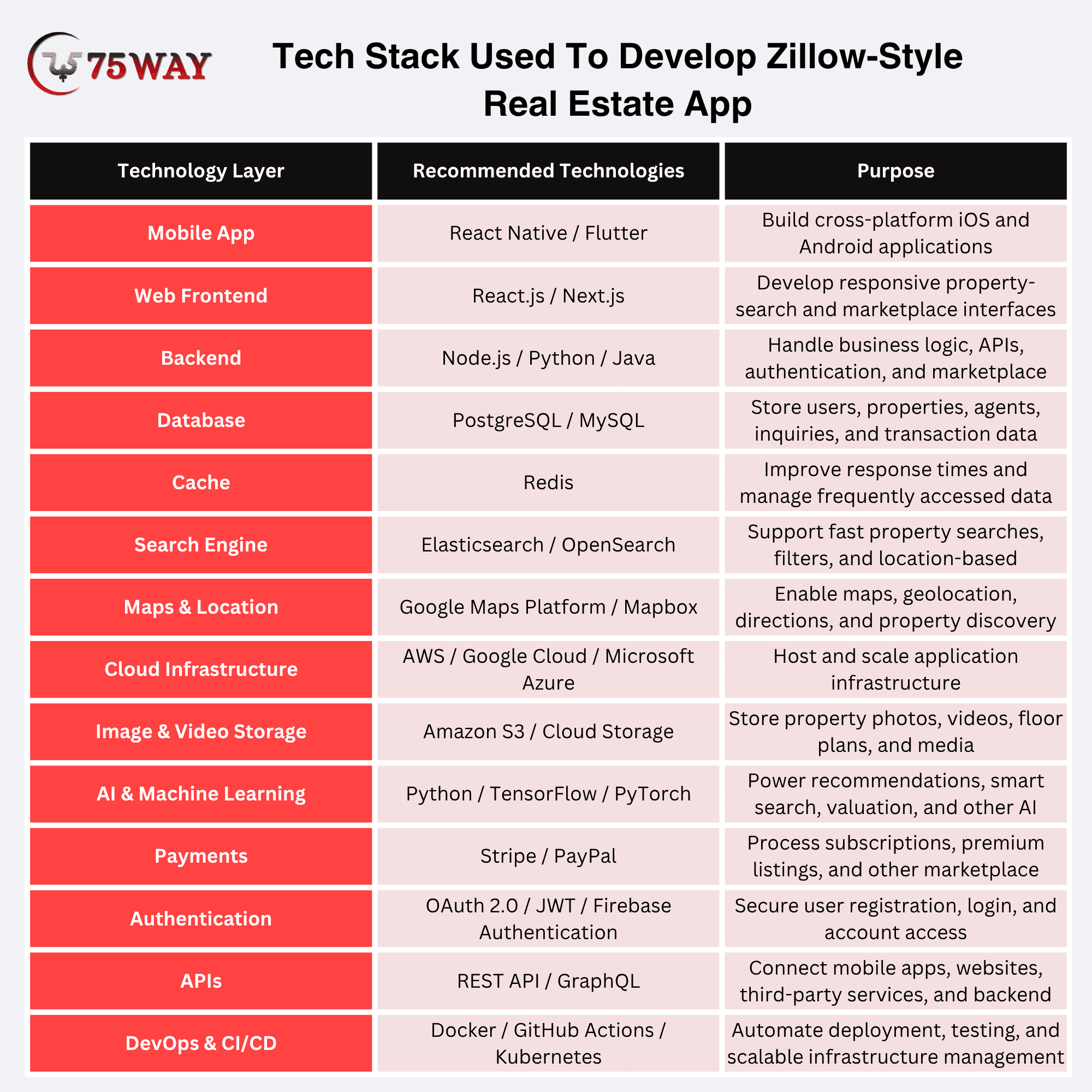
The final stack should depend on your expected traffic, development budget, integrations, data requirements, and long-term roadmap rather than simply following what another company uses.
Real Estate Data And MLS Integration While Building App-Like Zillow
Property data is one of the most important parts of a Zillow-like application.
You need a reliable way to bring listings into your platform and keep them updated. Depending on your market, this may involve MLS connectivity, licensed data providers, partner feeds, APIs, or direct listing submissions.
Data quality matters because outdated listings can quickly damage user trust.
Your development team should therefore plan for:
- Listing synchronization
- Duplicate detection
- Property status updates
- Data validation
- Image management
- Location normalization
- Agent information
- Availability updates
The exact data sources and licensing requirements will depend on the market in which you operate.
How Much Does It Cost To Build A Real Estate App Like Zillow?
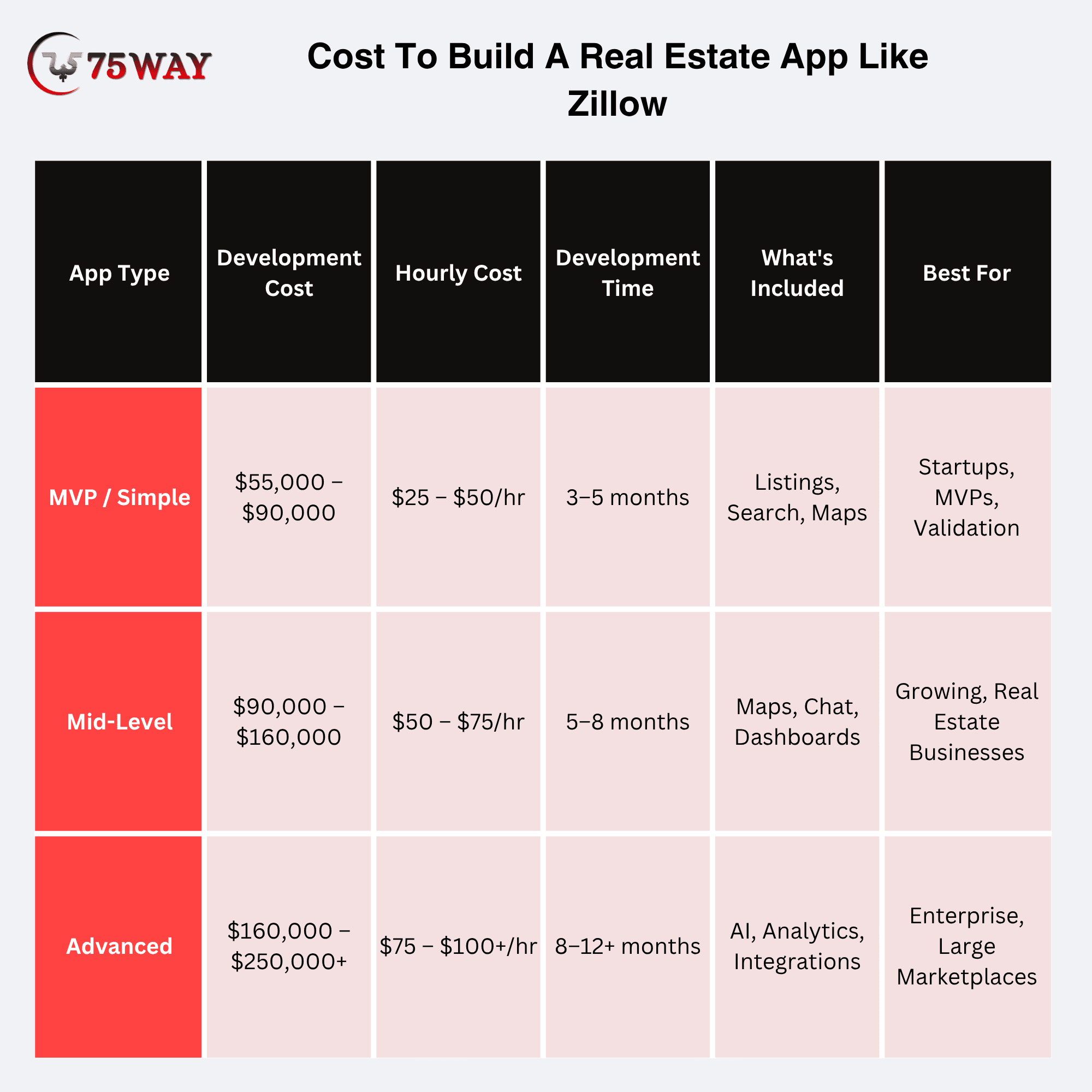
A Zillow-like real estate app can cost approximately $55,000 to $250,000+ depending on the scope. A basic MVP with property listings, search, filters, user accounts, maps, favorites, and inquiries will generally require a smaller investment than a large marketplace with AI, advanced analytics, virtual tours, multiple dashboards, payment systems, and extensive property-data integrations.
- MVP/Simple Zillow-Like App Cost: $55,000 – $90,000
This basic version covers the essential features needed to launch a functional real estate marketplace and validate your business idea.
Includes: Basic property listings, standard search filters, user profiles, and map integration.
Estimated Time: 3 to 5 months
- Mid-Level Zillow-Like App Cost: $90,000 – $160,000
A mid-level app adds more advanced functionality to improve property discovery, communication, and marketplace management for growing businesses.
Includes: Interactive maps, in-app chat, agent and admin dashboards, push notifications, and enhanced property management.
Estimated Time: 5 to 8 months
- Advanced Zillow-Like App Cost: $160,000 – $250,000+
An advanced platform is designed for businesses planning a feature-rich and highly scalable real estate marketplace with intelligent capabilities and extensive integrations.
Includes: AI-powered recommendations, advanced property search, real-time communication, payment integration, and enterprise-grade security.
Estimated Time: 8 to 12+ months
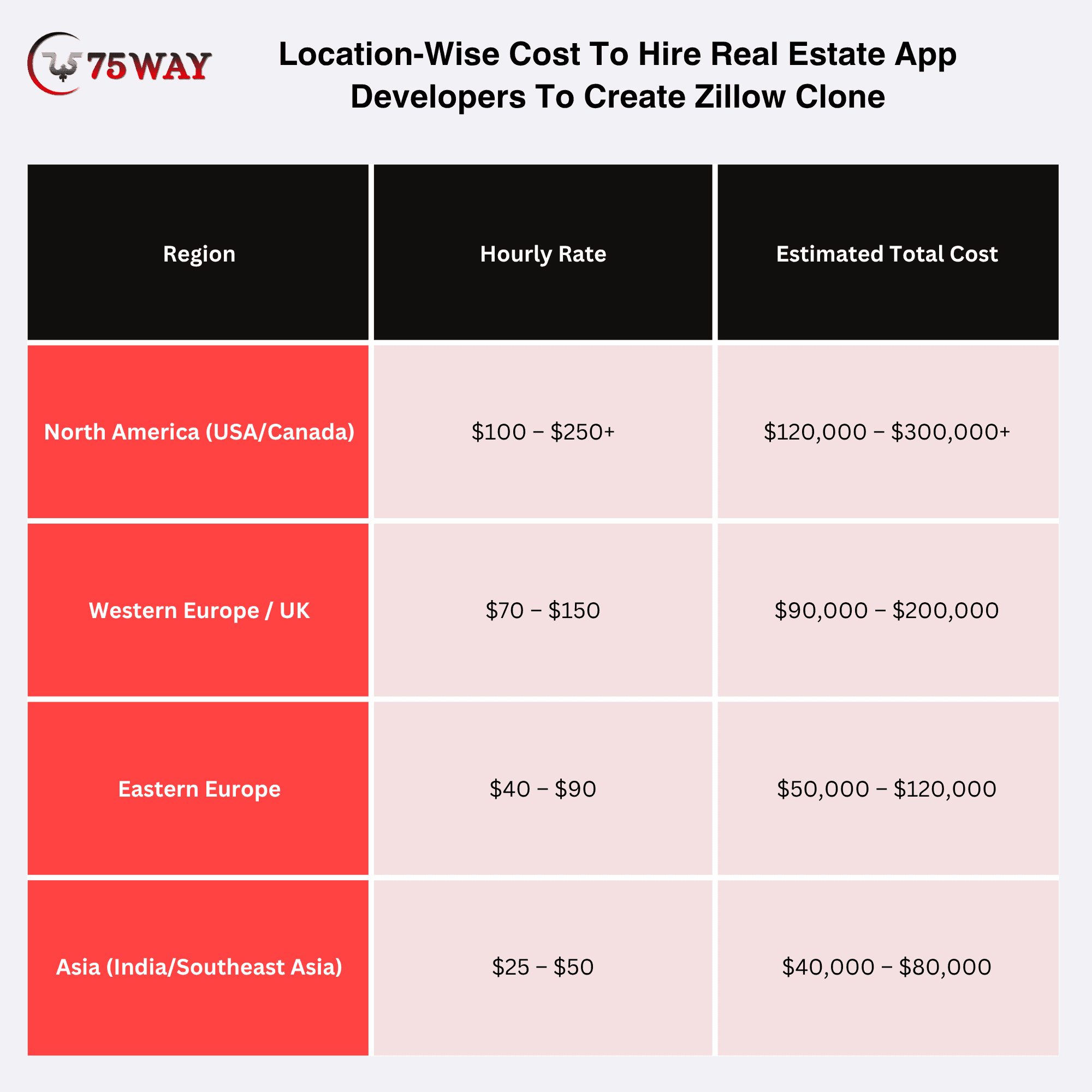
Location-Wise Cost To Hire Real Estate App Developers To Create Zillow Clone
The cost of hiring real estate app developers varies by region, with hourly rates and overall project costs depending on expertise, complexity, and development scope.
Factors That Influence Zillow Clone App Development Cost
Several decisions can move the budget significantly:
- Feature Complexity: AI recommendations and valuation systems require more work than basic listings.
- Platforms: Building for iOS, Android, and web increases the development scope.
- UI/UX: Custom user experiences require additional design and development resources.
- Third-Party Integrations: Maps, property data, payments, communication, analytics, and other APIs add development and ongoing costs.
- Backend Architecture: A platform expected to support large numbers of users and listings needs stronger infrastructure.
- Security: Property, financial, identity, and communication data require appropriate security controls.
- Maintenance: Launching the application is only the beginning. Updates, bug fixes, infrastructure, monitoring, and feature improvements require an ongoing budget.
Security Considerations To Develop Real Estate App Similar To Zillow
Security should be designed into the platform rather than treated as a final development step.
Important areas include:
- Secure authentication
- Role-based access control
- Data encryption
- Secure API communication
- Payment security
- Document protection
- Fraud detection
- Secure cloud infrastructure
- Regular security testing
- Privacy controls
If your platform handles sensitive financial or identity information, involve security and legal specialists early in the product planning process.
How Long Does It Take To Build A Zillow-Like App?
Development time depends on the size of the first release. A focused MVP may take around 4–6 months, while a more advanced platform can take 6–12 months or longer.
A typical development roadmap can look like this:
- Discovery & Planning: 2–4 weeks
- UI/UX Design: 4–6 weeks
- Backend & API Development: 8–16 weeks
- Mobile/Web Development: 8–16 weeks
- Testing & QA: 3–6 weeks
- Launch Preparation: 1–3 weeks
Some activities can happen simultaneously, so these stages should not simply be added together to estimate the final delivery date.
How To Launch Your Real Estate App Successfully
Launching the application is only one part of building a successful marketplace. The real challenge is creating enough value to attract both property seekers and property providers.
Start with a focused market instead of trying to cover every location and property type immediately.
For example, you could begin with:
- One city
- One property category
- A specific buyer segment
- A rental-focused audience
- A professional real estate niche
This gives you a smaller environment in which to test your assumptions, improve the product, and understand user behavior.
Once you have meaningful traction, expand the property inventory, geographic coverage, user base, and monetization options.
How Does A Zillow-Like Real Estate App Make Money?
A real estate marketplace can use multiple revenue streams rather than depending on one source. For example, even a platform with 1,000 paying agents at an average of $50 per month could generate $50,000 in monthly subscription revenue, before considering other income streams.
- Featured Listings
Agents, brokers, developers, and property owners can pay to increase the visibility of selected listings. For example, you could charge $20–$100 per featured listing depending on its duration, location, and visibility.
- Agent Subscriptions
Offer agents monthly or annual plans with additional listings, lead tools, analytics, profile enhancements, and other professional features. For example, plans could start at $49/month and increase to $199/month for advanced professional features.
- Lead Generation
Charge real estate professionals for qualified buyer or renter leads generated through the platform. For example, you could charge $10–$50 per qualified lead, depending on property value, location, and lead quality.
- Advertising
Property developers, mortgage providers, insurance companies, moving services, and other relevant businesses can advertise to users. Depending on traffic and placement, advertising packages could range from $500 to $5,000+ per month for business customers.
- Premium Property Services
You can introduce paid services around mortgages, property valuation, moving, inspections, photography, or other parts of the real estate journey. For example, a platform could earn $25–$200+ per service referral through partnerships or service commissions.
- Transaction-Based Revenue
If your platform eventually supports applications, payments, bookings, or other transactions, you can explore transaction fees where legally and commercially appropriate. For example, a 1%–3% platform fee on eligible transactions could create an additional revenue stream.
How 75way Technologies Helps You Build a Zillow-Like App?
75way Technologies helps businesses turn real estate marketplace ideas into scalable Zillow-like applications tailored to their target audience and business model. Our team can handle the complete development journey, including UI/UX design, property listing management, advanced search, map integration, customer and agent modules, admin dashboards, secure authentication, communication, payments, and third-party API integrations. Whether you want to launch a focused MVP or build a feature-rich real estate marketplace, we can structure the solution around your specific requirements.
Beyond development, 75way Technologies focuses on building a platform that can grow with your business. We can integrate AI-powered property recommendations, smart search, analytics, notifications, and other advanced capabilities while maintaining a scalable architecture for increasing users and listings. From initial planning and technology selection to testing, deployment, and post-launch support, our team helps you build a reliable Zillow-like real estate app designed for long-term business growth.
Final Thoughts
Building a real estate app like Zillow in 2027 is an opportunity to create more than a property-listing platform. With accurate data, intuitive search, location-based discovery, personalized recommendations, useful financial tools, and a clear monetization strategy, your application can become a valuable part of the property journey.
The most practical approach is to begin with a focused MVP, validate demand, collect user feedback, and gradually introduce advanced capabilities such as AI search, valuation, virtual tours, and predictive recommendations. With development costs potentially ranging from $55,000 to $250,000+, careful planning can help you invest in the features that matter most instead of paying to recreate every part of an established platform.
To build your own Zillow-like real estate app, you can contact with an experienced real estate app development team to turn your concept into a scalable digital property platform.
Frequently Asked Questions (FAQs)
How Can A Real Estate App Build Trust With First-Time Users?
Trust grows through verified property information, transparent business practices, responsive support, and authentic user feedback. Clear ownership details and reliable communication can further strengthen confidence.
How Can A Real Estate App Attract Its First Users?
Start with a focused geographic market and build relationships with local property professionals. Referral programs, targeted content, partnerships, and social campaigns can gradually create initial traction.
What Type Of Real Estate App Is Easiest To Launch Initially?
A focused rental marketplace can provide a manageable starting point for testing demand and user behavior. Concentrating on one audience or location also simplifies early marketplace operations.
How Can A Real Estate Startup Compete With Established Property Platforms?
Startups can compete by serving specific audiences, locations, or property needs that larger platforms overlook. Faster experimentation and highly personalized experiences can become meaningful competitive advantages.
What Team Is Needed To Create A Real Estate Marketplace?
A typical team may include product managers, designers, developers, testers, and cloud specialists. Depending on complexity, data, AI, security, and marketing expertise may also become necessary.
How Can A Real Estate App Retain Users After Their First Search?
Personalized alerts, useful market insights, saved preferences, and timely recommendations can give users reasons to return. Regularly improving relevance is essential for long-term engagement and retention.