AI Summary
Food truck mobile app development can cost $10,000 to $150,000+, depending on business goals and functionality. This guide breaks down pricing, features, integrations, timelines, and ongoing expenses. It also explains budgeting choices for growing food truck businesses.
Key Takeaways
- Food truck app development costs typically range from $10,000 to $150,000+.
- Business model and app complexity significantly influence the overall development budget.
- Essential features can launch an MVP without unnecessary initial development expenses.
- Advanced integrations, tracking, loyalty, and analytics increase development and maintenance costs.
- The U.S. food truck services market may reach $3.1 billion by 2033.
A food truck app can do far more than display a menu. It can turn a passing customer into a repeat buyer by making ordering, payments, pickup, and truck discovery easier.
But before investing in food truck app development, the real question is: how much does a food truck pay for mobile app development, and what should that budget actually cover?
With development costs ranging from $10,000 to $150,000+, the right budget depends on your app’s features, platforms, integrations, business model, and growth plans.
This guide breaks down the costs, development stages, essential and advanced features, hidden expenses, and practical budgeting considerations to help you plan your food truck app investment.
Food Truck App Market Growth And Business Opportunities in USA
A food truck can move locations every day, but its customer base does not have to start from zero each morning. Mobile ordering and location-based experiences can help operators stay connected with customers even when the truck moves across neighborhoods or event venues. The market growth and business opportunities surrounding food truck apps show where this digital model can create commercial value.
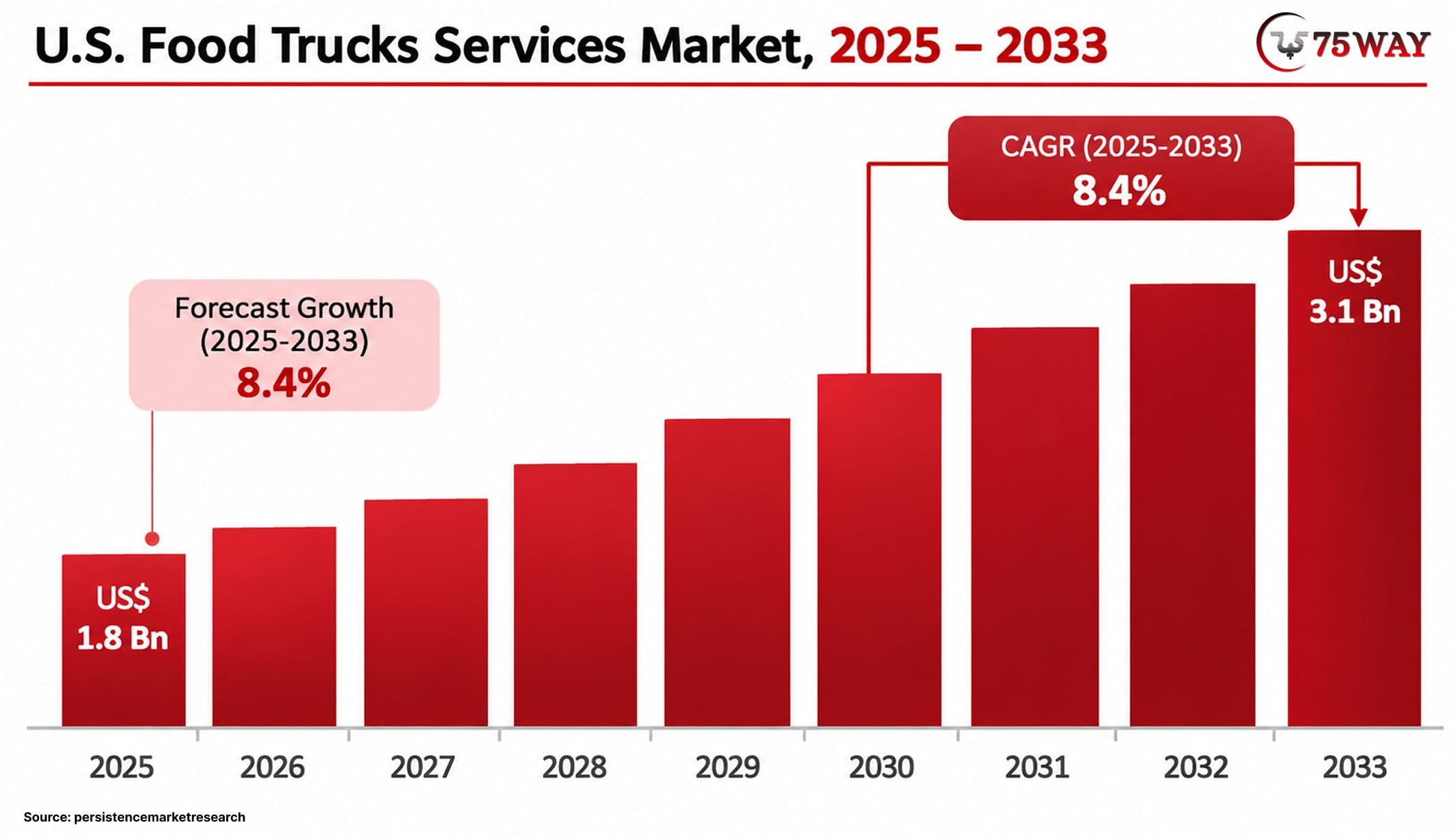
- The U.S. food truck services market is projected to grow from $1.8 billion in 2026 to $3.1 billion by 2033, reflecting an 8.4% CAGR.
- Food offerings are expected to lead the market in 2026, accounting for approximately 55% of total revenue.
- American cuisine is projected to hold the largest cuisine share, contributing over 40% of revenue.
What Should Food Truck Pay to Build a Food Truck App?
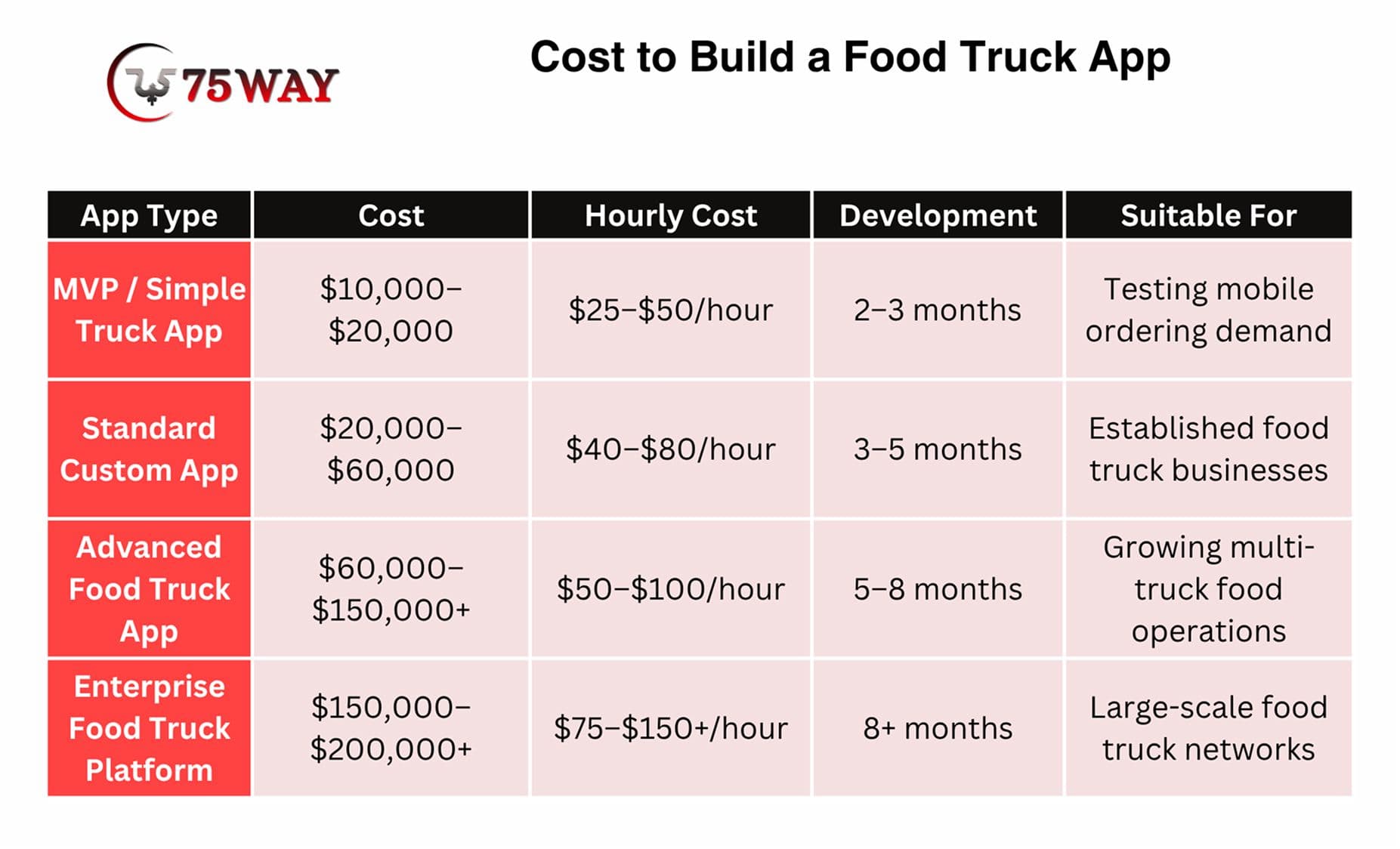
A custom food truck mobile app typically costs $10,000–$200,000+, depending on the scope, features, functionality, technical requirements, and business integrations. The following cost breakdown explains where the money goes and what can push your project toward the higher end.
1. MVP/Simple Truck App Cost: $10,000–$20,000
- Covers essential ordering and customer management features.
- Suitable for validating mobile ordering demand.
Estimated Development Time: 2–3 months
2. Standard Custom App Cost: $20,000–$60,000
- Supports broader ordering and customer engagement features.
- Suitable for established food truck businesses.
Estimated Development Time: 3–5 months
3. Advanced Food Truck App Cost: $60,000–$150,000+
- Includes advanced integrations and operational capabilities.
- Suitable for growing multi-truck food businesses.
Estimated Development Time: 5–8 months
4. Enterprise Platform
Enterprise Food Truck Platform Cost: $150,000–$200,000+
- Supports complex workflows across multiple food trucks.
- Built for large-scale operations and expansion.
Estimated Development Time: 8+ months
The price should therefore be tied to business scope rather than simply the number of screens.
How To Estimate Cost of Custom Food Truck App Development
Estimating the cost of a food truck app starts with identifying the required features, development hours, team rates, and additional expenses. A simple calculation can give you an initial budget before discussing detailed requirements with a development company.
Total Development Cost = Development Hours × Hourly Rate + Third-Party Costs + Additional Expenses
Where:
- Development Hours include planning, UI/UX design, frontend and backend development, integrations, testing, and deployment.
- Hourly Rate depends on the development team's location and expertise.
- Third-Party Costs cover payment gateways, maps, SMS, cloud services, APIs, and other external tools.
- Additional Expenses may include maintenance, app-store fees, security, and post-launch support.
Suppose you are building a food truck app with online ordering, payments, truck tracking, preorder scheduling, notifications, and an admin dashboard.
- Estimated development hours: 2,000 hours
- Developer hourly rate: $40/hour
- Third-party integrations: $5,000
- Testing, deployment, and additional expenses: $5,000
Total Cost = (2,000 × $40) + $5,000 + $5,000
Total Estimated Cost = $90,000
So, a food truck app with this feature set could require approximately $90,000 for initial development. The actual cost can be lower or higher depending on the platforms, feature complexity, integrations, design requirements, and development location.
Food Truck App Development Cost Based On Stages
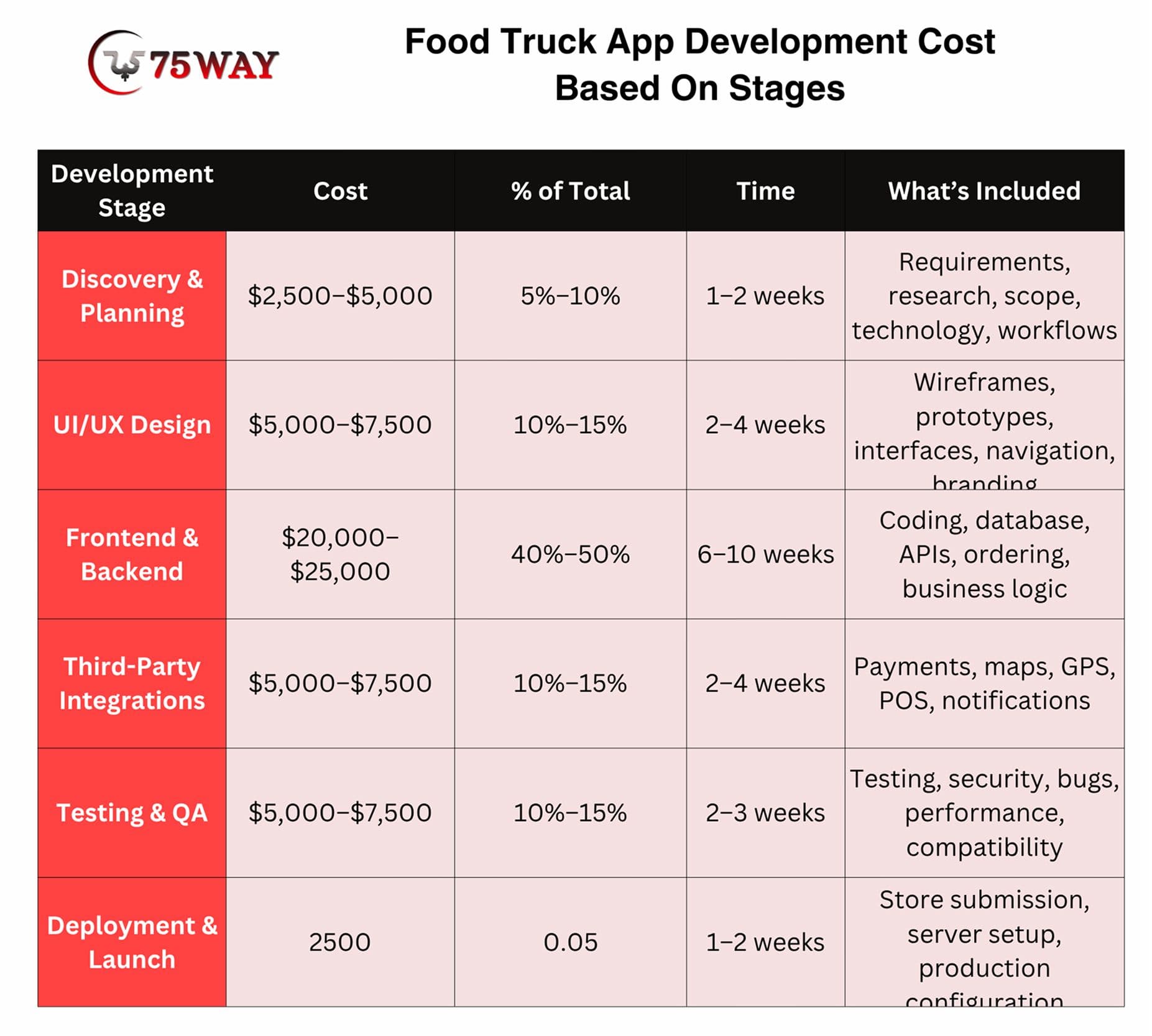
The food truck mobile app development cost quote is rarely just a developer’s fee. Research, UI/UX, coding, testing, deployment, and post-launch work can all contribute to the final investment. The breakdown below gives you a clearer picture of how development costs accumulate across each stage.
Stage 1: Discovery & Planning: 5% – 10%
Define business requirements, target users, feature scope, technology stack, and core application workflows.
Estimated Cost: $2,500 – $5,000
Timeline: 1–2 weeks
Stage 2: UI/UX Design: 10% – 15%
Create wireframes, interactive prototypes, navigation flows, and brand-aligned interfaces for mobile users.
Estimated Cost: $5,000 – $7,500
Timeline: 2–4 weeks
Stage 3: Frontend & Backend: 40% – 50%
Develop customer interfaces, backend systems, databases, menus, ordering workflows, authentication, and business logic.
Estimated Cost: $20,000 – $25,000
Timeline: 6–10 weeks
Stage 4: Third-Party Integrations: 10% – 15%
Connect payment gateways, mapping services, GPS tracking, POS systems, notifications, and essential external services.
Estimated Cost: $5,000 – $7,500
Timeline: 2–4 weeks
Stage 5: Testing & QA: 10% – 15%
Test functionality, security, performance, payments, compatibility, and user experience across supported devices.
Estimated Cost: $5,000 – $7,500
Timeline: 2–3 weeks
Stage 6: Deployment & Launch: 5%
Prepare production servers, configure applications, and submit builds to major mobile app stores.
Estimated Cost: $2,500
Timeline: 1–2 weeks
No-Code Food Truck App Builders Vs. White-Label Vs. Custom Food Truck Cost
Why spend heavily on a custom app when a ready-made solution can get your food truck online faster? The cheaper route, however, may come with limitations that become costly once your orders, customers, integrations, or business operations grow.
A food truck owner can launch an app without hiring a development team from scratch, but the trade-off may appear later in flexibility and control. No-code builders, white-label solutions, and custom food truck app development offer very different ways to turn a food truck concept into a digital product, and so does their cost.
A closer comparison of no-code, white-label, and custom options makes those differences easier to understand.
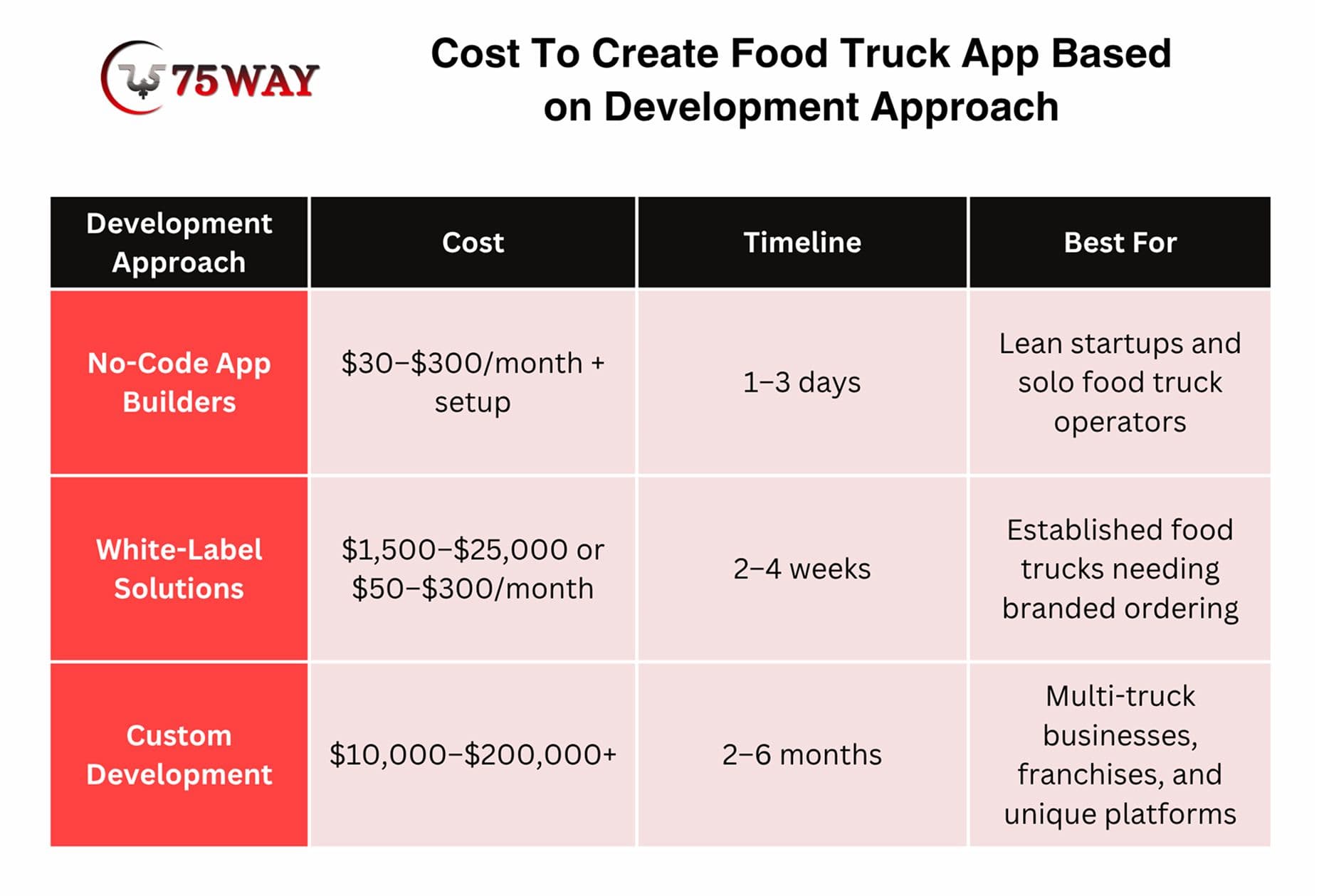
1. No-Code Food Truck App Builder Cost
No-code platforms can help food truck owners launch a basic digital ordering experience without a large upfront development investment. They work well for simple menus, ordering links, and customer interactions but may become restrictive as requirements grow.
- Cost: $30–$300 per month, plus setup fees.
- Timeline: 1–3 days.
- Best for: Lean startups or solo operators needing basic ordering capabilities.
- Details: Platforms such as Glide, Bubble, and Adalo provide drag-and-drop development. However, advanced requirements such as complex food modifiers, real-time truck tracking, POS integrations, and specialized workflows may require custom solutions.
2. White-Label Food Truck App Development Cost
White-label platforms provide a faster route to launching a branded food truck application because the underlying software is already developed. They can provide essential ordering and management functionality while reducing the time and cost associated with building everything from scratch.
- Cost: $1,500–$25,000 or $50–$300 per month.
- Timeline: 2–4 weeks.
- Best for: Established food trucks seeking branded mobile ordering.
- Details: Businesses typically customize an existing framework with their branding, menu, and business information. Depending on the provider, features may include customer ordering, merchant dashboards, payments, and POS integrations.
3. Custom Food Truck App Development Cost
Custom development provides the greatest control over functionality, design, integrations, scalability, and business workflows. It is particularly relevant when a food truck business operates multiple vehicles, serves different locations, or plans to build a differentiated digital platform.
- Cost: $10,000–$200,000+.
- Timeline: 2–6 months.
- Best for: Multi-truck franchises, marketplaces, and specialized food businesses.
- Details: A custom app can support advanced capabilities such as real-time truck tracking, dynamic menus, loyalty programs, POS synchronization, catering bookings, multiple user roles, analytics, and customized administrative workflows.
Key Factors That Influence Food Truck Mobile App Development Cost
Several factors determine the final food truck mobile app development budget, from the number of platforms to technical complexity, integrations, security, and the level of customization required.
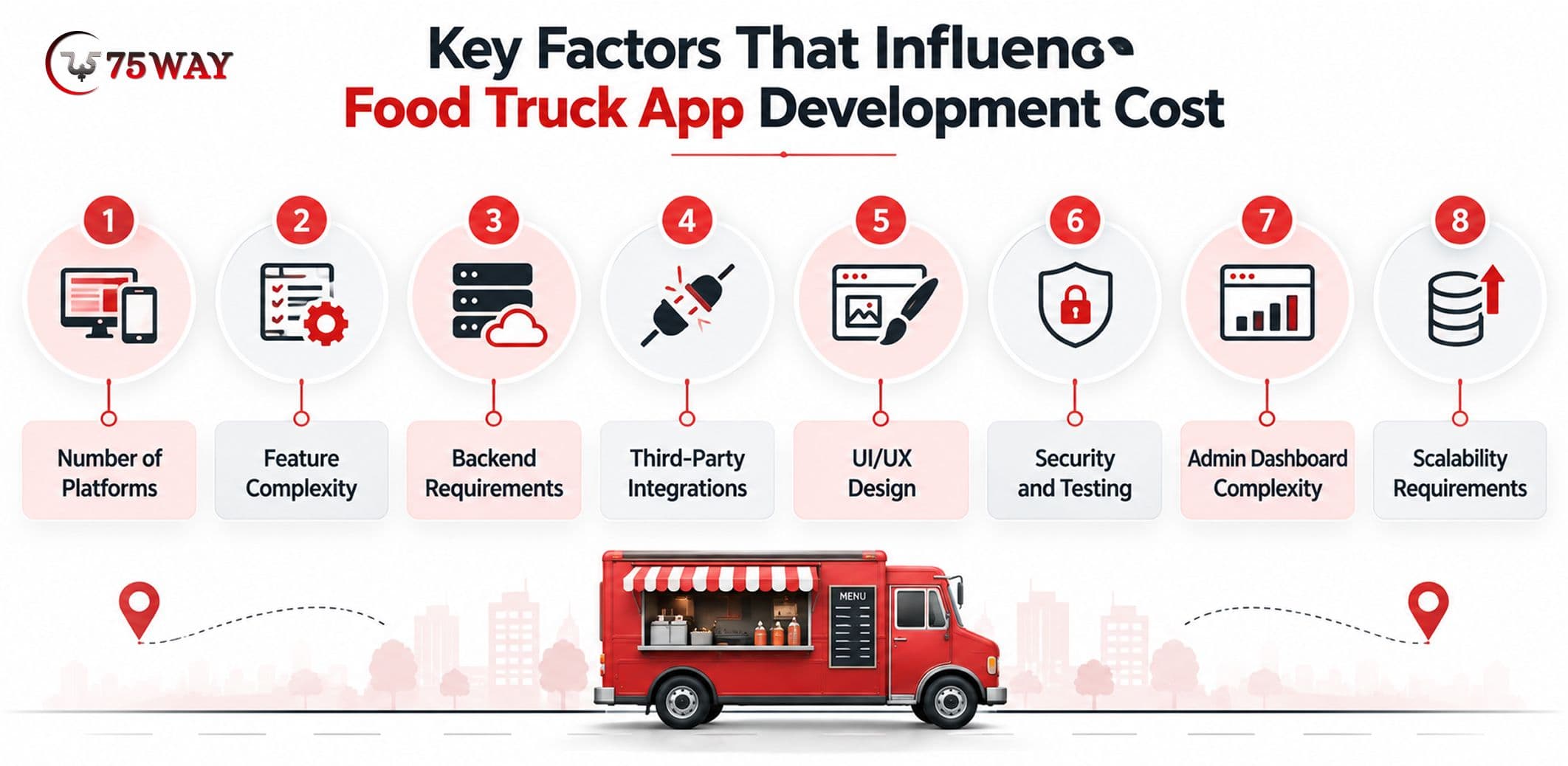
1. Number of Platforms
Building for iOS only generally requires less initial development than creating separate native iOS and Android applications. Cross-platform development can reduce duplicated work when supporting both platforms, although savings depend on features and integrations.
Estimated Cost: $5,000–$30,000+
2. Feature Complexity
A basic menu and ordering app requires less development effort than one supporting real-time truck tracking, dynamic menus, loyalty programs, POS synchronization, event scheduling, and advanced analytics.
Estimated Cost: $5,000–$40,000+
3. Backend Requirements
The backend manages users, menus, orders, payments, notifications, locations, promotions, analytics, and business rules. Multi-truck operations require more sophisticated account, scheduling, inventory, and reporting structures.
Estimated Cost: $5,000–$35,000+
4. Third-Party Integrations
Payment gateways, maps, POS systems, SMS services, notifications, analytics, customer support, and accounting software can all require additional development and testing. Each integration also adds potential maintenance requirements.
Estimated Cost: $2,000–$20,000+
5. UI/UX Design
A straightforward ordering experience costs less to design than a highly customized interface with interactive maps, animations, personalized recommendations, advanced filtering, and complex checkout journeys.
Estimated Cost: $3,000–$15,000+
6. Security and Testing
Payment processing, customer information, authentication, API security, device compatibility, performance, and checkout reliability require dedicated testing and engineering before launch.
Estimated Cost: $2,000–$12,000+
7. Admin Dashboard Complexity
The administrative dashboard controls orders, menus, customers, promotions, truck locations, employees, analytics, and operational settings. More user roles and controls increase development requirements.
Estimated Cost: $3,000–$15,000+
8. Scalability Requirements
An application designed for one truck has different infrastructure requirements than a platform expected to support multiple trucks, thousands of customers, high order volumes, and future geographic expansion.
Estimated Cost: $3,000–$20,000+
Cost To Hire Food Truck App Developers By Location
The location of your development team can significantly influence your food truck app budget. Hourly rates vary across regions because of differences in developer salaries, operating costs, technical expertise, and project complexity. For a food truck app requiring design, backend development, integrations, testing, and deployment, the following ranges provide a practical budgeting reference.
- North America (USA & Canada): $100–$250/hour
- Western Europe (UK, Germany): $70–$150/hour
- Eastern Europe (Poland, Ukraine): $40–$80/hour
- Asia (India, Southeast Asia): $20–$45/hour
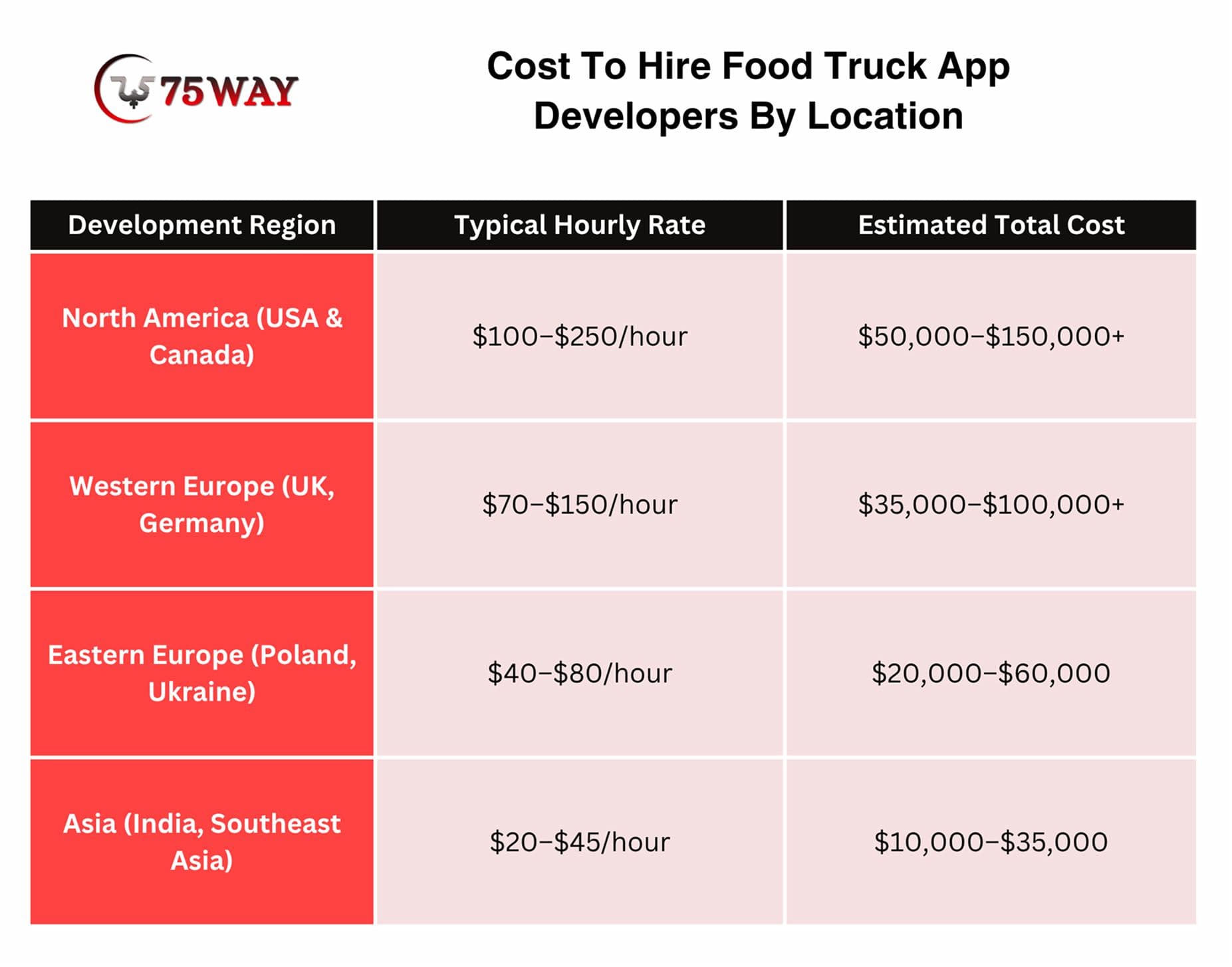
These total-cost ranges are planning estimates for a custom food truck mobile app and can vary based on the number of platforms, features, integrations, UI/UX requirements, and development hours. A simple ordering app may fall toward the lower end, while a multi-truck platform with POS integration, real-time tracking, analytics, and advanced administration can exceed these ranges.
Hidden Costs That Affect Your Food Truck App Development Budget
Beyond development, several less-visible expenses can increase your overall food truck app investment. Planning for these costs early helps prevent budget overruns and supports smoother operations after launch.
- Cloud Hosting and Infrastructure: Servers, databases, storage, backups, and traffic management can account for around 5%–10% of development costs, depending on app usage and customer volume.
- Third-Party API Usage: Maps, location tracking, SMS, notifications, analytics, and other external APIs may consume 5%–15% of the development budget through integration and ongoing usage charges.
- Payment Gateway Charges: Payment processing can add approximately 2%–5% through transaction-related costs, integration work, refunds, and payment infrastructure requirements.
- App Store and Platform Fees: Publishing and maintaining applications across major app stores can represent around 1%–3% of the initial development investment, excluding other platform-specific requirements.
- Security and Compliance: Authentication, data protection, payment security, vulnerability testing, and compliance measures can require another 5%–10% of development costs.
- Maintenance and Updates: Bug fixes, operating-system compatibility, security patches, server maintenance, and minor improvements can cost approximately 15%–25% of the original development cost each year.
- Customer Support Systems: Chat support, ticketing tools, automated responses, and customer service integrations may add around 3%–8% depending on the support model.
- Marketing and User Acquisition: App promotion, local campaigns, social media advertising, referral programs, and customer acquisition can require an additional 10%–30% of the development investment.
- Analytics and Monitoring Tools: Analytics, crash monitoring, performance tracking, and business intelligence tools can contribute approximately 2%–5% to the overall technology budget.
- Feature Upgrades and Scaling: Adding new features, supporting more trucks, increasing server capacity, and improving integrations can require another 10%–20% annually as the business grows.
How Much Does Each Feature Cost To Create Food Truck Application?
A food truck app can start with simple ordering and quickly become a much larger product once GPS tracking and business management enter the picture. Each added capability brings its own design, development, integration, and testing work, which can change the overall budget significantly. The feature-wise cost breakdown makes it easier to see what you may spend on each part of the application.
- Customer Registration and Login: Allows customers to create accounts, securely sign in, manage profiles, and access personalized ordering features.
Development Cost: $1,000–$3,000
- Menu and Food Catalog: Displays food items with images, descriptions, prices, categories, availability, and customization options for customers.
Development Cost: $1,500–$4,000
- Cart and Checkout: Lets customers review selected items, modify quantities, apply discounts, and complete orders through a streamlined checkout.
Development Cost: $2,000–$5,000
- Payment Integration: Connects secure payment methods for processing card, digital wallet, and other supported online transactions.
Development Cost: $1,500–$4,000
- Preorder and Pickup Scheduling: Enables customers to place orders ahead and select convenient pickup times based on truck availability.
Development Cost: $2,000–$5,000
- Truck Location: Helps customers find current truck locations and view relevant operating areas through integrated mapping services.
Development Cost: $2,000–$5,000
- Push Notifications: Sends timely alerts about order confirmations, preparation updates, pickup reminders, promotions, and other customer communications.
Development Cost: $800–$2,000
- Loyalty Program: Rewards repeat customers through points, discounts, special offers, and redeemable benefits based on purchases.
Development Cost: $2,000–$5,000
- Reviews and Ratings: Allows customers to rate food and service while providing feedback that businesses can monitor and manage.
Development Cost: $1,000–$3,000
- Admin Dashboard: Gives owners centralized controls for managing orders, menus, customers, promotions, availability, and operational information.
Development Cost: $3,000–$8,000
- POS Integration: Connects the application with point-of-sale systems to synchronize orders and streamline truck-side operations.
Development Cost: $3,000–$10,000+
- Analytics Dashboard: Provides insights into sales, orders, customer behavior, popular items, locations, and overall business performance.
Development Cost: $2,000–$6,000
- Multi-Truck Management: Enables centralized management of multiple trucks, locations, menus, schedules, staff permissions, and operational activities.
Development Cost: $4,000–$10,000+
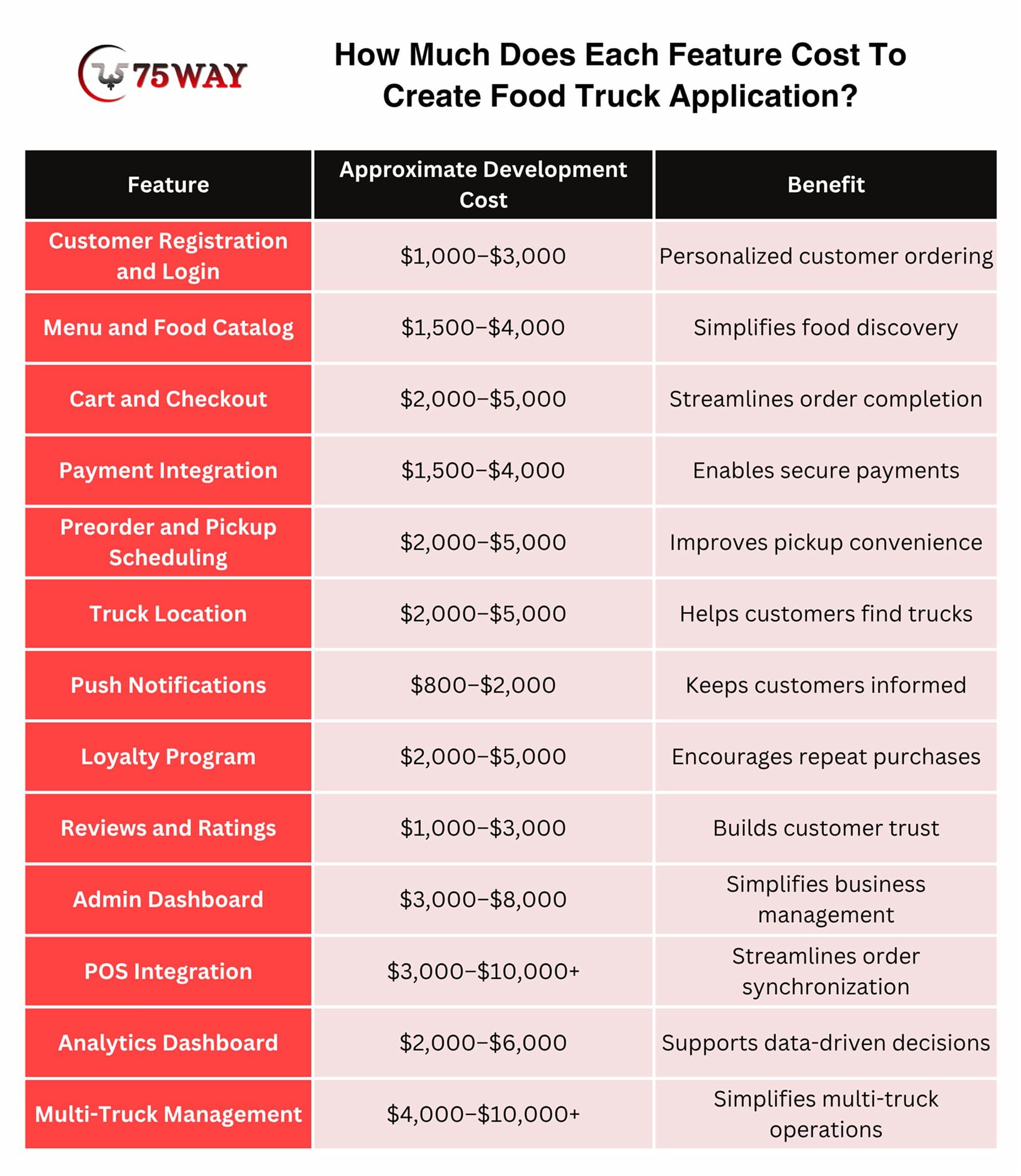
These figures should not be added mechanically because features share backend, design, authentication, testing, and infrastructure components.
For example, adding payments to an existing ordering system is different from building the complete checkout architecture from scratch.
Cost For Building Food Truck App Based On Business Models
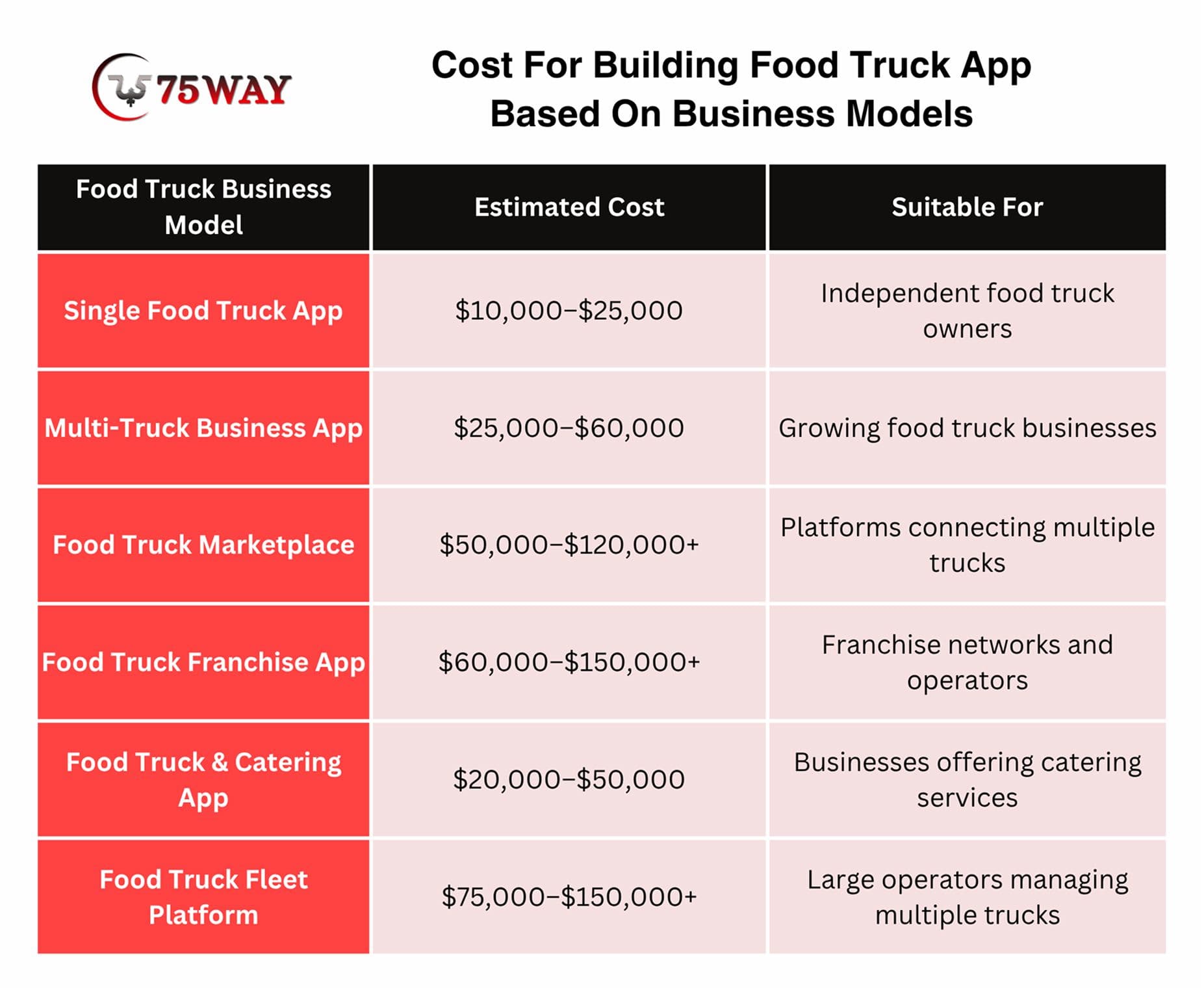
The business model you choose directly affects the app's features, integrations, workflows, and overall development budget. Here are the common food truck models and their estimated app development costs.
- Single Food Truck: $10,000–$25,000
A basic app can support digital menus, online ordering, payments, pickup scheduling, customer accounts, and push notifications. This model suits owners operating one truck with straightforward ordering requirements.
- Multi-Truck Business: $25,000–$60,000
Multiple trucks require centralized menus, individual truck profiles, location tracking, scheduling, order management, and staff permissions. Development costs increase as the platform needs to coordinate operations across several vehicles.
- Food Truck Marketplace: $50,000–$120,000+
A marketplace app connects customers with multiple independent food trucks. The app may require vendor onboarding, separate truck dashboards, commissions, reviews, payments, location services, and centralized administration.
- Food Truck FranchiseApp: $60,000–$150,000+
Franchise-focused apps need centralized brand management while allowing individual locations or franchisees to manage menus, orders, schedules, and customer activity. Advanced reporting and role-based access can further increase development costs.
- Food Truck & Catering App: $20,000–$50,000
This model combines everyday food ordering with catering bookings. Features can include event requests, custom menus, guest estimates, scheduling, deposits, and catering order management alongside standard truck ordering.
- Food Truck Fleet Platform: $75,000–$150,000+
Large operators may need a comprehensive platform for managing trucks, locations, employees, menus, inventory, orders, schedules, POS systems, and business analytics. The broader operational scope makes this model more expensive to develop.
How Much Does Food Truck App Maintenance Cost?
A practical planning model is to reserve 15%–25% of the original development cost per year for ongoing maintenance, support, updates, monitoring, and improvements.
For example, if your application costs $40,000 to build, an initial planning range of approximately $6,000–$10,000 annually can be used for maintenance.
The actual amount depends on:
- Number of platforms
- Number of integrations
- Traffic
- Feature complexity
- Security requirements
- Support expectations
- Frequency of product updates
Maintenance should not be confused with hosting or third-party usage fees. Those expenses may be separate.
How Can You Reduce Food Truck Application Development Costs?
Cost control does not mean removing every useful feature.
1. Start With One Core Customer Journey
Build the ordering and pickup experience before adding complex secondary functionality.
2. Use Cross-Platform Development Where Appropriate
A shared codebase can reduce duplicated development work for iOS and Android.
3. Use Established APIs
Do not build payment processing, mapping, SMS delivery, or cloud infrastructure from scratch when established services can meet the requirement.
4. Delay Advanced AI
AI recommendations and predictive analytics can be useful, but they are usually more valuable after sufficient customer and order data exists.
5. Build for One Truck First
If you operate a small business, validate the ordering experience with one truck before building complex multi-truck management.
6. Define Integrations Early
Late POS, payment, or accounting requirements can cause redesign and additional development work.
7. Avoid Feature Creep
Every new feature affects design, development, backend logic, testing, documentation, and maintenance.
What ROI Should a Food Truck Owner Calculate Before Building an App?
Instead of asking only, "How much does the app cost?", calculate whether the additional business generated can justify the investment.
A simple model is:
App payback period = Total app investment ÷ Additional monthly contribution generated by the app
For example, suppose the complete first-year technology investment is $45,000, and the app contributes an additional $5,000 per month in gross contribution after relevant transaction and operating costs.
The simple payback period would be:
$45,000 ÷ $5,000 = 9 months
This is only a planning calculation. Actual profitability depends on food costs, labor, payment fees, discounts, marketing, delivery expenses, customer retention, and incremental order volume.
The important point is to evaluate the application as a business investment rather than treating development cost as an isolated technology expense.
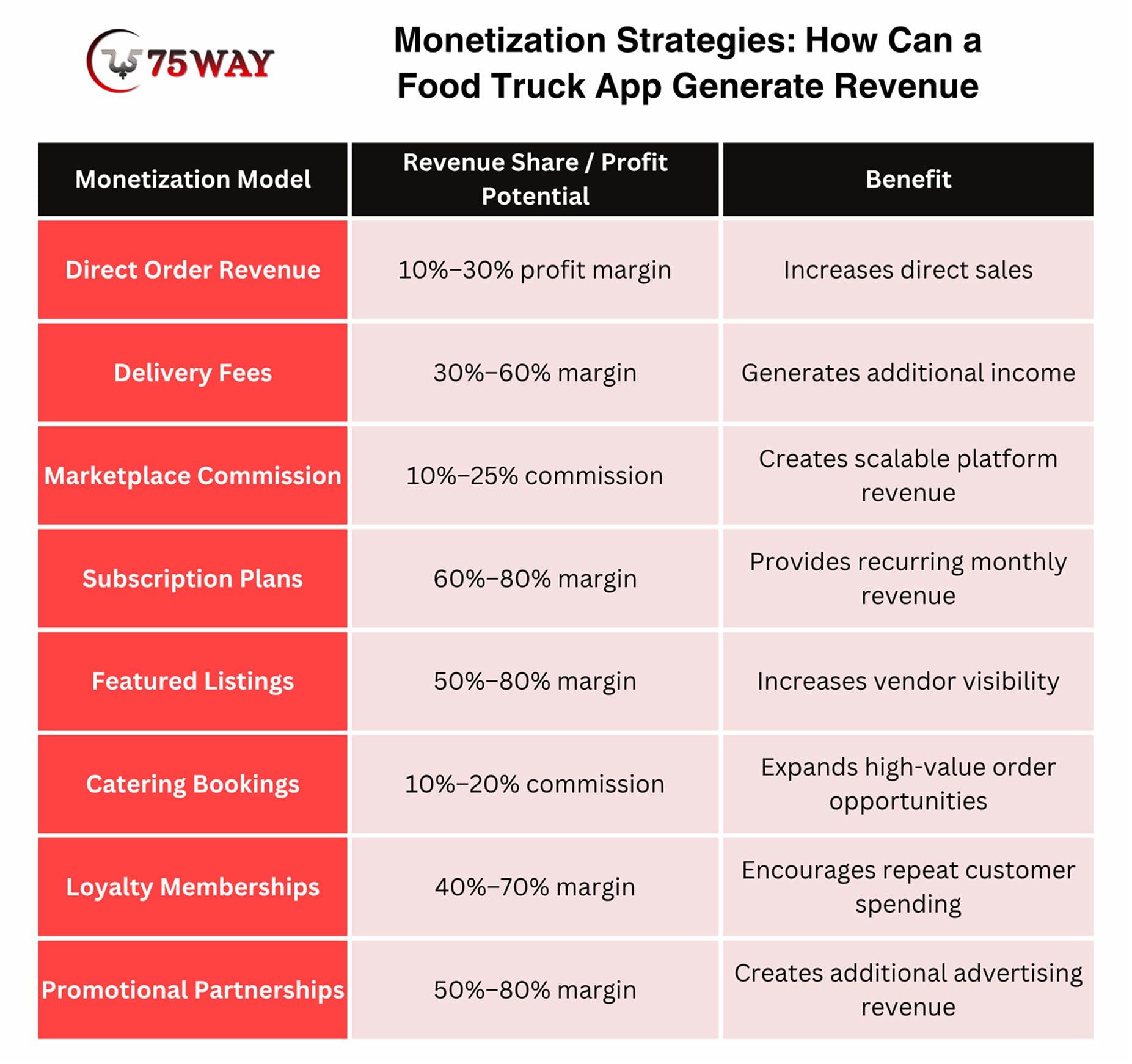
Monetization Strategies: How Can a Food Truck App Generate Revenue
A food truck app can generate revenue through direct orders, delivery fees, commissions, subscriptions, promotions, and catering services. The right monetization model depends on whether you operate one truck, multiple trucks, or a marketplace platform.
1. Direct Order Revenue
Food truck owners can use the app to accept orders directly from customers and generate revenue from every food purchase. This approach also reduces dependence on third-party ordering platforms and gives businesses greater control over customer relationships.
Example: A customer places a $25 order through the app. If the food truck retains the full order value, the business generates $25 in sales, excluding food, payment processing, and other operating costs.
2. Delivery Fees
Apps offering delivery can charge customers a separate delivery fee based on distance, order value, or delivery conditions. The fee can create an additional revenue stream while helping cover driver and transportation expenses.
Example: A customer pays $5 for delivery on a $30 food order. The app generates $5 in delivery-fee revenue before accounting for delivery-related costs.
3. Marketplace Commission
A food truck marketplace can charge participating vendors a percentage of each order processed through the platform. This model becomes particularly relevant when the app connects customers with multiple independent food trucks.
Example: If a food truck receives a $50 order and the platform charges a 10% commission, the platform earns $5 from that transaction.
4. Subscription Plans
Food truck businesses can pay a recurring subscription for access to premium app features such as analytics, marketing tools, loyalty programs, advanced scheduling, or multi-truck management.
Example: A platform charges food truck owners $99 per month for a premium plan. With 50 subscribed businesses, monthly subscription revenue reaches $4,950 before operating expenses.
5. Featured Listings
Food trucks can pay to appear prominently in search results, event listings, recommended sections, or location-based discovery screens. This gives vendors an additional way to reach customers through the platform.
Example: A food truck pays $200 per month for a featured placement that increases its visibility among customers browsing nearby trucks.
6. Catering Bookings
The app can generate revenue by facilitating catering requests for corporate events, private parties, festivals, and other gatherings. The platform can charge a booking fee or commission on confirmed catering orders.
Example: A customer books catering worth $2,000 through the app, and the platform charges a 10% booking commission, generating $200 in revenue.
7. Loyalty Memberships
A paid loyalty program can provide customers with exclusive discounts, free items, priority ordering, or special offers. Recurring membership payments create another revenue source while encouraging repeat purchases.
Example: A loyalty membership costs $9.99 per month. With 500 active members, the app could generate approximately $4,995 in monthly membership revenue before applicable fees and expenses.
8. Promotional Partnerships
The platform can partner with food brands, beverage companies, event organizers, or local businesses to promote relevant products and services to its customer base.
Example: A beverage brand pays $1,000 for a promotional campaign displayed to customers ordering from participating food trucks. This creates advertising revenue without charging customers directly.
What Should Owners Ask a Food Truck Mobile App Development Company?
Before accepting a proposal, ask:
- What exactly is included in the quoted development cost?
- Does the price include UI/UX design?
- Is backend development included?
- Are iOS and Android included?
- Which integrations are included?
- Who owns the source code?
- What third-party services will create recurring costs?
- What is included in testing and QA?
- What happens after launch?
- Is maintenance included?
- How are change requests priced?
- Can the architecture support multiple trucks later?
- How will customer and payment data be protected?
- What analytics will be available after launch?
- What is the estimated cost of future feature development?
These questions can reveal why two development proposals with similar feature lists have very different prices.
Final Thoughts
The cost to develop a food truck mobile app generally falls around $10,000–$60,000 for basic to standard custom products, while advanced multi-truck platforms can reach $60,000–$120,000+. The biggest cost drivers are not the app's name or industry but its functionality, integrations, platform strategy, backend requirements, and operational complexity.
For a new food truck, the most practical approach is often to validate the core ordering journey first. Start with menu browsing, online ordering, payments, pickup scheduling, notifications, truck information, and an owner dashboard, then expand into loyalty, POS integration, multi-truck management, advanced analytics, and personalization as actual usage justifies the investment.
Planning a food truck mobile app? Talk to an experienced on-demand mobile app development agency to get a scope-based estimate for your features, platforms, integrations, timeline, and long-term product roadmap.
Frequently Asked Questions (FAQs)
How Long Does It Take To Develop A Food Truck Mobile App?
A focused MVP can take around 2–3 months, while a standard custom application may require 3–5 months. Advanced products with multiple trucks, POS integrations, real-time tracking, loyalty programs, analytics, and complex backend workflows can take 5–8 months or longer.
What Features Should A Food Truck App Have?
Core features can include menu browsing, customer accounts, online ordering, payments, pickup scheduling, truck information, notifications, order history, and an admin dashboard. Advanced applications can add real-time location, loyalty programs, POS integration, analytics, multi-truck management, catering, and personalized recommendations.
Is It Cheaper To Build An App For One Food Truck?
Usually, yes. A single-truck application has fewer menus, locations, user roles, operational workflows, and administrative requirements than a multi-truck platform. Starting with one truck can also reduce the initial scope and provide real customer data before expanding the technology.
Should A Food Truck Build An iOS Or Android App First?
The decision should be based on the target customer's device usage, business goals, launch strategy, and available development budget. If the business wants both platforms, cross-platform development may reduce duplicated implementation work compared with maintaining two separate native codebases.
Is A White-Label Food Truck App Cheaper Than Custom Development?
A white-label application generally has a lower initial cost and faster launch because much of the underlying software already exists. However, customization, integrations, ownership, scalability, and vendor dependency should be evaluated before choosing it.
Can A Food Truck App Integrate With a POS System?
Yes. POS integration can synchronize orders and operational data between the mobile application and the truck's existing point-of-sale workflow. The development cost depends on the POS provider, available APIs, synchronization requirements, and the business processes being connected.
Can A Food Truck App Support Catering And Event Bookings?
Yes. Catering functionality can include event dates, guest counts, menu selections, location information, quotes, deposits, communication, scheduling, and booking management. These capabilities require additional workflows beyond standard mobile ordering.
What Is The Cheapest Way To Build A Food Truck App?
The lowest-cost approach is usually a tightly scoped MVP or a suitable white-label solution. For a custom product, limiting the first release to essential ordering, payment, pickup, notifications, and administration can reduce development time while leaving advanced features for later releases.
How Do I Calculate Whether A Food Truck App Is Worth The Investment?
Compare the complete technology investment with the incremental contribution generated through additional orders, repeat purchases, direct ordering, catering leads, and operational savings. Include development, maintenance, transaction fees, marketing, hosting, and other recurring expenses in the calculation.