AI Summary
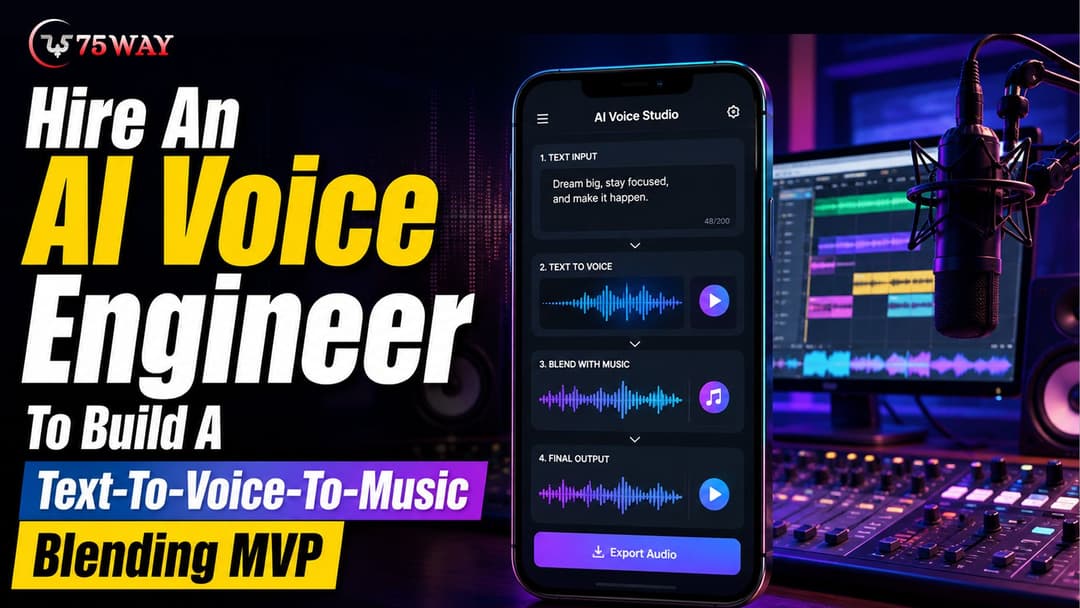
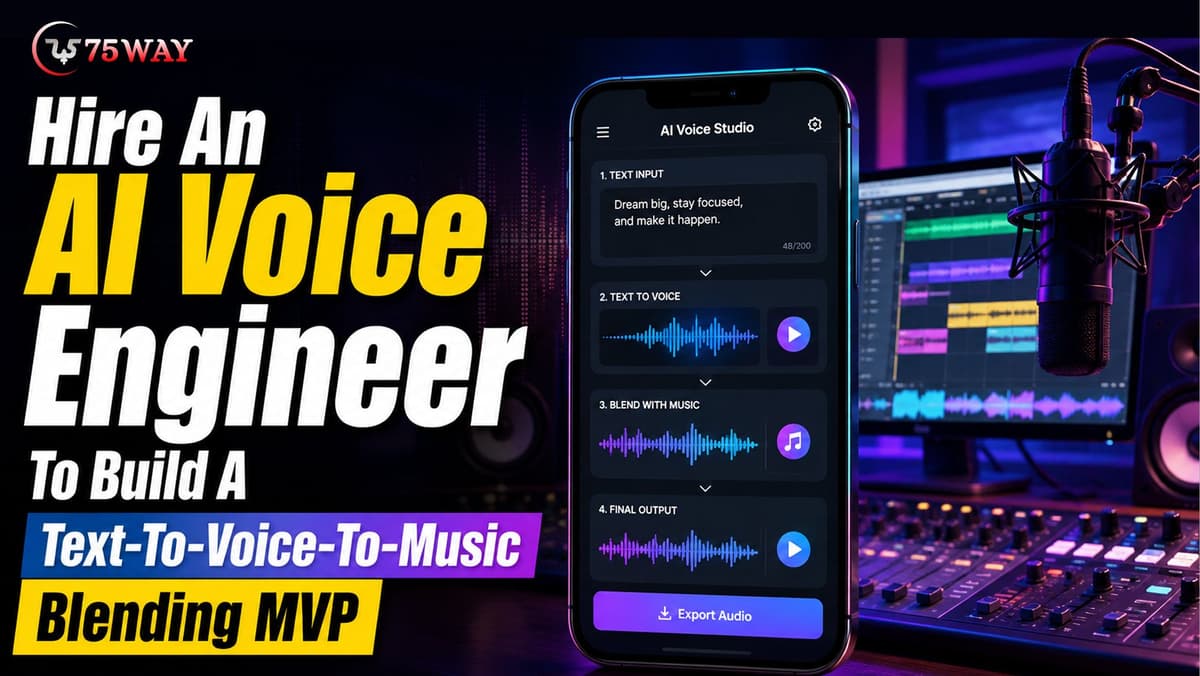
Hiring an AI voice engineer can help turn a text-to-voice-to-music concept into a functional MVP. This guide explains the required expertise, core features, development process, AI architecture, technology choices, costs, and validation strategy for launching it.
Key Takeaways
- Understand why specialized AI voice engineering matters for audio MVP development.
- Learn which text-to-voice and music blending features your MVP needs.
- Discover how AI voice engineers design architecture for seamless audio generation.
- Explore development costs, timelines, technologies, integrations, and MVP validation strategies.
- Learn how to hire an AI voice engineer for your project.
If you’re planning a text-to-voice-to-music blending MVP, hiring an AI voice engineer with the right combination of voice AI and audio engineering skills should be one of your first priorities. The engineer will play a central role in connecting text processing, voice generation, music integration, and audio mixing into one working product.
For an MVP development of a text-to-voice-to-music blending platform, you need someone who can make these components work together without overcomplicating the initial build. Model selection, API integration, voice quality, audio synchronization, processing speed, and the overall generation workflow all need to be considered from the beginning.
This guide covers what businesses and founders should know before hiring an AI voice engineer for this type of MVP, including required skills, responsibilities, development requirements, and hiring considerations.
Why Hire an AI Voice Engineer for a Text-To-Voice-To-Music MVP?
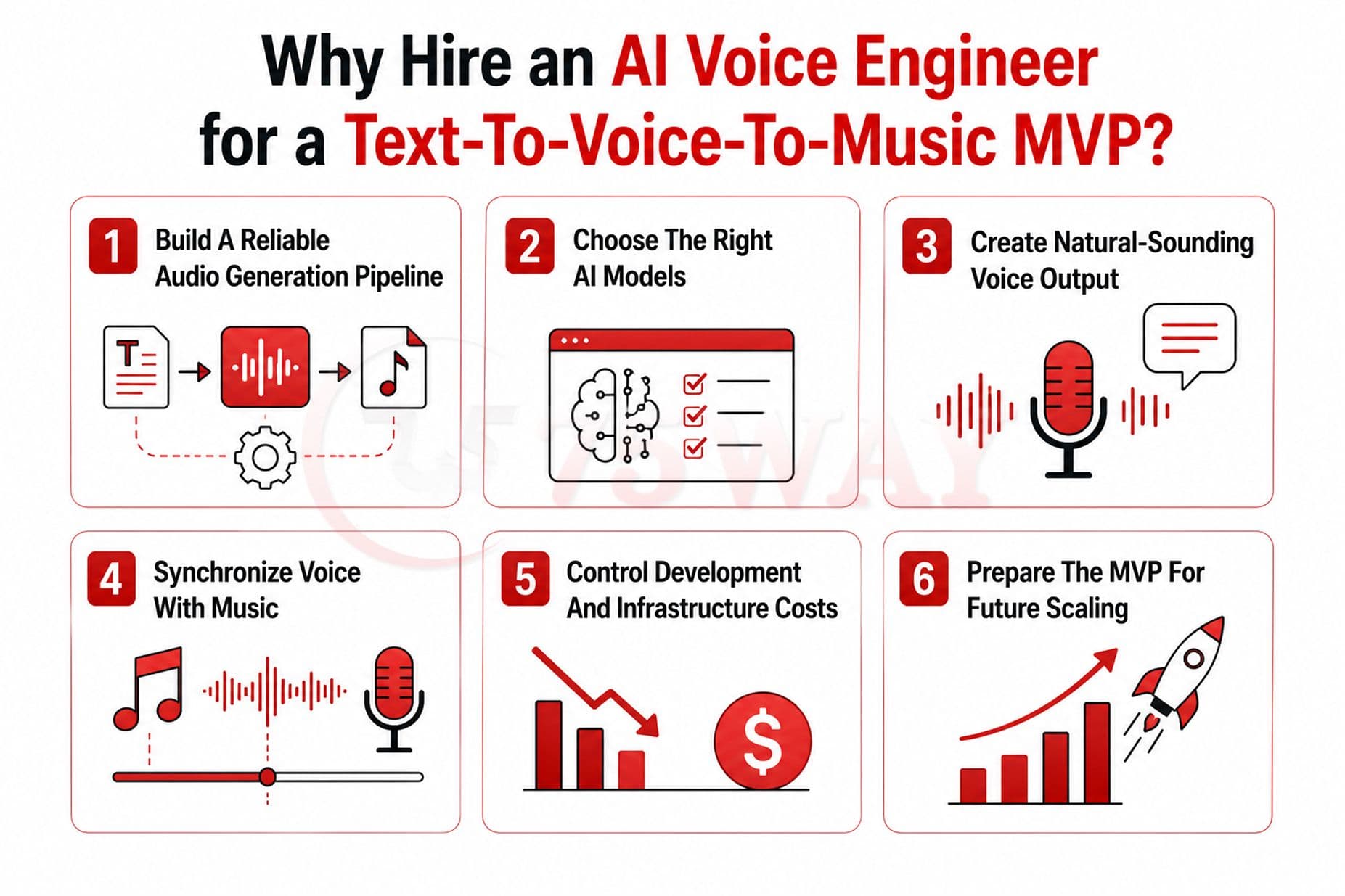
An AI voice engineer can turn your text-to-voice-to-music idea into a functional MVP by connecting voice generation, music creation, audio processing, and application workflows. Their expertise helps founders choose the right AI models, avoid unnecessary development, and validate the product faster. The following reasons explain why specialized AI voice expertise matters when building this type of MVP.
1. Build A Reliable Audio Generation Pipeline
An AI voice engineer can design the complete pipeline that converts text into voice and blends it with generated or selected music. They ensure each stage works together instead of treating speech generation, music generation, and audio mixing as separate features.
2. Choose The Right AI Models
Not every MVP needs custom AI models. An experienced engineer can evaluate available text-to-speech, voice-generation, music-generation, and voice-conversion models and select options based on quality, latency, customization, licensing, and cost.
3. Create Natural-Sounding Voice Output
Voice quality can directly influence how users perceive an AI audio product. An AI voice engineer can optimize pronunciation, pacing, tone, voice characteristics, and processing workflows to make generated speech sound more natural and suitable for the intended use case.
4. Synchronize Voice With Music
Combining speech and music requires more than placing two audio files together. The engineer can develop workflows for timing, volume balancing, transitions, synchronization, and audio processing so that the generated voice remains clear while the music supports rather than overwhelms it.
5. Control Development And Infrastructure Costs
An experienced engineer can identify which capabilities should use existing APIs and which may justify custom development. This can help reduce unnecessary model training, infrastructure spending, and technical experimentation while keeping the MVP focused on its core value proposition.
6. Prepare The MVP For Future Scaling
The first version may rely on third-party AI models, but the architecture should leave room for future improvements. An AI voice engineer can structure the system so you can later introduce additional voices, models, audio controls, higher generation volumes, custom models, or real-time capabilities without rebuilding the entire product.
What Does An AI Voice Engineer Do For Your MVP?
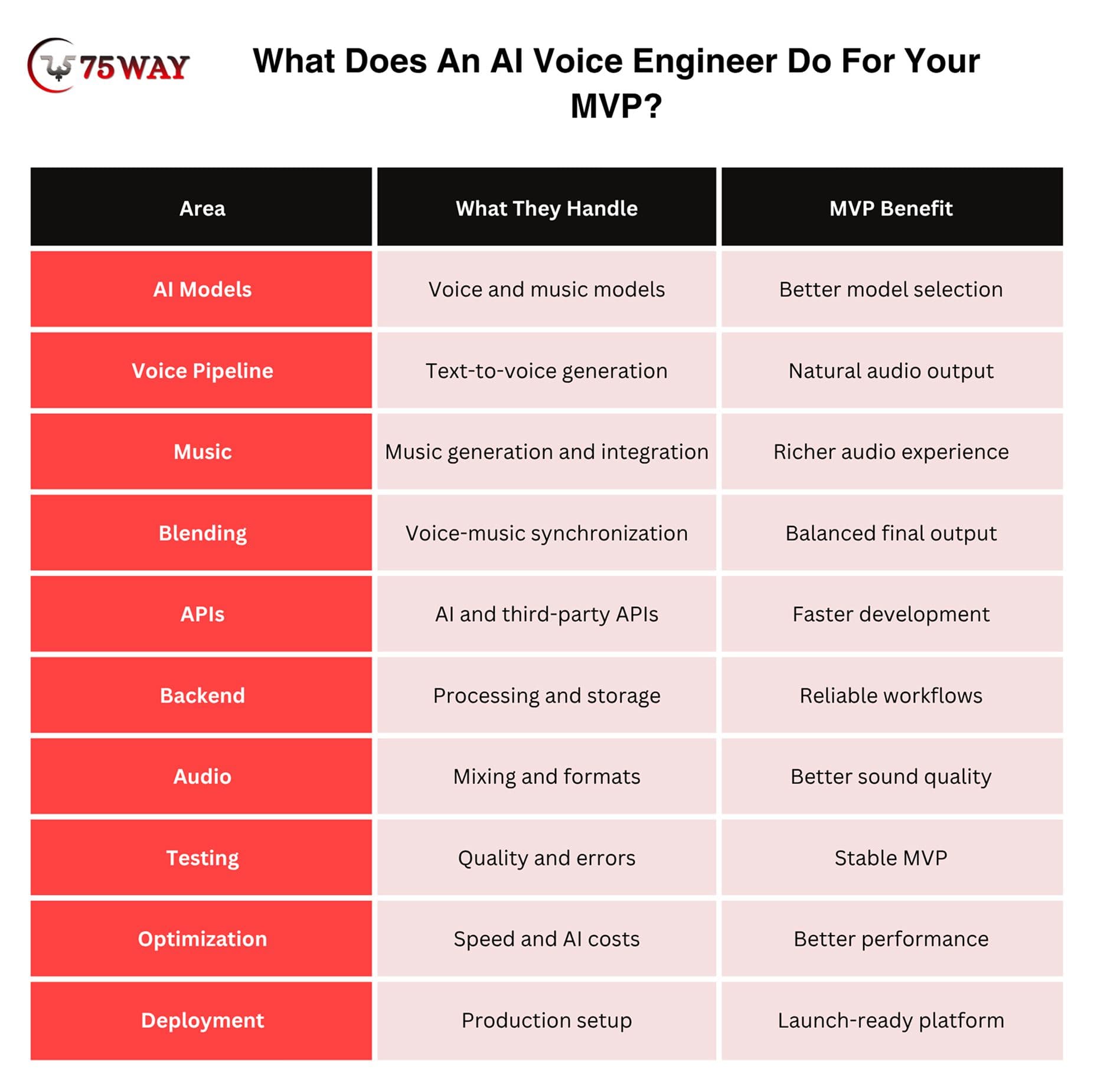
An AI voice engineer brings the technical expertise needed to turn an audio concept into a working product. Instead of focusing on one AI feature, they connect voice generation, music processing, backend systems, and user interactions into one practical workflow.
For a text-to-voice-to-music MVP, their role begins with understanding what the product needs to generate and how users will interact with the final audio. They help select suitable models, APIs, processing methods, and infrastructure without overbuilding the first version.
Their work also extends beyond development. They test generated outputs, identify quality or latency issues, optimize the pipeline, and prepare the MVP architecture for future capabilities as user demand and product requirements grow.
The engineer should also understand the difference between a technical demo and a product-ready MVP. A demo may generate one impressive audio clip, while an MVP needs repeatable workflows, error handling, user controls, storage, monitoring, and a predictable user experience.
Skills To Look For When Hiring An AI Voice Engineer For Voice-To-Music Platform
Hiring a general AI developer may not be enough for this type of product. Look for someone with experience across several connected areas.
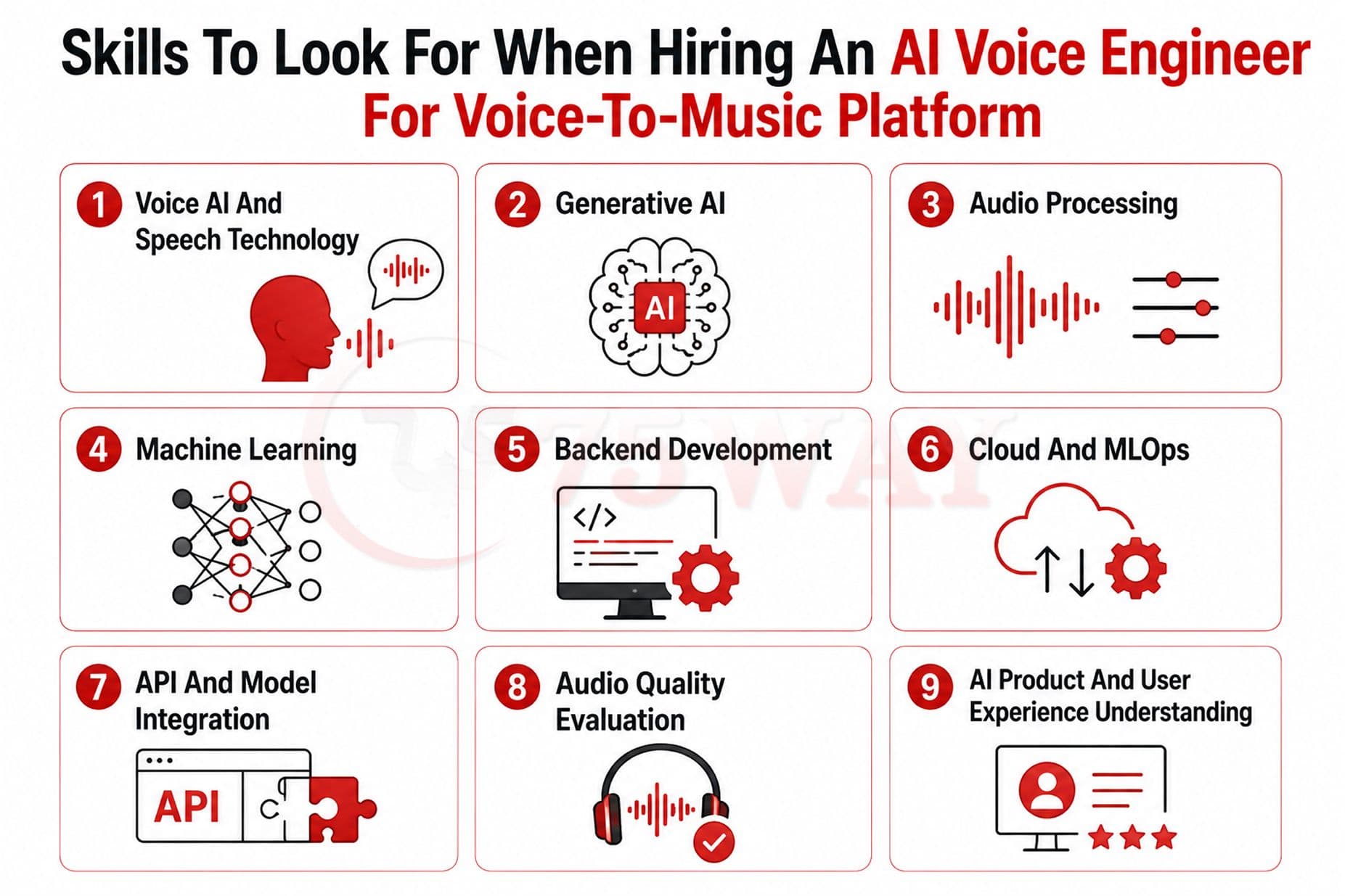
- Voice AI And Speech Technology
The engineer should understand text-to-speech, speech processing, voice characteristics, pronunciation, latency, and audio quality.
They should also know how different voice models behave across accents, speaking styles, languages, and use cases. This expertise helps create voice output that sounds natural and remains understandable after music is blended.
- Generative AI
Experience with generative AI models helps the engineer evaluate existing models, APIs, model limitations, prompting approaches, and customization options.
They should understand how to select models based on output quality, inference speed, scalability, and the specific requirements of the MVP. This can prevent unnecessary experimentation with unsuitable or overly complex models.
- Audio Processing
The engineer should understand audio formats, sampling, channels, mixing, synchronization, normalization, and post-processing.
These skills are important when combining generated voice with music while maintaining clear vocals and balanced sound. They should also be comfortable handling different audio inputs and outputs across the application workflow.
- Machine Learning
ML knowledge becomes more important if your MVP requires custom model adaptation, evaluation pipelines, voice conversion, or proprietary AI capabilities.
An engineer with strong machine learning fundamentals can assess whether an existing model is sufficient or whether customization is actually necessary. This helps establish a practical development path without adding unnecessary research costs.
- Backend Development
The AI pipeline still needs reliable application infrastructure for handling requests, processing jobs, storing outputs, managing users, and connecting APIs.
Backend expertise helps the engineer create reliable communication between the AI models and the rest of the product. It also supports features such as authentication, job queues, audio storage, and generation history.
- Cloud And MLOps
Cloud infrastructure becomes important when audio generation requires GPUs, queues, scalable processing, monitoring, model deployment, or large media storage.
The engineer should understand how to deploy and monitor AI workloads without creating excessive infrastructure costs. Strong MLOps knowledge also makes it easier to update models and maintain reliable production workflows.
- API And Model Integration
An experienced engineer should know how to evaluate and integrate third-party AI services instead of building every capability from scratch.
They should be able to compare APIs based on pricing, capabilities, latency, reliability, and usage restrictions. This allows the MVP to reach the market faster while keeping the architecture flexible for future model changes.
- Audio Quality Evaluation
The engineer should know how to evaluate generated audio for clarity, consistency, synchronization, and overall listening quality.
They can establish practical testing methods to identify problems that may not be obvious during basic functional testing. This becomes especially important when users generate different voices, music styles, prompts, and audio combinations.
- AI Product And User Experience Understanding
Technical expertise should also translate into a simple experience for the end user. The engineer should understand how generation controls, prompts, voice settings, music choices, and processing states fit into the product journey.
This helps ensure the AI capabilities are useful and accessible rather than becoming complicated technical features.
How To Hire An AI Voice Engineer For Your MVP of Text-to-Speech-to-Music System?
Hiring an AI voice engineer for a text-to-voice-to-music MVP requires more than checking technical skills or comparing hourly rates. You need someone who understands how voice AI, generative music, audio processing, APIs, backend infrastructure, and product requirements work together. The following steps can help you evaluate candidates more carefully and select an engineer who can build a practical MVP without unnecessary technical complexity.
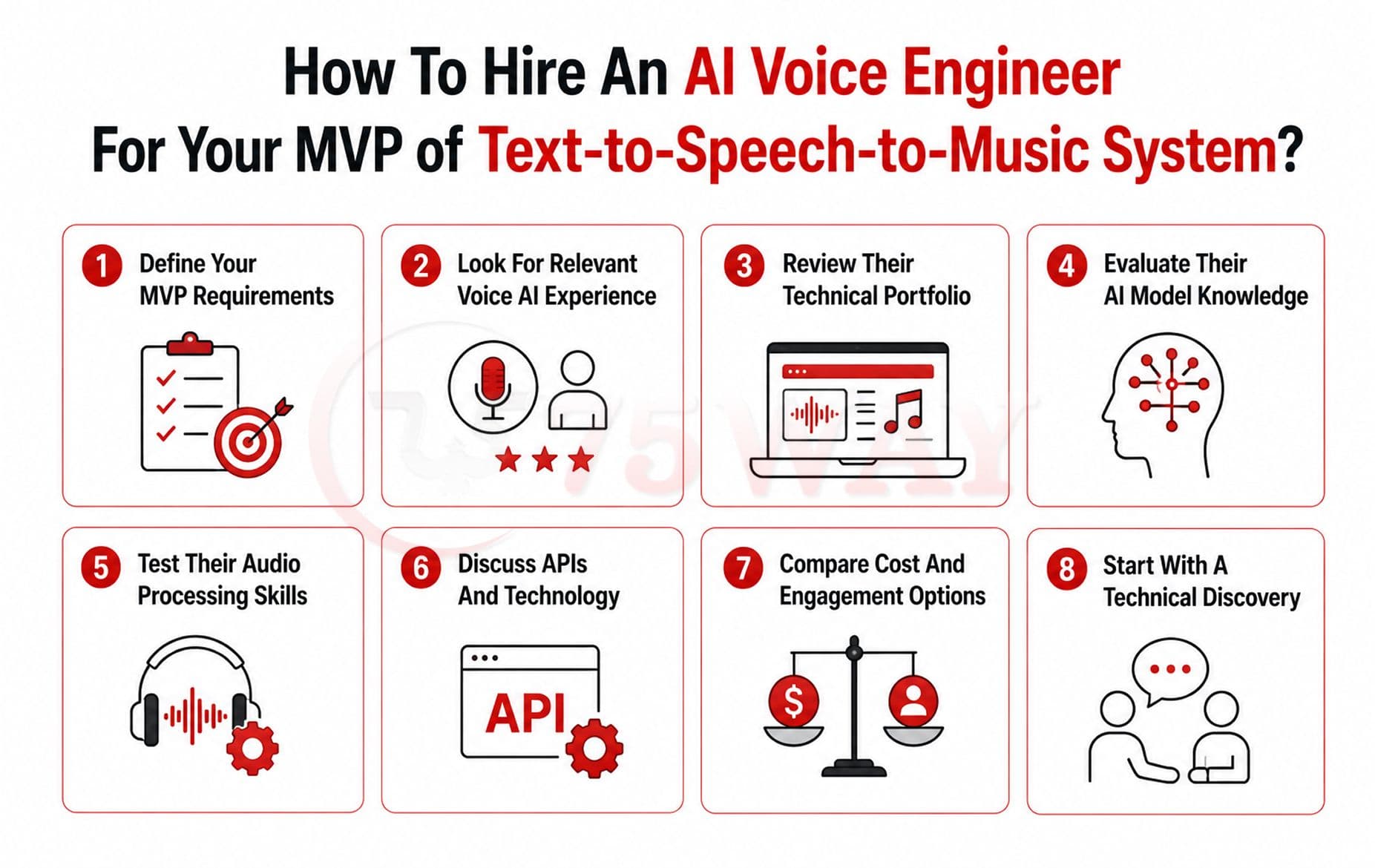
1. Define Your MVP Requirements
Start by documenting exactly what you expect the MVP to accomplish. Decide whether users will enter text, select a voice, generate music, control voice characteristics, blend vocals with music, or download the final audio.
Also define your target users, supported platforms, expected generation time, number of voice options, audio formats, and user controls. A clear scope allows engineers to estimate the work more accurately and prevents you from paying for features that are not necessary for the first release.
2. Look For Relevant Voice AI Experience
Prioritize engineers who have hands-on experience with text-to-speech, voice synthesis, voice conversion, speech processing, generative audio, or AI music systems. General AI experience is useful, but voice and audio projects involve technical considerations that a conventional chatbot or computer-vision developer may not understand.
Ask candidates about projects where they worked with audio generation and what challenges they solved. Their experience should match the technical direction of your MVP rather than simply showing a long list of AI tools.
3. Review Their Technical Portfolio
A portfolio can reveal much more than a resume when hiring an AI voice engineer. Look for demonstrations of voice generation, audio applications, AI-powered media products, model integrations, or similar systems they have actually developed.
Pay attention to the quality of the output, application workflow, responsiveness, and technical complexity of their previous projects. If possible, ask what portion of each project they personally handled so you can distinguish genuine engineering experience from work completed by an entire team.
4. Evaluate Their AI Model Knowledge
Your engineer should be able to explain which AI models or APIs are appropriate for your MVP and why. Ask them to compare options according to voice quality, music capabilities, latency, pricing, customization, scalability, API limitations, and licensing considerations.
A strong engineer should not automatically recommend custom model development. If an existing model can deliver your required output, using it may help you launch faster and reduce initial development costs. Custom models can be considered later when they provide a clear product advantage.
5. Test Their Audio Processing Skills
Text-to-voice-to-music products require more than generating speech and music separately. The engineer should understand how to process, synchronize, mix, normalize, and optimize different audio streams.
Ask how they would keep vocals understandable when background music is added. They should also be familiar with audio formats, sampling rates, volume levels, timing, transitions, noise handling, and post-processing. These capabilities can have a direct impact on the quality users experience.
6. Discuss APIs And Technology
Ask candidates to explain the technology stack they would recommend for your specific MVP. This can include AI voice APIs, music-generation services, backend technologies, cloud infrastructure, databases, storage, queues, authentication, and monitoring.
Do not choose an engineer simply because they use a particular framework or AI provider. Instead, evaluate whether their technology choices support your MVP budget, expected traffic, audio-generation requirements, scalability, and future product roadmap.
7. Compare Cost And Engagement Options
Compare the total value of different hiring models instead of selecting the lowest hourly rate. A freelancer may be suitable for a focused MVP, while a dedicated engineer can provide greater ownership throughout development.
An AI development agency may be more appropriate when you need multiple specialists, including AI engineers, backend developers, designers, and QA professionals. Staff augmentation can work well when you already have an internal team but need additional voice-AI expertise.
Consider experience, availability, communication, ownership, delivery timeline, and technical responsibility alongside cost when comparing candidates.
8. Start With A Technical Discovery
A technical discovery phase can help you validate the project before committing your full MVP budget. During this stage, the engineer can assess the feasibility of your concept, recommend AI models, design the initial architecture, identify technical risks, and define the development scope.
You can also use this phase to test the quality of generated voice and music before building the complete application. This is particularly valuable for text-to-voice-to-music products because the final experience depends heavily on audio quality, model capabilities, generation speed, and blending performance.
A successful discovery phase should leave you with a clearer MVP scope, recommended technology approach, estimated development effort, major risks, and a practical roadmap for moving into development.
Cost To Hire An AI Voice Engineer for Text-To-Voice-To-Music Blending System
The cost depends heavily on position, experience, location, engagement model, specialization, and project complexity.
Current 2026 market benchmarks show substantial differences. For example, Upwork lists AI engineers around $35–$60/hour, while other 2026 benchmarks put U.S. senior AI contractors around $130–$200/hour and specialized ML contractors around $150–$250/hour.
For a text-to-voice-to-music MVP, it is better to budget according to the actual expertise required rather than applying a generic “AI developer” rate.
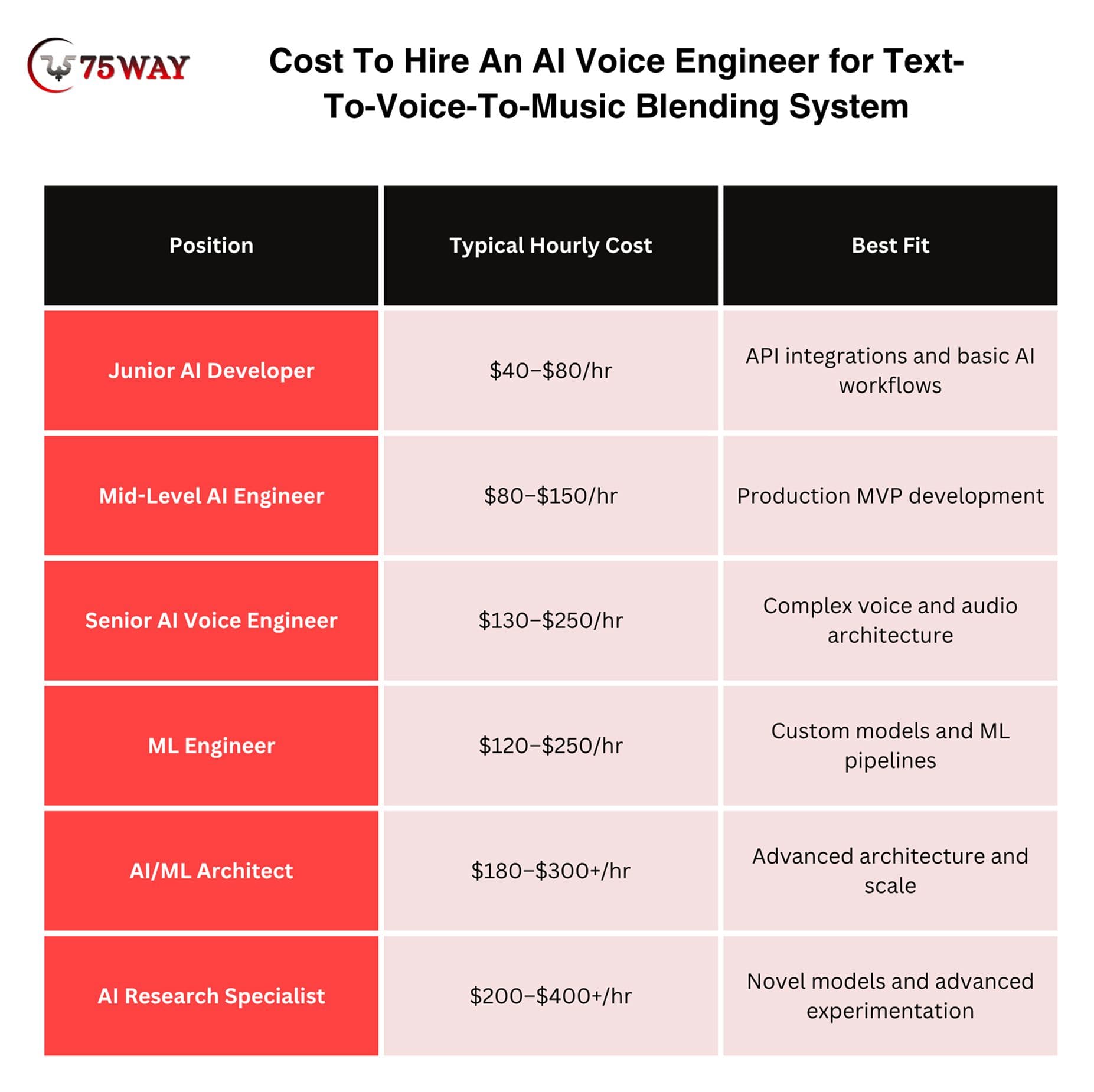
These should be treated as planning ranges, not fixed quotations. Specialized AI voice work can command higher rates when the engineer brings production experience in real-time inference, custom models, audio processing, or advanced generative AI.
Current 2026 market benchmarks show senior U.S. AI contractors commonly reaching $130–$200/hour, with higher specialist rates possible.
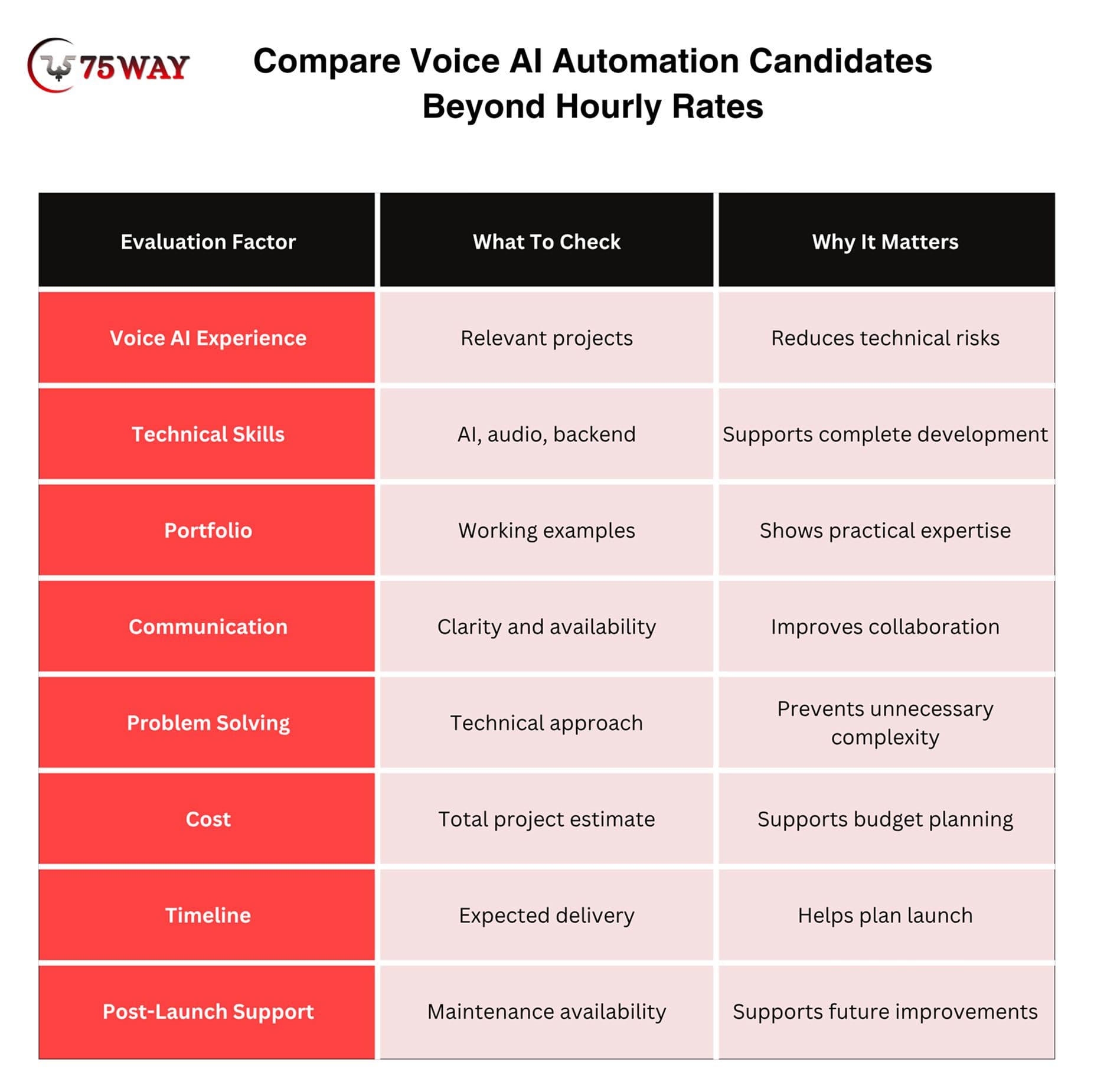
Compare Voice AI Automation Candidates Beyond Hourly Rates
The cheapest AI voice engineer may not always deliver the lowest overall project cost. A candidate with stronger voice-AI experience can identify technical risks earlier, choose suitable models, and avoid costly redevelopment. Compare candidates based on their ability to deliver your specific MVP, not simply their quoted hourly rate.
Cost of Hiring AI Voice Engineer For Text-to-Voice-to-Music System Based On Location
Location can create a major difference in development budgets. Current market data shows mid-level AI/ML contractors in the U.S. costing substantially more than comparable talent in several other regions.
- United States
Hiring an AI voice engineer in the United States typically costs around $120–$250+ per hour. U.S.-based specialists are suitable for complex projects requiring advanced generative AI, voice technology, machine learning, audio processing, and close collaboration with product teams.
- Western Europe
AI voice engineers in Western Europe generally charge around $70–$150 per hour. This region can be a good choice for businesses looking for experienced AI professionals with strong software engineering, communication, and product development capabilities.
- Eastern Europe
Eastern European engineers may charge approximately $50–$120 per hour. The region offers access to experienced AI and software developers who can handle AI integrations, backend systems, audio workflows, and MVP development at comparatively lower rates.
- Latin America
Hiring an AI voice engineer from Latin America may cost around $50–$120 per hour. Its time-zone overlap with the U.S. makes the region attractive for startups that want nearshore development and regular collaboration with their engineering team.
- India And South Asia
AI voice engineers in India and other South Asian markets may charge approximately $25–$80 per hour. This can be an economical option for startups developing MVPs involving AI APIs, backend development, audio processing, and application integration.
- Southeast Asia
Southeast Asian AI engineers generally charge around $30–$80 per hour. Businesses can consider this region for AI integrations, backend development, application engineering, and other implementation work where specialized voice-AI expertise is not the only requirement.
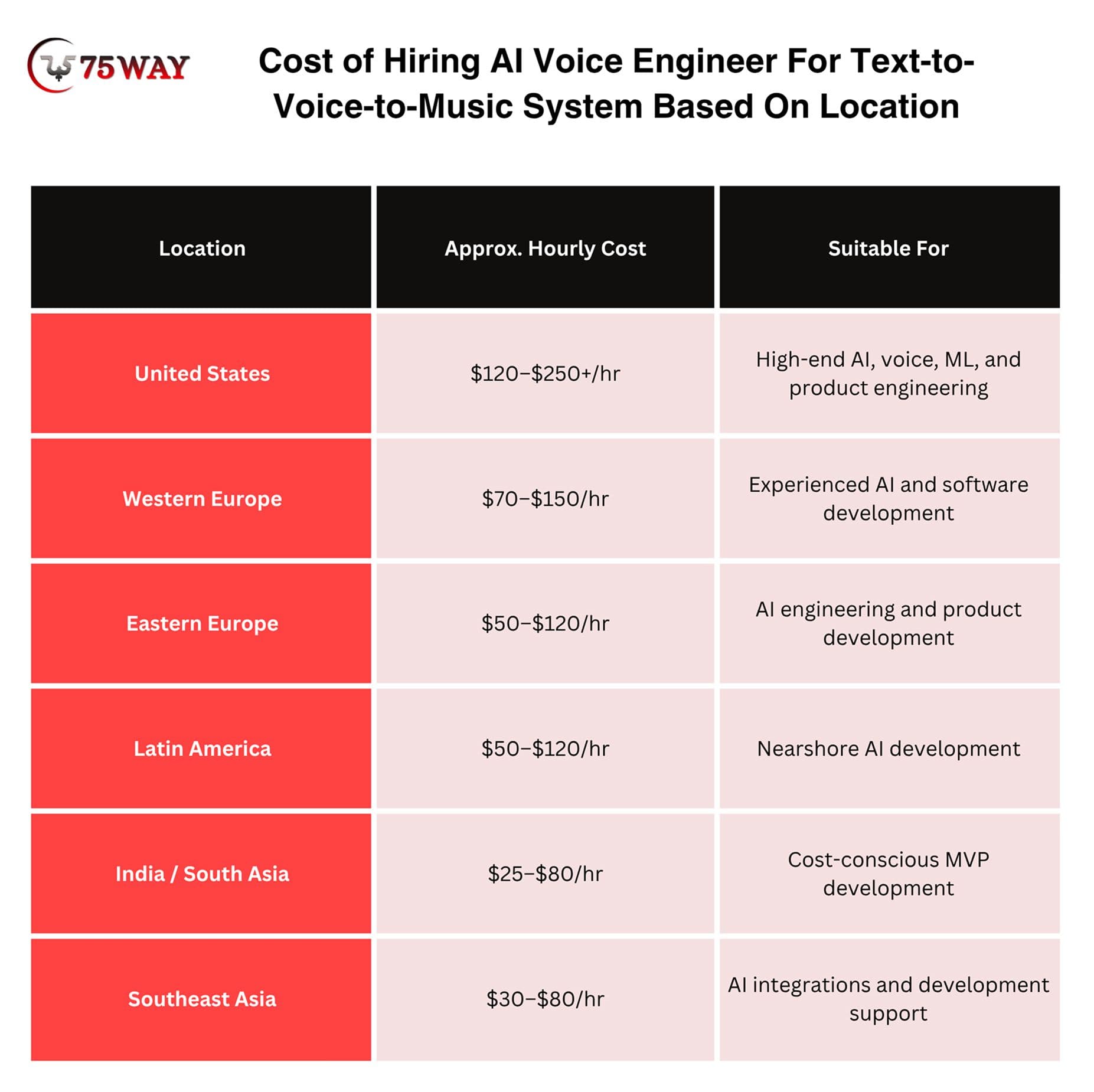
For a founder, however, hourly rate should not be the only hiring criterion. A lower-cost engineer who needs extensive supervision or cannot handle audio-generation architecture can increase the total project cost.
AI Voice Engineer Hiring Cost Based On Text-to-Voice-to-Music AI System Project Complexity
The complexity of the text-to-voice-to-music MVP can have an even greater impact on total cost than location.
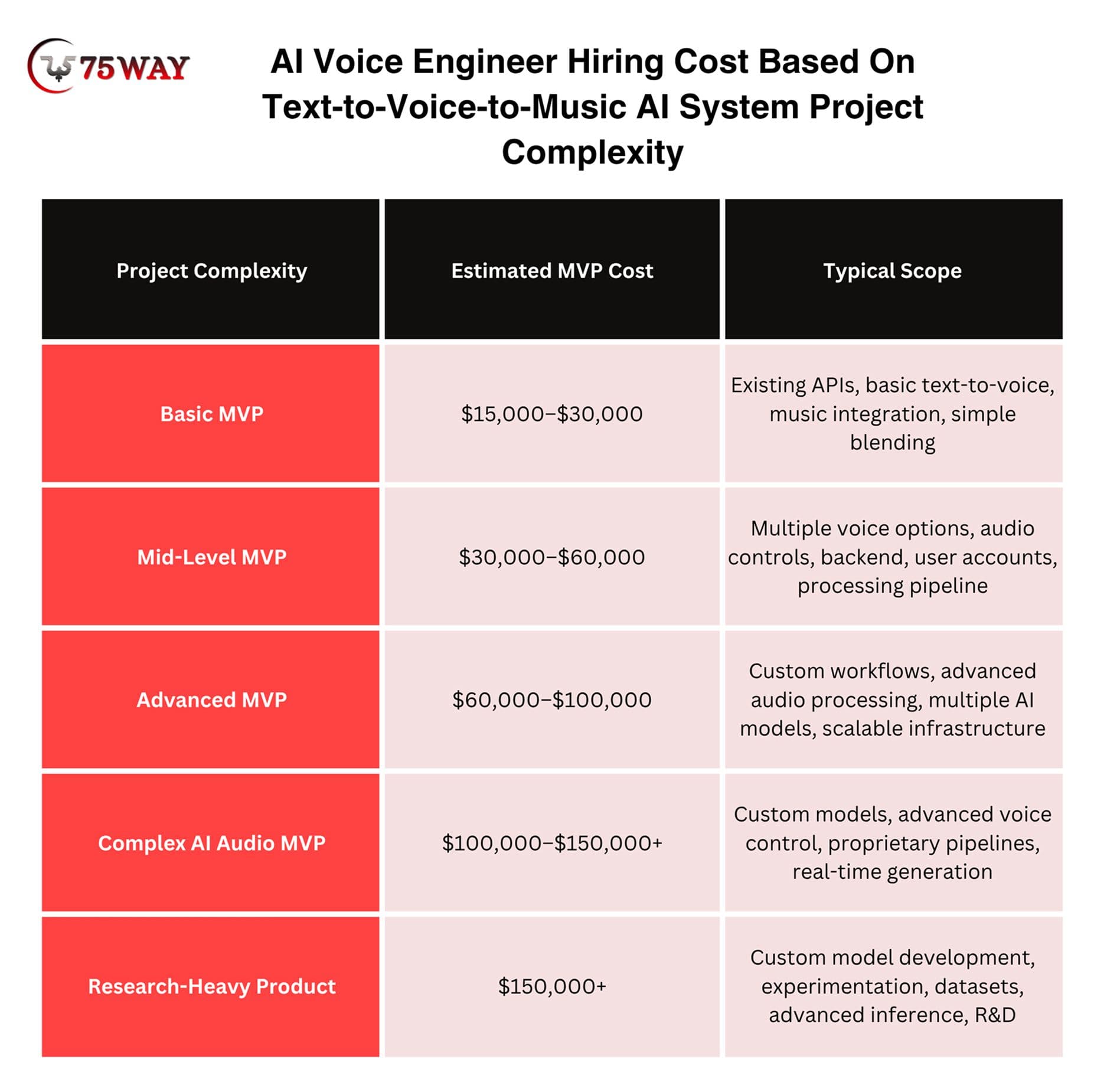
These figures are budgeting ranges rather than guaranteed development prices. Current market references place full AI product MVPs in the tens of thousands, while specialized senior AI engineering can exceed $150/hour and advanced research-oriented work can cost considerably more.
What Makes A Text-To-Voice-To-Music MVP More Expensive?
Several factors can increase the cost of hiring an AI voice engineer.
- Custom Voice Models: Using existing voice APIs is generally simpler than developing or adapting proprietary voice models.
- Custom Music Generation: A product that generates original music rather than simply attaching existing tracks requires a more sophisticated AI pipeline.
- Real-Time Generation: Real-time audio generation introduces additional latency, infrastructure, streaming, and optimization requirements.
- Voice And Music Synchronization: Automatically aligning generated vocals with music can require additional processing and quality-control logic.
- Custom Training: Training or fine-tuning models requires data preparation, experimentation, compute resources, evaluation, and ongoing maintenance.
- High-Volume Generation: If users generate thousands or millions of audio files, infrastructure and inference costs become significant considerations.
- Advanced Audio Controls: Features such as voice style, emotion, pitch, tempo, music intensity, timing, and mixing controls increase product complexity.
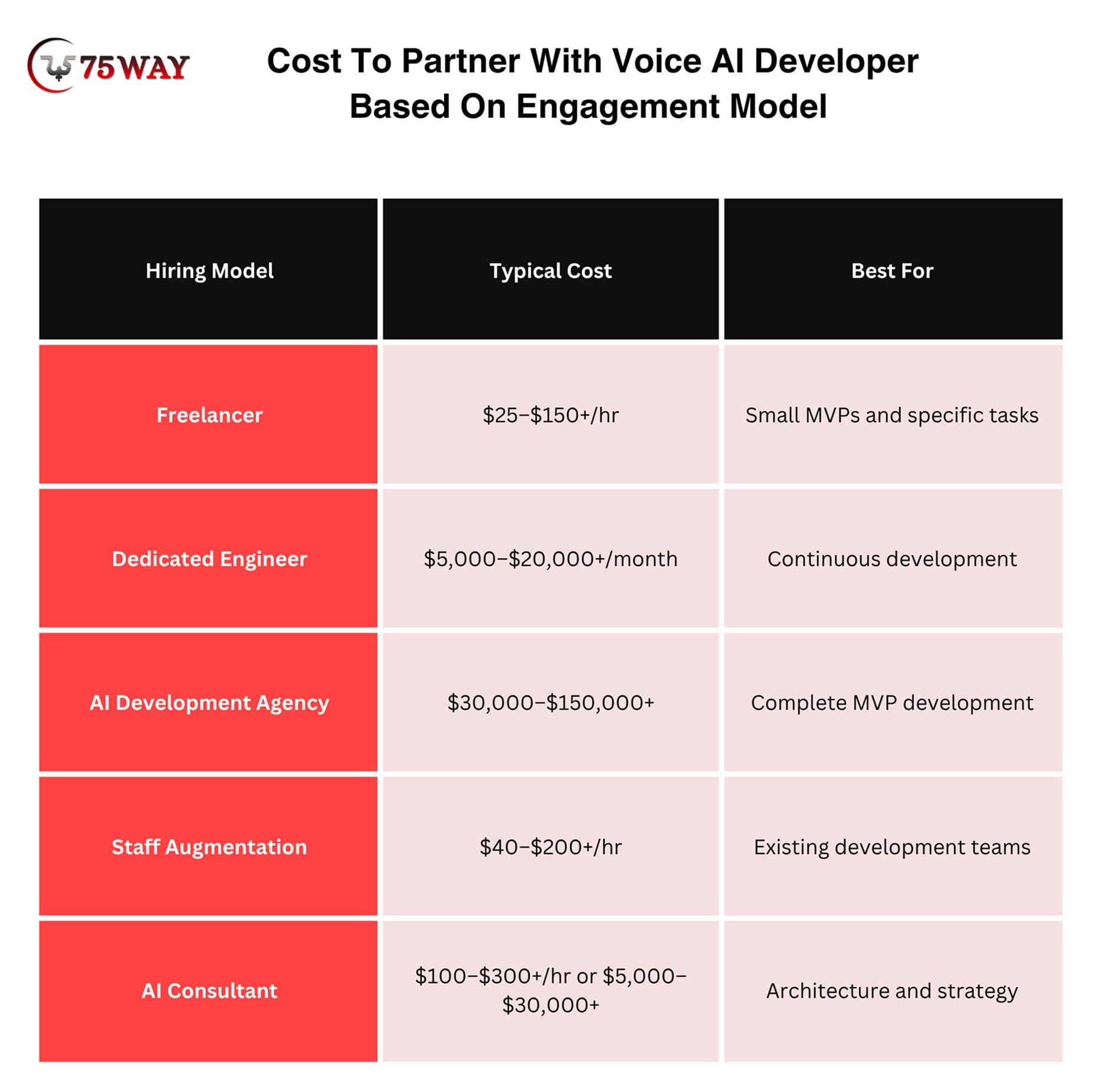
Cost To Partner With Voice AI Developer Based On Engagement Model For Text-to-Voice-to-Music System
The way you hire a voice AI developer can significantly influence your overall MVP budget. A freelancer may work well for a narrowly defined integration, while an agency or dedicated engineer can be more suitable when your text-to-voice-to-music system requires continuous development, architecture, testing, and scaling.
- Freelancer
Hiring a freelancer can cost approximately $25–$150+ per hour, depending on experience, location, and specialization. Freelancers are suitable for smaller MVPs, specific AI integrations, audio-processing tasks, or short-term development requirements. This approach can keep initial costs lower, but you may need to manage coordination, testing, and other product requirements separately.
- Dedicated AI Voice Engineer
A dedicated engineer may cost approximately $5,000–$20,000+ per month, depending on seniority, location, and engagement terms. This model works well when you need someone continuously involved in developing and improving the voice-AI pipeline. It provides greater ownership and technical continuity throughout the MVP lifecycle.
- AI Development Agency
Partnering with an AI development agency can cost approximately $30,000–$150,000+ for an MVP, depending on project complexity. Agencies can provide AI engineers, backend developers, designers, QA professionals, and project managers under one engagement. This makes the model suitable for founders who want an end-to-end development team rather than hiring and coordinating individual specialists.
- Staff Augmentation
Staff augmentation may cost approximately $40–$200+ per hour, depending on the engineer's expertise and location. This model is useful when you already have a development team but need specialized voice-AI expertise for model integration, audio processing, architecture, or generative-AI implementation.
- AI Consultant
An AI consultant may charge approximately $100–$300+ per hour or $5,000–$30,000+ for a defined consulting engagement. This option is generally better for architecture planning, technology evaluation, AI model selection, feasibility studies, and technical strategy rather than complete MVP development.
What Services Does An AI Voice Expert Provide For A Text-To-Voice-To-Music MVP?
An AI voice engineer can handle the technical work required to transform your text-to-voice-to-music concept into a functional MVP. Their services can cover AI model selection, voice generation, music integration, audio processing, backend development, testing, and deployment. The exact scope depends on whether you are using existing AI APIs or building customized voice and music capabilities.
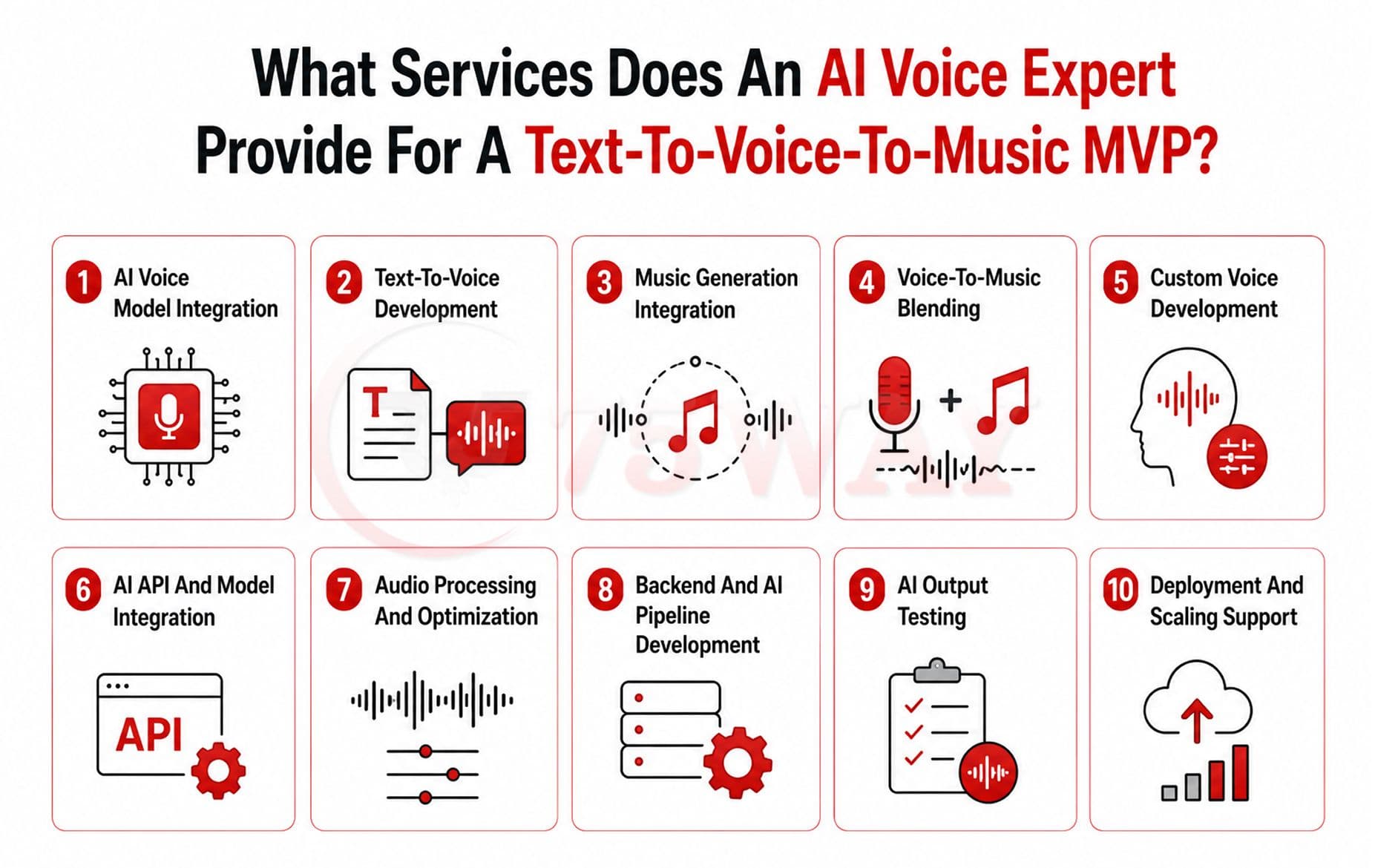
1. AI Voice Model Integration
The engineer integrates suitable text-to-speech or voice-generation models into your MVP. They configure model parameters, connect APIs, and establish workflows for generating voice from user-provided text.
2. Text-To-Voice Development
They build the workflow that converts written input into natural-sounding speech. This can include voice selection, pronunciation controls, speaking styles, language support, and other voice parameters required by your product.
3. Music Generation Integration
The engineer can connect appropriate AI music-generation models or APIs to create background music based on user inputs, prompts, moods, genres, or predefined settings.
4. Voice-To-Music Blending
They develop the audio pipeline that combines generated voice with music. This may involve synchronization, volume balancing, timing adjustments, transitions, normalization, and other processing required for a usable final track.
5. Custom Voice Development
If your product requires unique or branded voices, the engineer can evaluate options for voice customization, voice conversion, model adaptation, or other approaches. They can also determine whether custom development is justified for the MVP.
6. AI API And Model Integration
An engineer can integrate third-party AI services for speech, music, voice processing, storage, or other required capabilities. They can also design the architecture so models or providers can be replaced as your product evolves.
7. Audio Processing And Optimization
The engineer manages technical audio requirements such as file formats, sampling, encoding, mixing, normalization, and processing. Optimization can help improve output quality while controlling generation time and infrastructure usage.
8. Backend And AI Pipeline Development
They build the backend workflows responsible for receiving prompts, sending generation requests, processing audio, storing files, managing generation jobs, and returning completed outputs to users.
9. AI Output Testing
The engineer evaluates generated audio for voice quality, music quality, synchronization, latency, failures, and consistency. Testing helps identify problems before users encounter them in the MVP.
10. Deployment And Scaling Support
Once the MVP is ready, the engineer can deploy the AI pipeline and configure the required cloud infrastructure. They can also prepare the system for increasing users, generation requests, audio storage, and model usage as the product grows.
Text-to-Voice-to-Music MVP Development Process Followed By An AI Voice Engineer
An AI voice engineer follows a structured development process to transform your text-to-voice-to-music concept into a functional MVP. The process focuses on validating the idea, selecting suitable AI technologies, developing the audio pipeline, and testing the final experience before launch. A clear seven-step approach helps control development complexity while keeping the product ready for future improvements.
1. Define MVP Requirements
The engineer first understands your product concept, target users, audio requirements, and expected user journey. They define essential capabilities such as text input, voice selection, music generation, blending, audio controls, output formats, and supported platforms.
2. Select AI Models And Technologies
The engineer evaluates text-to-speech, voice-generation, music-generation, and audio-processing technologies. They compare output quality, latency, customization, pricing, APIs, licensing, and scalability to select options that fit your MVP requirements.
3. Design The AI Audio Architecture
Next, the engineer plans how the application's components will communicate. The architecture can include the frontend, backend, AI models, APIs, audio-processing layer, storage, job queues, and final audio delivery.
4. Develop Voice And Music Pipelines
The engineer builds the core generation workflows for converting text into voice and generating or integrating music. They configure the required model parameters and establish reliable communication between the different AI services.
5. Blend And Process Audio
The generated voice and music are combined into a final audio output. This stage can include synchronization, volume balancing, normalization, timing adjustments, transitions, encoding, and other processing needed for a polished listening experience.
6. Test And Optimize
The engineer tests different prompts, voices, music styles, audio combinations, and generation scenarios. They identify quality issues, API failures, latency problems, and infrastructure costs, then optimize the pipeline for a reliable MVP.
7. Deploy And Monitor
After successful testing, the engineer deploys the MVP and establishes monitoring for generation errors, performance, resource usage, and user activity. Feedback from early users can then guide improvements, additional voice capabilities, and future product development.
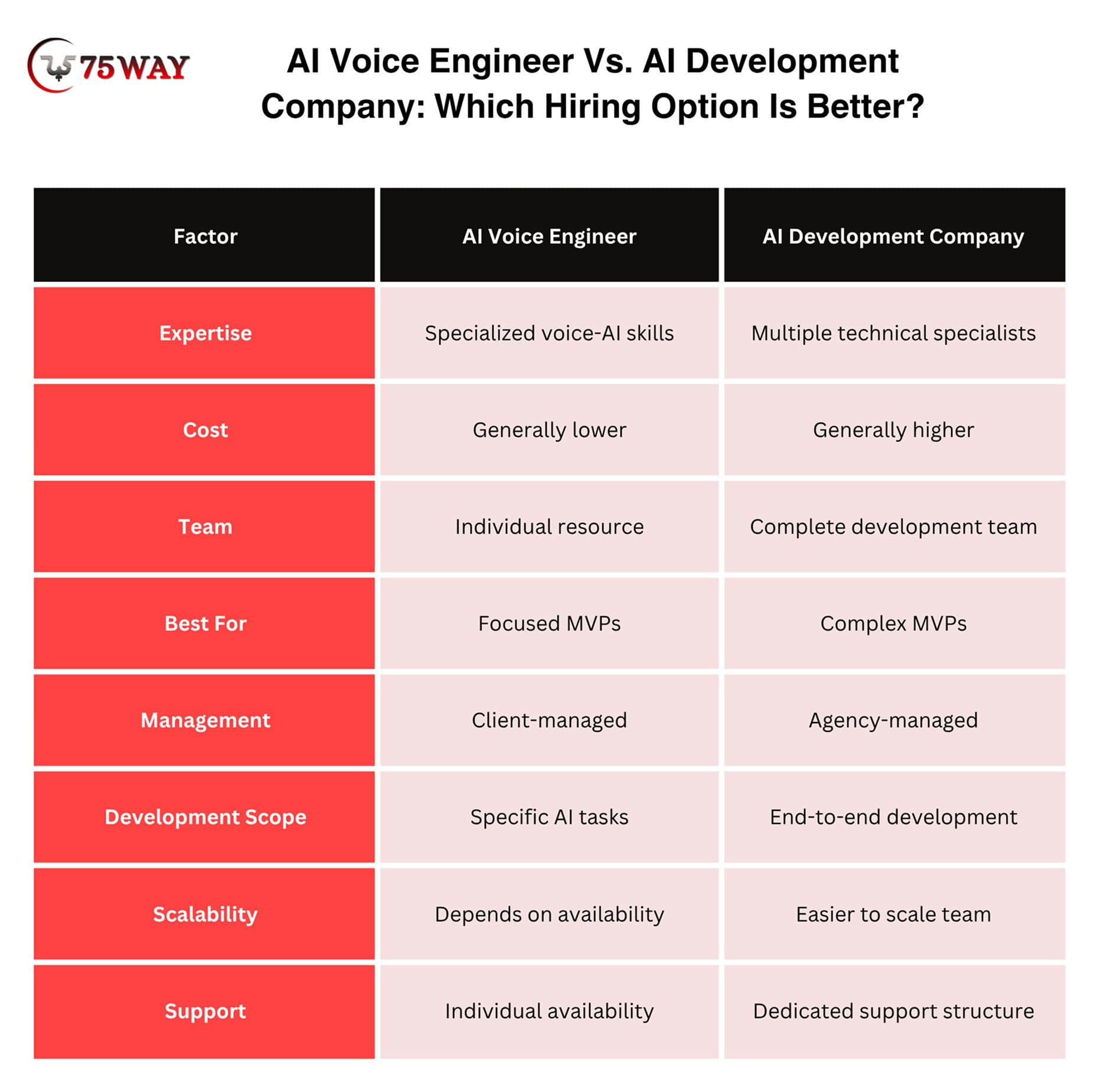
AI Voice Engineer Vs. AI Development Company: Which Hiring Option Is Better?
Choosing between an individual AI voice engineer and an AI development company depends on your text-to-voice-to-music AI System MVP's complexity, budget, timeline, and in-house technical capabilities. An individual specialist can provide focused expertise and direct collaboration, while a development company can bring multiple specialists and manage the complete product lifecycle. The right option is the one that matches the technical demands and growth plans of your text-to-voice-to-music MVP.
When Should You Hire An AI Voice Engineer?
An individual AI voice engineer can be a practical choice when your MVP has a clearly defined scope and primarily requires specialized AI expertise. This approach works particularly well when you already have designers, backend developers, or product managers handling other parts of development.
It can also provide more direct communication with the person responsible for the AI pipeline. You may choose this model when your product mainly requires voice-model integration, audio processing, API development, or AI pipeline optimization rather than complete application development.
When Should You Hire An AI Development Company?
An AI development company can be more suitable when your MVP requires several technical disciplines. Alongside AI voice engineering, you may need UI/UX designers, mobile developers, backend engineers, QA specialists, cloud engineers, and project managers.
This option can reduce the effort required to coordinate multiple independent professionals. It is particularly useful for a text-to-voice-to-music MVP that requires customer-facing applications, backend infrastructure, AI integrations, audio processing, payments, cloud deployment, testing, and ongoing support.
Which Option Should You Choose?
Choose an AI voice engineer when you have an existing technical team and need specialized voice-AI expertise. Choose an AI development company when you need a complete team to take the product from concept and architecture through development, testing, deployment, and future improvements.
For a complex text-to-voice-to-music MVP, an AI development company can provide broader capabilities, while a specialized engineer may be more cost-effective for a focused proof of concept.
What Questions Should You Ask Before Hiring An AI Voice Engineer?
Hiring an AI voice engineer is a technical decision that can directly affect your MVP's quality, development cost, and launch timeline. Instead of evaluating candidates only through resumes and hourly rates, ask questions that reveal their experience with voice AI, audio processing, model selection, architecture, and real-world product development. These questions can help you identify whether a candidate can actually handle the technical demands of your text-to-voice-to-music MVP.
1. Have You Built A Similar Voice AI Project?
Ask whether they have previously developed text-to-speech, voice-generation, voice-conversion, AI music, or audio-processing applications. Request relevant examples and understand exactly what they contributed to each project.
2. Which AI Models Would You Recommend?
Ask which voice and music models or APIs they would use for your MVP and why. A capable engineer should explain the trade-offs involving quality, latency, customization, pricing, scalability, and licensing.
3. Can You Build The Audio Pipeline?
Ask how they would connect text input, voice generation, music generation, audio processing, and final output. Their response should demonstrate a clear understanding of the complete text-to-voice-to-music workflow.
4. How Will You Handle Voice And Music Blending?
Ask how the engineer plans to synchronize vocals and music while maintaining voice clarity. They should be able to discuss volume balancing, timing, normalization, transitions, and other relevant audio-processing techniques.
5. What Should Be Included In The MVP?
Ask the engineer to separate essential capabilities from advanced features. This helps prevent unnecessary development and keeps your initial budget focused on features that validate the product concept.
6. Will We Need Custom AI Models?
Ask whether existing APIs or models can meet your initial requirements. A strong engineer should be willing to recommend existing solutions when they are sufficient rather than pushing custom model development without a clear business reason.
7. How Will You Control AI And Infrastructure Costs?
Ask how the engineer will manage API usage, model inference, cloud resources, audio storage, processing jobs, and generation volume. Cost control becomes increasingly important as users begin generating large amounts of audio.
8. How Will You Test Audio Quality?
Ask what methods they will use to evaluate generated voices, music, synchronization, latency, and output consistency. You should understand how quality issues will be identified before the MVP reaches users.
9. How Will The MVP Scale Later?
Ask whether the proposed architecture can support additional voices, AI models, users, audio-generation requests, and future features. The goal is not to overbuild the MVP, but to avoid an architecture that requires a complete rebuild when usage grows.
Final Remarks
To conclude, the right voice AI specialist can help you select suitable models for a text-to-voice-to-music system, create the voice and music pipeline, blend audio, integrate APIs, control infrastructure costs, and validate your core product before scaling. Before hiring, evaluate candidates based on relevant experience, technical skills, portfolio quality, communication, pricing, and post-launch support.
If your project requires broader expertise, a complete development team can simplify architecture, development, testing, and deployment while reducing coordination challenges. Ready to turn your audio concept into a working MVP? Hire engineers from a reliable AI development company and start building today.
Frequently Asked Questions (FAQs)
What Should I Provide an AI Voice Expert Before Development Starts?
Provide your product concept, target audience, desired audio experience, sample outputs, user workflow, preferred platforms, MVP goals, budget, and expected launch timeline.
Can an AI Voice Developer Work With An Existing Development Team?
Yes. An AI voice engineer can work alongside your developers, designers, product managers, and other specialists to handle the voice-AI and audio components.
What Information Should I Include in an AI Voice Engineer Job Description?
Mention your MVP objective, required voice capabilities, music functionality, AI technologies, expected responsibilities, technical experience, engagement model, timeline, and project budget.
How Do I Verify an AI Voice Engineer’s Technical Claims?
Ask candidates to explain their previous projects, demonstrate relevant work, describe technical decisions, and complete a small practical assessment related to your MVP requirements.
Should an AI Voice Engineer Sign An NDA Before Discussing My Idea?
An NDA can help protect confidential product information when discussing proprietary concepts, technical plans, datasets, or business strategies with potential engineering partners.
Can One AI Voice Engineer Build The Entire MVP?
It depends on the scope. One experienced engineer may handle the AI and backend components, but larger products may require additional expertise in design, frontend development, QA, and cloud infrastructure.
What Ownership Rights Should I Discuss Before Hiring an AI Voice Engineer?
Clarify ownership of source code, custom workflows, prompts, documentation, datasets, generated assets, integrations, and other deliverables before signing the development agreement.