Summary
This guide explores healthcare insurance app development, including market opportunities, application types, essential features, and technology stacks. You'll also discover emerging innovations, development costs, and key success factors shaping the future of healthcare insurance solutions in 2026 and beyond.
Quick Overview
- Strategic app development strengthens customer retention and engagement.
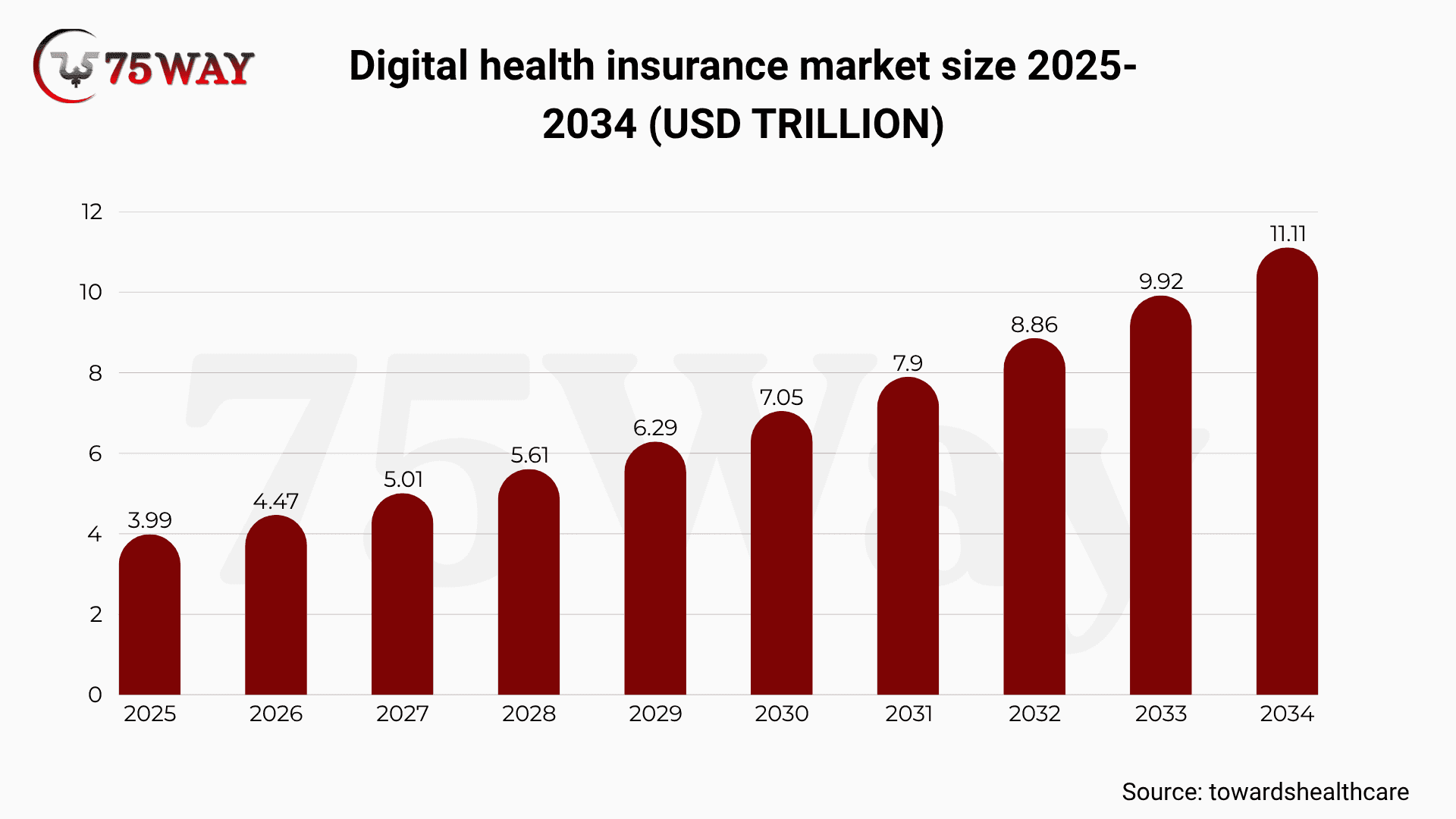
- The digital health insurance market is expected to surpass $11.11 trillion by 2034.
- Healthcare insurance app development cost ranges from $40,000 – $300,000+
- Claims automation significantly reduces processing delays and costs.
- AI enhances fraud detection and personalized policy recommendations.
- Compliance requirements influence architecture and development decisions.
Managing health insurance should not feel more complicated than receiving healthcare itself. Yet many insurers still struggle with manual claims processes. Policyholders are increasingly expecting mobile-first services, and insurance providers are being pushed to modernize how they deliver and manage coverage.
The opportunity is massive. The global health insurance market is projected to surpass $4 trillion by 2030. In the United States, major insurers, such as UnitedHealth Group, Cigna, and Aetna, have invested heavily in building mobile applications that allow members to manage policies and track claims directly from their smartphones.
Thus, healthcare insurance app development has become a strategic priority in 2026. Modern insurance applications do much more than display policy information. They help users purchase plans, submit claims, track approvals, access digital insurance cards, and receive personalized recommendations through a single platform.
So what does it take to build a successful healthcare insurance app in 2026? Which features matter most?
This business guide covers everything you need to know about healthcare insurance app development, including features, architecture, technology stack, development process, compliance requirements, costs, challenges, and future industry trends.
What Is A Healthcare Insurance App?
A healthcare insurance app is a mobile or web application that allows users to manage their insurance plans from a single platform. Instead of handling paperwork, visiting offices, or waiting on customer support calls, users can access important insurance services directly through their devices.
In simple terms, it acts as a digital insurance hub that keeps policy information, claims, coverage details, and healthcare services easily accessible. Users can review benefits, submit claims, track approvals, download insurance cards, and connect with providers whenever needed.
These applications simplify insurance management for individuals, families, employers, and healthcare organizations. By bringing everything together in one place, they make insurance services faster, more convenient, and easier to understand.
Healthcare Insurance App Market Size & Growth Opportunities
Healthcare insurance apps are becoming an essential part of modern insurance services, making policy management and claims processing more accessible. Below, we describe the market trends and business opportunities driving industry growth.
- The digital health insurance market is projected to grow from $3.99 trillion in 2025 to around $11.11 trillion by 2034, expanding at a CAGR of 12.05%.
- North America currently dominates the global digital health insurance market.
- According to Precedence Research, the global insurtech market is expected to surpass $739.69 billion by 2035, growing at a CAGR of 35.27%.
- Around 48% of seniors are comfortable using digital health insurance apps, while 71% of Gen Z consumers expect fully functional mobile insurance experiences.
- Health insurance reminders delivered through in-app messaging achieve response rates nearly 3X higher than traditional emails.
Why Healthcare Insurance Apps Are Becoming Essential?
Healthcare insurance apps provide value for both insurers and policyholders. Modern consumers expect access to information whenever needed. Waiting for business hours, contacting support centers, or navigating complex paperwork no longer aligns with customer expectations. AI-powered healthcare insurance apps address these challenges by providing:
- Real-time policy access
- Faster claims submissions
- Digital document management
- Secure communication channels
- Instant notifications
- Self-service capabilities
For insurance companies, these platforms create opportunities to reduce manual workloads while improving customer experiences.
How Health Insurance Apps Work: From Enrollment to Claims
Health insurance apps make it easier for users to access and manage insurance services from a single platform. Instead of navigating paperwork, emails, and multiple support channels, most tasks can be completed directly within the app. The following steps show how users typically interact with a health insurance application from registration to claims management.
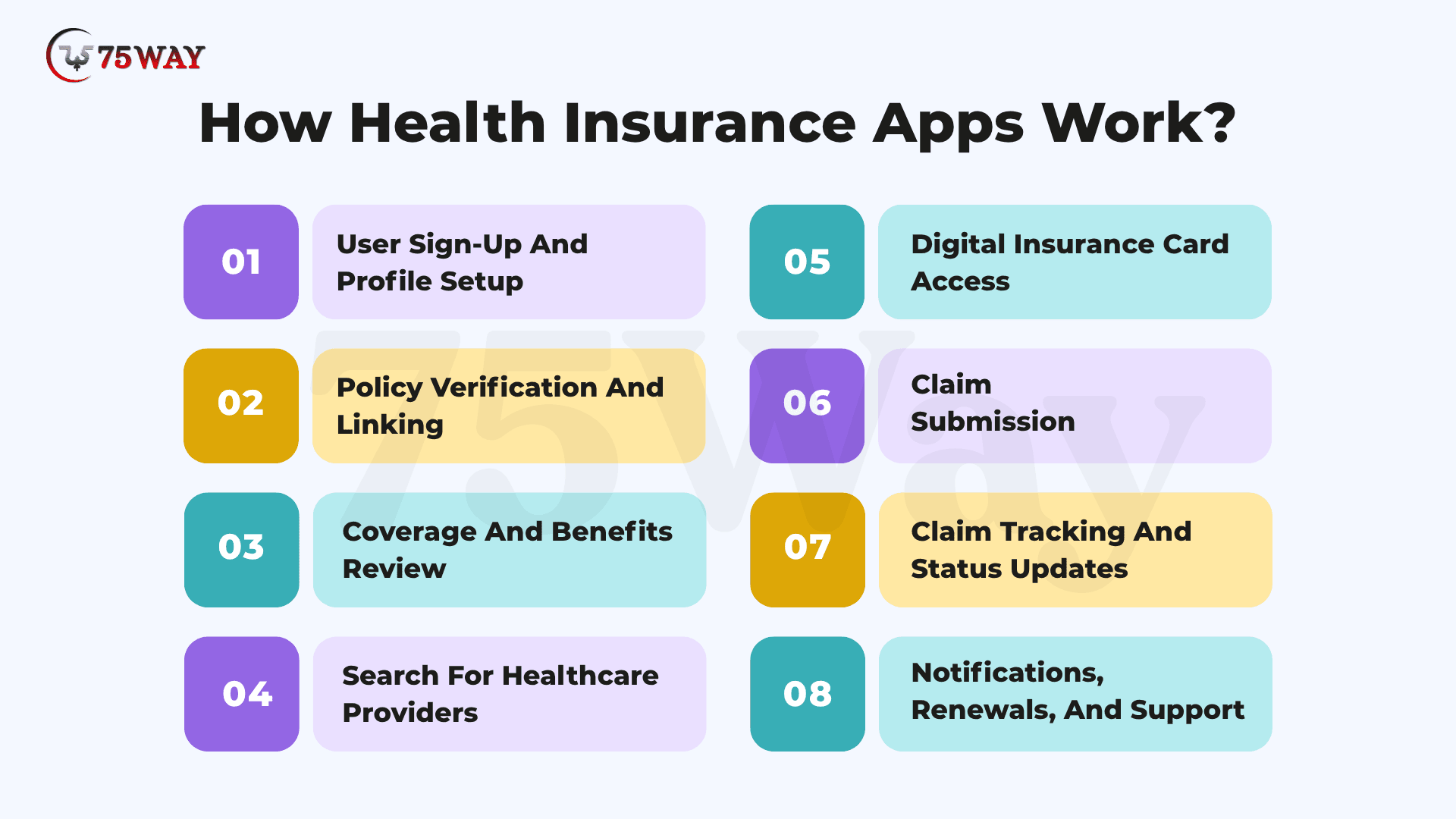
Step 1: User Sign-Up And Profile Setup
The process begins when users create an account within the app. They can register using their email address, phone number, or insurance policy details depending on the platform.
After signing in, users complete their profiles by adding personal information, covered family members, and policy data. This helps the app personalize the experience and display relevant insurance information.
Step 2: Policy Verification And Linking
Once the profile is created, users connect their existing insurance policy to the application. Some apps automatically verify policy details, while others may require policy numbers or supporting information.
After verification, the app syncs coverage details, benefits, and policy records. This gives users instant access to important insurance information whenever needed.
Step 3: Coverage And Benefits Review
Users can view their policy information directly from the dashboard. This typically includes coverage limits, deductibles, premium details, network providers, and benefit summaries.
Having all information in one place makes insurance plans easier to understand. It also helps users make informed healthcare decisions before seeking treatment.
Step 4: Search For Healthcare Providers
Most health insurance apps include a provider directory that helps users find hospitals, clinics, pharmacies, and specialists within their network.
Users can search by location, specialty, or service type to find suitable healthcare providers. This reduces the time spent searching for covered medical services.
Step 5: Digital Insurance Card Access
The app stores a digital version of the user's insurance identification card. This allows policyholders to access proof of coverage directly from their mobile devices.
The digital card can be presented during appointments, hospital visits, or pharmacy transactions. This eliminates the need to carry physical documents.
Step 6: Claim Submission
When medical expenses occur, users can submit claims through the app. Many platforms allow them to upload bills, receipts, prescriptions, and supporting documents directly.
Digital claim submission reduces paperwork and simplifies the reimbursement process. It also makes filing claims faster and more convenient.
Step 7: Claim Tracking And Status Updates
After a claim is submitted, users can monitor its progress through the application. The app provides updates for reviews, approvals, requests for additional information, and final decisions.
This transparency helps users stay informed throughout the claims process. It also reduces the need to contact customer support for updates.
Step 8: Notifications, Renewals, And Support
Health insurance apps continue to assist users after policy setup and claims management. They send reminders about premium payments, policy renewals, claim updates, and important announcements.
Many platforms also provide in-app customer support and self-service resources. This ensures users can quickly resolve issues and manage their insurance plans with confidence.
Top Advantages of Developing a Healthcare Insurance Mobile App
As mobile-first experiences become the norm, insurance providers are using apps to modernize the way policyholders interact with their services. The major advantages of healthcare insurance app development are discussed below.
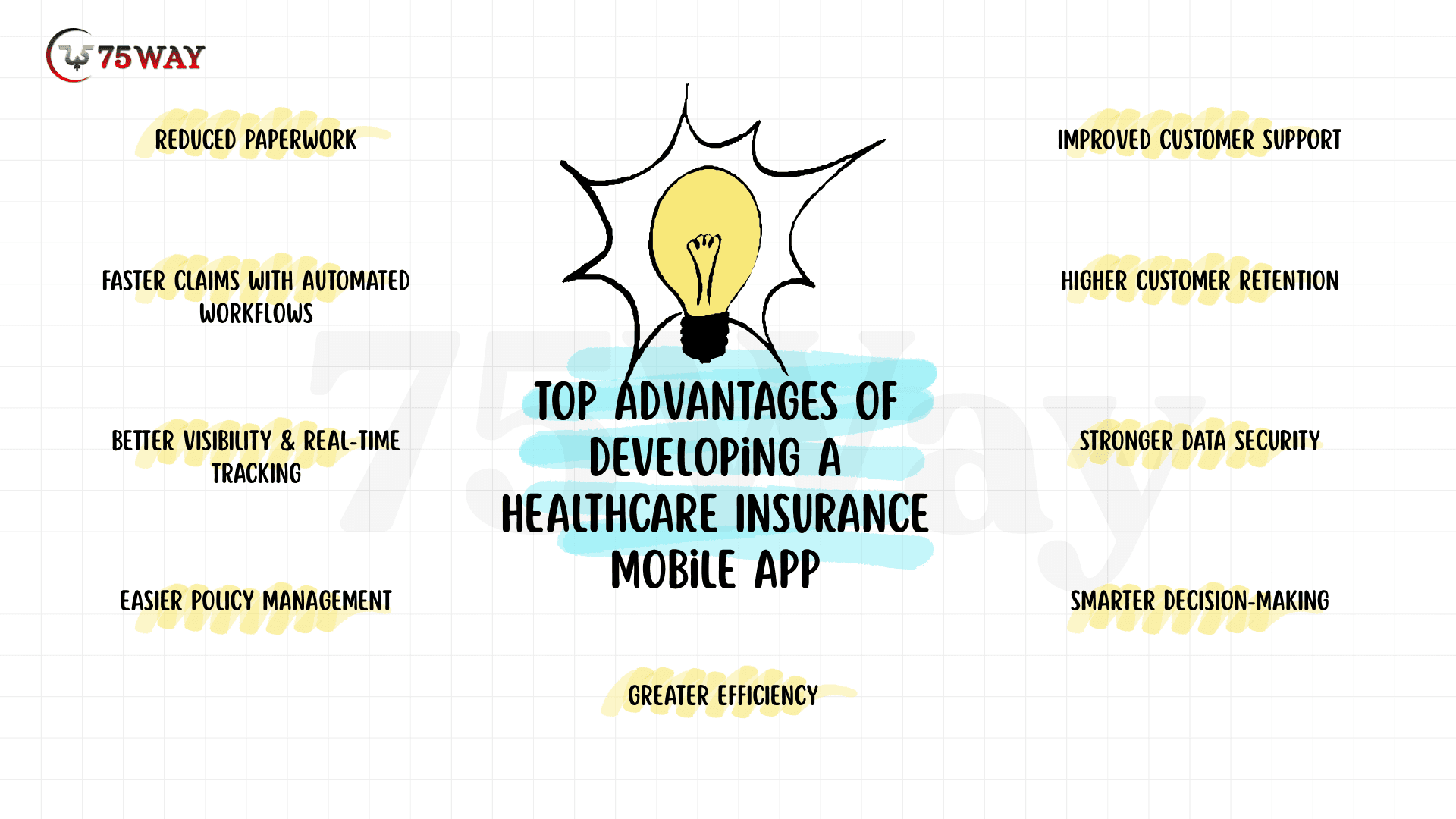
- Reduced Paperwork
Insurance processes often involve forms, receipts, and policy documents that can be difficult to manage manually. Health insurance apps store everything digitally, allowing users to upload, access, and share documents whenever needed. This creates a more organized experience while reducing errors caused by missing paperwork and manual record handling.
- Faster Claims With Automated Workflows
Claim processing can take time when information is reviewed manually across multiple departments. Mobile apps streamline this process by collecting documents digitally and routing claims through automated workflows. As a result, approvals move faster and users receive updates without unnecessary delays.
- Better Visibility & Real-Time Tracking
Many policyholders feel uncertain after submitting a claim because they have limited visibility into the process. Health insurance apps solve this problem by providing real-time claim tracking and status notifications. Users can see progress instantly, creating a more transparent and reassuring experience.
- Easier Policy Management
Managing insurance information becomes much simpler when everything is available within a single application. Users can review coverage details, policy documents, renewal dates, and benefits without switching between different channels. This makes important information easier to find whenever it is needed.
- Improved Customer Support
Getting answers to insurance-related questions can sometimes be frustrating and time-consuming. Mobile apps provide support options such as chat assistance, help centers, and service requests directly within the platform. This allows users to resolve issues more quickly and conveniently.
- Higher Customer Retention
People are more likely to stay with insurance providers that offer convenient and reliable digital services. A well-designed mobile app reduces friction throughout the customer journey and makes policy management easier. Positive experiences often lead to stronger customer loyalty and long-term retention.
- Stronger Data Security
Sensitive insurance information requires secure handling and controlled access. Modern health insurance apps use authentication systems, encryption technologies, and secure storage practices to protect user data. This helps build trust while supporting regulatory compliance requirements.
- Smarter Decision-Making
Every interaction within the app generates valuable information about customer behavior and service usage. Insurance providers can analyze this data to identify trends, improve services, and make more informed business decisions. These insights support continuous improvement across operations.
- Greater Efficiency
Many repetitive insurance tasks can be automated through mobile applications. Activities such as claim updates, document verification, policy notifications, and payment reminders require less manual effort. This allows teams to focus on customer service and strategic initiatives rather than administrative work.
Types of Healthcare Insurance Apps You Can Build
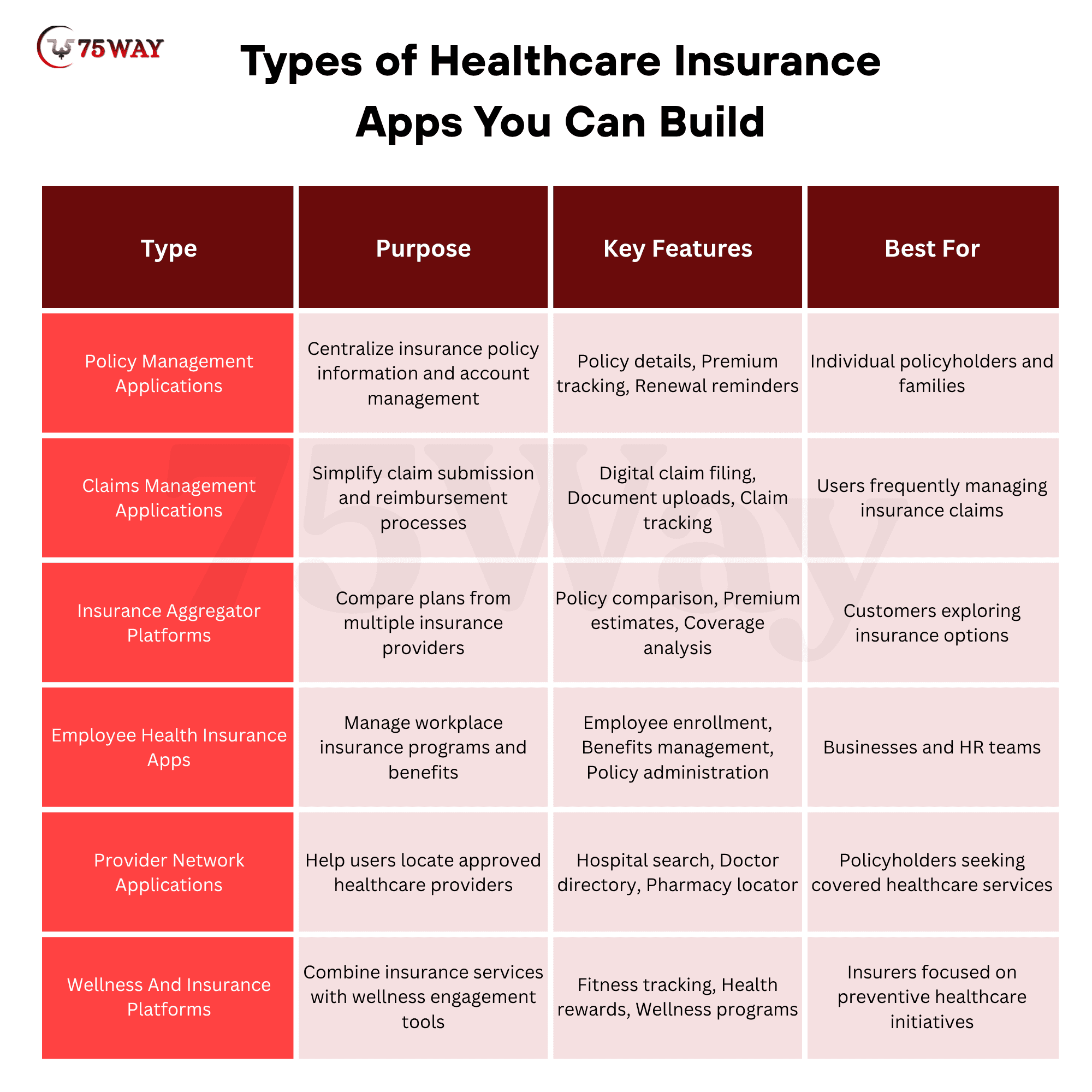
Healthcare insurance apps are built to serve different user needs and business goals. Some focus on policy management, while others simplify claims, provider access, or employee benefits administration. The most common types of healthcare insurance applications are explained below.
1. Policy Management Applications
Policy management apps help users keep all insurance information in one place. They provide access to coverage details, policy documents, premium payments, renewal dates, and benefit summaries through a simple interface.
Instead of searching through emails or paperwork, policyholders can review important information whenever they need it. This makes insurance plans easier to understand and manage.
2. Claims Management Applications
Claims management apps are designed to simplify one of the most important parts of the insurance process. Users can upload documents, submit claims, monitor progress, and receive updates directly through the application.
Digital workflows reduce manual effort and improve transparency throughout the claims journey. As a result, users spend less time waiting for information and support.
3. Insurance Aggregator Platforms
Insurance aggregator apps bring multiple insurance providers together within a single platform. Users can compare plans, coverage options, pricing, and benefits before making a purchase decision.
This approach makes policy selection more convenient and transparent. It also helps customers identify plans that best match their healthcare needs and budget.
4. Employee Health Insurance Apps
Many organizations use dedicated applications to manage employee health insurance programs. These platforms support enrollment, policy administration, benefit tracking, and employee communication.
Employees gain easier access to healthcare benefits while HR teams spend less time handling administrative requests. This creates a smoother experience for everyone involved.
5. Provider Network Applications
Provider network apps help users find approved healthcare facilities covered by their insurance plans. They typically include searchable directories for hospitals, clinics, pharmacies, specialists, and diagnostic centers.
Having this information readily available makes it easier to locate covered healthcare services. It also reduces confusion when seeking treatment or medical consultations.
6. Wellness And Insurance Platforms
Some insurers combine healthcare coverage with wellness-focused features in a single application. These platforms may include fitness tracking, preventive care programs, health assessments, rewards systems, and insurance services.
By encouraging healthier lifestyles, insurers can increase engagement beyond traditional policy management. Users benefit from tools that support both their healthcare coverage and overall well-being.
Healthcare Insurance App Development Process
Building a healthcare insurance application requires a structured development approach that aligns business objectives, regulatory compliance, user expectations, and scalable technology design. Each stage plays a crucial role in ensuring the final product is secure, reliable, and capable of supporting long-term growth in a competitive insurance ecosystem.
Phase 1: Market Research And Business Analysis
This stage focuses on understanding the insurance market landscape before any technical development begins. Teams analyze user needs, industry trends, competitor products, and regulatory frameworks to define a clear product direction. Key activities include:
- Identifying target user segments such as individuals, families, and enterprises
- Studying competitor apps to understand features and gaps
- Evaluating compliance requirements like HIPAA or GDPR standards
- Defining revenue models such as subscriptions or commission-based pricing
Strong research ensures the product is aligned with real market demand and reduces the risk of building irrelevant features.
Phase 2: Requirement Gathering
This phase involves documenting all functional, technical, and compliance requirements in detail. It creates a clear blueprint for developers, designers, and stakeholders to follow throughout the project. These healthcare insurance app creation requirements typically include:
- Functional requirements such as claims processing and policy management
- Technical requirements like APIs, databases, and third-party integrations
- Security requirements including encryption and authentication standards
- Compliance requirements based on healthcare and insurance regulations
Clear documentation reduces ambiguity and helps prevent scope changes during development.
Phase 3: UI/UX Design
Designing a healthcare insurance app is not just about visuals. It’s about making complex insurance processes simple for everyday users. The focus is on clarity, accessibility, and smooth navigation.
User journeys are mapped to understand how people interact with features like claims submission, policy viewing, and provider search. Designers then create wireframes and interactive prototypes to test flow before development begins. Accessibility considerations ensure the app works well for all age groups, including non-technical users.
A strong design directly impacts engagement because users are more likely to trust and use an app that feels simple and intuitive.
Phase 4: Architecture Planning
This stage defines the technical foundation of the application. It ensures the system can handle large volumes of data, users, and transactions without performance issues. Core planning areas include:
- Backend architecture for handling business logic and workflows
- Database design for secure storage of sensitive insurance data
- API strategy for connecting external systems and services
- Security framework to protect user data and transactions
- Cloud infrastructure setup for scalability and reliability
Well-planned architecture supports future expansion and feature upgrades.
Phase 5: Application Development
In this stage, developers build the actual application components based on approved designs and architecture. Both frontend and backend systems are developed in parallel.
- Frontend Development: Creates responsive mobile and web interfaces delivering smooth user experiences across devices with intuitive navigation and consistent visual design.
- Backend Development: Handles application logic, data processing, and system operations for secure and efficient performance across all platform functionalities.
- API Integration: Connects third-party services like payments, verification, and insurers for seamless data exchange and real-time operational functionality across systems.
- Admin Dashboards: Provide insurers centralized control panels for managing users, claims, policies, analytics, and overall business operations.
- Integration Layers: Ensure smooth communication between multiple systems, databases, and services for unified workflows and consistent data synchronization across platforms.
Agile development practices are commonly used for faster iteration and feedback.
Phase 6: Security Implementation
In healthcare insurance apps, security is not optional. It is a core requirement. Since the platform deals with sensitive personal and financial data, multiple layers of protection are implemented.
Encryption is used to secure data both in storage and during transmission. Authentication systems such as OTPs and multi-factor login protect user accounts. Role-based access ensures that only authorized users can access specific data. Monitoring tools continuously track system activity for suspicious behavior. This layered approach builds trust and ensures compliance with industry regulations.
Phase 7: Quality Assurance Testing
After development and integration stages are completed, quality assurance testing ensures the application performs correctly across all devices, user scenarios, and system loads. It validates both functionality and overall system stability before deployment to production environments. Diverse testing types are:
- Functional testing for verifying feature behavior
- Performance testing for handling high traffic loads
- Security testing for identifying vulnerabilities
- Compatibility testing across devices and platforms
- User acceptance testing for real-world feedback validation
Thorough testing reduces production issues and improves user satisfaction.
Phase 8: Deployment And Launch
After successful testing, the application is deployed to production environments and made available to users. This phase ensures a controlled transition from development to live usage, where infrastructure, servers, and application components are configured for real-world performance, scalability, and reliability. Cloud environments are set up to host the system, and load balancing is implemented to manage traffic efficiently across multiple servers.
The launch process also includes app store submissions for iOS and Android platforms, along with final validation checks to confirm system readiness. Monitoring tools are activated to track performance, detect issues, and maintain stability after release. A well-planned deployment ensures minimal downtime, smooth user onboarding, and consistent application performance across all devices and user scenarios.
Phase 9: Ongoing Maintenance
Post-launch maintenance ensures the application remains secure, updated, and competitive in the evolving market. Continuous improvements are essential for long-term success. The ongoing stage includes:
- Bug fixing and performance optimization
- Security patches and compliance updates
- Feature enhancements based on user feedback
- System scaling to handle increasing users
- Regular monitoring and uptime improvements
Ongoing updates help the platform evolve with changing business and user needs.
Must-Have Features of A Healthcare Insurance App
The success of a healthcare insurance app depends on how well it meets the needs of both policyholders and insurance providers. A well-designed platform should simplify insurance management, improve accessibility, and support smooth user experiences across every interaction. The essential features that form the foundation of a modern healthcare insurance application are outlined below.
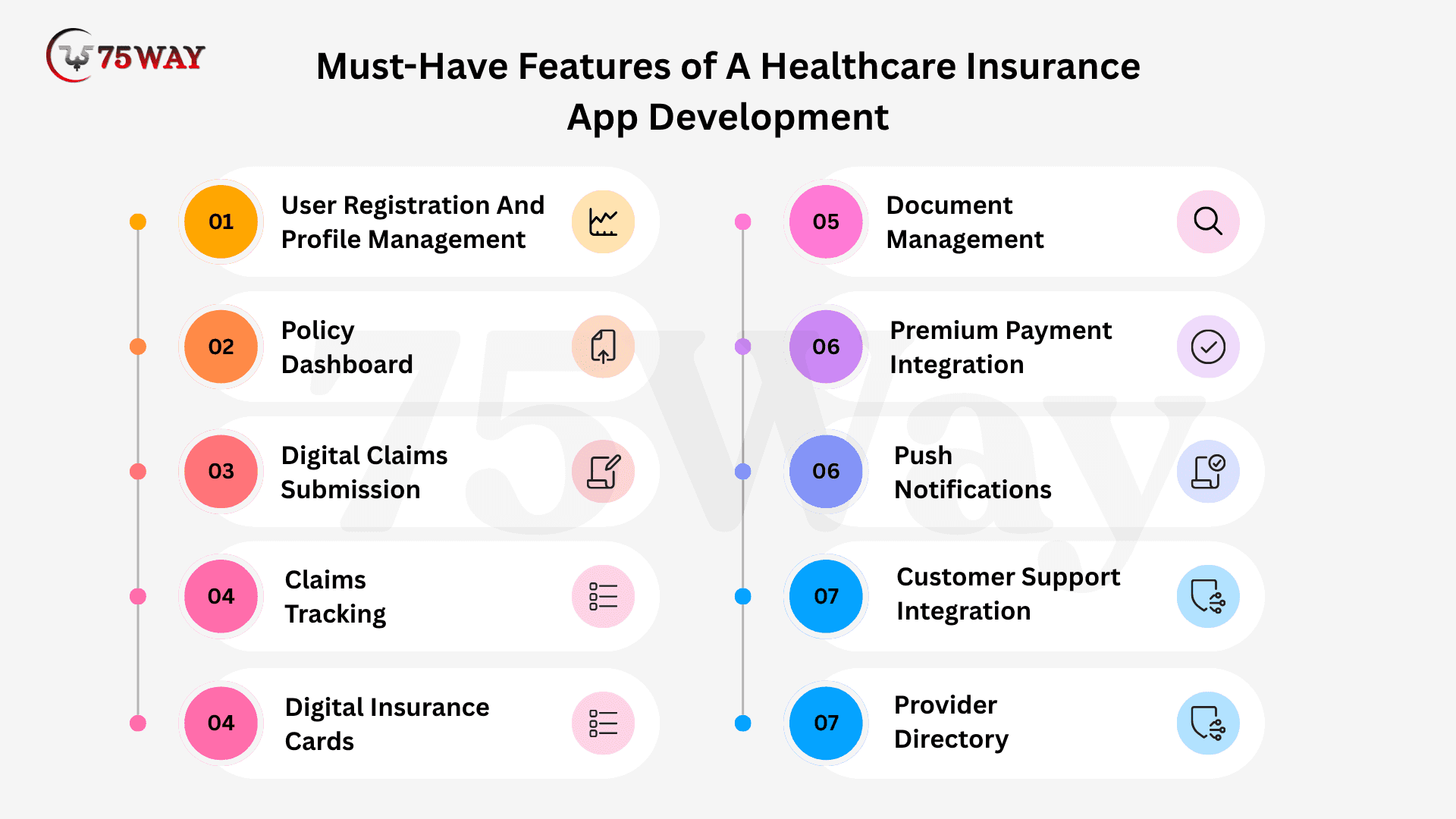
1. User Registration And Profile Management
A secure onboarding process forms the foundation of any healthcare insurance platform. It includes:
- User registration
- Identity verification
- Profile management
- Multi-factor authentication
- Password recovery
2. Policy Dashboard
Users should be able to access complete policy information through an intuitive dashboard. The dashboard typically displays:
- Policy status
- Coverage details
- Premium schedules
- Renewal information
- Beneficiary information
3. Digital Claims Submission
Claims submission is among the most important features. It simplifies the insurance process by allowing users to file claims directly through mobile or web platforms without physical paperwork. Users should be able to:
- Upload medical bills
- Submit supporting documents
- Provide claim information
- Track submission progress
4. Claims Tracking
Real-time status tracking improves transparency and reduces customer inquiries. It helps users stay informed at every stage of the claim lifecycle, reducing uncertainty and improving overall trust in the system. Common claim statuses include:
- Submitted
- Under Review
- Additional Information Required
- Approved
- Rejected
- Payment Processed
5. Digital Insurance Cards
Digital insurance cards give users instant access to their insurance identification details directly from the app. Instead of carrying physical cards, policyholders can view, download, or present virtual insurance cards whenever healthcare services are required.
These cards typically include member information, policy numbers, coverage details, and insurer contact information. Easy access to digital credentials helps streamline hospital visits, pharmacy transactions, and medical appointments while reducing the risk of lost or misplaced documents.
6. Document Management
A secure repository allows users to access and manage important insurance-related documents from a centralized location. This improves accessibility, reduces paperwork dependency, and helps users retrieve critical records whenever required. Users can securely store, organize, download, and review documents throughout the entire insurance lifecycle from a single dashboard.
- Policy documents
- Claim records
- Medical reports
- Payment receipts
- Renewal notices
7. Premium Payment Integration
Integrated payment gateways make it easier for users to pay insurance premiums directly through the app without visiting external platforms. This creates a smooth and secure payment experience while ensuring timely transactions. Supported payment methods may include:
- Credit cards
- Debit cards
- Digital wallets
- Net banking
- UPI payments
8. Push Notifications
Push notifications play a crucial role in keeping users engaged and informed throughout their insurance journey. They ensure timely updates, reduce missed actions, and improve communication between users and the platform. Notifications keep users informed about:
- Claim updates
- Premium reminders
- Policy renewals
- Document requests
- Coverage changes
9. Customer Support Integration
Users expect quick and reliable help when dealing with policy issues, claims, or coverage-related questions. Integrated support systems make it easier for insurers to improve user satisfaction and reduce resolution time. Support options may include:
- Live chat
- AI chatbots
- Call scheduling
- Ticket management
- Knowledge bases
10. Provider Directory
A searchable provider directory helps users locate approved hospitals, specialists, pharmacies, diagnostic centers, and healthcare facilities covered under their insurance plans. Users can search by location, specialty, treatment type, ratings, or availability to find the most suitable healthcare provider.
Many modern apps also include maps, contact information, directions, appointment details, and provider profiles within the directory. This makes it easier for policyholders to access covered medical services while reducing confusion about network eligibility and out-of-pocket expenses.
Advanced AI-Powered Features For Healthcare Insurance Apps
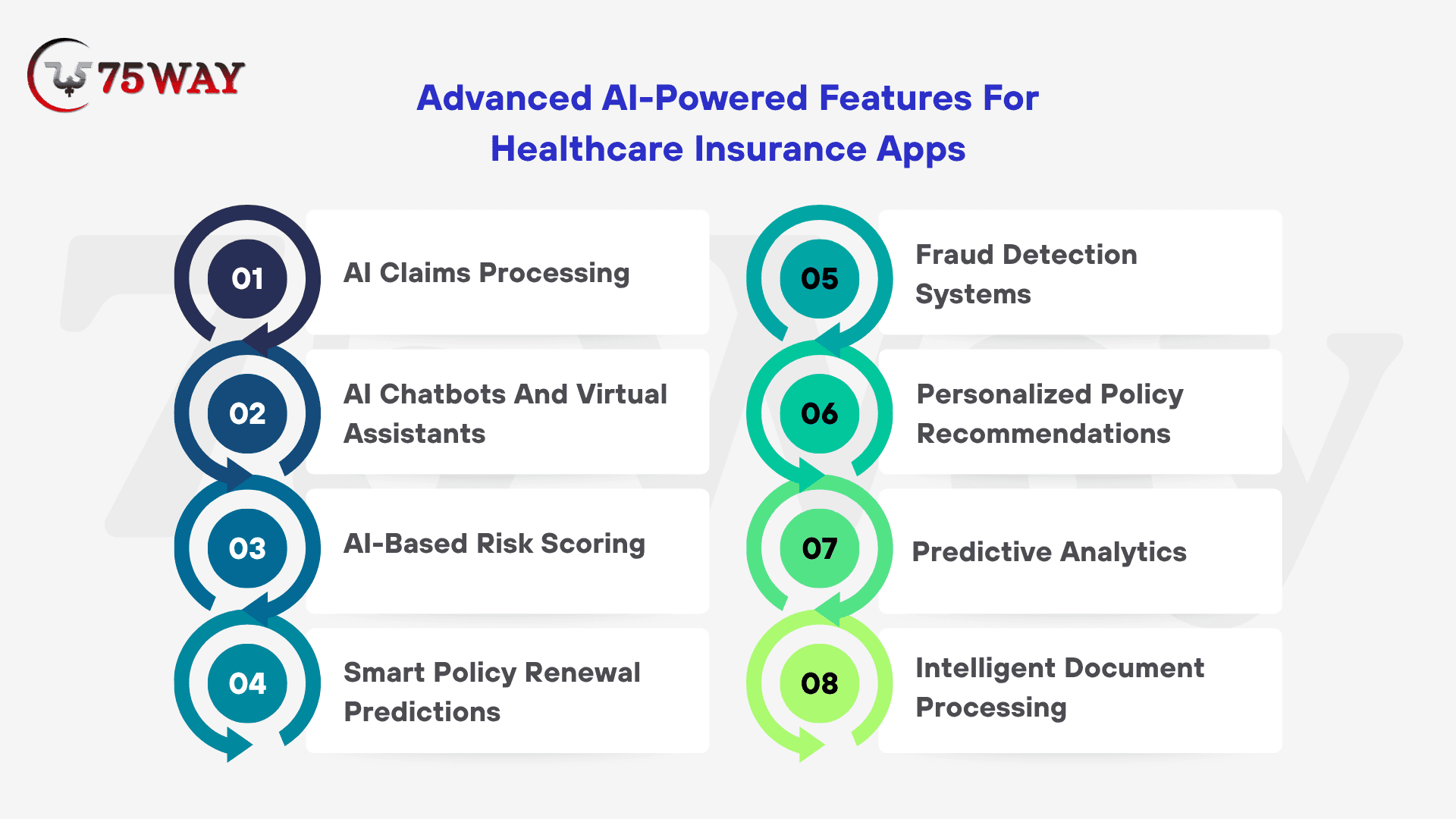
Artificial intelligence is reshaping how healthcare insurance apps operate by making processes faster, more accurate, and more user-focused. Instead of relying heavily on manual work, insurers now use AI to automate claims, detect fraud, and deliver personalized services at scale. The key AI-powered capabilities transforming modern healthcare insurance platforms are explained below.
1. AI Claims Processing
AI-driven claims processing reduces the need for manual verification by automatically reviewing documents and extracting key information. It helps identify missing details, validate submissions, and speed up approval workflows. This results in quicker settlements and smoother user experiences.
- Automated document analysis for faster claim review
- Intelligent data extraction from medical bills and reports
- Real-time validation of submitted claim information
- Workflow automation for faster approvals
2. AI Chatbots And Virtual Assistants
AI chatbots handle customer queries related to policies, claims, payments, and provider searches. These AI assistants provide instant responses without requiring human agents for every request. This improves service availability and reduces operational pressure on support teams.
- 24/7 automated customer assistance
- Instant responses to common insurance queries
- Multi-language support for wider accessibility
- Seamless escalation to human agents when required
3. AI-Based Risk Scoring
AI systems evaluate each policyholder’s risk level by analyzing medical history, claim patterns, lifestyle data, and behavioral trends. This helps insurers make more accurate underwriting decisions and manage risk exposure.
- Real-time risk assessment using customer data
- Behavioral and medical history analysis
- Dynamic underwriting support for insurers
- Continuous risk model updates for accuracy
4. Smart Policy Renewal Predictions
AI can predict when users are likely to renew, modify, or cancel their insurance policies based on engagement patterns and past behavior. This helps insurers take proactive actions to improve retention rates.
- Renewal probability prediction models
- Early churn detection signals
- Personalized renewal reminders and offers
- Customer retention optimization insights
5. Fraud Detection Systems
AI-based fraud detection systems analyze large volumes of claims data to identify unusual patterns and suspicious activities. They help insurers reduce financial losses by detecting fraud early in the process. This strengthens trust and improves system reliability.
- Pattern recognition for fraudulent claims detection
- Behavioral analysis of users and providers
- Real-time anomaly detection in transactions
- Risk scoring for claim verification
6. Personalized Policy Recommendations
AI models study user profiles, medical history, and behavior to recommend suitable insurance plans. This ensures users receive more relevant coverage options based on their actual needs. It also improves conversion rates for insurers.
- Customer behavior-based policy suggestions
- Health data-driven plan matching
- Dynamic recommendation engines
- Personalized coverage optimization
7. Predictive Analytics
Predictive analytics helps insurers forecast risks, customer behavior, and claim trends using historical and real-time data. It supports better decision-making across pricing, underwriting, and customer retention strategies. This leads to more stable and data-driven operations.
- Risk prediction models for policyholders
- Customer churn analysis and prevention
- Claims volume forecasting
- Cost and resource optimization insights
8. Intelligent Document Processing
AI automates the extraction and organization of information from healthcare documents such as bills, prescriptions, and reports. It reduces manual data entry errors and speeds up backend processing. This improves overall operational efficiency.
- Automated data extraction from medical documents
- OCR-based text recognition for paperwork digitization
- Structured data conversion for claims processing
- Error detection and correction mechanisms
Technology Stack For Healthcare Insurance Mobile Application Development
Technology selection plays a critical role in determining how scalable, secure, and efficient a healthcare insurance application will be. The right tech stack ensures smooth performance, easier maintenance, and the ability to handle growing user demands over time. Below is a breakdown of commonly used technologies across different layers of development.
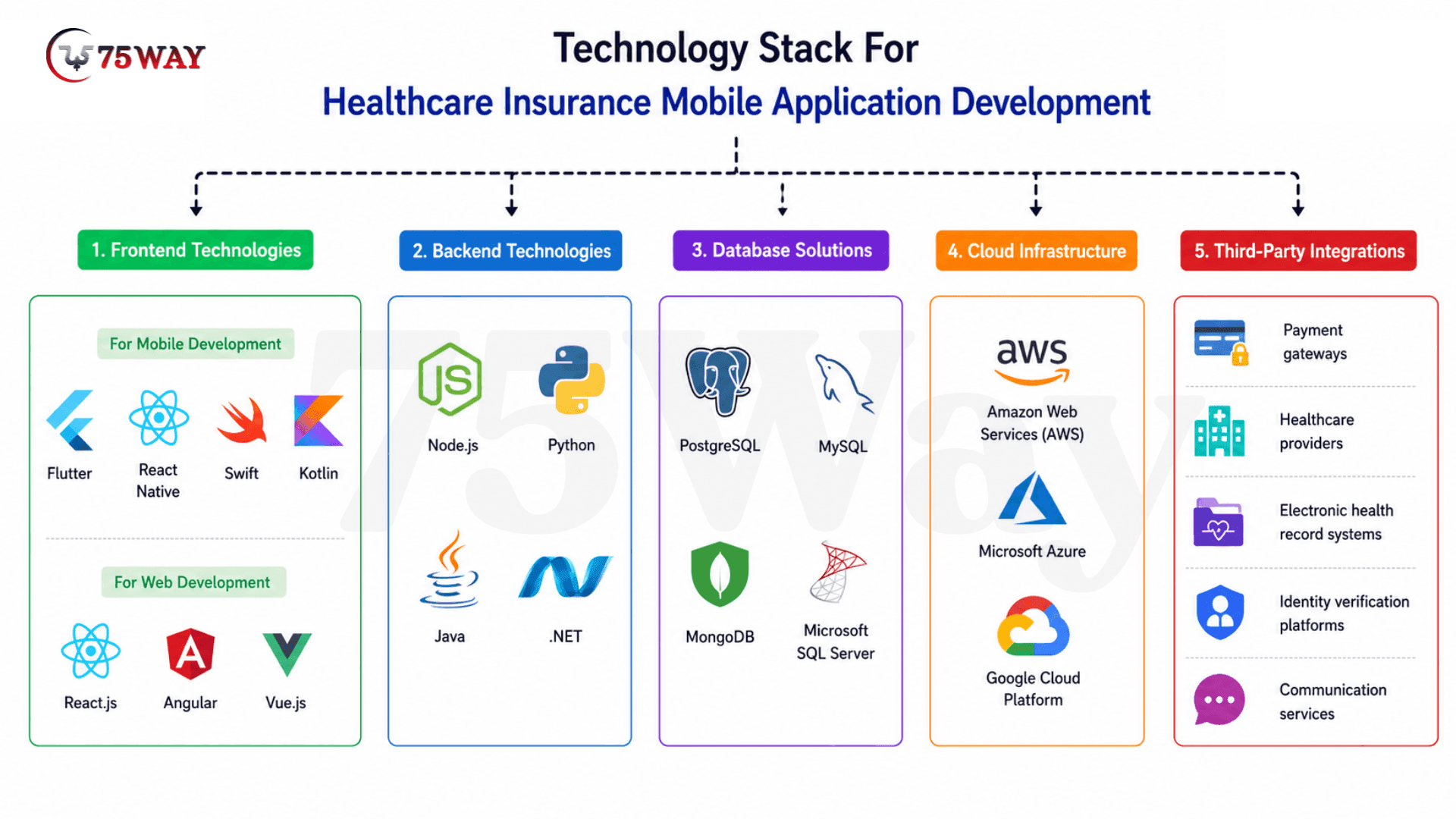
- Frontend Technologies: Frontend development focuses on building the user interface that policyholders interact with on mobile and web platforms. A well-designed frontend improves usability and ensures smooth navigation across features like claims, policies, and provider search. For mobile applications, frameworks such as Flutter and React Native are widely used for cross-platform development, while Swift and Kotlin are preferred for native iOS and Android apps. On the web side, React.js, Angular, and Vue.js are commonly adopted for building responsive and dynamic interfaces.
- Backend Technologies: Backend systems handle core business logic, data processing, authentication, and integrations. They ensure that all frontend requests are processed. Popular backend technologies include Node.js, Python, Java, and .NET. These frameworks are chosen based on scalability needs, system complexity, and integration requirements with external services.
- Database Solutions: Databases are used to securely store sensitive insurance and healthcare data, including policies, claims, user profiles, and transaction records. Performance, security, and scalability are key factors when selecting a database system. Commonly used solutions include PostgreSQL and MySQL for structured data, MongoDB for flexible document-based storage, and Microsoft SQL Server for enterprise-grade applications.
- Cloud Infrastructure: Cloud platforms provide the foundation for hosting, scaling, and managing healthcare insurance applications. They ensure high availability, disaster recovery, and flexible resource allocation. Widely used providers include Amazon Web Services (AWS), Microsoft Azure, and Google Cloud Platform. These platforms help maintain system reliability even during high traffic and large-scale operations.
- Third-Party Integrations: Healthcare insurance apps rely on external services to extend functionality and improve user experience. These integrations reduce development complexity while adding essential features. Common integrations include payment gateways for premium transactions, healthcare provider systems, electronic health record platforms, identity verification services, and communication tools like SMS and email APIs.
Compliance And Security Requirements To Build Medical Insurance App
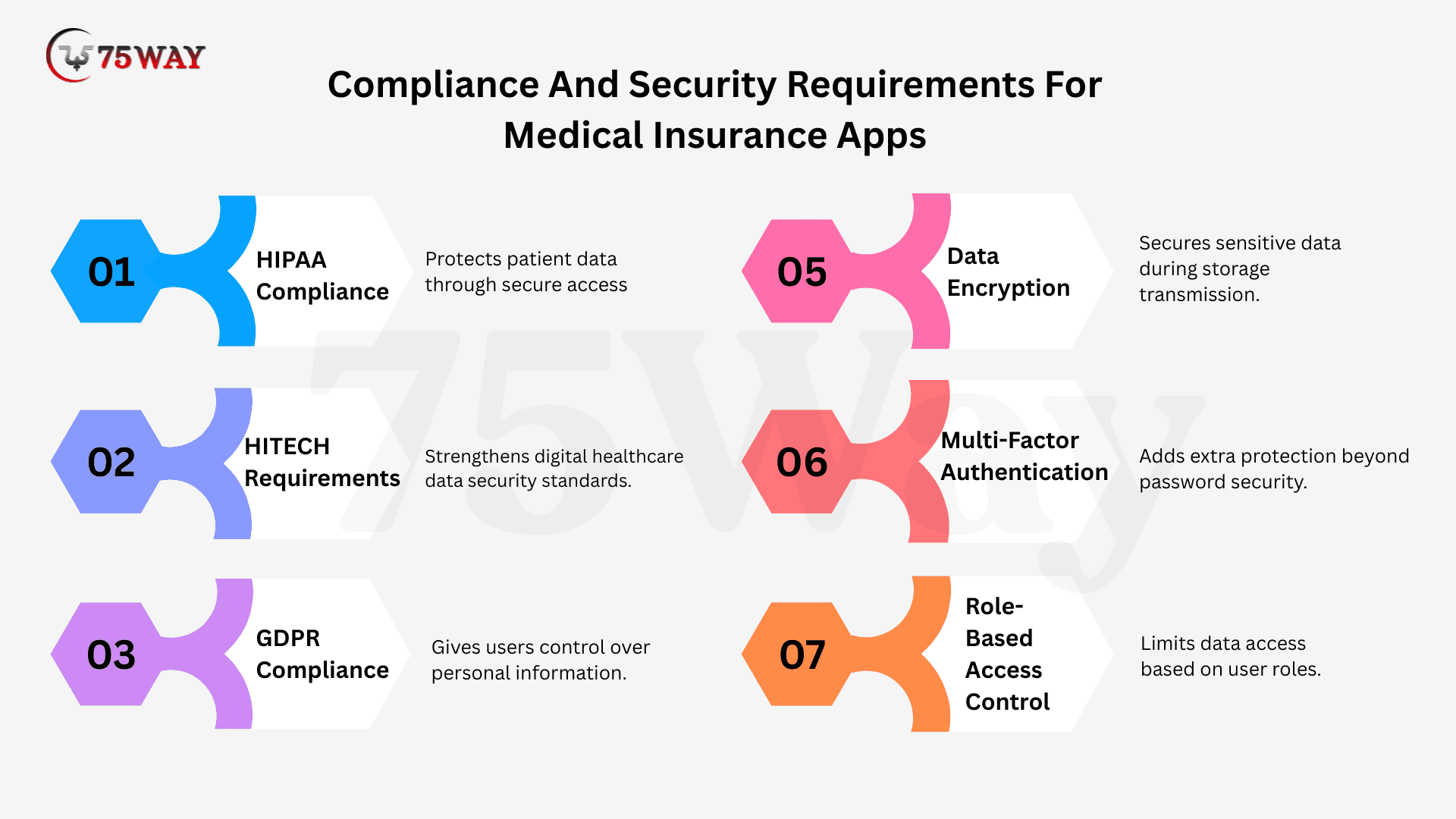
Healthcare insurance applications handle sensitive personal, financial, and medical data, making compliance and security one of the most critical parts of development. A strong regulatory and security framework not only ensures legal adherence but also builds user trust and protects the platform from data breaches and misuse.
- HIPAA Compliance
HIPAA compliance is essential for healthcare insurance applications operating in the United States. It sets strict guidelines for how patient data is stored, accessed, and transmitted across systems.
It primarily focuses on protecting personal health information through secure access controls, encrypted communication, and detailed audit logs. Non-compliance can lead to heavy financial penalties and long-term reputational damage for insurance providers.
- HITECH Requirements
HITECH builds on HIPAA by strengthening data security standards and promoting the adoption of digital healthcare systems. It is designed to improve accountability in handling electronic health records.
It requires organizations to implement breach notification systems, advanced security controls, and stronger protection for electronic health information. The regulation encourages healthcare providers and insurers to adopt more secure and transparent digital systems.
- GDPR Compliance
For applications serving users in the European region, GDPR compliance is mandatory. It focuses on giving users full control over their personal data and how it is used.
It includes requirements such as clear consent collection, the ability to delete personal data, and transparency in data usage policies. Users must also be informed about how their information is stored and processed. This regulation improves trust while ensuring ethical handling of personal data.
- Data Encryption
Data encryption is a core security layer that protects sensitive information from unauthorized access. It ensures that even if data is intercepted, it cannot be read without proper authorization.
Modern healthcare insurance apps commonly use AES-256 encryption for stored data and SSL/TLS protocols for secure communication between systems and users.
- Multi-Factor Authentication
Multi-factor authentication adds an extra layer of security beyond just passwords. It ensures that only verified users can access accounts, even if login credentials are compromised.
Common methods include OTP verification, authentication apps, and biometric authentication such as fingerprint or facial recognition.
- Role-Based Access Control
Role-based access control ensures that users only access information relevant to their role within the system. This prevents unnecessary exposure of sensitive data.
For example, policyholders, healthcare providers, and administrators each have different levels of access based on their responsibilities. This structure significantly reduces security risks and improves system governance.
What’s the Healthcare Insurance App Development Cost?
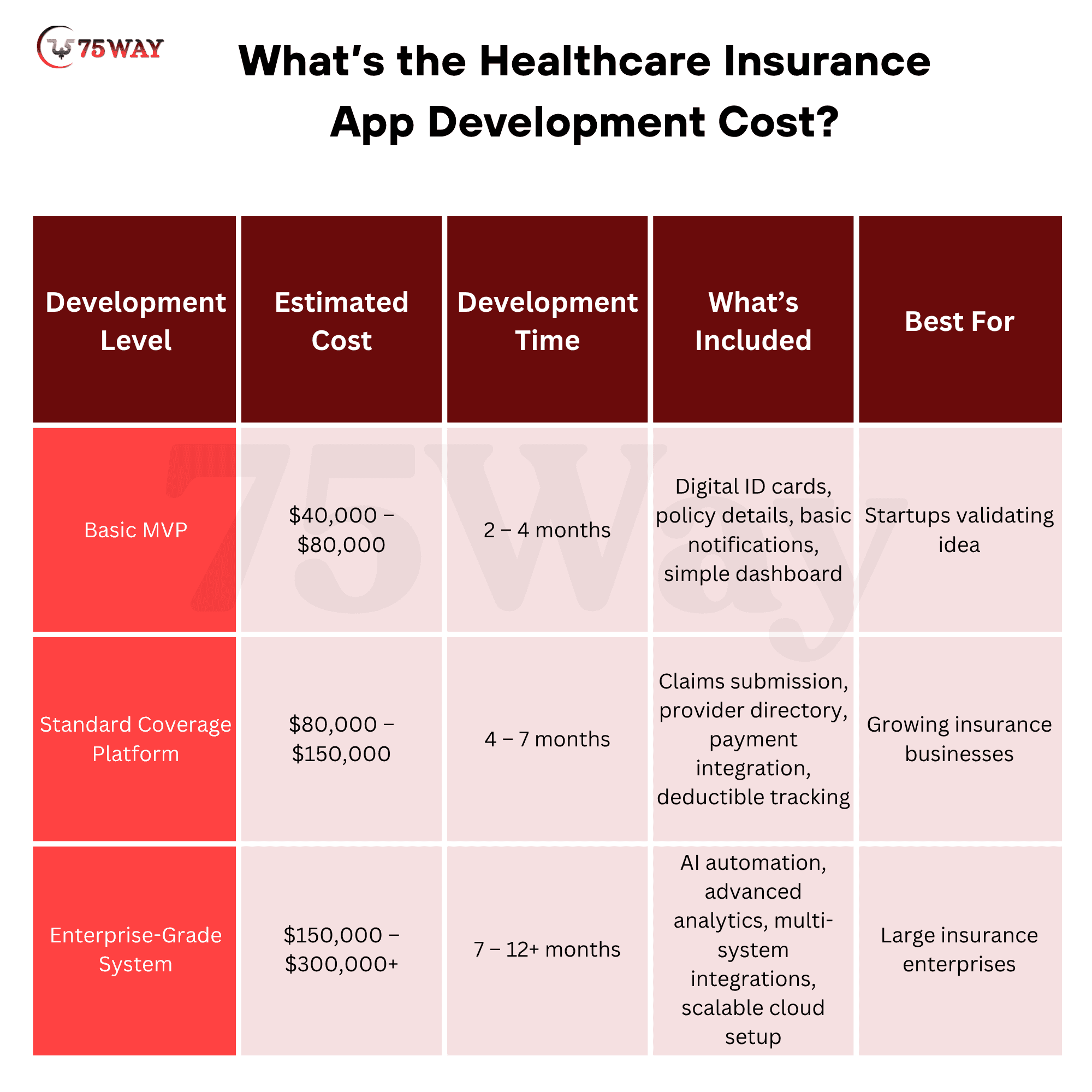
Healthcare insurance app development cost typically ranges from $40,000 – $300,000+, depending on features, complexity, integrations, and scalability requirements. The final budget is influenced by design quality, technology stack, compliance needs, and advanced capabilities such as AI, analytics, and automation.
- Basic MVP Healthcare Insurance App Cost: $40,000 – $80,000
This version focuses on essential insurance functionalities required to validate the product idea in the market. It includes digital ID cards, basic policy management, and simple notification systems for user engagement. At this stage, the goal is to launch quickly with core features that support user onboarding and basic policy access without advanced automation or integrations.
- StandardHealthcare Insurance App Cost: $80,000 – $150,000
This development level introduces more advanced insurance functionalities that improve usability and operational efficiency. It includes in-app claims submission, provider directory access, deductible tracking, and secure payment integrations. This version is suitable for growing insurance businesses that want to improve customer experience and streamline core insurance processes through digital workflows.
- Enterprise-Grade Healthcare Insurance App Cost: $150,000 – $300,000+
Enterprise-level applications are built for large insurance providers that require high scalability, advanced security, and complex system integrations. This includes AI-driven features, real-time analytics, automation workflows, and multi-platform support. These systems are designed to handle large user bases, high transaction volumes, and strict compliance requirements while maintaining performance and reliability.
Other Cost Drivers of Healthcare Insurance App
1. Regulatory Compliance Costs: Healthcare applications that handle protected health information (PHI) must follow strict compliance standards such as HIPAA in the United States. Meeting these regulations requires secure system design, legal agreements like BAA (Business Associate Agreements), and regular penetration testing to identify vulnerabilities. These compliance measures typically add an additional $15,000 – $50,000 to the overall development budget, depending on system complexity and audit requirements.
2. System Integration Costs: Modern healthcare insurance apps rarely operate in isolation. They need to connect with internal CRMs, hospital systems, billing platforms, and healthcare data standards such as HL7 and FHIR. These integrations improve interoperability but also increase development effort. On average, system integration can add $20,000 – $80,000 depending on the number of external systems and complexity of data exchange workflows.
3. Development Location Impact: The geographic location of your development team significantly influences the overall project cost. Different regions have varying hourly rates and expertise levels. For example,
- Outsourcing to Eastern Europe or Asia typically ranges between $40 – $80 per hour, making it cost-effective for startups and mid-scale projects.
- Agencies in the US or Western Europe charge around $100 – $250 per hour, reflecting higher operational and talent costs.
4. Ongoing Maintenance Costs: Healthcare insurance apps require continuous maintenance to ensure security, performance, and regulatory compliance. Businesses should allocate around $15,000 – $50,000 per year for ongoing maintenance to keep the application stable, secure, and compliant with evolving healthcare regulations.
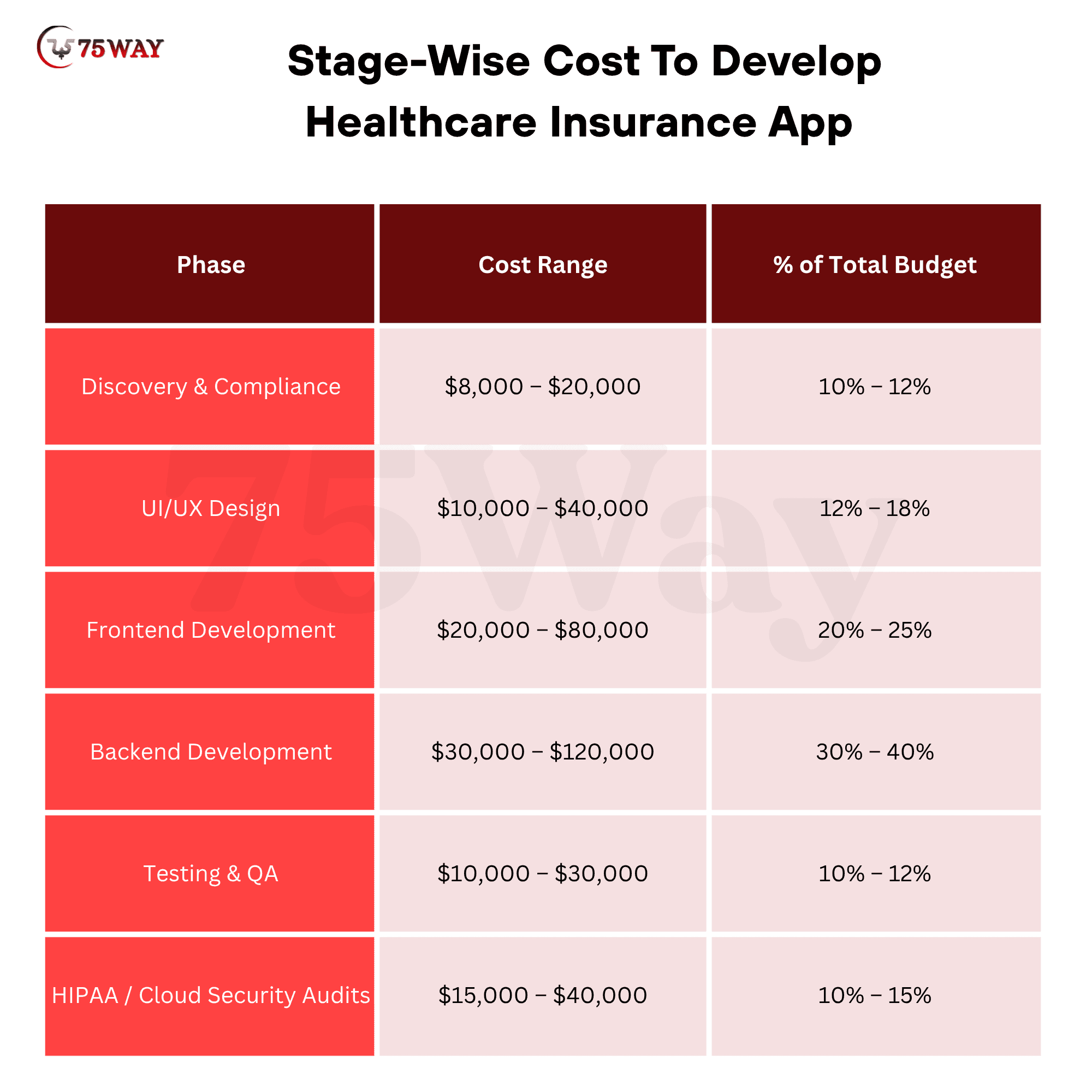
Stage-Wise Cost To Develop Healthcare Insurance App
- Discovery & Compliance: $8,000 – $20,000
This phase focuses on preparing the foundation for a compliant healthcare insurance system. It includes PHI data mapping, regulatory risk planning, market research, and setting up a secure BAA-compliant cloud architecture to ensure the platform meets healthcare data protection standards from the start.
- UI/UX Design: $10,000 – $40,000
Design work covers user journey mapping, wireframing, and building intuitive interfaces for patients, providers, and administrators. It also includes accessibility compliance such as WCAG standards to ensure the application is easy to use across different user groups.
- Frontend Development: $20,000 – $80,000
This stage involves developing the user-facing side of the application for mobile and web platforms. Technologies like React Native, Flutter, or native iOS and Android frameworks are used to build responsive and smooth interfaces.
- Backend Development: $30,000 – $120,000
Backend development focuses on building secure server-side logic, APIs, authentication systems, role-based access control (RBAC), and audit logging. These components ensure data integrity, scalability, and compliance with healthcare regulations.
- Testing & QA: $10,000 – $30,000
This phase ensures the application works reliably across all environments. It includes functional testing, performance testing, usability validation, and security testing to detect and fix issues before launch.
- HIPAA / Cloud Security Audits: $15,000 – $40,000
Security audits ensure the system meets healthcare compliance requirements. This includes HIPAA validation, penetration testing, cloud infrastructure audits, and vulnerability assessments to protect sensitive medical data.
Common Healthcare Insurance App Development Challenges
- Regulatory Complexity: Healthcare regulations evolve frequently.
Solution: Engage compliance specialists during planning and development phases.
- Data Security Risks: Sensitive healthcare information attracts cyber threats.
Solution: Implement encryption, monitoring systems, and security audits.
- Legacy System Integration: Many insurers rely on outdated infrastructure.
Solution: Use API-based integration strategies and phased modernization approaches.
- User Adoption Challenges: Complex interfaces can discourage engagement.
Solution: Invest heavily in UX research and usability testing.
- Scalability Concerns: Growing user bases increase infrastructure demands.
Solution: Adopt cloud-native architectures with elastic scaling capabilities.
- Data Accuracy Issues: Insurance decisions rely on accurate information.
Solution: Implement validation mechanisms and automated verification workflows.
Future Trends In Building Healthcare Insurance App 2026 And Beyond
Healthcare insurance technology is evolving rapidly due to artificial intelligence, automation, and patient-centric digital ecosystems. The next wave of innovation focuses on predictive intelligence, interoperability, and hyper-personalized insurance experiences.
- AI-Driven Autonomous Insurance Systems: Insurance platforms are shifting toward autonomous systems that reduce manual decision-making. These systems improve claim processing speed, fraud detection, and operational efficiency.
- Blockchain For Transparent Claims Processing: Blockchain ensures secure and transparent claim records across all transactions. It improves trust, prevents fraud, and enables automated smart contract-based insurance payouts.
- Hyper-Personalized Insurance Products: Future insurance apps will adjust policies based on user lifestyle and behavior data. This enables dynamic premiums, usage-based coverage, and highly personalized insurance plans.
- IoT-Based Health Monitoring Integration: Wearable devices and IoT sensors will continuously track health metrics. This supports real-time risk assessment, preventive care, and chronic disease monitoring systems.
- Interoperable Healthcare Ecosystems: Insurance platforms will integrate with hospitals, labs, and telemedicine services. This creates seamless data exchange and improves overall patient care coordination.
How To Choose The Right Healthcare App Development Company
Selecting the right development partner is critical for building a secure, scalable, and compliant healthcare insurance application. The quality of your vendor directly impacts performance, user experience, and long-term success of the platform. Below are the key evaluation factors to consider.
- Choose Experienced Industry Experts
A reliable development company should have proven experience in healthcare and insurance domain projects. This ensures they understand workflows, compliance requirements, and user expectations from the beginning.
Look for teams that have previously built healthcare apps, insurance platforms, or regulated digital systems to reduce execution risks.
- Evaluate Strong Technical Expertise
Technical capability determines how efficiently and securely the application will perform under real-world conditions. The development team must be skilled in modern technologies and scalable system design.
This includes AI integration, cloud architecture, secure backend systems, and mobile development frameworks for cross-platform compatibility.
- Ensure Regulatory Compliance Knowledge
Compliance expertise is essential when dealing with sensitive healthcare and insurance data. A strong partner must understand legal and security frameworks from the start.
This includes HIPAA, GDPR, and other data protection standards that ensure user privacy and system accountability.
- Review Portfolio And Case Studies
A company’s previous work reflects its ability to handle complex healthcare projects. Reviewing their portfolio helps you assess quality, scalability, and execution approach.
Case studies and client testimonials provide insight into real-world performance and successful project delivery.
- Check Scalable Architecture Capability
Healthcare applications must support increasing users, data, and transactions without performance issues. Scalability should be a core part of system design.
The development team should be capable of building cloud-based, modular, and future-ready architectures that grow with business needs.
- Confirm Reliable Post- Launch Support
Ongoing support is essential for maintaining application stability and performance after deployment. Without it, even well-built systems can degrade over time.
Ensure the company provides bug fixes, security updates, performance monitoring, and continuous feature enhancements.
How 75way Technologies Helps You Build Healthcare Insurance App?
75way Technologies helps businesses design and develop scalable healthcare insurance applications focused on performance, security, and user experience. The development approach ensures that insurance platforms remain simple for users while staying efficient and reliable for providers.
Our team manages the complete product lifecycle, including planning, UI/UX design, backend development, integrations, compliance implementation, and deployment. This ensures the application is aligned with healthcare industry standards and real-world operational needs.
Strong emphasis is placed on building secure, cloud-based, and scalable systems capable of handling high traffic and sensitive medical data. Core insurance functions such as policy management, claims processing, and provider access are integrated into a unified digital platform.
Advanced technologies like artificial intelligence and automation are also used to improve accuracy and reduce manual effort across workflows. For example, in a recent project called HealthSure Connect, 75way Technologies developed a digital insurance platform with automated claims processing, digital ID cards, provider search, and AI-based validation, which helped the client reduce processing time and significantly improve user experience after launch.
Conclusion
Healthcare insurance app development has become a strategic priority for modern insurers aiming to deliver faster services, improve customer satisfaction, and reduce operational inefficiencies. With AI-driven automation, secure architecture, and seamless digital workflows, insurance platforms are transforming how policies are managed and claims are processed. Organizations investing in scalable mobile solutions gain stronger customer retention and improved decision-making capabilities. Businesses adopting these technologies early will secure long-term competitive advantages in both developed and emerging markets while meeting rising consumer expectations. To build a high-performance healthcare insurance app, contact a trusted healthcare app development company.
Frequently Asked Questions (FAQs)
How Does AI Improve Healthcare Insurance Apps?
AI improves fraud detection, automates claims processing, enhances customer support through chatbots, and enables personalized policy recommendations based on user behavior and data analysis.
Are Healthcare Insurance Apps Secure?
Yes, when built correctly using encryption, multi-factor authentication, role-based access controls, and compliance frameworks like HIPAA and GDPR, these apps provide strong data security.
Can Insurance Apps Integrate With Hospitals And EHR Systems?
Yes, modern insurance apps integrate with hospital systems, EHR platforms, telemedicine apps, and payment gateways using secure APIs for seamless data exchange and workflow automation.
Why Should Insurance Companies Invest In Mobile Apps?
Mobile apps improve customer experience, reduce operational costs, speed up claims processing, and provide valuable data insights that help companies make better business and pricing decisions.