AI Summary
White-label taxi app development offers businesses a faster way to enter the ride-hailing market without building a platform from scratch. This guide explores the essential features, business advantages, development considerations, technology requirements, and future innovations that help create scalable, user-friendly, and competitive taxi applications ready for the evolving transportation industry in 2026.
Quick Overview
- Modern taxi apps require AI-driven automation and seamless user experiences.
- Rider and driver features contribute equally to platform success.
- Real-time tracking improves operational transparency and customer confidence.
- Smart admin tools simplify fleet and business management.
- Scalable technology supports long-term business expansion.
- Choosing the right features reduces future development costs.
Planning to build and launch a taxi app? One of the biggest questions you will face is, “Which features are actually essential and which ones are just nice to have?” With riders expecting the same smooth experience offered by platforms like Uber and Lyft, choosing the right features from the start can directly impact customer satisfaction and business growth.
That is why white-label taxi app development has become the preferred choice for many startups and transportation businesses. It allows you to launch a fully branded platform much faster without building everything from scratch. But not all white-label solutions are created equal, and missing key features can limit your platform as it grows.
In this guide, we break down the essential features every white-label taxi app should include in 2026. From rider and driver functionality to admin controls, AI-powered capabilities, and business management tools, you will learn what it takes to build a competitive and scalable taxi platform.
Why Choosing The Right Features Matters More Than Ever
A taxi app is much more than a booking platform. It represents your brand, shapes customer experiences, and determines how efficiently your business operates every day. Even a well-designed application can struggle if it lacks the features users now expect as standard.
Think about your own experience when booking a ride. Would you wait for a driver without live tracking? Would you trust an app that doesn't provide an estimated fare before confirming the booking? Probably not. Today's users expect convenience, transparency, and speed at every step of their journey.
The same applies to drivers and fleet operators. They need navigation tools, earnings insights, ride management, and simple communication systems to work productively. Meanwhile, business owners require analytics, dispatch controls, and operational visibility to make informed decisions and grow their services.
Choosing the right features from the beginning doesn't just improve customer satisfaction. It reduces operational challenges, supports future expansion, and minimizes expensive upgrades later. A scalable feature set gives your business the flexibility to adapt as customer expectations and market trends continue to evolve.
Major Features Required For Building A White-Label Taxi App in 2026
The success of a white-label taxi app isn't determined by its design alone. It's shaped by the experience it delivers to riders, drivers, and business owners every single day. A fast booking flow might attract users initially, but features like accurate tracking, transparent pricing, secure payments, and intelligent fleet management are what keep them coming back.
At the same time, administrators need complete operational visibility to scale the business without increasing complexity. So, which features truly make a difference in today's competitive ride-hailing market? Below are the essential capabilities every modern white-label taxi app should include in 2026.
A) Customer App Features Every White-Label Taxi App Should Include
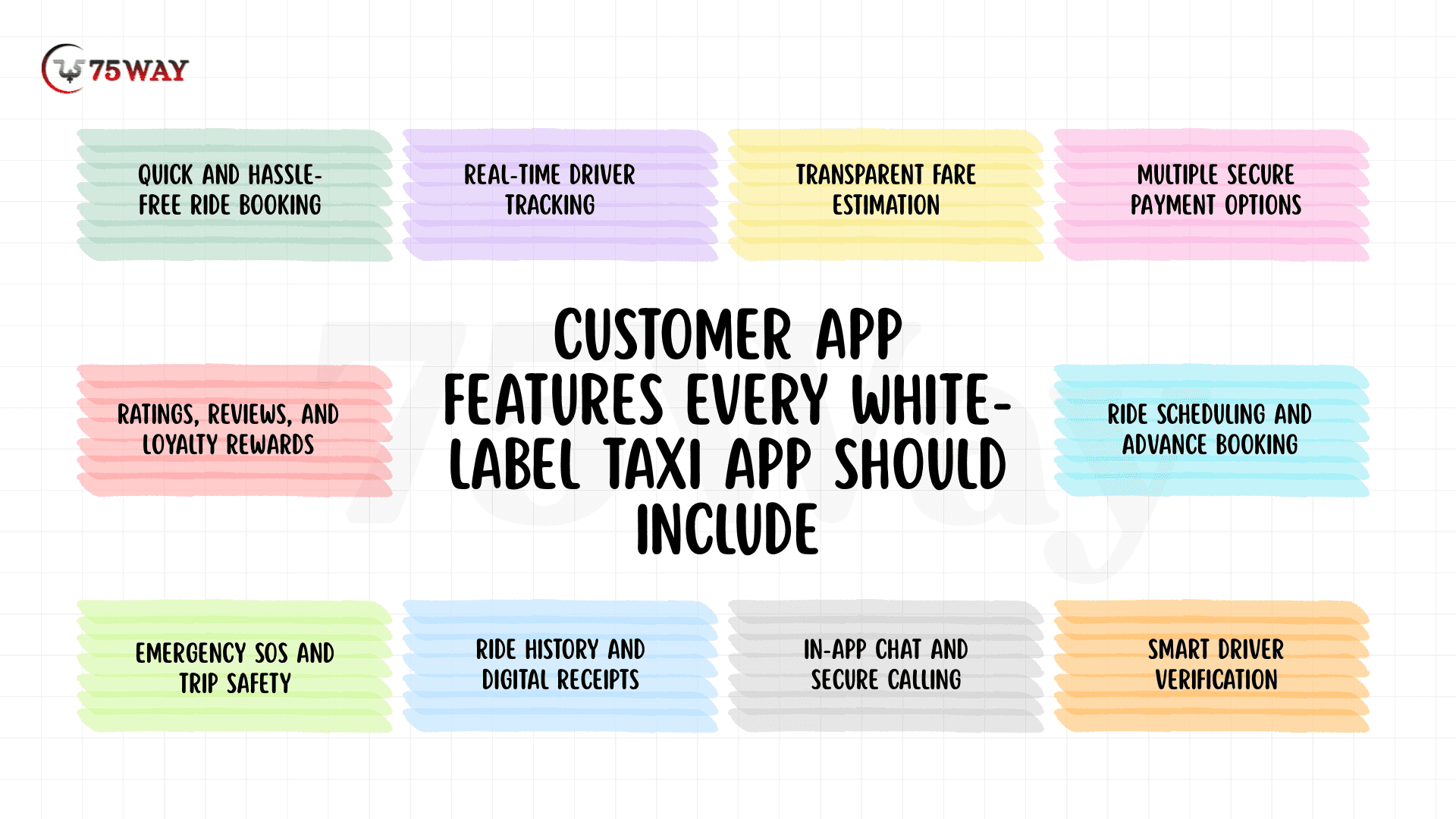
The rider application is the face of your taxi business. It's where customers book rides, make payments, track drivers, and decide whether they'll use your service again. If the experience feels slow or confusing, users won't hesitate to switch to another platform. That's why every customer-facing feature should be designed to make booking a ride simple, transparent, and stress-free. Here are the essential features every modern white-label taxi app should offer to passengers.
1. Quick And Hassle-Free Ride Booking
The booking experience is often the first impression customers have of your taxi service, and it should feel fast and effortless. Riders should be able to enter their pickup and destination, choose their preferred vehicle, review the estimated fare, and confirm the ride within seconds. Reducing unnecessary steps makes booking more convenient and encourages customers to return whenever they need transportation.
Why It Matters
- Simplifies the booking experience.
- Reduces ride abandonment.
- Increases customer satisfaction.
What It Should Include
- One-tap booking
- Saved locations
- Vehicle selection
- Booking confirmation
- Estimated arrival time
2. Real-Time Driver Tracking
Waiting without knowing where the driver is can quickly frustrate passengers. Live driver tracking lets riders follow the driver's location on a map, check the estimated arrival time, and monitor the journey after pickup. This transparency reduces uncertainty while helping passengers better plan their time.
Why It Matters
- Builds customer confidence.
- Reduces unnecessary support calls.
- Creates a transparent ride experience.
What It Should Include
- Live GPS tracking
- Driver location updates
- Estimated arrival time
- Route visualization
- Live trip progress
3. Transparent Fare Estimation
Passengers appreciate knowing the ride cost before confirming a booking. An estimation feature calculates pricing using distance, travel time, vehicle type, traffic conditions, and surge pricing when applicable. Showing an estimated fare upfront helps customers make informed decisions and minimizes disputes after the trip is completed.
Why It Matters
- Improves pricing transparency.
- Builds customer trust.
- Reduces payment disputes.
What It Should Include
- Upfront fare estimate
- Dynamic pricing
- Distance calculation
- Traffic-based pricing
- Promotional discounts
4. Multiple Secure Payment Options
Every rider has different payment preferences. Some prefer cards, while others rely on digital wallets or cash. Supporting multiple payment methods makes the booking process more convenient while giving users the flexibility to pay the way they prefer. Secure payment gateways also protect financial information and increase customer confidence.
Why It Matters
- Offers payment flexibility.
- Improves checkout experience.
- Supports secure transactions.
What It Should Include
- Credit and debit cards
- Digital wallets
- Apple Pay & Google Pay
- UPI and cash payments
- Encrypted payment gateway
5. Ride Scheduling And Advance Booking
Not every journey is booked at the last minute. Many passengers schedule rides for airport transfers, business meetings, office commutes, or medical appointments. An advance booking feature lets users reserve a ride ahead of time, giving them peace of mind while helping businesses manage driver availability more efficiently.
Why It Matters
- Supports planned travel.
- Improves customer convenience.
- Optimizes driver allocation.
What It Should Include
- Scheduled bookings
- Booking reminders
- Ride rescheduling
- Calendar support
- Future trip management
6. Smart Driver Verification
Passengers don't just book rides. They trust your platform with their safety. Before a ride begins, they should be able to view a verified driver profile containing the driver's name, photograph, vehicle details, ratings, and verification status. Behind the scenes, the platform verifies identity documents, driving licenses, vehicle registrations, insurance records, and background checks before allowing drivers to accept rides. This additional layer of verification helps passengers feel more confident every time they book.
Why It Matters
- Builds passenger trust.
- Improves ride safety.
- Strengthens platform credibility.
What It Should Include
- Verified driver profile
- Identity verification
- Driving license validation
- Vehicle verification
- Insurance verification
- Background screening
7. In-App Chat And Secure Calling
Sometimes passengers need to contact the driver to clarify pickup points or provide additional instructions. Instead of exposing personal phone numbers, in-app messaging and calling enable secure communication directly through the platform. This protects user privacy while reducing confusion and improving pickup accuracy.
Why It Matters
- Protects personal information.
- Improves pickup coordination.
- Reduces missed rides.
What It Should Include
- Secure voice calls
- In-app messaging
- Number masking
- Quick replies
- Pickup instructions
8. Ride History And Digital Receipts
Passengers often need access to previous bookings for reimbursement, expense tracking, or personal reference. A ride history section stores completed trips, payment details, invoices, and travel routes in one convenient location. Digital receipts can also be downloaded or shared whenever required.
Why It Matters
- Simplifies expense tracking.
- Improves user convenience.
- Reduces support requests.
What It Should Include
- Ride history
- Digital invoices
- Payment records
- Trip summaries
- Downloadable receipts
9. Emergency SOS And Trip Safety
Safety features can make a significant difference during unexpected situations. An SOS button allows passengers to quickly notify emergency contacts or local authorities while sharing their live location. Additional safety tools like trip sharing and verified driver information help create a safer and more reassuring ride experience.
Why It Matters
- Improves passenger safety.
- Builds customer confidence.
- Supports emergency response.
What It Should Include
- SOS button
- Live location sharing
- Emergency contacts
- Trip sharing
- Safety alerts
10. Ratings, Reviews, And Loyalty Rewards
Customer feedback and reward programs help build a stronger ride-hailing community. After each trip, passengers should be able to rate drivers, leave reviews, and report concerns if necessary. At the same time, loyalty points, referral rewards, cashback offers, and promotional coupons encourage repeat bookings and strengthen long-term customer relationships.
Why It Matters
- Improves service quality.
- Encourages repeat bookings.
- Builds customer loyalty.
What It Should Include
- Driver ratings
- Customer reviews
- Referral program
- Loyalty rewards
- Discount coupons
B) Must-Have Driver App Features for White-Label Taxi Apps
The driver app acts as their daily workspace, helping them accept rides, navigate efficiently, track earnings, and manage trips with minimal effort. When drivers have the right tools, they complete more rides, spend less time handling manual tasks, and deliver a better customer experience. Below are the essential driver app features every white-label taxi solution should include.
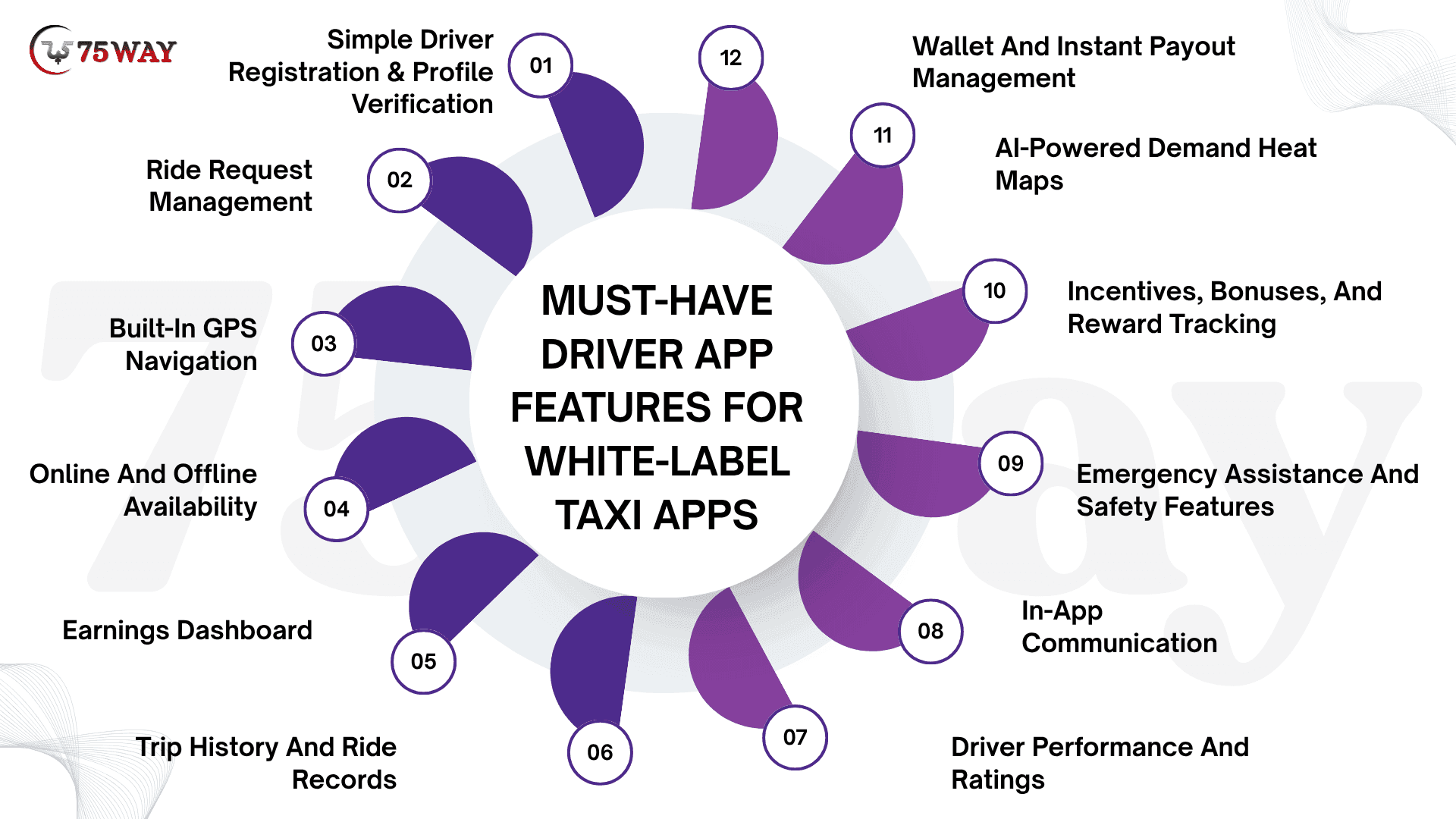
1. Simple Driver Registration And Profile Verification
The onboarding process should be quick while maintaining strict verification standards. Drivers should be able to register through the app, upload required documents, verify their identity, and complete profile setup without visiting an office. Once approved, they can immediately begin accepting ride requests, making the onboarding experience faster and more convenient.
Why It Matters
- Simplifies driver onboarding.
- Speeds up account activation.
- Maintains platform security.
What It Should Include
- Mobile registration
- Document upload
- Identity verification
- License verification
- Profile management
2. Ride Request Management
Drivers need complete control over incoming ride requests. The app should instantly notify them of new bookings while displaying pickup location, destination, estimated fare, distance, and trip duration. Drivers can accept or decline requests based on availability, helping them manage their workload more effectively.
Why It Matters
- Improves response time.
- Simplifies trip management.
- Reduces booking delays.
What It Should Include
- Instant ride alerts
- Accept or reject rides
- Trip information
- Pickup navigation
- Booking history
3. Built-In GPS Navigation
Drivers rely on accurate navigation throughout the day. Instead of switching between multiple applications, the driver app should provide integrated GPS navigation with live traffic updates, alternate routes, and turn-by-turn directions. This minimizes travel time, improves punctuality, and creates a smoother ride experience for passengers.
Why It Matters
- Reduces navigation errors.
- Improves trip efficiency.
- Saves fuel and time.
What It Should Include
- Turn-by-turn navigation
- Live traffic updates
- Alternate route suggestions
- Route optimization
- ETA calculation
4. Online And Offline Availability
Drivers should decide when they want to work. A simple online/offline toggle allows them to start accepting rides when available and pause bookings whenever they need a break. This flexibility gives drivers greater control over their schedules while helping the platform accurately identify available vehicles.
Why It Matters
- Gives drivers flexibility.
- Improves ride allocation.
- Prevents unnecessary requests.
What It Should Include
- Online/offline switch
- Availability status
- Break mode
- Auto logout
- Shift management
5. Earnings Dashboard
Transparency plays a major role in driver satisfaction. A dedicated earnings dashboard lets drivers monitor daily income, completed trips, bonuses, commissions, incentives, and payment history in real time. Instead of contacting support for payment-related questions, they can access all financial information directly within the app.
Why It Matters
- Builds driver confidence.
- Improves financial transparency.
- Encourages better performance.
What It Should Include
- Daily earnings
- Weekly reports
- Incentive tracking
- Bonus calculations
- Payment history
6. Trip History And Ride Records
Drivers often need access to previous trips for performance reviews, payment verification, or customer inquiries. A trip history section stores details such as completed rides, cancelled trips, travel routes, earnings, and ride duration. Having this information readily available helps drivers manage their work more efficiently.
Why It Matters
- Simplifies ride management.
- Improves payment tracking.
- Reduces support dependency.
What It Should Include
- Completed trips
- Cancelled rides
- Route history
- Ride summaries
- Earnings records
7. Driver Performance And Ratings
Feedback isn't just valuable for passengers. It also helps drivers improve their service. The app should display customer ratings, reviews, acceptance rates, cancellation rates, and overall performance metrics. These insights encourage professional behavior while helping drivers understand where they can improve.
Why It Matters
- Encourages quality service.
- Improves driver accountability.
- Supports performance improvement.
What It Should Include
- Customer ratings
- Driver reviews
- Acceptance rate
- Cancellation rate
- Performance score
8. In-App Communication
Clear communication between drivers and passengers helps avoid missed pickups and unnecessary delays. Drivers should be able to contact riders through secure in-app calling and messaging without revealing personal phone numbers. This protects privacy while making pickups more efficient.
Why It Matters
- Improves pickup coordination.
- Protects driver privacy.
- Reduces communication issues.
What It Should Include
- Voice calling
- Secure messaging
- Number masking
- Quick replies
- Pickup instructions
9. Emergency Assistance And Safety Features
Drivers may also face unexpected situations during trips. An emergency assistance feature allows them to instantly notify emergency contacts, contact support teams, or share their live location if they feel unsafe. Combined with ride tracking and incident reporting, these features create a safer working environment.
Why It Matters
- Improves driver safety.
- Supports emergency response.
- Builds platform trust.
What It Should Include
- Emergency SOS
- Live location sharing
- Incident reporting
- Emergency contacts
- Safety alerts
10. Incentives, Bonuses, And Reward Tracking
Motivated drivers contribute directly to better customer service. The driver app should display active incentive programs, bonus opportunities, referral rewards, and milestone achievements. Clear visibility into these rewards encourages drivers to complete more rides and remain active on the platform.
Why It Matters
- Increases driver engagement.
- Improves retention.
- Encourages higher trip completion.
What It Should Include
- Incentive dashboard
- Bonus tracking
- Referral rewards
- Target achievements
- Reward history
11. AI-Powered Demand Heat Maps
Drivers often waste valuable time waiting in areas with little or no demand. AI-powered heat maps analyze historical ride patterns, live bookings, traffic conditions, and local events to highlight zones where ride requests are likely to increase. Instead of driving aimlessly, drivers can reposition themselves strategically, improving their chances of receiving more bookings and increasing daily earnings.
Why It Matters
- Reduces driver idle time.
- Increases booking opportunities.
- Maximizes daily earnings.
What It Should Include
- Demand hotspot map
- Real-time demand updates
- Peak-hour insights
- Ride prediction
- Suggested high-demand areas
12. Wallet And Instant Payout Management
Drivers appreciate quick and transparent access to their earnings. An integrated wallet allows them to monitor available balances, view transaction history, track commissions, and request instant payouts directly through the app. This eliminates uncertainty around payments and provides greater financial flexibility, especially for drivers who rely on daily or weekly income.
Why It Matters
- Simplifies earnings management.
- Improves payment transparency.
- Enhances driver satisfaction.
What It Should Include
- In-app wallet
- Instant payout requests
- Transaction history
- Commission breakdown
- Earnings balance
C) Business-Ready Features for Admin Panel of White-Label Taxi Apps
The admin panel is the operational backbone of a white-label taxi platform. The admin dashboard provides complete control over day-to-day operations. A feature-rich admin panel helps streamline workflows, improve decision-making, and support business growth as your ride-hailing service expands.
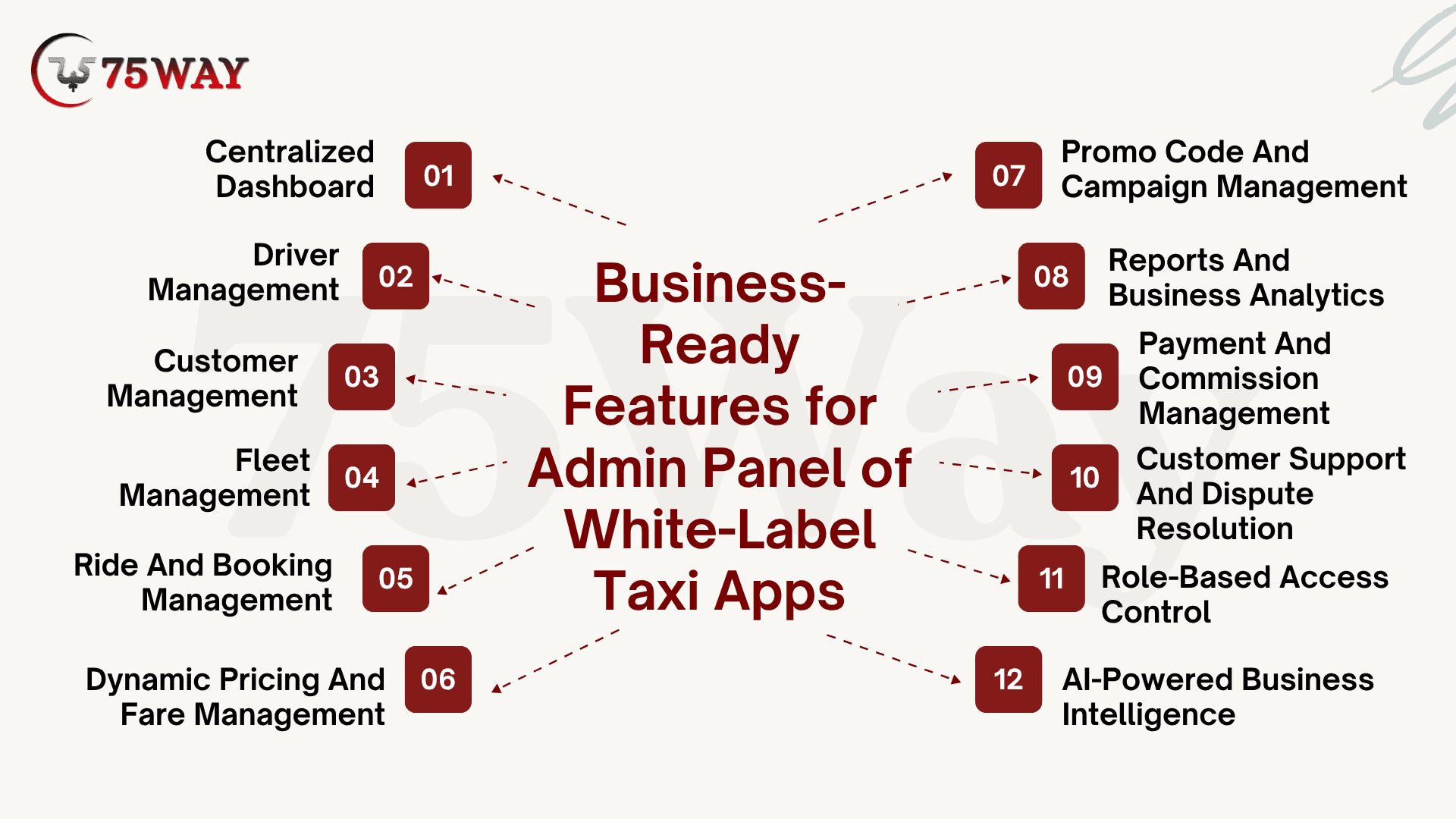
1. Centralized Dashboard
The admin dashboard should provide a real-time overview of your entire taxi business without requiring multiple systems. Administrators should be able to monitor active rides, online drivers, daily bookings, revenue, cancellations, and customer activity from a single screen. Having key business metrics readily available enables faster decisions and better operational visibility.
Why It Matters
- Simplifies business monitoring
- Improves operational visibility
- Supports faster decision-making
What It Should Include
- Live business overview
- Active rides
- Online drivers
- Revenue summary
- Business KPIs
2. Driver Management
Managing hundreds of drivers manually can quickly become overwhelming. The admin panel should allow administrators to approve registrations, verify documents, suspend accounts, monitor driver performance, and manage onboarding from one place. This helps maintain service quality while keeping the platform secure and compliant.
Why It Matters
- Simplifies driver administration
- Maintains service quality
- Improves platform security
What It Should Include
- Driver approval
- Document verification
- Profile management
- Account suspension
- Driver performance tracking
3. Customer Management
Providing excellent customer service starts with having complete visibility into rider accounts. Administrators should be able to manage customer profiles, booking history, complaints, payment records, and account status. This enables quicker issue resolution and delivers a better overall customer experience.
Why It Matters
- Improves customer support
- Simplifies account management
- Enhances service quality
What It Should Include
- Customer profiles
- Ride history
- Complaint management
- Account status
- Payment records
4. Fleet Management
As your transportation business grows, keeping track of vehicles becomes increasingly complex. A fleet management module provides complete visibility into vehicle availability, maintenance schedules, active assignments, and operational status. This helps maximize fleet utilization while minimizing downtime caused by maintenance or poor vehicle allocation.
Why It Matters
- Optimizes fleet utilization
- Reduces vehicle downtime
- Improves operational efficiency
What It Should Include
- Vehicle management
- Fleet availability
- Maintenance scheduling
- Assignment monitoring
- Vehicle status tracking
5. Ride And Booking Management
Every ride generated through the platform should be easy to monitor and manage. Administrators should have access to booking details, ride status, cancellations, driver assignments, fare information, and customer requests. This allows quick intervention whenever operational issues arise.
Why It Matters
- Simplifies ride operations
- Improves service management
- Reduces operational delays
What It Should Include
- Ride monitoring
- Booking management
- Cancellation tracking
- Driver assignment
- Fare details
6. Dynamic Pricing And Fare Management
Pricing strategies often need to change based on demand, traffic, weather, special events, or business goals. A dynamic pricing module enables administrators to configure fare structures, surge pricing, promotional discounts, minimum fares, and regional pricing rules without modifying the application's core functionality.
Why It Matters
- Maximizes revenue
- Supports flexible pricing
- Responds to market demand
What It Should Include
- Surge pricing
- Fare configuration
- Discount management
- Regional pricing
- Tax settings
7. Promo Code And Campaign Management
Customer acquisition and retention often depend on well-planned promotional campaigns. The admin panel should allow businesses to create coupons, referral rewards, loyalty programs, seasonal discounts, and targeted promotional offers. Managing these campaigns from one dashboard simplifies marketing while helping increase bookings.
Why It Matters
- Boosts customer retention
- Supports marketing campaigns
- Encourages repeat bookings
What It Should Include
- Coupon creation
- Referral programs
- Loyalty campaigns
- Promotional offers
- Campaign scheduling
8. Reports And Business Analytics
Business growth depends on understanding performance, not guessing it. A comprehensive reporting module should provide insights into revenue, completed rides, driver performance, customer retention, cancellations, booking trends, and peak operating hours. These reports help business owners identify opportunities and improve strategic planning.
Why It Matters
- Supports data-driven decisions.
- Identifies growth opportunities.
- Measures business performance.
What It Should Include
- Revenue reports
- Booking analytics
- Driver reports
- Customer insights
- Performance dashboards
9. Payment And Commission Management
Managing financial transactions accurately is critical for every ride-hailing business. The admin panel should track completed payments, pending transactions, platform commissions, driver payouts, refunds, and settlement records. Automated calculations reduce manual work while improving financial transparency.
Why It Matters
- Simplifies financial operations.
- Improves payment transparency.
- Reduces accounting errors.
What It Should Include
- Commission management
- Driver payouts
- Payment tracking
- Refund processing
- Financial reports
10. Customer Support And Dispute Resolution
Questions, complaints, and ride disputes are inevitable, making efficient support tools essential. Administrators should be able to manage support tickets, review ride details, communicate with users, and resolve issues quickly from a centralized system. Faster resolutions improve customer satisfaction and strengthen trust in the platform.
Why It Matters
- Improves customer satisfaction.
- Resolves issues faster.
- Strengthens brand reputation.
What It Should Include
- Support ticket management
- Complaint handling
- Ride investigation
- User communication
- Resolution tracking
11. Role-Based Access Control
As the business grows, multiple team members often need access to the admin panel. Role-based access control allows businesses to assign different permissions to administrators, managers, finance teams, dispatchers, and customer support staff. Each user can access only the information relevant to their responsibilities, improving both security and operational efficiency.
Why It Matters
- Enhances platform security.
- Protects sensitive information.
- Improves team productivity.
What It Should Include
- Custom user roles
- Permission management
- Secure login controls
- Activity logs
- Multi-admin access
12. AI-Powered Business Intelligence
Raw data alone doesn't drive growth; actionable insights do. AI-powered business intelligence analyzes booking trends, customer behavior, fleet utilization, demand forecasts, and revenue patterns to provide meaningful recommendations. Instead of reacting to problems after they occur, businesses can make proactive decisions that improve efficiency and profitability.
Why It Matters
- Improves strategic planning.
- Predicts business trends.
- Supports smarter decisions.
What It Should Include
- Demand forecasting
- Revenue predictions
- Customer behavior insights
- Fleet utilization analysis
- AI-generated recommendations
Advanced Features To Build A Future-Ready White-Label Taxi App
Launching a taxi app with essential features is only the beginning. As the ride-hailing industry evolves, businesses need intelligent capabilities that improve operational efficiency, personalize user experiences, and create a competitive advantage. If you're planning to build a white-label taxi app in 2026, these next-generation features are worth considering from the start.
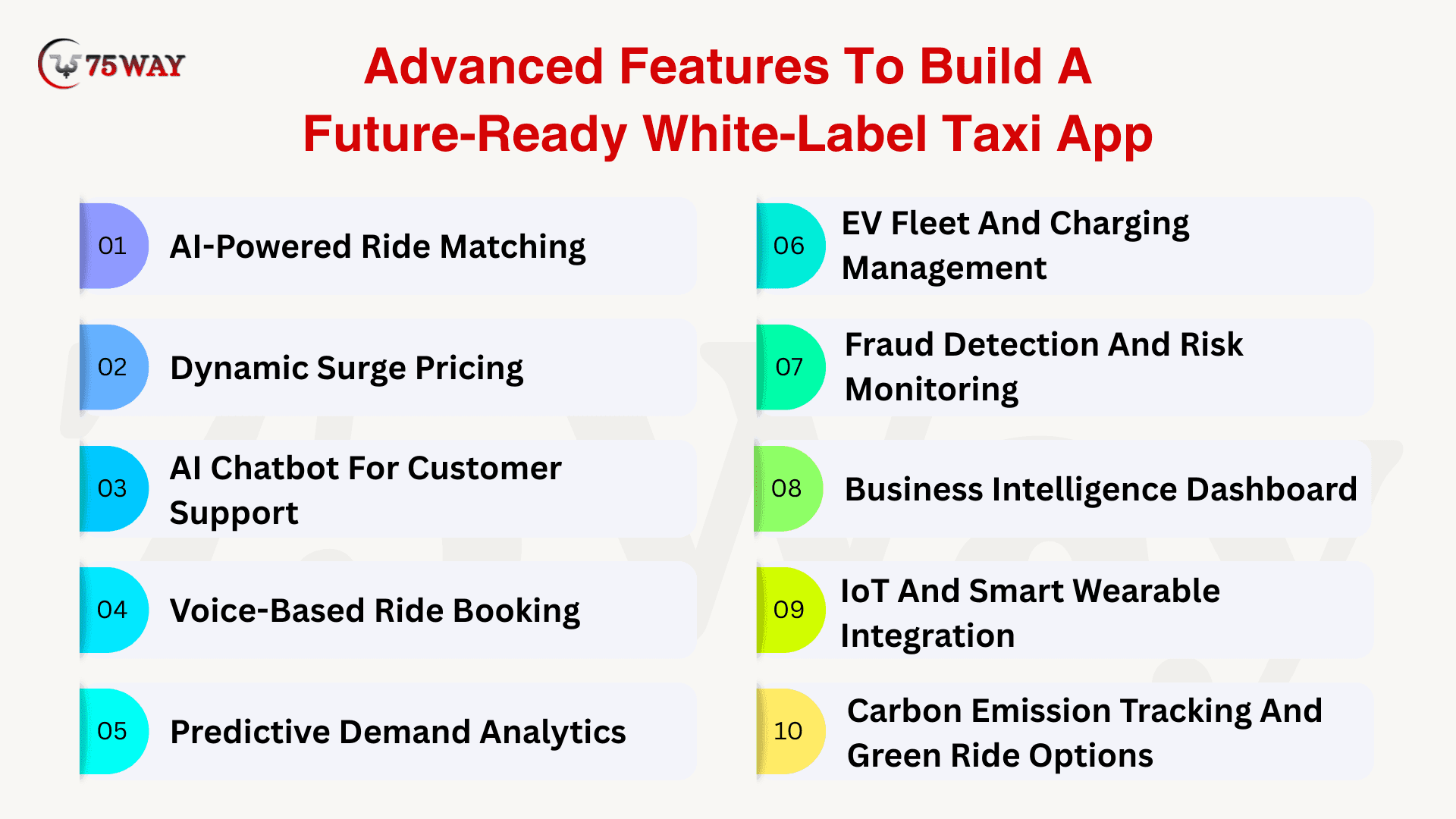
1. AI-Powered Ride Matching
Assigning the nearest driver doesn't always create the best experience. AI-powered ride matching considers multiple factors, including driver availability, traffic conditions, vehicle category, customer location, historical acceptance rates, and estimated arrival time before assigning a ride. This intelligent approach helps balance driver workloads while reducing passenger waiting times.
Beyond improving operational efficiency, AI matching also increases trip completion rates and customer satisfaction. During peak hours, the system continuously analyzes live data to allocate rides more accurately, helping businesses serve more customers without increasing fleet size.
2. Dynamic Surge Pricing
Demand for taxis changes constantly throughout the day. Rush hours, concerts, sporting events, airport traffic, poor weather, and holidays can all create sudden spikes in booking requests. Dynamic surge pricing automatically adjusts fares according to real-time demand and available drivers, allowing businesses to maintain service availability while maximizing revenue.
Instead of manually updating pricing rules, administrators can configure automated pricing strategies based on predefined conditions. This creates a fair balance between customer demand and driver availability while encouraging more drivers to become active during busy periods.
3. AI Chatbot For Customer Support
Customers often have simple questions that don't require a human support representative. An AI-powered chatbot can instantly answer queries about bookings, cancellations, payments, refunds, estimated arrival times, lost items, and promotional offers at any time of the day.
As the chatbot continues interacting with users, it learns common customer concerns and delivers faster, more accurate responses. More complex issues can be seamlessly transferred to live support agents, reducing response times while lowering customer support costs.
4. Voice-Based Ride Booking
Typing addresses isn't always convenient, especially while driving, walking, or carrying luggage. Voice-enabled booking allows users to request rides, select destinations, check trip status, or contact drivers using simple voice commands, making the application more accessible and easier to use.
This functionality is particularly valuable for elderly passengers, visually impaired users, and customers who prefer hands-free interactions. As voice assistants continue to become part of everyday life, voice booking helps create a more modern and user-friendly ride-hailing experience.
5. Predictive Demand Analytics
Successful taxi businesses don't just respond to demand—they anticipate it. Predictive analytics studies historical booking trends, weather forecasts, traffic patterns, holidays, and local events to estimate where ride demand is likely to increase throughout the day.
These insights allow businesses to position drivers proactively in high-demand locations before requests begin arriving. Better demand forecasting reduces passenger waiting times, increases completed rides, improves driver earnings, and helps operators utilize their fleet more efficiently.
6. EV Fleet And Charging Management
As electric vehicles become a larger part of commercial transportation, taxi platforms need dedicated tools to manage them efficiently. EV fleet management tracks battery levels, estimates remaining driving range, recommends nearby charging stations, and schedules charging sessions to reduce operational interruptions.
The system also provides valuable insights into energy consumption, charging history, and fleet utilization. These capabilities help businesses lower operating costs while supporting sustainability goals and preparing for the growing adoption of electric mobility.
7. Fraud Detection And Risk Monitoring
Fraud can impact both profitability and customer trust if it isn't detected early. AI-powered fraud detection continuously monitors booking behavior, payment transactions, login activity, and ride patterns to identify suspicious behavior before financial losses occur.
Instead of relying solely on manual reviews, the system automatically flags unusual activities such as fake accounts, duplicate bookings, payment fraud, or abnormal ride requests. Early detection helps businesses maintain platform security while protecting genuine riders and drivers.
8. Business Intelligence Dashboard
Every booking, payment, cancellation, and completed ride generates valuable business data. A business intelligence dashboard transforms this information into easy-to-understand reports and visual insights, helping operators monitor overall platform performance in real time.
Rather than simply displaying numbers, advanced analytics reveal customer behavior, driver productivity, booking trends, revenue performance, and operational bottlenecks. These insights help business owners make smarter strategic decisions, improve resource allocation, and identify new growth opportunities with greater confidence.
9. IoT And Smart Wearable Integration
Modern transportation is becoming increasingly connected, and taxi platforms can benefit from integrating with IoT devices and smart vehicle technologies. By connecting with GPS sensors, dash cameras, telematics systems, fuel monitors, and vehicle diagnostics, administrators gain real-time visibility into fleet performance and driver activity. This helps improve operational efficiency while reducing unexpected vehicle downtime.
The same integration can also support smart wearables for drivers, enabling features like emergency alerts, fatigue monitoring, or hands-free notifications. As connected mobility continues to evolve, IoT integration helps businesses build a more intelligent, data-driven taxi ecosystem that delivers safer and more reliable transportation services.
10. Carbon Emission Tracking And Green Ride Options
Sustainability is becoming an important factor for both transportation companies and passengers. A carbon emission tracking feature measures the environmental impact of completed trips and provides insights into fuel consumption, emissions, and eco-friendly driving habits. Businesses can use this data to monitor sustainability goals while promoting environmentally responsible transportation.
The platform can also offer Green Ride options, allowing passengers to choose electric or hybrid vehicles whenever available. Along with encouraging eco-friendly travel, this feature helps businesses strengthen their brand image, comply with future environmental regulations, and attract customers who actively prefer sustainable mobility solutions.
Final Thoughts
To summarize, we have explored the essential features every white-label taxi app should include in 2026, along with advanced capabilities, business benefits, technology stack, development costs, and the key factors that influence long-term success. Whether you're launching a startup or expanding an existing transportation business, selecting the right feature set and scalable technology foundation is critical to delivering a seamless experience for riders, drivers, and administrators. A well-designed white-label taxi solution not only accelerates your market entry but also positions your business to adapt to changing customer expectations and future mobility trends. To launch your white-label taxi app, you can consult a prominent taxi app development company that offers end-to-end ride-hailing app solutions.
Frequently Asked Questions (FAQs)
Can A White-Label Taxi App Be Customized After Launch?
Yes, most modern white-label taxi applications are built with scalability in mind, allowing businesses to introduce new features, redesign the interface, integrate additional payment gateways, expand into new cities, or add services like bike taxis, rentals, and corporate transportation without rebuilding the entire platform.
Can One Taxi Platform Manage Multiple Cities Or Regions?
Yes, enterprise-ready white-label taxi platforms support multi-city operations from a centralized admin dashboard. Businesses can configure separate pricing models, service zones, driver fleets, taxes, promotional campaigns, and operational settings for each city while managing everything through a single system.
Can Third-Party Services Be Integrated Into A White-Label Taxi App?
Yes, white-label taxi applications can integrate with various third-party services, including payment gateways, navigation platforms, SMS providers, analytics tools, CRM systems, customer support software, loyalty programs, and business intelligence solutions. These integrations improve functionality without requiring major changes to the core application.
Can A White-Label Taxi App Support Multiple Vehicle Types?
Yes, businesses can configure multiple ride categories such as economy cars, premium vehicles, SUVs, electric vehicles, motorcycles, luxury rides, airport transfers, and rental services. Each category can have its own pricing structure, availability rules, and service configurations to meet different customer needs.
Does A White-Label Taxi App Require Regular Updates?
Yes, regular updates help maintain compatibility with new mobile operating systems, improve application performance, strengthen security, resolve technical issues, and introduce new features based on changing customer expectations and market trends. Continuous maintenance also supports long-term platform reliability and scalability.
Can A White-Label Taxi App Be Expanded Beyond Ride-Hailing Services?
Absolutely, many businesses gradually evolve their platforms by introducing food delivery, courier services, parcel delivery, grocery delivery, chauffeur services, and corporate transportation. A scalable white-label architecture makes it easier to expand into new on-demand services without developing separate applications from scratch.