AI Summary
Learn how to build a Zomato/Swiggy-style food ordering app with AI in 2026. Explore essential customer, restaurant, delivery, and admin features, recommended tech stack, AI integrations, development steps, estimated costs, and strategies for creating a scalable food delivery
Key Takeaways
- Build a complete ecosystem with customer, restaurant, delivery, and admin panels.
- Include essential features like payments, tracking, menu management, and personalization.
- Use AI for recommendations, demand forecasting, routing, fraud detection, and support.
- Choose a scalable tech stack to support real-time operations and future growth.
- Start with an MVP and gradually add advanced AI features to control development costs
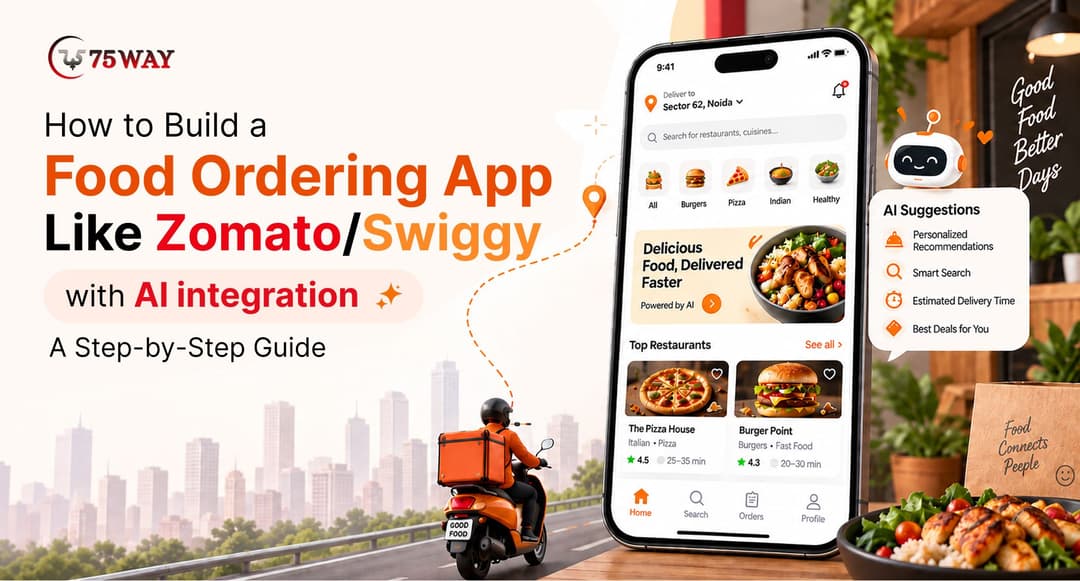
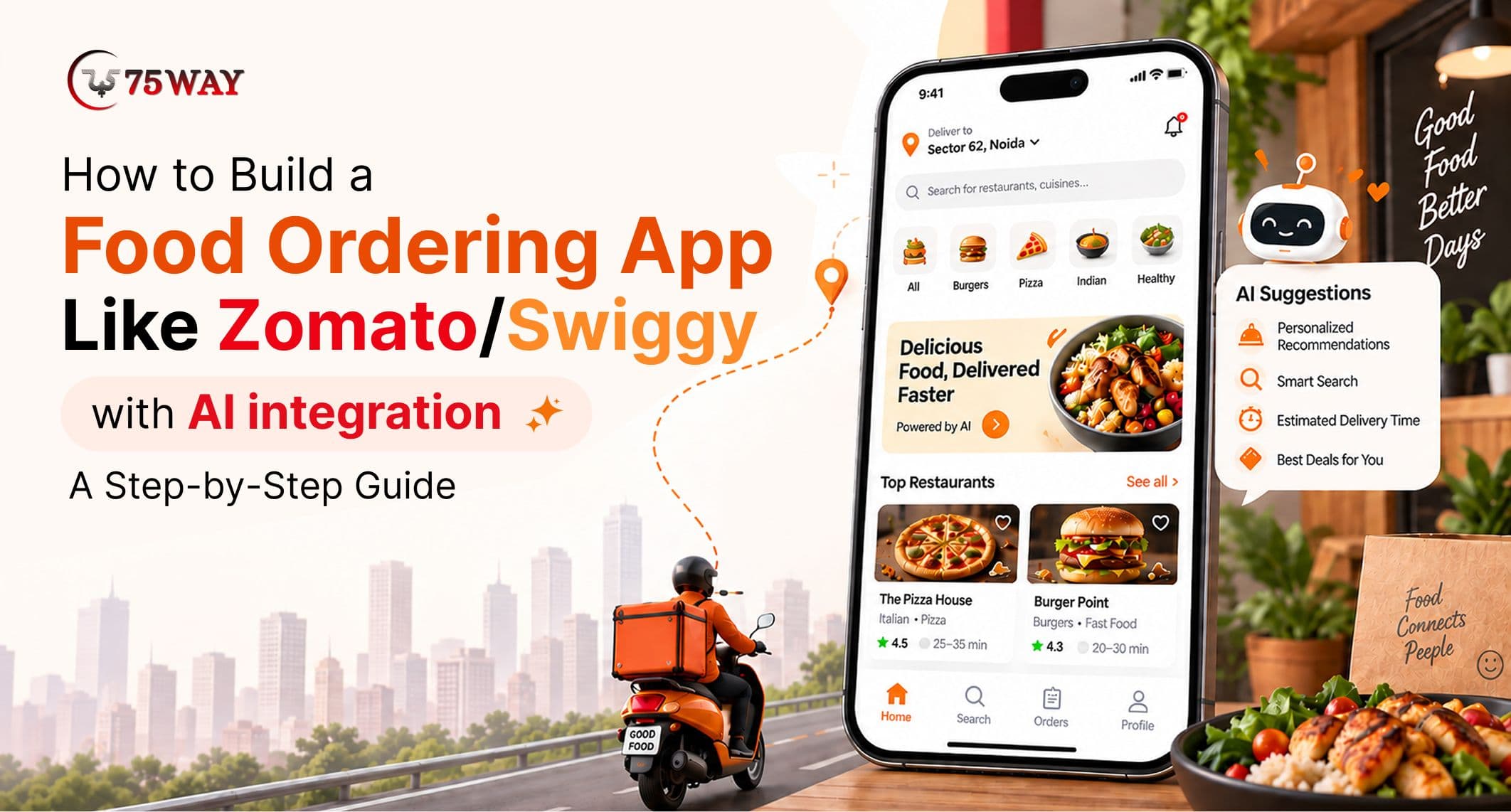
Food app development is the process of building a platform that connects customers, restaurants, and delivery partners covering browsing, ordering, payments, and real-time tracking in one seamless ecosystem.
Early food apps were little more than digital menus: browse, order, wait for a confirmation call. There was no personalization and almost no intelligence behind the experience.
Today, platforms like Zomato and Swiggy have transformed this into a three-app ecosystem customer app, restaurant panel, and delivery app, all linked through a central admin system. And AI now powers nearly every layer: personalized recommendations, conversational ordering, demand forecasting, and smart delivery routing.
In short, food app development has evolved from a simple transactional tool into a smart, AI-driven ecosystem.
Why Zomato/Swiggy-Style Apps Are Still a Booming Business Model in 2026
The Zomato/Swiggy-style food delivery model is no longer simply about delivering restaurant meals. In 2026, it has evolved into a broader on-demand food, convenience, dining, and hyperlocal commerce ecosystem.
India's food-services market is projected to grow from approximately $90 billion in 2026 to $150 billion by 2031, according to Swiggy's 2026 Capital Markets Day presentation. Swiggy also expects its Food Delivery Gross Order Value (GOV) to grow 2.5–3.5x by FY31, demonstrating the company's confidence in continued category expansion.
The opportunity extends beyond food delivery. Swiggy's FY2025 annual report showed its food-delivery GOV growing 16.4% year over year to ₹28,783 crore, while monthly transacting users increased 15% to 14.7 million.
More recent results show that the category is still expanding. For FY2026, Swiggy reported 22.6% YoY growth in food-delivery GOV, reaching ₹9,005 crore in Q4 FY26, while food-delivery monthly transacting users grew 21% to 18.3 million
—-----------------------------------------------------------------------------------------------------------------
Core Components of a Food Ordering App
A food ordering app includes customer, restaurant, delivery partner, and admin panels, supported by secure payment and order management systems for seamless ordering, tracking, and operations.
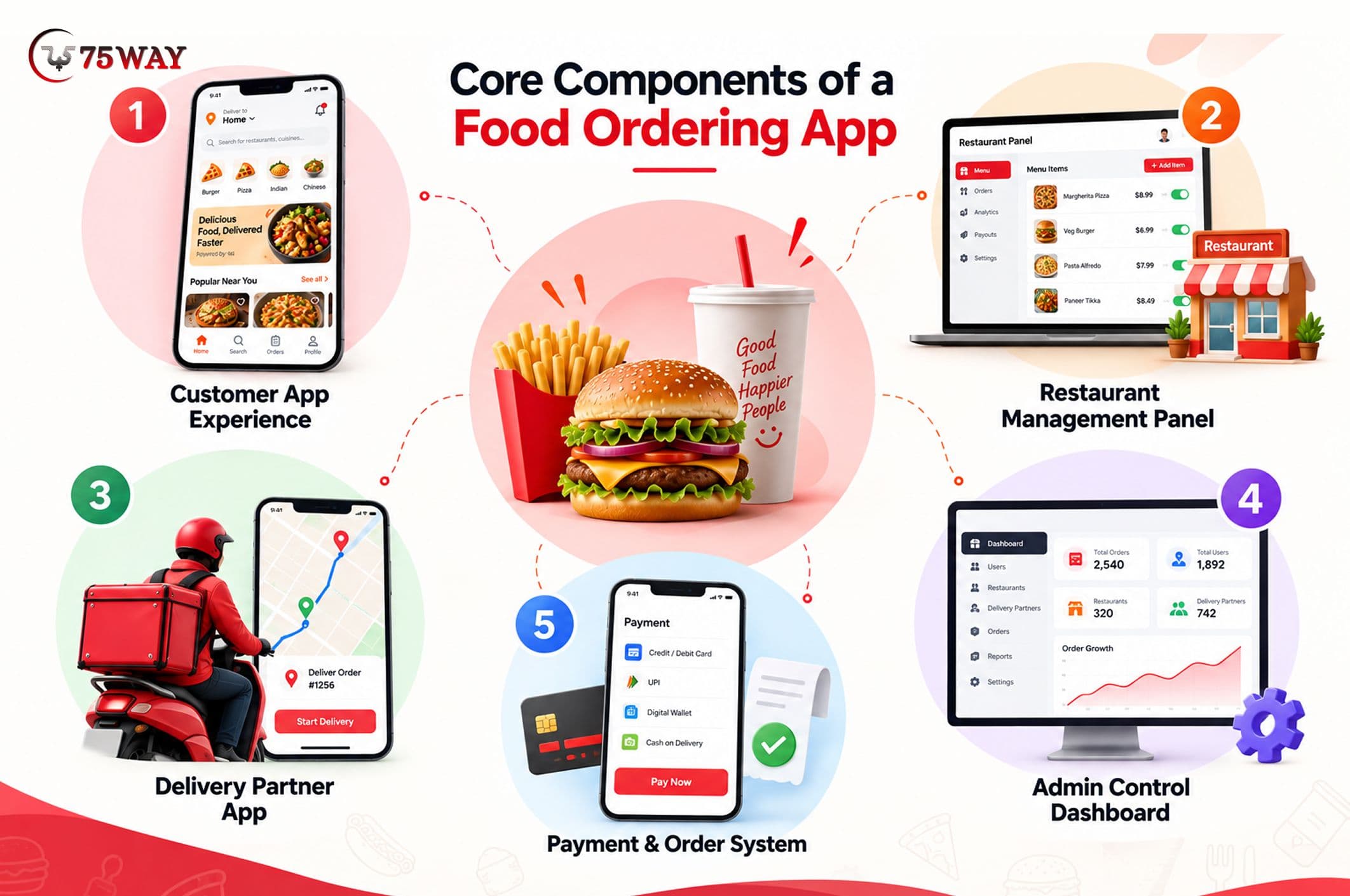
1. Customer App Experience
The customer-facing app allows users to discover nearby restaurants, browse menus, customize meals, add items to carts, and place orders. Features such as personalized recommendations, restaurant ratings, order history, favorites, multiple payment options, and real-time order tracking create a convenient ordering experience and encourage customers to return to the platform regularly.
2. Restaurant Management Panel
The restaurant dashboard enables businesses to manage their digital operations efficiently. Restaurant owners can create and update menus, manage prices, upload food images, accept or reject orders, update preparation status, monitor earnings, and respond to customer reviews. Real-time notifications and analytics also help restaurants understand demand and improve their overall service performance.
3. Delivery Partner App
The delivery partner application connects restaurants, customers, and delivery executives. Drivers can receive nearby delivery requests, accept orders, navigate using integrated maps, update delivery statuses, and view their earnings. GPS-based tracking provides customers with accurate delivery updates while helping businesses optimize delivery routes, reduce delays, and improve overall fulfillment efficiency.
4. Admin Control Dashboard
The admin dashboard provides centralized control over the entire food ordering ecosystem. Administrators can manage customers, restaurants, delivery partners, orders, payments, commissions, promotions, reviews, and platform settings. Advanced analytics can provide insights into order volumes, revenue, customer behavior, restaurant performance, and delivery operations, enabling better decision-making and platform management.
5. Payment & Order System
A secure payment and order management system handles the complete transaction journey. Customers can choose options such as cards, digital wallets, UPI, or cash on delivery. The system manages payment processing, order confirmation, refunds, invoices, cancellations, and notifications. Integrating reliable payment gateways helps provide secure transactions and a smoother checkout experience.
—-----------------------------------------------------------------------------------------------------------------------------------------
Must-Have Features for Each App Panel
A successful food ordering app should include essential features across customer, restaurant, delivery, and admin panels to simplify ordering, payments, tracking, management, and personalized experiences.
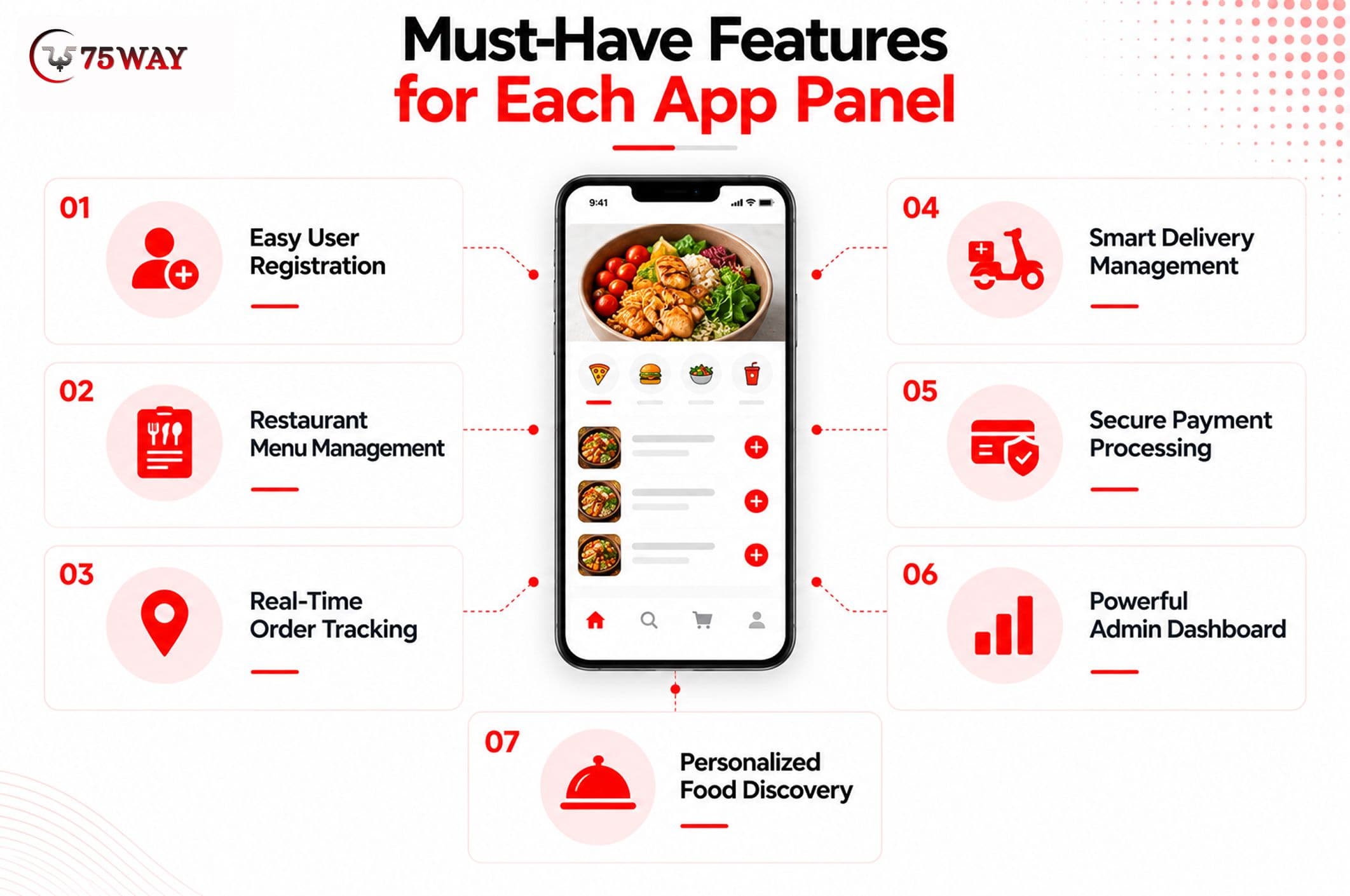
1. Easy User Registration
The customer panel should make account creation quick and convenient, allowing users to register through multiple options.
- Email and phone registration
- OTP-based verification
- Social media login
- Profile management
- Saved addresses
- Login and logout
A simple onboarding process reduces friction and helps users start discovering restaurants and placing orders quickly.
2. Restaurant Menu Management
The restaurant panel needs comprehensive tools to manage menus and food items efficiently.
- Add or remove dishes
- Update prices and descriptions
- Upload food images
- Manage categories
- Mark items available/unavailable
- Add customization options
Restaurants should be able to update menu information instantly so customers always see accurate pricing, availability, ingredients, and customization choices.
3. Real-Time Order Tracking
Real-time tracking allows customers and restaurants to monitor an order throughout the delivery process.
- Order confirmation updates
- Food preparation status
- Delivery partner location
- Estimated delivery time
- GPS-based tracking
- Delivery notifications
This feature improves transparency and customer confidence while helping restaurants and delivery partners coordinate efficiently from order acceptance through final delivery.
4. Smart Delivery Management
The delivery partner panel should provide tools that simplify order acceptance, navigation, and delivery operations.
- Nearby order requests
- Order acceptance/rejection
- GPS navigation
- Pickup and drop-off details
- Delivery status updates
- Earnings tracking
Route optimization and location tracking can help delivery partners complete more orders efficiently while reducing unnecessary travel time and improving the overall delivery experience.
5. Secure Payment Processing
A reliable payment system is essential for completing transactions securely and providing customers with convenient payment choices.
- Credit and debit cards
- UPI payments
- Digital wallets
- Cash on delivery
- Payment confirmation
- Refund management
The system should also generate invoices and maintain transaction records. Secure payment gateway integration helps protect financial information while reducing payment failures during checkout.
6. Powerful Admin Dashboard
The admin panel should provide centralized control over restaurants, customers, delivery partners, orders, payments, and platform operations.
- User management
- Restaurant approvals
- Delivery partner management
- Order monitoring
- Commission management
- Promotional campaigns
- Business analytics
Administrators can use real-time dashboards and reports to monitor platform performance, identify operational issues, manage disputes, and make data-driven decisions for business growth.
7. Personalized Food Discovery
Personalization can make the customer experience more engaging by recommending restaurants and dishes based on individual preferences.
- AI-powered recommendations
- Location-based restaurants
- Search and filters
- Cuisine preferences
- Personalized offers
- Previous-order suggestions
Machine learning can analyze ordering patterns, favorite cuisines, spending behavior, and browsing activity to deliver more relevant recommendations and promotions, potentially increasing customer engagement, repeat orders, and overall platform revenue.
—---------------------------------------------------------------------------------------------------------------------------------
From Data to Delivery: Key Places AI Powers a Food Ordering App
AI can transform food ordering apps by enabling personalized recommendations, conversational ordering, demand forecasting, intelligent delivery routing, fraud detection, and review analysis for smarter operations.
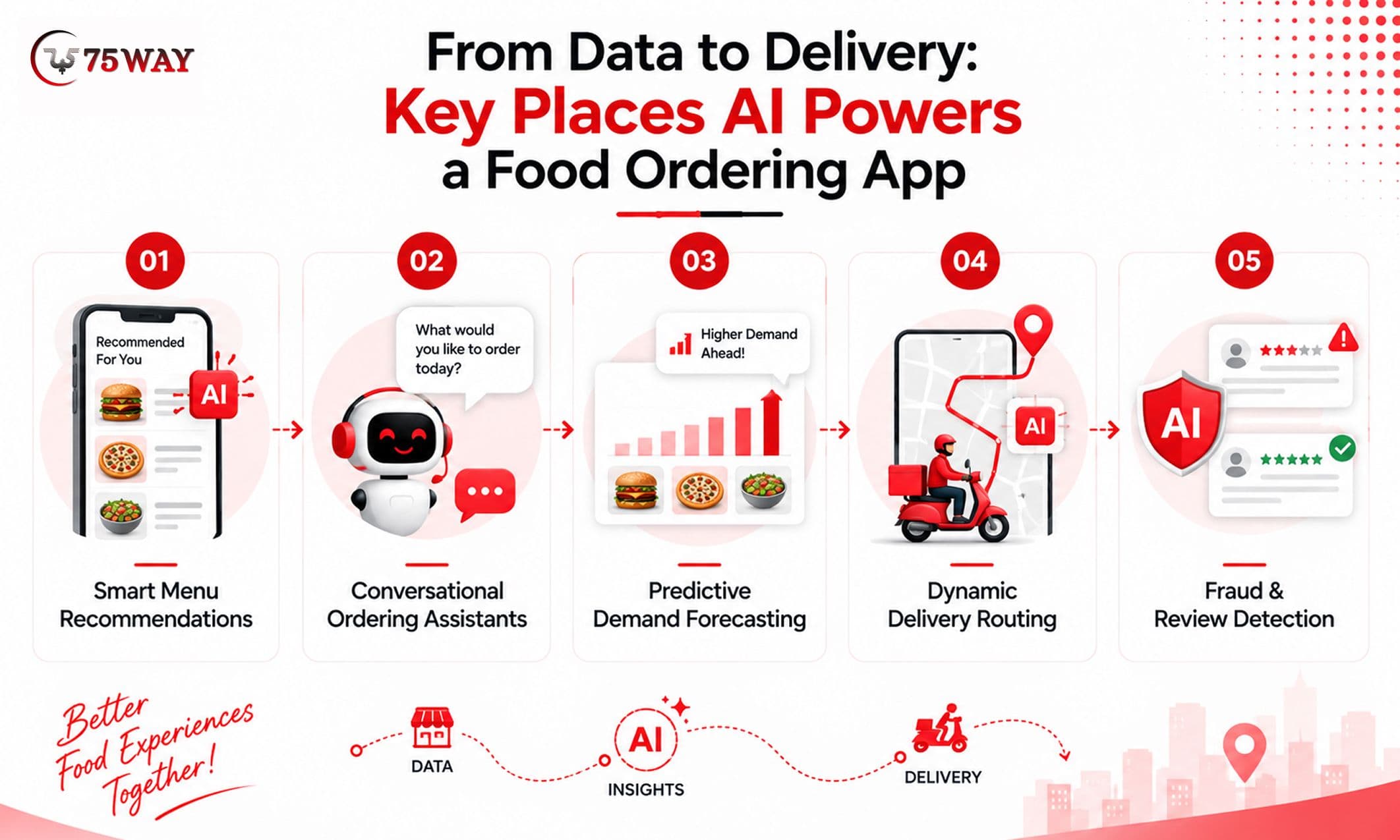
Smart Menu Recommendations
AI analyzes past orders, browsing behavior, and preferences to suggest dishes each user is most likely to enjoy. This boosts average order value and improves the overall experience by surfacing relevant options instantly. Platforms like Zomato use this to personalize homepages, showing different menus to different users based on individual taste patterns and ordering history.
Conversational Ordering Assistants
AI-powered chatbots and voice agents let customers place orders, ask about menu items, or track deliveries through natural conversation instead of manual navigation. This reduces friction, speeds up ordering, and cuts support costs. Voice-based ordering is especially useful for repeat customers and hands-free use cases like drive-throughs or smart speakers.
Predictive Demand Forecasting
By analyzing historical order data, weather, time of day, and local events, AI predicts demand spikes before they happen. This helps restaurants prep inventory and staff accordingly, while the platform can proactively notify delivery partners to reduce wait times during rush hours, improving efficiency across the entire supply chain.
Dynamic Delivery Routing
AI-driven route optimization calculates the fastest, most efficient delivery paths in real time, factoring in traffic, distance, and multiple pickups. This reduces delivery times, fuel costs, and partner idle time. Some platforms also use AI to batch nearby orders intelligently, maximizing delivery partner efficiency without compromising food quality or speed.
Fraud & Review Detection
AI algorithms flag suspicious transactions, fake reviews, and abnormal ordering patterns to protect platform integrity. Sentiment analysis on reviews also helps restaurants understand genuine customer feedback at scale, filtering out spam or manipulated ratings — building trust between customers, restaurants, and the platform itself.
—-------------------------------------------------------------------------------------------------------------------------------------
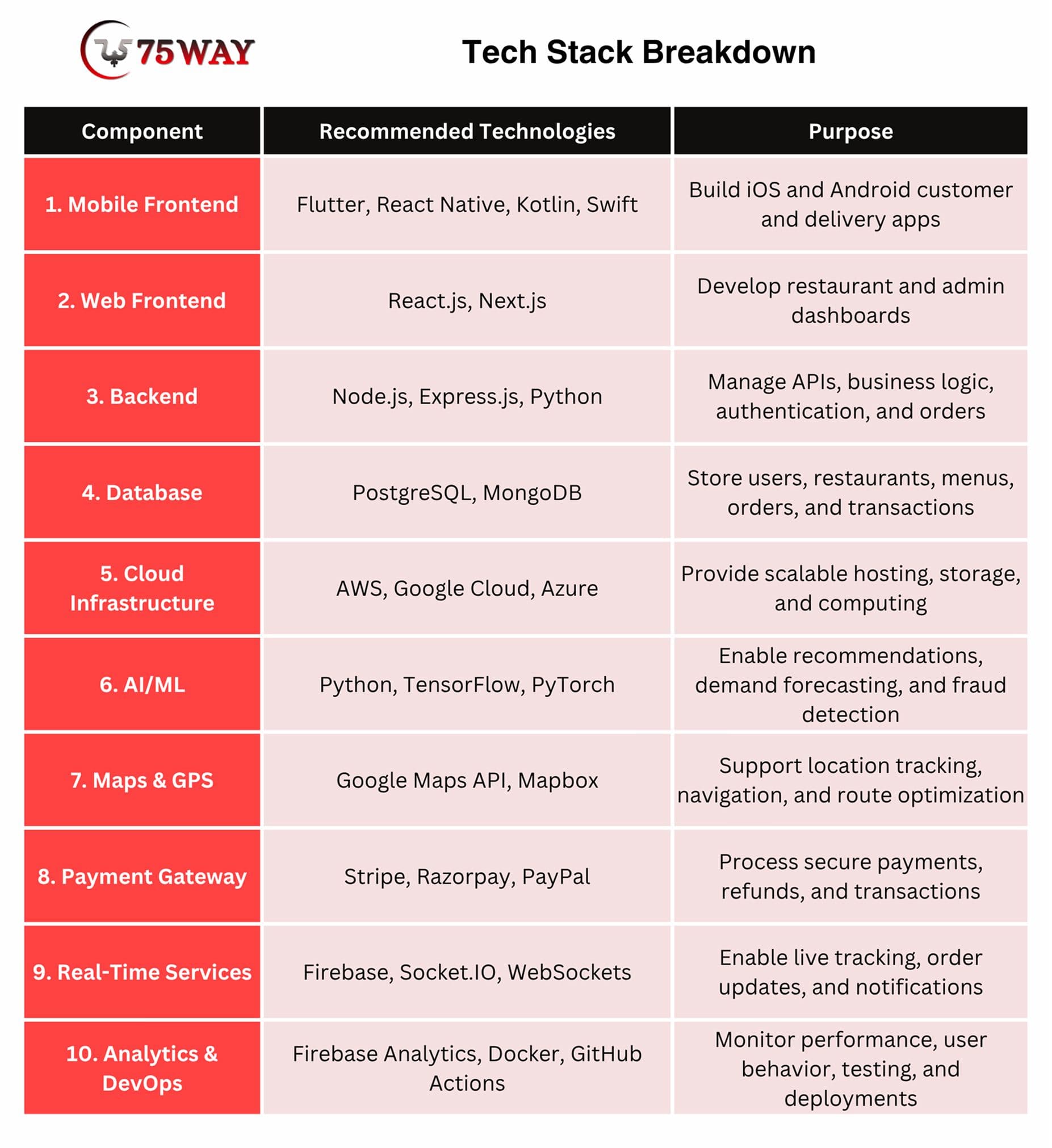
Tech Stack Breakdown
A food ordering app requires a scalable technology stack that supports fast interfaces, secure transactions, real-time order tracking, restaurant management, and AI-powered personalization. The right combination of frontend, backend, databases, cloud infrastructure, AI/ML frameworks, and third-party APIs ensures reliability, scalability, security, and a smooth experience for customers, restaurants, delivery partners, and administrators.
Step-by-Step Development Process
Building a Zomato/Swiggy-style food ordering app requires a structured development approach covering research, planning, UI/UX, development, integrations, testing, deployment, and ongoing improvements. Following a systematic process helps reduce development risks, maintain scalability, deliver a better user experience, and ensure the platform can support customers, restaurants, delivery partners, and administrators.
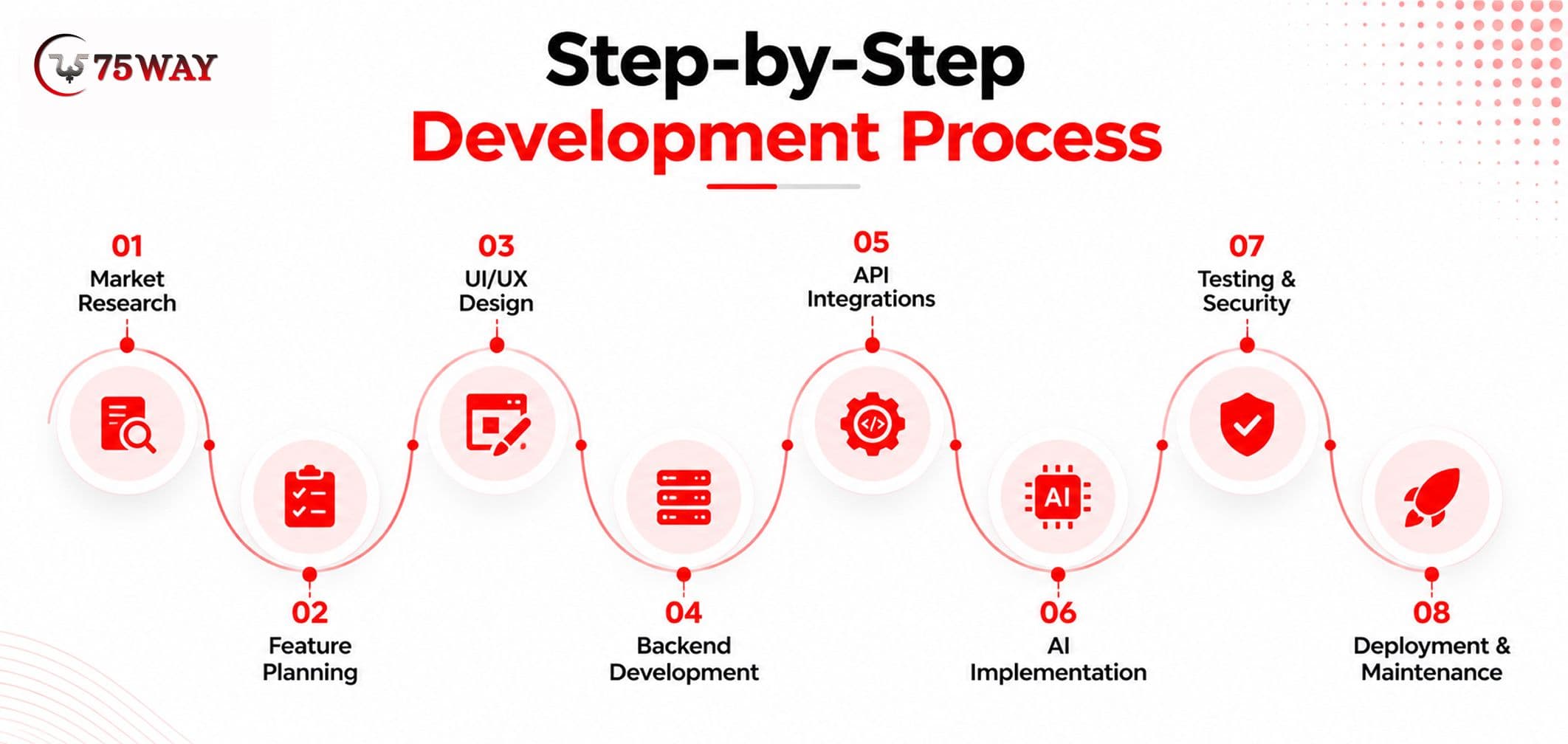
1. Market Research
Start by analyzing the target market, competitors, customer expectations, restaurant requirements, and delivery ecosystem. Identify your niche, geographic focus, pricing strategy, and unique value proposition. Research platforms such as Zomato and Swiggy to understand their features, revenue models, strengths, and limitations. This research helps define a practical product strategy before development begins.
2. Feature Planning
Define the features required for every platform component, including customer, restaurant, delivery partner, and admin panels. Prioritize essential features for the Minimum Viable Product (MVP), such as registration, restaurant discovery, menus, cart, payments, order tracking, and notifications. Advanced features such as AI recommendations and loyalty programs can be introduced during later development phases.
3. UI/UX Design
Create intuitive and visually appealing interfaces that make restaurant discovery and ordering simple. Designers develop wireframes, prototypes, navigation flows, and high-fidelity screens for different user roles. The design should prioritize easy navigation, quick checkout, clear food information, accessibility, responsive layouts, and consistent branding across mobile applications and web-based dashboards.
4. Backend Development
Develop the backend infrastructure responsible for managing users, restaurants, menus, orders, payments, delivery operations, and business logic. APIs connect the frontend applications with backend services and databases. A scalable backend architecture ensures that the platform can handle increasing users, restaurants, orders, transactions, and real-time activities without compromising performance.
5. API Integrations
Integrate essential third-party services required for smooth platform operations. These may include Google Maps for location and navigation, payment gateways for transactions, Firebase for notifications, SMS services for OTP verification, and analytics platforms for tracking user behavior. Proper API integration ensures accurate data exchange between the application and external services.
6. AI Implementation
AI can be introduced to make the platform more intelligent and personalized. Machine-learning models can analyze customer behavior, previous orders, restaurant preferences, delivery patterns, and demand trends. These capabilities can support personalized food recommendations, demand forecasting, dynamic delivery optimization, fraud detection, intelligent search, and AI-powered customer support.
7. Testing & Security
Conduct comprehensive testing before launching the application to identify functional, performance, usability, and security issues. Test different user journeys, payment transactions, order workflows, location tracking, APIs, and notifications. Security testing should also protect customer information, payment data, authentication credentials, and business data against unauthorized access and potential cyber threats.
8. Deployment & Maintenance
After successful testing, deploy the applications to the required app stores and cloud infrastructure. Configure production servers, databases, monitoring, analytics, backups, and security systems. Post-launch maintenance includes fixing bugs, improving performance, updating features, monitoring user feedback, implementing security updates, and continuously optimizing the platform based on business and customer requirements.
—------------------------------------------------------------------------------------------------------------------------------------
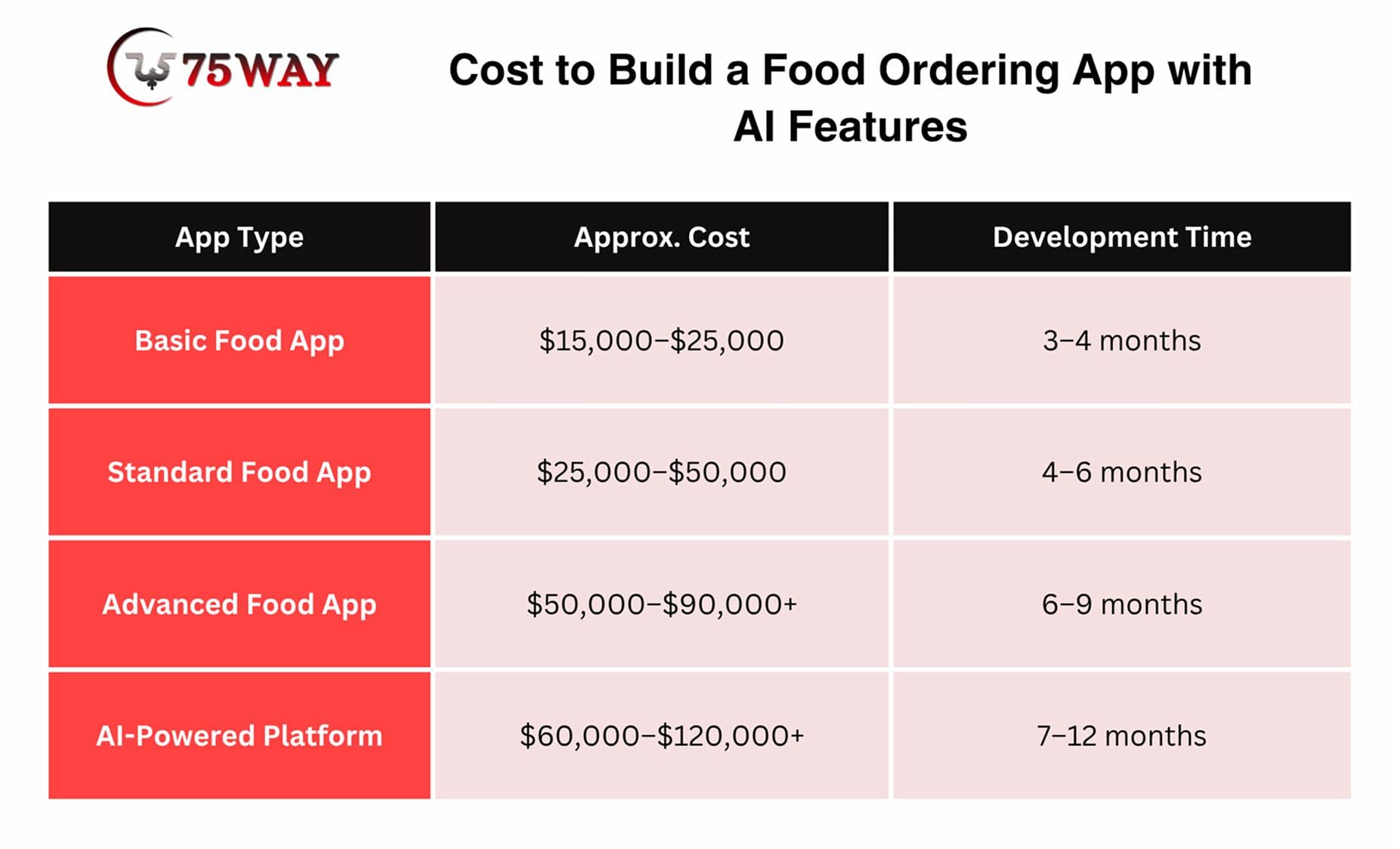
Cost to Build a Food Ordering App with AI Features
The cost of developing a Zomato/Swiggy-style food ordering app with AI features depends on the number of platforms, features, integrations, UI complexity, technology stack, and development team location. Since the platform typically includes customer, restaurant, delivery partner, and admin panels, development costs can vary significantly.
AI Can Increase Development Costs
AI implementation requires additional expenses for data preparation, model development, API usage, cloud computing, testing, and continuous optimization. For example, a basic recommendation system using third-party AI APIs may be relatively affordable, while developing customized machine-learning models for demand prediction or dynamic delivery optimization can require considerably more investment.
For a startup, an MVP-first approach is usually more practical: launch the essential ordering, restaurant, delivery, payment, and admin functionality first, then introduce AI capabilities based on actual customer and business data.
—-----------------------------------------------------------------------------------------------------------------------------------
Choosing the Right Development Partner
Choosing the right technology partner is one of the most important decisions when building a food ordering app. The right development company should understand not only mobile app development but also marketplace architecture, real-time delivery systems, payment integrations, cloud infrastructure, and AI implementation.
What Should You Look For?
1. Industry ExperienceChoose a development partner with experience building food delivery, marketplace, or on-demand applications. Industry knowledge helps developers understand restaurant workflows, delivery operations, customer journeys, and the complexities of managing multiple user panels.
2. Strong Technology ExpertiseYour development partner should have expertise across mobile development, backend systems, databases, cloud platforms, APIs, and third-party integrations. This ensures the application can remain stable and scalable as the number of users, restaurants, and orders increases.
3. AI & Automation CapabilitiesAI can become a major differentiator for modern food ordering platforms. Look for a partner capable of implementing AI-powered recommendations, intelligent search, demand forecasting, automated customer support, fraud detection, and delivery optimization.
4. Scalable ArchitectureA food ordering platform needs to handle potentially thousands of concurrent users and orders. Your development partner should follow scalable architecture practices and use technologies that support future expansion without requiring a complete rebuild.
5. Post-Launch SupportApp development doesn't end at deployment. Choose a company that provides maintenance, security updates, performance optimization, bug fixes, feature enhancements, and technical support after launch
Why 75Way Technologies?
With expertise in AI development and mobile app development, 75Way Technologies can help businesses transform food delivery concepts into scalable digital platforms. Its technology capabilities can support AI-powered applications, custom mobile development, API integrations, cloud solutions, and intelligent automation—making it possible to build a food ordering platform designed around specific business requirements rather than simply replicating an existing app.
Conclusion
The food delivery industry continues to create opportunities for entrepreneurs looking to build innovative Zomato/Swiggy-style food ordering apps. However, success depends on more than simply offering online food ordering. Businesses need a seamless customer experience, efficient restaurant and delivery management, secure payments, real-time tracking, scalable infrastructure, and increasingly, AI-powered personalization and automation.
Starting with a focused MVP and gradually introducing advanced features can help businesses control development costs while validating their business model. With the right technology stack and development partner, a food ordering platform can evolve into a broader on-demand food and hyperlocal commerce ecosystem.
Frequently Asked Questions
1. How much does it cost to build a food ordering app?
The cost can range from approximately $15,000 to $120,000+, depending on features, platforms, integrations, AI capabilities, design complexity, and development requirements.
2. How long does it take to build a food delivery app?
A basic MVP can take around 3–4 months, while a feature-rich platform with multiple panels, integrations, and AI capabilities may require 6–12 months or more.
3. What AI features can a food ordering app have?
AI can power personalized food recommendations, intelligent search, demand forecasting, AI chatbots, fraud detection, customer segmentation, and delivery route optimization.
4. What panels are needed for a food ordering app?
A complete platform generally includes four major panels: customer app, restaurant/vendor panel, delivery partner app, and admin dashboard. Each panel manages different parts of the ordering and delivery ecosystem.
5. Can I build a niche food delivery app?
Yes. Instead of competing directly with large platforms, entrepreneurs can target specific cities, cuisines, customer segments, dietary preferences, campuses, corporate users, or underserved markets to create a differentiated food delivery business.