AI Summary
A successful car wash app development requires careful planning. Customer expectations continue evolving rapidly. AI is transforming service experiences. Smart business decisions reduce long-term development risks. This guide explains everything required to build, launch, manage, and scale a profitable car wash application in 2026.
Quick Overview
- Understand car wash app development from planning to successful launch.
- Explore AI-powered features enhancing customer convenience and business operations.
- Compare business models before investing in app development confidently today.
- Cost to build car wash app lies between $$10,000-$150,000+ based on requirements
- Discover practical strategies for scaling profitable on-demand car wash businesses.
If you are planning to build a car wash app, you're probably trying to answer one question,
“Is car wash mobile app development really worth the investment in 2026?”
The short answer is yes, but only if it is built around how customers actually book and use car wash services today.
Many businesses start with a straightforward idea: let customers book a wash, pay online, and track the service. In practice, that's only the foundation.
A competitive app needs to manage schedules, handle real-time availability, personalise offers, support subscriptions, integrate secure payments, and provide a smooth experience for customers, service professionals, and administrators alike.
That's why successful car washing platforms are not built by copying competitors. They are built by solving everyday operational problems while making booking a car wash as convenient as ordering food or requesting a ride.
This guide walks you through every stage of car wash app development, from choosing the right business model and essential features to AI capabilities, development costs, to monetization strategies, so you can make informed decisions before investing in development.
What Is Car Wash App Development?
Car wash app development is the process of creating a mobile application that lets customers book car wash or detailing services. This app allows businesses to manage appointments, staff, payments, and daily operations digitally.
Instead of relying on phone calls or walk-in bookings, everything is handled through one platform, making the experience faster, more organized, and more convenient for both customers and business owners.
For instance, you want to clean your car before work. You open a car wash app, select a wash package, choose her office as the service location, book a convenient time, and pay online. A nearby technician receives the booking, completes the service, and you get a digital invoice and can leave a review. This seamless experience is what car wash app development makes possible.
Car Wash Mobile Apps Market Size, Revenue, & Growth Opportunities in USA
Car wash apps have become one of the fastest-growing digital investments in the automotive service industry. Customers now expect faster bookings, cashless payments, and on-demand services that fit busy schedules. The figures below highlight why businesses are increasingly investing in car wash apps to capture this growing demand.
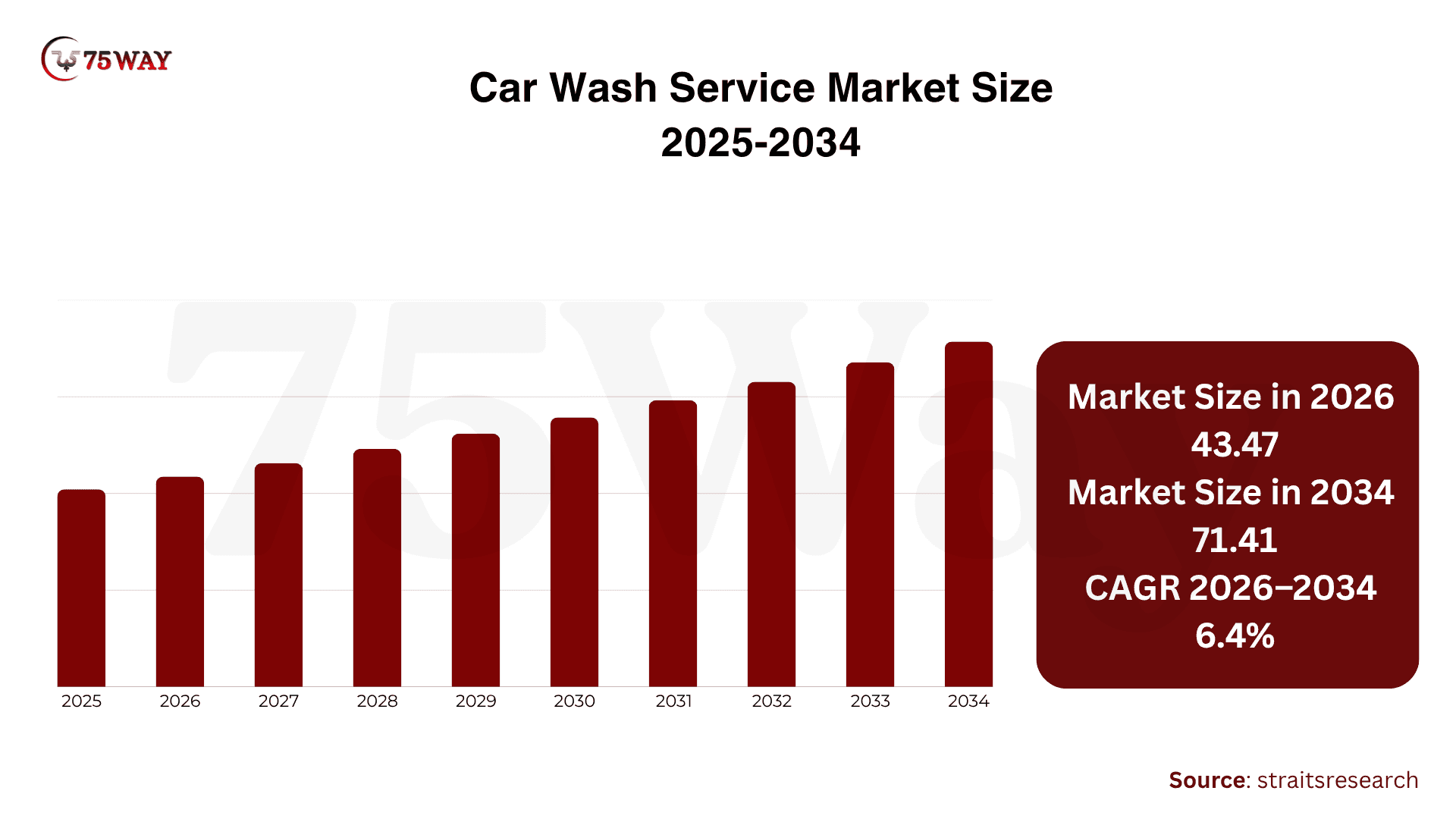
- The global car wash service market is projected to grow from $43.47 billion in 2026 to $71.41 billion by 2034, at a CAGR of 6.4%.
- The U.S. car wash industry is highly organized, with major chains like Mister Car Wash and ZIPS Car Wash rapidly expanding through advanced technologies.
- Another report indicates that the global car wash apps market is expected to reach $2,318.6 billion by 2034, growing at a CAGR of 11.2%.
- Automatic tunnel and conveyor systems account for the largest share of the car wash market at 48.12%.
- Single-service visits lead the market by service model, contributing 55.78% of total revenue.
- Mobile car wash apps hold the largest type share, accounting for 38.7% of the market.
- North America dominates the market with a 41.3% revenue share.
- The total addressable market (TAM) is projected to reach approximately $25.68 billion during 2026–2034.
Why Businesses Are Investing In Mobile Car Wash App Development in 2026
A car wash app isn't just another way for customers to book appointments. It changes how the entire business operates. From reducing manual work to improving customer retention, the right app can solve many of the problems that slow business growth. Here are the biggest reasons businesses are making the switch.
- Customers Expect Digital Convenience: Users want to book car washing services in seconds.
If they have to call, wait for a response, or visit a location just to schedule an appointment, many will choose a competitor with a better digital experience. A mobile app removes that friction by letting customers book anytime, from anywhere.
- Reduce Manual Work: Managing bookings through phone calls, text messages, or spreadsheets takes time and increases the chance of mistakes.
A car wash app automates scheduling, confirmations, reminders, payments, and customer records, allowing staff to focus on delivering better service instead of handling repetitive administrative tasks.
- Increase Repeat Business: Acquiring a new customer is often more expensive than keeping an existing one.
Features like loyalty rewards, personalized offers, memberships, and push notifications encourage customers to return instead of trying another service.
- Improve Daily Operations: Business owners can manage appointments, assign technicians, monitor workloads, and track completed jobs from one dashboard.
Instead of constantly checking with employees, they have real-time visibility into daily operations.
- Generate Valuable Business Insights: Every booking creates useful data. Business owners can see which services are most popular, identify peak booking times, understand customer preferences, and measure revenue trends.
These insights make future business decisions much easier.
- Build A Stronger Brand: A professional car washing mobile app builds trust and credibility.
Customers are more likely to return to a business that offers a smooth, modern experience than one that still depends entirely on phone calls and walk-in appointments.
Quick Read:Top 10 App Development Companies in USA
How Does A Car Wash App Work?
Although booking a car wash feels simple to customers, several processes happen behind the scenes to complete every appointment successfully. Here's how the typical workflow looks.
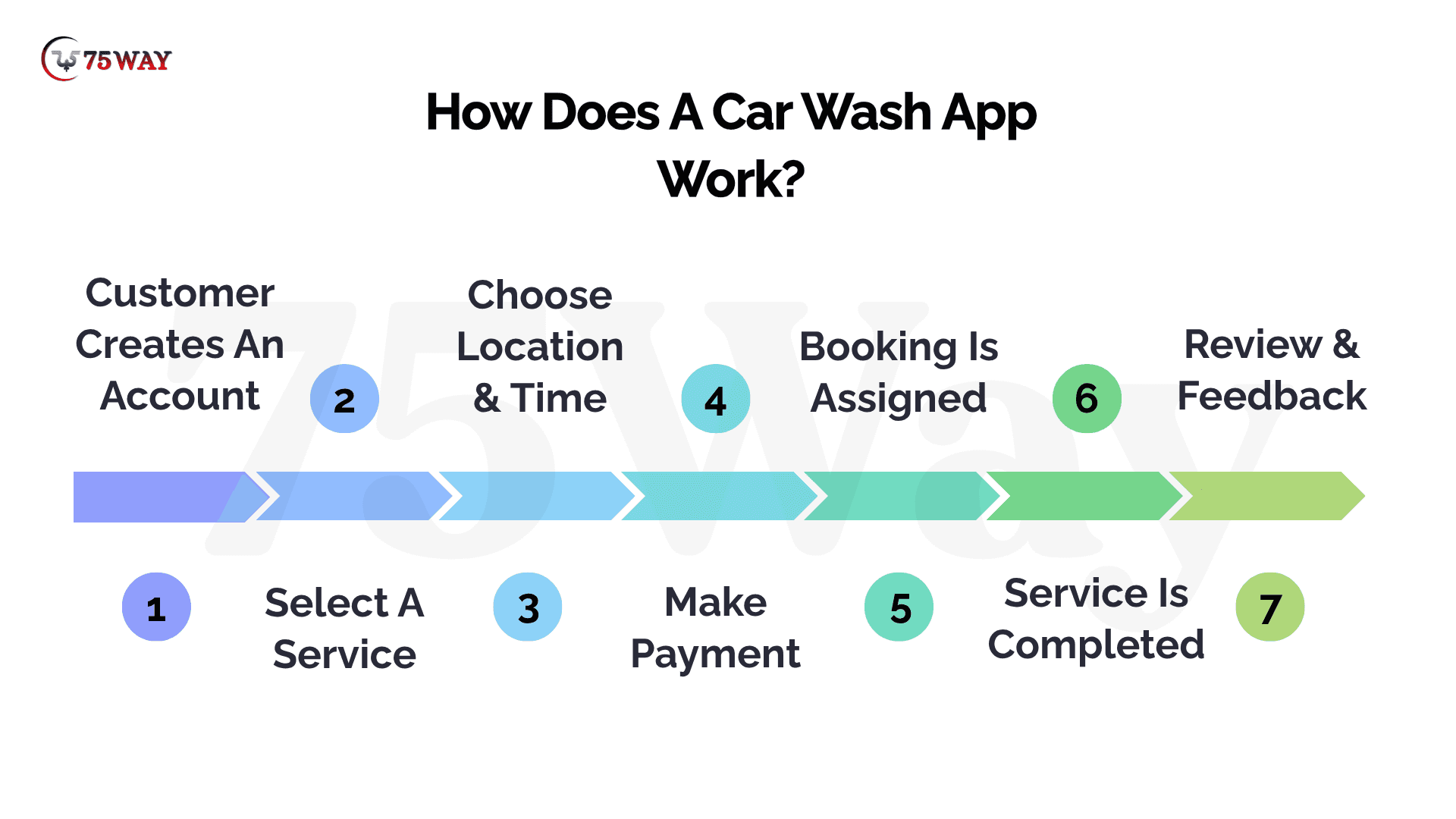
Step 1: Customer Creates An Account
The customer signs up using an email address, phone number, or social media account and adds basic vehicle information.
Step 2: Select A Service
The customer chooses a package, such as an exterior wash, interior detailing, ceramic coating, or a complete detailing service.
Step 3: Choose Location And Time
Depending on the business model, the customer either selects a nearby service centre or enters a preferred service location for a mobile wash.
Step 4: Make Payment
The customer pays securely using their preferred payment method or selects another available payment option.
Step 5: Booking Is Assigned
The system automatically assigns the job to the nearest available technician or service team based on availability and location.
Step 6: Service Is Completed
The technician performs the requested service while the customer receives real-time updates through the app.
Step 7: Review And Feedback
After the job is complete, the customer receives a digital receipt, rates the service, and shares feedback that helps the business improve future experiences.
Read More:Taxi App Business Model: How It Works And Makes Revenue in 2026?
Who Can Invest In AI-Powered Car Wash Mobile App Development?
If you think car wash apps are only for large brands with dozens of locations, think again. We've seen businesses with just one service van grow into profitable operations simply because customers could book a wash in seconds instead of making a phone call. The real question isn't "How big is your business?" It's
"Are you losing customers because booking your service isn't easy?"
Whether you wash ten cars a day or hundreds every week, the right app can help you save time, reduce manual work, and create a better customer experience. Here are the businesses that benefit the most.
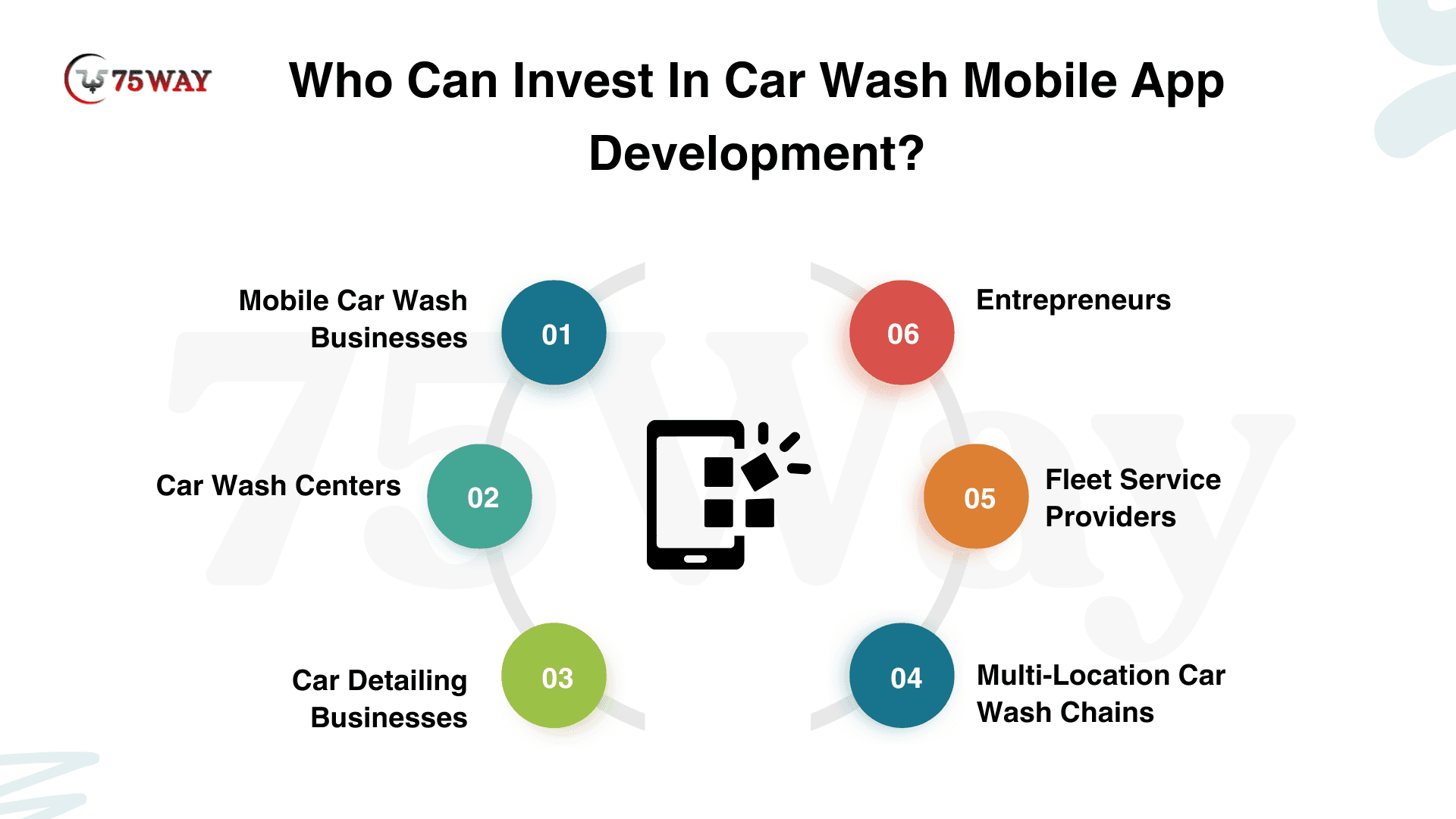
- Mobile Car Wash Businesses
Imagine a technician driving across town only to discover the customer isn't home, or another booking was accidentally scheduled for the same time. These small mistakes happen more often than most business owners realize.
A car wash app solves these problems by allowing customers to choose their location, book an available time slot, receive arrival updates, and pay online. Meanwhile, technicians receive their next job automatically, complete with navigation and customer details. Less time is wasted, and more appointments can be completed every day.
- Car Wash Centers
Weekend mornings are busy. Some customers wait in line, while others drive away because they don't have time to wait.
With a mobile app, customers reserve their preferred time before leaving home. Instead of dealing with unpredictable rushes, your team works from a scheduled booking calendar. Customers spend less time waiting, and your business serves more vehicles throughout the day.
- Car Detailing Businesses
Detailing isn't as simple as choosing a basic wash. One customer wants ceramic coating, another needs paint correction, while someone else only wants an interior deep clean.
A dedicated app lets customers explore every service, compare packages, upload photos of their vehicle, and request custom quotes without endless back-and-forth conversations. That means fewer phone calls and more confirmed bookings.
- Multi-Location Car Wash Chains
Running one location is manageable. Running five or ten is a completely different challenge.
Without centralized software, every location becomes its own operation. Tracking bookings, staff performance, revenue, and customer feedback across multiple branches quickly becomes overwhelming.
A car wash app brings everything together in one dashboard, giving owners a complete view of their entire business without switching between different systems.
- Fleet Service Providers
A logistics company with 200 delivery vans can't book washes one vehicle at a time.
Fleet managers need recurring schedules, service history, invoices, and reports that are generated automatically. A custom car wash platform handles these tasks while ensuring every vehicle stays clean and ready for the next delivery.
- Entrepreneurs
You don't even need to own a car wash business to enter this industry. Many entrepreneurs build marketplace apps that connect customers with local car wash professionals.
Instead of washing cars yourself, your platform helps customers find nearby providers, compare prices, read reviews, and book services. Every completed booking generates revenue through commissions or subscription fees.
Different Types of Car Wash Applications Businesses Can Develop
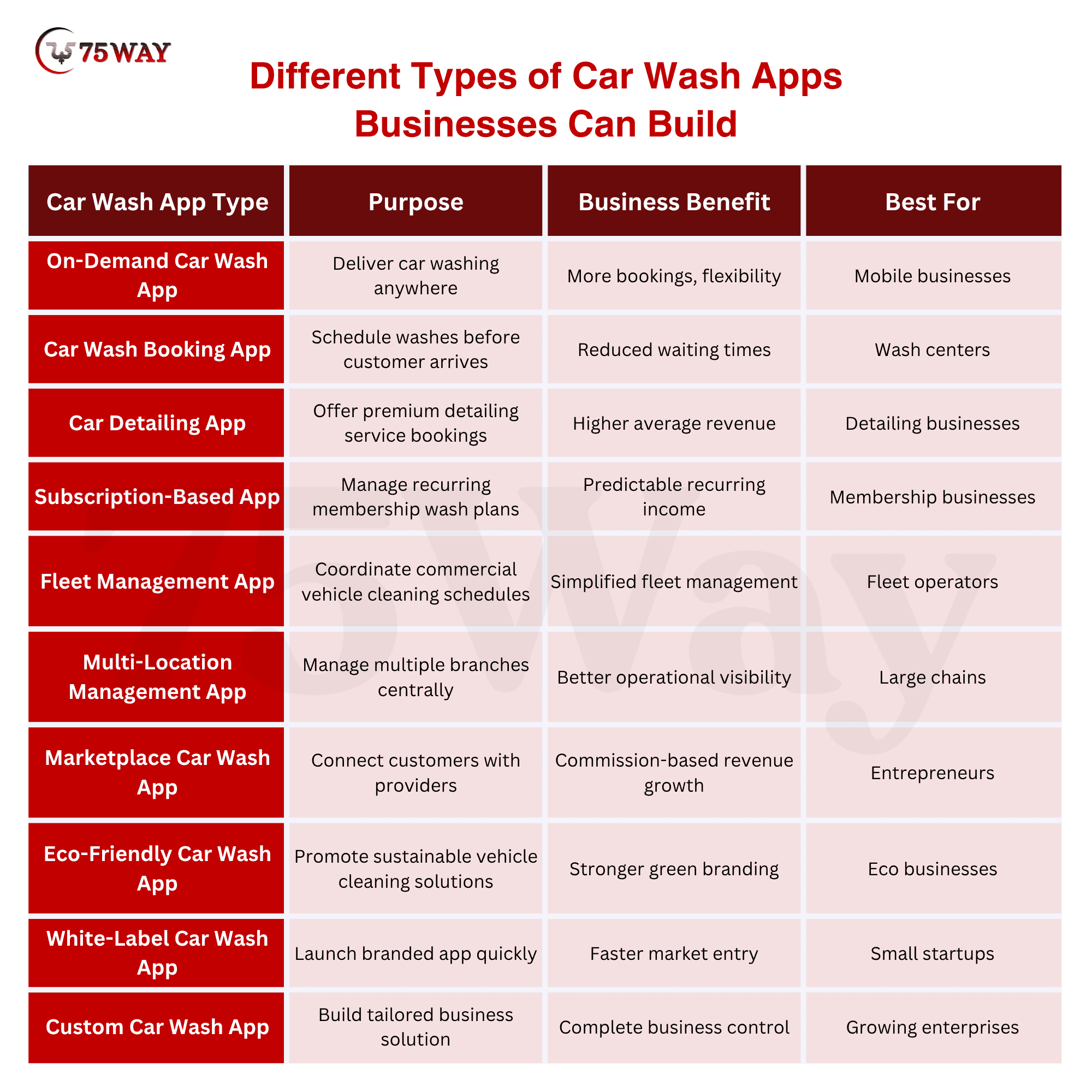
Not every car wash business operates the same way, so not every app should either. A mobile car wash startup has very different needs than a multi-location car wash chain or a fleet service provider. Before starting development, it's important to choose an app model that aligns with your business goals, target customers, and revenue strategy. Below are the most common types of car wash apps businesses build in 2026.
1. On-Demand Car Wash App
An on-demand car wash app lets customers book a wash wherever their vehicle is parked, whether at home, work, or another location. After a booking is confirmed, the on-demand app for booking car wash assigns the nearest available technician to complete the service.
This model eliminates the need for customers to drive to a car wash, making it one of the fastest-growing segments in the industry. It's especially popular in busy cities where people value convenience and time savings.
Best for: Mobile car wash businesses, startups, and local service providers.
2. Car Wash Booking App
A car wash booking app is designed for businesses with one or more physical locations. Instead of waiting in line, customers can browse available services, choose a preferred time slot, pay online, and arrive at their scheduled appointment.
This helps businesses reduce wait times, improve customer satisfaction, and manage daily appointments more efficiently.
Best for: Automatic car washes, self-service facilities, and traditional car wash centers.
3. Car Detailing App
Unlike a standard car wash, detailing services often require customized packages and longer appointments. A car detailing app allows customers to choose premium services such as ceramic coating, paint correction, waxing, interior detailing, or engine cleaning.
Customers can also upload vehicle photos, request personalized quotes, and communicate directly with the service provider before confirming a booking.
Best for: Professional detailing businesses and luxury vehicle service providers.
4. Subscription-Based Car Wash App
Many customers prefer paying a fixed monthly fee instead of purchasing individual washes. A subscription-based app allows businesses to offer membership plans with benefits such as unlimited washes, discounted detailing services, priority booking, or exclusive promotions.
For businesses, recurring subscriptions create predictable revenue while improving customer retention and lifetime value.
Best for: Businesses focused on repeat customers and long-term memberships.
5. Fleet Car Wash Management App
Fleet operators often manage dozens or even hundreds of vehicles, making manual scheduling nearly impossible. A fleet car wash app allows businesses to schedule recurring services, monitor vehicle cleaning history, generate invoices, and manage multiple vehicles from one dashboard.
The platform can also automate reminders to ensure every vehicle stays clean and operational.
Best for: Logistics companies, delivery services, rental agencies, taxi operators, and corporate fleets.
6. Multi-Location Car Wash Management App
Businesses with multiple branches need more than a simple booking application. They need centralized control over operations.
A multi-location app allows owners to monitor appointments, revenue, employee performance, inventory, and customer activity across every location through a single admin dashboard. Managers can also compare branch performance and launch promotions for individual locations.
Best for: Regional and national car wash chains.
7. Marketplace Car Wash App
A marketplace app connects customers with multiple independent car wash businesses instead of offering services directly. Users can compare nearby providers, pricing, customer ratings, available time slots, and service packages before making a booking.
The platform owner earns revenue through booking commissions, featured listings, subscription plans, or advertising.
Think of it as the Uber or Airbnb model for car wash services.
Best for: Entrepreneurs looking to build a scalable service marketplace.
8. Eco-Friendly Car Wash App
As environmental awareness grows, many businesses now specialize in waterless or low-water vehicle cleaning. An eco-friendly car wash app helps customers find sustainable cleaning services, schedule appointments, and learn about environmentally responsible practices.
Some apps even display estimated water savings after each completed service, encouraging customers to make greener choices.
Best for: Businesses offering waterless or environmentally friendly car wash solutions.
9. White-Label Car Wash App
A white-label car wash app is a ready-made solution that businesses can rebrand with their own logo, colors, and business information. Since the core platform is already developed, businesses can launch much faster and at a lower cost than building a custom application from scratch.
However, white-label solutions often have limited customization options, making them less suitable for businesses with unique operational requirements or long-term scalability plans.
Best for: Small businesses, startups, and companies looking for a faster time-to-market.
10. Custom Car Wash App
A custom car wash app is built entirely around your business requirements instead of adapting your operations to existing software. Every feature, workflow, design element, and integration is developed specifically for your business goals.
Whether you need AI-powered scheduling, loyalty programs, fleet management, dynamic pricing, CRM integration, or advanced analytics, a custom solution provides the flexibility to support both your current operations and future growth.
Although the initial investment is higher than a white-label solution, custom development offers greater scalability, stronger branding, better security, and complete ownership of the platform.
Best for: Growing businesses, enterprises, franchises, and companies planning long-term digital expansion.
Must-Have Features of On-Demand Car Wash Booking App Development In 2026
A successful car wash app is much more than an online booking tool. It should make life easier for customers, simplify daily work for service providers, and give business owners complete control over their operations.
To make that happen, a car wash app is usually divided into three main parts: the customer app, the service provider app, and the admin panel. Each one includes features designed for a specific group of users while working together as one connected platform.
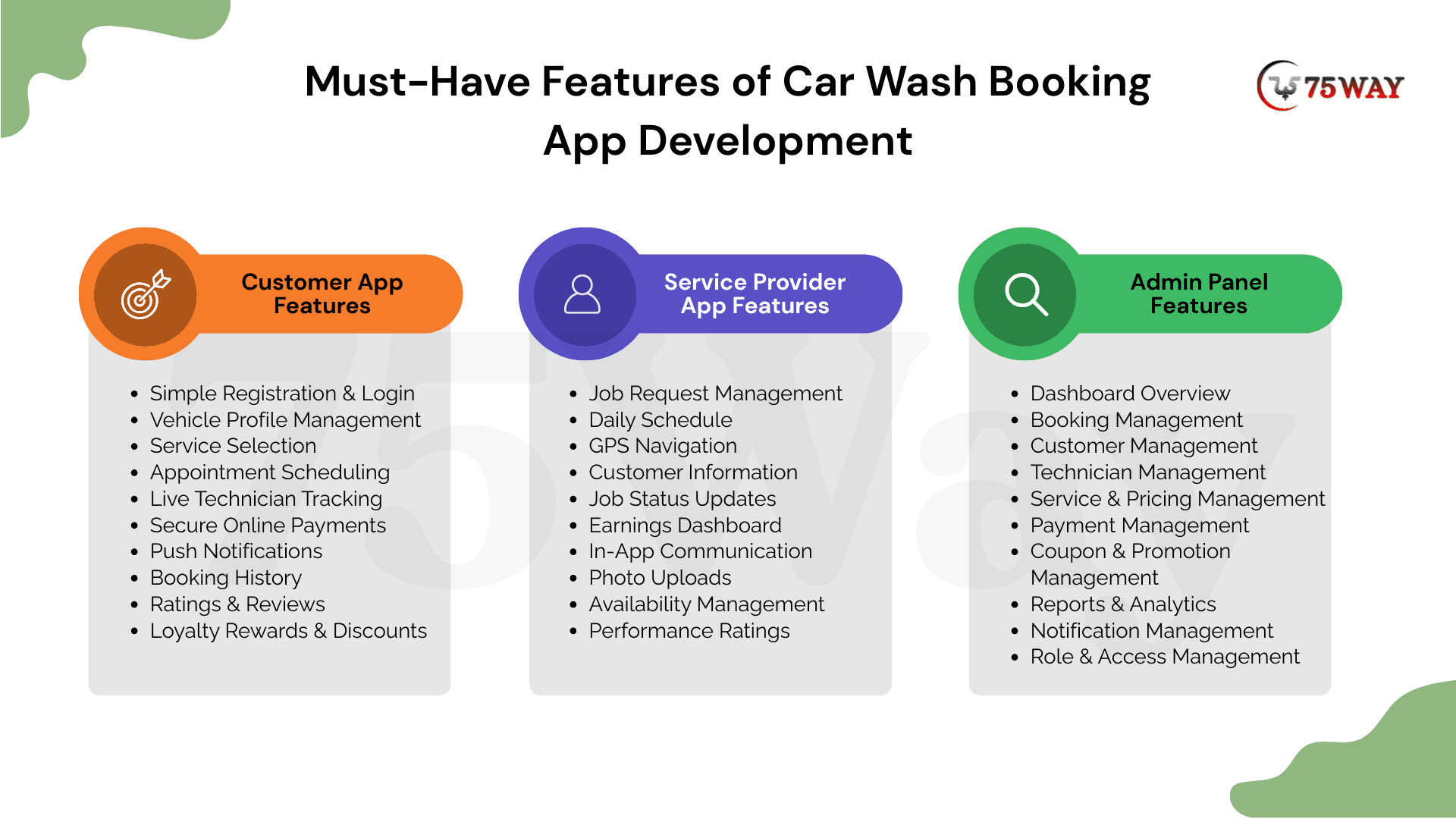
1. Customer App Features
The customer app is the face of your business. It should make booking a car wash simple enough that anyone can complete it within a few minutes.
- Simple Registration & Login: Customers should be able to create an account within a few seconds using their phone number, email, or social login. A simple signup process removes barriers and helps them start booking services quickly.
- Vehicle Profile Management: Customers don't want to enter their car details every time they book a wash. This feature lets them save information like vehicle type, model, and number plate for faster future bookings.
- Service Selection: Customers can explore different washing and detailing options before booking. They can check available packages, understand what's included, and choose the service that matches their vehicle's condition.
- Appointment Scheduling: Instead of calling a car wash centre and waiting for confirmation, customers can select an available time slot directly from the app and book a service whenever it is convenient for them.
- Real-Time GPS Tracking: Customers can see where their assigned technician is and when they are expected to arrive. This creates a better experience because they always know the service status.
- Secure Online Payments: Customers can pay for their service directly through the app using cards, wallets, or other payment options. A smooth payment experience makes booking faster and more convenient.
- Push Notifications: Customers receive important updates like booking confirmation, appointment reminders, technician arrival alerts, and special offers without needing to open the app repeatedly.
- Booking History: Customers can check their previous washes, view invoices, and quickly book the same service again. This makes repeat bookings much easier.
- Ratings & Reviews: After completing a service, customers can share their experience through ratings and reviews. This helps businesses understand customer expectations and improve their services.
- Loyalty Rewards: Customers can earn points, unlock discounts, and receive special offers based on their bookings. Reward programs help businesses encourage repeat customers.
2. Service Provider App Features
The technician app helps service providers stay organized throughout the day. Instead of relying on phone calls or paperwork, every job is managed from a single application.
- Job Request Management: New service requests appear instantly inside the provider app, allowing technicians to review customer requirements, service type, and location before accepting the job.
- Daily Schedule: A clear daily schedule gives technicians a better view of their upcoming appointments. They know where they need to go, what services they need to complete, and how to plan their time.
- GPS Navigation: Reaching customers on time is important for mobile car wash businesses. Built-in navigation helps technicians find the fastest route and avoid wasting time searching for locations.
- Customer Information: Before arriving at a customer's location, technicians can review important details such as vehicle type, selected package, address, and special instructions to better prepare for the service.
- Job Status Updates: From accepting a request to completing the wash, technicians can update each stage of the job. Customers stay informed without needing to call for updates.
- Photo Uploads: Before-and-after photos allow technicians to show the condition of the vehicle before service and the results after completion. It also builds trust between customers and businesses.
- Earnings Dashboard: A personal earnings section allows service providers to track completed jobs, payments, bonuses, and overall income without maintaining separate records.
- Availability Management: Technicians can control when they are available for bookings. This makes it easier for businesses to assign jobs based on real-time availability.
- In-App Communication: A built-in communication option allows technicians and customers to discuss arrival details, parking instructions, or service-related questions without switching between different apps.
- Performance Tracking: Service providers can review customer ratings, completed jobs, and feedback to understand their performance and improve the quality of their work.
3. Admin Panel Features
The admin panel gives business owners complete control over the entire platform. Instead of managing operations manually, everything can be monitored from one centralized dashboard.
- Business Dashboard: The admin dashboard works as the command center of the car wash business. Owners can view bookings, revenue, customers, and team activity from one place.
- Booking Management: Managing hundreds of appointments becomes easier with a centralized system. Admins can track active bookings, make changes, handle cancellations, and monitor service progress.
- Customer Management: All customer details, booking history, preferences, and feedback stay organized in one place. This allows businesses to deliver more personalized experiences.
- Technician Management: Owners can manage their entire service team by adding new technicians, assigning work, checking availability, and reviewing individual performance.
- Service Management: Businesses can easily update their offerings whenever needed. Whether adding a new detailing package or changing prices, everything can be managed directly from the panel.
- Payment Management: The admin panel keeps payment records organized, making it easier to monitor transactions, process refunds, and maintain accurate financial records.
- Promotion Management: Businesses can create targeted offers, discount codes, and seasonal campaigns to attract new customers and encourage existing customers to book again.
- Reports & Analytics: Detailed reports help owners understand what is happening in their business. They can identify popular services, track revenue trends, and make decisions based on real data.
- Notification Management: Admins can send booking reminders, promotional messages, and important updates to customers without relying on manual communication.
- Role Management: Different team members can be given different access levels based on their responsibilities. This keeps sensitive business information protected while allowing smooth collaboration.
Advanced AI-Powered Features Required To Build Car Washing App In 2026
To meet customers’ expectations, car wash businesses are adding AI-powered features that make their apps smarter and easier to use. These features help automate routine tasks, improve customer experiences, and support better business decisions. Here are some AI features that can make a car wash app more advanced in 2026.
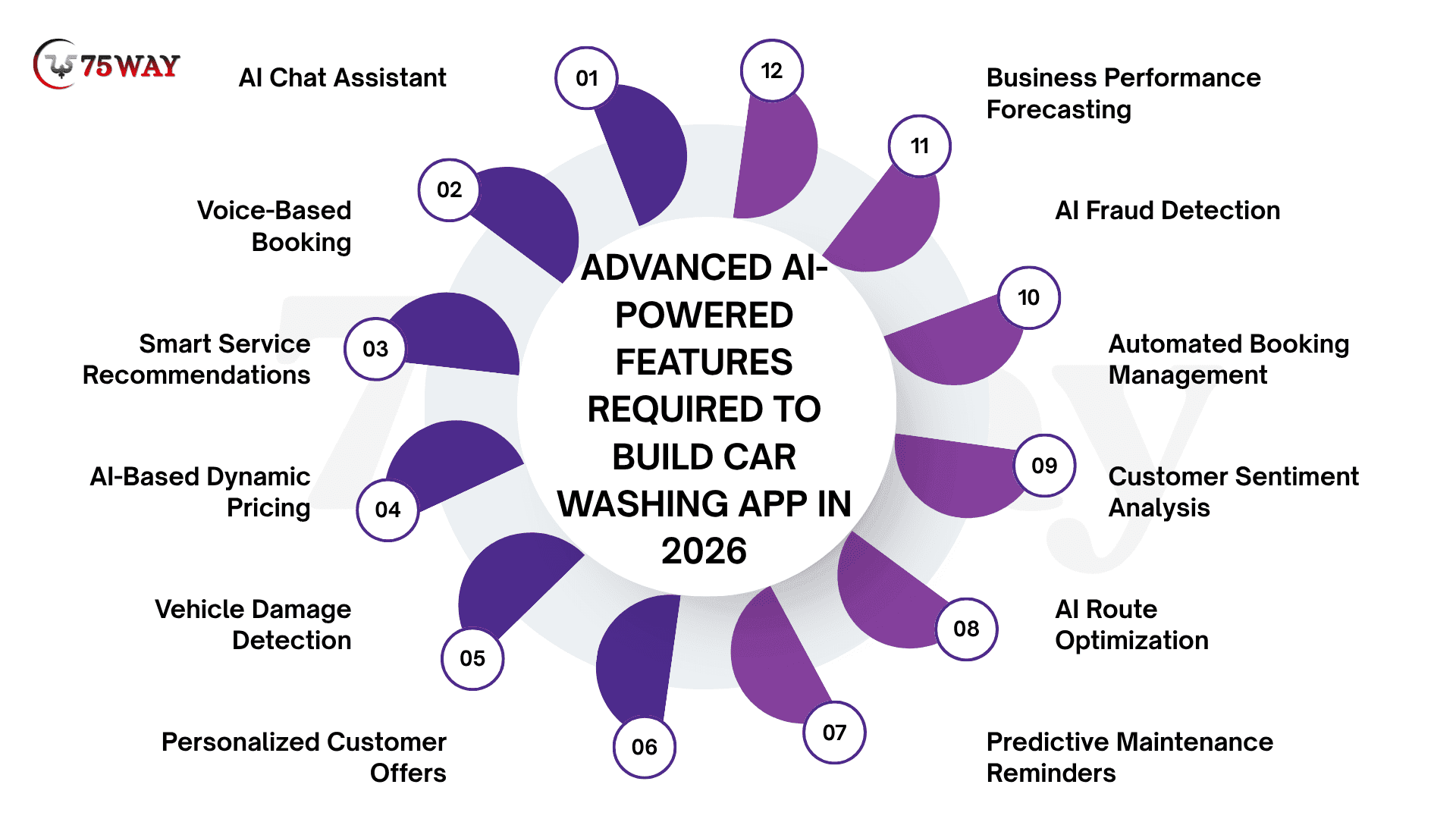
- Smart Chat Assistant: Imagine a customer checking your app late at night and asking, "How much does interior detailing cost?" or "Can I book a wash tomorrow morning?" Instead of waiting until business hours, an AI assistant can answer instantly and guide customers through the booking process.
- Voice Booking: Not every customer wants to scroll through menus and fill out forms. Voice booking allows users to simply say what they need, such as "Book an exterior wash at my office tomorrow at 10 AM," making the process faster and more convenient.
- Personalized Service Suggestions: Choosing the right car wash service is not always easy. A customer may not know whether their vehicle needs a basic wash, interior cleaning, or complete detailing. The system can study past bookings, vehicle details, and preferences to suggest the most suitable option.
- Smart Pricing Adjustments: Weekends, holidays, and peak hours often bring higher demand for car wash services. A smart pricing system helps businesses understand these patterns and adjust prices based on demand, availability, and customer activity.
- Vehicle Condition Analysis: Before booking expensive detailing work, customers can share vehicle images through the app. The system reviews visible marks, stains, or scratches, helping businesses understand the condition and recommend the right service.
- Personalized Deals & Offers: A discount that works for one customer may not interest another. By understanding booking habits and service preferences, businesses can send offers that feel more relevant, such as maintenance discounts for regular customers.
- Automatic Service Reminders: Many vehicle owners delay their next wash simply because they forget. The system can look at previous service records and send reminders when it is likely time for another cleaning.
- Smarter Technician Routes: Reaching multiple customers in different locations can become difficult for mobile car wash teams. The system can consider traffic, distance, and appointment timings to suggest better routes and reduce unnecessary driving.
- Customer Feedback Understanding: A simple review can reveal important business insights. The system can analyze customer comments, identify repeated concerns, and help owners understand what customers appreciate or where improvements are needed.
- Intelligent Appointment Management: Handling a growing number of bookings manually can create scheduling issues. The system can organize appointments, balance technician workloads, and reduce chances of overlapping bookings.
- Payment Risk Detection: Digital payments make the booking process easier, but businesses still need protection from suspicious activity. The system can identify unusual transaction patterns and help reduce payment-related risks.
- Business Performance Forecasting: Knowing future demand helps businesses prepare better. The system can study booking trends, customer behavior, and revenue patterns to help owners plan staffing, promotions, and growth strategies.
- Smart Chat Assistant: Customers often have quick questions before booking a service. A smart assistant can provide instant answers about pricing, available services, and appointment details without making customers wait for support.
- Voice-Based Booking: Some customers prefer speaking instead of typing. Voice booking allows them to simply describe their requirements, such as service type, location, and preferred time, making the booking process faster.
Car Wash App Development Process: Step-by-Step Process
Building a car wash app involves much more than creating a booking screen. You need to design a complete ecosystem where customers can request services, technicians can manage jobs, and business owners can control operations from one place.
A successful car wash platform usually includes three connected parts:
- Customer App for booking and payments
- Service Provider App for managing assigned jobs
- Admin Panel for controlling the entire business
Here is how the development process works from idea to launch.
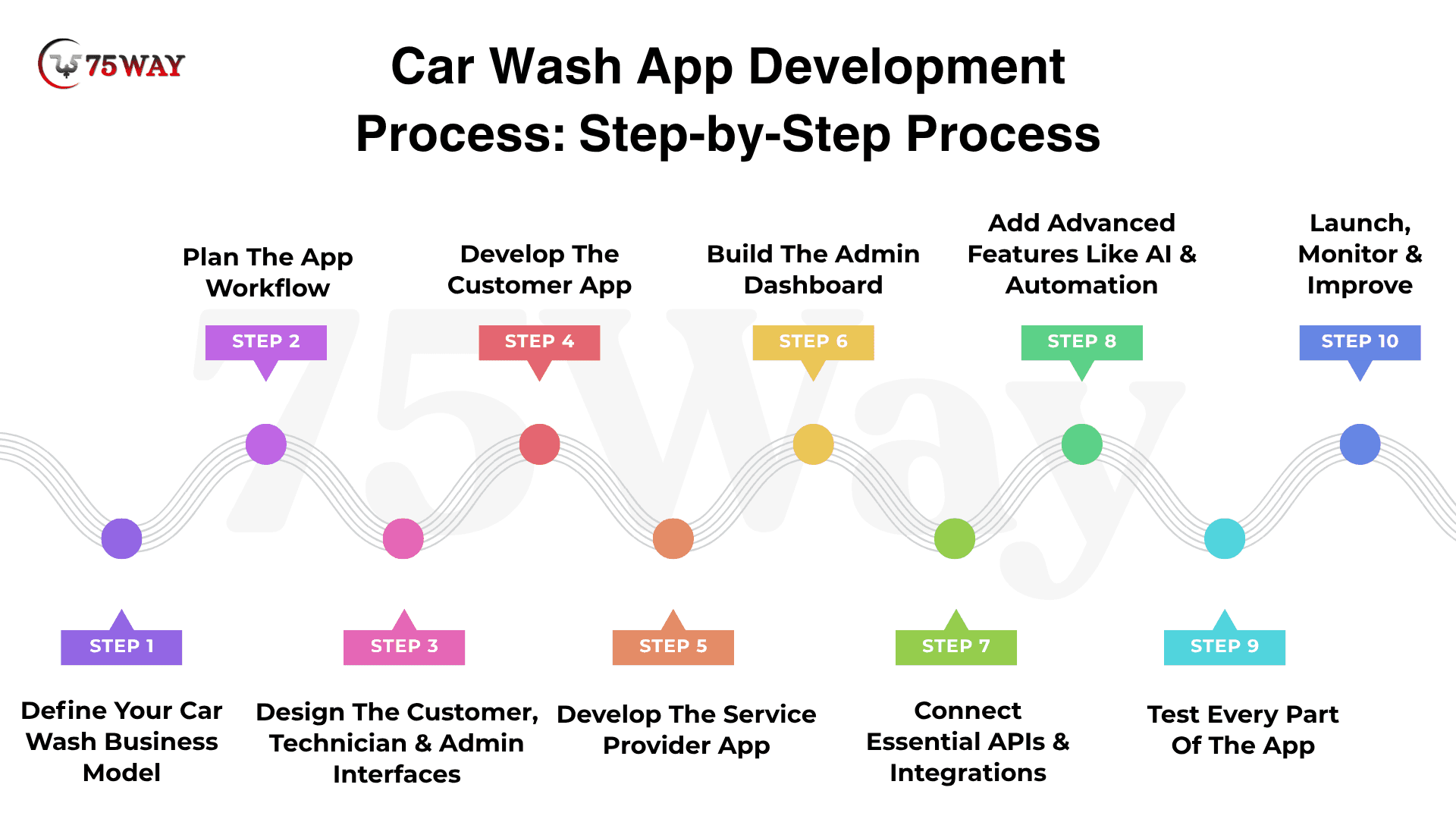
1. Define Your Car Wash Business Model
The first step is deciding how your car wash app will operate because the development approach depends on your business model.
For example, a mobile car wash business needs features like technician tracking, route planning, and location-based bookings. A marketplace app needs provider listings, commissions, and customer reviews. A car wash chain may require multi-location management and centralized reporting.
At this stage, you finalize:
- Type of car wash app you want to build
- Target customers
- Revenue model
- Required user roles
- Core features
A clear business model prevents unnecessary features and helps create the right app structure.
2. Plan The App Workflow
Before development starts, the complete user journey is mapped out. For example, a typical customer journey looks like:
Customer opens app → selects service → adds vehicle details → chooses location → selects time slot → makes payment → tracks technician → receives service completion update.
Similarly, the technician workflow includes:
Accept booking → view customer details → navigate to location → update job status → complete service → receive payment details.
This stage helps developers understand how every feature should connect and ensures there are no gaps during development.
3. Design The Customer, Technician & Admin Interfaces
A car wash app has different users, so each interface needs a different design approach. The customer app focuses on simplicity. Users should be able to book a wash in a few taps.
The technician app focuses on speed. Service providers need quick access to job requests, routes, customer details, and earnings.
The admin panel focuses on control. Business owners need dashboards to manage bookings, staff, payments, and reports.
Designers create wireframes and prototypes to show how each screen will work before development begins.
4. Develop The Customer App
Once the app structure and design are finalized, development starts with building the customer-side experience. The focus is on making every step feel simple, from opening the app for the first time to completing a booking.
Developers first create the app screens and connect them with the backend system where customer information, services, availability, and bookings are stored. The booking flow is then built step-by-step so customers can move smoothly from selecting a service to confirming their appointment.
During this stage, the team also connects important services like payment gateways, location systems, and notifications to ensure customers receive real-time updates. Every interaction is tested from a customer's perspective to remove unnecessary steps and make booking faster.
5. Develop The Service Provider App
The technician app connects customers with the people completing the service.
During development, the team focuses on creating a practical workflow that matches how a car wash business operates in real life.
- Understanding Technician Workflow: Before writing code, developers study how technicians receive jobs, travel to locations, complete services, and update customers. This helps create an app flow that feels natural instead of forcing technicians to follow complicated steps.
- Connecting Customer & Provider Systems: The provider app is connected with the customer app so every action stays synchronized. When a customer books a service, the technician receives the request, and when the job status changes, customers get updates instantly.
- Building For Real-World Usage: Developers consider situations technicians face every day, such as poor internet connectivity, multiple bookings, changing locations, and last-minute updates. The app is built to handle these challenges smoothly.
- Testing Complete Service Journey: Before launch, the team tests the complete process from booking acceptance to service completion. This ensures technicians can manage jobs easily and customers receive a reliable experience.
The main goal is to create an app that works like a digital assistant for technicians, helping them spend less time managing tasks and more time completing quality car wash services.
6. Build The Admin Dashboard
The admin dashboard is where the entire car wash business comes together. Unlike customer and technician apps that focus on individual tasks, the dashboard gives business owners a complete view of what is happening across their operations.
At this stage, developers focus on building a central system that collects and organizes data from different parts of the platform. The challenge is not just displaying information but making it useful for everyday business decisions.
- Planning Business Control: The development team first understands how owners want to manage their operations. This includes deciding how bookings, technicians, payments, services, and customer data should be managed within the dashboard.
- Creating A Central Management System: Developers connect the dashboard with the customer and provider applications so business owners can monitor activities without switching between different platforms. Every update made through the apps reflects in the admin panel.
- Designing Clear Data Views: A good dashboard should not overwhelm owners with unnecessary information. Developers arrange important business insights in a simple way so owners can quickly understand bookings, revenue, service performance, and operational issues.
- Ensuring Security & Scalability: Since the dashboard handles important business information, developers implement secure access controls and build the system in a way that can support more customers, technicians, and locations as the business grows.
The goal is to create a powerful control center that helps car wash businesses manage daily operations, identify growth opportunities, and make smarter decisions with complete visibility.
7. Connect Essential APIs & Integrations
A car wash app depends on several external services to work smoothly.
Developers integrate:
- Payment Gateways: To process secure online payments.
- Maps & GPS: To provide location selection, technician tracking, and route guidance.
- Push Notifications: To send booking updates, reminders, and promotional messages.
- Cloud Storage: To store customer data, vehicle images, and service records securely.
- Analytics Tools: To understand bookings, revenue, and user behavior.
These integrations make the app more reliable and convenient.
8. Add Advanced Features Like AI & Automation
Once the core app is ready, businesses can add advanced features to improve efficiency.
Examples include:
- AI chat assistants for customer support
- Smart service recommendations
- Automated appointment scheduling
- Route optimization for technicians
- Vehicle image analysis
- Predictive maintenance reminders
- Personalized offers
These features help businesses provide a more personalized experience while reducing manual work.
9. Test Every Part of The App
Testing is one of the most important stages because a car wash app involves multiple users and real-time activities.
The development team tests:
- Booking accuracy
- Payment processing
- GPS tracking
- Notifications
- App speed
- Data security
- Admin operations
- Technician workflows
Testing ensures customers can book smoothly and businesses can manage operations without errors.
10. Launch, Monitor, & Optimize Mobile App
After successful testing, the app is launched on the App Store and Google Play Store.
But development does not stop here. After launch, businesses monitor:
- Customer feedback
- App performance
- Booking trends
- Technical issues
- New feature requirements
Regular improvements help the app stay competitive and support business growth.
What’s The Cost For Car Wash App Development in 2026?
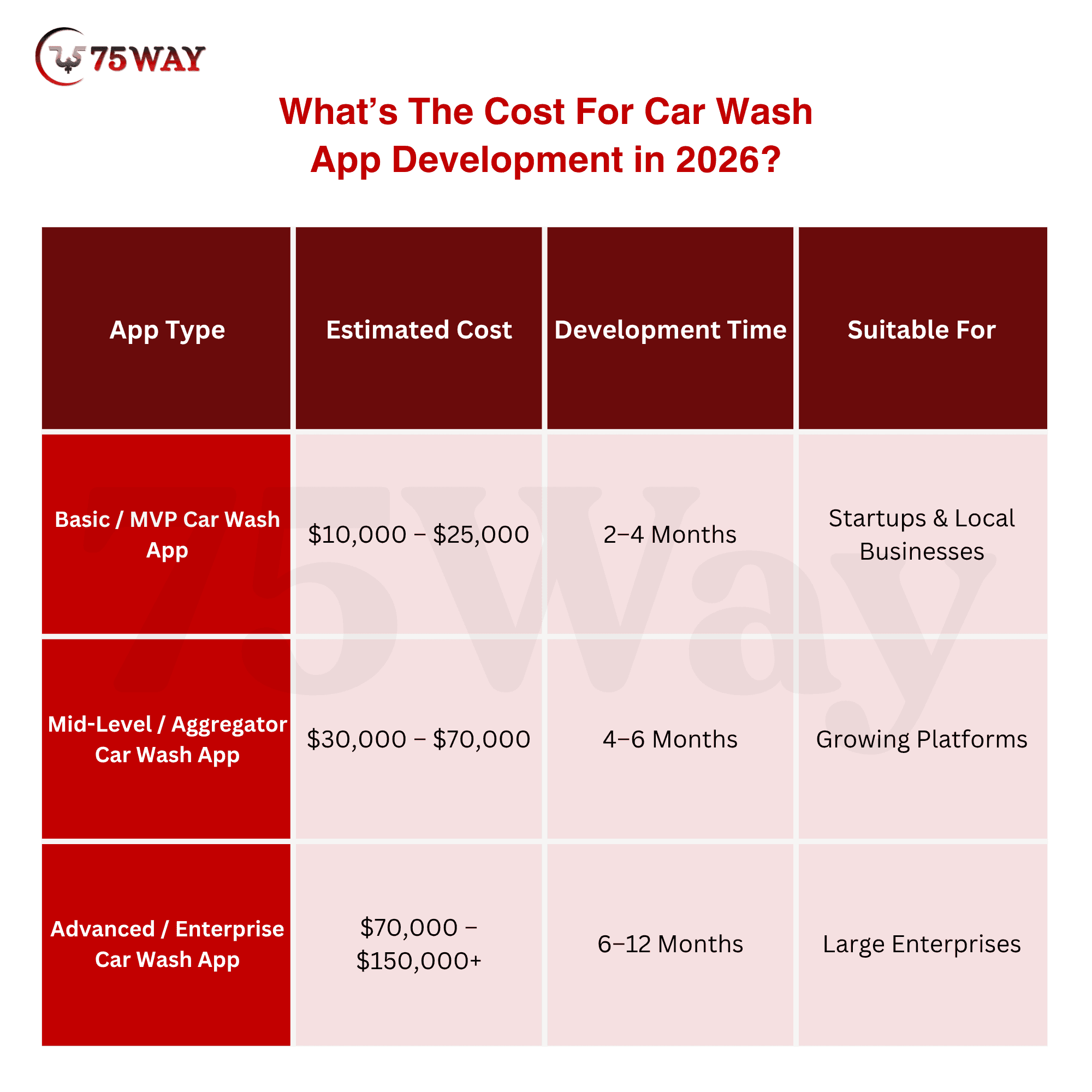
The cost of developing a car wash app depends on what type of platform you want to build, the number of features, app complexity, development team location, and the level of customization required.
On average, the development cost can range from $10,000 for a basic MVP app to $150,000+ for an advanced enterprise-level car wash platform. Let's break down the estimated cost based on different development requirements.
Basic / MVP Car Wash App ($10,000 – $25,000)
A basic MVP is designed for businesses that want to test their idea in the market before investing in a full-scale platform.
This version usually includes essential functionality needed to start accepting bookings, such as customer registration, service selection, appointment scheduling, basic payments, and an admin panel for managing operations.
It is a suitable option for startups, local car wash businesses, or entrepreneurs who want to validate their business model with minimum investment.
Mid-Level / Aggregator Car Wash App ($30,000 – $70,000)
A mid-level app is built for businesses that want more than simple booking functionality. This model usually connects customers with multiple service providers or supports growing car wash operations.
This option works well for on-demand car wash platforms and businesses planning to expand their customer base.
Advanced / Enterprise Car Wash App
Estimated Cost: $70,000 – $150,000+
An enterprise-level car wash app is built for large businesses, multi-location brands, and platforms that require advanced automation.
This type of platform requires more development time, stronger infrastructure, and continuous optimization to support large-scale operations.
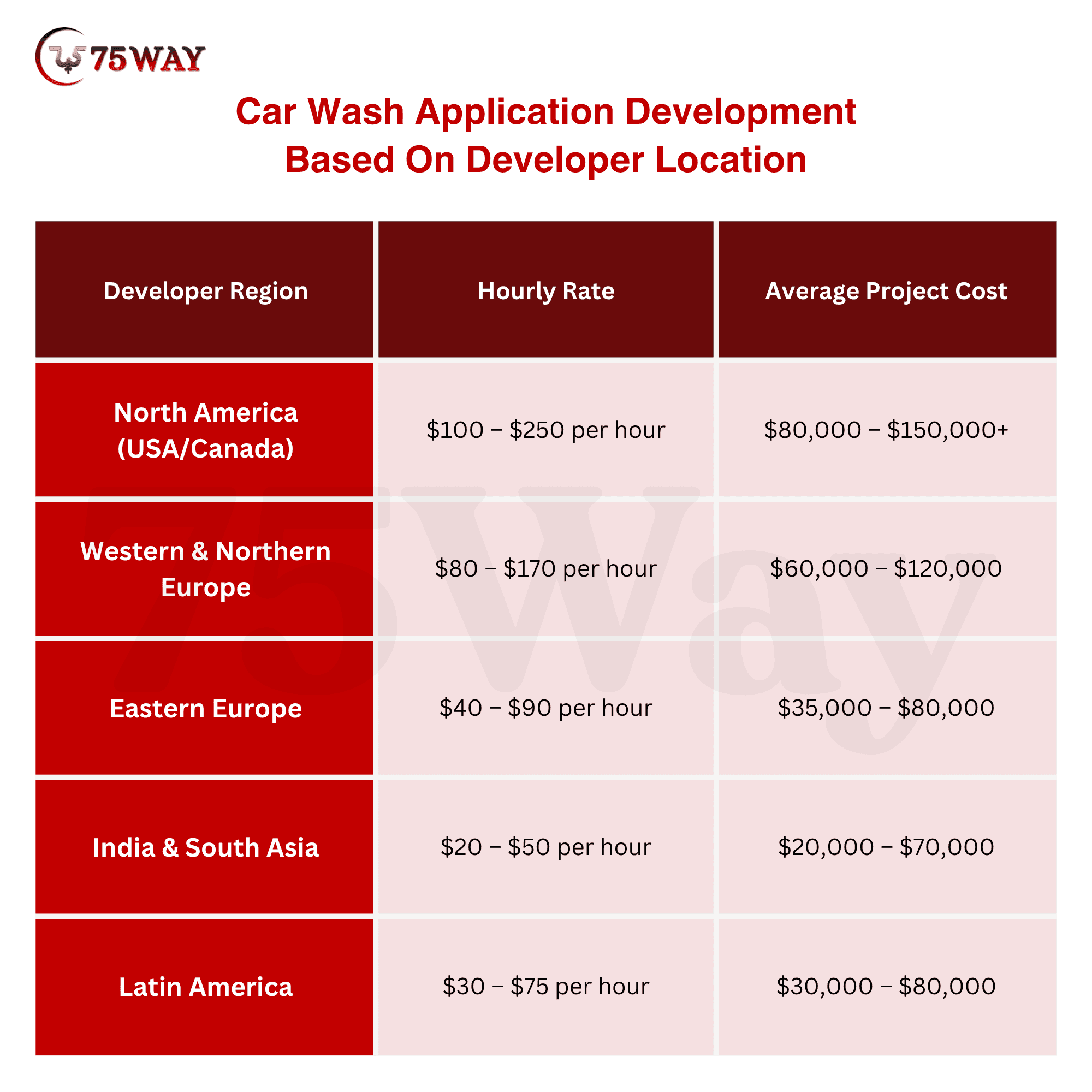
Car Wash Application Development Based On Developer Location
The location of your development team plays a major role in determining the overall app development budget. Hourly rates vary because of differences in market demand, developer experience, and local operating costs.
North America (USA/Canada): $100 – $250 per hour
Hiring developers from North America usually comes with higher hourly rates because of advanced technical expertise and higher labour costs.
Western & Northern Europe: $80 – $170 per hour
European development teams offer strong technical capabilities with pricing generally lower than North America.
Eastern Europe: $40 – $90 per hour
Eastern European developers are known for providing quality development services at comparatively affordable rates.
India & South Asia: $20 – $50 per hour
Development teams in India and South Asia often provide cost-effective solutions while maintaining strong technical expertise. Hiring from this region can reduce overall development costs.
Latin America: $30 – $75 per hour
Latin American developers offer a balance between cost and quality, making the region a popular choice for outsourcing software development projects.
Cost To Create Car Wash App Based On Development Stage
Understanding the cost at each development stage helps businesses plan their budget more effectively.
1. Research & Technical Documentation
Estimated Cost: $1,000 – $3,000
Before development begins, the project needs a clear direction. This stage focuses on understanding your business idea, target users, competitors, and technical requirements.
Timeframe: 1–2 weeks
2. UI/UX Design
Estimated Cost: $1,500 – $5,000
A car wash app needs a simple, engaging design so customers can book services without confusion.
During this stage, designers create the complete visual experience for customers, technicians, and administrators.
Timeframe: 2–4 weeks
3. MVP / Core App Development
Estimated Cost: $10,000 – $40,000
This is where the approved designs are converted into a working application. Developers build the main functionality required for users to interact with the platform.
Timeframe: 6–10 weeks
4. Advanced Feature Integration
Estimated Cost: $10,000 – $50,000
Once the core application is ready, advanced features are added to improve user experience and business efficiency.
These features help transform a basic car wash app into a more powerful platform.
Timeframe: 4–8 weeks
5. Quality Assurance & Testing
Estimated Cost: $2,000 – $5,000
Before launching the app, every part of the platform needs proper testing to ensure smooth performance. The testing team checks whether customers, technicians, and admins can use the app without errors.
Timeframe: 2–3 weeks
Factors That Can Impact Cost of Building Car Washing App Development
Several elements can affect the overall budget of a car wash app. The final cost depends on the level of customization, number of platforms, advanced technologies, and additional features required for your business goals. Understanding these factors helps you plan your investment better and choose the right development approach.
- Number of Platforms: Building apps for iOS, Android, and web requires extra development time, testing, and maintenance.
- Custom UI/UX Design: Unique designs with personalized layouts and interactions increase design complexity and development effort.
- Third-Party Integrations: Connecting payment gateways, maps, CRMs, and other tools adds development and testing requirements.
- AI & Automation Features: Advanced capabilities like recommendations, chat assistants, and automation require additional technology expertise.
- GPS & Real-Time Tracking: Live location features need complex mapping systems and real-time data processing.
- Multi-Location Support: Managing multiple branches requires additional systems for locations, staff, bookings, and reporting.
- Subscription Models: Recurring payments need billing systems, plan management, and subscription tracking functionality.
- Advanced Reporting Systems: Detailed analytics require additional data collection, processing, and dashboard development.
- Ongoing Maintenance & Updates: Regular improvements, security fixes, and updates add long-term operational costs.
How To Calculate Car Wash App Development Cost?
Calculating the cost of a car wash app is not as simple as adding the price of a few features. The total budget depends on multiple factors, including the number of apps you need, development hours, feature complexity, and the team you hire.
A simple way to estimate the cost is:
Total Development Cost = Development Hours × Developer Hourly Rate
For example, if your app requires 1,000 development hours and the developer charges $50 per hour, the estimated development cost would be:
1,000 × $50 = $50,000
However, the total hours depend on your app requirements. Here is how businesses can estimate the cost more accurately:
1. Calculate Based On App Complexity
First, decide what type of car wash app you want to build.
- Basic MVP App: Requires fewer screens and essential features like booking, payments, and basic admin control. Development usually takes less time and costs less.
- Mid-Level App: Includes more advanced workflows such as technician management, GPS tracking, notifications, reviews, and better business controls.
- Advanced Enterprise App: Requires complex systems like AI features, automation, multi-location support, analytics, CRM integration, and custom solutions.
2. Estimate Development Hours By Module
A car wash app usually includes multiple parts, and each part requires different development time.
- Customer App: Booking flow, vehicle management, payments, and customer accounts require development hours.
- Service Provider App: Technician workflows, job management, navigation, and service updates add additional development effort.
- Admin Dashboard: Business management tools, reports, user controls, and operational features require separate development time.
- Backend Development: The backend connects all applications and manages data, security, notifications, and integrations.
3. Add Design & Testing Costs
Development is only one part of the budget. A complete app also requires:
- UI/UX Design: Creating user flows, wireframes, and app interfaces.
- Quality Testing: Finding bugs, improving performance, and ensuring the app works properly across devices.
- Deployment: Preparing the application for app stores and production use.
4. Consider Developer Location
Hourly rates vary significantly depending on where your development team is located.
For example:
- North America: $100 – $250/hour
- Western Europe: $80 – $170/hour
- Eastern Europe: $40 – $90/hour
- India & South Asia: $20 – $50/hour
- Latin America: $30 – $75/hour
The same app may have different development costs depending on the team location.
Example Car Wash App Cost Calculation
Suppose you want to build a mid-level car wash app:
- Customer app: 500 hours
- Service provider app: 300 hours
- Admin dashboard: 200 hours
- Backend & integrations: 300 hours
- Testing and improvements: 100 hours
Total Estimated Hours: 1,400 hours
If your development team charges $50/hour:
1,400 × $50 = $70,000
So, the estimated development cost would be around $70,000.
This calculation gives businesses a realistic starting point before planning their car wash app development budget. The exact cost can change after finalizing features, technology requirements, and customization needs.
How To Reduce The Cost of Creating A Mobile Car Wash App
Building a mobile car wash app doesn't always require a six-figure budget. The smartest approach isn't cutting corners. It's investing in the features that deliver immediate value and postponing everything else until your business starts growing. Here are practical ways to reduce development costs without sacrificing quality.
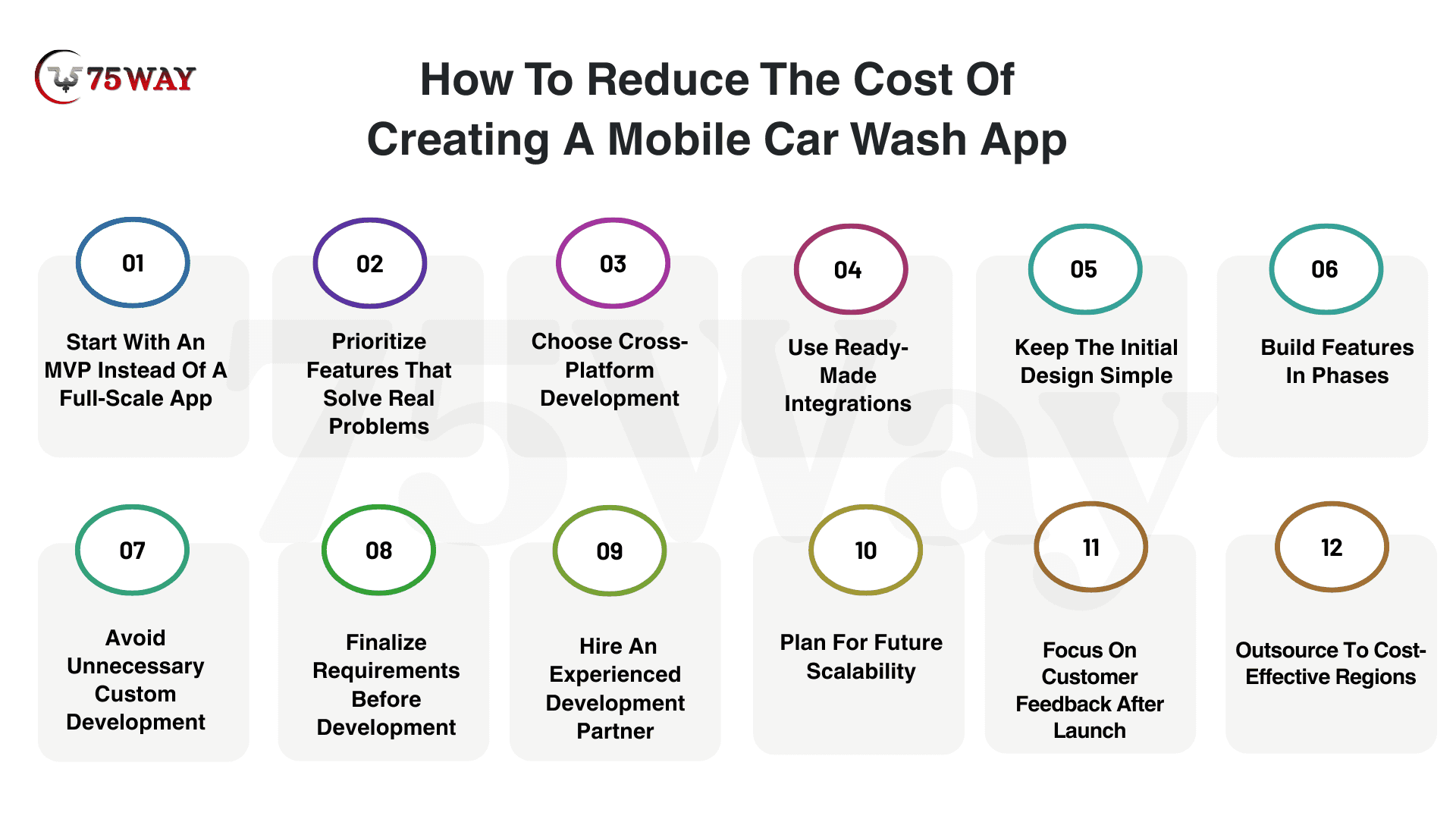
- Start With An MVP Instead Of A Full-Scale App
Many businesses try to launch with every feature they can imagine. This often increases both development time and cost. Start with the core functionality customers actually need, gather real feedback, and introduce advanced features in future updates.
- Prioritize Features That Solve Real Problems
Every feature should have a clear business purpose. Before adding AI, subscriptions, or advanced analytics, ask whether they will improve bookings, customer experience, or daily operations. If the answer is no, consider adding them later.
- Choose Cross-Platform Development
Instead of building separate apps for iOS and Android from scratch, use cross-platform frameworks like Flutter or React Native. This approach allows developers to share much of the same code, reducing both development time and overall project costs.
- Use Ready-Made Integrations
There's no need to build everything from scratch. Services like payment gateways, maps, authentication, and push notifications already have reliable APIs that can be integrated into your app much faster than developing custom solutions.
- Keep The Initial Design Simple
A clean, intuitive interface is more valuable than complex animations or highly customised screens. A simple design takes less time to build, performs better, and often provides a smoother user experience.
- Build Features In Phases
Launching every feature in Version 1 is rarely necessary. Start with essential functionality, release the app, study customer behaviour, and then invest in advanced features based on real business needs rather than assumptions.
- Avoid Unnecessary Custom Development
Custom functionality should be reserved for features that genuinely differentiate your business. If a standard solution works well, using it can save both time and development costs.
- Finalize Requirements Before Development
Changing requirements after development begins often leads to additional costs. Spending time on planning, wireframes, and technical documentation helps reduce revisions and keeps the project on schedule.
- Hire An Experienced Development Partner
Choosing the cheapest development team can become expensive if poor-quality code leads to delays or major rework. An experienced team can recommend the right technology, avoid common mistakes, and deliver a more scalable solution from the beginning.
- Plan For Future Scalability
Your app should be built with future growth in mind. A scalable architecture makes it easier to add new features, support more users, or expand into new locations without rebuilding the entire platform later.
- Focus On Customer Feedback After Launch
Instead of guessing what users want, launch the app, collect customer feedback, and improve it based on real usage. This prevents spending money on features that customers may never use.
- Outsource To Cost-Effective Regions
Developer rates vary significantly across the world. Hiring an experienced team in regions like India or South Asia can reduce development costs by up to 60% compared with North America or Western Europe while still delivering high-quality results, provided you choose a reputable development partner.
Monetization Models To Generate Revenue From A Car Wash App
When you launch a car wash app, it is only half the journey. The real success comes from choosing a revenue model that matches your business goals. Some businesses earn directly from customers, while others generate recurring income through subscriptions, partnerships, or marketplace commissions. Many successful car wash platforms combine multiple monetization models to create steady and long-term revenue, which are defined below.
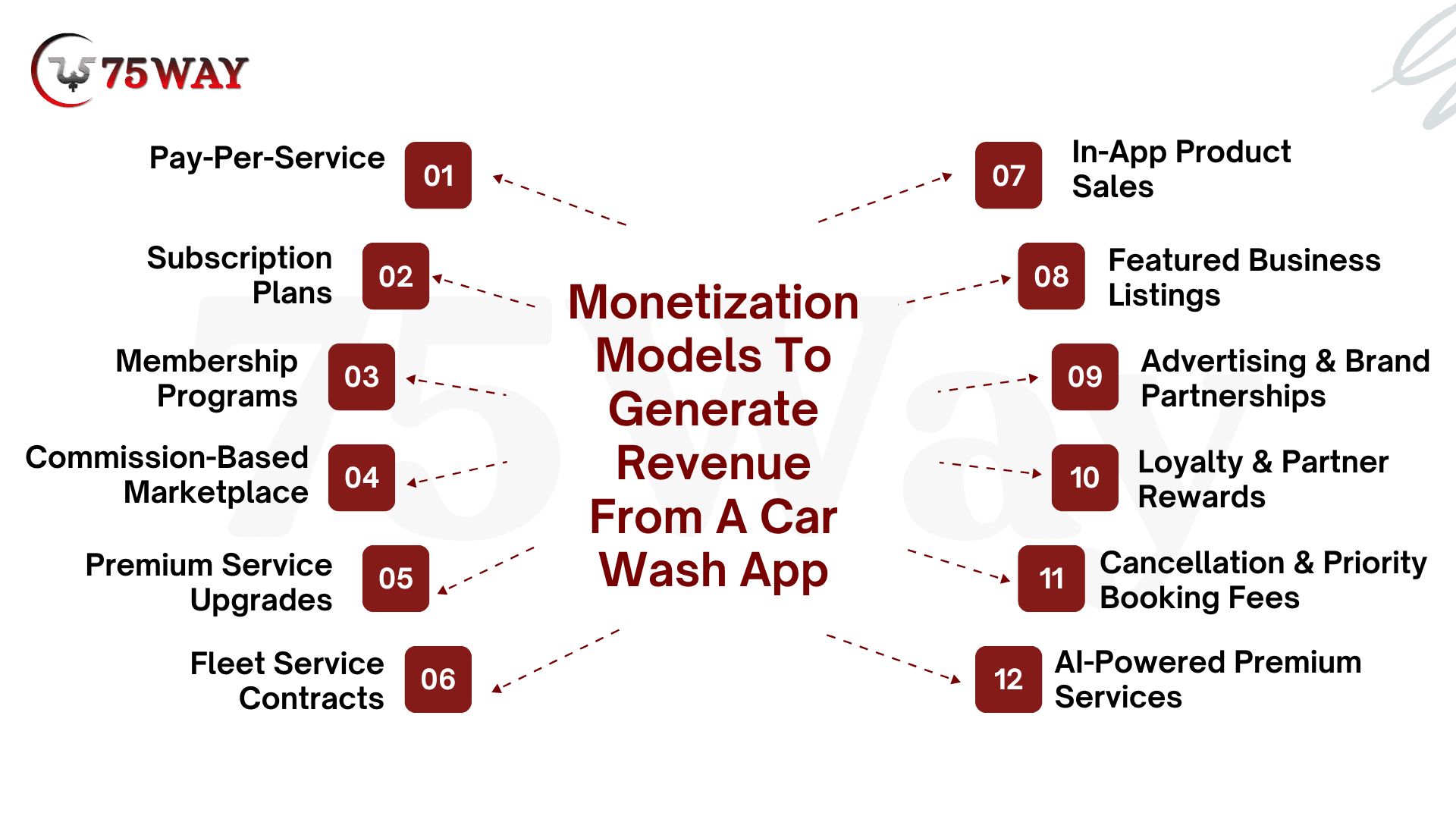
1. Pay-Per-Service
Customers pay every time they book a car wash or detailing service through the app. The more bookings you receive, the more revenue your business generates.
Example: If your average order value is $30 and your app receives 50 bookings per day, your daily revenue would be $1,500. That's around $45,000 per month before operating expenses.
2. Subscription Plans
Offer weekly or monthly subscription plans where customers pay a fixed fee for regular car washes. This creates recurring revenue, making monthly income easier to predict.
Example: If 300 customers subscribe to a $40 monthly plan, your business generates $12,000 every month before providing additional services.
3. Membership Programs
Members pay a recurring fee to receive exclusive benefits such as discounted services, priority booking, or complimentary upgrades. This encourages customer loyalty while generating steady revenue.
Example: If 500 customers purchase a $10 monthly membership, your business earns $5,000 per month before any service bookings.
4. Commission-Based Marketplace
If your app connects customers with independent car wash professionals, you can charge a commission on every completed booking without performing the service yourself.
Example: A service costs $40, and your platform charges a 20% commission. You earn $8 from every completed booking. With 200 bookings per day, that's $1,600 in commission revenue per day.
5. Premium Service Upgrades
Customers often book a basic wash but decide to add services like waxing, ceramic coating, interior detailing, or engine cleaning during checkout.
Example: If 20 customers upgrade their booking by $15 each day, your business earns an additional $300 daily, or approximately $9,000 per month.
6. Fleet Service Contracts
Businesses with delivery vans, taxis, rental cars, or company vehicles often require regular cleaning. Long-term contracts provide consistent income throughout the year.
Example: A logistics company signs a contract worth $2,500 per month. Just 10 fleet clients can generate $25,000 in recurring monthly revenue.
7. In-App Product Sales
The app can sell car care products such as microfiber towels, cleaning kits, wax, tyre shine, and air fresheners alongside car wash services.
Example: If 15 customers purchase products worth $20 each day, your business generates $300 in daily product sales, creating another reliable revenue stream.
8. Featured Business Listings
Marketplace apps can charge local car wash businesses to appear at the top of search results or featured sections.
Example: If 40 businesses pay $75 per month for featured placement, your platform earns $3,000 in recurring monthly advertising revenue.
9. Advertising & Brand Partnerships
Automotive brands, insurance providers, fuel stations, and accessory companies may pay to promote their products inside your app.
Example: A tyre company pays $1,200 per month to advertise in your app, creating passive income without increasing operational costs.
10. Loyalty & Partner Rewards
Partner with cafés, petrol stations, parking operators, or automotive brands to offer reward points and exclusive discounts. Partners often pay referral or promotional fees for every successful customer.
Example: If a fuel station pays $3 for every successful referral and your app generates 600 referrals each month, your business earns an additional $1,800 monthly.
11. Cancellation & Priority Booking Fees
Some businesses charge customers for last-minute cancellations or offer priority booking for an extra fee.
Example: If 100 customers choose priority booking each month and pay an additional $8, your business earns $800 in extra monthly revenue.
12. AI-Powered Premium Services
Advanced features such as vehicle health reports, predictive maintenance reminders, or fleet insights can be offered as paid premium services.
Example: If 150 business customers subscribe to an AI fleet management add-on costing $30 per month, your platform generates $4,500 in recurring monthly revenue.
Challenges In Car Wash App Creation And How To Overcome Them
Developing a car wash app isn't only about adding features and launching it on app stores. As your customer base grows, you'll face challenges related to scheduling, technician management, real-time updates, payments, and user experience. If you find these challenges early, you can build a more reliable app and avoid costly changes later.
- Managing Real-Time Bookings
When multiple customers book the same time slot, scheduling conflicts can happen if the system isn't updated instantly.
Solution: Build a real-time booking engine that automatically updates available time slots whenever a booking is confirmed, cancelled, or rescheduled.
- Assigning The Right Technician
Finding the best technician for every booking becomes difficult as daily appointments increase.
Solution: Use automated job assignment based on technician availability, location, workload, and service expertise to reduce manual coordination.
- Handling Last-Minute Cancellations
Cancelled appointments can leave technicians idle and reduce daily revenue.
Solution: Add cancellation policies, waiting lists, and automatic slot reassignment to fill empty schedules more quickly.
- Managing Multiple Locations
As the business expands, handling bookings, staff, and services across different branches becomes more complicated.
Solution: Build a centralized admin dashboard that allows owners to monitor every location from a single platform.
- Providing Accurate Arrival Times
Customers become frustrated when they don't know when the technician will arrive.
Solution: Integrate GPS tracking and live status updates so customers can follow technician progress in real time.
- Keeping Customer Data Secure
A car wash app stores customer details, payment information, and booking history, making security essential.
Solution: Protect sensitive information using secure authentication, encrypted data storage, and trusted payment gateways.
- Maintaining Fast App Performance
As users, bookings, and data grow, the app may become slower if the backend isn't designed for scale.
Solution: Build a scalable cloud infrastructure that can handle increasing traffic without affecting performance.
- Reducing No-Shows
Missed appointments waste technician time and reduce business efficiency.
Solution: Send automated reminders through push notifications, SMS, or email before scheduled appointments.
- Supporting Business Growth
Many apps work well for small businesses but struggle when new branches, technicians, and customers are added.
Solution: Design a scalable architecture from the beginning so new locations, services, and users can be added without rebuilding the platform.
- Meeting Changing Customer Expectations
Customer expectations continue to evolve, with users expecting faster bookings, personalized experiences, and smarter recommendations.
Solution: Release regular updates, introduce new features based on user feedback, and monitor customer behaviour to keep the app competitive.
How To Choose The Right Car Wash App Development Company?
Now, you might have a question: "I understand the app", but "Who should build my car wash app?" A right car washing development agency isn't just about comparing prices. You're trusting a team to build the technology that will run your business for years.
The right partner should understand your business model, recommend practical solutions, and build an app that can grow with your company. Before making a decision, evaluate potential development companies using these factors.
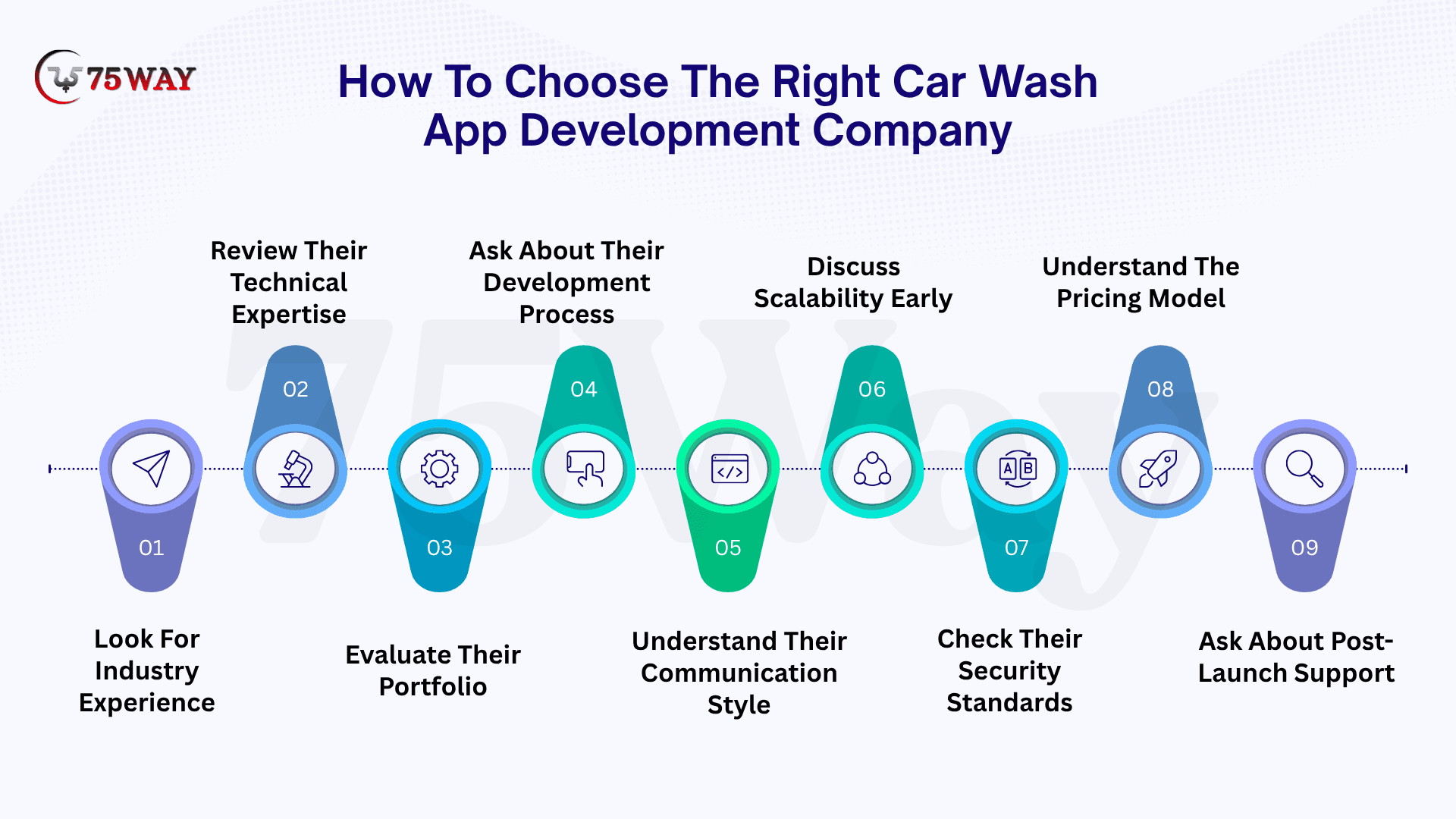
- Look For Industry Experience
Not every software company understands on-demand service businesses. A team that has built booking, marketplace, or field-service applications will already understand common challenges and recommend better solutions.
What to check: Previous projects, case studies, and experience with similar industries.
- Review Their Technical Expertise
A car wash app involves much more than mobile development. It requires backend systems, payment integration, GPS, notifications, cloud infrastructure, and strong security.
What to check: Technologies they use, development process, and technical capabilities.
- Evaluate Their Portfolio
A portfolio shows the quality of work more clearly than marketing claims. Pay attention to design quality, app performance, and the complexity of projects they have completed.
What to check: Live apps, screenshots, client testimonials, and success stories.
- Ask About Their Development Process
A structured development process reduces delays and unexpected costs. Good companies explain how they handle planning, design, development, testing, launch, and post-launch support.
What to ask: How will the project be managed? How often will progress be shared?
- Understand Their Communication Style
App development usually takes several months. Regular updates and quick communication make the entire project easier to manage.
What to check: Response times, dedicated project managers, meeting schedules, and reporting methods.
- Discuss Scalability Early
Your first version may only serve one city, but your long-term goal could be nationwide expansion. Make sure the app can support more users, technicians, locations, and features without major redevelopment.
What to ask: How will the platform handle future growth?
- Check Their Security Standards
Your app will store customer information, payment records, and business data. Security should be part of the development process, not an afterthought.
What to check: Data encryption, secure authentication, backup systems, and compliance practices.
- Understand The Pricing Model
The cheapest proposal isn't always the most affordable in the long run. Ask for a detailed cost breakdown so you understand exactly what is included and whether future changes will cost extra.
What to ask: Are maintenance, updates, and bug fixes included?
- Ask About Post-Launch Support
Launching the app is only the beginning. Regular updates, bug fixes, operating system compatibility, and new features will be needed as your business grows.
What to check: Maintenance plans, support response times, and long-term partnership options.
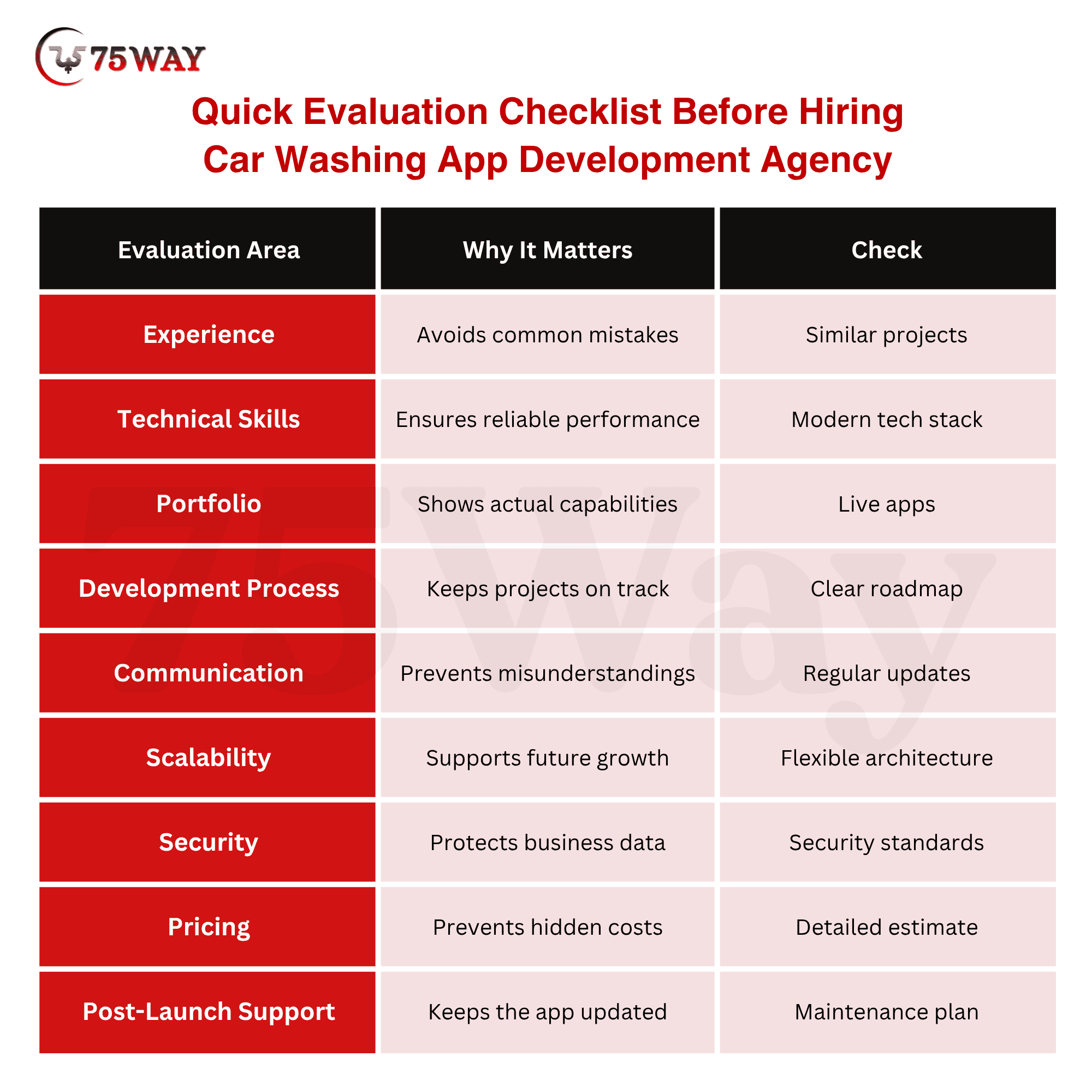
Quick Evaluation Checklist Before Hiring Car Washing App Development Agency
Technology Trends Driving The Future of Car Wash Apps
The car wash industry is changing quickly as customer expectations continue to evolve. People no longer want to make phone calls or wait in long queues. They expect faster bookings, personalized services, digital payments, and real-time updates. Here are some of the biggest trends shaping the future of car wash app development.
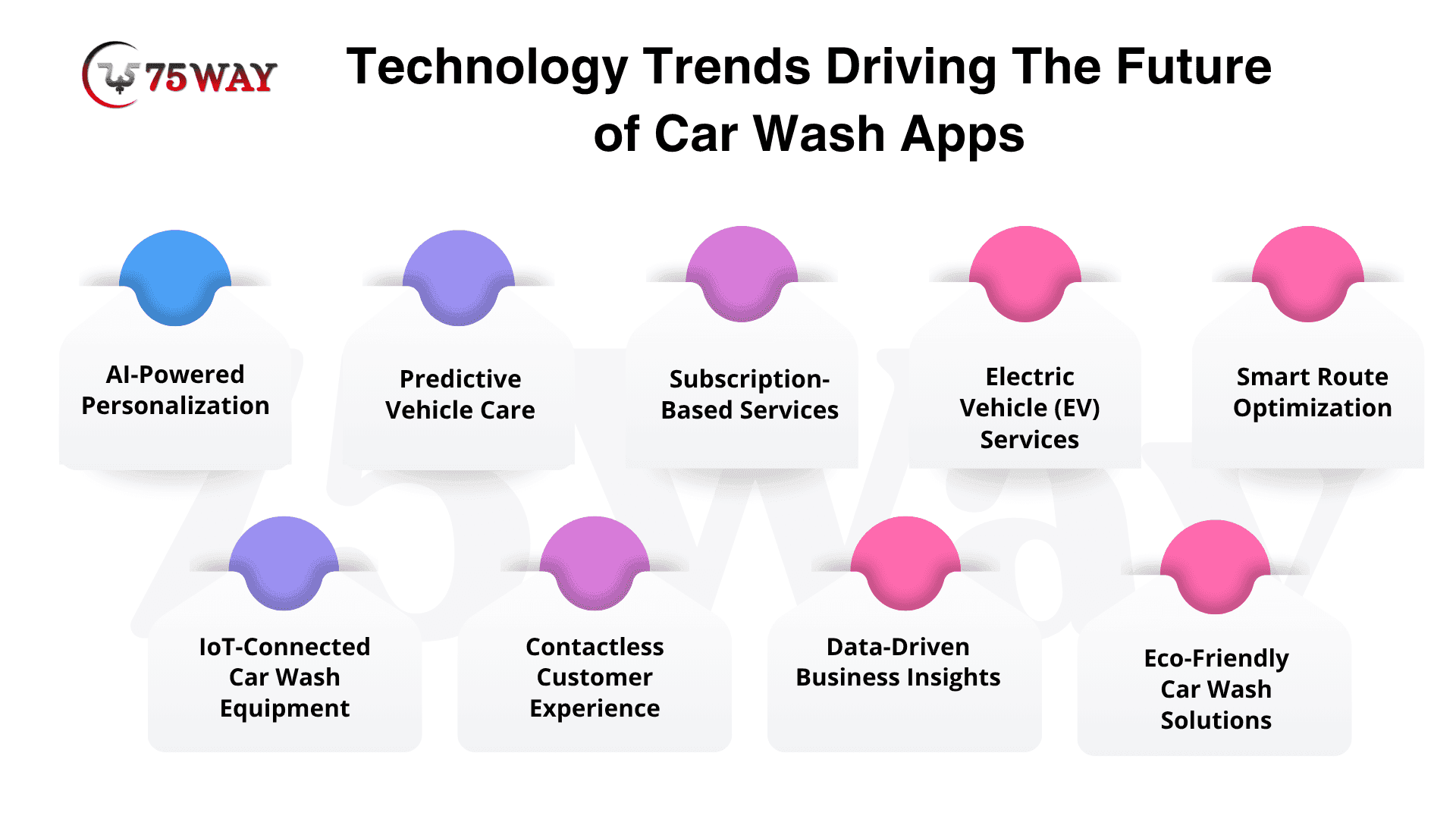
- AI-Powered Personalization: Every customer has different preferences, and the app should reflect that. AI can recommend the right services based on vehicle type, previous bookings, location, and customer behavior, creating a more personalized experience.
- Predictive Vehicle Care: Most drivers wait until their car looks dirty before scheduling a wash. AI can analyze service history, weather conditions, and driving patterns to remind customers when it's the right time for their next appointment.
- Subscription-Based Services: Instead of relying only on one-time bookings, more businesses are offering monthly subscription plans. This creates predictable recurring revenue while encouraging customers to book services more frequently.
- Electric Vehicle (EV) Services: As electric vehicles become more popular, car wash businesses are introducing specialized cleaning packages designed for EV owners. Apps can also recommend services based on the type of vehicle customers own.
- Smart Route Optimization: Mobile car wash businesses often lose valuable time traveling between appointments. Intelligent route planning helps technicians reach customers faster, reduce fuel costs, and complete more jobs every day.
- IoT-Connected Car Wash Equipment: Modern equipment can send maintenance alerts, track water consumption, and monitor machine performance in real time. Connecting this data with a mobile app helps businesses improve efficiency and reduce downtime.
- Contactless Customer Experience: Customers expect a smooth experience without unnecessary steps. Features like digital payments, QR code verification, online invoices, and contactless check-ins make the entire service faster and more convenient.
- Data-Driven Business Insights: Running a successful car wash business requires more than tracking daily bookings. Advanced analytics help owners understand customer behavior, identify popular services, measure revenue trends, and make smarter business decisions.
- Eco-Friendly Car Wash Solutions: Sustainability is becoming an important buying factor for many customers. Future apps can highlight water-saving techniques, environmentally friendly products, and other green initiatives to help businesses build trust and stand out from competitors.
How 75way Helps Businesses Build Successful Car Wash Apps
A successful car wash app requires much more than attractive screens and basic booking features. Every business has different goals, operational challenges, and growth plans, which is why the development approach should align with the way the business actually operates. The right technology partner helps shape the product strategy before a single line of code is written.
At 75way Technologies, every project is built around your business model, customer expectations, and long-term vision. Our team develops scalable car wash applications with intuitive user experiences, reliable performance, secure integrations, and modern technologies that support future growth instead of limiting it.
A startup contacted 75way after struggling with manual appointment scheduling through phone calls and WhatsApp. Missed bookings, scheduling conflicts, and delayed customer updates were affecting daily operations and limiting business growth.
After understanding their workflow, our team developed a custom car wash booking app with dedicated customer and technician applications connected to a centralized admin dashboard. The platform streamlined bookings, automated technician assignments, enabled online payments, and provided real-time service updates.
Business Impact
- Reduced manual booking coordination through automation.
- Improved technician scheduling and daily job management.
- Delivered a smoother booking experience for customers.
- Built a scalable platform ready to support future expansion.
Conclusion
To summarize, a well-designed car wash app can simplify daily operations, improve customer satisfaction, create new revenue opportunities, and help your business stay competitive in a growing market.
Whether you're planning a simple booking app, a mobile car wash platform, or a feature-rich marketplace, success starts with understanding your business goals and building the right solution from day one.
Careful planning, the right features, scalable technology, and an experienced development partner can help you create an app that delivers long-term value for both your customers and your business.
If you're ready to build a custom car wash app, contact a reliable app development firm that turns your idea into a secure solution tailored to your business needs.
Frequently Asked Questions (FAQs)
Do I Need Separate Apps For Customers, Technicians, And Administrators?
Not always, but it's the most practical approach. Separate apps allow each user group to access the tools they need without unnecessary features, resulting in a better experience and easier business management.
Can I Launch A Car Wash App In One City And Expand Later?
Yes. Most businesses start in a single city to validate their idea and optimize operations. Once the platform is stable, additional cities, service areas, and technicians can be added without changing the core business model.
Which Payment Methods Should A Car Wash App Support?
A modern car wash app should support credit and debit cards, digital wallets like Apple Pay and Google Pay, and other secure online payment options based on your target market.
Is An Internet Connection Required To Use A Car Wash App?
Customers need an internet connection to book services, make payments, and receive real-time updates. Some technician features can be designed to work offline temporarily and sync automatically when connectivity is restored.
Can A Car Wash App Support Both Fixed-Location And Mobile Services?
Yes. Many businesses offer both options through a single platform. Customers can either visit a car wash center or schedule a technician to clean their vehicle at their preferred location.
Can I Integrate My Existing Business Software With A Car Wash App?
Yes. Most custom-built car wash apps can integrate with CRM systems, accounting software, payment gateways, marketing tools, and other third-party platforms through APIs.