AI Summary
A QuickGo-style app can turn everyday home services into a convenient digital marketplace. This guide explores the business model, core features, development process, technology, costs, and monetization opportunities. It also explains how to launch, differentiate, and scale your platform successfully.
Key Takeaways
- Understand QuickGo’s marketplace model and its customer-to-professional service journey.
- Discover essential features for customers, professionals, payments, bookings, and communication.
- Follow practical development steps for building your own marketplace platform.
- The global on-demand home services market may reach $20.50B by 2034.
- Home services app development costs can range from $5,000 to $150,000+
A customer who needs a plumber, beautician, tutor, cleaner, trainer, or other professional already has buying intent. The real business opportunity is capturing that demand before they call a competitor.
An on-demand home services marketplace development solution like QuickGo can put those customers and service providers on one platform, creating a digital channel for bookings, payments, communication, and repeat business.
For business owners, the bigger opportunity is not simply launching another home service app like QuickGo. A well-built home services marketplace app can create multiple revenue streams while giving professionals a way to manage bookings and customers and giving users a faster way to discover trusted services.
QuickGo provides a useful product reference because its current customer journey is built around four actions: discover a service, chat with a professional, book a time slot, and pay through the app.
But if you are a founder planning a similar product, copying screens or features is not enough. So, how do you create an app like QuickGo? What does it cost to develop a home services marketplace, and what is the business model working behind a QuickGo-style app?
This guide explains how to create an app like QuickGo, what features you need, how the technology works, development stages, estimated cost, monetization options, operational challenges, and the strategy for launching a scalable home services marketplace.
What Is QuickGo App?
QuickGo is a home services marketplace designed to make household services bookable through a single ecommerce application. Customers can discover available services, communicate with professionals, select a booking slot, and complete payment within the platform.
The platform currently operates in India, including Chandigarh Tricity and Delhi, and presents services such as domestic help, deep cleaning, bathroom cleaning, AC services, pest control, and water tank cleaning.
QuickGo also has a professional marketplace component. Service providers can list their services, set availability, get discovered by nearby customers, manage bookings and payments, and collect ratings and reviews.
The important product insight is that QuickGo is not simply a home-service booking app.
It is a two-sided marketplace:
1. Customers: Discover and book services
2. Professionals: Offer and fulfill services
3. Platform: Manages trust, discovery, scheduling, payments, and marketplace operations
That distinction directly affects your app architecture, business model, and development budget.
How Does An App Like QuickGo Work?
A QuickGo-style app connects customers with nearby home-service professionals through a simple four-step journey. Users can discover the right service, communicate with professionals, confirm a booking, and complete payment through one marketplace.
1. Discover Service: Customers browse available home services based on their needs, location, and preferred service category. They can review relevant options before choosing a professional.
2. Chat With Professionals: Customers can chat with professionals to clarify service requirements, availability, pricing, or other booking-related questions. This communication helps both sides confirm expectations before the appointment.
3. Book Service: Once customers find a suitable professional, they select an available time and confirm the service booking. The platform records the appointment details and keeps both parties updated.
4. Pay Securely: Customers complete payment through the app using the available payment options. The platform can then process the transaction and manage the applicable professional payout or marketplace commission.
Why Build An Ecommerce Marketplace App Like QuickGo?
An ecommerce marketplace can turn a fragmented buying journey into one platform where multiple sellers compete for customer demand. For business owners, that creates opportunities to earn from transactions while expanding the product catalog without owning every item being sold. The commercial reasons for building a QuickGo-like marketplace are worth examining before investing.
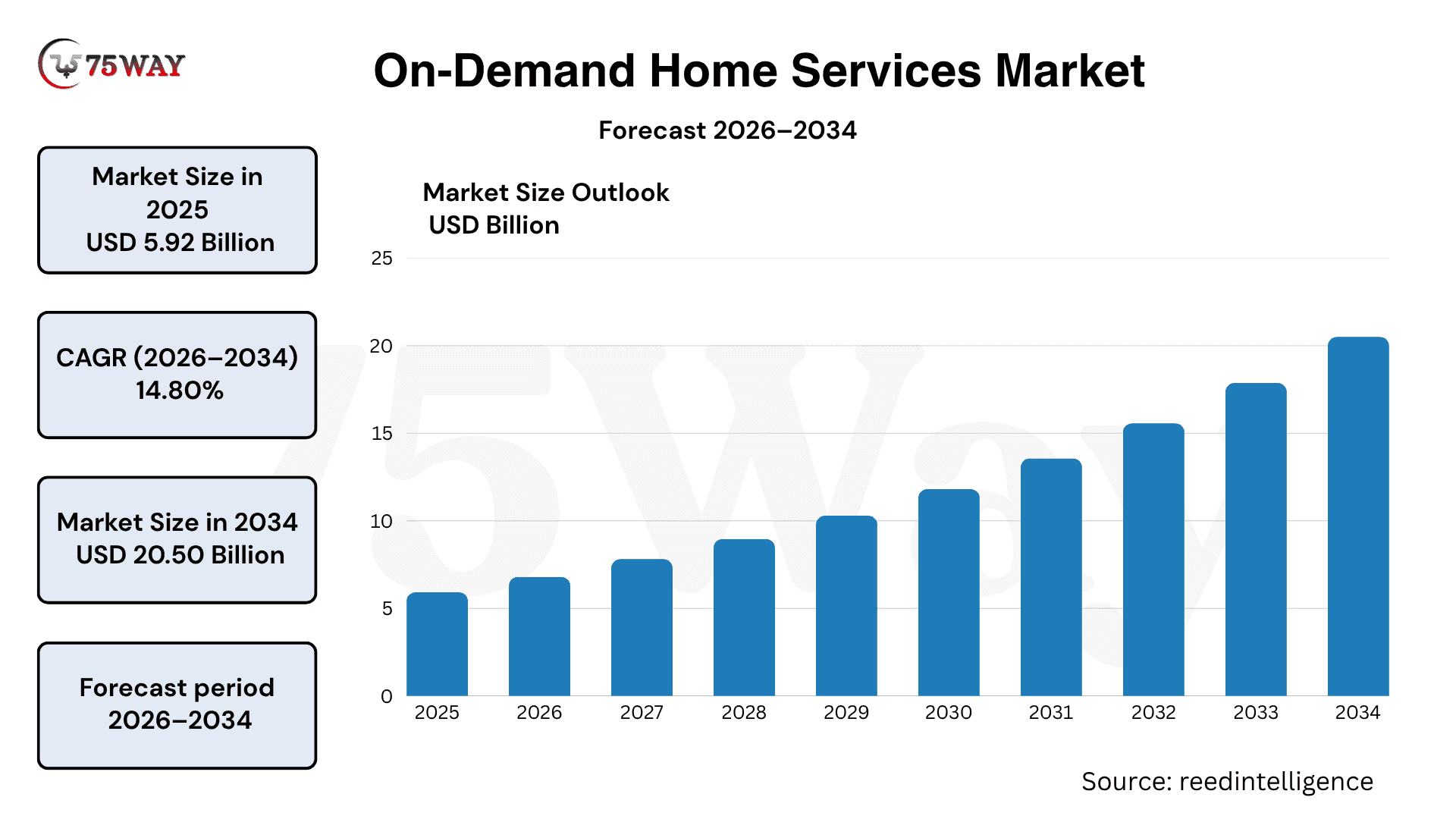
The key business opportunities behind a QuickGo-like ecommerce marketplace are
- The global on-demand home services market is projected to grow from $6.80 billion in 2026 to $20.50 billion by 2034, registering a 14.80% CAGR.
- North America dominated the online on-demand home services market, accounting for approximately 36% of the global market share.
- Another market forecast estimates the global online on-demand home services sector will expand from $6.94 billion in 2026 to $22.81 billion by 2034.
- According to the International Telecommunication Union (ITU), around 5.5 billion people were using the internet in 2024, representing 68% of the global population, up from 65% in 2023.
- North America held a 40.1% global market share, supported by its established digital infrastructure.
- Home cleaning services represented the largest service category, capturing 34.5% of the market, driven by recurring consumer demand.
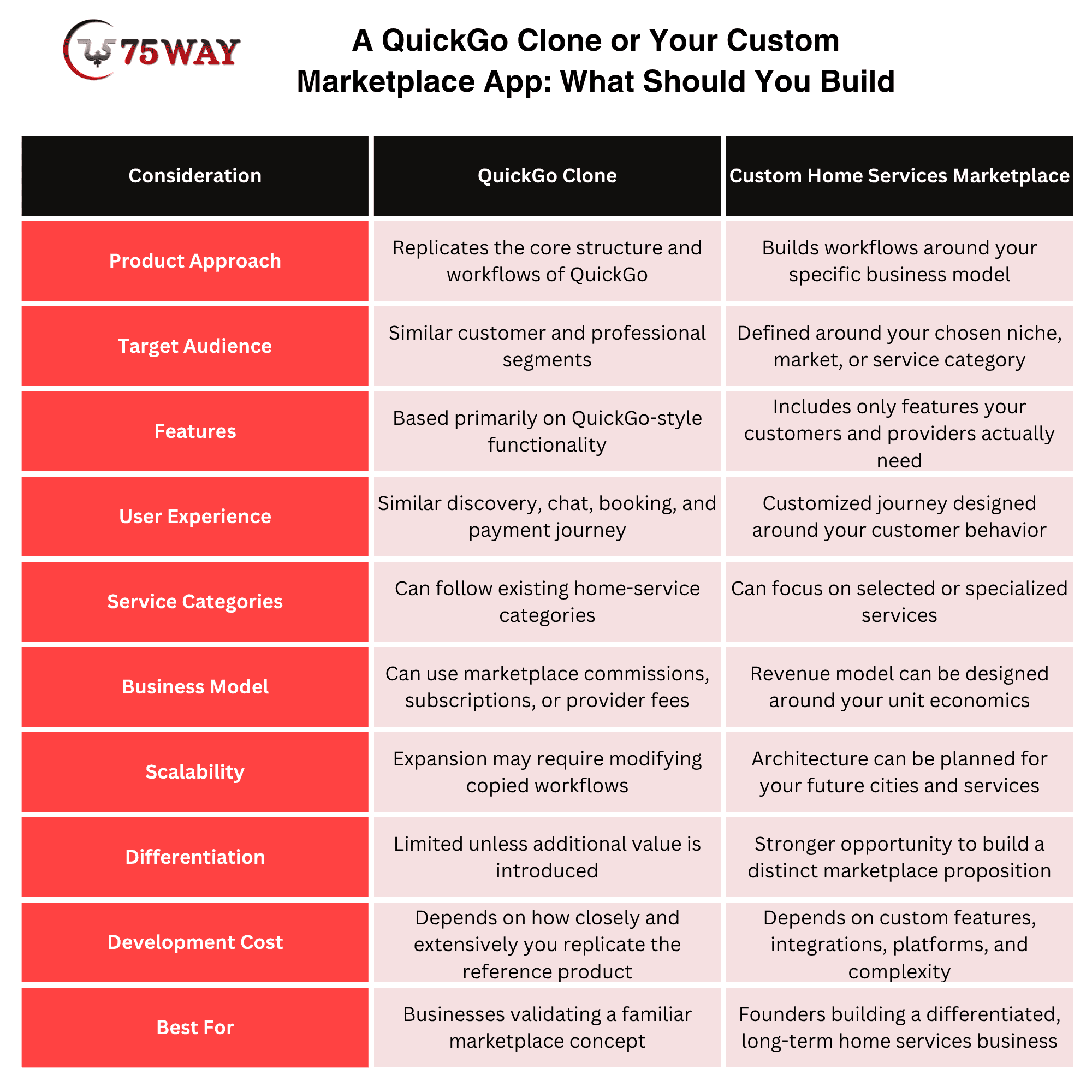
A QuickGo Clone or Your Custom Marketplace App: What Should You Build
Before development begins, decide whether you actually need a QuickGo clone.
For most founders, copying the entire product is unnecessary.
A better approach is to identify the underlying product mechanics and build a differentiated version.
Your platform could focus on home cleaning, elder care, handyman services, plumbing, electrical services, HVAC, beauty at home, lawn care, pet care, moving services or home maintenance.
You could also differentiate through subscription-based services, recurring appointments, corporate accounts, instant bookings, quote-based services, fixed-price packages, membership plans, or provider subscriptions.
Build the marketplace logic, not the competitor's identity.
Your UX, branding, workflows, pricing, service categories, and value proposition should belong to your business.
How To Create An App Like QuickGo: A Strategic Roadmap
A QuickGo-like app needs a strategy that connects customer demand with provider participation while leaving room for sustainable revenue and expansion. The complete process to build a marketplace like QuickGo below focuses on the decisions that can determine whether the marketplace becomes a viable business or another unused app.
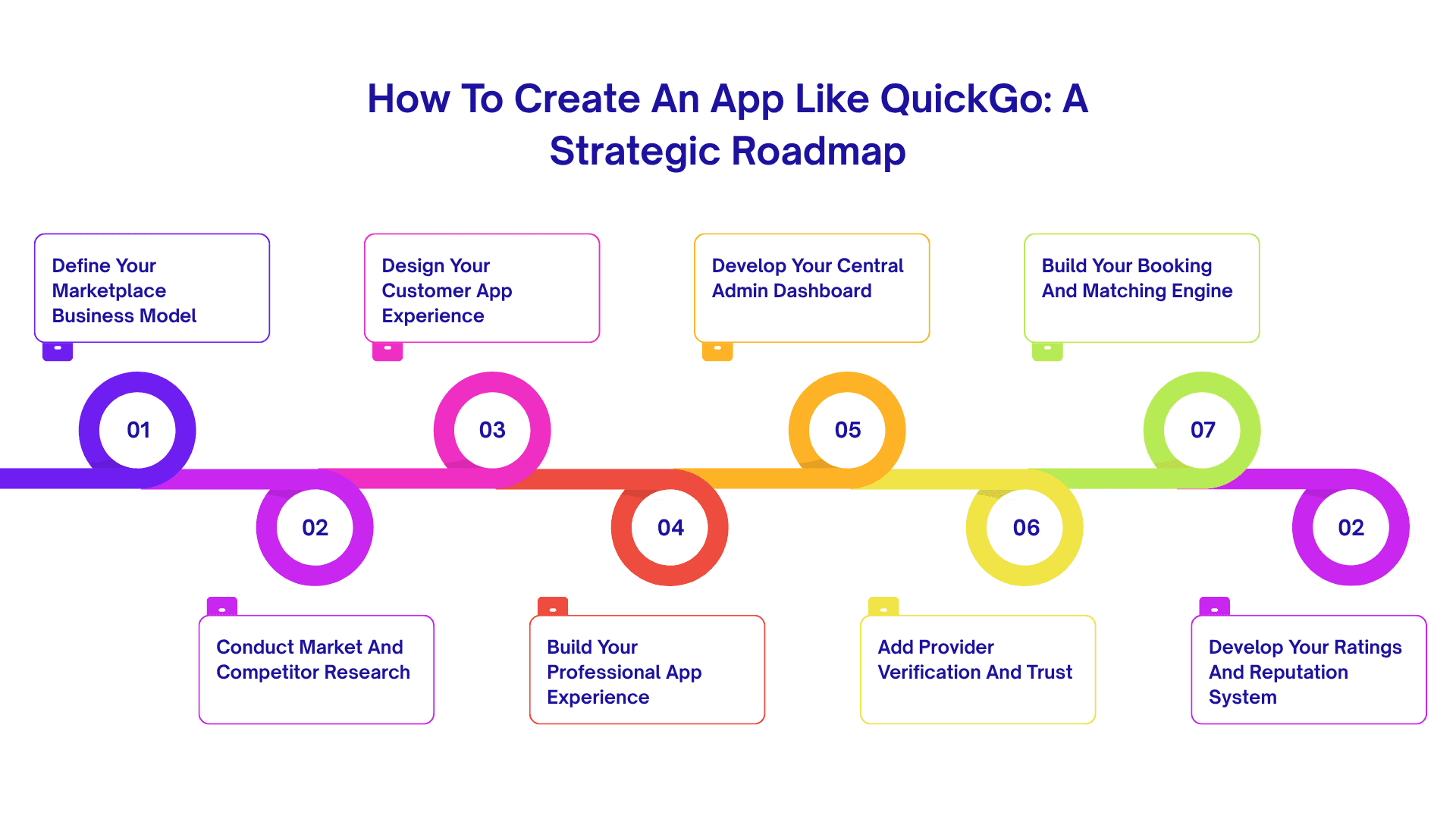
1. Define Your Marketplace Business Model
Start by identifying the exact marketplace you want to build, including the services, customers, professionals, and locations you will serve.
Your target audience could include homeowners, tenants, families, property managers, or businesses seeking reliable home services. On the supply side, target verified professionals such as cleaners, pest-control specialists, technicians, and maintenance workers.
Next, define how your marketplace will operate. Decide who sets prices, how professionals are matched with customers, how providers are verified, how cancellations and disputes are handled, and how your platform generates revenue.
A focused launch is usually easier to manage than introducing dozens of categories across multiple markets. For example, a cleaning marketplace could initially serve one metropolitan area with three core services before expanding its categories and service coverage.
2. Conduct Market & Competitor Research
Before development begins, study comparable home-service marketplaces to understand how customers and professionals move through the platform.
Analyze service discovery, search, location selection, pricing, professional profiles, availability, booking, cancellations, payments, ratings, support, provider onboarding, earnings, and retention.
The goal is not to copy another platform's interface. Instead, identify customer frustrations, provider challenges, and marketplace gaps that could create a meaningful opportunity for your product.
For example, if customers struggle to judge professional reliability, stronger verification, detailed profiles, transparent reviews, and clearer service information could become important product differentiators.
3. Design Your Customer App Experience
The customer app represents the demand side of your marketplace, so its journey should make finding and booking services straightforward.
Customers should be able to discover services, compare professionals, communicate about requirements, select convenient schedules, make payments, and manage their bookings from one application.
Core customer features can include:
- User registration and login
- Location management
- Service discovery
- Search and filters
- Professional profiles
- Service details
- In-app chat
- Scheduling
- Booking management
- Online payments
- Booking tracking
- Ratings and reviews
- Booking history
- Cancellation and rescheduling
4. Build Your Professional App Experience
The professional app manages the supply side of your marketplace and gives service providers the tools needed to run their work.
Providers should be able to create profiles, list services, control availability, receive bookings, communicate with customers, manage jobs, monitor earnings, and maintain their reputation.
For a marketplace like QuickGo, this experience is especially important because professionals need a simple way to become discoverable and manage incoming service requests.
- Professional Registration: Allow professionals to create profiles with their essential personal and service information.
- Identity Verification: Collect required documents and verification details before professionals can accept customer bookings.
- Service Management: Let providers add services, descriptions, pricing, service areas, and relevant qualifications.
- Availability Management: Allow professionals to define working hours, unavailable dates, and appointment capacity.
- Booking Management: Give providers access to upcoming requests, customer details, schedules, status updates, and cancellations.
- Earnings Dashboard: Show completed jobs, commissions, payouts, transaction history, and earnings summaries in one place.
5. Develop Your Central Admin Dashboard
The admin panel acts as the operational center of the marketplace, giving your team control over customers, professionals, bookings, payments, and platform activity.
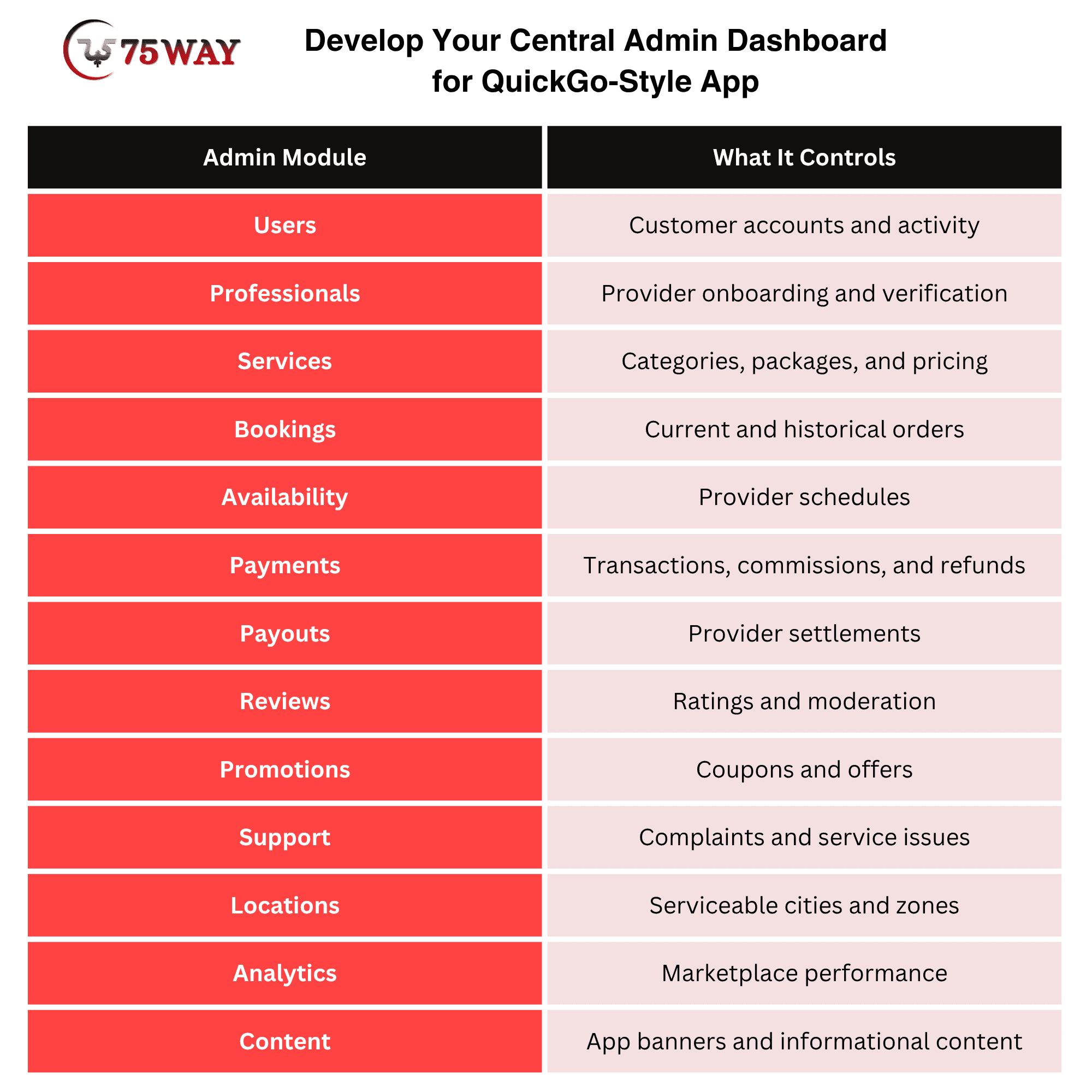
As your platform grows, the dashboard should evolve into an operations command center. It can eventually support automated alerts, marketplace analytics, provider performance monitoring, dispute management, and demand forecasting.
6. Add Provider Verification And Trust
Home-service marketplaces face a major trust challenge because customers are inviting professionals into their homes.
Your verification system should therefore be designed around the risks associated with each service category and market.
Depending on your location and business model, verification can include identity checks, address verification, background screening, skill verification, certifications, provider documents, training records, ratings, complaint history, and completed-service records.
QuickGo describes its professionals as team-verified and highlights identification, address, background, and skill-related checks. Your own verification framework should reflect applicable laws, insurance requirements, and the risk profile of each service category.
7. Build Your Booking And Matching Engine
The booking and matching engine determines which professionals can fulfill a customer's service request.
A basic system can evaluate service category, location, availability, and provider status. More advanced matching can incorporate distance, historical performance, customer preferences, workload, service area, and provider ratings.
For example:
Customer requests bathroom cleaning → Platform checks location → Finds available professionals → Applies matching rules → Displays eligible providers → Customer confirms booking.
As your marketplace expands, you can introduce smarter recommendations, demand forecasting, automated scheduling, and AI-assisted operational insights where they provide measurable business value.
8. Develop Your Ratings And Reputation System
Ratings are more than a customer-facing feature; they help establish trust across the marketplace and create accountability for service professionals.
A structured reputation system allows customers to evaluate their experience while helping reliable professionals build credibility and attract additional bookings.
Consider collecting feedback across multiple service dimensions:
- Overall Rating: Capture the customer's overall satisfaction with the completed service.
- Professionalism Score: Let customers evaluate professional behavior, conduct, and service etiquette.
- Punctuality Rating: Measure whether professionals arrive within the agreed appointment window.
- Service Quality: Assess how well the professional completed the requested service.
- Communication Rating: Evaluate responsiveness and clarity throughout the booking process.
- Value Assessment: Understand whether customers considered the service worthwhile for its price.
Your platform should also establish clear policies for fake reviews, duplicate submissions, retaliation, abusive content, and disputed feedback.
A well-designed reputation system can strengthen customer confidence while giving professionals a transparent way to build credibility through completed work and positive experiences.
Technology Stack Used For QuickGo Clone App Development
Your technology stack should depend on your product requirements rather than following a fashionable framework. A practical architecture could include:
- iOS & Android: Flutter and React Native can help build applications for both iOS and Android from a shared codebase. They can reduce duplicated development work while supporting customer and professional app experiences.
- Backend: Node.js, Python, and Java can support the APIs, business logic, booking workflows, user management, and marketplace operations. The right choice depends on your team's expertise, scalability requirements, integrations, and application complexity.
- Database: PostgreSQL can store structured marketplace data, including users, professionals, services, bookings, transactions, reviews, and availability. Its relational capabilities make it suitable for applications with interconnected business data.
- Cache: Redis can temporarily store frequently accessed data, reducing repeated database queries and improving application responsiveness. It can also support sessions, temporary booking data, rate limiting, and real-time marketplace workflows.
- APIs: REST and GraphQL can connect mobile applications with backend services and marketplace functionality. REST offers a familiar API structure, while GraphQL can provide more flexible data retrieval for complex application interfaces.
- Cloud: AWS, Google Cloud, and Azure provide infrastructure for hosting application servers, databases, storage, monitoring, and other backend services. Cloud infrastructure can also scale resources as customer demand and marketplace activity increase.
- Maps: Google Maps Platform or another mapping provider can support location selection, geocoding, directions, distance calculations, and service-area management. These capabilities are particularly useful when matching customers with nearby professionals.
- Payments: Stripe and market-specific payment gateways can handle customer payments and marketplace transactions. Your choice should account for supported countries, payment methods, fees, payouts, refunds, taxes, and regulatory requirements.
- Notifications: Firebase Cloud Messaging and Apple Push Notification Service can deliver booking confirmations, reminders, chat alerts, payment updates, and provider notifications. Combining push notifications with in-app notification history helps users stay informed about important activity.
- Authentication: OAuth, OTP, and secure session management can provide different authentication options for customers and professionals. The implementation should protect account access while supporting a convenient login experience across devices.
- Analytics: Product analytics can reveal how customers discover services, complete bookings, and interact with marketplace features. Cloud monitoring can help development teams track application performance, errors, availability, and infrastructure health.
- Admin: React or another modern web framework can power a responsive administrative dashboard for managing users, professionals, services, bookings, payments, reviews, and support. The interface should give operations teams clear visibility into marketplace activity and controls.
For a startup, cross-platform development can reduce duplicated mobile engineering work, while a native approach may make sense where platform-specific capabilities or performance requirements justify it.
How Much Does It Cost To Build An App Like QuickGo?
There is no single reliable price for a QuickGo-like app because the product can range from a small MVP to a multi-city marketplace with sophisticated dispatch, payments, and operational tooling. For planning purposes, the average development cost typically falls between $5,000 and $150,000+, depending on the app's scope, features, technology, integrations, and development team.
- Basic MVP: $5,000–$25,000
Suitable for validating a focused home-services marketplace with essential customer, provider, booking, and payment features.
- Mid-Level App: $25,000–$75,000
Supports separate customer and provider experiences, stronger admin controls, real-time features, reviews, notifications, and multiple integrations.
- Advanced Marketplace: $75,000–$150,000+
Includes sophisticated matching, real-time tracking, automated workflows, advanced analytics, AI capabilities, scalable infrastructure, and multi-location operations.
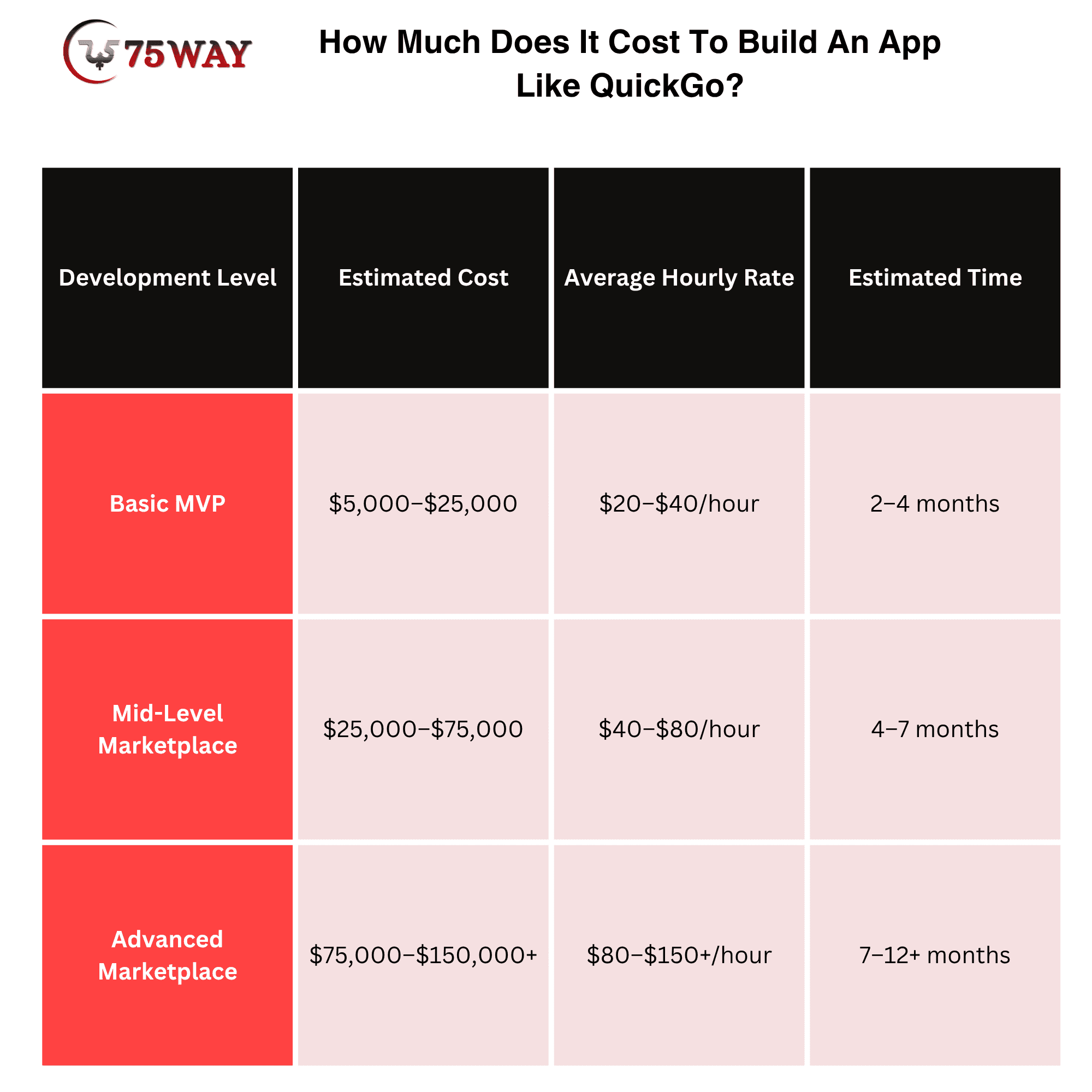
These are planning ranges, not fixed market prices or quotations. The actual budget depends on design depth, platforms, integrations, engineering location, compliance requirements, third-party services, and operational complexity.
For a QuickGo-inspired startup, the more useful question is:
“What is the smallest product that can validate my marketplace?”
rather than:
“How much would it cost to copy every QuickGo feature?”
Factors Affecting QuickGo-Like App Development Cost
A QuickGo-like marketplace can begin with a modest budget and quickly become a major technology investment once the business needs multiple user types, service categories, and complex marketplace operations. The gap between a basic MVP and a production-ready platform can be substantial. The cost drivers behind that difference are examined here.
- Number of Applications
Customer app, provider app, and admin dashboard require more work than a single customer application.
- Number of Platforms
iOS, Android, and web development can increase design, development, and QA requirements.
- Booking Complexity
Simple scheduled bookings are easier than dynamic dispatch, recurring appointments, instant booking, and variable pricing.
- Payment Architecture
Marketplace payouts, refunds, commissions, and disputes require more sophisticated payment workflows.
- Provider Verification
Document processing, background checks, and external verification services add integration and operational requirements.
- Real-Time Features
Tracking, chat, live availability, and status updates require real-time infrastructure.
- Number of Service Categories
Cleaning, plumbing, AC repair, and healthcare-related services may require different forms, pricing structures, and workflows.
- Geographic Expansion
Multi-city operations introduce service zones, localized pricing, provider density, and regional operational rules.
- AI Features
AI-powered search, support, recommendations, and matching can increase both development and ongoing infrastructure costs.
How Long Does It Take To Create A Mobile App Like QuickGo?
A focused MVP may take approximately 3–5 months, while a more comprehensive multi-category marketplace may take 6–10 months or longer, depending on scope and team size. A typical roadmap could look like:
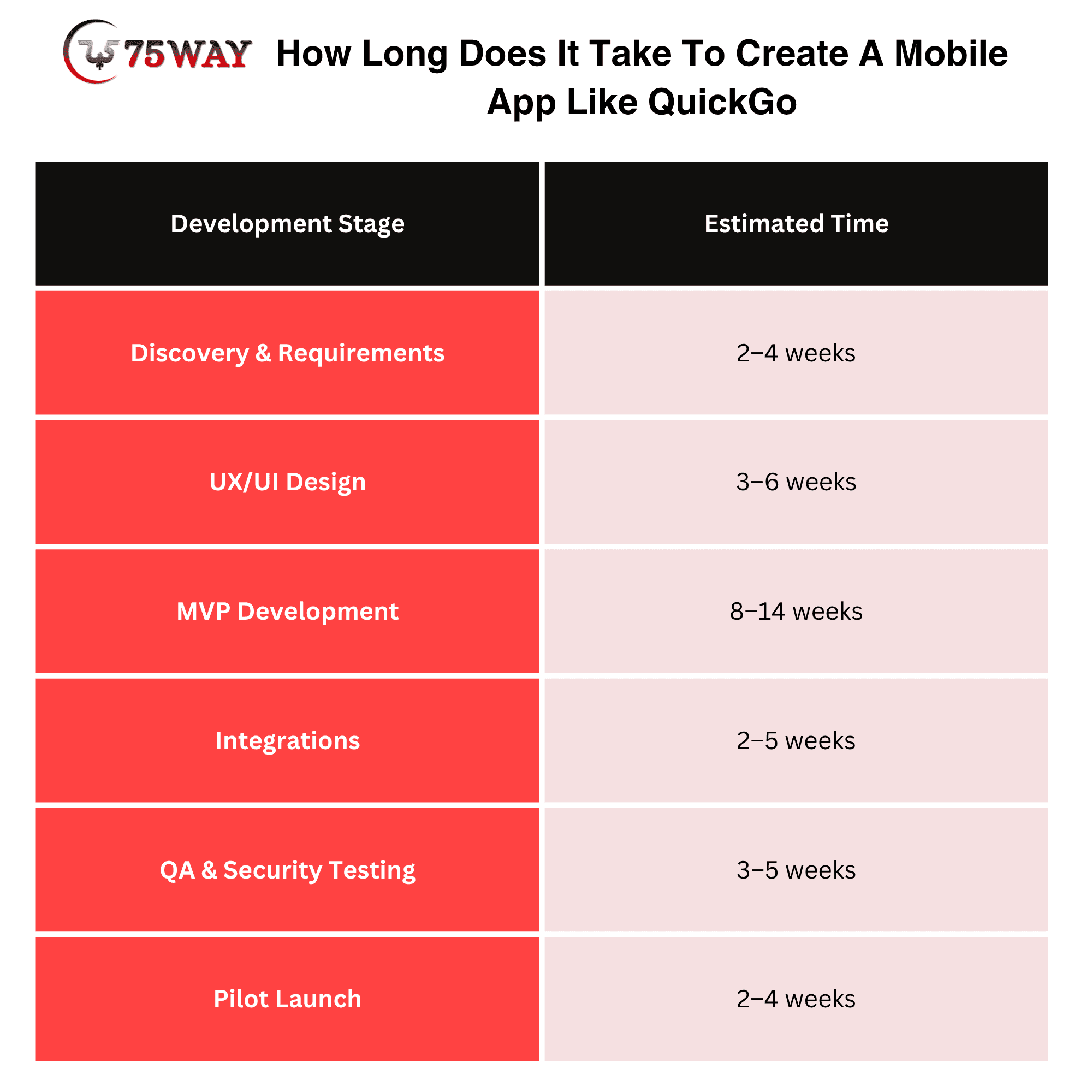
Some activities overlap, so the total calendar time is not simply the sum of every row.
The most important factor is scope discipline.
Adding ten features halfway through development can create more delay than choosing a slightly different technology stack.
What's The Business Model Behind A QuickGo App?
A QuickGo-style marketplace can generate revenue by connecting customers who need home services with professionals willing to fulfill those requests. The platform earns by creating value on both sides: customers get convenient service access, while professionals gain visibility, bookings, and tools to manage their work.
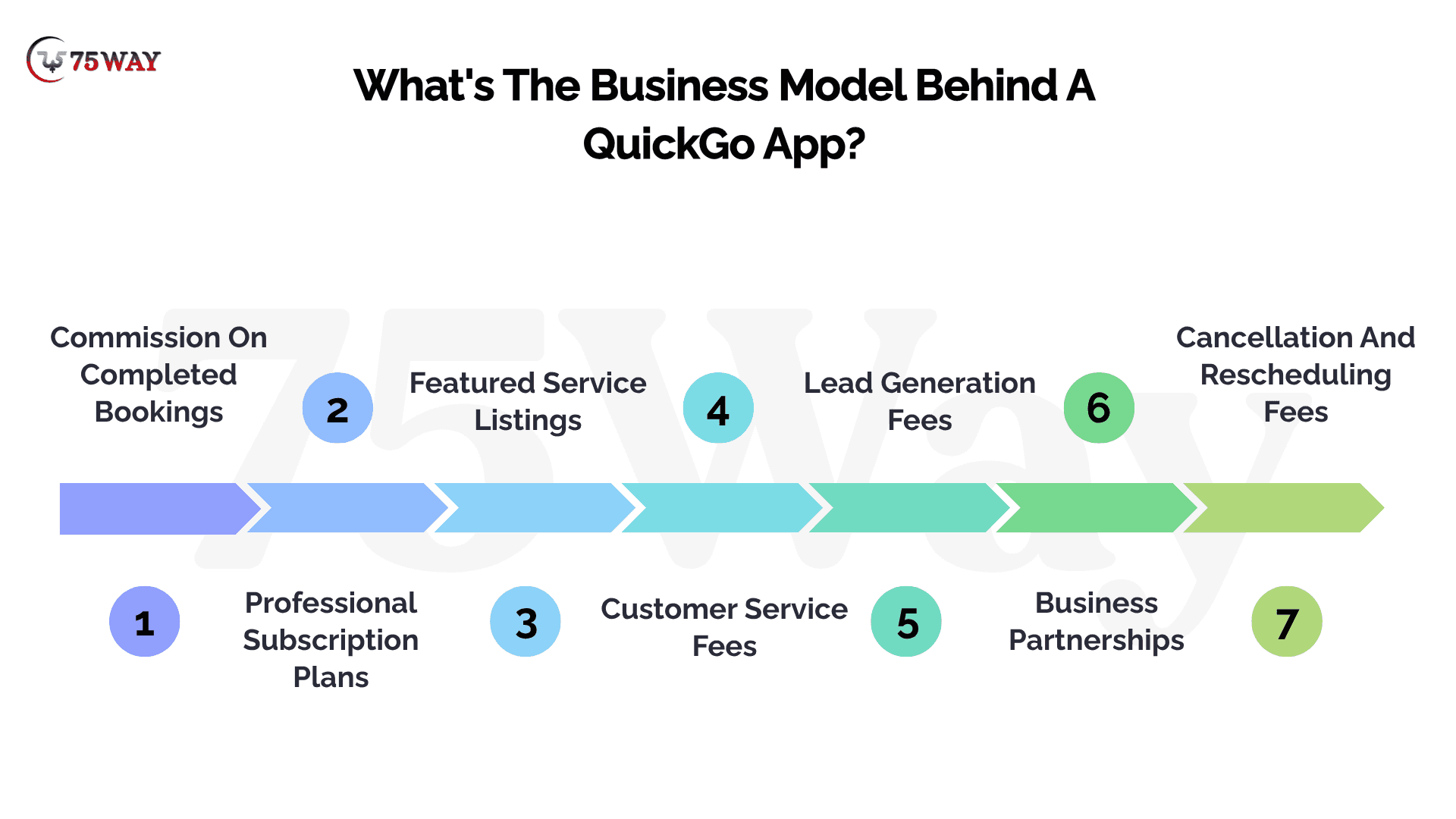
1. Commission On Completed Bookings
Charge professionals or customers a percentage of every successfully completed service. This creates revenue that grows alongside your marketplace's booking volume.
2. Professional Subscription Plans
Offer paid plans that provide professionals with enhanced visibility, additional listings, analytics, priority leads, or advanced business-management tools.
3. Featured Service Listings
Allow professionals to pay for greater visibility within relevant service categories or local searches. This can create an additional advertising-style revenue stream.
4. Customer Service Fees
Add a transparent platform or convenience fee to selected customer bookings. The fee can help cover marketplace operations, technology, payment processing, and customer support.
5. Lead Generation Fees
Charge professionals for qualified customer leads instead of taking a percentage from completed bookings. This model can work particularly well for services where customers compare multiple providers before hiring.
6. Business Partnerships
Partner with property managers, residential communities, real-estate businesses, or other organizations that regularly require home-service professionals. These partnerships can generate recurring service demand and larger booking volumes.
7. Cancellation And Rescheduling Fees
Apply clearly disclosed fees for late cancellations or repeated rescheduling when appropriate. The policy should be transparent and aligned with local consumer-protection requirements.
For an early-stage QuickGo-style marketplace, combining booking commissions with professional subscriptions or featured listings can create multiple revenue streams without depending on a single monetization method.
How To Launch A Home Services Marketplace Like QuickGo
Your first 1,000 customers will not appear simply because your QuickGo-like app is live in the App Store. Early traction depends on having the right service providers, building customer trust, creating demand, and giving both sides enough reason to return. The launch approach below focuses on turning those early marketplace conditions into sustainable growth. A practical rollout could be:
Phase 1: One Market
Select one geographic market and a small group of high-demand services.
Phase 2: Build Provider Supply
Recruit, verify, and train enough professionals to fulfill expected demand.
Phase 3: Launch MVP
Release the customer booking journey, provider workflow, and admin operations.
Phase 4: Measure Marketplace Health
Track booking conversion, cancellation rate, provider acceptance, completion rate, repeat booking rate, customer acquisition cost, average order value, provider utilization, customer complaints, and contribution margin.
Phase 5: Expand Categories
Add services only after the initial marketplace demonstrates healthy operational performance.
Phase 6: Expand Geography
Move into another city when the operating model can be reproduced.
This approach helps prevent a common marketplace problem: expanding the technology faster than the supply network can support it.
Advanced Features To Add After MVP Development of QuickGo-Like Marketplace
Your MVP has traction, bookings are coming in, and the provider network is growing. Now the limitations of a basic marketplace start becoming visible. Advanced capabilities can address those gaps while supporting larger operations, stronger retention, and more sophisticated monetization. Here’s where a QuickGo-like marketplace can evolve after the MVP stage.
- AI Service Discovery
Customers describe what they need in natural language and receive relevant service options.
- Smart Provider Matching
Use location, availability, service category, and historical performance to improve matching.
- Demand Forecasting
Predict periods of high demand to help providers and operations teams plan capacity.
- Dynamic Pricing
Adjust pricing according to service complexity, demand, and availability where legally and commercially appropriate.
- Recurring Bookings
Allow customers to schedule weekly, biweekly, or monthly services.
- Subscription Plans
Create recurring customer memberships or service packages.
- Smart Notifications
Use booking context to determine when customers and professionals need reminders.
- AI Customer Support
Automate routine questions while routing complex issues to human support.
The goal should be useful automation, not adding AI simply because competitors mention it.
Security And Compliance Considerations for Building QuickGo Clone
Because the platform handles customer identities, addresses, payment information, and provider records, security should be part of the architecture from the beginning.
Consider:
- Encryption in transit and at rest
- Secure authentication
- Role-based access control
- Payment-tokenization practices
- Audit logs
- Secure API design
- Data minimization
- Backup and disaster recovery
- Fraud monitoring
- Vulnerability testing
- Privacy controls
- Data retention policies
If launching in another country, legal and compliance requirements should be reviewed for that specific jurisdiction, including privacy, consumer protection, payments, worker classification, insurance, and background-check requirements where applicable.
Do not simply copy India's operating model into another country.
Final Takeaway
To summarize, creating an app like QuickGo means building a home services marketplace, not simply cloning a mobile interface. The difficult parts are connecting customer demand with reliable professional supply, maintaining accurate availability, managing bookings and payments, establishing trust, handling service issues, and creating sustainable marketplace economics.
QuickGo provides a useful reference architecture: customers discover services, communicate with professionals, book appointments and pay, while professionals can list services, manage availability and bookings, and build marketplace reputation.
If you are planning your own home services marketplace, like QuickGo, talk to a reliable on-demand app development team to scope the MVP, technology architecture, features, timeline, and development budget around your business model.
Frequently Asked Questions (FAQs)
What Services Does QuickGo Offer?
QuickGo currently promotes services including domestic help, deep cleaning, AC service, and pest control, with additional home-care categories available through its platform.
How Much Does It Cost To Build An App Like QuickGo?
A planning budget can range from roughly $25,000 for a focused MVP to $100,000–$200,000+ for a sophisticated multi-city marketplace. Actual cost depends heavily on scope, integrations, and operational requirements.
How Long Does It Take To Develop a QuickGo-Like App?
A focused MVP can take around 3–5 months, while a comprehensive multi-category marketplace may require 6–10 months or longer.
What Are The Main Components of a QuickGo-Like App?
The core system typically includes a customer app, professional app, admin dashboard, booking engine, service catalog, payments, notifications, reviews, verification, and marketplace operations.
Can I Build An App Like QuickGo for Another Country?
Yes. However, you should redesign payments, privacy, provider verification, insurance, taxation, worker classification, and service operations around the target market.
Should I Build All QuickGo Features in the MVP?
No. Start with the smallest version capable of validating your customer demand, provider supply, and booking economics.
Can AI Be Integrated Into A Home Services Marketplace?
Yes. AI can support natural-language service discovery, customer support, recommendations, matching, demand forecasting, and operational analytics. It should be introduced where it solves a measurable product problem.
Can Professionals List Their Own Services?
Yes. A marketplace can allow providers to create service listings, manage availability, receive bookings, communicate with customers, and build reputation through reviews. QuickGo currently provides these capabilities for professionals.
What Technology Is Suitable For A QuickGo-Like App?
Flutter or React Native can support cross-platform mobile development, while Node.js, Python, or similar backend technologies can support APIs, booking logic, payments, and marketplace operations.