
With increasing cybersecurity threats, most users worry about sharing personal information online. In the current digital era, where data leaks and surveillance dominate the headlines, anonymous messaging apps have attained popularity among USA users, especially GenZ in 2026. These apps allow users to communicate freely without exposing their identity. Now, you may have a question: why? The reason is that these apps integrate security, convenience, and often, AI-driven enhancements that make chats safer and more personalized.
Startups and founders face a real challenge related to chat app development that protects privacy and delivers an engaging user experience. This guide provides a complete roadmap for creating anonymous messaging apps, from the initial idea to selecting the right AI tools. The ways to create a secure messaging architecture, and analyze the best anonymous messaging apps currently succeeding in the USA. By the end, you will gain clear insights into designing a secure, AI-powered platform that not only attracts users but also enhances their trust and loyalty.
What Is An Anonymous Messaging App?
An anonymous messaging app is a communication system where you can send and receive messages without sharing personal information such as names, addresses, or contact numbers. And the most interesting thing is that you do not need to share your personal details, such as name, email, or phone number. Unlike traditional chat apps, these apps offer privacy-first features, anonymous identities, encrypted messages, and self-destructing conversations. Not only this, these private messaging apps help users interact with pseudonyms or randomized IDs and enjoy honest conversations.
Now, people want freedom to express themselves while protecting sensitive information. And anonymous messaging apps provide the same. These apps provide diverse mental health support, peer feedback, or genuine texting options. For startups and founders, anonymous chatting applications provide a unique business opportunity. These private messaging apps serve your niche market that values privacy and provide new ways to generate revenue through ads, subscriptions, or premium features.
Read More: How to Start a Taxi Business? Guide for Beginners
A Complete Roadmap To Build An AI-Driven Anonymous Messaging App
The process to develop an anonymous messaging app in 2026 requires more than basic encryption or hidden profiles. This methodology follows a step-by-step approach to design intuitive interfaces, AI-driven features, and a privacy-first design. Now, users want a texting app that offers judgment-free communication and data protection. And, a structured roadmap acts significantly to execute every development phase of creating an anonymous message app for casual conversations, mental health support, or whistleblower communication.
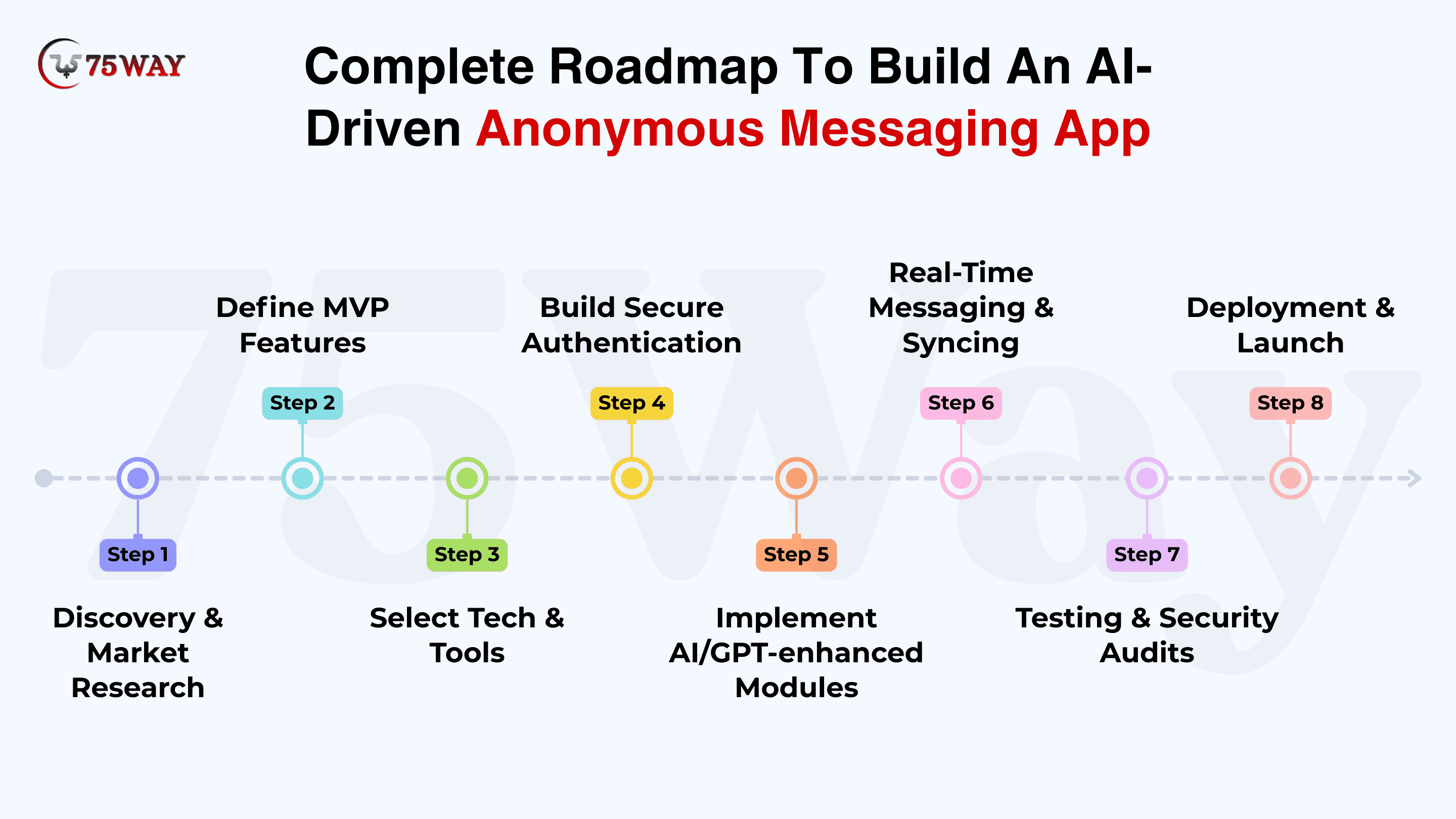
Discovery & Market Research
This stage lays the foundation for an AI-driven anonymous messaging app. Initially, you must find whether your app addresses a genuine communication need and balances anonymity, safety, and compliance. The earlier anonymous apps demonstrate unclear positioning and weak user understanding, which lead to trust issues and low retention. Thus, a structured research process is needed to align user intent, AI capability, and privacy architecture from the beginning.
- Define Core Purpose: Before developing an anonymous messaging app, its core purpose must be clearly defined. You must define the type of app you want to create: an anonymous feedback app, a confession platform, a mental health expression tool, or a whistleblower system. Every app requires different levels of anonymity, data-handling policies, and AI and generative AI strategies.
- Understand User Behavior: Different user groups interact with anonymity in different ways. Students seek quick expression, professionals expect confidentiality, and vulnerable users require emotional safety. Behavioral research helps define onboarding flows, message limits, the depth of identity masking, and AI-powered content controls that feel protective rather than intrusive.
- Analyze Competitor Apps: Competitor analysis is another essential part of market analysis. You must review existing anonymous messaging apps to find common pain points such as abuse, lack of moderation, weak encryption, and poor scalability. When you identify these gaps, you can refine feature priorities and avoid patterns that violate platform policies.
- Prioritize Privacy and Legal Compliance: Anonymous apps must align with United States data protection standards, AI transparency expectations, and platform safety guidelines. Early compliance planning ensures that anonymity claims are technically enforceable and legally defensible, reducing long-term risk.
Define MVP Features
After defining the user needs, you have to focus on MVP Development to launch a basic version of your anonymous messaging app with core functionality. Early features should balance usability, privacy, and AI-assisted safety without overwhelming users. Core messaging, anonymous onboarding, and basic AI moderation form the foundation allow you to test real user engagement and trust. This lean minimum viable product reduces development costs, improves feedback collection, and establishes a strategic roadmap for advanced AI features such as sentiment analysis and personalized suggestions. Here are the top considerations while creating an MVP for an anonymous messaging app.
- Core Messaging: Your anonymous messaging app development begins with core messaging. Messages must be secure and delivered in real time, with strong encryption ensuring conversations remain private. Reliable delivery from the very first interaction establishes trust, which is essential for user retention and adoption in privacy-conscious markets.
- Anonymous Onboarding: This phase allows users to join without sharing personal data or phone numbers. It enhances privacy and encourages wider adoption across diverse user groups, particularly in the USA, where privacy expectations are high.
- Basic AI Moderation: Once users are onboarded, it becomes critical to moderate AI features. AI-driven content filtering manages abusive, harmful, or unsafe messages without storing sensitive data. This step protects users, reinforces trust, and lays the groundwork for advanced AI capabilities such as GPT-powered conversation assistance and behavioral analysis.
- Self-Destruct Messages: To further protect privacy, implement self-destruct messages that automatically delete content after a set period. Ephemeral messaging enhances user confidence, secures sensitive conversations, and differentiates your app from competitors in a privacy-aware market.
- Minimal Design & UI/UX: After that, you must create a simple, intuitive interface that lets users focus on messaging rather than navigating complex features. An engaging UI/UX design also makes AI integration seamless and reduces onboarding confusion, both of which are critical for adoption.
- Feedback & AI-Ready Foundation: Finally, feedback loops and AI-ready infrastructure are essential. Early user feedback informs feature prioritization and future enhancements, while the technical foundation supports AI modules, including personalized suggestions, moderation, and behavior analysis. This step offers scalability, legal compliance, and continuous improvement as the app evolves.
Select Tech & Tools
Now that you know the steps to build an MVP, it is time to understand the technology part. But, which programming languages, security protocols, and tools are suitable? This stage highlights every aspect of selecting the right technology stack to build a secure, AI-driven anonymous messaging app. The precise technology decides the performance, reliability, cost, and future integration of AI modules like GPT-powered moderation and behavioral analysis. In addition, choosing tools that support encryption, compliance, and cloud deployment in the USA enhances privacy, safety, and user trust. Each technology decision must align with the app’s roadmap, user expectations, and regulatory requirements.
- Frontend Technology: The front-end of your private messaging app defines the wayusers interact with your app. You must create a responsive framework and interactive interfaces for smooth performance across devices. React Native or Flutter can be implemented for cross-platform deployment and smooth integration with AI features like sentiment feedback or personalized suggestions.
- Backend Framework: A strong backend covers the creation of messaging, authentication, and AI modules. Here, you have to select the scalable frameworks such as Node.js, Django, or Spring Boot for high performance, real-time messaging, secure API handling, and GPT integration. It also simplifies the addition of upcoming features without re-architecture.
- Database Solutions: Databases store messages, user settings, and analytics in your anonymous messaging app. You can adopt secure, encrypted solutions like PostgreSQL, MongoDB, or Firebase to provide zero-log storage for anonymity and maintain high-speed read/write performance. Compliance with the USA data protection laws must be considered while implementing databases.
- Cloud Infrastructure: To manage user data, cloud services are required for hosting, scalability, and AI computation. You can deploy to AWS, Google Cloud, or Azure with USA-region servers to meet regulatory compliance requirements, align with GDPR/CCPA requirements, and offer reliable performance. Cloud-native AI services simplify the deployment and monitoring of the GPT module.
- AI & GPT Integration: Your tech stack must support AI-driven features, behavioral insights, and personalized recommendations. GPT APIs or custom AI pipelines can filter abusive content, analyze sentiment, and assist user engagement without storing sensitive data. API and AI integration at this stage reduces the need for scalable development.
- Messaging Queues & Protocols: Real-time messaging relies on protocols like WebSockets, MQTT, or RabbitMQ. These models help you provide fast, reliable delivery across devices while supporting offline syncing and maintaining encrypted channels.
Build Secure Authentication
Authentication is the backbone of anonymous messaging apps. It must protect users without exposing their identities, prevent impersonation, and ensure secure access to encrypted data. Traditional logins with emails or phone numbers defeat the purpose of anonymity. Instead, cryptographic design using device-based keys, token-based validation, or pseudonymous identifiers clarifies that the users remain fully anonymous. It maintains accountability and security. The authentication development at this stage allows privacy-first operations and enhances trust with users in the USA, where data protection and transparency are critical.
- Anonymous IDs: Assign unique, pseudonymous identifiers to protect real user identity.
- Token-Based Validation: Issue secure tokens for session verification without storing personal data.
- Device-Based Keys: Use device fingerprints or cryptographic keys for seamless login security.
- Two-Factor Options: Optional 2FA enhances security and preserves user privacy.
- Password-Free Access: Minimize friction with passwordless authentication using tokens or biometrics.
- Encrypted Credentials: Encrypt all tokens, keys, and authentication metadata for compliance.
- Session Management: Monitor and terminate sessions securely to prevent unauthorized access.
- Audit Logging: Maintain privacy-compliant logs to detect anomalies without exposing user data.
Implement AI/GPT‑enhanced Modules
AI and GPT modules add intelligence and safety to your anonymous messaging app while fully preserving user privacy. These modules enable automated moderation, behavioral insights, personalized suggestions, and conversational enhancements without storing sensitive data. Integrating AI at this stage determines whether your platform is scalable, legally compliant, and capable of maintaining user trust in the USA market. By planning AI integration early, you can avoid technical debt and prepare the app for future advanced features like predictive moderation and intelligent recommendations.
Automated moderation filters harmful content, while sentiment analysis detects risky behavior and emotional distress. GPT-powered assistance enhances messaging quality and provides conversational support without compromising anonymity. AI modules also support spam detection, contextual alerts, and behavioral insights to improve engagement safely. With artificial intelligence development, your system can handle growing user bases and maintain consistent performance, security, and privacy as the app expands.
Real‑Time Messaging and Syncing
Real-time messaging is the core of any anonymous messaging app, ensuring conversations happen seamlessly and without delay. Implementing encrypted WebSockets, reliable message queues, and offline syncing guarantees that messages are delivered instantly while maintaining complete privacy. Consistent performance builds trust, encourages engagement, and reinforces the app’s reliability, which is critical for adoption in the USA market, where users demand speed and security.
Syncing across devices ensures that conversations remain consistent regardless of where users log in. Offline caching combined with background synchronization preserves message continuity even during network interruptions. When paired with AI modules, real-time syncing allows moderation, spam detection, and sentiment analysis to operate instantly, enhancing both safety and user experience. Properly engineered real-time messaging lays the foundation for scalable, AI-enhanced communication without compromising anonymity.
- You can deploy end-to-end encryption protocols to protect message content
- WebSocket integration enables instant, bi-directional communication across multiple devices.
- Scalable and fault-tolerant message queues ensure reliable delivery
- Cross-device sync maintains message history and continuity across multiple devices.
Testing & Security Audits
This stage of building an anonymous messaging app validates both usability and safety. Penetration testing, vulnerability assessments, and privacy audits ensure that the app’s encryption, authentication, and AI modules function as intended. Thorough testing not only protects sensitive data but also builds user trust, which is essential for adoption in the USA market, where privacy and compliance expectations are high.
- Penetration Testing: Identify vulnerabilities before attackers exploit them in real scenarios.
- Privacy Audits: Ensure compliance with CCPA, USA privacy laws, and policies.
- Load Testing: Simulate high traffic to maintain app performance reliability.
- Functional Testing: Validate all messaging, authentication, and AI features work correctly.
- AI Accuracy Checks: Confirm GPT/AI moderation functions without false positives or errors.
- Encryption Verification: Test end-to-end encryption and data handling integrity thoroughly.
- Regulatory Review: Evaluate adherence to legal standards and ethical AI practices.
- Continuous Monitoring: Track system health post-launch for security and performance issues.
Deployment & Launch
Deployment is the stage where your anonymous messaging app moves from development to production. A careful, phased rollout ensures stability, minimizes risks, and captures early user feedback. Monitoring tools track performance, system health, and AI moderation accuracy in real time. Gradual deployment allows teams to identify and resolve issues before full-scale adoption, ensuring a smooth launch and strong initial impressions for users in the USA, where reliability and trust are essential.
Post-launch improvements focus on tuning AI modules, optimizing message delivery, and refining the user experience. Feedback from early adopters informs feature prioritization, bug fixes, and enhancements for scalability. By combining robust monitoring, continuous iteration, and compliance checks, deployment transforms a functional MVP into a reliable, AI-enhanced anonymous messaging platform ready to grow safely and efficiently.
Also Read: How to Build an App Like SpicyChat AI From Scratch
Why Build an AI‑Driven Anonymous Messaging App?
Market trends strongly indicate sustained growth across the messaging ecosystem, driven by rising demand for privacy-centric communication. According to Market Analysis Report, the global messaging application API market is expected to expand at a rapid pace, registering a compound annual growth rate of 18.9% through 2030. In parallel, the anonymous messaging app segment is gaining momentum, with projections indicating a 9.5% CAGR through 2033 and ultimately reaching a market valuation of USD 3.2 billion, as highlighted by Verified Market Reports. This growth reflects increasing user awareness around data privacy, digital anonymity, and secure communication platforms.
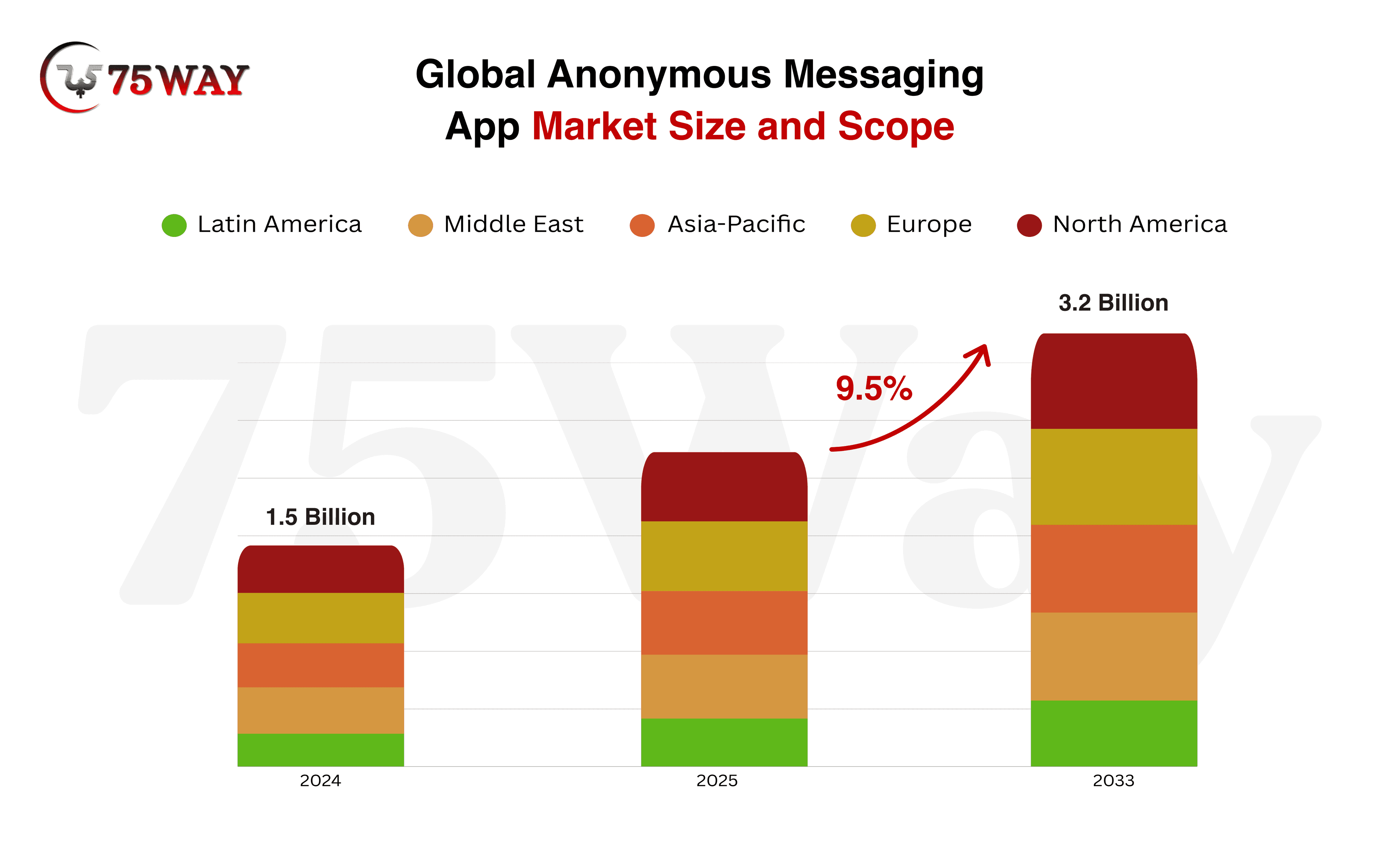
Rising privacy concerns and digital surveillance have made anonymity a top priority for users. AI-driven messaging apps combine secure communication and personalized experiences while protecting identities. Businesses and startups can meet growing demand, enhance user trust, and create scalable, compliance-ready platforms. Intelligent AI ensures safety, engagement, and a competitive edge in the expanding USA market.
Quick Snapshot: How to Build IoT Apps in 2026: A Guide for Startups, Founders & Business Owners
Core Features of a Next‑Gen Anonymous Messaging App
A next-generation anonymous messaging app balances security, AI intelligence, and user experience. Its features ensure identity protection, prevent abuse, and enhance engagement without compromising privacy. You can combine encryption, AI-driven models, and user-friendly design to build trust and safety and enable anonymous AI-driven communication.
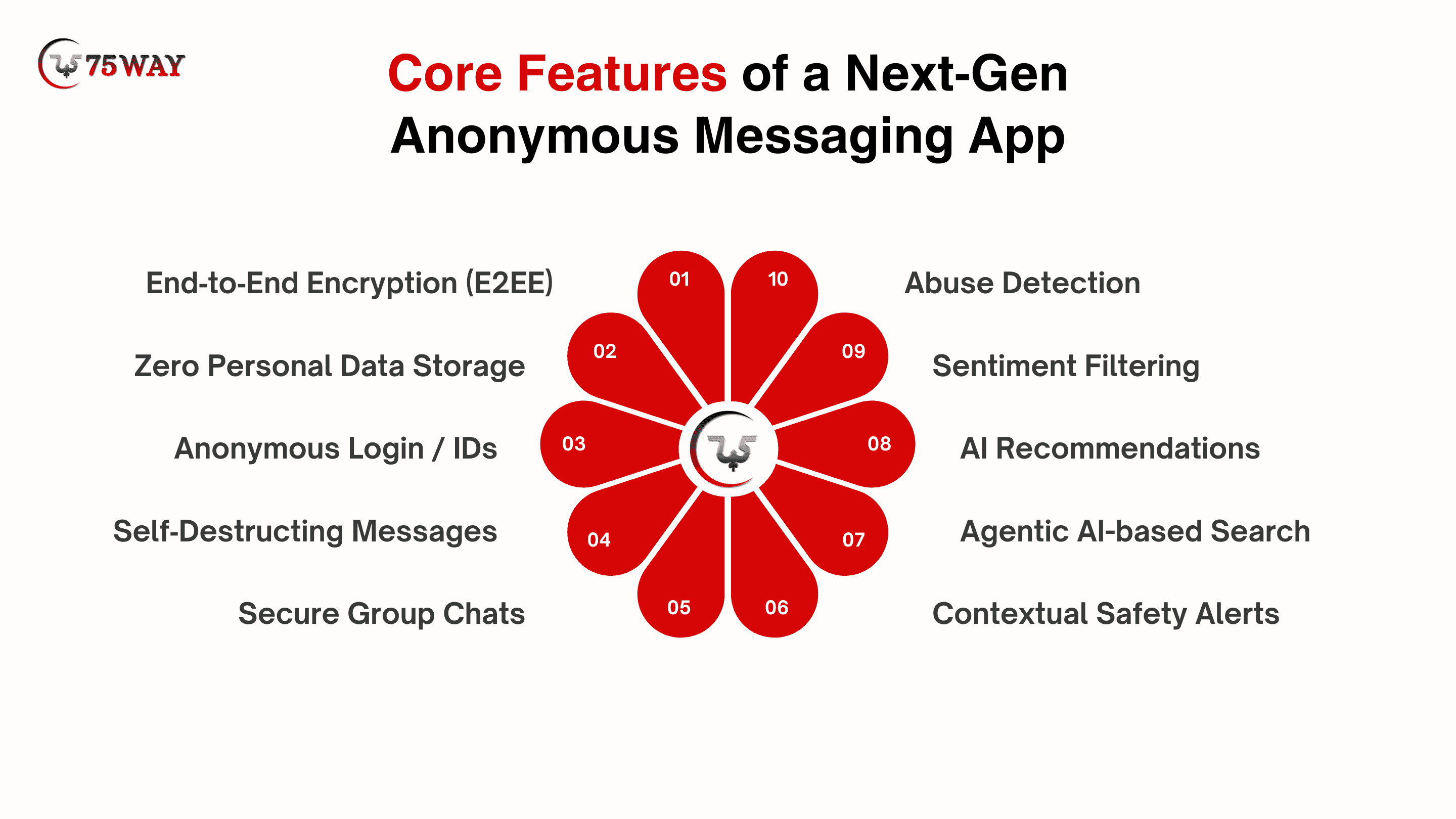
End‑to‑End Encryption (E2EE): End-to-end encryption ensures messages are readable only by the intended recipients, preventing interception or eavesdropping. Strong encryption is the backbone of secure anonymous communication to build user trust and make your app reliable for sensitive conversations in the USA.
Zero Personal Data Storage: Zero data storage minimizes legal and security risks. Messages and metadata are never permanently stored, which aligns with privacy regulations, like CCPA. Users gain confidence when they know their personal information cannot be accessed. Hence, user trust and adoption are increased.
Anonymous Login/IDs: Anonymous IDs replace personal credentials with randomized identifiers for secure communication without revealing identities. This approach streamlines onboarding, protects anonymity, and allows AI modules to operate.
Self‑Destructing Messages: Messages that automatically delete after a set period reduce data footprint and increase user confidence. Ephemeral messaging reassures users that sensitive conversations remain private and supports both legal compliance and trust in long-term usage.
Secure Group Chats: Encrypted group chats allow safe, collaborative interactions. With access controls and AI tools, users can engage in communities without compromising anonymity, while abusive behavior is automatically flagged or filtered.
Abuse Detection: AI-powered abuse detection identifies harassment patterns in real time. Automated features reduce the need for manual review, protect users from harmful interactions, and ensure compliance with USA safety standards.
Sentiment Filtering: Sentiment analysis assesses the emotional tone of messages. Early identification of negativity or distress allows proactive interventions. It makes conversations safer and provides a positive environment without tracking personal data.
AI Recommendations: AI-driven recommendations personalize chat experiences and suggest relevant conversations or communities. This increases engagement and preserves anonymity to deliver intelligent, context-aware content to users.
Agentic AI-based Search: Agentic AI search enables users to find content or contextual conversation. Intelligent querying enhances usability and discovery while respecting anonymity, allowing users to find meaningful interactions.
Contextual Safety Alerts: Real-time safety alerts notify users of potentially risky interactions. These proactive warnings empower users to control conversations, avoid unsafe scenarios, and maintain privacy in dynamic, anonymous environments.
Read More: How to Build an Astrology App Like Co-Star? A Strategic Guide 2026
10 Top Examples of Anonymous Messaging Apps
Several anonymous messaging apps are available in USA to offer privacy, security, and usability. These apps provide startups and founders with valuable insights into design choices, AI integration, and encryption standards that can inspire smart, privacy-first platforms.
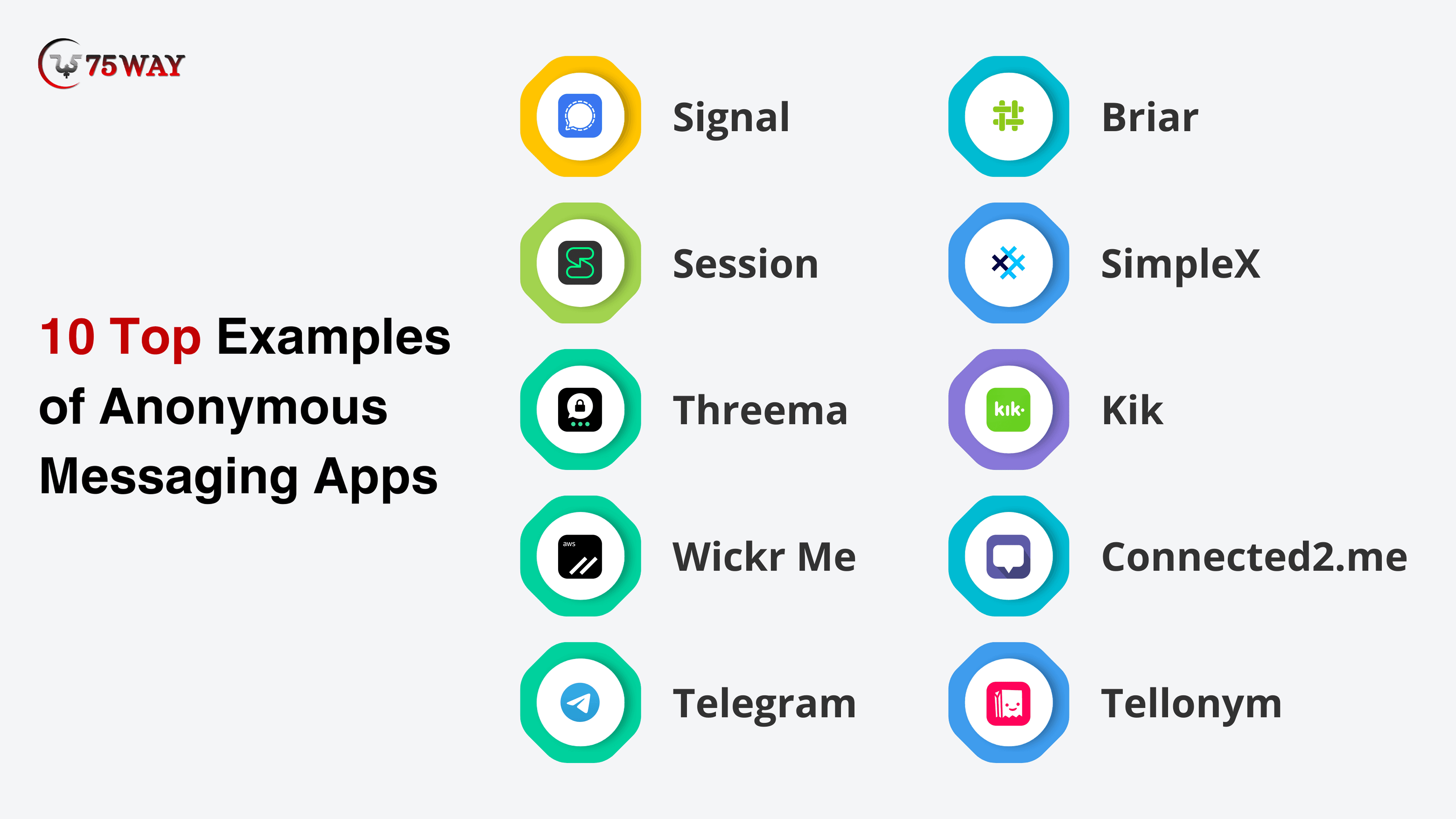
Signal: Signal is a privacy-first messaging app widely recognized for strong encryption and minimal data retention. It supports secure messaging, encrypted calls, and disappearing messages. Open-source security ensures transparency, while simplicity attracts individual users. Signal is ideal for privacy-conscious individuals, professionals handling sensitive information, and organizations needing trusted communication platforms. Its minimal data collection aligns with US privacy standards and promotes AI-ready integration for safety.
- End-To-End Encryption: Messages remain unreadable by third parties.
- Disappearing Messages: Timed messages enhance privacy automatically.
- Encrypted Voice Calls: Secure calls protect sensitive conversations.
- Open-Source Security Model: Transparency builds trust with developers.
- Group Messaging Support: Private groups enable anonymous collaboration.
- Cross-Platform Availability: Works on iOS, Android, and desktop.
Session: Session is a fully decentralized messaging app that eliminates phone numbers entirely, using onion routing to protect anonymity. It offers end-to-end encrypted messaging and offline support for enhanced privacy. Performance may be slower due to decentralization, but it prioritizes user anonymity above speed. Session is best suited for privacy purists, activists, and journalists requiring confidential communication channels while remaining fully AI-compatible for sentiment analysis.
- Decentralized Infrastructure: No central server collects data.
- Onion Routing Enabled: Network traffic anonymizes user connections.
- End-To-End Encryption: Secure messages across all devices.
- Offline Messaging Support: Conversations work without an internet connection.
- Anonymous Identifier System: No phone numbers required.
- Open-Source Transparency: Code accessible for security audits.
Threema: Threema assigns random IDs to maintain anonymity and operates under strict Swiss privacy laws. It provides encrypted text, voice, and group messaging with a focus on compliance. The paid model limits adoption but ensures quality, security, and reliability. Threema is ideal for enterprises, compliance-driven users, and teams that require alignment with GDPR and US privacy laws. AI features can be integrated without storing personal user data.
- Random ID Assignment: Protects real user identities.
- End-To-End Encryption: Ensures total message security.
- Group Chat Functionality: Secure team collaboration features.
- Voice Message Encryption: Protects sensitive audio communications.
- Paid Access Model: Enhances security and reliability.
- Anonymous Polling Tool: Collect feedback safely within groups.
Wickr Me: Wickr Me delivers military-grade encryption and self-destructing messages for maximum privacy. The app offers secure file sharing, voice calls, and group messaging. While the interface can feel complex for casual users, enterprises value its robust security features. Ideal for professional communication, corporate teams, and sensitive projects, Wickr Me integrates AI and behavioral analysis while fully respecting anonymity and compliance requirements.
- Military-Grade Encryption: Strongest security protocols applied.
- Self-Destruct Messages: Automatically deletes content after a set duration.
- Secure File Sharing: Share documents privately and safely.
- Encrypted Voice Calls: Maintain confidential conversations effortlessly.
- Group Chat Encryption: Secure team communication platform.
- Anonymous Account Setup: No personal data required.
Telegram: Telegram enables anonymous usernames and secret chats, supporting large communities and fast messaging. While encryption defaults are not always end-to-end, secret chats protect sensitive conversations. It is ideal for community engagement, public discussions, and social networking, while enabling AI-driven features and sentiment analysis to enhance group safety. Telegram’s scalable architecture provides insights for building mass-adoption features in the USA markets while preserving individual users' privacy.
- Username-Based Messaging: Users communicate without personal identifiers.
- Secret Chat Option: Ensures end-to-end encryption.
- Large Group Support: Communities up to 200,000 members.
- Media Sharing Enabled: Photos, videos, and documents.
- Cross-Platform Accessibility: Available on web, mobile, and desktop.
- Cloud-Based Syncing: Messages are accessible across devices.
Briar: Briar is a peer-to-peer anonymous messaging app that works without central servers. Messages sync directly between devices via Bluetooth, Wi-Fi, or Tor network, offering extreme privacy and offline usability. Limited usability affects mainstream adoption, but it is perfect for activists, journalists, and high-risk users. Briar integrates AI tools for abuse detection and behavioral insights while maintaining strict anonymity.
- Peer-To-Peer Messaging: No server intermediaries involved.
- Offline Connectivity: Messages sync without internet.
- Tor Network Integration: Enhances anonymity and routing privacy.
- End-To-End Encryption: Secures all communications effectively.
- Anonymous User IDs: Protects identities across interactions.
- Group Messaging: Small private communities supported.
SimpleX: SimpleX avoids user IDs entirely, offering serverless messaging for complete anonymity. It supports encrypted chat and peer-to-peer file sharing. Technical complexity limits mainstream appeal, but privacy purists find it ideal. Startups and developers can integrate AI-powered features or content suggestions without touching user data, ensuring full EEAT-compliant operation for USA audiences.
- Serverless Messaging: No central data storage.
- Peer-To-Peer Encryption: Messages remain secure end-to-end.
- Anonymous Chat IDs: No personal credentials required.
- File Sharing: Safe peer-to-peer transfer support.
- Cross-Platform Capability: Accessible on multiple devices.
- Minimalistic Design: Focuses on privacy and usability.
Kik: Kik supports username-based messaging without phone numbers, maintaining basic anonymity. Popular among younger audiences, it enables casual anonymous chats with multimedia sharing. Security features are weaker than those in newer apps, but Kik’s approach highlights lessons in onboarding simplicity and scalability. AI integration can improve safety for younger users while maintaining privacy and anonymity.
- Username-Based Accounts: No phone numbers required.
- Multimedia Messaging: Share images and videos.
- Group Chat Support: Create private or public groups.
- Basic Encryption Layer: Protects messages to some extent.
- Cross-Device Access: Works on mobile and web.
- In-App Content: AI-assisted filtering for safer chats.
Connected2.me: Connected2.me emphasizes anonymous social discovery and allows profile-based interactions with chat initiation. Engagement features like gifts and polls increase activity, though privacy depth is moderate. It is perfect for social discovery, influencer engagement, and casual anonymous conversations. AI modules can enhance moderation, detect abuse, and provide safe interaction recommendations for USA users.
- Anonymous Profiles: Users interact without personal info.
- Discovery-Based Chat: Connects users randomly or by interests.
- Engagement Tools: Polls, gifts, and interactive content.
- Built-in System: Filters abusive behavior automatically.
- Messaging Encryption: Basic secure communication is provided.
- Cross-Platform: Available on mobile and web apps.
Tellonym: Tellonym supports anonymous feedback and Q&A interactions for creators, educators, and influencers. Users can send anonymous questions or comments, while moderation ensures safety. Popular among social content platforms, it fosters engagement and trust. AI modules enhance content filtering, sentiment analysis, and abusive behavior detection while preserving anonymity for USA audiences.
- Anonymous Q&A: Users send questions without identification.
- Feedback System Built-In: Collect anonymous insights effectively.
- Content Moderation: AI-assisted filters prevent abuse.
- Message Encryption: Secures user communication.
- Cross-Platform: Works across devices seamlessly.
- Engagement Metrics: Tracks activity safely and anonymously.
Read Also: Top 10 IoT Development Companies in USA
What Is The Cost To Develop An Anonymous Messaging App
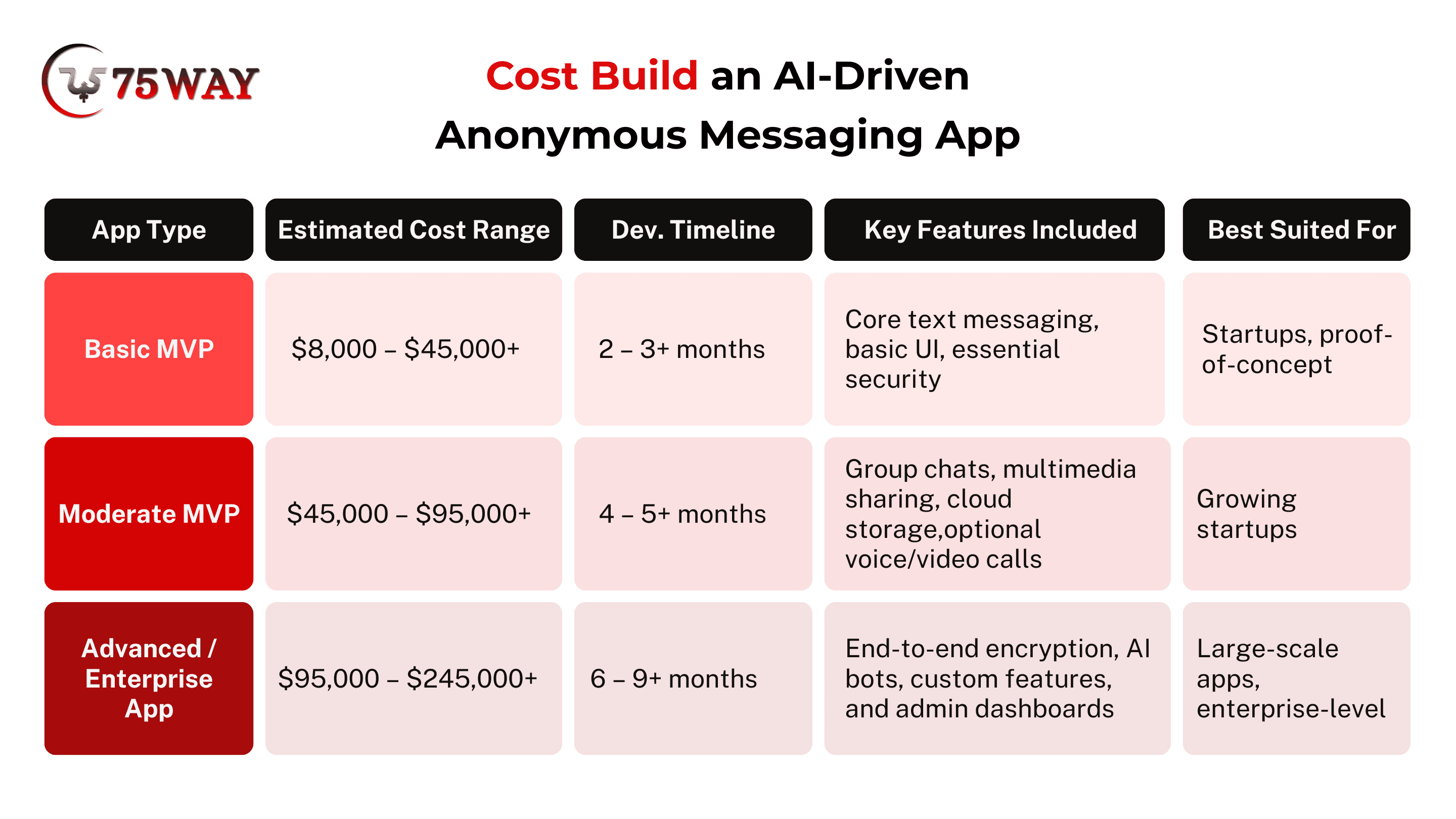
The development cost for an anonymous messaging app depends on complexity, security depth, and AI integration. A basic MVP costs less but limits scalability, while advanced apps require a higher investment for encryption, AI moderation, and compliance. USA-based development typically reflects higher security and infrastructure standards, which influence both the timeline and the cost.
Basic MVP: A standard MVP costs between $8,000 and $45,000+ and typically takes 2 to 3 months to develop. This version includes core text messaging, a simple and intuitive UI, and essential security features to ensure user privacy. It is ideal for startups or proof-of-concept testing. The basic version allows founders to validate demand, gather user feedback, and lay the groundwork for future AI and advanced functionality while keeping costs manageable.
Moderate App: A moderate app ranges from $45,000 to $95,000+ and requires 4 to 5 months of development. It includes group chat, multimedia sharing, cloud storage, and optional voice and video calling. This version suits growing startups seeking enhanced engagement and scalability. By integrating these features early, businesses can provide a richer user experience, test AI and generative AI features, and prepare the platform for advanced analytics and larger audiences in the USA market.
Advanced/Enterprise App: An advanced or enterprise app costs $95,000 to $245,000+ and usually takes 6 to 9 months to build. It includes end-to-end encryption, AI-powered bots, custom features, and admin dashboards for monitoring and analytics. It is perfect for large-scale applications or enterprise-level solutions. This tier supports high user volumes, regulatory compliance, and AI-driven moderation. This private messaging app offers robust security, seamless performance, and a strong foundation for continuous feature updates and growth in the competitive USA anonymous messaging market.
Additional Cost Components & Time Estimates
- Third-Party Integrations: These services typically costs $5,000 to $15,000+ and can take 2 to 4 weeks depending on complexity. These integrations include payment gateways, cloud hosting, AI APIs, and messaging APIs, which enhance functionality without building everything from scratch.
- Backend & API Development: Backend and API development range from $10,000 to $40,000+ and usually require 1 to 3 months. This work establishes scalable server infrastructure, secure messaging logic, and real-time message delivery.
- AI & Personalization Logic: AI and personalization features are often included in advanced app tiers and take 1 to 2 months to implement. This includes AI-driven chats, behavioral insights, and recommendation algorithms that enhance user engagement while respecting anonymity.
- Maintenance & Updates: Ongoing maintenance and updates typically cost 10% to 15% of the app annually. This includes bug fixes, new feature development, platform compatibility adjustments, and security patching.
Quick Read: How AI Development Help US Companies Scale Faster
Monetization Strategies For Anonymous Messaging App Development
Revenue generation for an anonymous messaging app depends on preserving user trust while offering tangible value. Smart monetization balances profitability with privacy, ensuring that users remain confident in anonymity. These approaches anonymous messaging app development encourage engagement and long-term adoption. Startups and founders in the USA can adopt strategies that scale safely and maintain compliance.
Freemium Model: The freemium model keeps basic messaging and anonymity features free. However, advanced tools such as AI and machine learning integration, personalization, and enhanced security options are available through paid upgrades. This approach attracts users rapidly and allows startups to validate demand before offering premium capabilities.
In-App Advertising: In-app advertising helps businesses generate revenue through contextual ads that do not rely on personal data. The ad placement preserves anonymity and user trust while still delivering measurable monetization. This model is ideal for apps that target mass audiences or for casual, anonymous communication, to provide a sustainable income.
Subscription Model: This revenue model in private messaging apps offers recurring revenue with premium features. Users are allowed to pay for enhanced security and loyalty, which helps the businesses to generate predictable income streams. With AI integration into subscription tiers, these anonymous apps increase retention and comply with US privacy laws, maintaining a balance between monetization and user trust.
In-App Purchases: Optional in-app purchases enhance the user experience without imposing mandatory payments. This monetization model in anonymous messaging apps allows customization of themes, avatars, or temporary premium features. This approach encourages voluntary spending while respecting anonymity and privacy.
Premium Features: Premium features, such as AI-powered content suggestions, advanced tools, and private channels, drive upsell opportunities for serious users or enterprises. These features provide tangible value while respecting anonymity. Startups can leverage GPT/AI modules to enhance user experience and offer premium privacy.
Affiliate Marketing: Affiliate marketing partnerships generate revenue without compromising user anonymity. These private messaging apps can promote privacy-focused products or services and receive commissions for conversions. This method provides an additional revenue stream for startups and founders to maintain trust and privacy.
Pay-Per-Message: Transactional messaging works for enterprise or verification-based use cases, where certain communications carry a cost, such as verified feedback, secure reporting, or premium support channels. This monetization model aligns with professional environments and USA compliance standards and enables high-value interactions.
Read More: Top 10 Dating Apps in USA in 2026: A Complete Guide
Conclusion
To summarize, anonymous messaging apps represent the future of private communication. The rise in privacy concerns, AI-driven moderation, and scalable architectures creates significant opportunities for startups and founders. A well-planned roadmap for an anonymous messaging app should include a secure feature set and proven examples to reduce risk and increase market readiness. The USA market already shows strong demand, and timing favors action. The right AI product development for private messaging apps positions businesses ahead of the competition. Partnering with a trusted chatting app development company ensures technical excellence, compliance, and long-term growth.
FAQs
What is an AI‑driven Anonymous Messaging App Development?
AI-driven anonymous messaging app development refers to building a communication platform where users can exchange messages without revealing personal identity, while artificial intelligence ensures safety, usability, and scalability. Unlike traditional chat apps, these platforms replace personal identifiers with pseudonymous IDs and minimize data storage.
AI plays a critical role in maintaining balance. Machine learning models moderate harmful content, detect abuse patterns, analyze sentiment, and prevent misuse, without storing sensitive user data. GPT-based modules can enhance conversations, provide contextual assistance, and support mental health use cases while respecting privacy. Together, anonymity architecture and AI intelligence create a secure, compliant, and engaging messaging ecosystem.
How Do Messaging Apps Stay Anonymous?
Anonymous messaging apps preserve anonymity by removing direct links between users and their real identities. Instead of phone numbers or emails, apps generate randomized identifiers or cryptographic keys that represent users internally.
Session-based tokens manage authentication without permanent identity storage, while metadata such as IP addresses and device details are either masked, minimized, or encrypted. Many platforms also implement zero-log or limited-retention policies, ensuring messages and identifiers are not stored long-term. Combined, these mechanisms prevent identity tracing while still allowing secure message delivery.
Can Anonymous Chat Apps Be Secure?
Yes, anonymous chat apps can be highly secure when privacy and security are built into the architecture from the beginning. End-to-end encryption ensures only intended recipients can read messages, even if data is intercepted. Zero-knowledge storage prevents service providers from accessing message content or identities.
Security is further strengthened through AI-powered abuse detection, rate limiting, and anomaly monitoring, which protect users without revealing personal information. Regular penetration testing, encryption audits, and compliance with U.S. data protection standards help maintain trust while reducing operational and legal risks.
What Technologies Power Anonymous Messaging?
Anonymous messaging apps rely on a combination of privacy-focused and real-time technologies. Encrypted protocols such as Signal Protocol secure message transmission, while WebSockets or MQTT enable instant message delivery. Backend systems often use scalable cloud infrastructure with region-based compliance controls.
AI technologies include NLP models for moderation, sentiment analysis engines, and GPT-based assistance layers that enhance usability. Cryptographic tools generate anonymous IDs and secure tokens, while containerized microservices ensure scalability. Together, these technologies form a resilient foundation that supports anonymity, performance, and intelligent safety controls.