AI Summary
Aviation software development connects complex aviation operations with modern digital systems. This guide explores airline software types, essential capabilities, architecture, AI applications, cybersecurity, compliance, development costs, and timelines. It also explains practical development approaches for aviation businesses.
Key Takeaways
- The aviation MRO software market will reach $10.62 billion by 2034.
- Aviation software supports airlines, airports, MROs, and diverse aviation operations.
- Architecture must address integration, security, scalability, reliability, and operational requirements.
- AI enables predictive maintenance, disruption management, analytics, and decision support.
- Compliance requirements vary according to software function, risk, and environment.
- Aviation software development costs range from $8,000 to $900,000+.
Aviation businesses cannot afford software that simply looks modern but struggles when real operational demands begin. Airlines need technology that can support high transaction volumes, connect with existing systems, and remain dependable across customer-facing and internal operations.
For airline decision-makers, software development is therefore closely tied to business performance. The right aviation software solution can help teams gain better control over information, reduce repetitive work, improve coordination, and create a more connected experience for passengers and employees.
The challenge is turning complex aviation requirements into software that is practical, scalable, and aligned with commercial goals.
But how do you develop aviation software? What does aviation software development cost? And which development services should an airline business consider?
This guide provides a detailed look at aviation software development and the key areas businesses need to understand before starting a project.
What Is Aviation Software Development?
Aviation software development involves creating digital systems that support the operation, maintenance, management, distribution, and safety of aviation services and assets.
These systems can range from airline management and flight operations platforms to MRO applications, airport management systems, passenger applications, aviation analytics platforms, and safety-critical airborne software.
The important distinction is that not every aviation software product has the same regulatory or certification requirements.
For example, a passenger loyalty application has a very different risk profile from software used in an aircraft flight-control system. Similarly, an MRO records platform has different requirements from an airport resource-management system.
That distinction should be established during project discovery because it influences architecture, testing, documentation, security controls, development processes, and project cost.
For airborne software, the FAA recognizes RTCA DO-178C and EUROCAE ED-12C as an acceptable means of demonstrating compliance with applicable airworthiness requirements. The FAA also maintains specific guidance covering software used in airborne systems and equipment.
Market Size & Revenue Growth of Airline Software Solutions in USA
The airline software market is expanding alongside the growing need for digital systems across flight operations, passenger services, and airline management. For aviation businesses, this growth represents a larger commercial opportunity for software providers and technology investments. The market size, revenue growth, and key figures provide a clearer view of where the industry is heading.
- The global aviation MRO software market is projected to grow from US$8.67 billion in 2026 to $10.62 billion by 2034, registering a 2.57% CAGR.
- The U.S. aviation MRO software services market is expected to reach approximately US$2.30 billion by 2030.
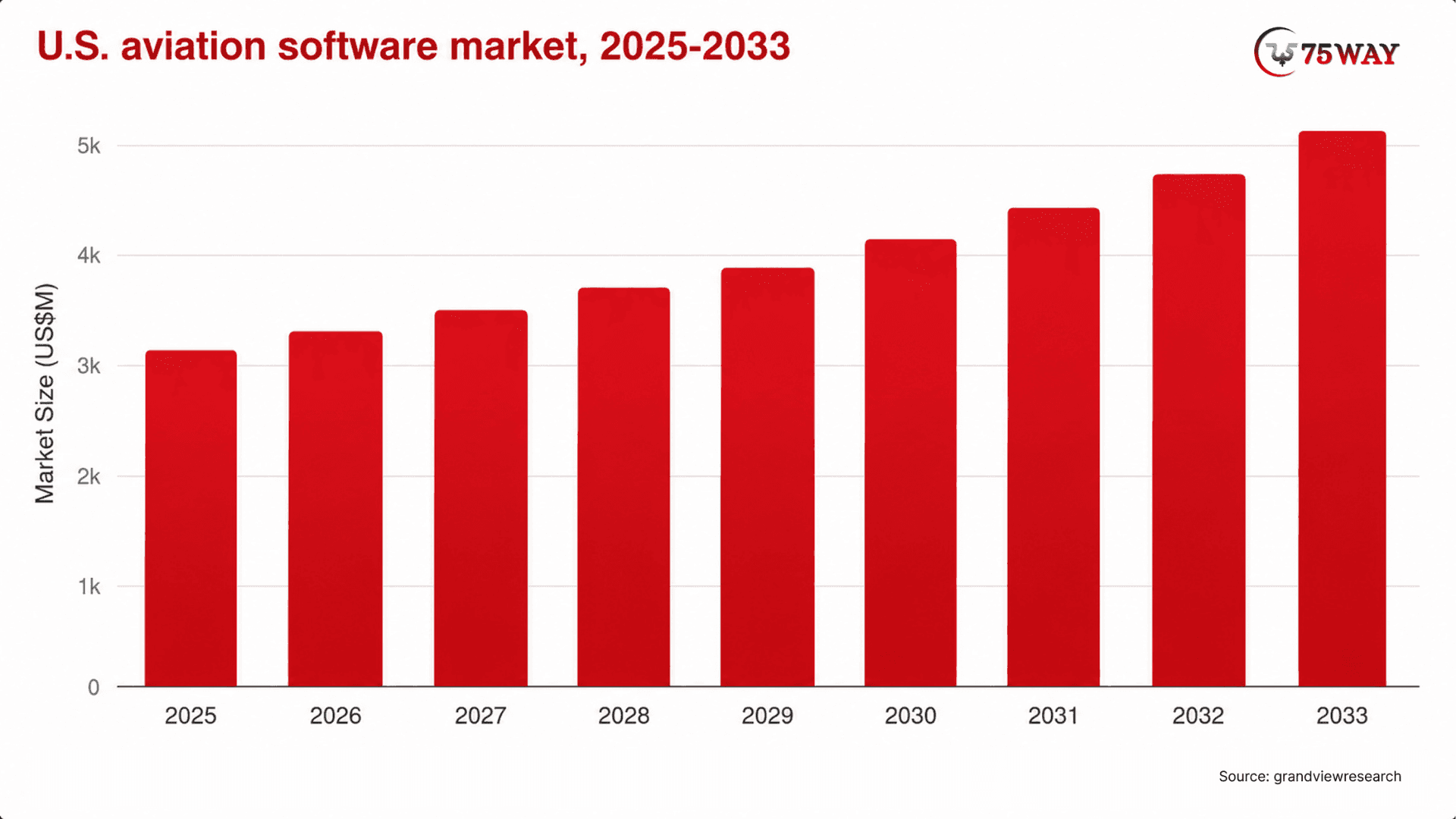
- The U.S. aviation software market is forecast to generate around US$5.12 billion in revenue by 2033.
- Within North America, the U.S. aviation software market is projected to lead the region with 1,280.1 million by 2033 in revenue by 2033.
- Cloud-based solutions dominated the aviation software market in 2025, holding a 70.00% market share, while on-premises deployment is projected to grow at the fastest rate, with a 9.80% CAGR from 2026 to 2035.
- Commercial aviation accounted for the largest aircraft-type revenue share in 2025 at 54.20%, while military aviation is projected to record the fastest growth, with a 4.45% CAGR through 2031.
Why Aviation Businesses Invest in Airline IT Solutions?
The business case for airline IT solutions goes beyond replacing outdated systems or adding new digital tools. Aviation companies can use modern IT infrastructure to improve operational visibility, strengthen passenger services, and support growth without adding unnecessary complexity. The key drivers behind these investments become clearer through the points discussed in this section.
1. Streamline Airline Operations
Airline software development solutions bring flight operations, crew management, aircraft information, scheduling, and other workflows into connected digital systems. This reduces manual coordination, minimizes information gaps, and helps teams manage daily operations with greater visibility.
2. Improve Operational Decision-Making
Centralized operational data gives managers timely insights into flights, aircraft, crews, maintenance, and disruptions. With dashboards, analytics, and automated alerts, decision-makers can identify issues sooner and respond using current business information.
3. Reduce Manual Work
Automation can handle repetitive activities such as data entry, reporting, notifications, scheduling updates, and workflow approvals. This allows employees to spend more time on operational tasks that require judgment, coordination, and direct attention.
4. Enhance Passenger Experience
Digital airline platforms can support booking, check-in, boarding passes, flight updates, loyalty programs, and customer communication. Connecting these services with operational systems helps passengers receive more timely and relevant information throughout their journey.
5. Connect Legacy Systems
Airlines often operate multiple systems that were introduced at different stages of business growth. Modern avionics software can use APIs, integration services, and data platforms to connect legacy applications with newer technologies without requiring immediate replacement of every existing system.
6. Strengthen Data And Analytics
Airline IT solutions can consolidate information from operations, maintenance, customer interactions, finance, and other business functions. Structured data enables reporting, performance monitoring, forecasting, and advanced analytics that help organizations identify operational patterns and business opportunities.
7. Support Long-Term Digital Growth
A scalable airline software foundation makes it easier to introduce new applications, automation, AI capabilities, integrations, and digital services as the airline expands. Businesses can therefore develop technology around evolving operational requirements instead of repeatedly rebuilding disconnected systems.
Types of Aviation Software Solutions You Can Build
One aviation business may need software to manage passengers, while another may need technology focused on aircraft, crew, or operational workflows. These different requirements have created a wide range of software solutions designed for specific aviation activities and business goals. The main types worth considering are explained in the following discussion.
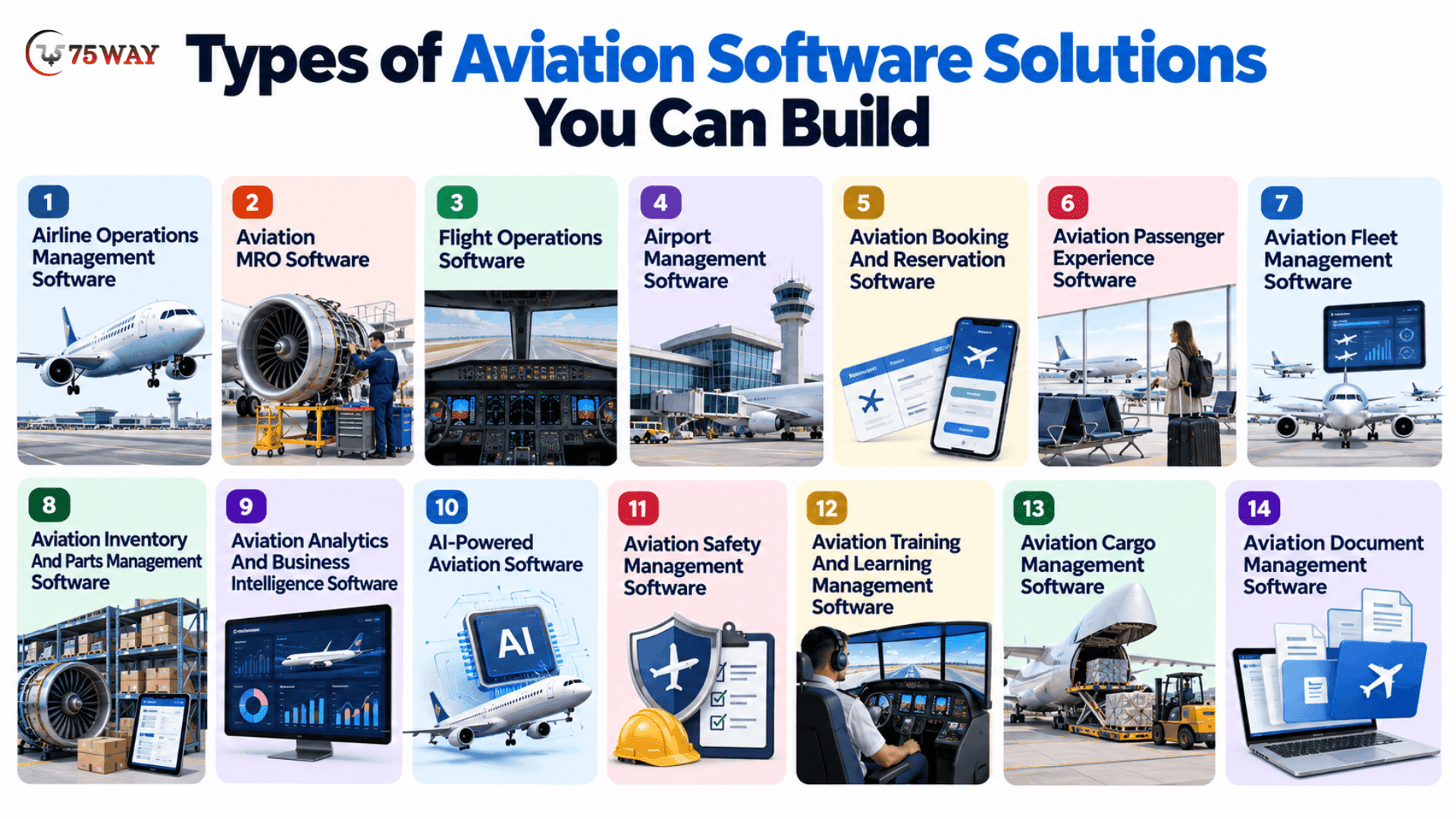
1. Airline Operations Management Software
Airline operations management software centralizes flight scheduling, aircraft allocation, crew coordination, dispatch, operational monitoring, and disruption management. It gives operations teams a shared view of daily activities while connecting information from different airline systems. Custom platforms can also include dashboards, automated alerts, workflow management, and real-time operational data.
Ideal For: Airlines, regional carriers, charter operators, and aviation management companies.
Estimated Development Cost: $100,000–$500,000+
2. Aviation MRO Software
Aviation MRO software helps maintenance teams manage aircraft maintenance activities, work orders, inspections, technical records, inventory, components, and maintenance schedules. A custom MRO platform can connect maintenance planning with parts availability and aircraft information, helping organizations maintain accurate records and coordinate maintenance workflows.
Ideal For: MRO providers, airlines, aircraft operators, maintenance organizations, and aviation service companies.
Estimated Development Cost: $150,000–$700,000+
3. Flight Operations Software
Flight operations software supports flight planning, dispatch, route management, fuel planning, weather information, aircraft availability, flight monitoring, and operational communication. Businesses can customize the platform around their fleet, operational procedures, integrations, and reporting requirements.
Ideal For: Airlines, charter companies, cargo operators, flight departments, and aviation operators.
Estimated Development Cost: $100,000–$500,000+
4. Airport Management Software
Airport management software connects airport resources and operational workflows through a centralized platform. Depending on the scope, it can support gate and stand management, turnaround coordination, baggage operations, resource allocation, passenger flow, asset management, and operational reporting.
Ideal For: Airports, airport authorities, ground-handling companies, and aviation infrastructure providers.
Estimated Development Cost: $200,000–$900,000+
5. Aviation Booking And Reservation Software
Aviation booking and reservation platforms allow customers or travel partners to search flights, compare availability, make reservations, manage bookings, and complete payments. Custom systems can integrate airline inventory, customer accounts, loyalty programs, ancillary services, notifications, and third-party travel platforms.
Ideal For: Airlines, aviation startups, travel companies, charter operators, and flight-booking platforms.
Estimated Development Cost: $80,000–$400,000+
6. Aviation Passenger Experience Software
Passenger experience software focuses on digital interactions throughout the travel journey. It can include mobile applications, online check-in, digital boarding passes, flight-status updates, baggage notifications, loyalty features, self-service options, and personalized customer communication.
Ideal For: Airlines, airports, passenger service providers, and aviation technology startups.
Estimated Development Cost: $50,000–$300,000+
7. Aviation Fleet Management Software
Fleet management software provides centralized visibility into aircraft utilization, availability, maintenance status, operating information, schedules, and associated assets. Businesses can use customized dashboards and analytics to monitor fleet performance and coordinate aircraft-related activities.
Ideal For: Airlines, aircraft operators, charter companies, leasing businesses, and fleet managers.
Estimated Development Cost: $100,000–$450,000+
8. Aviation Inventory And Parts Management Software
This software manages aviation parts, components, inventory levels, procurement, suppliers, warehouse activities, and component histories. Integration with MRO and ERP systems can provide maintenance teams with better visibility into parts availability and purchasing requirements.
Ideal For: MRO organizations, airlines, aviation suppliers, aircraft operators, and parts distributors.
Estimated Development Cost: $80,000–$350,000+
9. Aviation Analytics And Business Intelligence Software
Aviation analytics platforms consolidate operational and business data into dashboards, reports, forecasting tools, and analytical models. Organizations can monitor indicators such as aircraft utilization, maintenance trends, delays, operational performance, costs, and resource usage from centralized interfaces.
Ideal For: Airlines, airports, MRO providers, aviation enterprises, and aviation technology companies.
Estimated Development Cost: $80,000–$400,000+
10. AI-Powered Aviation Software
AI-powered aviation software applies machine learning, natural language processing, computer vision, and predictive analytics to specific aviation workflows. Depending on the use case, it can support predictive maintenance, delay prediction, document analysis, anomaly detection, intelligent assistants, and operational decision support.
Ideal For: Airlines, MRO providers, airports, aerospace companies, aviation startups, and technology-driven aviation businesses.
Estimated Development Cost: $100,000–$600,000+
11. Aviation Safety Management Software
Aviation safety management software helps organizations manage safety reports, hazards, incidents, risk assessments, corrective actions, audits, and safety documentation. A centralized system can improve visibility into safety-related workflows while maintaining appropriate records and access controls.
Ideal For: Airlines, airports, MRO organizations, flight operators, and aviation safety teams.
Estimated Development Cost: $100,000–$400,000+
12. Aviation Training & Learning Management Software
Aviation training platforms manage employee training, courses, assessments, certifications, schedules, training records, and competency requirements. They can provide separate workflows for pilots, cabin crew, maintenance technicians, ground staff, and other aviation personnel.
Ideal For: Airlines, aviation academies, MRO providers, airports, and aviation training organizations.
Estimated Development Cost: $60,000–$300,000+
13. Aviation Cargo Management Software
Cargo management software digitizes shipment booking, tracking, documentation, warehouse coordination, cargo status, and communication between relevant stakeholders. Integration with airline, warehouse, customs, and logistics systems can create better shipment visibility across the cargo journey.
Ideal For: Cargo airlines, freight operators, airports, freight forwarders, and aviation logistics companies.
Estimated Development Cost: $100,000–$500,000+
14. Aviation Document Management Software
Aviation document management software organizes technical manuals, maintenance documents, certificates, operational records, compliance documents, and other controlled information. Features such as version control, permissions, audit trails, search, and document workflows can help organizations manage large volumes of aviation documentation.
Ideal For: Airlines, MRO providers, airports, aerospace organizations, and aviation compliance teams.
Estimated Development Cost: $50,000–$250,000+
Aviation Software Architecture: What Should Businesses Plan?
The architecture behind aviation software can determine how reliably the system performs as operational demands increase. Airlines need an architecture that supports connected systems, secure data exchange, high availability, and room for future capabilities. The main architectural areas businesses need to plan for are explained throughout this section.
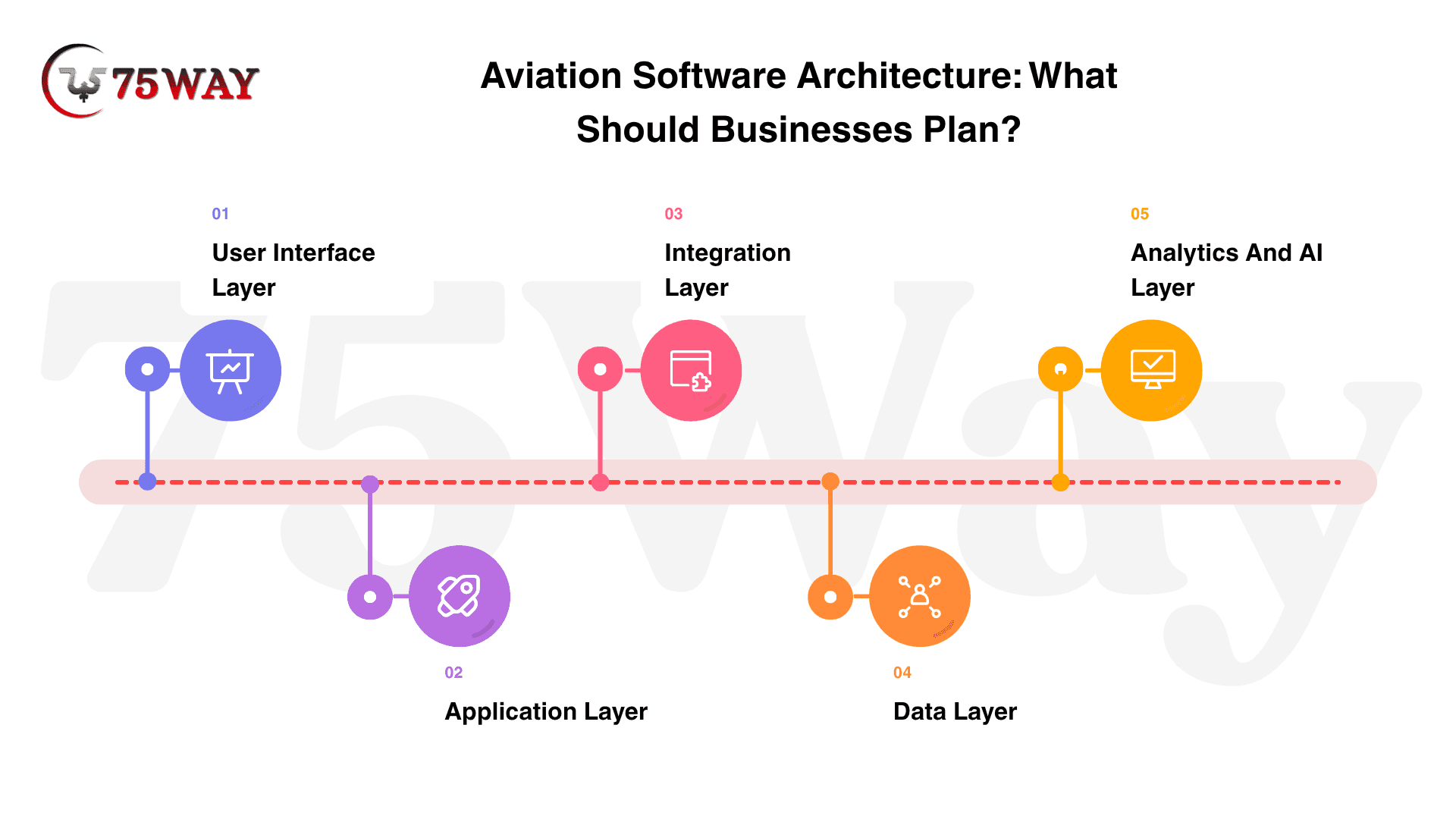
1. User Interface Layer
Web applications, mobile applications, technician interfaces, crew applications, dashboards, and administrative portals sit at the user-facing layer.
The interface should reflect the user's operational environment rather than simply replicate a conventional enterprise dashboard.
2. Application Layer
This layer contains business workflows such as maintenance management, flight operations, scheduling, resource allocation, notifications, and reporting.
Domain-driven architecture can help separate major aviation processes and reduce unnecessary dependencies.
3. Integration Layer
The integration layer connects the application with internal and external systems.
It may include APIs, event-driven messaging, integration services, data transformation, authentication, and monitoring.
4. Data Layer
The data architecture may include transactional databases, data warehouses, data lakes, event stores, document storage, and analytics systems.
The architecture should define data ownership and retention requirements early, particularly when multiple systems exchange the same operational information.
5. Analytics And AI Layer
Analytics services can consume operational data for reporting, forecasting, anomaly detection, predictive maintenance, and decision support.
AI functionality should have clear boundaries, especially when recommendations could influence safety-sensitive or operational decisions.
How To Build Aviation Software: End-To-End Development Process
A reliable aviation software platform starts long before developers write the first line of code. Each stage needs to keep the business requirements, operational environment, system reliability, and future scalability in focus. The comprehensive process for turning an aviation software idea into a production-ready solution is covered here.
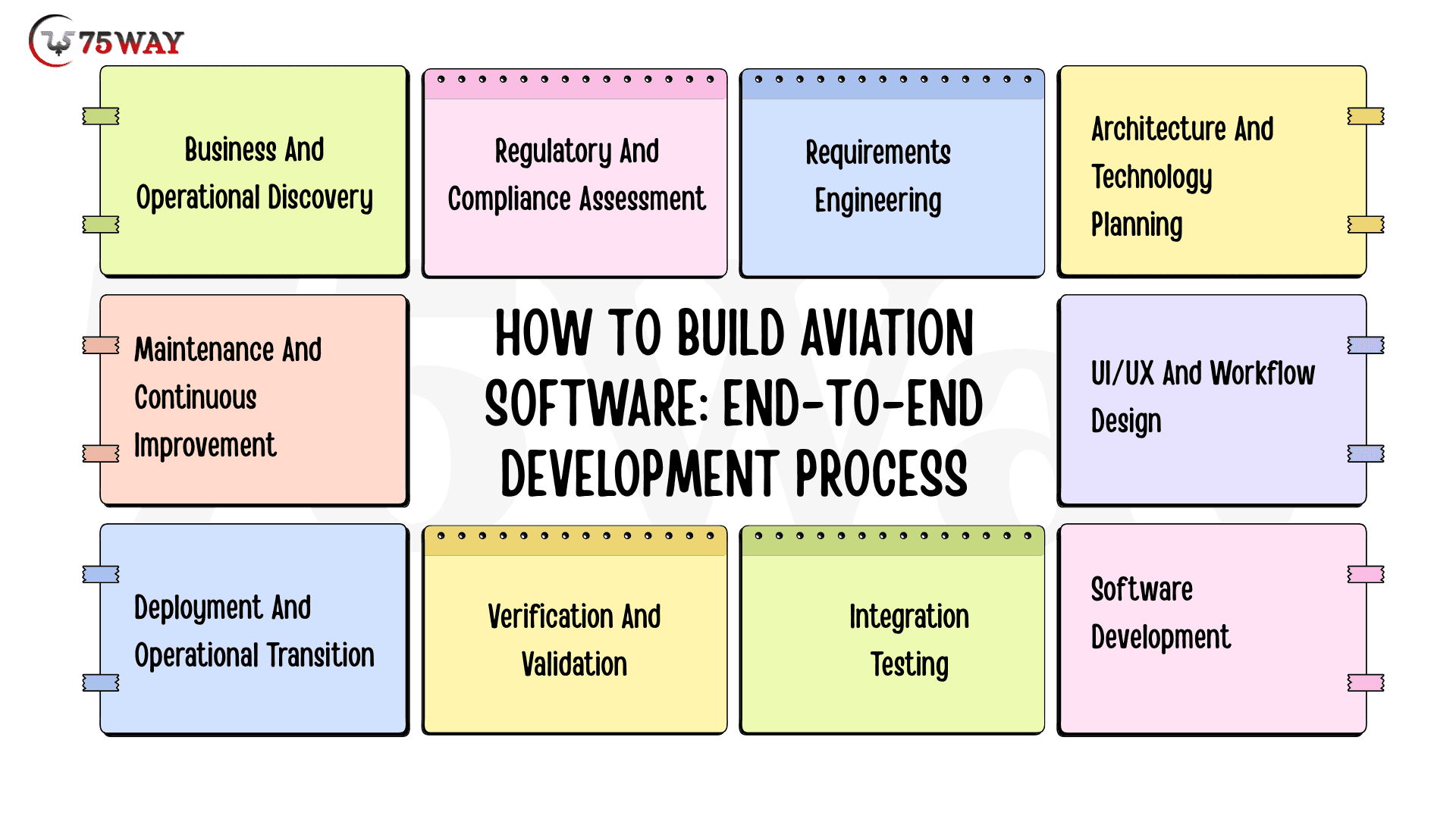
1. Business And Operational Discovery
Start by understanding the business problem.
Identify users, workflows, aircraft or fleet characteristics, operational constraints, existing systems, data sources, integration requirements, and measurable business objectives.
The outcome should be a clear definition of what the software needs to change operationally.
2. Regulatory And Compliance Assessment
Determine which regulations, standards, approvals, and assurance processes apply.
This stage should happen before architecture and implementation decisions are finalized.
The goal is to prevent a situation where a technically functional product later requires major redesign because the original development process did not produce the necessary evidence.
3. Requirements Engineering
Translate business and regulatory requirements into testable software requirements.
Safety-related requirements should be traceable through the relevant development and verification activities where applicable.
4. Architecture And Technology Planning
Design the system architecture around availability, security, scalability, integration, data management, operational environments, and compliance requirements.
Technology selection should follow these requirements instead of being driven by popularity.
5. UI/UX And Workflow Design
Design interfaces around the people who actually use the system.
A technician working beside an aircraft has different needs from an executive reviewing fleet performance.
Reducing unnecessary steps and presenting the right information at the right moment can have a major operational impact.
6. Software Development
Develop the platform in controlled increments.
Use automated testing, code reviews, version control, CI/CD where appropriate, secure development practices, and traceability mechanisms required by the project's assurance framework.
7. Integration Testing
Test connections with existing aviation and enterprise systems.
Integration failures often emerge from data mismatches, legacy interfaces, timing assumptions, incomplete records, authentication differences, or unexpected third-party behavior.
8. Verification And Validation
Testing should cover more than whether a button works.
Depending on the system, verification may include functional testing, integration testing, performance testing, security testing, reliability testing, data validation, and formal assurance activities.
For safety-critical software, the applicable certification framework determines additional verification evidence and objectives.
9. Deployment And Operational Transition
Aviation organizations should generally avoid treating production deployment as a single technical event.
A phased rollout can allow teams to validate workflows, train users, monitor operational performance, and identify issues before expanding the system across the organization.
10. Maintenance And Continuous Improvement
Aviation software continues to evolve after launch.
Regulatory requirements, aircraft configurations, supplier systems, APIs, security threats, operational processes, and business requirements can change.
The software therefore needs an ongoing maintenance and governance strategy.
Core Features of Custom Aviation Software Development
The right feature set depends on the aviation business and software category. However, several capabilities commonly form the foundation of modern aviation platforms.
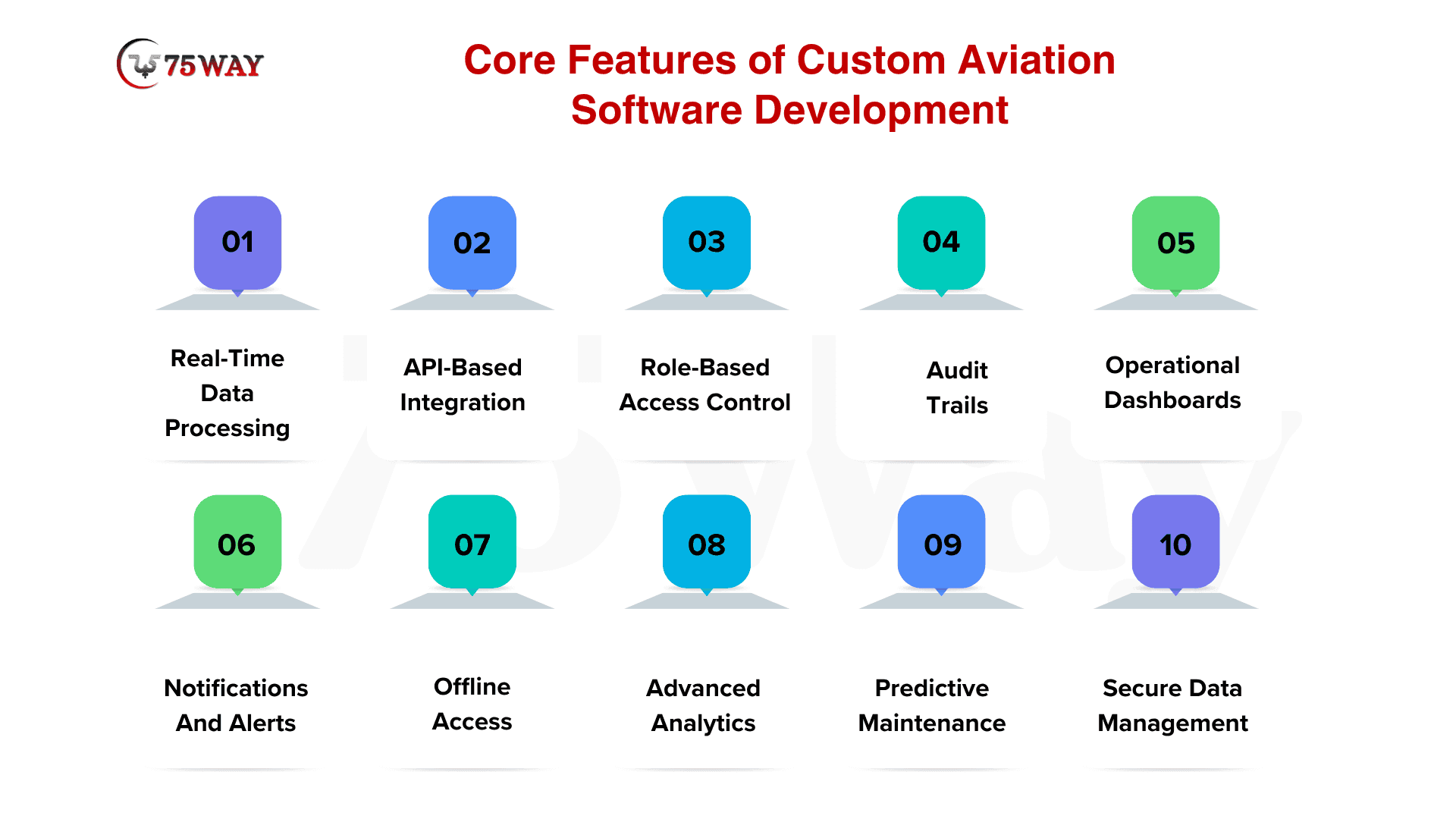
- Real-Time Data Processing: Process flight, maintenance, passenger, and operational information as events occur across connected aviation systems. Real-time visibility helps teams monitor changing conditions, identify exceptions, and respond promptly for teams.
- API-Based Integration: Connect aviation applications with legacy platforms, enterprise systems, and third-party services through secure APIs. Reliable integration keeps information synchronized across interconnected operational workflows and reduces data silos for teams.
- Role-Based Access Control: Give users permissions based on their responsibilities, departments, and operational roles. Granular access controls help protect sensitive aviation information while limiting unauthorized actions across business functions for teams.
- Audit Trails: Record important user activities, changes, approvals, and system events throughout the application. Detailed audit trails improve accountability, traceability, compliance preparation, and operational oversight during critical workflows for teams.
- Operational Dashboards: Present critical aviation metrics, alerts, schedules, maintenance information, and performance indicators through role-specific dashboards. Users can quickly understand operational conditions without navigating multiple systems or reports for teams.
- Notifications And Alerts: Automatically notify users about schedule changes, maintenance events, approvals, disruptions, and important thresholds. Configurable alerts help teams prioritize time-sensitive issues without overwhelming them with unnecessary notifications for teams.
- Offline Access: Allow selected applications and information to remain available when connectivity becomes unreliable or unavailable. Local data access supports field operations while synchronization restores updated information afterward while preserving changes.
- Advanced Analytics: Analyze operational, maintenance, financial, and customer data to identify trends and performance patterns. Advanced analytics supports forecasting, reporting, resource planning, and data-driven business decisions across aviation operations enterprise-wide.
- Predictive Maintenance: Inspect aircraft, component, sensor, and maintenance data to identify patterns associated with potential failures. Predictive insights can help maintenance teams prioritize inspections, planning, and proactive intervention when appropriate.
- Secure Data Management: Protect aviation information through encryption, authentication, authorization, backups, and controlled data handling. Strong data management reduces exposure while supporting availability, integrity, governance, and secure operational continuity across systems.
Advanced Features Required In Airline Software Development
Airline software becomes more valuable when it can handle complex operational requirements without creating additional manual work for teams. Advanced capabilities can extend the platform’s role across customer service, operations, decision-making, and business management. The features that can add greater functionality to airline software are covered here.
1. AI-Powered Decision Support
AI can analyze operational data, identify patterns, and provide recommendations for scheduling, disruptions, maintenance, and resource allocation while keeping human teams involved in important operational decisions.
2. Predictive Maintenance
Machine learning models can analyze aircraft and component data to identify potential maintenance issues before failures occur, helping teams plan inspections, parts, and maintenance activities more proactively.
3. Dynamic Flight Optimization
Advanced optimization engines can evaluate routes, weather, aircraft availability, fuel requirements, and operational constraints to identify suitable flight plans and support better resource utilization.
4. Intelligent Disruption Management
AI-driven systems can analyze delays, cancellations, aircraft availability, crew constraints, and connecting schedules to present recovery options that help operations teams manage disruptions more effectively.
5. Real-Time Fleet Tracking
Real-time tracking provides centralized visibility into aircraft locations, status, schedules, and operational events. Teams can monitor fleet movements and respond faster when conditions change during operations.
6. Automated Crew Management
Advanced crew management features can automate scheduling, roster adjustments, availability checks, qualification validation, and disruption-related reassignment while considering applicable operational and regulatory constraints.
7. Advanced Revenue Management
Revenue management systems can analyze demand, booking patterns, inventory, pricing information, and market conditions to support fare decisions and improve revenue opportunities across available flight capacity.
8. Digital Twin Capabilities
Digital twins can create virtual representations of aircraft, assets, or operational environments using connected data. Airlines can use these models for simulation, monitoring, predictive analysis, and operational planning.
Aviation Software Compliance And Standards To Build Avionics Software
Compliance is one of the areas where generic software-development advice becomes insufficient. The applicable requirements depend on what the software does, where it operates, what data it handles, and whether it is part of an aircraft or ground-based system.
- DO-178C For Airborne Software
RTCA DO-178C provides software considerations for airborne systems and equipment certification.
The FAA recognizes DO-178C/ED-12C through AC 20-115D as an acceptable means of demonstrating compliance with applicable airworthiness requirements for software aspects of airborne systems and equipment. The FAA also states that AC 20-115D is an acceptable means, not the only possible means, of showing compliance.
This distinction matters for business leaders because saying that software is simply “DO-178C compliant” can oversimplify a much larger certification process.
- DO-278A For Ground-Based ATM Software
Ground-based air traffic management and related systems can fall under different assurance considerations.
The FAA identifies DO-278A/ED-109A alongside DO-178C/ED-12C in its software assurance and certification materials for CNS/ATM systems.
- ARP4754A
ARP4754A addresses aircraft and system development processes and safety considerations at the system level.
It should not be treated as a replacement for software-specific assurance activities.
Instead, system-level development and software assurance processes need to work together where applicable.
- DO-254
DO-254 addresses airborne electronic hardware.
It becomes relevant when a project includes hardware development or hardware assurance alongside aviation software.
- DO-326A
DO-326A relates to airworthiness security processes.
Cybersecurity requirements should be considered during system architecture rather than added after the application has already been built.
- FAA Requirements
The FAA provides guidance and approval processes relevant to aviation software and airborne systems.
Its Aircraft Certification Service specifically covers software and airborne electronic hardware used in products such as aircraft, engines, and propellers.
The exact regulatory pathway depends on the product and its intended use.
Business takeaway: Do not choose standards after development begins. Determine the applicable assurance and regulatory environment during discovery.
Aviation Software Development Cost: Pricing Details
Aviation software development can cost anywhere from $8,000 to $900,000+, depending on the complexity and operational demands of the solution. A basic airline application and a sophisticated aviation platform have very different development requirements, which can create a wide gap in total investment. The cost breakdown ahead explains what can drive the budget from a small project to a large-scale aviation system.
1. Basic Apps & Entry-Level MVP
Development Cost: $8,000 – $25,000
This range can cover simple flight booking tools, basic reservation systems, internal staff utilities, straightforward dashboards, or limited-scope aviation applications with minimal integrations.
Average Development Cost: Around $16,500 for a basic aviation MVP with limited functionality.
2. Mid-Range Software
Development Cost: $25,000 – $150,000
Mid-range aviation software can include multi-role workflows, third-party integrations, user management, operational dashboards, notifications, databases, and standard analytics capabilities.
Average Development Cost: Around $87,500 for a moderately complex aviation software solution.
3. Enterprise & Mission-Critical Systems
Development Cost: $150,000 – $400,000+
Enterprise systems may support complex MRO operations, airport management, airline operations, fleet management, extensive integrations, advanced security, and large numbers of users.
Average Development Cost: Around $275,000 for a substantial enterprise aviation platform.
4. Advanced & High-Scale Platforms
Development Cost: $500,000 – $900,000+
Advanced platforms may involve large-scale aviation ecosystems, sophisticated AI, real-time processing, extensive integrations, high availability, complex data architectures, or demanding assurance requirements.
Average Development Cost: Around $1,000,000 for a high-scale aviation platform with advanced capabilities.
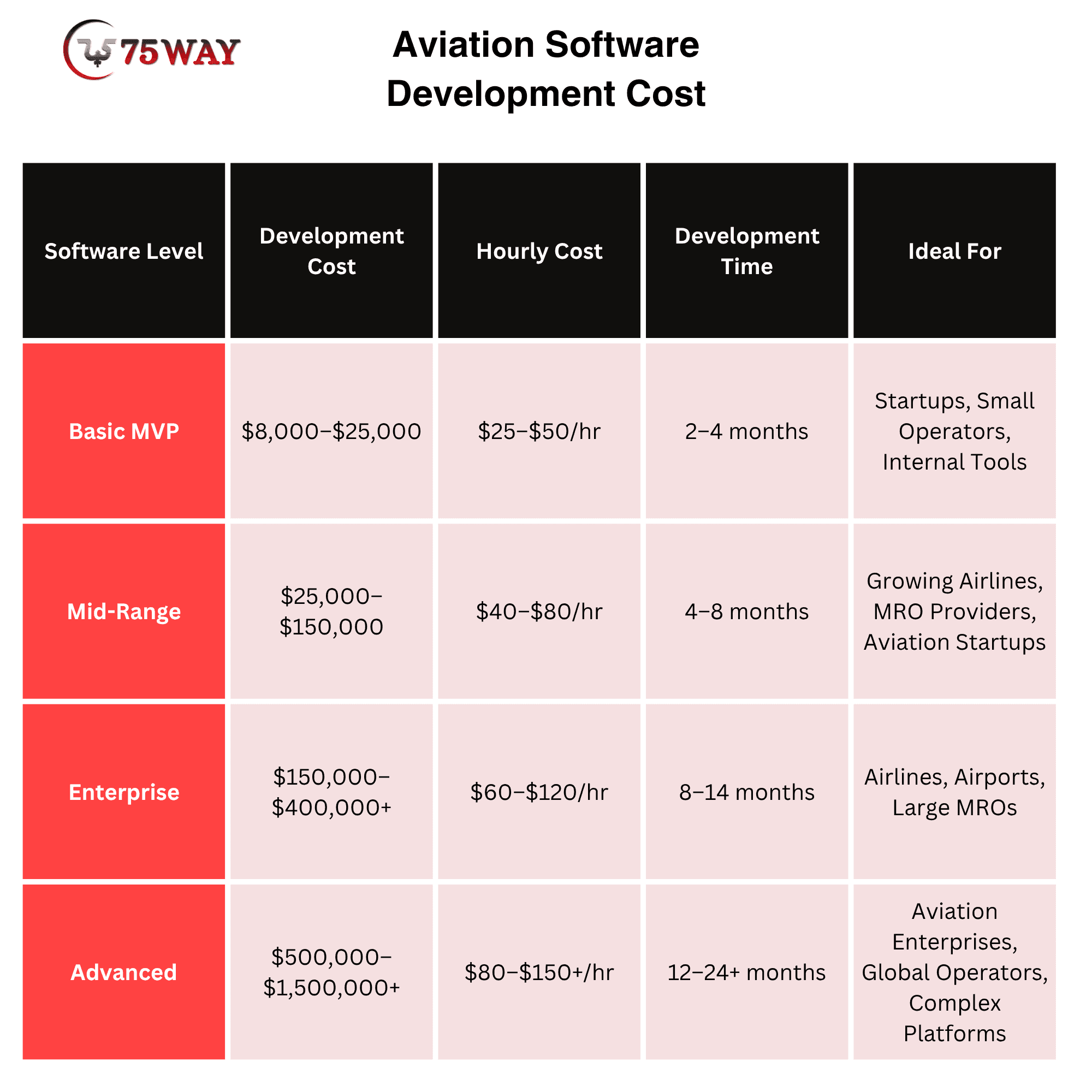
How Long Does It Take To Develop Aviation Management Software?
Development time depends on scope and regulatory requirements.
A relatively focused aviation business application can move from discovery to an MVP in several months, while a large MRO, airline operations, or airport platform can require a substantially longer phased program.
Safety-critical software may require additional time for requirements engineering, verification, documentation, reviews, and certification activities.
A realistic project timeline should therefore include:
- Discovery
- Requirements
- Architecture
- UX design
- Development
- Integration
- Testing
- Security assessment
- Compliance activities
- User acceptance
- Deployment
- Training
- Post-launch support
A short coding timeline does not necessarily mean a short aviation software project.
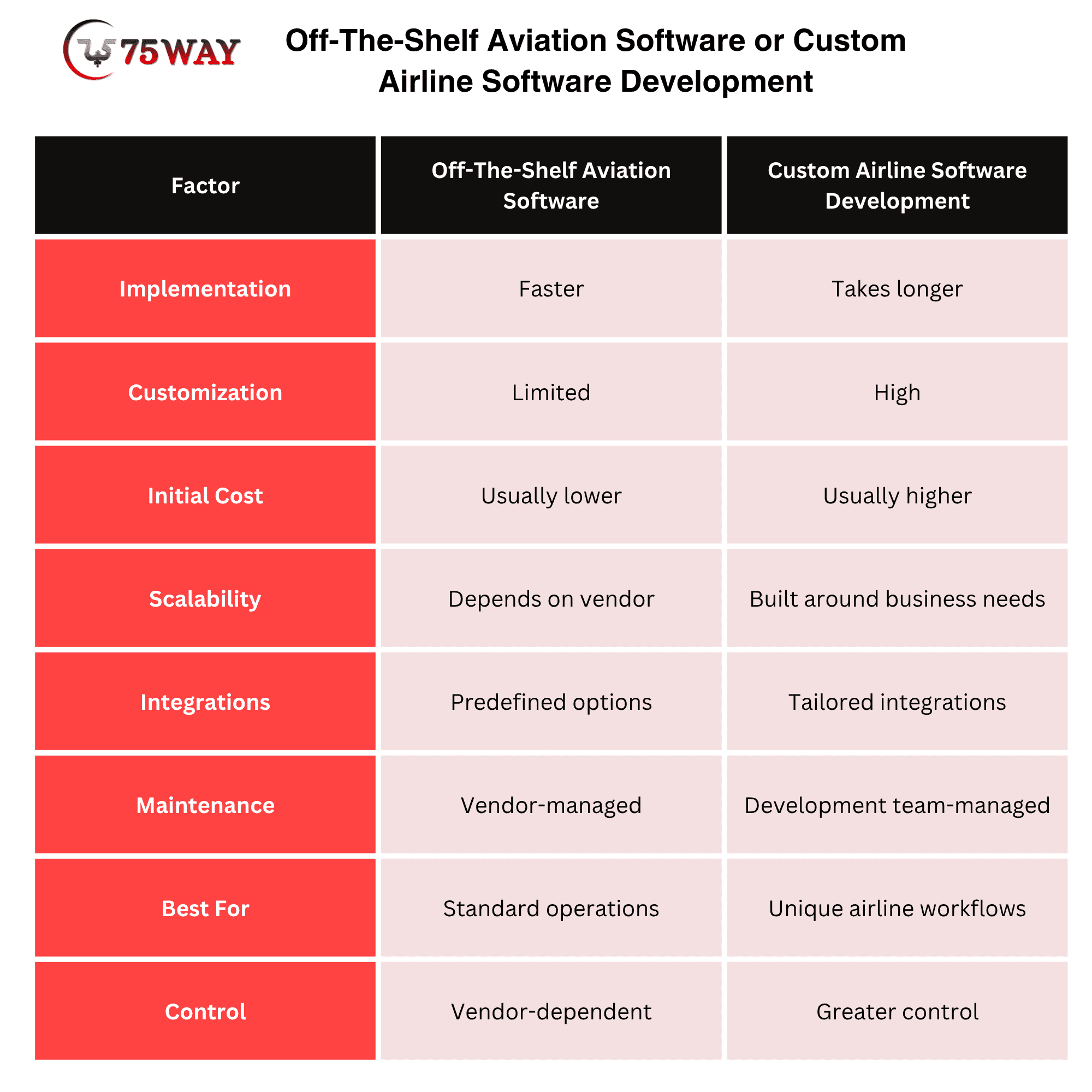
Off-The-Shelf Aviation Software or Custom Airline Software Development: Which Approach Is Better?
The build-versus-buy decision should be based on business differentiation, integration requirements, regulatory needs, available resources, and long-term ownership costs.
Off-The-Shelf Aviation Software: The workflow is standardized, existing products already satisfy most requirements, customization needs are limited, and rapid deployment is more important than full control.
Custom Aviation Software: Your processes are highly specialized, existing products cannot integrate adequately with your environment, you need ownership of the product roadmap, or the software itself supports a strategic business capability.
Consider A Hybrid Model when
Standard capabilities can be purchased while differentiated workflows are developed internally or through a technology partner.
For many aviation organizations, this can provide a practical middle ground. The important question is not simply “Should we build or buy?” It is:
“Which capabilities are strategic enough to own, and which capabilities are better purchased as standardized services?”
Common Aviation Software Development Challenges & Solutions
Understanding project risks before development starts can prevent expensive changes later.
1. Legacy Integration
Older aviation systems may use proprietary interfaces, outdated data structures, or undocumented business rules.
Integration discovery should therefore happen before the development team commits to the final architecture.
2. Data Quality
AI, analytics, reporting, and automation all depend on reliable data.
If aircraft identifiers, component records, maintenance events, schedules, or operational data are inconsistent, the resulting automation can produce unreliable outcomes.
3. Regulatory Complexity
Regulatory requirements vary according to the system's function and risk profile.
Treating compliance as a final-stage documentation exercise can create major project delays.
4. User Adoption
A technically sophisticated aviation platform can still fail if technicians, dispatchers, crew members, or operations teams find it difficult to use.
User research and workflow testing should happen before development is complete.
5. Change Management
Replacing familiar workflows can affect training, productivity, processes, and operational continuity.
Deployment planning should therefore include training, documentation, support, and phased adoption.
How To Choose An Aviation Software Development Company
Choosing a development partner should involve more than reviewing a portfolio of generic mobile and web applications.
- Aviation Experience: The team should demonstrate practical experience with aviation workflows, operational requirements, and industry-specific software challenges.
- Engineering Capability: The company should have expertise in cloud architecture, APIs, mobile apps, data engineering, AI, cybersecurity, testing, and enterprise integrations.
- Compliance Knowledge: The team should understand the standards relevant to your specific aviation system and required development documentation. They should also know how compliance requirements can affect architecture, testing, and deployment.
- Integration Experience: The company should have experience connecting software with airline, MRO, airport, ERP, operational, and third-party systems. This helps reduce integration challenges during implementation and deployment.
- Long-Term Support: The development partner should provide ongoing maintenance as APIs, regulations, security requirements, aircraft configurations, and business processes evolve. Reliable post-launch support helps keep the software aligned with changing operational needs.
A strong partner should be willing to challenge an unrealistic scope rather than simply promise to build everything.
Comprehensive Aviation Software Development Services For Diverse Needs
Aviation businesses need software services that address real operational requirements rather than generic digital needs. The right development partner can help design, build, integrate, modernize, and maintain aviation systems around specific business workflows. The aviation software development services businesses can avail are covered in detail here.
1. Custom Aviation Software Development
Purpose-built aviation platforms can be designed around specific operational workflows, user roles, data requirements, and business rules. This approach suits organizations whose processes cannot be adequately supported by off-the-shelf aviation products.
2. Aviation Software Consulting
Strategic consulting helps identify suitable technology approaches, system requirements, integration dependencies, and potential project risks before development begins. It can also help business leaders determine whether a new platform, modernization initiative, or hybrid approach fits their operational goals.
3. Aviation Software Modernization
Legacy aviation applications can be upgraded through modern architectures, APIs, cloud infrastructure, improved interfaces, and modular components without automatically replacing every existing system. A phased modernization strategy can reduce disruption while gradually addressing technical limitations and integration bottlenecks.
4. Aviation System Integration
Integration services connect airline, MRO, airport, ERP, CRM, reservation, fleet, and third-party systems so information can move across operational environments. Careful integration design also addresses authentication, data mapping, synchronization, error handling, and compatibility with legacy interfaces.
5. Aviation Mobile App Development
Mobile applications can place relevant operational or passenger workflows directly on smartphones and tablets used across aviation environments. Depending on the audience, applications can support flight updates, maintenance tasks, inspections, crew activities, passenger services, notifications, or field operations.
6. Aviation AI Development
Artificial intelligence can be incorporated into aviation workflows for use cases such as predictive maintenance, document intelligence, anomaly detection, delay forecasting, and operational decision support. The most practical implementations begin with a defined business problem, suitable data, measurable outcomes, and appropriate human oversight.
7. Aviation Cloud Solutions
Cloud-based aviation systems can provide scalable infrastructure for applications, databases, analytics, APIs, and distributed users across locations. Architecture can be designed around availability, security, data governance, integration requirements, and the operational constraints of the specific aviation environment.
8. Avionics Software Testing And Compliance
Specialized testing validates whether aviation software performs reliably across functional, integration, security, performance, and other applicable requirements. For systems subject to aviation assurance or certification processes, development and verification activities can also be structured around the standards and regulatory expectations relevant to that system.
Questions To Ask Before Starting An Aviation Software Project
Before signing a development contract, business leaders should be able to answer:
- What operational problem are we solving?
If the answer is simply “we need an aviation app,” the project is not sufficiently defined.
- Who will use the system?
Identify every major user group and their workflows.
- Which existing systems must connect to it?
Create an integration inventory before architecture decisions are finalized.
- What regulatory and assurance requirements apply?
Determine this before development begins.
- What data will the system create, consume, and retain?
Data ownership and governance should be explicit.
- What happens if the system becomes unavailable?
Define recovery objectives and operational fallback procedures.
- Which decisions can AI support?
Define human oversight and system boundaries before introducing AI into operational workflows.
- How will success be measured?
Choose measurable business outcomes such as reduced manual work, shorter turnaround time, improved maintenance planning, reduced delays, faster reporting, or better operational visibility.
AI-Powered Aviation Software Creation: What Businesses Should Prioritize
Successful aviation software is not defined by the number of features inside the application.
It is defined by how well the technology fits the operation.
Aviation organizations should prioritize:
- Operational fit: The software should reflect real workflows rather than forcing teams into unsuitable processes.
- Integration: The platform should work with the systems that already power the organization.
- Data quality: Reliable data should be treated as infrastructure for automation and analytics.
- Security: Security controls should be incorporated into architecture and development from the beginning.
- Compliance: Applicable regulatory and assurance requirements should influence the project from discovery onward.
- Usability: Interfaces should be designed around actual users and operational environments.
- Scalability: Architecture should support future aircraft, locations, users, integrations, and workflows without unnecessary redesign.
- Measurable outcomes: The project should have clear operational and commercial objectives.
Emerging Trends Shaping The Future of Avionics Software Development
Aviation software is moving toward more connected, predictive, and data-driven operations.
AI-assisted decision support, predictive maintenance, digital twins, intelligent workflow automation, cloud platforms, real-time analytics, and connected aviation ecosystems will continue to influence how organizations manage aircraft and operations.
However, aviation is different from many other industries because innovation must operate alongside safety, reliability, security, and regulatory requirements.
That means the future is unlikely to be defined simply by adding more AI.
The stronger direction is trusted automation: systems that can process large amounts of operational data, identify patterns, recommend actions, and automate appropriate workflows while maintaining human oversight where operational or safety decisions require it.
Recent aviation developments illustrate this direction. In September 2026, the FAA was working with major airlines on SMART, a software system intended to use predictive analytics for flight rescheduling and disruption management, demonstrating how operational software is increasingly being positioned as part of aviation infrastructure rather than merely administrative tooling.
Final Takeaway
Aviation software development requires a different mindset from ordinary software development. The project must connect business objectives with aviation workflows, system integration, cybersecurity, data architecture, user experience, testing, and applicable regulatory requirements.
For an airline, airport, MRO provider, aerospace business, or aviation technology startup, the first step should not be selecting a technology stack or requesting a development quote.
It should be defining the operational problem, users, systems, data, regulatory environment, and measurable business outcome.
Once those elements are clear, the development team can determine the appropriate architecture, technology stack, development approach, testing strategy, timeline, and investment.
If your organization is planning a custom aviation software platform, you can partner with a trusted software development company.
Frequently Asked Questions (FAQs)
What Data Should Aviation Software Collect From Users?
Aviation software should collect only data required for defined operational, security, or business purposes. Data fields should follow access controls, retention policies, privacy requirements, and governance practices.
How Can Aviation Software Improve Customer Retention?
Personalized communication, loyalty services, self-service options, and timely updates can create smoother customer interactions. Better digital experiences can encourage repeat bookings and strengthen long-term customer relationships.
How Should Aviation Software Handle System Downtime?
Critical aviation applications should define backup procedures, recovery objectives, redundancy requirements, and fallback workflows before production deployment. These measures help organizations maintain essential operations during service interruptions.
What Should An Aviation Software MVP Include?
An aviation MVP should focus on one clearly defined operational problem, essential workflows, required integrations, and measurable outcomes. Additional capabilities can be introduced after validating adoption and business value.
How Can Airline Software Support Sustainability Goals?
Software can help organizations monitor fuel consumption, optimize resource utilization, analyze operational patterns, and identify avoidable inefficiencies. These insights can support broader sustainability initiatives without replacing established operational controls.
How Can Aviation Software Accommodate Multiple Business Units?
A modular architecture can separate workflows, permissions, reporting, and configurations across airlines, maintenance teams, airports, or subsidiaries. Shared services can reduce duplication while preserving business-specific operational requirements.
What Documentation Should Businesses Request From Software Vendors?
Businesses should request architecture documentation, API specifications, security procedures, testing evidence, deployment guides, support policies, and system limitations. Clear documentation simplifies governance, onboarding, maintenance, and future integrations.
How Can Businesses Measure Aviation Software ROI?
ROI can be measured through operational savings, reduced manual work, improved resource utilization, faster processes, fewer errors, and additional revenue opportunities. Establish baseline metrics before implementation to compare measurable improvements.