Summary
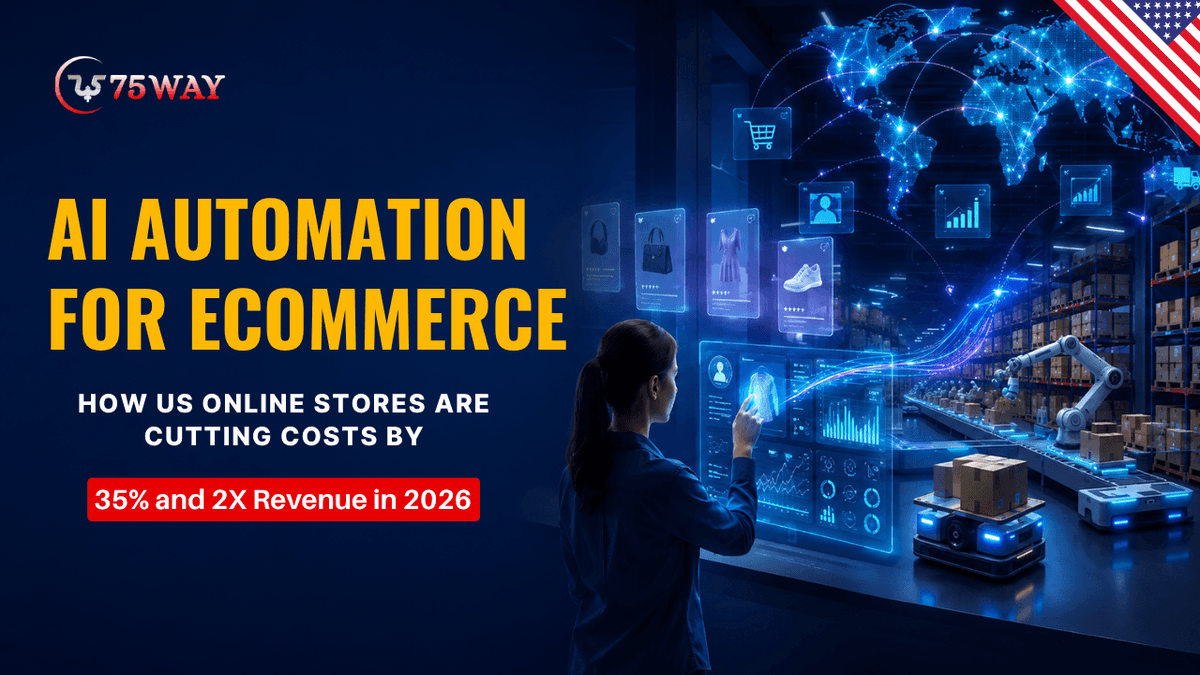
AI automation helps ecommerce businesses reduce costs, increase revenue, and improve customer experiences through personalization, support automation, inventory forecasting, dynamic pricing, and marketing optimization. Success comes from implementing high-ROI use cases strategically, measuring results, and scaling automation over time.
Quick Overview
- AI personalization increases conversions, revenue, and average order values.
- Customer support automation reduces costs and improves response times.
- Abandoned cart recovery delivers the fastest ecommerce AI returns.
- Start with one use case before expanding automation efforts.
- Clean data and measurement are essential for AI success.
Most ecommerce businesses are investing in AI automation. Very few are actually making money from it. Even 89% of US retailers are using or piloting AI, but only 7% have scaled it to generate measurable business impact.
That 82-point gap between "we're doing AI" and "AI is actually making us money" is the most important statistic in US ecommerce right now.
The stores on the right side of that gap, the 7%, are not doing anything exotic. They are not building proprietary machine learning systems or hiring teams of data scientists. They are deploying AI automation in a focused, disciplined way against their most expensive and most repetitive operational problems: support tickets, cart abandonment, inventory mismanagement, pricing decisions, and marketing personalization.
The results are not incremental. They are structural:
- Up to 35% reduction in operational costs
- Up to 40% increase in revenue from AI-driven personalization alone
- 300–800% ROI from customer-facing automation within 90 days
- 69% of AI-adopting retailers report measurable revenue increases directly attributable to AI
This guide covers exactly how they are doing it, with real numbers, real tools, real costs, and a clear implementation roadmap for US ecommerce businesses in 2026.
The State of AI in US Ecommerce: 2026 Snapshot
The AI-enabled ecommerce market crossed $8.65 billion in 2025 and is projected to reach $22.6 billion by 2032, growing at a 14.6% compound annual rate. Global ecommerce itself hit $7 trillion in 2026, and AI automation is the primary operational lever separating stores that are growing profitably from those that are not.
A few data points that frame the opportunity:
- 95% of retail brands using AI in ecommerce are seeing positive ROI, making it one of the highest-ROI technology categories in business history
- 72% of AI-adopting retailers report decreased operating costs
- 69% report direct revenue increases traceable to AI implementation
- 40% more revenue is generated by personalization leaders compared to non-adopters
- AI-powered product recommendations alone account for 35% of Amazon's total annual revenue, approximately $70 billion
- Generative AI traffic to US ecommerce stores surged 4,700% in a single year (Adobe Analytics)
The shift is not gradual. And for US online stores, the window to implement before competitors lock in the advantage is closing.
Traditional Ecommerce Systems Vs AI-Powered Ecommerce Platforms
Why "Traditional Automation" Is No Longer Enough?Most ecommerce businesses have already automated some things: email sequences, order confirmation messages, shipping notifications, low-stock alerts. These are rules-based automations: if X happens, do Y.
AI automation is fundamentally different. Here is why it matters:

A rule-based system sends an abandoned cart email at 1 hour after abandonment to every customer. An AI automation system analyzes the specific customer's purchase history, the items abandoned, the time of day, their browsing session behavior, and their historical response to different message types, and decides whether to send an email, an SMS, a push notification, or nothing at all, with personalized content, at the exact moment most likely to convert.
That difference in precision is where the revenue gap between AI adopters and non-adopters comes from.
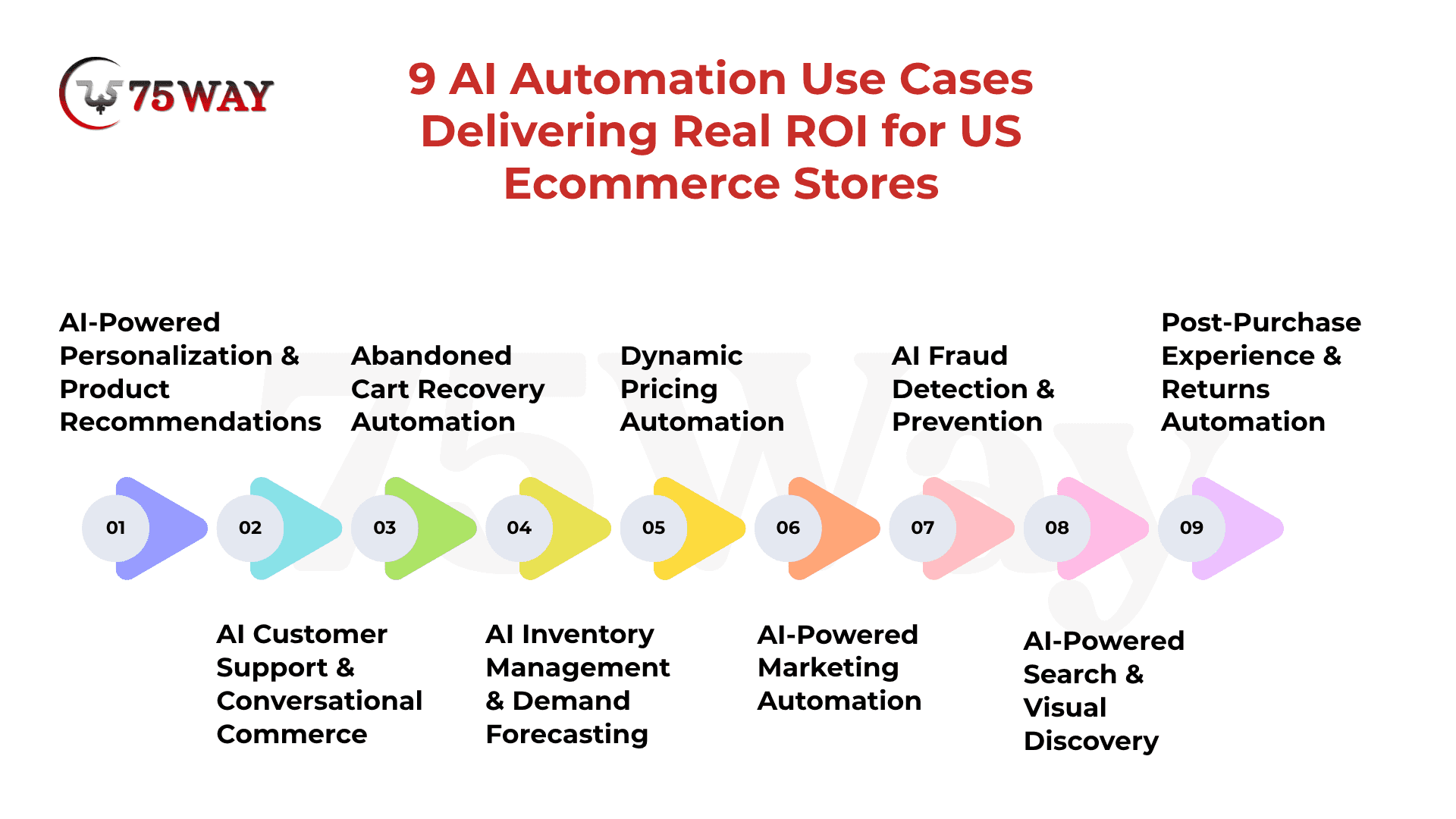
9 AI Automation Use Cases Delivering Real ROI for US Ecommerce Stores
1. AI-Powered Personalization & Product Recommendations
What it does: Analyzes each visitor's browsing history, purchase patterns, cart contents, stated and inferred intent, timing, and device context to deliver real-time personalized product recommendations, on the homepage, product pages, cart, checkout, and post-purchase emails.
The numbers:
- AI-driven recommendations can increase revenue by up to 300%, conversions by 150%, and average order value by 50%
- Fast-growing companies derive 40% more revenue from personalization than slower-growing peers
- 71% of shoppers report frustration when their experience lacks personalization — yet only 34% feel retailers actually do it well
Real case study
- Stitch Fix combined AI recommendations with human stylists. AI now drives 75% of all styling selections. The result: return rates dropped 30%, and average order value increased 40%.
- Amazon's recommendation engine, running for over two decades, accounts for an estimated 35% of total revenue, roughly $70 billion annually from a single automation system.
- Zalando's AI recommendation layer grew average basket size from €56.8 in 2021 to €61.1 by Q1 2025 through systematic personalization compounding over time.
Tools:
- Enterprise: Dynamic Yield (Mastercard), Nosto ($47K/year avg), Bloomreach
- Mid-market: Klaviyo, Yotpo, LimeSpot
- Shopify-native: Shopify Inbox, Shop AI, LimeSpot Personalizer
- Custom development: LangChain + OpenAI/Claude + your product catalog
Implementation cost: $200–$2,000/month (SaaS tools) or $30,000–$80,000 (custom AI recommendation engine)
2. AI Customer Support & Conversational Commerce
What it does: Handles inbound customer inquiries 24/7, order status, returns, product questions, sizing, complaints, with full context awareness across sessions. In 2026, these are not scripted chatbots. They are conversational AI agents that remember prior interactions, understand nuanced questions, and take action on your backend systems.
The numbers:
- AI customer support resolves tickets 18% faster with a 71% success rate without human intervention
- Retail chatbots increase sales by 67% through enhanced engagement throughout the purchase journey
- AI agents deliver 300–800% ROI on customer-facing automation within 90 days
- By 2030, AI is projected to manage 80% of all customer interactions
Real case study
Doe Beauty implemented Shopify Flow automations and reported saving $30,000 per week and four hours of daily human labor, from workflow automation alone, before any advanced AI layer.
An H&M Group brand (& Other Stories) deployed AI-powered fit recommendations combined with 3D product guides and saw a 32% reduction in return rates, directly reducing one of ecommerce's largest cost centers.
Tools:
- Enterprise: Zendesk AI, Salesforce Einstein, Intercom Fin
- Mid-market: Tidio, Gorgias AI, Freshdesk Freddy
- Shopify-native: Shopify Inbox with AI features
- Custom: Claude API / GPT-4o + RAG pipeline connected to your order management system
Implementation cost: $50–$500/month (SaaS) or $15,000–$50,000 (custom AI support agent)
3. Abandoned Cart Recovery Automation
What it does: Detects cart abandonment in real time, analyzes why the specific customer likely left (price sensitivity, distraction, shipping cost concern, product uncertainty), and triggers a personalized multi-channel recovery sequence, email, SMS, push notification, or retargeting ad, at the optimal moment with the right message.
The numbers:
- ~70% of online shopping carts are abandoned before checkout, the single largest revenue leak in ecommerce (Baymard Institute)
- AI-powered abandoned cart sequences recover 35% of abandoned carts on average
- BNPL (Buy Now Pay Later) integration alone drives a 39% average conversion increase
- AI-optimized cart recovery delivers $36–$42 for every $1 spent on email alone (eMarketer 2026)
The ROI math for a mid-size US store:
- Monthly revenue: $500,000
- Cart abandonment rate: 70% → $350,000 in abandoned revenue monthly
- Recovery rate with AI: 35% → $122,500 recovered per month
- Cost of AI tool: $300–$800/month
- ROI: 150x+
Tools: Klaviyo, Omnisend, Recart (SMS), Attentive, CartHook
Implementation cost: $100–$1,000/month (SaaS tools, no custom development needed for most stores)
4. AI Inventory Management & Demand Forecasting
What it does: Analyzes historical sales data, seasonal trends, supplier lead times, competitor pricing signals, and external factors (weather, local events, social trends) to predict demand at the SKU level, automatically triggering reorder requests, redistributing inventory across warehouses, and flagging overstock risks before they destroy your margins.
The numbers:
- Global retailers lose an estimated $1.7 trillion annually to combined stockouts and overstock situations
- AI demand forecasting reduces forecast errors by 20–50% compared to traditional methods
- AI cuts stockouts by up to 65% and reduces total inventory levels by 20–35%
- Logistics costs improve by 15% and inventory carrying costs drop significantly
Real case study
Walmart's AI inventory strategy, focused on getting the right products to the right places at the right time, produced measurable operational efficiency gains across thousands of locations. The results validated that technology investments pay off when they solve real problems, not when they chase flashy innovations.
Cozykids, a children's brand with a catalog of 6,000–7,000 products, implemented Shopify Flow for inventory management. "Usual stock management involves human involvement, but by setting up Flow, we're able to save a huge amount of time and eliminate human error," said their creative strategy director.
Tools:
- Enterprise: Blue Yonder, o9 Solutions, Relex
- Mid-market: Inventory Planner, Brightpearl AI, Linnworks
- Shopify-native: Shopify Flow + third-party forecasting apps
- Custom: ML demand forecasting model integrated with your ERP
Implementation cost: $200–$2,000/month (SaaS) or $40,000–$120,000 (custom ML forecasting system)
5. Dynamic Pricing Automation
What it does: Monitors competitor prices, demand signals, inventory levels, customer segments, and time-based factors in real time, automatically adjusting your prices every few minutes to maximize revenue and margin without manual intervention.
The numbers:
- Leading retailers now update prices every 10 minutes using AI-powered dynamic pricing
- AI pricing balances immediate revenue with long-term profitability — preventing high-LTV customers from being trained to wait for discounts
- AI pricing drives measurable improvements in gross margins, faster inventory turnover, and significant reduction in unnecessary promotional spend
The key insight for 2026: Unlike earlier systems that optimized only for the short-term transaction, AI in 2026 balances immediate revenue with long-term profitability. A high-lifetime-value customer is not trained to wait for a discount, and clearance strategies protect margin rather than destroy it.
Tools: Prisync, Wiser, Omnia Retail, Feedvisor (for Amazon/marketplace sellers)
Implementation cost: $300–$3,000/month depending on catalog size and platform
6. AI-Powered Marketing Automation
What it does: Creates, segments, schedules, and optimizes marketing campaigns across email, SMS, social media, and paid ads, using behavioral data to send the right message to the right customer at the right moment, automatically.
The numbers:
- Marketing automation is the most common AI use case, adopted by 48.9% of retail companies
- Email marketing delivers $36–$42 for every $1 spent (eMarketer 2026)
- However, 68% of ecommerce brands only use email broadcast, not behavioral triggers, leaving most of that value uncaptured
- AI-powered targeting delivers a 25% boost in conversion rates
- In 2026, social platforms account for over 60% of product discovery, surpassing Google, making AI-automated social presence non-optional
Highest-ROI automation workflows (in order):
- Abandoned cart sequence (fastest payback)
- Welcome series for new subscribers
- Post-purchase cross-sell and upsell
- Winback campaign for lapsed customers
- Browse abandonment sequence
Real case study: ASOS trained an AI model on 100,000 curated outfits to power its "Styled for You" personalized outfit suggestions. Combined with AI for product copy and imagery, ASOS reduced the time from trend identification to published product page from six weeks to under one week.
Tools:
- Email/SMS: Klaviyo, Omnisend, Attentive
- Social: Hootsuite AI, Buffer AI, Jasper (content at 3x the output)
- Paid ads: Google Performance Max, Meta Advantage+, TikTok Smart Performance Campaigns
- Full-stack: Enrich Labs ($39/month for AI agent execution across all channels)
Implementation cost: $100–$2,000/month (SaaS stack) or $25,000–$60,000 (custom AI marketing agent)
7. AI Fraud Detection & Prevention
What it does: Analyzes transaction patterns, device fingerprints, behavioral biometrics, IP data, and purchase history in real time to flag fraudulent orders before they ship, without adding friction to legitimate customers.
The numbers:
- In 2025, total retail returns reached approximately $850 billion, with roughly 9% attributed to fraudulent returns
- For every $1 of fraudulent return, retailers lose an average of $4.61
- AI fraud detection reduces false declines (legitimate orders incorrectly blocked) while catching actual fraud, a dual benefit that directly protects revenue
Tools: Signifyd, NoFraud, Kount (Equifax), Shopify's native fraud analysis
Implementation cost: Typically performance-based pricing (0.1–0.5% of GMV protected) or $200–$2,000/month flat
8. AI-Powered Search & Visual Discovery
What it does: Understands customer search intent (not just keywords), delivers semantically relevant results, supports visual search (upload an image, find matching products), and provides voice-activated browsing, dramatically improving product discovery and conversion.
The numbers:
- Google Lens processes nearly 20 billion visual searches per month
- Visual search users convert at 20–30% higher rates with up to 48% higher average order value
- 62% of Gen Z and Millennials expect visual search on ecommerce sites
- AI-powered search reduces the "I can't find it" abandonment that accounts for a significant share of lost conversions
Tools: Searchanise, Boost Commerce, Klevu, Constructor.io, Algolia AI
Implementation cost: $100–$2,000/month (SaaS) or $20,000–$60,000 (custom search implementation)
9. Post-Purchase Experience & Returns Automation
What it does: Automates order tracking updates, proactive delay notifications, returns initiation, refund processing, and post-purchase review requests, turning what is typically a cost center into a customer retention engine.
The numbers:
- 95% of retailers report that AI implementation is actively helping decrease annual operating costs — with post-purchase automation as a key driver
- A seamless returns experience drives repeat purchases and builds loyalty — returns management has evolved from a cost center into a strategic revenue lever
- 30% increase in Customer Lifetime Value (CLV) achieved by brands integrating AI across the full value chain, including post-purchase
Tools: Loop Returns (Shopify), AfterShip, Route, Narvar
Implementation cost: $100–$500/month (SaaS)
The Real Cost of AI Automation for US Ecommerce Stores
Here is the complete cost landscape for 2026 — from off-the-shelf tools to full custom development:
By Business Size
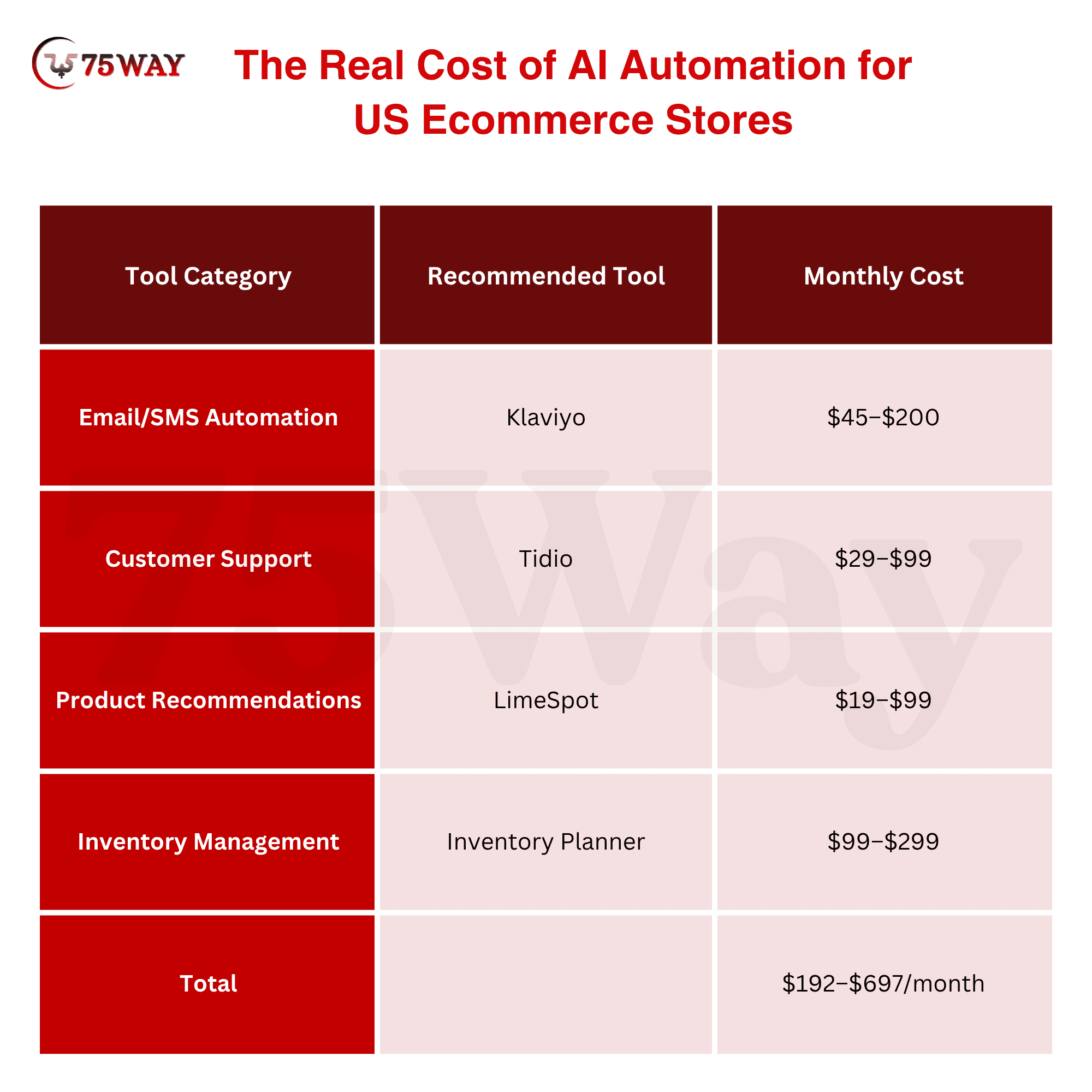
Small Ecommerce Store (Under $1M Annual Revenue) The right starting point is platform-native AI features — Shopify's built-in AI tools, Klaviyo's behavioral automation, and Tidio for customer support. Total monthly investment: $200–$800/month.
Start with one use case (abandoned cart recovery is almost always the highest immediate ROI). Measure for 60 days. Expand from there.
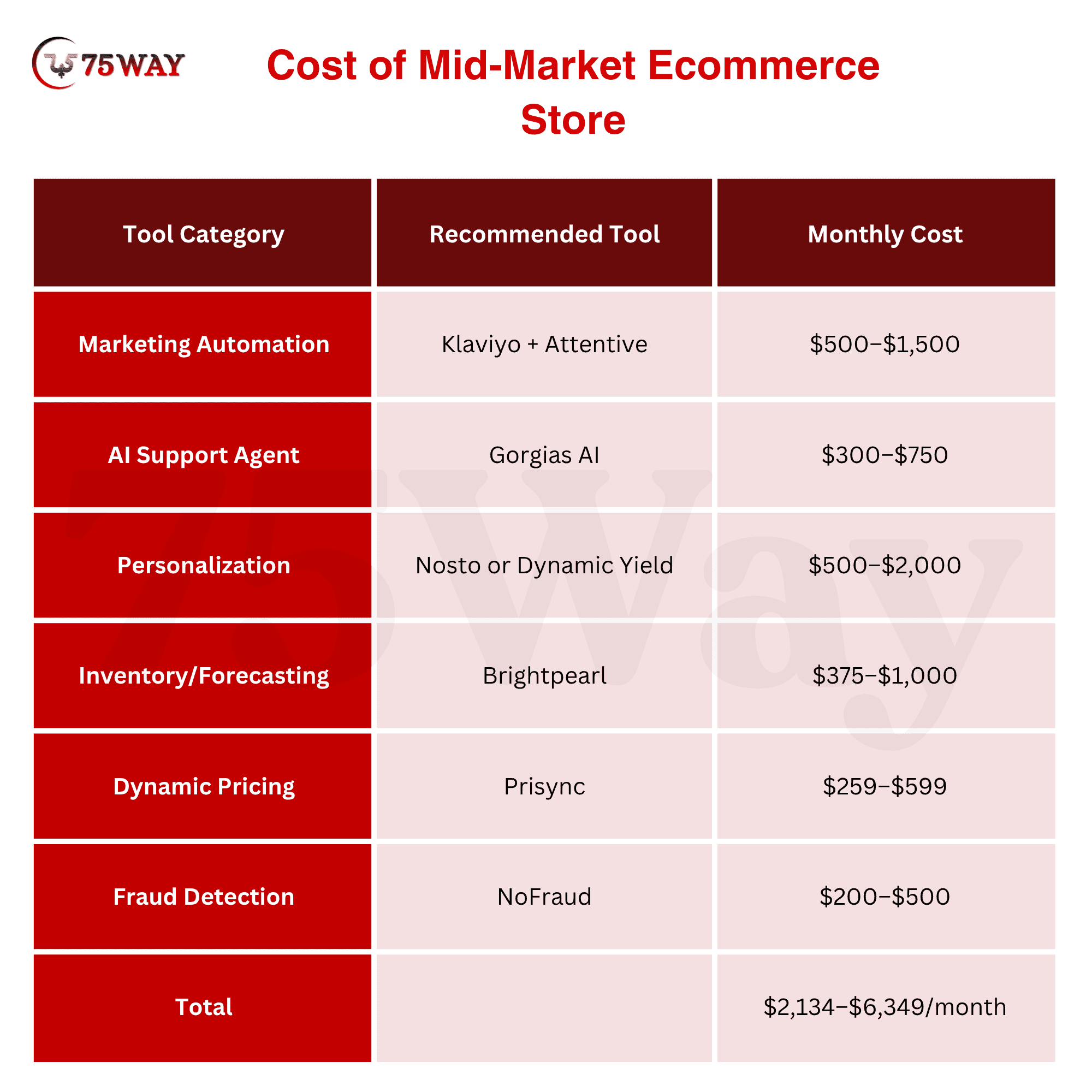
Mid-Market Ecommerce Store ($1M–$10M Annual Revenue)
This is where a more integrated stack, and in some cases, custom development, begins to generate significantly higher returns. Total monthly investment: $1,500–$6,000/month.
Enterprise Ecommerce ($10M+ Annual Revenue)
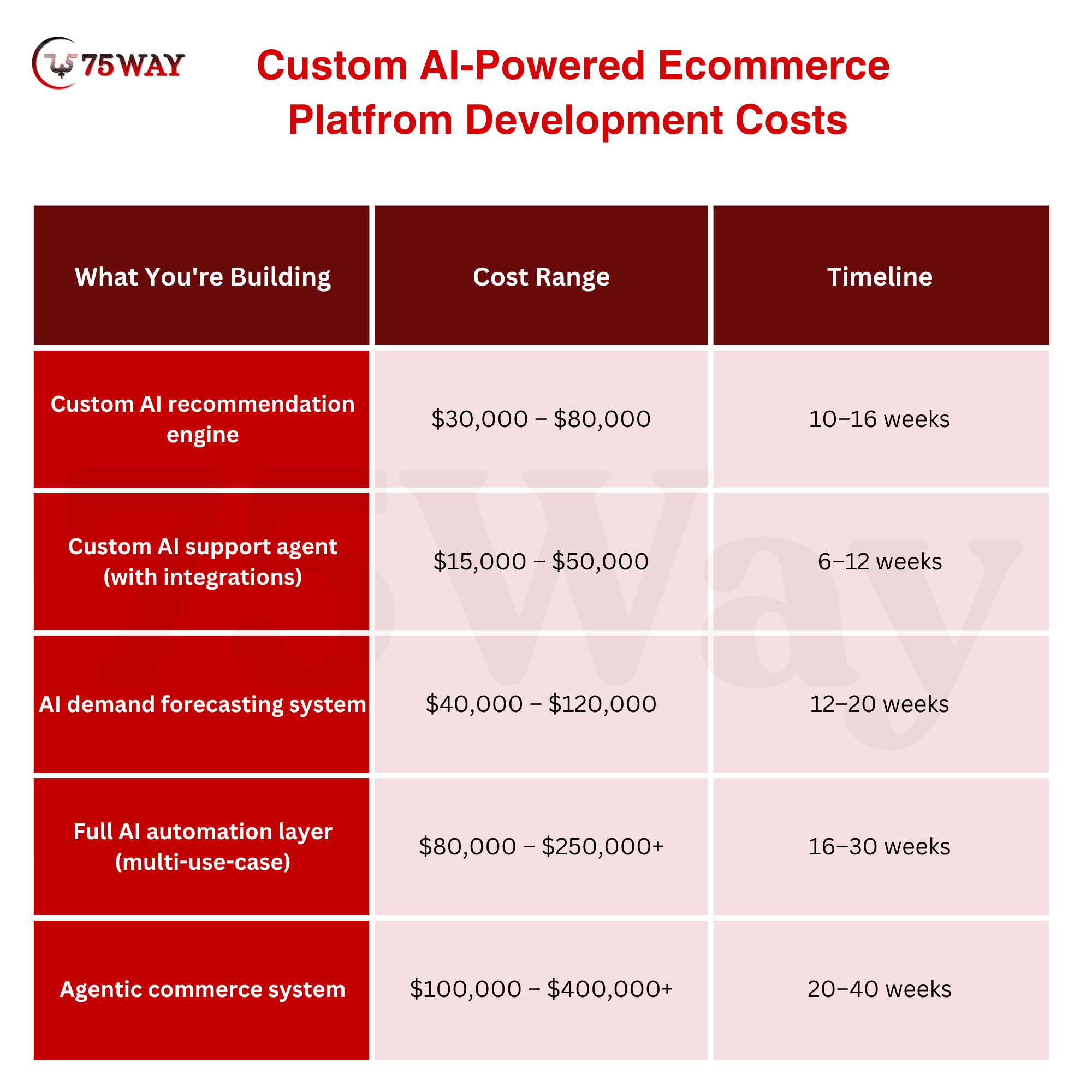
At this scale, custom AI development — recommendation engines trained on proprietary data, custom demand forecasting models, purpose-built AI agents — generates returns that off-the-shelf tools cannot match. Total investment: $100,000–$500,000+ for custom builds, plus $5,000–$20,000/month ongoing.
ROI Timeline: What to Expect From AI in Ecommerce And When
The ROI of AI ecommerce automation compounds over time. Here is a realistic expectation:
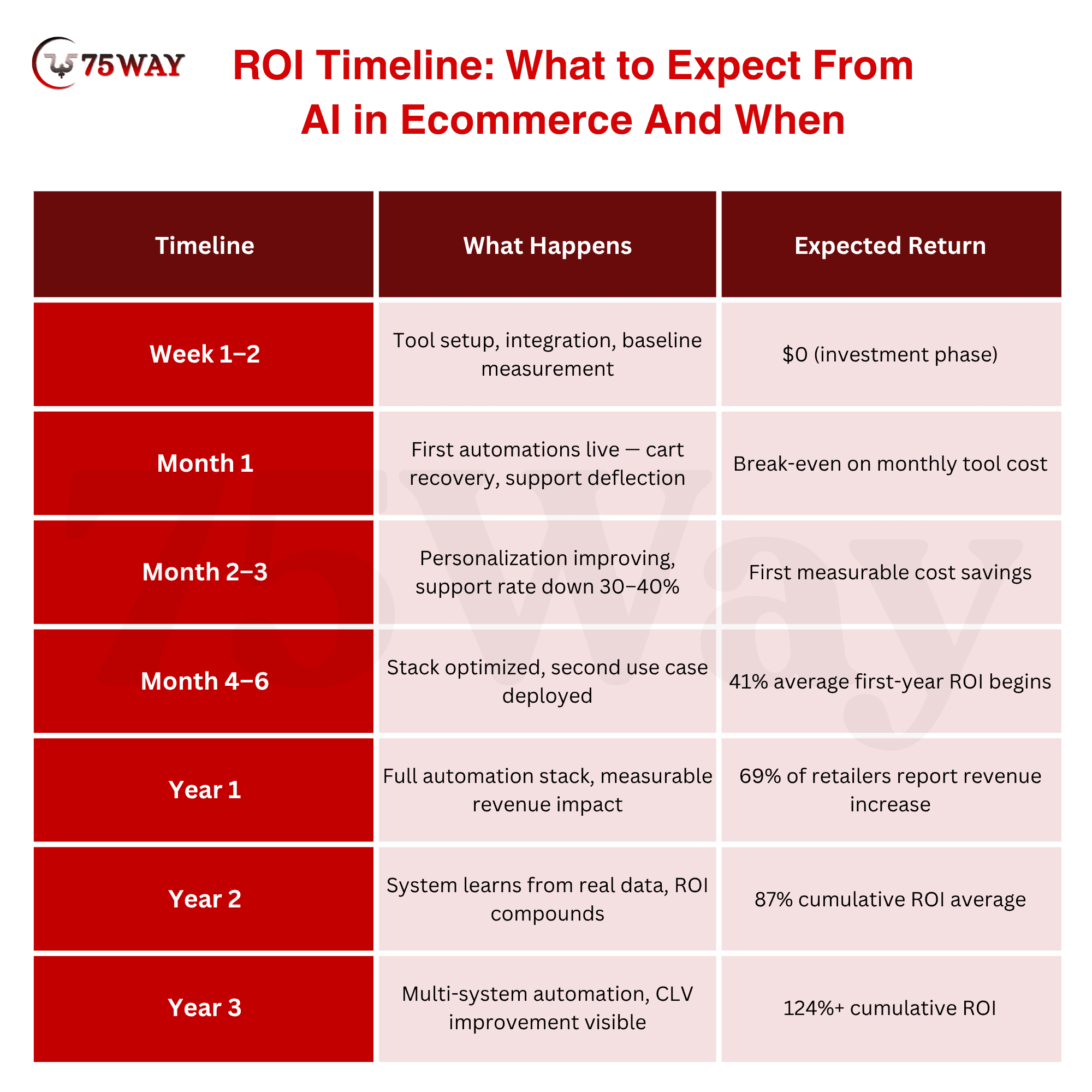
One benchmark to keep in mind: Organizations earn an average of $1.41 for every $1 spent on AI, but most need 2–4 years to reach satisfactory ROI at full scale. For individual use cases (abandoned cart recovery, support automation), payback can come within 30–60 days.
The 90-Day AI Automation Roadmap for US Ecommerce Stores
You do not need a $500,000 budget or an internal data science team to get started. Here is a practical 90-day plan:
Days 1–30: Audit, Prioritize, and Measure Baselines
Step 1: Identify your top 3 revenue leaks and cost centers.
Ask: Where is money leaving my store right now?
- Cart abandonment rate (benchmark: 70% — what is yours?)
- Support ticket volume and cost per ticket
- Inventory stockout and overstock rates
- Email open and conversion rates vs. industry benchmarks
- Return rate vs. category average
Step 2: Establish measurable baselines before deploying anything.
You cannot prove ROI you never measured. Before turning on any AI tool, record:
- Monthly revenue
- Conversion rate
- Average order value
- Support ticket volume and resolution time
- Cart abandonment rate
- Email revenue per recipient
Step 3: Pick one use case. The one with the highest combination of: frequency, cost, measurability, and urgency. For most US ecommerce stores, this is either abandoned cart recovery or AI customer support.
Days 31–60: Deploy Your First AI Automation
- Set up your chosen tool and connect it to your ecommerce platform (Shopify, WooCommerce, BigCommerce, Magento)
- Define the automation scope — exactly what does the AI handle, and when does a human take over?
- Run an A/B test: 50% of traffic gets the AI treatment, 50% gets the current experience
- Track your chosen KPI daily: cart recovery rate, support deflection rate, or conversion rate
A/B testing is not optional. It is how you prove the value of AI to your stakeholders and identify what is working before you scale.
Days 61–90: Measure, Optimize, and Expand
- Review A/B test results at day 60
- If positive: scale to 100% of traffic and calculate payback period
- Identify the top 3 friction points in the first automation and address them
- Plan your second use case deployment for Month 4
Month 4 onwards: Deploy your second automation (typically personalization or inventory management). Connect systems where it makes sense, your support agent's conversation data informs your personalization engine. Your inventory system's signals inform your dynamic pricing.
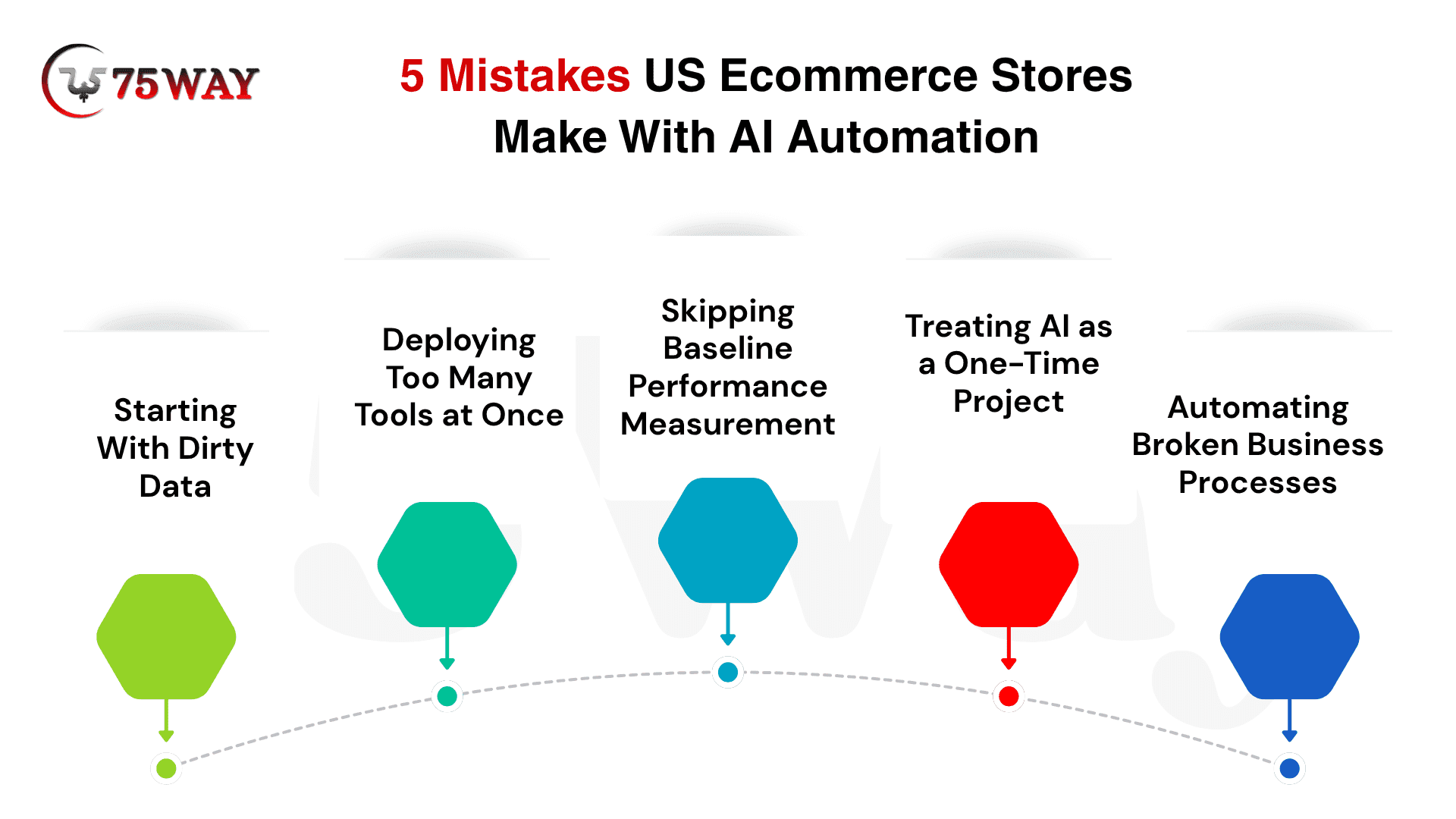
5 Mistakes US Ecommerce Stores Make With AI Automation
1. Starting With Dirty Data
AI outputs are only as strong as the inputs. Before deploying a personalization engine or demand forecasting system, audit your product catalog, customer data, and order history. Inconsistent naming conventions, duplicate records, and missing attributes will produce an AI that confidently gives wrong recommendations.
2. Deploying Too Many Tools at Once
The ecommerce AI market offers hundreds of tools. Deploying six at once makes it impossible to attribute results, manage integrations, or identify what is working. One use case, one tool, one measured outcome, then expand.
3. Skipping the Baseline Measurement
"We deployed AI and revenue went up" is not a business case; it is a coincidence until you can prove causation. Establish clean baselines before any deployment.
4. Treating AI as a One-Time Project
AI models degrade as business data shifts, customer behavior evolves, and product catalogs change. Budget for quarterly reviews, retraining, and prompt/model updates as standard operating costs, not optional extras.
5. Automating a Broken Process
If your current returns process is a mess, automating it produces an automated mess. If your support responses are inconsistent and unhelpful, an AI agent trained on them will be inconsistent and unhelpful at scale. Fix the process first, then automate it.
Platform-Specific AI Automation Insights for Ecommerce
Shopify Stores
Shopify has the richest native AI ecosystem in 2026. Start with:
- Shopify Inbox (free) for AI-assisted customer chat
- Shopify Flow for workflow automation (Doe Beauty saves $30,000/week with this alone)
- Shop AI for personalized shopping recommendations
- Shopify Magic for AI-generated product descriptions and email content
Then layer on: Klaviyo (email/SMS), Gorgias (support), LimeSpot (recommendations), Inventory Planner (forecasting).
WooCommerce Stores
WooCommerce's open architecture makes it highly flexible for custom AI integrations. Best starting stack:
- AutomateWoo for behavioral workflow automation
- Metorik for customer analytics and segmentation
- Tidio for AI customer support
- Clerk.io for AI-powered search and recommendations
BigCommerce Stores
BigCommerce's BigAI suite provides native AI capabilities:
- BigAI Copywriter for product descriptions
- BigAI Personalizer for product recommendations
- Native integrations with Klaviyo, Yotpo, and Searchanise
How 75way Builds AI Automation for US Ecommerce Businesses?
Off-the-shelf tools cover 80% of common ecommerce automation needs. But when your business has specific workflows, proprietary data advantages, or a need for competitive differentiation that a $200/month SaaS tool cannot deliver — that is where custom AI development creates lasting value.
At 75way, we build custom AI automation systems for US ecommerce businesses that are ready to go beyond off-the-shelf:
What we build:
- Custom AI Recommendation Engines: Trained on your specific product catalog, customer behavior, and business logic, not a generic algorithm that treats your store like every other store on the platform.
- Custom AI Support Agents: Connected to your real order management system, your CRM, your returns platform, and your product knowledge base, so they take real action, not just answer generic questions.
- AI Demand Forecasting Systems: Built on your historical data, your supplier relationships, your seasonal patterns, and your category dynamics, not an off-the-shelf model trained on other industries.
- Full Ecommerce AI Automation Layers: When you are ready to connect personalization, support, pricing, inventory, and marketing into a coordinated system — we architect and build the full stack.
Our ecommerce AI stack:
- LLMs: OpenAI GPT-4o, Anthropic Claude 3.5, Google Gemini
- Orchestration: LangChain, LangGraph, CrewAI
- Data: Pinecone, Weaviate (vector databases for product and customer knowledge)
- Integrations: Shopify, WooCommerce, BigCommerce, Magento, HubSpot, Klaviyo, Zendesk, custom ERPs
Our process:
- Discovery (2 weeks): We audit your current operations, identify your top 3 automation opportunities, and build a prioritized ROI case for each
- Architecture (1 week): We design the system to integrate with your existing stack without disruption
- Development (6–16 weeks): We build, test, and iterate on the AI system with your team
- Launch & Optimize (ongoing): We monitor performance, retrain models, and expand scope as ROI is proven.
Conclusion
The ecommerce AI gap is real; it is widening, and it is already costing you revenue.
The 7% of US ecommerce stores that have scaled AI to generate measurable business impact are not doing anything that is unavailable to you today. They started with one focused use case, abandoned cart recovery, AI customer support, or personalized recommendations, measured the results rigorously, and expanded from there.
The 35% cost reduction and revenue doubling that define the top performers in this market did not happen in a single deployment. They happened through disciplined, sequential automation of the workflows that matter most, starting with the one that has the clearest ROI and the most direct connection to revenue.
If you are a US ecommerce business ready to move from the 82% who are experimenting to the 7% who are scaling: Get your free ecommerce AI automation audit from 75way.
Frequently Asked Questions
What is AI Automation For Ecommerce?
AI automation for ecommerce refers to the use of artificial intelligence systems to handle repetitive, data-intensive business tasks, including personalized product recommendations, customer support, abandoned cart recovery, inventory forecasting, dynamic pricing, fraud detection, and marketing campaign optimization, without requiring human intervention for each individual action. Unlike rule-based automation that follows fixed scripts, AI automation learns from real customer behavior and adapts its actions to maximize revenue and minimize cost.
How Much Does AI Automation Cost For A US Ecommerce Store?
The cost of AI automation for ecommerce ranges from as low as $200/month for small stores using platform-native tools (Shopify Flow, Klaviyo, Tidio) to $6,000+/month for a full mid-market automation stack. Custom AI development, for recommendation engines, demand forecasting systems, or purpose-built AI agents, costs $15,000 to $250,000+ depending on scope and complexity. Most businesses start with $200–$800/month and scale investment as ROI is proven.
What is the ROI of AI Automation For Ecommerce?
AI automation delivers an average of $1.41 for every $1 invested, with 95% of ecommerce brands using AI reporting positive ROI. Specific use cases deliver faster returns: abandoned cart automation typically pays back within 30–60 days; customer support automation within 60–90 days; personalization engines within 3–6 months. Over a three-year horizon, cumulative ROI averages 124%+ as systems improve from real-world data.
Which AI Automation Use Case Delivers The Fastest ROI For Ecommerce?
Abandoned cart recovery delivers the fastest ROI for most US ecommerce stores. With approximately 70% of online shopping carts abandoned before checkout, even a 20–35% recovery rate on abandoned carts generates substantial monthly revenue at a very low tool cost ($100–$300/month for most stores). For businesses with high inbound support volume, AI customer support automation is equally fast to prove ROI.
Does AI Automation Work For Small Ecommerce Stores?
Yes. In 2026, platform-native AI tools (Shopify Flow, Shopify Inbox, Klaviyo) have made meaningful AI automation accessible to stores at any revenue level. A store doing $200,000/year in revenue can deploy abandoned cart automation, AI customer support, and behavioral email sequences for under $300/month — with measurable impact within the first 30 days. The returns scale proportionally with business size.
What Platforms Support AI Automation For Ecommerce?
All major ecommerce platforms support AI automation in 2026. Shopify has the richest native AI ecosystem, including Shopify Magic, Shop AI, Shopify Inbox, and Shopify Flow. WooCommerce is highly flexible through plugins and custom integrations. BigCommerce offers its BigAI suite. Magento (Adobe Commerce) supports enterprise-grade AI through Adobe Sensei. All platforms connect with third-party AI tools through native app stores and API integrations.
How Long Does It Take To Implement AI Automation For Ecommerce?
Implementation timelines depend on the approach. Off-the-shelf SaaS tools (Klaviyo, Tidio, Gorgias) can be set up and tested in 3–7 days. Full custom AI development, recommendation engines, demand forecasting systems, and custom AI agents take 6–20 weeks from discovery to launch. Most businesses start with off-the-shelf tools for immediate impact and move to custom development when the ROI case is proven, and specific business requirements exceed what packaged tools can deliver.