AI Summary
Choosing the right software development company requires more than comparing prices. Evaluate technical expertise, security practices, communication, team structure, and delivery processes. Use a structured scorecard, identify red flags early, and select a partner aligned with your long-term business goals.
Quick Overview
- Define project goals before approaching any software vendor.
- Evaluate vendors using objective criteria instead of assumptions.
- Security, communication, and process maturity matter significantly.
- Low pricing often creates higher long-term project costs.
- Compare engagement models based on business requirements carefully.
Approximately 70% of software projects either fail outright or are severely challenged. Only 31% are completed on time, on budget, and with the expected scope. The most expensive mistake isn't technical. It's the partner you choose.
Most businesses that end up with a bad software development partner did not choose wrong because they were careless. They chose wrong because nobody told them what to actually look for. They read a few blog posts, picked a company with a nice website and a few recognizable logos on their homepage, and moved forward.
Six months later: half-built software, burned budget, a vendor that stopped responding on time, and the exhausting process of starting over. This guide is built so that doesn't happen to you.
Why Choosing a Software Development Partner Is Different in 2026
The global software development outsourcing market has passed $600 billion and keeps growing. The number of vendors pitching themselves as top-tier has never been higher. On paper, many of them look identical: polished website, client logos, Clutch reviews, "agile methodology."
In practice, outcomes vary significantly, especially when timelines, budgets, and communication come under pressure. Three things make the 2026 market genuinely different from even two years ago:
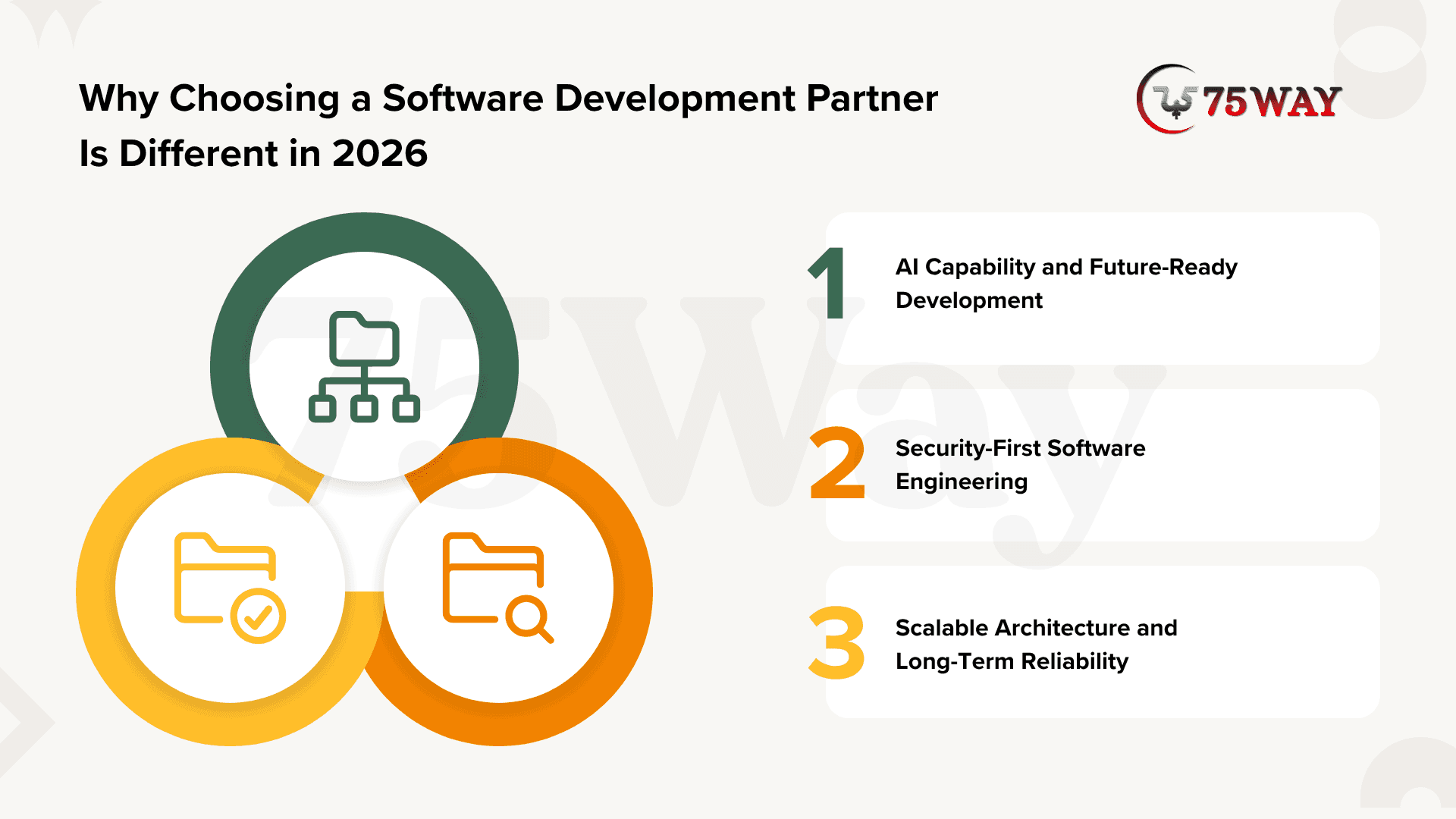
1. AI capability is now a real differentiator. GitHub's Octoverse report found that AI-assisted coding adoption crossed 97% among developers in 2025. A development partner that isn't using AI tooling internally is delivering at a speed and cost disadvantage, and one that can't build AI-powered features for your product is a vendor you'll outgrow within 12 months.
2. Security is foundational, not optional. The average SMB data breach now costs $3.31 million, as per a report by IBM. Any software development partner worth considering should raise security without being asked, not treat it as a feature to add before launch.
3. The cost of fixing a flawed architecture post-launch is 4 to 7 times higher than building it right the first time. The vendor selection decision is the single biggest predictor of whether a project lands in the 31% that meet time-budget-scope expectations, or the 70% that don't.
How To Select A Reliable Software Development Agency in US?
Let's cut through the noise.
Step 1: Define Your Project Clearly Before You Talk to Anyone
The most expensive mistake in hiring a software partner is not choosing the wrong agency. It's starting the search before you know what you're actually looking for.
Vague requirements lead to vague proposals, which lead to scope creep, misalignment, and uncontrollable costs.
Before you contact a single vendor, answer these questions honestly:
What are you building?
- A brand-new product from scratch, or upgrading an existing one?
- Web app, mobile app, desktop software, or all three?
- B2B or B2C? Consumer-facing or internal tool?
What is your engagement model?
- A defined project with a clear end date?
- An ongoing product that needs a long-term embedded team?
What are your actual priorities? Speed, cost, and quality, in which order? These three are genuinely in tension. A vendor optimized for speed and cost will make different architectural decisions than one optimized for long-term quality and scalability.
What does "winning" software look like? Not in terms of features, in terms of measurable business outcomes. The first warning sign of a failing software project is when leadership cannot clearly explain what success actually means.
If you are building a mobile app for consumers, you need a partner with proven mobile development experience, not a generalist web shop that has "done mobile before." Match the company to your project type before you start evaluating proposals.
Step 2: Know the Engagement Models And Their Real Trade-Offs
How a development company structures cost strategy defines a great deal about how it executes development phases. Three models dominate in 2026:
1. Fixed-Price Projects
Best for: Well-defined scope with minimal expected changes, a landing page, a specific integration, a clearly documented feature set.
Real trade-off: Fixed-price contracts feel safe. They are a trap unless backed by an extremely detailed Statement of Work that both sides have gone through line by line. The Standish Group's CHAOS Report confirmed that scope ambiguity is the leading cause of cost overruns, and in a fixed-price model, every ambiguity becomes a negotiation. A $120K quote that becomes $190K through change orders is not a fixed price.
Red flag: A vendor that quotes a fixed price in the first call, before any discovery, is either underestimating scope or planning to recover margin through change orders.
2. Time & Materials (T&M)
Best for: Products where requirements are likely to evolve, which is most products. Gives flexibility when scope legitimately changes. Requires strong project management on both sides.
Real trade-off: If your milestones and budget limits are not clearly established, time-and-materials (T&M) projects are suitable for you. You can define measurable deliverables for each stage and set regular review checkpoints to maintain control over progress, timelines, and costs before the project begins.
3. Dedicated Team / Staff Augmentation
Best for: Long-term products that need continuous development, or companies that want to embed external engineers into their existing team.
Real trade-off: Requires active management from your side. You're responsible for direction; the vendor delivers execution. Works well when you have a product owner internally. Works poorly when you expect the vendor to run the show.
The 2026 reality: Many of the most successful software companies in 2026 use a hybrid approach, which is strategic oversight close to the client's market, with engineering execution distributed across cost-effective regions. Lower hourly rates don't automatically mean lower quality, but lower rates without strong project management, clear documentation, and accountability systems do increase risk.
Step 3: 8 Factors to Evaluate Every Software Development Vendor Before Partnership
Use this as your evaluation scorecard. Score each dimension 0–10, weight them by importance to your project, and compare vendors on consistent criteria, not gut feel.
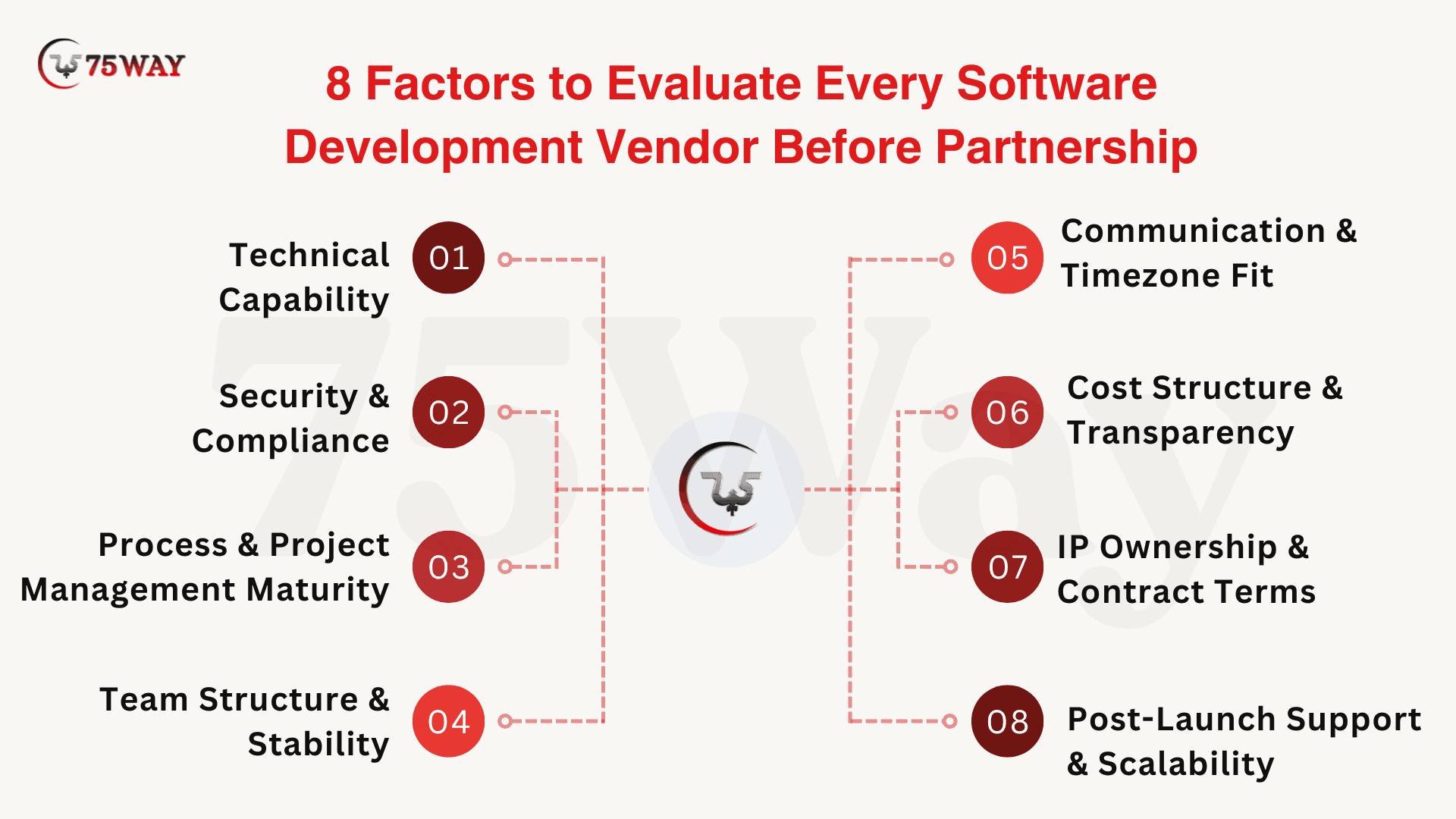
Dimension 1: Technical Capability (Weight: 25%)
Before hiring any software agency, the initial question is not "What can you build?" It's "Show me what you have built, at what scale, and what problems you solved." For this, you can request before any commercial conversation:
- A case study with technology stack, team size, timeline, and measurable outcome (not just "the client was happy")
- Ask: "Can I download and use an app you built? Can I sign up for a platform you delivered?" If the answer is always "it's under NDA," probe harder. Good agencies have at least a few products they can demonstrate publicly.
- Confirm AI capability: "What AI tools does your team use, and can you show me a project where you implemented AI functionality for a client?"
2026 must-haves: Experience with cloud-native architecture, DevOps and CI/CD pipelines, and at least one completed AI/ML integration project. Low-code readiness (FlutterFlow, Bubble, n8n) is a bonus; a strong partner explains where these tools make sense and where they become limiting.
Dimension 2: Security & Compliance (Weight: 20%)
Security in 2026 is a foundational software engineering expectation, not a feature added before launch. Any software creation agency worth serious consideration should raise it without being asked.
Minimum bar for a serious vendor:
- SOC 2 Type II certification (especially for SaaS products serving US markets)
- ISO 27001:2022 certification for systematic information security management
- Recent (within 12 months) third-party penetration test; ask for the summary and remediation record
- Explicit NDA and data handling policies from day one
For regulated industries:
- Healthcare: HIPAA Business Associate Agreement capability
- Payments: PCI-DSS compliance experience
- Any EU-resident data: GDPR Data Processing Agreements with documented sub-processor chains
Test question: Ask "When was the last dependency audit? How are user passwords stored? Is data encrypted at rest?" A professional team answers all three without hesitation. Evasion or "we use framework defaults" without knowing what those defaults are is a warning sign.
Dimension 3: Process & Project Management Maturity (Weight: 15%)
A technically skilled team that runs a chaotic development process will still produce late, buggy, over-budget software. Process matters as much as talent.
Ask vendors directly:
- What methodology do you use? Agile, Scrum, Kanban, or hybrid?
- How do you handle requirements gathering and documentation?
- How often do clients see working software? (Answer should be: every 1–2 weeks minimum)
- How do you handle scope changes?
- The demo frequency signal: Projects with a regular weekly demo cadence are 2.5 times more likely to ship on schedule. When a team repeatedly says "the demo isn't ready," you're usually looking at one of two situations: there's no working software, or there is, and they don't want you to see it.
- Scope change process: Every project evolves. The question isn't whether scope will change; it will. The question is whether the vendor has a transparent, defined process for pricing and approving changes, or whether everything turns into an ad-hoc negotiation.
Dimension 4: Team Structure & Stability (Weight: 15%)
One of the most common unpleasant surprises in software development partnerships is the team presented during the sales process not being the team that works on your project.
Before signing:
- Get the names and CVs of the people who will actually work on your project
- Ask who else has a claim on their time; are they split across other projects?
- Clarify whether you'll be notified before anyone on the team is replaced
- Ask for the team's annual turnover rate. Offshore teams with annual turnover above 20% create significant re-onboarding risk
- Ask for the senior-to-junior ratio on your project
Ask directly: "Are the engineers I'm meeting now the ones who will be on my project? What happens if a key person leaves?"
Dimension 5: Communication & Timezone Fit (Weight: 10%, but underrated)
More software projects consume higher budgets due to communication failures than technical failures. It is not a close comparison.
Four hours of daily timezone overlap is manageable for short engagements. For a 6-month project, timezone friction compounds into a real coordination cost, delayed decisions, misunderstood requirements, and slower iteration cycles.
Evaluate:
- What hours does the core team actually work?
- How are decisions documented and tracked?
- What is the communication stack? (Slack, Jira, Confluence, and are they willing to match yours?)
- Have a live call with the proposed team, not the sales team, before you decide. Most of what goes wrong in vendor engagements was predictable from how the team communicates before the contract.
Dimension 6: Cost Structure & Transparency (Weight: 10%)
A quote that is 50% cheaper than the market rate looks attractive on paper. That saving typically disappears within the first three months, replaced by delay costs, rework fees, and eventually the cost of starting over with a different partner entirely.
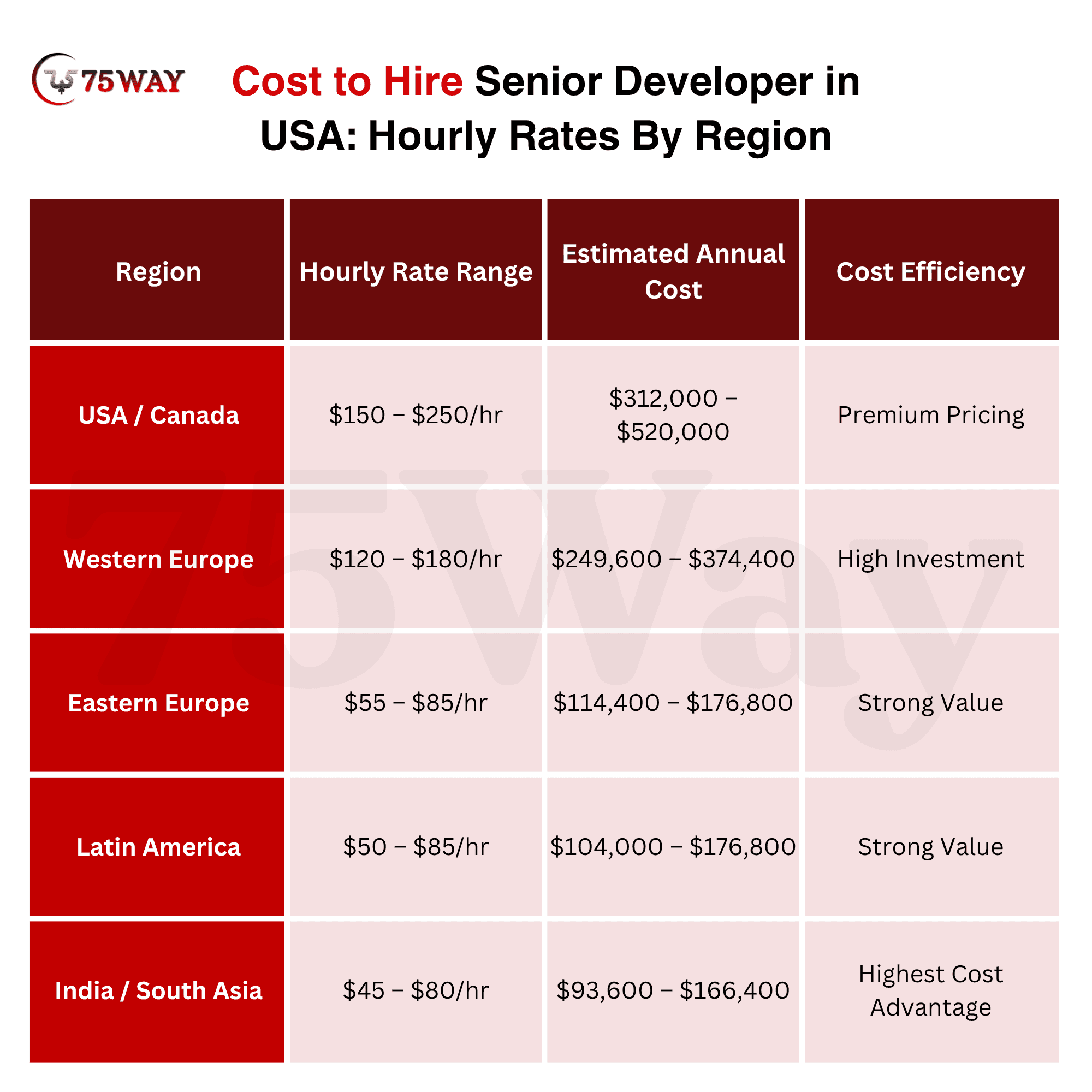
Cost to Hire Senior Developer in USA: Hourly Rates By Region
What to look for:
- Detailed breakdown of cost components, not a single number
- Clear change-order process with defined authorization limits
- On-time and on-budget delivery metrics for the previous 10 comparable projects
- Explicit post-launch support pricing; annual maintenance costs run 15–25% of the initial build cost per year
Dimension 7: IP Ownership & Contract Terms (Weight: 7%)
In many jurisdictions, if the contract doesn't explicitly assign IP to the client, ownership can default to the vendor. This creates vendor lock-in; you can't switch partners without losing the codebase you paid for.
What to insist on:
- Full IP assignment upon final payment (or at milestone payment stages)
- Irrevocable access to the source code repository at all times
- Explicit language on who owns third-party libraries, frameworks, and utilities used in development
If there's hesitation or hand-waving when you ask about IP ownership, negotiate before the contract is signed, not during a breakup.
Source-code escrow: For enterprise-critical systems, consider source-code escrow with verified release triggers. This protects you if the vendor goes bankrupt or is acquired.
Dimension 8: Post-Launch Support & Scalability (Weight: 3%, but critical long-term)
The MVP launch is not the finish line. Software needs support, maintenance, and iteration after launch, and your vendor's capacity and commitment to this phase determines whether your product succeeds post-launch.
Ask before signing:
- What are your SLA terms? What is the critical bug response time?
- Do you offer a retainer-based maintenance model?
- What does scaling support look like if user volume grows 10x?
- Who is responsible for third-party dependency updates and security patches?
12 Questions to Ask Every Software Engineering Company Before Signing
These questions are not designed to catch vendors off-guard. They're designed to reveal operational maturity. Clear, specific answers indicate experience. Vague or defensive answers indicate risk.
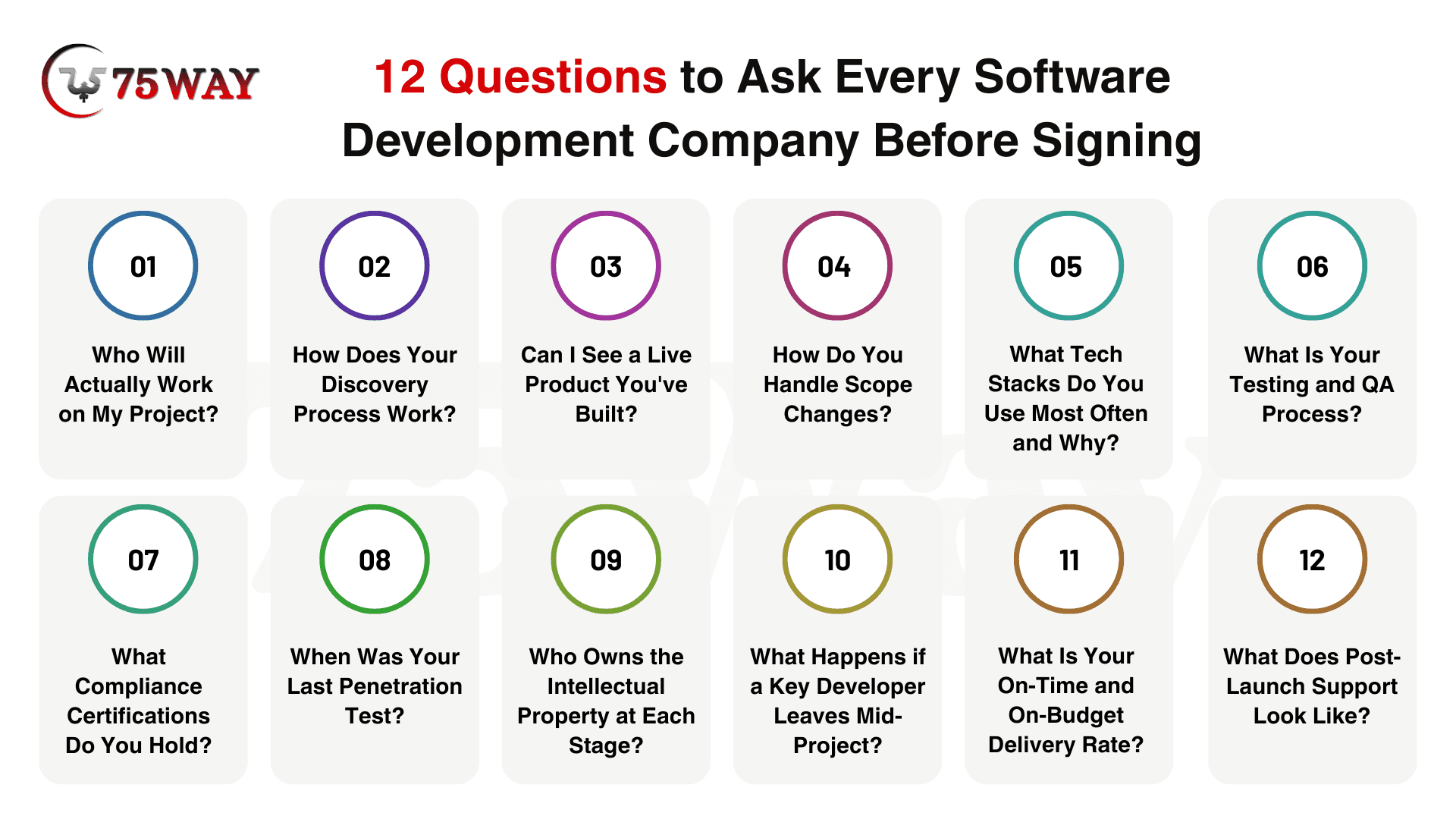
- Who will actually work on my project? Get names, CVs, and availability. "Our team" is not an answer.
- How does your discovery process work, and how long does it take? A real discovery phase is never instant. A team that jumps into coding without clarifying scope is already showing you something.
- Can I see a live product you've built? Not a screenshot, something I can open, click, and use.
- How do you handle scope changes? Walk me through a specific example from a past project.
- What tech stacks do you use most often and why? Watch how specifically they answer. Opinion-based answers signal experience; vague answers signal generalism.
- What is your testing and QA process? "Our developers test their own code" is not QA.
- What compliance certifications do you hold, and what was the scope? Ask for documentation, not just names.
- When was your last penetration test? Can you share the remediation summary?
- Who owns the IP at each stage of development? Get the answer in writing.
- What happens if the main developer member leaves mid-project?
- Show me your on-time and on-budget delivery rate for the last 10 comparable projects.
- What does post-launch support look like, and what does it cost?
10 Red Flags That Should Make You Walk Away
Patterns that consistently appear in bad vendor engagements, usually before the contract is signed, always before the damage is done.
Red Flag 1: A Detailed Quote Within 24 Hours of the First Call
No discovery session. No requirement clarification. Just a fast proposal. This is either scope underestimation or a sales tactic, and both mean you'll be managing change orders for the rest of the project.
Red Flag 2: They Say Yes to Everything
A vendor that agrees to every requirement, every timeline, every budget constraint without pushback is not a strong technical partner. What you need is a team that brings real expertise, one that challenges your assumptions, questions feature priorities, and says "no" when it serves your product's success. A "yes" to everything in the sales process is a "surprise" to everything in delivery.
Red Flag 3: They Can't Show You Live Products
"All our work is under NDA", every single project? Good agencies have at least a few products they can demonstrate publicly. Ask: "Give me three products I can open on my phone today." Watch how they respond.
Red Flag 4: Senior People Disappear After Contract Signing
The pre-sale meetings featured an experienced architect or lead engineer. After signing the contract, your project is handed off to junior developers with limited oversight. You must ask early: "Will a senior developer or architect stay active throughout the project? How are key decisions reviewed?" If they give vague answers here, that is a red flag worth taking seriously.
Red Flag 5: Pricing That's 50%+ Below Market Rate
A $25/hour team for senior full-stack work in 2026 is not a bargain. It's either misrepresented experience, heavy junior staffing, or a model that recovers margin through change orders. Understand what's actually included in the rate before celebrating the savings.
Red Flag 6: No Staging Environment
Every professional development team has a staging environment, a copy of the live application where changes are tested before real users see them. "We test in production" is a deal-breaker.
Red Flag 7: Vague or Absent Security Answers
Ask about security in the first meeting. If it requires three follow-ups to get a real answer, security is not baked into their process. A professional team answers questions about data encryption, authentication, and penetration testing without hesitation.
Red Flag 8: No Structured Process for Communication
When a vendor cannot walk you through its delivery model, sprints, releases, feedback loops, that is a meaningful warning sign. Transparency about how work is organized, tracked, and reviewed is not optional.
Red Flag 9: Ambiguous IP Language in the Contract
"We'll sort out the IP details later" is not acceptable. If the contract doesn't explicitly assign IP to you, it may default to the vendor. Negotiate this before signing.
Red Flag 10: They Start Building Without a Discovery Phase
Red flags when choosing a partner include resistance to a discovery phase, "why waste time, let's start building." A team that begins coding before clarifying your users, business goals, and technical constraints will build the wrong thing correctly. The discovery phase is not overhead, it's the single most cost-effective investment in a software project.
How to Compare Multiple Vendors: The Scoring Approach
Don't compare vendors on impressions. Compare them on consistent criteria. Use the 8 dimensions from Step 3 as your scorecard. Score each vendor 0–10 on each dimension, multiply by the weight, and sum the results:
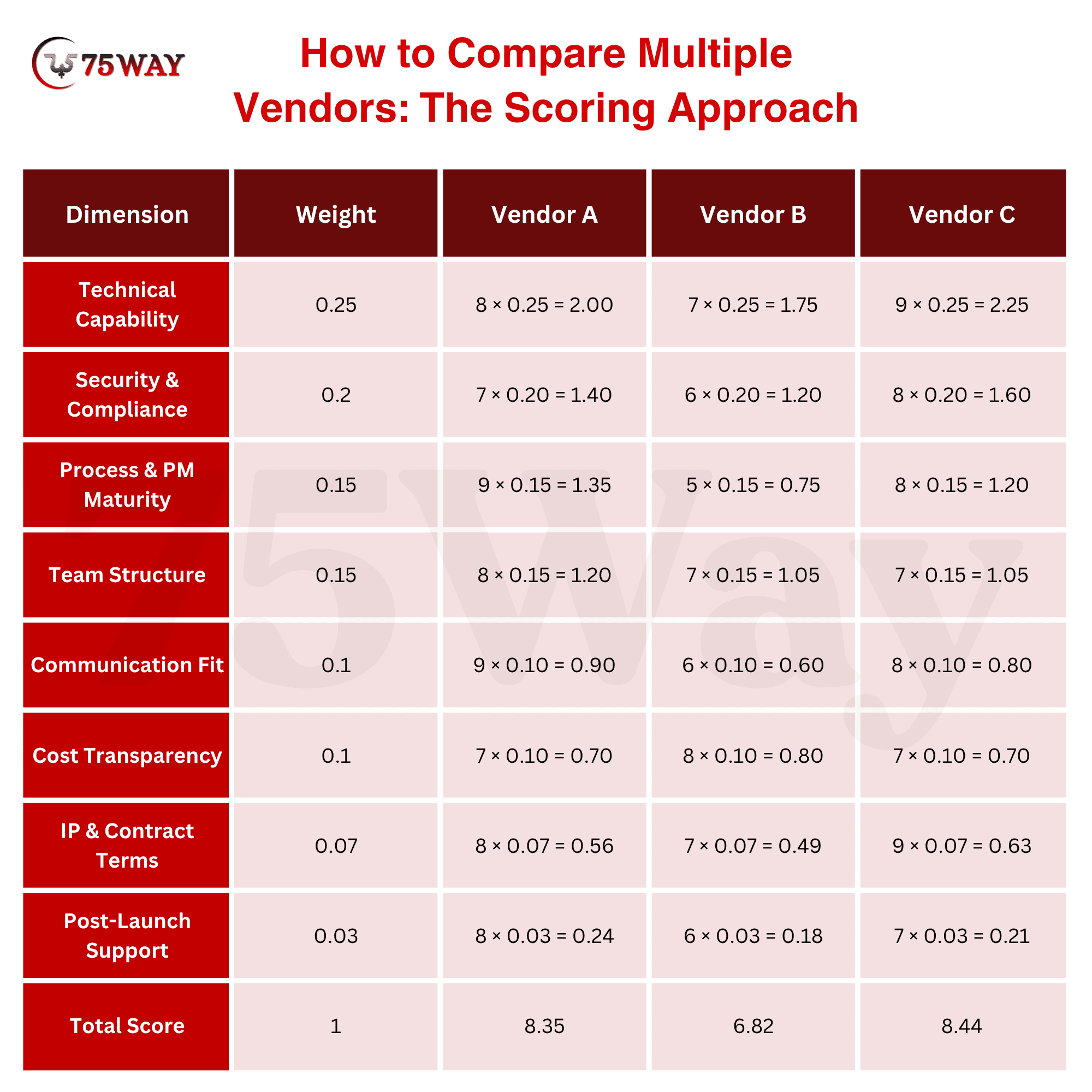
Interpretation: Vendors above 85 (on a 100-point scale) are typically approved; 70–84 proceed with monitoring; 55–69 require remediation conversations; below 55, walk away.
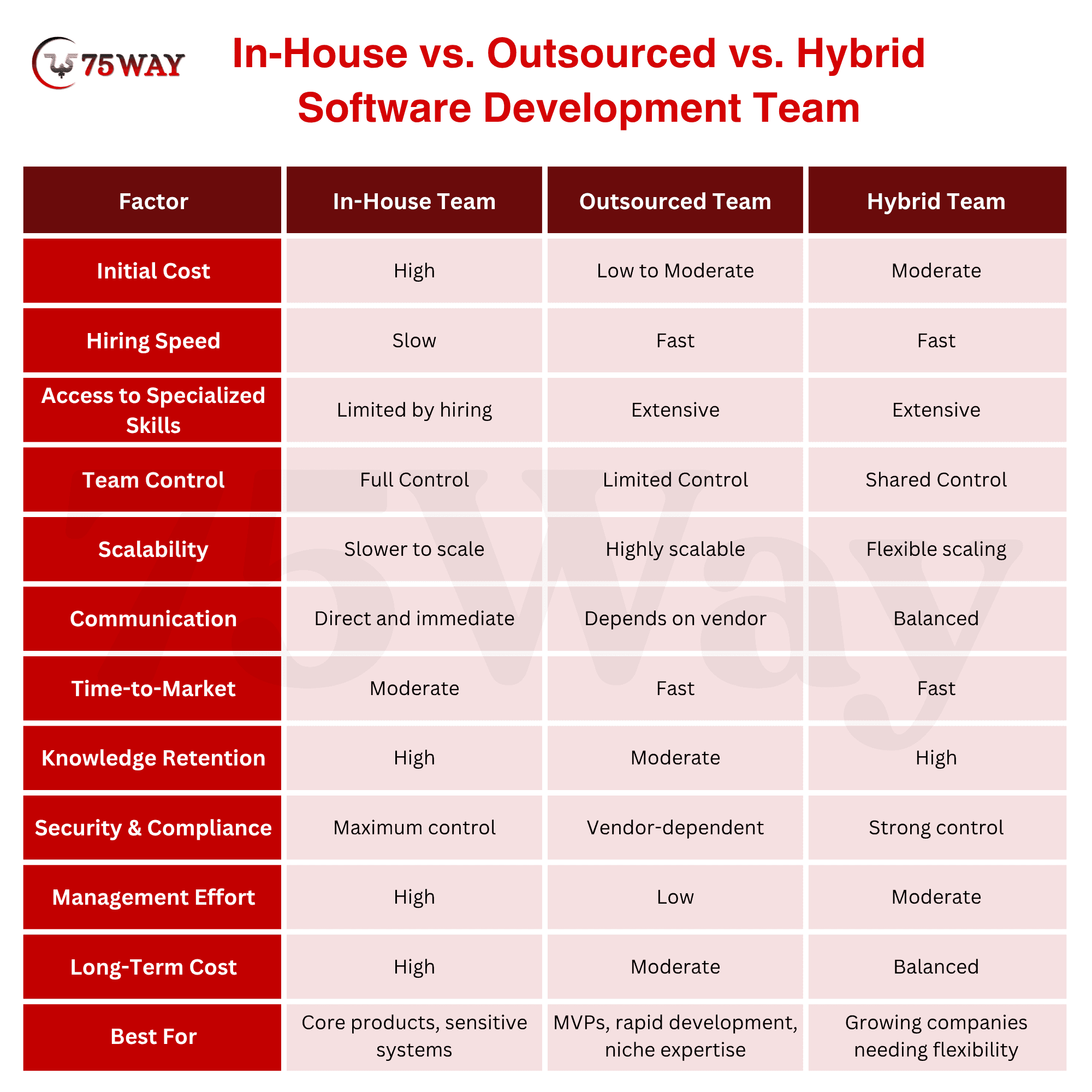
In-House vs. Outsourced vs. Hybrid Software Development Team: Choosing the Right Hiring Model
Before evaluating vendors, confirm that software outsourcing is the right model for your situation.
Recruiting and onboarding new engineers can take months. A software development partner can begin delivering production-quality code in weeks, which matters when you have a launch date, a fundraising deadline, or a competitor moving fast.
Which Hiring Model to Look for by Project Type?
If you're building an MVP: Prioritize speed and flexibility. Choose a vendor with demonstrated MVP delivery experience, lean methodology, and willingness to make scope trade-off recommendations. Avoid enterprise-grade firms whose process overhead will slow you down.
- If you're scaling an existing product: Focus on architecture and stability. Choose a vendor who starts with an architectural review, not just feature development. Ask specifically about scalability planning and load testing.
- If your system is complex or regulated: Choose experience over cost. A vendor with documented experience in your industry's compliance requirements (HIPAA, PCI-DSS, SOC 2) is worth the premium. The cost of retrofitting security and regulatory controls after build completion typically doubles the implementation cost.
- If you're building AI-powered features: In 2026, any software partner you work with has to have a real AI story, not just the words, but actual delivered projects. Ask for specific examples of AI integrations: ML models, LLM APIs, RAG pipelines, or intelligent automation in backend workflows.
Why 75way for Your Software Development Project?
At 75way, we've worked with startups, SMEs, and enterprises across the USA, from New York to Los Angeles, Chicago to Miami, and we understand what it takes to be the kind of partner that gets recommended to others.
Here's how we approach every project:
- Discovery before development. Every 75way engagement starts with a structured 2-week discovery phase. We don't write a single line of production code until we've documented your business goals, mapped your user journeys, defined your tech architecture, and agreed on measurable success criteria.
- Full IP ownership from day one. Every client owns their code, their data, and their intellectual property. Full stop. No escrow needed, no license arrangements, no lock-in.
- The same team from kickoff to launch. The engineers you meet in week one are the engineers who build your product. Senior architects stay on your project, not just your proposal.
- Security built in, not bolted on. Every 75way project includes secure authentication, role-based access controls, encryption, and a staging environment as standard, not as an upgrade.
- AI-ready development. We build AI-powered features using OpenAI GPT-4o, Anthropic Claude, Google Gemini, and LangChain, and we use AI tooling internally to deliver faster without cutting corners.
- Transparent pricing. We provide detailed cost breakdowns with milestone-based payment schedules. No surprise change orders for work that was in scope on day one.
75way's capabilities as a trusted software development company in USA:
- Custom Web & Mobile App Development (React, Next.js, Flutter, React Native)
- AI Software Development
- Agentic AI System Development
- Web3 & Blockchain Development
- Cloud Architecture & DevOps
- UI/UX Design
- MVP Development for Startups
- Staff Augmentation & Dedicated Teams
Conclusion
Choosing the right software development company in the USA is as much a risk decision as a technology decision. The vendor selection decision is the single biggest predictor of whether a project lands in the 31% that succeed, or the 70% that don't.
The right partner is not the largest, the cheapest, or the one with the most impressive case study deck. It's the one that looks at your business outcomes before every technical decision, treats security and scalability as defaults rather than afterthoughts, communicates proactively and transparently throughout the process, and has delivered real, measurable results for clients willing to vouch for them publicly.
Use the framework in this guide, the 8 evaluation dimensions, the 12 questions, and the 10 red flags before you sign with anyone. And if you're ready to start the conversation with a development partner that puts your outcomes first: get a free project evaluation with 75way.
Frequently Asked Questions (FAQs)
How Do I Choose The Right Software Development Company In The USA?
Start by clearly defining your project requirements, engagement model, and success criteria before contacting any vendor. Then evaluate companies across eight dimensions: technical capability, security and compliance, process maturity, team structure, communication fit, cost transparency, IP ownership, and post-launch support. Use a weighted scorecard to compare vendors consistently, and ask the 12 questions in this guide before signing any contract.
What Are The Biggest Red Flags When Choosing A Software Development Company?
The biggest red flags include: a detailed quote within 24 hours of the first call (no discovery), agreeing to everything without pushback, inability to show live products they've built, senior people disappearing after the contract is signed, pricing 50%+ below market rate, no staging environment, vague security answers, and resistance to a discovery phase.
How Much Does It Cost To Hire A Software Development Company In US?
Software development costs in the USA range from $25,000 for a simple MVP to $500,000+ for enterprise-grade systems. US-based senior developers charge $150–$250 per hour; Eastern European teams charge $55–$85 per hour; South Asian teams charge $45–$80 per hour. Cost alone is not a reliable comparison metric; evaluate seniority, delivery model, automation maturity, and architectural depth alongside the rate.
Should I Choose A Local USA Development Company Or An Offshore Team?
This depends on your project requirements. For projects requiring frequent real-time collaboration, regulatory expertise in US markets, or security-critical systems, a US-based or nearshore team reduces coordination overhead. For cost-sensitive projects with clearly defined requirements, offshore teams with proven US client experience can deliver comparable quality at 40–60% lower cost. Many successful projects use a hybrid model: US-based project management and architecture with offshore engineering execution.
What Is The Failure Rate Of Software Development Projects?
Approximately 70% of software projects either fail outright or are severely challenged, according to the Standish Group's CHAOS Report. Only 31% are completed on time, on budget, and with the expected scope. Vendor selection is a predictor of project success. Choosing a partner with strong process maturity, clear communication, and genuine domain experience significantly shifts the odds.
What Questions Should I Ask Prior To Hire A Software Development Agency?
The most important questions are: Who will actually work on my project? How do you handle scope changes? Can I see a live product you've built? What is your on-time delivery rate for comparable projects? Who owns the IP? What does post-launch support look like and what does it cost? How does your discovery process work? Ask the sales team and ask the proposed engineering team, and compare the answers.
How Long Does It Take To Build Custom Software?
Timeline depends on complexity: simple web apps take 8–14 weeks, medium-complexity mobile apps take 14–20 weeks, and enterprise-grade systems with compliance requirements take 6–12+ months. Any vendor that quotes a firm timeline before completing a discovery phase is guessing, and scope underestimation is the leading cause of schedule overruns.
What Is A Discovery Phase In Software Development, And Why Does It Matter?
A discovery phase is a structured pre-development period (typically 2–4 weeks) where the development team maps your business goals, user journeys, technical requirements, and architectural approach before writing any production code. Teams that spend at least 20% of their project budget on the pre-development phase are 3x more likely to build a successful product. Resistance to a discovery phase is one of the clearest red flags in vendor evaluation.