Summary
AI agent software enables enterprises to automate workflows, decision-making, and operations using intelligent systems. This guide explains architecture, components, benefits, and the development approach. It helps decision-makers understand how AI agents reduce manual effort, improve efficiency, and build scalable automation ecosystems that transform modern enterprise operations.
Quick Overview
- AI agents automate complex enterprise workflows with intelligence.
- Businesses reduce operational costs through autonomous systems.
- Agent-based architecture improves decision-making speed significantly.
- Integration with enterprise tools enables seamless automation flow.
- Scalable systems support long-term digital transformation goals.
“Nearly 80% of enterprise workflows still contain repetitive manual tasks that slow down execution and increase operational cost.” This reality is forcing businesses to rethink how work actually gets done inside modern organizations.
The starting forward answer is: AI agent software. Instead of static CRM systems, enterprises are shifting toward intelligent AI software with agentic AI solutions that can interpret context, make decisions, and execute tasks across multiple tools in real time.
For founders and startups, these AI agent development solutions feel less like a technology upgrade and more like a restructuring of business operations. Work that once required coordination across multiple teams can now be handled by continuously running AI agents that operate in the background.
And the more astonishing part is that these agents offer faster execution cycles, lower manual intervention, and measurable improvements in operational efficiency. This guide covers the system architecture of AI agent software, underlying working mechanisms, and the growing role of AI agent software in enterprise-scale transformation.
What Is AI Agent Software?
AI agent software refers to intelligent systems designed to perform tasks autonomously by perceiving inputs, reasoning to make decisions, and executing actions in digital environments.
Unlike traditional automation tools, AI agents are dynamic. They do not simply follow predefined rules; instead, they analyze situations and adapt based on context. An enterprise AI agent typically consists of:
- Data processing layer
- Decision-making engine
- Task execution system
- Integration connectors
Together, these components enable businesses to automate complex workflows, including customer support, data analysis, reporting, scheduling, and operational management.
How AI Agents Work in Enterprise Systems?
AI agents function through a continuous loop of perception, reasoning, and action.
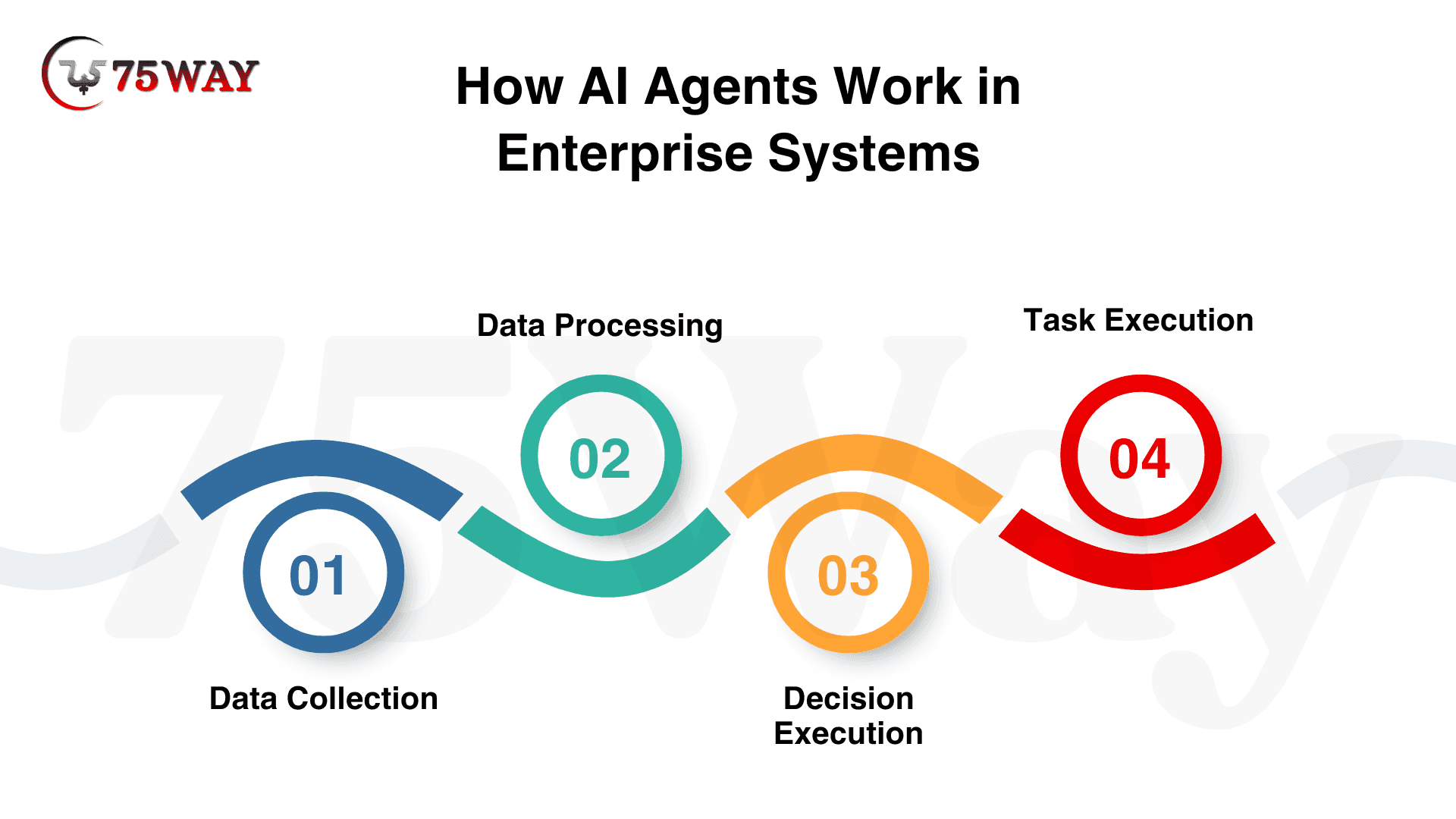
- Data Collection: First, they collect data from multiple enterprise systems such as CRMs, databases, APIs, and user inputs.
- Data Processing: Then, they analyze this information using machine learning models or large language models.
- Decision Execution: After processing, the agent decides the best possible action based on predefined goals or learned behavior.
- Task Execution: Finally, it executes tasks by interacting with enterprise tools or triggering automated workflows.
This cycle repeats continuously, allowing the system to improve over time and handle increasingly complex operations without manual intervention.
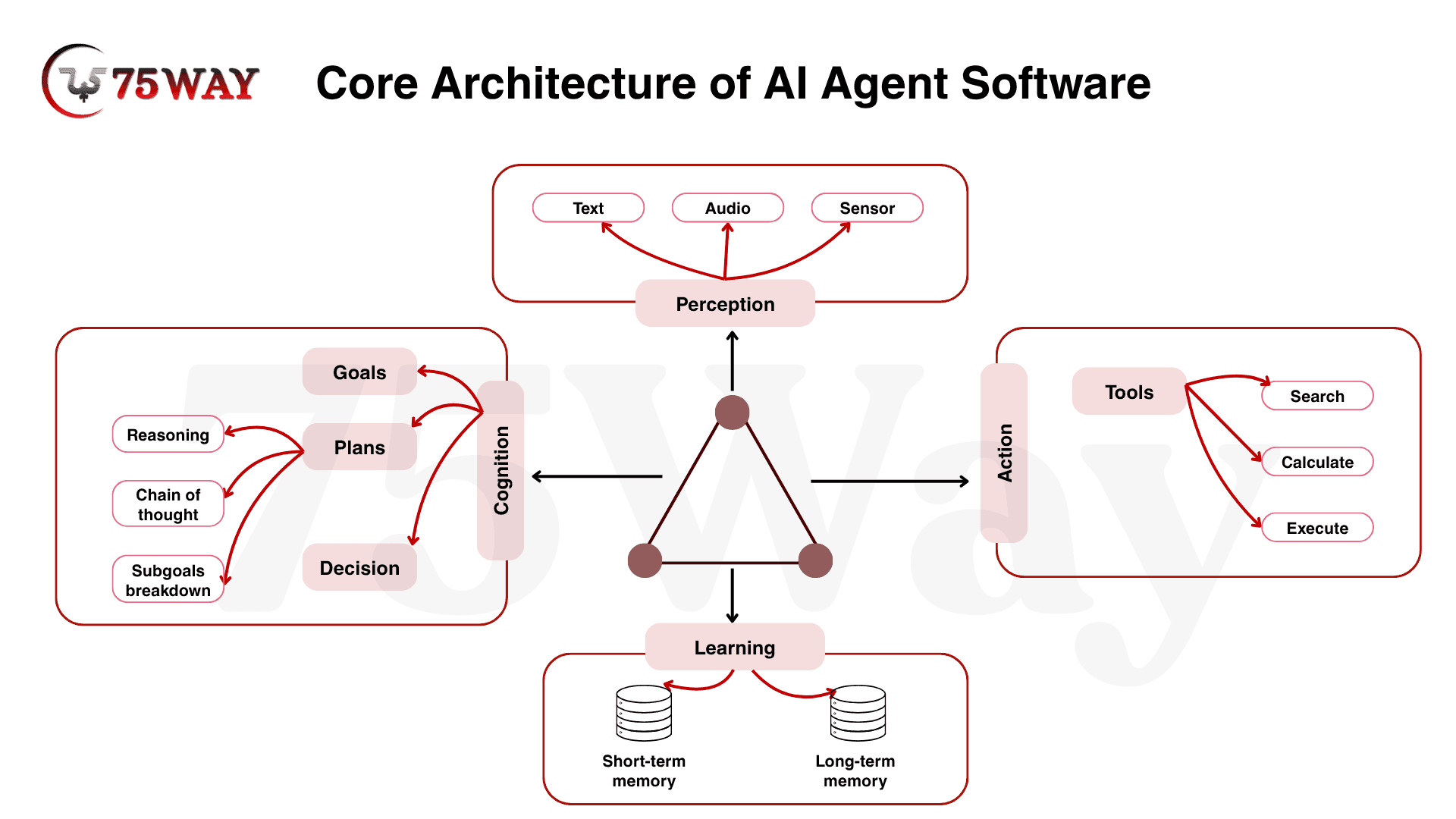
Core Architecture of AI Agent Software
Building enterprise AI agents requires a structured and scalable architecture.
- Input Layer: This layer collects data from APIs, databases, user queries, and enterprise systems.
- Reasoning Engine: The brain of the system that processes inputs and determines next actions using AI models.
- Memory System: Stores historical context, user interactions, and operational data for better decision-making.
- Action Layer: Executes tasks such as sending emails, updating systems, generating reports, or triggering workflows.
- Integration Layer: Connects with enterprise tools like CRM, ERP, analytics platforms, and communication systems.
Step-By-Step Roadmap: How To Build AI Agent Software
Building enterprise AI agent systems requires a structured engineering approach where each stage contributes to intelligence, integration, and execution capability. These stages ensure the final system is not only functional but also scalable, reliable, and adaptable to real business environments.
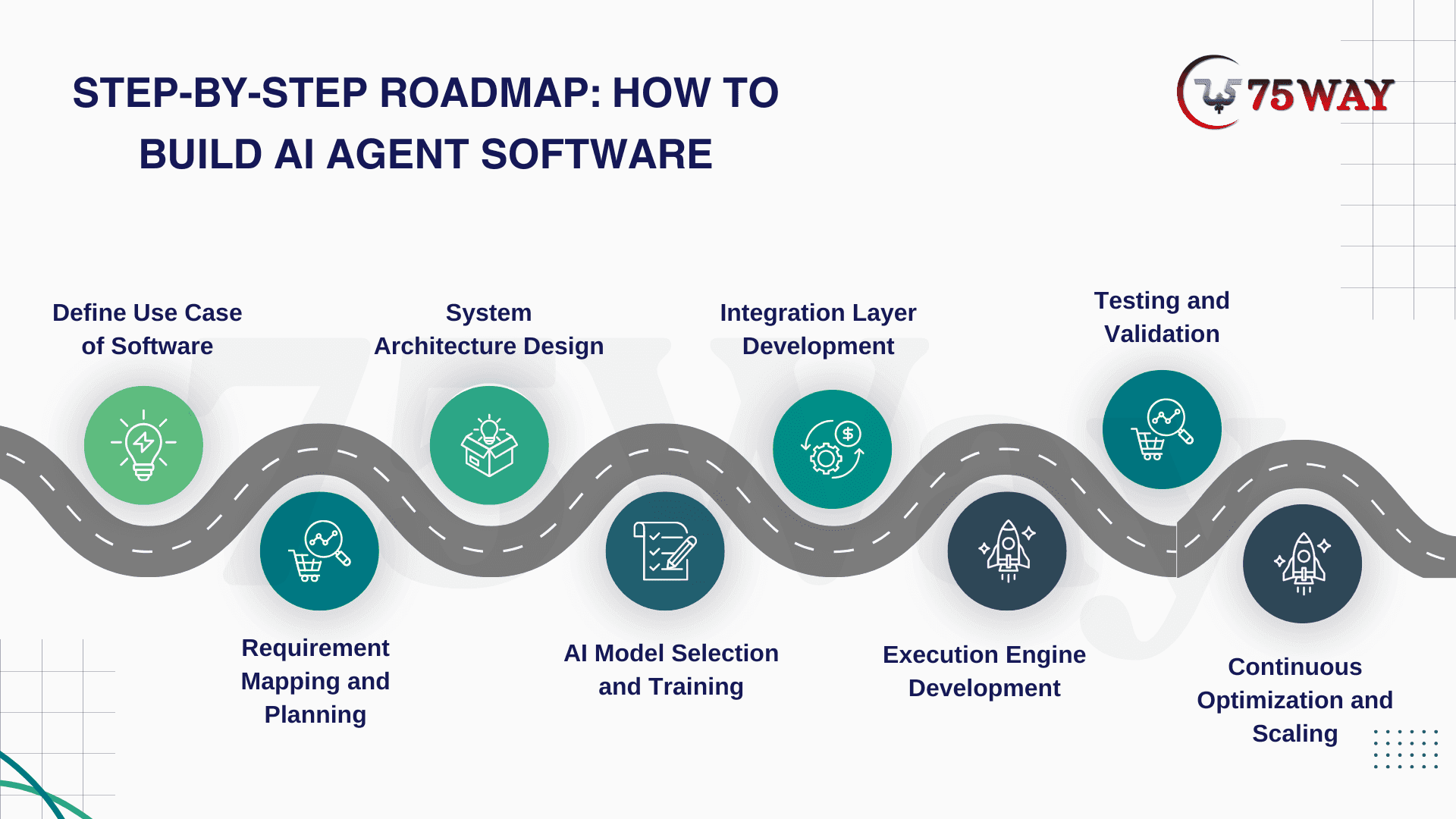
Step 1: Define Use Case of Software
The development process begins by identifying specific business problems that the AI agent will solve. This could include customer support automation, financial reporting, workflow coordination, or data processing tasks. A clearly defined use case ensures the system is purpose-driven and aligned with measurable business outcomes.
Step 2: Requirement Mapping And Planning
Once the use case is defined, functional and technical requirements are mapped in detail. This includes understanding data sources, user interactions, system dependencies, and expected outputs. Proper planning ensures alignment between business goals and technical architecture before development begins.
Step 3: System Architecture Design
At this stage, the core structure of the AI agent is designed, including memory systems, reasoning engines, and integration layers. Architects define how data flows between components and how decisions will be processed. A strong architecture ensures scalability and long-term system stability.
Step 4: AI Model Selection And Training
Appropriate machine learning or language models are selected based on task complexity and domain requirements. These models are trained or fine-tuned using relevant enterprise data to improve accuracy and contextual understanding. Model selection directly impacts the intelligence level of the agent.
Step 5: Integration Layer Development
Enterprise systems such as CRMs, databases, APIs, and third-party tools are connected through secure integration layers. This enables the AI agent to access and interact with real business environments. Strong integration ensures seamless data exchange across platforms.
Step 6: Execution Engine Development
The execution layer allows the AI agent to perform real-world actions such as sending emails, updating records, or triggering workflows. This transforms the system from a passive intelligence tool into an active operational assistant. Execution logic is carefully controlled to ensure reliability.
Step 7: Testing And Validation
Before deployment, the system undergoes extensive testing across multiple scenarios to evaluate performance, accuracy, and reliability. Edge cases and failure points are identified and corrected. This ensures the AI agent performs consistently under real-world conditions.
Step 8: Continuous Optimization And Scaling
After deployment, the system is continuously monitored and improved based on usage data and feedback. Performance tuning, model updates, and workflow enhancements are applied regularly. This ongoing optimization ensures the AI agent evolves with business needs.
Key Capabilities of Enterprise AI Agent Software
Enterprise AI agents represent a major shift in how modern organizations design and execute their operations. These agents combine automation, advanced analytics, and AI integration with the system to create a unified operational environment where tasks are executed accurately.
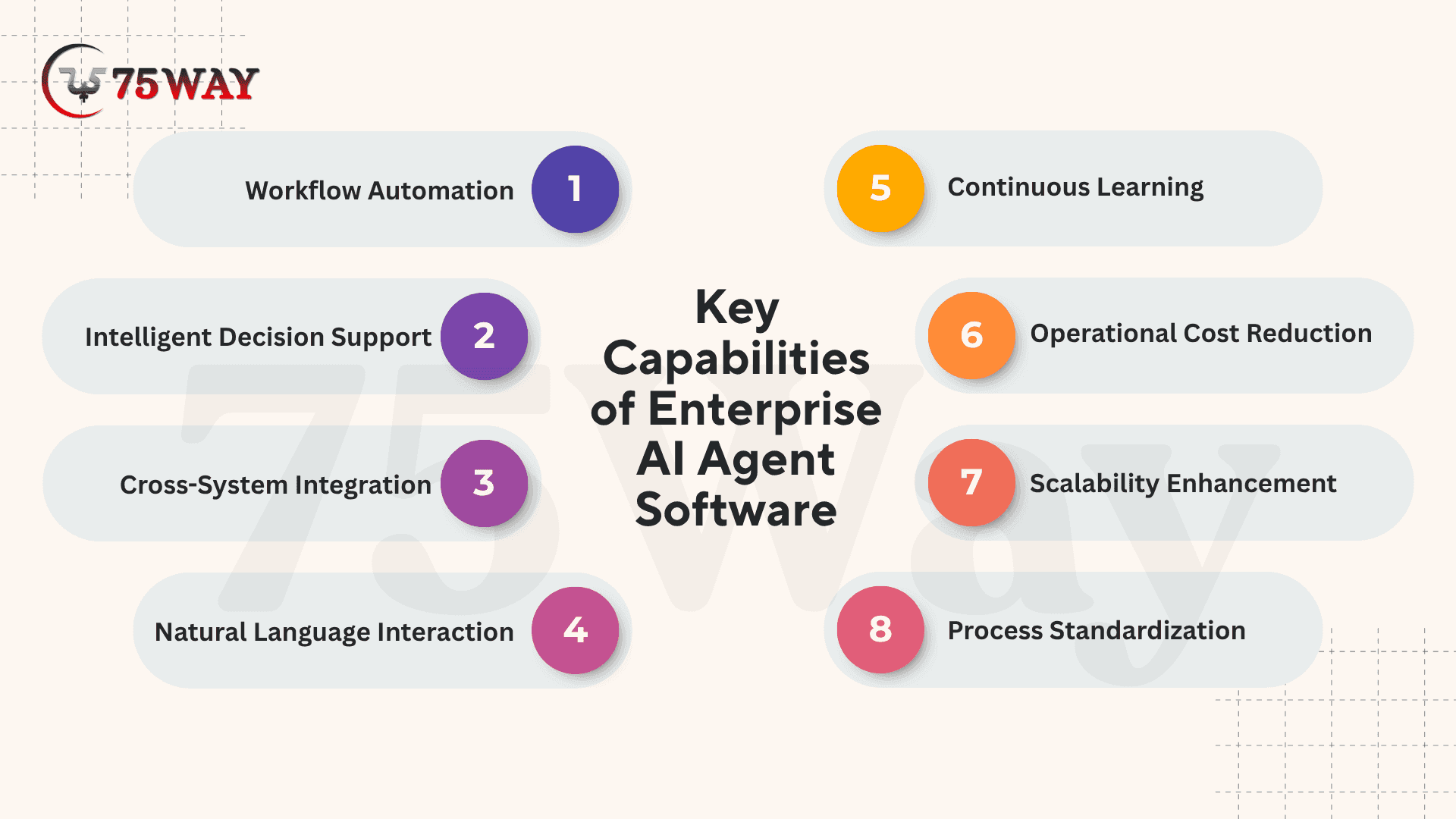
- Workflow Automation: AI agents eliminate repetitive operational tasks by executing end-to-end workflows across departments. This reduces manual dependency and increases overall execution speed within enterprise systems.
- Intelligent Decision Support: These systems analyze structured and unstructured data to generate actionable insights. Decision-makers receive faster recommendations that improve accuracy and reduce operational uncertainty.
- Cross-System Integration: AI agents connect fragmented enterprise tools into a unified operational ecosystem. This ensures seamless data flow between CRMs, databases, APIs, and internal platforms.
- Natural Language Interaction: Users can interact with enterprise systems using simple conversational commands instead of technical inputs. This improves accessibility and reduces training requirements across teams.
- Continuous Learning: The system improves over time by learning from usage patterns and feedback loops. Performance becomes more accurate and context-aware with each interaction cycle.
- Operational Cost Reduction: Automation reduces dependency on large manual teams for repetitive processes. This leads to significant savings in long-term operational expenses and resource allocation.
- Scalability Enhancement: AI agents handle increasing workloads without proportional increases in manpower or infrastructure. Businesses can scale operations smoothly while maintaining consistent performance levels.
- Process Standardization: Enterprise workflows become more structured and consistent through automated execution rules. This reduces human errors and ensures uniform quality across all business operations.
How Enterprises Gain Value From Agentic AI-Powered Software?
Adopting AI agent software creates a measurable business impact across multiple areas where traditional systems struggle with speed, coordination, and consistency.
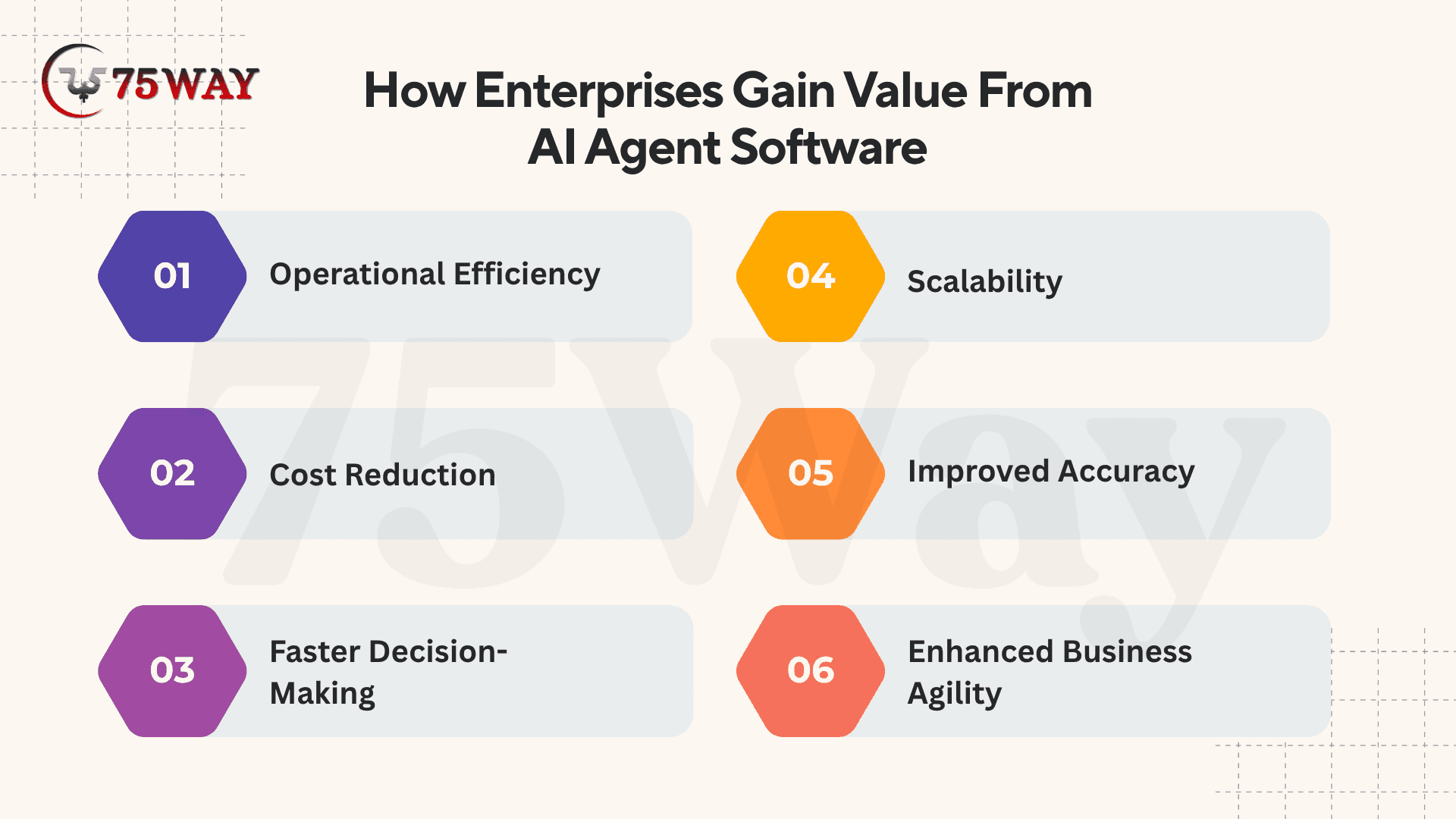
- Operational Efficiency
AI agent software streamlines workflows by reducing manual intervention across multiple departments. Tasks that previously required coordination between teams are now executed automatically within unified systems. This leads to faster completion cycles and smoother operational flow across the enterprise.
- Cost Reduction
Repetitive business functions are handled through automated processes, significantly lowering dependency on large operational teams. Enterprises can optimize resource allocation by shifting human effort toward higher-value activities. Over time, this creates a measurable reduction in overall operational expenditure.
- Faster Decision-Making
Real-time data processing enables instant access to insights across business systems. AI agents analyze inputs continuously and generate actionable recommendations without delay. This allows leaders to respond quickly to market changes and operational challenges.
- Scalability
Enterprise systems expand seamlessly without requiring proportional increases in workforce or infrastructure. AI agents manage growing workloads efficiently while maintaining consistent performance standards. This supports sustainable business expansion across multiple functions and regions.
- Improved Accuracy
Automated workflows reduce the likelihood of human error in data handling and execution processes. Information is processed consistently through predefined logic and learning models. As a result, enterprises achieve higher reliability in operational outputs.
- Enhanced Business Agility
AI agents enable organizations to adapt quickly to changing business conditions and priorities. Workflows can be modified dynamically without disrupting core operations. This flexibility strengthens overall responsiveness and competitive positioning in evolving markets.
How Agentic AI Software Solutions Transform Workflows and Operations?
AI agent software is reshaping enterprise operations by automating core business functions, improving decision speed, and enabling scalable workflows across diverse industry environments.
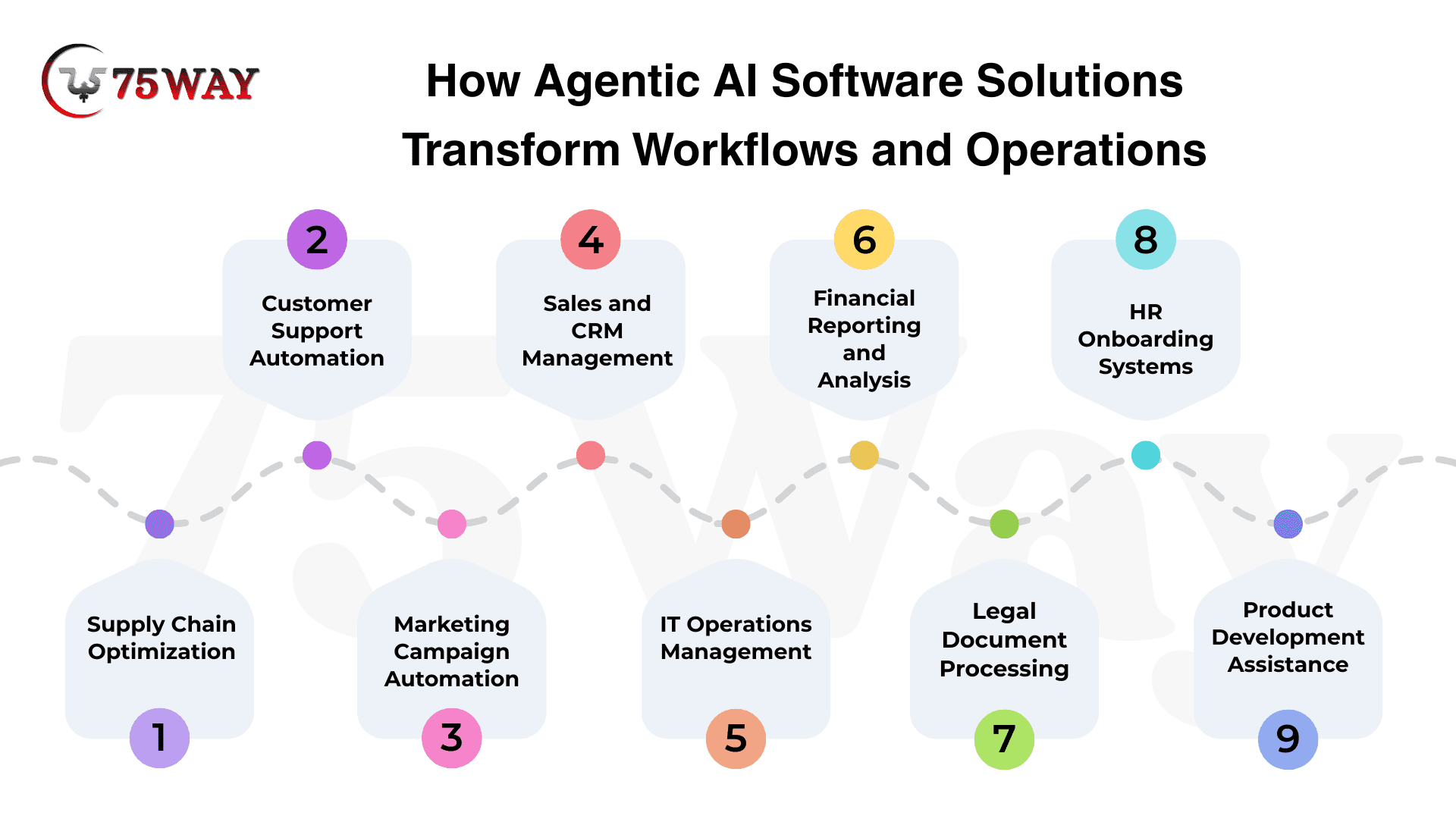
- Customer Support Automation: AI agents handle customer queries through chat, email, and voice systems efficiently. Customer support AI agents reduce response time while maintaining consistent service quality across channels.
- Sales And CRM Management: Sales pipelines are managed through automated tracking of leads, follow-ups, and conversions. AI sales agents help teams prioritize high-value prospects and improve closing rates effectively.
- Financial Reporting And Analysis: Financial data is collected, processed, and converted into real-time reports with finance AI agents. This improves forecasting accuracy and reduces manual dependency in accounting operations.
- HR Onboarding Systems: Employee onboarding processes are automated through document handling, training workflows, and task assignments. HR AI agents create a smoother experience for new hires while reducing HR workload.
- Supply Chain Optimization: Inventory levels, logistics, and demand forecasting are managed through intelligent automation systems. AI agents help reduce delays and improve overall supply chain efficiency across operations.
- Marketing Campaign Automation: Campaign creation, targeting, and performance tracking are handled automatically across platforms. Marketing AI agents optimize engagement strategies based on real-time user behavior and analytics insights.
- IT Operations Management: System monitoring, issue detection, and troubleshooting are automated using AI-driven workflows. This ensures faster incident resolution and improved infrastructure reliability for enterprises.
- Legal Document Processing: Contracts, compliance documents, and legal data are reviewed and organized automatically. Legal AI agents reduce manual review time while improving accuracy in documentation workflows.
- Product Development Assistance: Development workflows are supported through requirement analysis, testing coordination, and task automation. This helps teams accelerate product cycles and improve release efficiency.
Challenges in AI Agent Software Development
Despite its advantages, building AI agents requires careful planning.
- Data security and privacy concerns
- Integration complexity with legacy systems
- Model accuracy and reliability
- Cost of infrastructure scaling
- Continuous monitoring requirements
Enterprises must address these challenges with proper architecture and governance.
Final Thoughts
AI agent software is transforming enterprise automation by introducing intelligence, adaptability, and autonomy into business operations. Unlike traditional automation tools, AI agents do not rely on fixed rules; they understand context, make decisions, and execute tasks dynamically.
For enterprises, this shift represents a major opportunity to improve efficiency, reduce costs, and scale operations without increasing complexity. From workflow automation to intelligent decision-making, AI agents are becoming essential components of modern digital infrastructure.
Businesses that adopt this technology early gain a strong competitive advantage in speed, accuracy, and operational control. Partnering with a trusted AI development company can help enterprises design, build, and deploy scalable AI agent software tailored to their operational goals and long-term growth strategy.
Frequently Asked Questions (FAQs)
Can AI Agent Software Work With Existing Enterprise Systems?
Yes, AI agents can integrate with existing enterprise systems through APIs and middleware. They connect with CRM, ERP, databases, and communication tools, enabling smooth data exchange and unified workflows without requiring complete system replacement or disrupting current business operations or infrastructure setups.
How Do AI Agents Improve Business Decision Making?
AI agents analyze large volumes of real-time and historical data to identify patterns and insights. They assist decision-makers by providing recommendations, predictions, and automated analysis, which reduces guesswork, improves accuracy, and allows faster, data-driven decisions across different business departments and processes.
Is AI Agent Software Suitable For Small Enterprises?
Yes, AI agent software can be adapted for small enterprises depending on business needs and budget. It helps automate repetitive tasks, improve productivity, and reduce operational workload, allowing smaller teams to focus on growth, customer engagement, and strategic planning without increasing overhead costs.
How Secure Are AI Agent-Based Enterprise Systems?
AI agent systems are built with security layers, including encryption, access control, and secure API communication. When properly implemented, they maintain high data protection standards, ensuring sensitive enterprise information remains safe as it is securely interacted with across multiple systems and automated workflows.
Can AI Agents Handle Multiple Tasks At The Same Time?
Yes, AI agents are designed to multitask across multiple workflows simultaneously. They can process data, execute actions, respond to inputs, and coordinate between systems in parallel, improving operational speed and reducing delays in enterprise-level task management and business process execution.
Do AI Agent Systems Require Continuous Human Monitoring?
AI agent systems are designed to operate autonomously, but periodic human monitoring is recommended for optimization and performance tracking. Businesses usually oversee system outputs, refine workflows, and update models when necessary to ensure accuracy, efficiency, and alignment with changing operational goals.