Summary
Building an AI chatbot for ecommerce involves selecting suitable AI technologies. This guide defines the complete design of conversational workflows, integration of ecommerce systems, and customer interactions for higher conversions. You will know about advanced AI chatbot features that help you improve shopping experiences online, increase sales performance, and long-term customer engagement.
Quick Overview
- Nearly 60% of consumers have used AI-powered tools for online shopping.
- AI chatbots personalize ecommerce interactions using customer shopping preferences.
- Conversational commerce enhances product discovery and purchasing journeys.
- Automated support systems reduce abandoned carts and improve customer retention across ecommerce platforms.
- The cost to develop an AI chatbot in ecommerce lies between $5,000 – $300,000+
Around 6 out of 10 shoppers now rely on AI shopping assistants while making online purchases. Moreover, by 2033, the market of AI chatbots for ecommerce is expected to reach approximately $8.8 billion. Thus, large ecommerce brands are heavily investing in AI chatbot development solutions.
Conversational AI chatbots reduce response times, strengthen customer engagement, and help businesses scale customer interactions without expanding support teams. The AI chatbot solution for ecommerce creates personalized shopping experiences that influence customer decisions throughout the entire purchase cycle.
So, how to build AI chatbot in ecommerce? How to integrate these conversational AI chatbots into ecommerce platforms? And what’s the cost to develop an AI chatbot for ecommerce in 2026?
This comprehensive guide highlights ecommerce AI chatbot development strategies, essential features, and technology stack selection. So, whether you want to integrate an AI chatbot in your ecommerce website or implement it in ecommerce mobile app, this guide will describe implementation processes, integration approaches, monetization opportunities, and future industry trends shaping conversion-focused conversational commerce systems.
What is AI Chatbot for E-commerce and Retail?
AI chatbots in ecommerce are conversational systems that interact with online shoppers using artificial intelligence technologies. These chatbots communicate through text or voice interfaces while helping customers complete shopping-related activities across websites and mobile applications.
Unlike traditional rule-based chatbots, modern AI chatbots for ecommerce use machine learning and natural language processing to deliver personalized and contextual interactions. These enterprise AI chatbot solutions for ecommerce understand customer intent, learn from conversations, and provide more accurate responses based on user behavior and preferences.
AI-powered ecommerce chatbots support multiple business functions from product recommendations and order tracking to cart recovery and multilingual communication. These AI chatbot platforms for ecommerce help businesses improve customer experience, automate support operations, and increase online sales performance.
Ecommerce AI Chatbot Adoption Rate & Market Insights
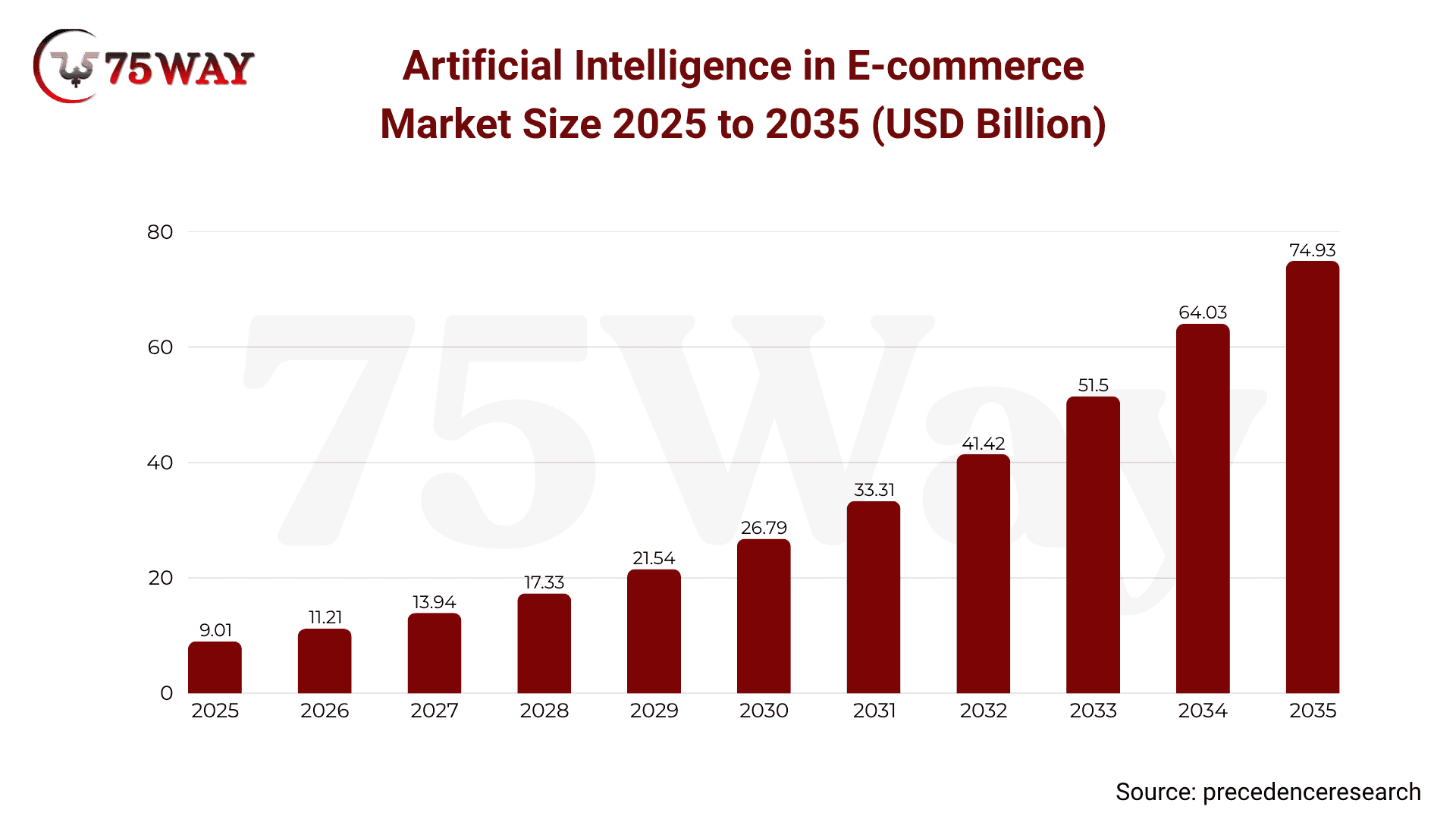
The global AI in e-commerce market is projected to grow from $11.21 billion in 2026 to nearly $74.93 billion by 2035, registering a CAGR of 23.59%. Further, the growth insights of AI chtabot in ecommerce and retail are given below.
- Spending on e-commerce chatbots and AI agents in the U.S. alone is expected to reach $4.3 billion this year.
- North America leads the AI in the e-commerce industry with a market share of 39%.
- Around 80% of online retail businesses are either using or planning to adopt AI chatbots.
- Stores implementing AI-assisted shopping experiences report up to 4x higher conversion rates.
- Retailers state that AI-powered shopping sessions can improve conversion rates by 20% to more than 67%.
Step-By-Step Roadmap: How To Build AI Chatbot For Ecommerce in 2026?
Building an AI chatbot for ecommerce requires a structured development approach focused on customer experience, intelligent automation, and scalable system architecture. A well-planned development process helps ecommerce brands improve conversions and deliver faster customer support experiences in competitive online marketplaces.
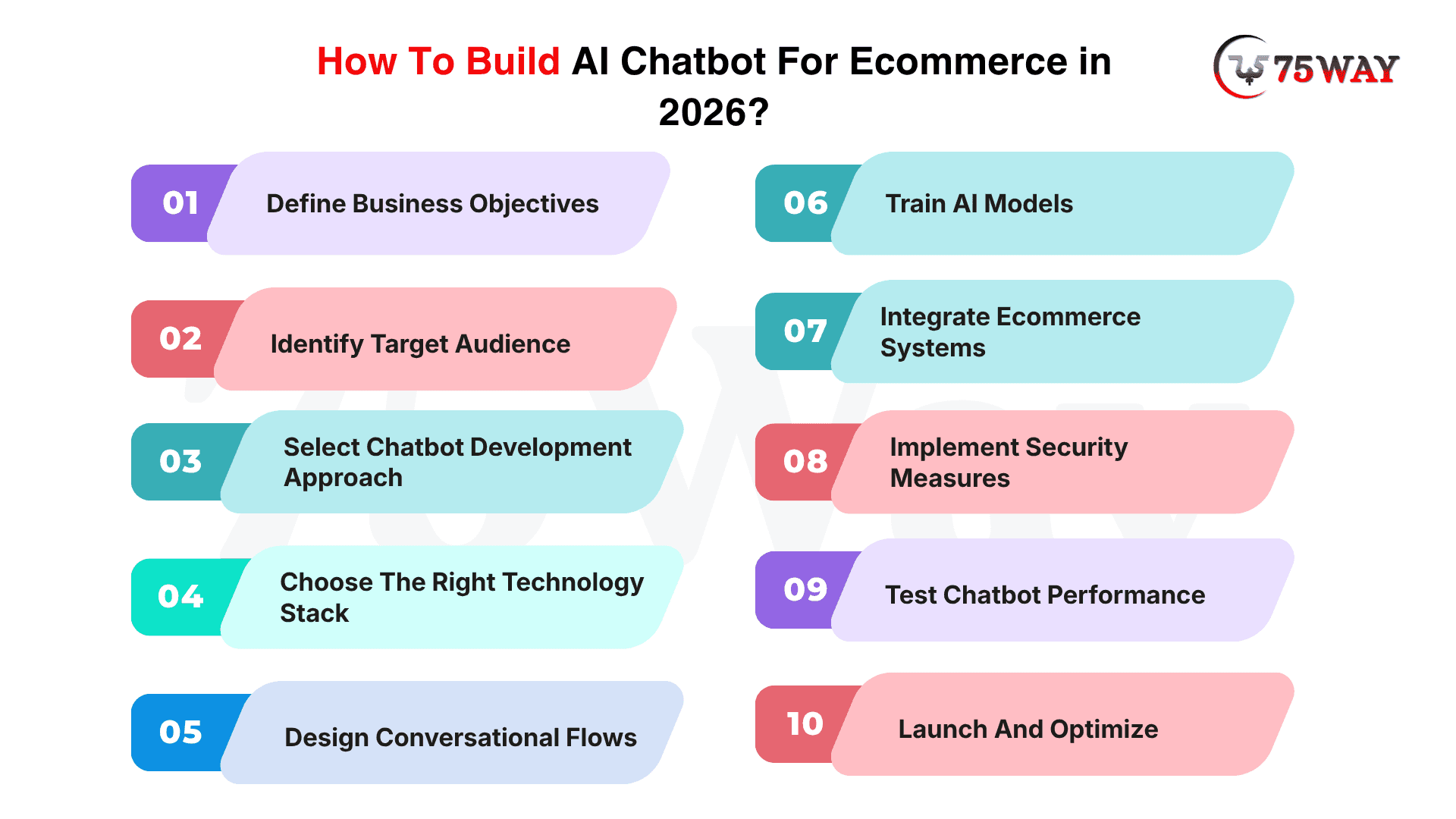
Stage 1: Define Business Objectives
The first step involves identifying the chatbot’s primary goals. Businesses must determine whether the chatbot will focus on customer support, sales growth, product recommendations, retention, or complete conversational commerce automation.
Clearly defined objectives help structure chatbot workflows, feature prioritization, and technology selection. Businesses should also evaluate operational challenges, existing ecommerce infrastructure, and automation requirements before beginning chatbot development.
This stage helps define integration priorities, workflow complexity, scalability expectations, and performance goals required for building a reliable and growth-oriented ecommerce AI chatbot solution.
Stage 2: Identify Target Audience
Understanding customer demographics, shopping behavior, and communication preferences is essential for chatbot development success. Audience research directly impacts chatbot conversational design and engagement strategies. Businesses should analyze:
- Customer Pain Points: Identify shopping difficulties, delayed responses, and support challenges affecting customer satisfaction and purchasing decisions online.
- Preferred Shopping Channels: Analyze platforms customers frequently use for browsing, communication, purchasing, and product engagement activities.
- Device Usage Patterns: Track customer interactions across smartphones, tablets, desktops, and connected devices during shopping experiences online.
- Buying Behavior: Study purchasing frequency, browsing habits, spending patterns, and product preferences influencing customer conversion decisions online.
- Geographic Distribution: Evaluate customer locations to optimize language support, regional marketing strategies, shipping workflows, and engagement experiences.
- Customer Expectations: Understand customer demands regarding response speed, personalization, convenience, seamless navigation, and support availability across ecommerce platforms.
Stage 3: Select Chatbot Development Approach
AI-powered conversational systems are more effective for ecommerce conversion growth because they support dynamic customer interactions. Businesses can choose between:
- Rule-Based Chatbot Systems: Rule-based chatbots operate through predefined workflows, scripted replies, and decision-tree logic for handling customer interactions. These systems work effectively for repetitive ecommerce queries requiring limited conversational flexibility and structured response management.
- AI-Powered Conversational Chatbots: AI-powered conversational chatbots use machine learning and natural language processing to understand customer intent dynamically. These systems deliver contextual responses and personalized interactions across complex ecommerce communication scenarios efficiently.
- Hybrid Chatbot Models: Hybrid chatbot models combine rule-based workflows with AI-driven conversational capabilities for balanced automation performance. These systems manage structured tasks while supporting flexible and intelligent customer engagement experiences simultaneously.
- Generative AI Chatbots: Generative AI chatbots create human-like responses using large language models and contextual understanding technologies. These systems support advanced conversations, personalized recommendations, and dynamic customer interaction experiences within ecommerce platforms.
Stage 4: Choose The Right Technology Stack
A scalable technology stack plays a critical role in ecommerce AI chatbot performance, flexibility, and long-term operational growth. Businesses must select technologies capable of supporting real-time conversations, customer data processing, omnichannel communication, and increasing interaction volumes across expanding digital commerce environments.
Popular chatbot development technologies include Python, Node.js, TensorFlow, OpenAI APIs, Dialogflow, LangChain, AWS, Google Cloud, and Azure AI Services. Technology selection depends on factors such as scalability requirements, development budget, integration complexity, AI capabilities, and long-term ecommerce automation objectives.
Stage 5: Design Conversational Flows
Conversation design significantly impacts user experience and conversion performance. Human-like conversational patterns improve customer trust and engagement.
- Product Discovery: Help customers find relevant products using conversational search, recommendations, and personalized browsing assistance.
- Customer Onboarding: Guide new users through account creation, platform navigation, preferences setup, and shopping processes.
- Checkout Support: Assist customers during payment processes by resolving issues and simplifying checkout completion workflows.
- Cart Recovery: Re-engage customers abandoning carts through reminders, offers, and personalized follow-up shopping interactions.
- Customer Complaints: Resolve customer issues quickly using automated responses, escalation workflows, and conversational support assistance.
- Loyalty Engagement: Encourage repeat purchases through rewards updates, personalized offers, and customer retention communication strategies.
- Upselling Journeys: Recommend premium products or complementary items based on customer preferences and purchasing behavior.
Stage 6: Train AI Models
AI model training helps ecommerce chatbots understand customer intent, shopping behavior, and conversational patterns accurately. High-quality datasets improve chatbot response relevance significantly. Training processes refine personalization capabilities continuously. Businesses achieve smarter and more adaptive conversational experiences through ongoing AI learning mechanisms. Training datasets should include:
- Customer support transcripts
- Product catalogs
- Ecommerce FAQs
- Purchase history
- User behavior analytics
Stage 7: Integrate Ecommerce Systems
Businesses can connect ecommerce AI chatbots using APIs, middleware platforms, cloud services, and webhook-based communication frameworks. Integration connects chatbot systems with ecommerce infrastructure for real-time data exchange and workflow automation. Ecommerce AI chatbot developers configure secure connections between platforms and backend services. You can integrate AI chatbots into:
- Ecommerce platforms
- CRM systems
- Inventory management
- Payment gateways
- Analytics tools
- Marketing automation systems
Integration creates centralized customer experiences and real-time data synchronization.
Stage 8: Implement Security Measures
Ecommerce chatbots process sensitive customer information, including payment details and personal data. Security implementation should include:
- End-To-End Encryption: Protect customer conversations and sensitive ecommerce data during transmission across connected digital communication systems.
- Authentication Protocols: Verify user identities through secure login mechanisms before granting chatbot access across ecommerce platforms.
- GDPR Compliance: Maintain customer data privacy according to European regulations governing digital information collection and processing activities.
- PCI DSS Standards: Secure online payment transactions by following industry standards, protecting customer financial information during purchases.
- Access Management: Control system permissions restricting unauthorized users from accessing sensitive chatbot infrastructure and customer datasets.
- Fraud Detection Systems: Identify suspicious customer activities and transactional anomalies, preventing fraudulent ecommerce interactions and payment risks.
Stage 9: Test Chatbot Performance
Comprehensive chatbot testing helps ecommerce businesses identify performance issues before deployment across live customer environments. Testing processes evaluate conversational quality, system stability, operational scalability, and customer interaction effectiveness under different shopping scenarios and communication conditions consistently.
Testing phases should analyze conversational accuracy, response speed, user experience, mobile compatibility, conversion impact, error handling, and scalability performance thoroughly. Continuous testing improves chatbot reliability, customer satisfaction, operational efficiency, and long-term ecommerce automation performance across expanding digital commerce ecosystems.
Stage 10: Launch And Optimization of AI Ecommerce Chatbot
Post-launch optimization is critical for long-term chatbot success. Launching an AI ecommerce chatbot requires continuous monitoring and performance optimization to maintain conversational quality and customer engagement effectiveness. Post-deployment analysis helps businesses identify operational gaps, improve interaction experiences, and adapt chatbot strategies according to evolving customer behavior patterns. Businesses should monitor:
- Customer engagement rates
- Conversion performance
- Bounce rates
- Customer satisfaction
- Session duration
- Revenue attribution
Analytics-driven optimization improves chatbot accuracy, shopping experiences, conversion opportunities, and long-term ecommerce growth across competitive digital commerce marketplaces.
Why Retailers Are Investing In AI Chatbot Platform For Ecommerce?
Ecommerce businesses invest in AI chatbot platforms to automate customer interactions, improve shopping experiences, and increase conversion opportunities across digital platforms. Another reasons are:
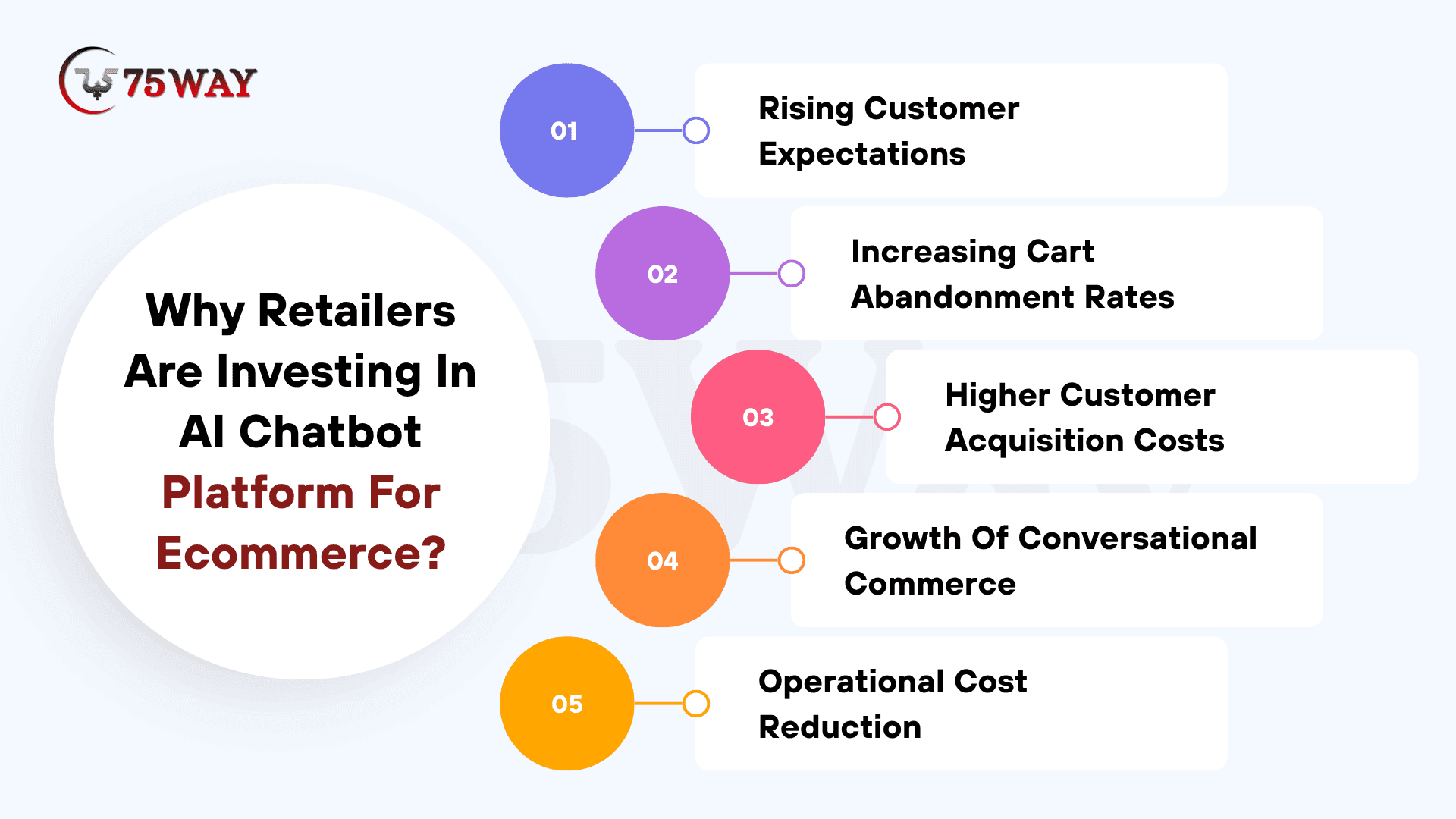
- Rising Customer Expectations
Modern consumers expect immediate responses while shopping online. Delayed support interactions often result in lost sales opportunities and increased bounce rates. AI ecommerce chatbots provide real-time assistance twenty-four hours a day across global markets.
- Increasing Cart Abandonment Rates
Cart abandonment remains one of the biggest ecommerce challenges worldwide. Ecommerce AI chatbots help recover potential customers by sending personalized reminders, discount offers, and product assistance during checkout stages.
- Higher Customer Acquisition Costs
Digital advertising costs continue to increase across search engines and social platforms. Businesses now focus heavily on conversion optimization and customer retention strategies. Retail AI chatbots improve conversion rates by simplifying customer decision-making processes.
- Growth of Conversational Commerce
Consumers increasingly prefer conversational shopping experiences through messaging platforms and voice assistants. Ecommerce brands are adapting to these behavioral shifts by integrating conversational AI technologies into customer engagement strategies.
- Operational Cost Reduction
AI chatbots for selling ecommerce automate repetitive support interactions, reducing dependency on large customer service teams. Businesses can manage higher customer volumes while lowering operational expenses.
Different Types of AI Chatbots for Ecommerce You Can Build in 2026
Ecommerce businesses use different types of AI chatbots to manage customer interactions, automate sales processes, and improve shopping experiences across digital platforms. Each chatbot category serves specific operational and customer engagement purposes within modern ecommerce ecosystems.
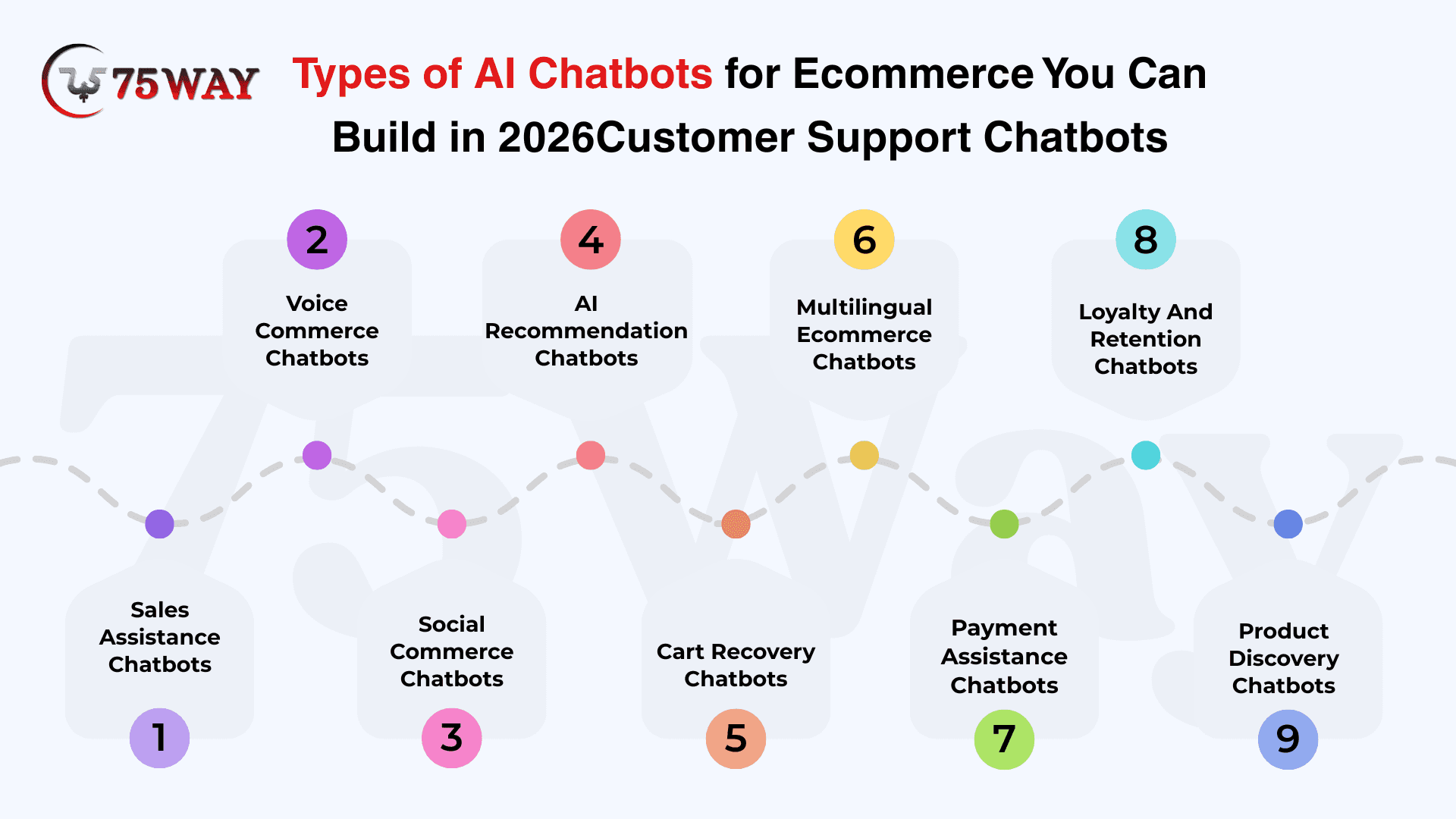
- Customer Support Chatbots: These chatbots manage customer service interactions such as order tracking, shipping updates, refunds, and product-related questions. They reduce support workload by handling repetitive customer queries automatically. Businesses improve response speed and customer satisfaction through continuous support availability.
- Sales Assistance Chatbots: Sales-focused chatbots guide customers through purchase journeys by recommending products based on browsing behavior and shopping preferences. These systems personalize shopping experiences using behavioral insights. Ecommerce brands increase conversions through targeted product suggestions and guided purchasing support.
- Voice Commerce Chatbots:Voice AI assistants allow customers to search products, place orders, and interact through spoken commands. Conversational AI in ecommerce systems simplifies hands-free shopping experiences across smart devices. Voice commerce improves accessibility and customer convenience within digital retail environments.
- Social Commerce Chatbots: These systems operate within messaging platforms like Facebook Messenger, Instagram, and WhatsApp to support conversational shopping experiences. Businesses engage customers directly through social communication channels. Social commerce chatbots improve customer interaction and accelerate purchase decisions.
- AI Recommendation Chatbots: Recommendation engines analyze customer behavior and suggest products likely to generate higher conversions and average order values. These systems personalize product discovery experiences. Businesses improve retention and increase cross-selling opportunities through intelligent recommendations.
- Cart Recovery Chatbots: Cart recovery chatbots re-engage users who abandon products before checkout completion. They send reminders, promotional offers, and personalized messages to encourage purchase completion. These systems help ecommerce businesses recover lost revenue opportunities.
- Multilingual Ecommerce Chatbots: Multilingual chatbots communicate with global customers in multiple languages across digital storefronts. They eliminate communication barriers during shopping interactions. Businesses expand international reach while improving customer experiences for diverse audiences.
- Payment Assistance Chatbots: Payment-focused chatbots guide users through checkout processes, payment methods, and transaction-related concerns. These systems reduce friction during the final purchase stages. Ecommerce businesses improve checkout completion rates and reduce cart abandonment.
- Loyalty & Retention Chatbots: These chatbots manage loyalty programs, rewards updates, personalized offers, and repeat customer engagement campaigns. They strengthen long-term customer relationships through interactive communication. Businesses improve retention and lifetime customer value through automated engagement strategies.
- Product Discovery Chatbots: Product discovery chatbots help customers find relevant products using conversational search experiences. They analyze customer intent, preferences, and browsing patterns for accurate recommendations. These systems simplify product navigation and improve ecommerce user experiences.
Must-Have Features for Creating AI Chatbot Solution for Ecommerce
As ecommerce competition continues growing in 2026, businesses investing in advanced AI chatbot capabilities gain stronger operational flexibility and improved conversion opportunities within evolving online marketplaces.
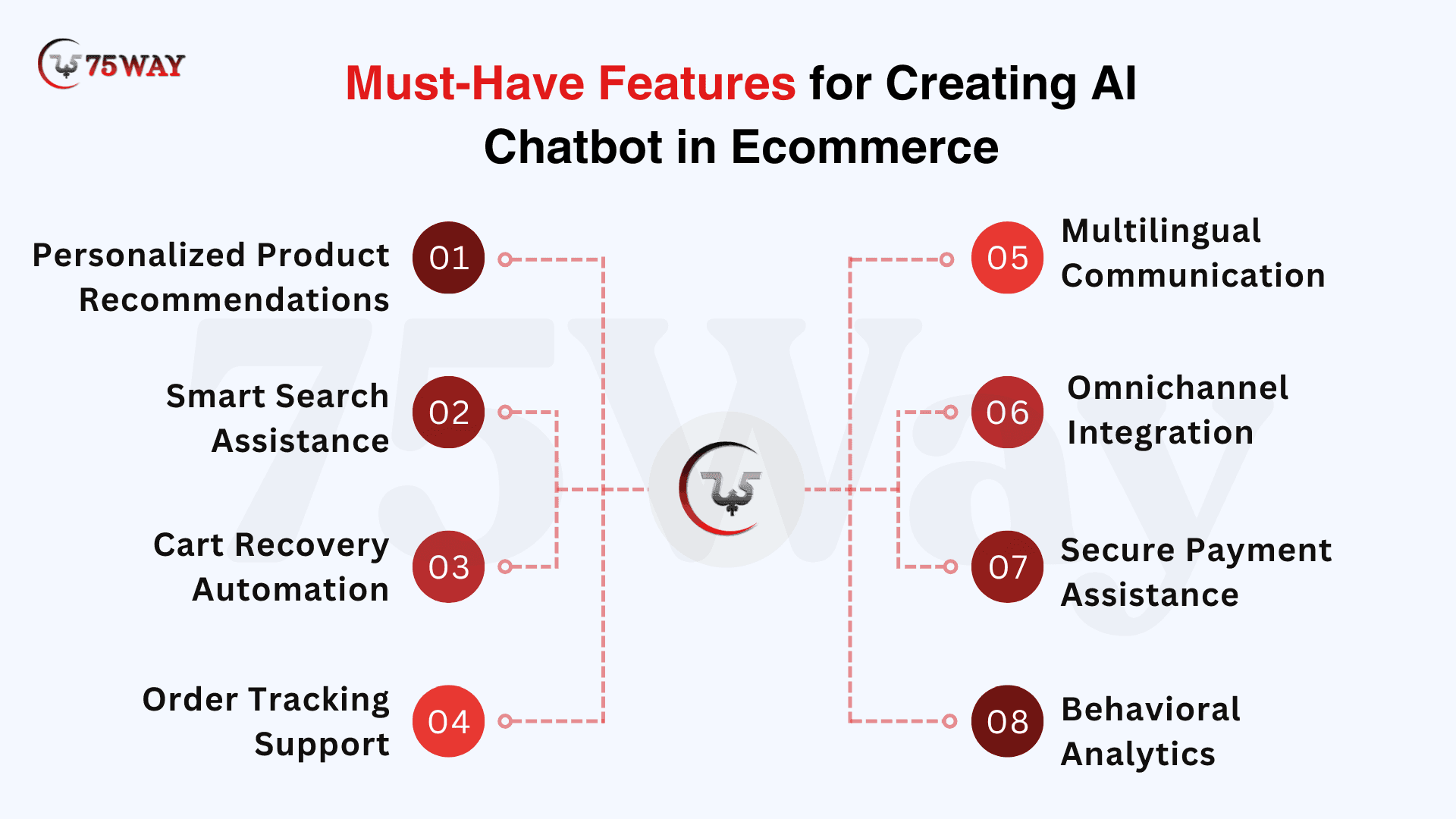
- Personalized Product Recommendations: AI chatbots analyze user preferences and shopping history to recommend products matching customer interests and purchasing behavior.
- Smart Search Assistance: Conversational search capabilities help users discover products quickly through natural language queries instead of traditional keyword-based searches.
- Cart Recovery Automation: AI chatbots identify abandoned carts and initiate re-engagement conversations through personalized reminders and promotional incentives.
- Order Tracking Support: Customers can receive instant shipment updates, delivery tracking details, and return processing assistance directly through chatbot interactions.
- Multilingual Communication: Global ecommerce businesses use multilingual chatbots to engage customers across international markets and diverse language preferences.
- Omnichannel Integration: Modern chatbots operate across websites, mobile apps, social media platforms, and messaging applications simultaneously.
- Secure Payment Assistance: AI chatbots can guide users through payment processes, discount application, coupon redemption, and checkout completion.
- Behavioral Analytics: Advanced analytics capabilities track customer interactions, conversion trends, and conversational engagement metrics for optimization purposes.
Core Tech Stack Required To Build Ecommerce AI Chatbot
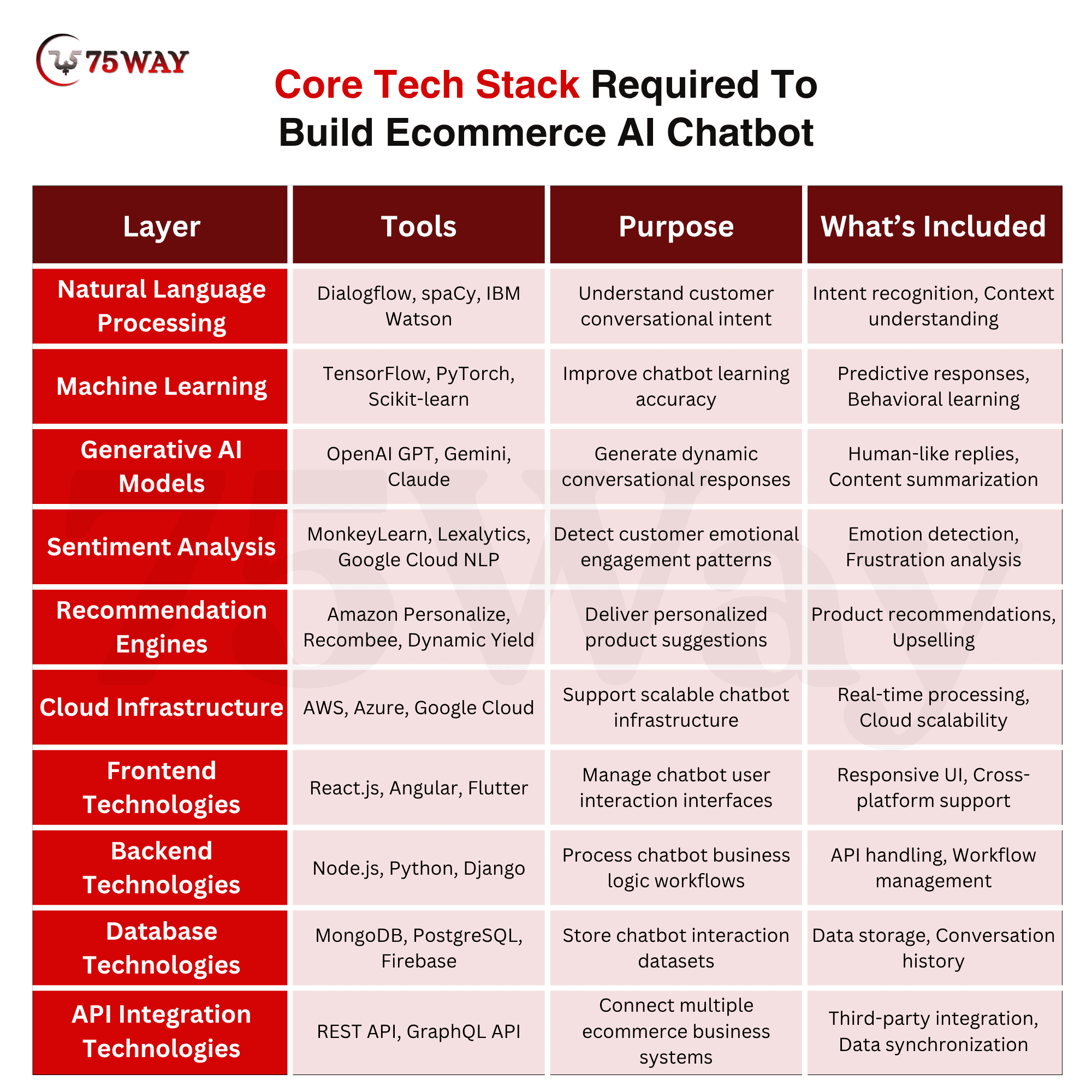
Modern AI chatbot ecommerce solutions combine multiple technologies to deliver intelligent, scalable, and personalized shopping experiences. These technologies support conversational understanding, integrations, and real-time customer engagement within ecommerce software and ecosystems.
- Frontend Technologies: Frontend technologies like React.js, Angular, Vue.js, and Flutter manage chatbot interfaces and user interaction experiences.
- Backend Technologies: Node.js, Python, Java, and Django handle chatbot logic, APIs, and data processing workflows.
- Database: The systems, like MongoDB, PostgreSQL, Firebase, and MySQL, store customer interactions, chatbot data, and conversation history.
- API Integration: API integration technologies connect ecommerce chatbots with CRM, payment, analytics, and inventory management systems using REST and GraphQL APIs.
- Natural Language Processing: Natural language processing enables chatbots to understand customer intent and conversational context using tools like Dialogflow, spaCy, and IBM Watson.
- Machine Learning: Machine learning algorithms improve chatbot accuracy through behavioral learning patterns using frameworks such as TensorFlow, PyTorch, and Scikit-learn.
- Generative AI Models: Generative AI models create human-like conversational responses using technologies like OpenAI GPT, Gemini, Claude, and Llama.
- Sentiment Analysis: Sentiment analysis identifies customer emotions and engagement tone using tools like MonkeyLearn, Lexalytics, and Google Cloud NLP.
- Recommendation Engines: Analyze customer behavior to suggest relevant products using Amazon Personalize, Dynamic Yield, and Recombee technologies.
- Cloud Infrastructure: Support chatbot scalability, storage, and real-time operations using AWS, Google Cloud, Microsoft Azure, and Oracle Cloud.
Best Ecommerce Platforms For AI Chatbot Integration
Choosing the right ecommerce platform plays a critical role in successful AI chatbot integration and conversational commerce performance. Modern ecommerce platforms support API connectivity, customer engagement systems, and scalable chatbot deployment.
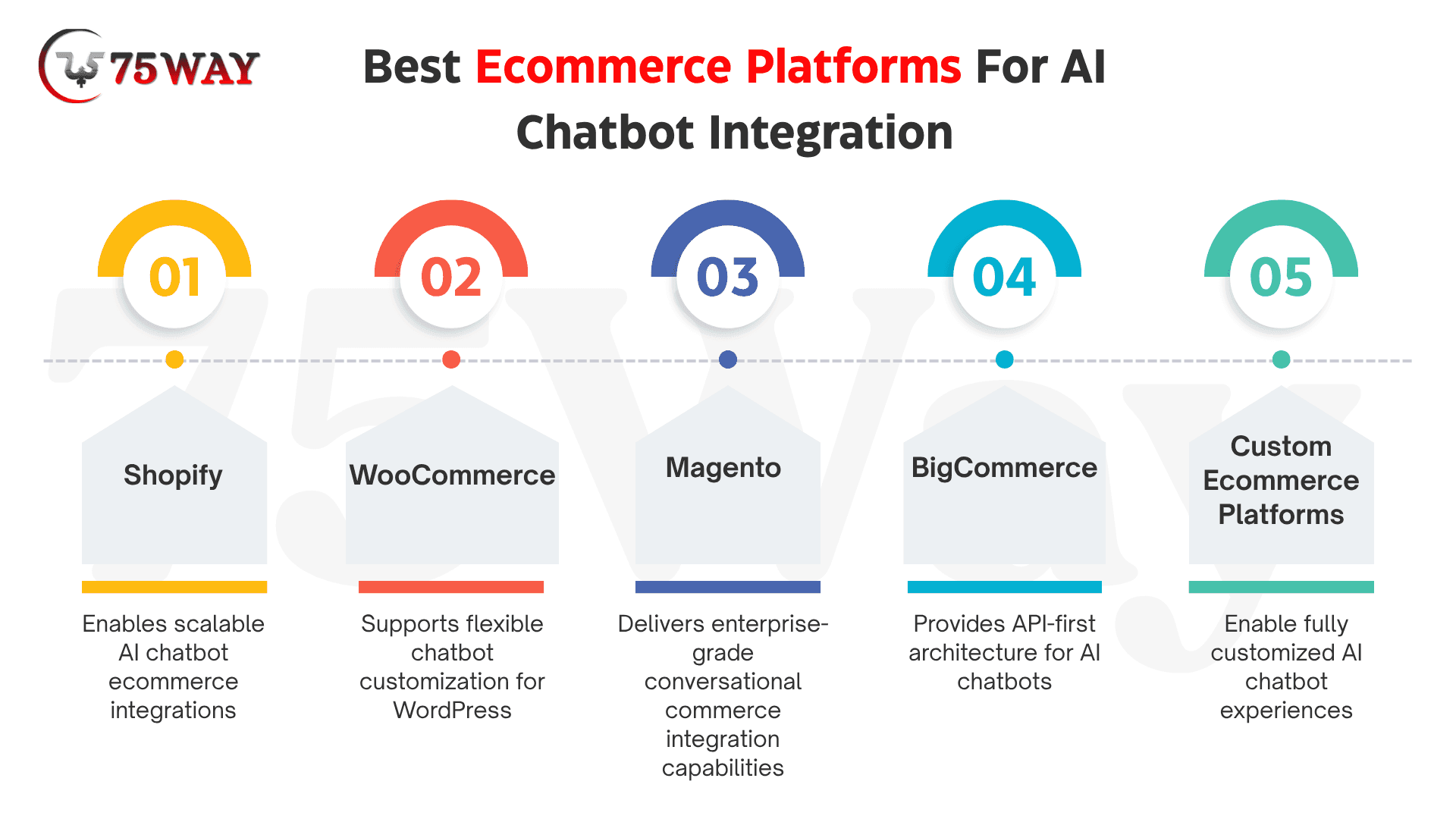
- Shopify: Shopify supports extensive chatbot integrations through APIs and app marketplaces. Ecommerce businesses commonly integrate AI assistants for product recommendations and automated customer support.
- WooCommerce: WooCommerce allows flexible chatbot customization for WordPress-based ecommerce stores with scalable plugin support.
- Magento: Magento supports enterprise-level chatbot implementations with advanced ecommerce functionality and complex integration capabilities.
- BigCommerce: BigCommerce offers API-first architecture suitable for conversational commerce systems and omnichannel customer engagement.
- Custom Ecommerce Platforms: Custom-built ecommerce platforms provide maximum flexibility for advanced AI chatbot integrations and personalized shopping experiences.
Use Cases of Enterprise AI Chatbot Solution for Ecommerce Driving Conversions
AI chatbot solutions for ecommerce and retail help businesses increase conversions by delivering personalized interactions, faster assistance, and intelligent shopping experiences across digital platforms. These conversational systems improve customer engagement, reduce purchasing friction, and create more opportunities for revenue growth within competitive ecommerce marketplaces.
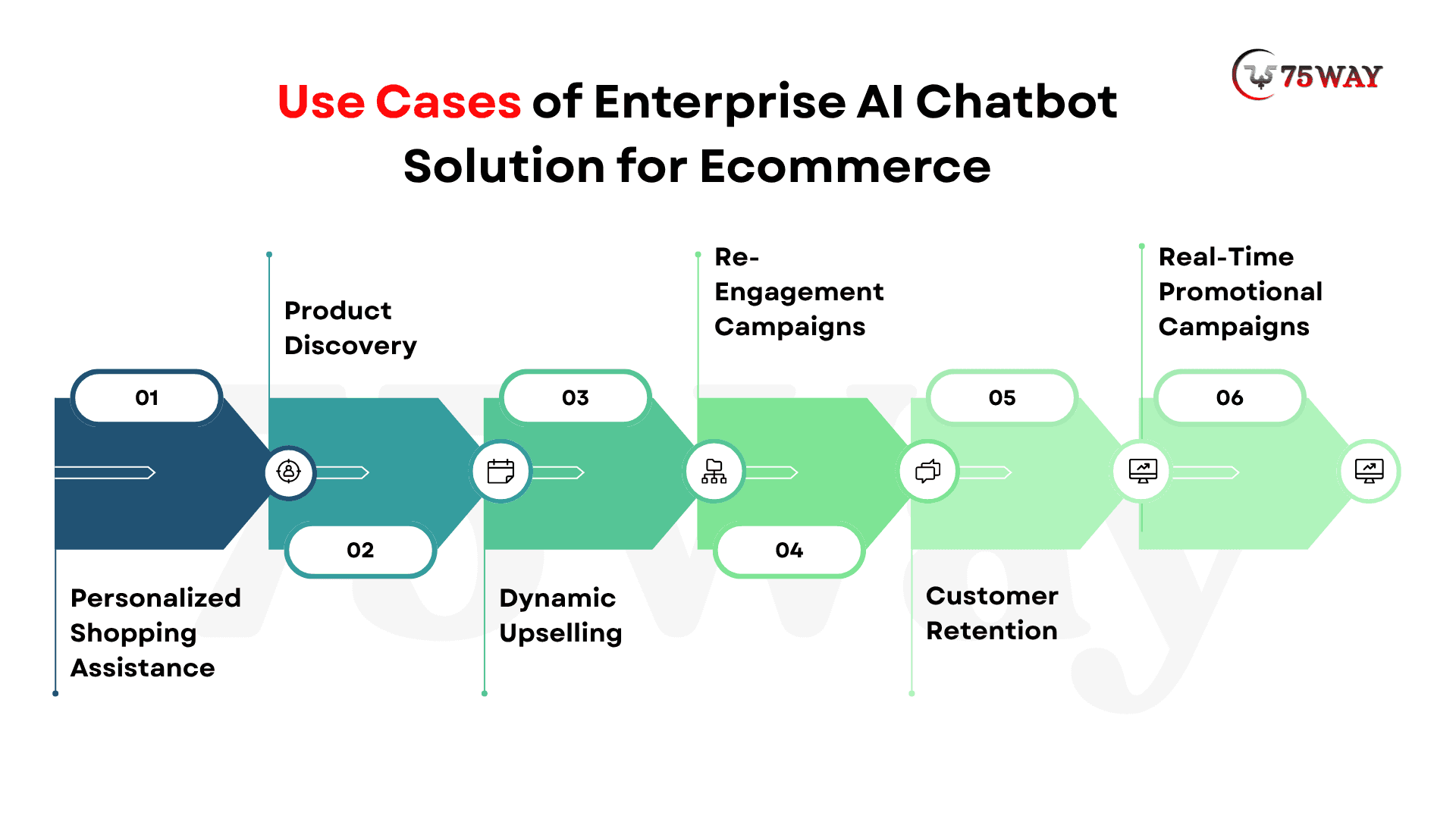
- Personalized Shopping Assistance: Analyze browsing behavior and guide customers toward products matching preferences, interests, and budget expectations.
- Product Discovery: Simplify product exploration through conversational interactions, so customers locate suitable items faster across ecommerce platforms.
- Dynamic Upselling: Recommend complementary products during checkout processes to increase average order values and improve ecommerce revenue opportunities.
- Re-Engagement Campaigns: Reconnect inactive customers using personalized offers, loyalty rewards, and targeted product recommendations automatically across channels.
- Customer Retention: Improve customer satisfaction through AI-powered support experiences to encourage repeat purchases and stronger long-term ecommerce relationships.
- Real-Time Promotional Campaigns: Deliver discount offers, flash sale notifications, and personalized promotions instantly during customer shopping interactions.
Strategic Benefits of Conversational AI Chatbots for Ecommerce Businesses
Conversational AI chatbot solution for ecommerce automates customer interactions and improves shopping experiences. These intelligent systems help brands increase conversions, strengthen customer relationships, and optimize digital commerce performance across highly competitive online marketplaces.
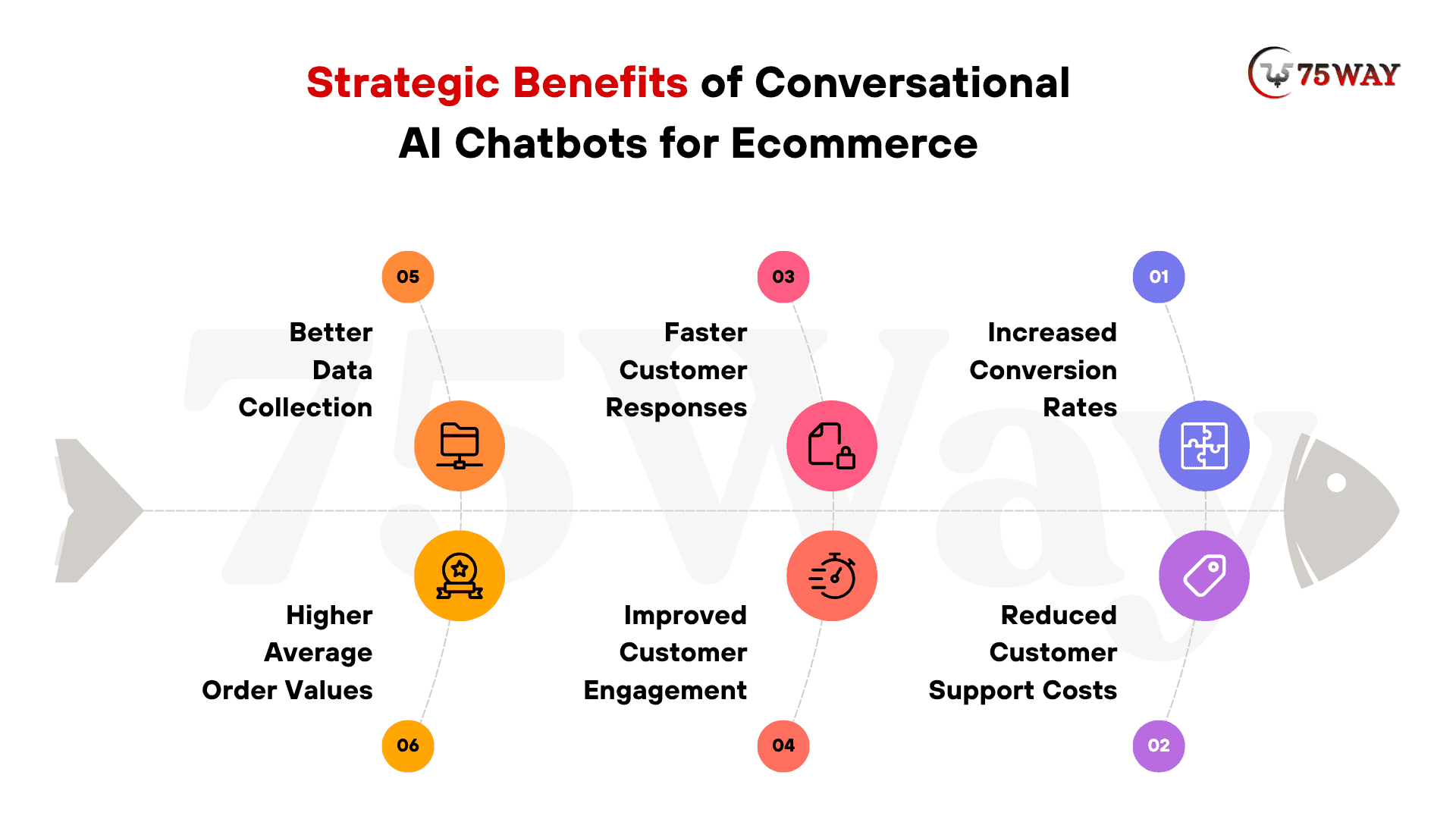
- Increased Conversion Rates
AI chatbots guide users throughout shopping journeys, reducing friction and improving purchase completion rates.
- Reduced Customer Support Costs
Automated support systems decrease dependency on large customer service teams while managing growing customer volumes.
- Faster Customer Responses
Instant conversational support improves user satisfaction and reduces bounce rates.
- Improved Customer Engagement
Interactive conversational experiences encourage longer browsing sessions and stronger customer relationships.
- Better Data Collection
AI chatbots gather valuable customer insights that support marketing, product planning, and personalization strategies.
- Higher Average Order Values
Recommendation engines increase cross-selling and upselling opportunities during customer purchase journeys.
Common Challenges In Ecommerce AI Chatbot Development & Solutions
Developing AI chatbots for ecommerce involves multiple technical, operational, and customer experience challenges throughout implementation and scaling stages. Companies must address conversational quality, system integrations, security requirements, and customer expectations carefully to build reliable and high-performing ecommerce chatbot solutions.
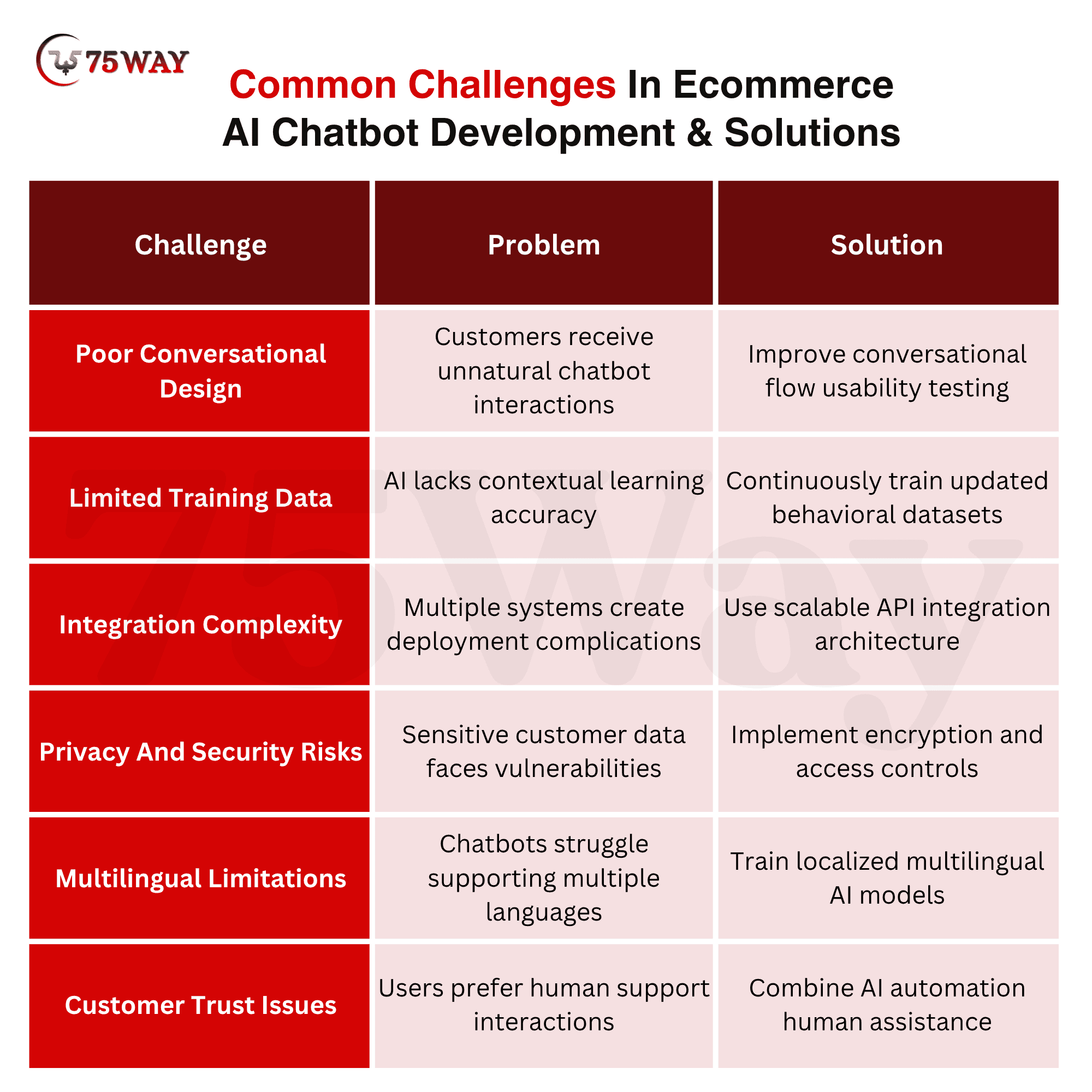
- Poor Conversational Design: Unnatural chatbot interactions frustrate customers and negatively impact conversion rates. Designing conversational flows using real interaction patterns and usability testing improves customer communication experiences.
- Limited Training Data: Insufficient customer interaction data reduces AI learning capabilities and conversational relevance. Collecting structured datasets and continuously training AI models improves chatbot intelligence and response quality.
- Integration Complexity: Connecting multiple ecommerce systems creates technical challenges during the implementation stages. Using scalable APIs, middleware platforms, and modular architectures simplifies deployment and operational synchronization.
- Privacy And Security Risks: Handling sensitive customer data requires strong cybersecurity and regulatory compliance frameworks. Implementing encryption, authentication systems, and secure access controls strengthens chatbot infrastructure protection.
- Multilingual Limitations: Global ecommerce businesses often struggle with maintaining conversational quality across multiple languages. Training multilingual AI models using localized datasets improves communication accuracy across international customer interactions.
- Customer Trust Issues: Some customers still prefer human interactions during complex support situations or high-value purchases. Combining AI automation with human escalation support creates more balanced and trustworthy customer service experiences.
Strategies To Improve Conversions Using AI Chatbot for an E-commerce Website
A strategic combination of personalization, timing, analytics, and customer experience optimization is required to maximize AI chatbot conversion rates in ecommerce. The strategies below help maximize engagement, increase sales opportunities, and improve overall chatbot performance
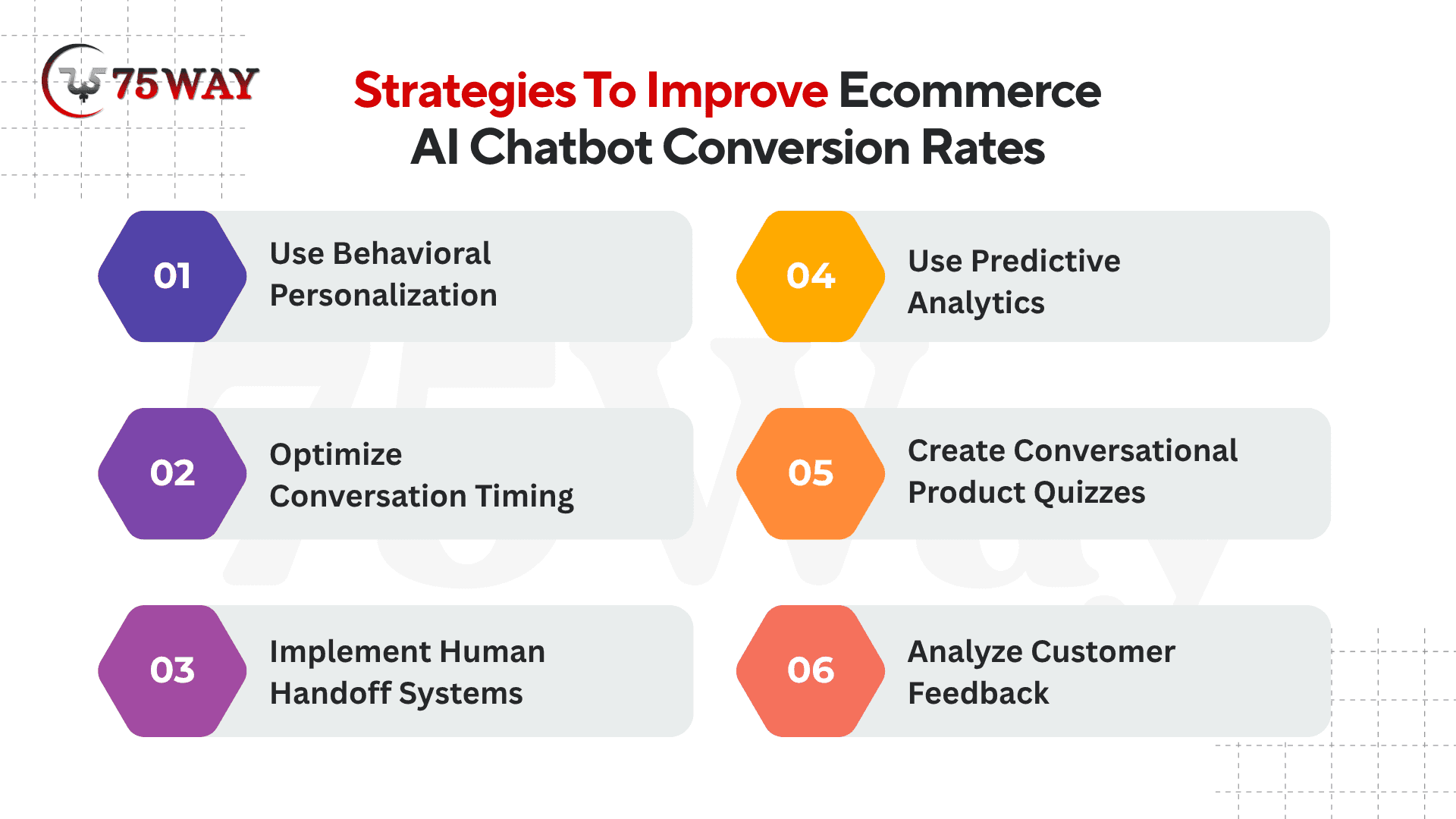
- Use Behavioral Personalization: Dynamic product recommendations based on browsing patterns improve customer engagement and sales opportunities.
- Optimize Conversation Timing: Trigger chatbot interactions strategically during browsing, checkout, or abandonment stages.
- Implement Human Handoff Systems: Allow seamless transition from chatbot conversations to human support representatives when necessary.
- Use Predictive Analytics: Predictive models identify high-intent customers and personalize engagement strategies accordingly.
- Create Conversational Product Quizzes: Interactive quizzes help customers discover products suited to their preferences and shopping goals.
- Analyze Customer Feedback: Continuous feedback analysis improves chatbot interactions and customer satisfaction levels.
How Much Does It Cost To Build An AI Chatbot For E-Commerce?
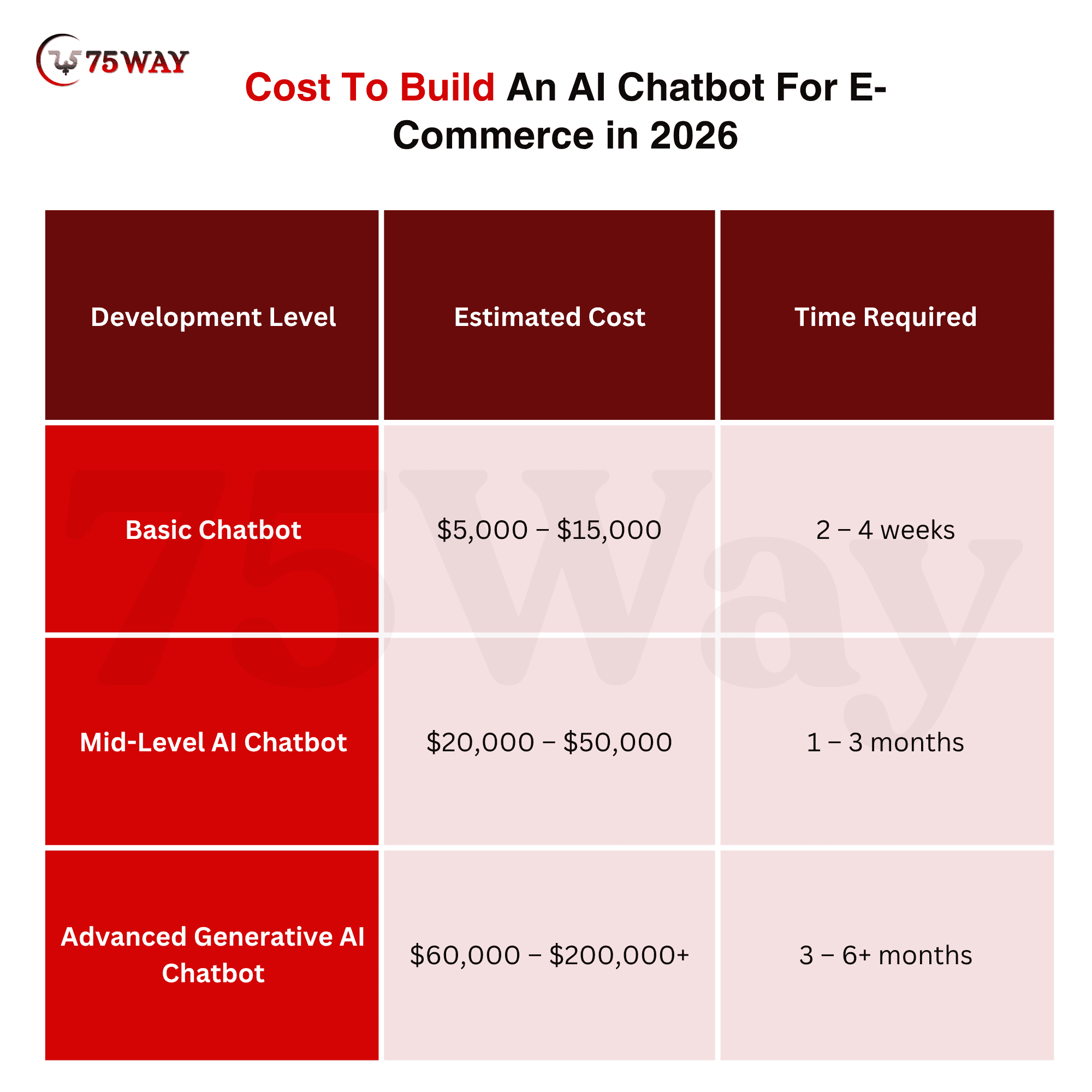
Ecommerce AI chatbot development cost varies based development costs depending on complexity, features, and level of customization required. On average, you can develop an AI chatbot for ecommerce between $5,000 – $300,000+.
Other Factors Affecting Cost of Ecommerce AI Chatbot Development
SaaS Platforms / Plug-and-Play: $20 – $500/month
Best suited for small businesses, these solutions offer ready-made AI chatbot tools that can be quickly connected to ecommerce stores. They handle basic customer queries such as FAQs, order tracking, and simple automated support.
Mid-Market Customization: $5,000 – $30,000
Ideal for growing ecommerce businesses, this model includes customized AI training using brand-specific data. It typically involves NLP model tuning and API integrations with platforms like Shopify or WooCommerce.
Enterprise Custom AI Agent: $50,000 – $200,000+
Designed for large-scale operations, this solution includes advanced AI systems deeply integrated with enterprise infrastructure. It supports complex backend systems, ERP connectivity, and advanced generative AI pipelines.
AI & NLP Engine Setup: $20,000 – $50,000
This cost includes building and training AI models to understand customer intent, detect sentiment, and generate accurate conversational responses tailored to ecommerce interactions.
Integrations: $10,000 – $75,000
This involves connecting the chatbot with CRM systems, inventory databases, payment gateways, and shipping platforms.
Machine Learning Training: $15,000 – $100,000+
This covers data preparation, model training, and continuous optimization to align chatbot behavior with brand voice, product catalog, and customer engagement strategies.
Future Trends In Ecommerce AI Chatbot Development
The future of ecommerce AI chatbot development is moving toward highly intelligent, immersive, and fully autonomous digital shopping experiences. As AI technologies evolve, chatbots will go beyond basic conversation handling and become core drivers of personalized commerce. These advancements will reshape how businesses interact with customers across digital retail ecosystems globally.
- Generative AI Commerce: Generative AI will create highly personalized shopping conversations and product storytelling experiences.
- Voice Commerce Expansion: Voice-based ecommerce interactions will continue growing across smart devices and mobile ecosystems.
- Hyper-Personalization: Advanced behavioral analytics will deliver increasingly personalized product recommendations and shopping journeys.
- Emotionally Intelligent Chatbots: Future AI systems will recognize emotional cues and adapt responses based on customer sentiment analysis.
- AR/VR Commerce Integration: AI chatbots will integrate with immersive shopping environments powered by augmented and virtual reality technologies.
- Autonomous Shopping Agents: AI systems may eventually automate purchasing decisions based on customer preferences and recurring buying patterns.
Best Practices For Ecommerce AI Chatbot Success
Ecommerce AI chatbot success depends on implementing structured strategies that enhance customer experience, improve engagement quality, and maximize conversion outcomes. Businesses must focus on usability, transparency, optimization, and continuous improvement to ensure chatbot systems deliver consistent performance across diverse customer interactions and digital commerce environments.
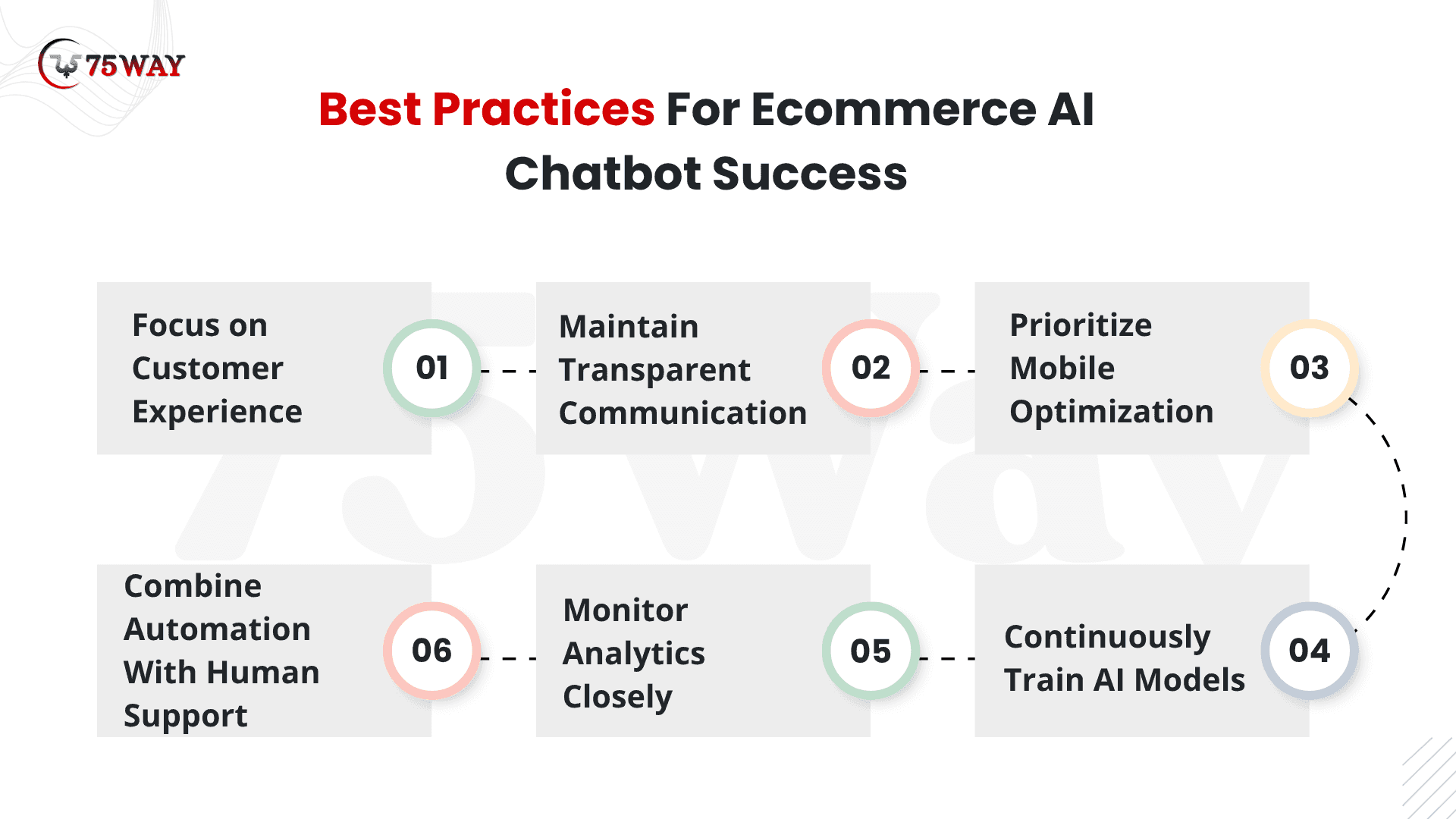
1. Focus on Customer Experience
Conversational experiences should feel natural, intuitive, and customer-centric across all interaction stages. Prioritize seamless navigation and reduce friction in every chatbot interaction.
2. Maintain Transparent Communication
Customers should clearly understand when they are interacting with AI systems instead of human representatives. Build trust by setting accurate expectations during conversations.
3. Prioritize Mobile Optimization
Mobile commerce dominates ecommerce traffic, making responsive chatbot experiences essential. Ensure interfaces load quickly and function smoothly across all mobile devices.
4. Continuously Train AI Models
Regular training updates improve chatbot learning capabilities and conversational quality over time. Use updated customer data to enhance accuracy and personalization.
5. Monitor Analytics Closely
Performance tracking helps identify conversion bottlenecks and engagement improvement opportunities. Use insights to refine chatbot workflows and optimize outcomes.
6. Combine Automation With Human Support
Balanced human-AI collaboration creates stronger customer experiences for complex support interactions. Provide smooth escalation paths to human agents when needed.
Conclusion
AI chatbots are rapidly becoming essential growth drivers within the ecommerce industry. However, building an AI chatbot for ecommerce requires strategic planning, scalable technology architecture, conversational design expertise, AI model training, and continuous optimization. Successful implementations focus not only on automation but also on creating meaningful customer experiences that influence purchasing behavior and strengthen long-term customer relationships. If you want to launch conversion-focused ecommerce solutions, connect with a leading AI chatbot development company.
Frequently Asked Questions (FAQs)
Can AI Chatbots Increase Repeat Purchases In Ecommerce?
Yes, AI chatbots improve repeat purchases by analyzing customer behavior, recommending relevant products, and creating engaging shopping interactions. Businesses can strengthen customer loyalty through targeted promotions, automated re-engagement campaigns, and conversational support experiences that encourage long-term customer relationships.
Do Ecommerce AI Chatbots Work For Small Businesses?
Yes, small ecommerce businesses can benefit significantly from AI chatbots because automation reduces support workloads and improves customer engagement. Modern chatbot platforms offer scalable deployment options suitable for startups, growing online stores, and niche ecommerce businesses.
How Do AI Chatbots Personalize Shopping Experiences?
AI chatbots analyze browsing behavior, purchase history, and preferences to suggest relevant products. They continuously refine recommendations based on real-time customer interactions and engagement patterns.
Are AI Chatbots Better Than Human Customer Support?
Yes, AI chatbots handle repetitive queries faster and provide 24/7 support. However, human agents are still needed for complex or emotionally sensitive customer issues.
What Data Do AI Chatbots Collect From Customers?
AI chatbots collect behavioral data, product preferences, purchase history, and interaction patterns. This data helps improve personalization, marketing campaigns, and ecommerce conversion optimization strategies.
Can AI Chatbots Be Integrated With Mobile Apps?
Yes, AI chatbots can be integrated into mobile ecommerce apps using APIs and SDKs. This enables seamless conversational shopping experiences across Android and iOS platforms.