Summary
Custom AI solutions and off-the-shelf AI tools serve different business goals, budgets, and operational requirements. This guide compares customization, scalability, costs, security, integrations, and long-term value across industries. Businesses seeking competitive advantages, proprietary capabilities, and sustainable growth often benefit from custom AI development, while ready-made tools support faster adoption and lower investment.
Quick Overview
- Custom AI delivers greater flexibility, control, and long-term business scalability benefits.
- Off-the-shelf AI enables rapid deployment with lower upfront implementation costs.
- Data ownership and security remain significant advantages of custom solutions.
- Growing businesses often outgrow standardized AI platforms and vendor limitations.
- Industry-specific workflows benefit more from tailored AI development approaches
Across the United States, organizations are leveraging artificial intelligence to automate operations, enhance customer experiences, improve decision-making, and create new revenue opportunities. For USA-based enterprises and startups alike, the critical question has shifted from "Should we invest in custom AI solutions or rely on off-the-shelf AI tools?
While both approaches can deliver significant value, the choice directly impacts scalability, operational flexibility, security, competitive differentiation, and long-term return on investment. A solution that works perfectly for a startup validating a new idea may not be suitable for an enterprise managing millions of transactions, complex workflows, or sensitive customer data.
Many organizations initially adopt ready-made AI platforms like ready-to-deploy AI agents because they offer quick deployment and lower upfront costs. However, as business requirements become more sophisticated, limitations related to customization, integrations, and data ownership often emerge. On the other hand, custom AI development requires a larger investment but provides greater control and the ability to create solutions tailored to specific operational goals.
The choice between custom AI solutions and off-the-shelf AI tools directly impacts your long-term ROI, operational flexibility, and data security. This guide breaks down the technical and strategic differences to help you secure a top-tier market position.
What Are Custom AI Solutions?
Custom AI solutions are purpose-built systems designed to address specific business requirements, workflows, and operational challenges. Unlike generic AI software, custom solutions are developed around an organization's unique data, processes, compliance requirements, and growth objectives. A custom AI development project may include:
- AI-powered automation systems
- Predictive analytics platforms
- Intelligent virtual assistants
- Recommendation engines
- AI sales agents
- Fraud detection systems
- Customer service automation
- Agentic AI solutions
- Enterprise knowledge assistants
- Generative AI applications
These systems are typically developed using advanced technologies such as large language models (LLMs), machine learning algorithms, retrieval-augmented generation (RAG), vector databases, workflow automation frameworks, and enterprise integration tools.
The primary advantage of custom AI is that the technology adapts to the business rather than forcing the business to adapt to the technology.
What Are Off-the-Shelf AI Tools?
Off-the-shelf AI tools are pre-built software products designed for broad market adoption. These solutions are typically delivered through a Software-as-a-Service (SaaS) model and require minimal implementation effort. Examples include:
- AI writing assistants
- Customer support AI agents and chatbots
- Marketing automation platforms
- AI-powered CRM tools
- Productivity assistants
- Content generation software
- Meeting transcription tools
- Data analytics platforms
These products are attractive because they provide immediate functionality without extensive development costs. Businesses can often subscribe, configure settings, and begin using the software within hours or days.
However, because they are designed for a wide audience, customization options are often limited, and businesses must operate within vendor-defined frameworks and capabilities.
Custom AI Solutions Vs. Off-the-Shelf AI Tools: A Detailed Comparison
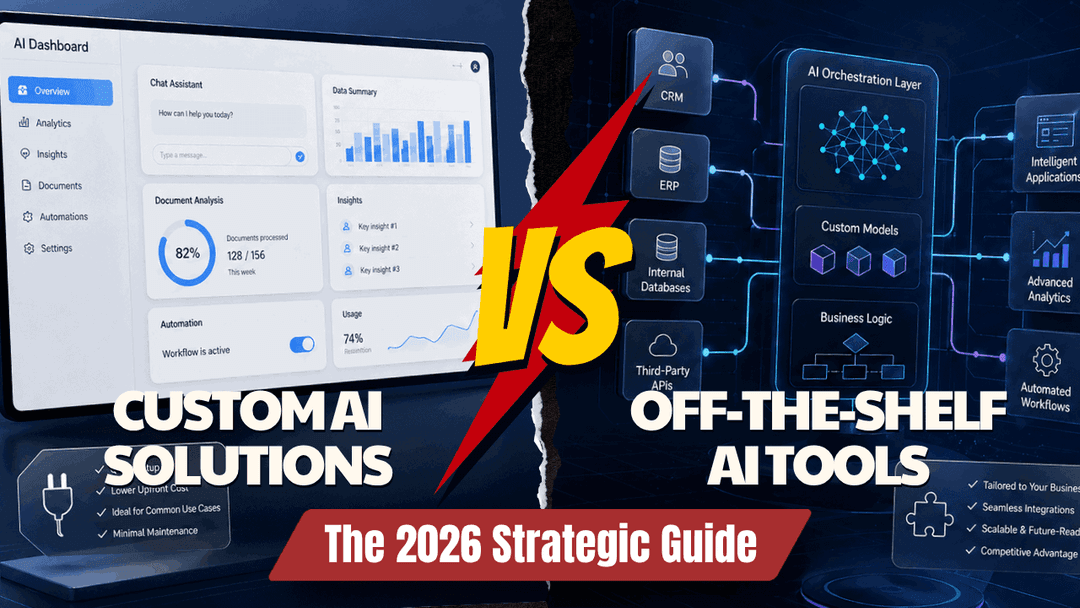
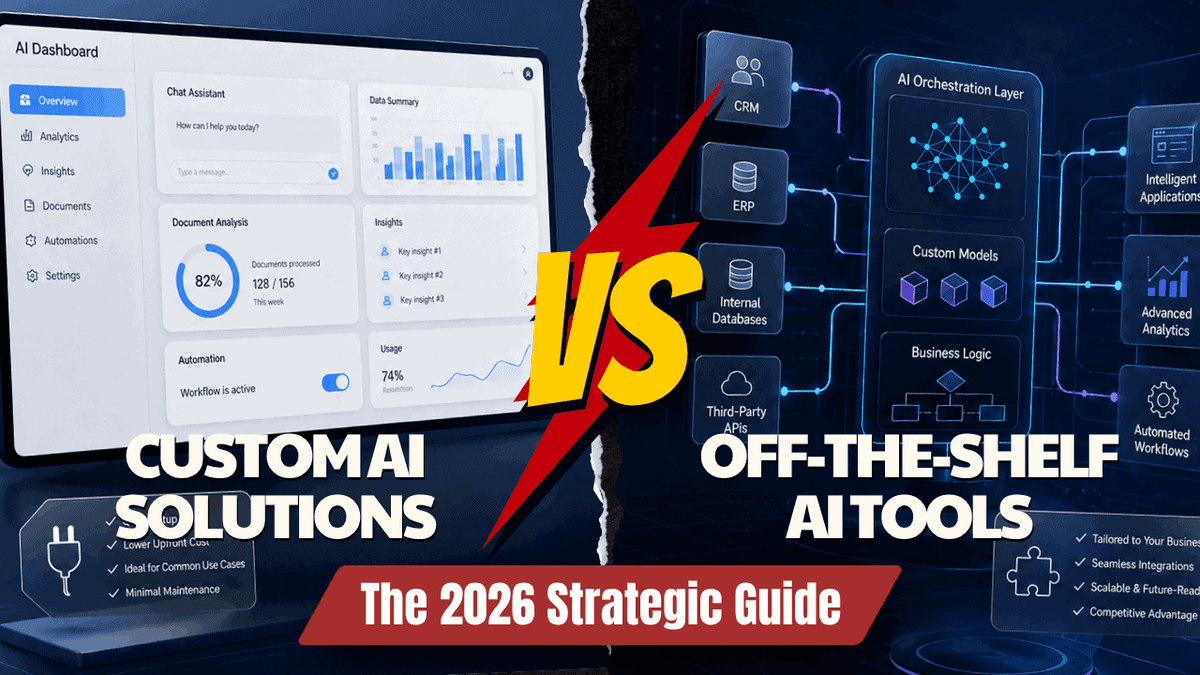
The primary difference between custom AI solutions and off-the-shelf AI tools lies in customization, control, and scalability. Custom AI is built specifically around a company's unique workflows and objectives, while off-the-shelf AI tools provide standardized capabilities designed to serve a broad range of businesses.
Custom AI solutions are bespoke systems developed from the ground up to address specific business challenges and operational requirements. They involve dedicated data engineering, model training, workflow automation, and seamless integration with existing ERP, CRM, and enterprise platforms. These solutions are ideal for organizations seeking specialized functionality, stronger security controls, long-term scalability, and full ownership of their intellectual property.
In contrast, off-the-shelf AI tools are pre-built, general-purpose platforms typically delivered through a Software-as-a-Service (SaaS) model. They are designed for rapid implementation and require minimal technical expertise to deploy. Common examples include AI chatbots, content generation platforms, customer support tools, and analytics software. While these solutions offer faster adoption and lower upfront costs, they often provide limited customization and depend on vendor-defined features and infrastructure.
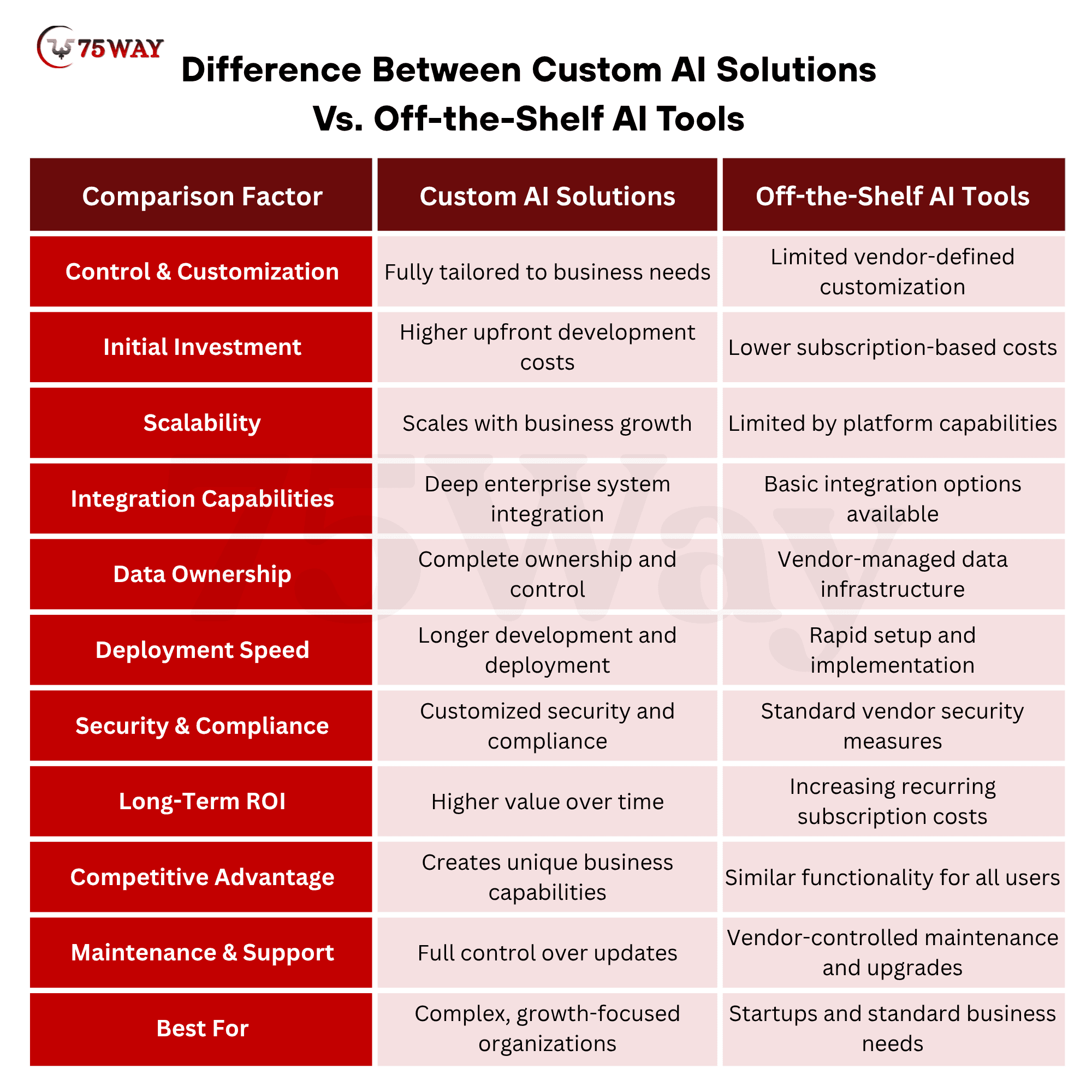
Here are the key differences between custom AI solutions and off-the-shelf AI tools
1. Control and Customization
Custom AI solutions provide complete control over architecture, features, workflows, integrations, and user experiences. Businesses can build systems that precisely match operational requirements.
Off-the-shelf tools typically offer standardized functionality. While some configuration options may be available, core capabilities are controlled by the vendor.
2. Initial Investment
Ready-made AI platforms generally require lower upfront investments. Subscription-based pricing allows businesses to access AI capabilities without significant capital expenditure.
Custom AI development involves discovery, engineering, testing, deployment, and maintenance costs, resulting in higher initial investment requirements.
3. Scalability
As organizations grow, AI requirements often become more complex. Custom AI solutions can evolve alongside business expansion, supporting additional users, workflows, integrations, and data volumes.
Off-the-shelf tools may become expensive or restrictive as usage increases.
4. Integration Capabilities
Businesses frequently rely on multiple software systems, including ERP platforms, CRM systems, inventory management solutions, and internal databases.
Custom AI can be deeply integrated into these environments, enabling seamless information flow across departments.
Pre-built tools often provide limited integration options and may require workarounds.
5. Data Ownership
Data has become one of the most valuable assets within modern organizations. Custom AI solutions allow businesses to maintain full ownership and control of their data, models, and intellectual property.
Many SaaS-based AI platforms store information on third-party infrastructure, creating potential concerns regarding privacy, compliance, and portability.
6. Deployment Speed
Ready-made AI tools can be deployed rapidly, allowing businesses to start using AI capabilities within days or even hours.
On the contrary, custom AI solutions require planning, development, testing, optimization, and deployment, resulting in longer implementation timelines but greater customization and long-term value.
7. Security and Compliance
Custom AI solutions enable businesses to implement tailored security frameworks, access controls, encryption protocols, and compliance measures aligned with industry regulations. This is particularly important for organizations operating in healthcare, finance, legal services, and other highly regulated sectors.
Off-the-shelf AI tools typically follow vendor-defined security standards. While many providers offer strong protection measures, businesses often have limited control over security architecture, compliance customization, and data governance policies.
8. Long-Term ROI
Custom AI solutions often require a larger upfront investment, but they can deliver greater long-term returns through process optimization, workflow automation, reduced manual effort, and improved operational efficiency. Businesses also avoid accumulating subscription costs associated with multiple third-party tools.
Off-the-shelf AI tools provide quicker access to AI capabilities at a lower initial cost. However, recurring subscription fees, user-based pricing, and feature limitations can increase total ownership costs over time as business needs expand.
9. Competitive Advantage
Custom AI solutions allow organizations to create proprietary capabilities that competitors cannot easily replicate. By leveraging unique business data, specialized workflows, and tailored automation, companies can build sustainable competitive advantages and differentiated customer experiences.
Off-the-shelf AI tools are widely available and offer similar functionality to all users. While they improve productivity and efficiency, they rarely provide the level of uniqueness required to establish a strong competitive edge within the market.
10. Maintenance and Support
Custom AI solutions provide businesses with greater control over updates, feature enhancements, performance optimization, and future development. Organizations can continuously refine the system to align with evolving business requirements and market demands.
Off-the-shelf AI tools are maintained by the vendor, who controls updates, feature releases, and product roadmaps. While this reduces internal maintenance efforts, businesses have limited influence over future functionality and platform changes.
Quick Overview of Difference Between Custom AI Solutions And Off-the-Shelf AI Tools
When Should Businesses Build & Adopt Custom AI Solutions?
Investing in custom development is a strategic move for organizations where AI is a core differentiator rather than just a utility.
- Complex Workflows: If your business processes are unique and do not align with standard industry templates, custom AI ensures the system adapts to you, not vice versa.
- Deep Integration: Custom solutions can be seamlessly woven into internal databases, ERPs, and legacy systems for frictionless data flow.
- Security & Compliance: For industries like healthcare and finance, which are high-demand sectors in the USA, custom protocols for data encryption and access control are often mandatory.
- Long-Term Scalability: While the initial cost is higher, custom AI avoids the "SaaS trap" of rising recurring fees as usage scales.
- Large-Scale Operations: Organizations managing high transaction volumes, extensive workflows, and growing user demands benefit from custom AI systems built to support long-term operational growth.
- Proprietary Data Assets: Businesses with valuable internal data can leverage custom AI to generate unique insights, automate decision-making, and create stronger competitive advantages.
- Competitive Differentiation: In highly competitive markets, custom AI enables organizations to develop distinctive capabilities, personalized experiences, and innovative solutions that are difficult to replicate.
When Are Off-the-Shelf AI Tools the Better Choice?
Pre-built solutions are ideal for businesses prioritizing speed and cost-efficiency for non-core functions.
- Standardized Tasks: For common needs like basic customer support chatbots or generic sales automation, ready-made tools offer a practical starting point.
- MVP Testing: Startups looking to validate a concept quickly can use off-the-shelf tools to demonstrate value before committing to a full-scale build.
- Lower Technical Overhead: These systems are maintained and updated by the vendor, reducing the need for an in-house team of AI engineers.
- Limited Budgets: Lower subscription costs and minimal implementation expenses make off-the-shelf AI tools an accessible option for cost-conscious businesses.
- Minimal Technical Resources: Vendor-managed maintenance, updates, and support reduce the need for specialized AI expertise or dedicated development teams.
- Standardized Workflows: Routine business functions such as customer service, lead management, and content generation can often be handled effectively using pre-built AI solutions.
Industry-Specific Impact in the USA Market
The demand for AI varies significantly across key American sectors:
- Healthcare: Focuses on custom AI for diagnostics and secure patient data management.
- Fintech: Utilizes bespoke agents for advanced fraud detection and predictive investment analytics.
- SaaS & Automation: USA clients are increasingly investing in custom AI sales agents and content generation tools to reduce costs and drive recurring revenue.
- Logistics: Custom route optimization and AI-based analytics are becoming essential for fleet management efficiency.
- Retail & E-commerce: Leverages custom AI for personalized product recommendations, demand forecasting, dynamic pricing, and customer experience optimization.
- Manufacturing: Implements AI-driven quality control, predictive maintenance, production planning, and supply chain optimization to improve operational efficiency.
- Real Estate: Uses custom AI for property valuation, lead qualification, market trend analysis, and personalized property recommendations.
Strategic Verdict on What To Choose: Custom AI Solutions Vs. Off-the-Shelf AI Tools
The decision ultimately hinges on your "Innovation vs. Utility" balance. If you need standard AI capabilities to keep pace with the market, off-the-shelf tools are your fastest route to adoption. However, if your goal is to create a sustainable competitive advantage through deep personalization and scalable intelligence, custom AI development is the superior long-term investment.
Questions to Ask Before Choosing Any AI Solution
- Is AI central to our long-term business strategy?
- Do we have unique workflows requiring customization?
- Are compliance and security critical concerns?
- Will our AI usage increase substantially over time?
- Do we require deep integration with existing systems?
- Is proprietary data a competitive asset?
- Are we seeking long-term differentiation rather than short-term convenience?
The answers can help determine whether custom development or off-the-shelf software is the better investment.
How to Choose the Right AI Partner to Launch Automation Solutions?
A strategic partner should focus not only on technology but also on measurable business outcomes.
Thus, selecting the right partner significantly impacts project outcomes. Look for providers with:
- Proven AI Expertise: Demonstrate successful AI development experience across diverse projects, technologies, deployment environments, and business objectives.
- Industry-Specific Experience: Understand sector challenges, compliance requirements, operational workflows, and market demands for effective solution delivery.
- Strong Security Practices: Implement robust data protection measures, encryption protocols, access controls, and compliance-focused security frameworks.
- Transparent Development Processes: Maintain clear communication, project visibility, milestone tracking, documentation standards, and stakeholder collaboration throughout.
- Scalable Architecture Capabilities: Build flexible AI infrastructures supporting growth, increasing workloads, expanding integrations, and evolving business requirements.
- Post-Launch Support Services: Provide ongoing monitoring, optimization, maintenance, updates, and technical assistance after successful deployment completion.
- Successful Implementation Case Studies: Showcase measurable outcomes, project achievements, client success stories, and real-world AI transformation results.
Wrap Up
The decision between custom AI solutions and off-the-shelf AI tools ultimately depends on business objectives, operational complexity, budget considerations, and growth plans. Ready-made AI platforms offer speed, affordability, and convenience, making them suitable for standardized tasks and early-stage experimentation. However, organizations seeking deeper customization, stronger security, seamless integrations, and sustainable competitive advantages often achieve greater long-term value through custom AI development. Organizations that view AI as a strategic business asset rather than simply a productivity tool are increasingly investing in custom solutions designed to create lasting competitive advantages and measurable returns. They can partner with a prominent artificial intelligence development company in USA.
Frequently Asked Questions (FAQs)
How Long Does It Take To Develop A Custom AI Solution?
Development timelines depend on complexity. Basic AI agents can be ready in weeks, while advanced, enterprise-grade systems often require several months of planning, training, and testing.
Can AI Integrate With My Existing CRM?
Yes, custom AI is specifically designed to integrate seamlessly with platforms like CRM, ERP, and accounting software via APIs and middleware, ensuring no disruption to current operations.
Is AI Secure For Small Businesses?
Security depends on design. While off-the-shelf tools rely on vendor security, custom solutions allow businesses to implement their own encryption and compliance measures, significantly reducing the risk of data breaches.
Is Custom AI More Cost-Effective Than Off-The-Shelf AI Tools?
While custom AI requires higher upfront investment, it often delivers greater long-term value through automation, reduced subscription costs, and improved operational efficiency. Businesses with growing usage and specialized requirements typically achieve stronger ROI over time.
Which Industries Benefit Most From Custom AI Solutions?
Industries with complex workflows, strict compliance requirements, and large data volumes gain the most value. Healthcare, finance, logistics, manufacturing, SaaS, and e-commerce businesses frequently invest in custom AI to improve efficiency and decision-making.
Can Custom AI Scale As My Business Grows?
Yes, custom AI solutions are built to accommodate increasing users, data volumes, and operational demands. Unlike many off-the-shelf platforms, they can be continuously expanded and optimized to support evolving business requirements and growth objectives.