AI Summary
AI-powered funeral apps help funeral homes coordinate services and support families. This guide covers features, development stages, teams, timelines, and costs. Owners gain context for evaluating and planning funeral technology.
Key Takeaways
- AI can support obituary drafting, planning assistance, and family communication.
- Worldwide funeral and cremation spending reaches $98.5 billion by 2030.
- App development costs can range from 120,000+, depending on scope.
- Strong privacy, consent, accessibility, and security shape funeral app requirements.
- Successful products connect family-facing tools with funeral-home operational workflows
A family planning a funeral may have dozens of small decisions to make, from selecting a service package to sharing memorial details with relatives. Now imagine being the funeral director responsible for helping several families through these arrangements at the same time. That is a real business challenge worth addressing.
An AI-powered funeral app development solution can give your business a more practical way to support these interactions. Families could use digital assistance for obituary drafts, service information, and memorial updates, while your team could spend less time handling repetitive administrative requests.
For founders and funeral home owners, the investment also raises practical questions.
- Which application model should you build?
- What AI features are worth implementing?
- How much will funeral app development cost?
- And how can the application generate sustainable business revenue?
This complete guide answers these questions through practical funeral app development insights, technical considerations, market opportunities, and business decisions.
What Is AI-Powered Funeral App Development?
AI-powered funeral app development is the process of creating mobile or web applications that use artificial intelligence, automation, and connected software systems to simplify funeral arrangements, memorial services, cremation management, and funeral home operations.
Traditional funeral applications generally provide service information, appointment booking, contact details, and basic management functionality. AI-powered applications extend these capabilities through intelligent assistance, document processing, personalized information retrieval, and workflow automation.
For example, a family member can use an AI assistant to understand available services, prepare an obituary draft, or find answers about funeral arrangements. At the same time, funeral directors can use automated document extraction, scheduling assistance, and centralized case management to organize their responsibilities.
A complete funeral technology platform may include:
- Family Application: Allows families to explore services, request arrangements, manage information, and receive updates.
- Funeral Director Dashboard: Helps professionals manage cases, schedules, documents, employees, and service providers.
- Admin Panel: Gives business owners control over users, locations, services, payments, and reporting.
- AI Integration Layer: Supports conversational assistance, obituary generation, document processing, and intelligent search.
- Vendor Portal: Connects florists, transportation providers, cemeteries, crematories, and other service partners.
The objective is to create one connected ecosystem that makes funeral service coordination easier while keeping families and funeral professionals in control.
Funeral Home App Market Analysis: Growth, Trends, And Opportunities
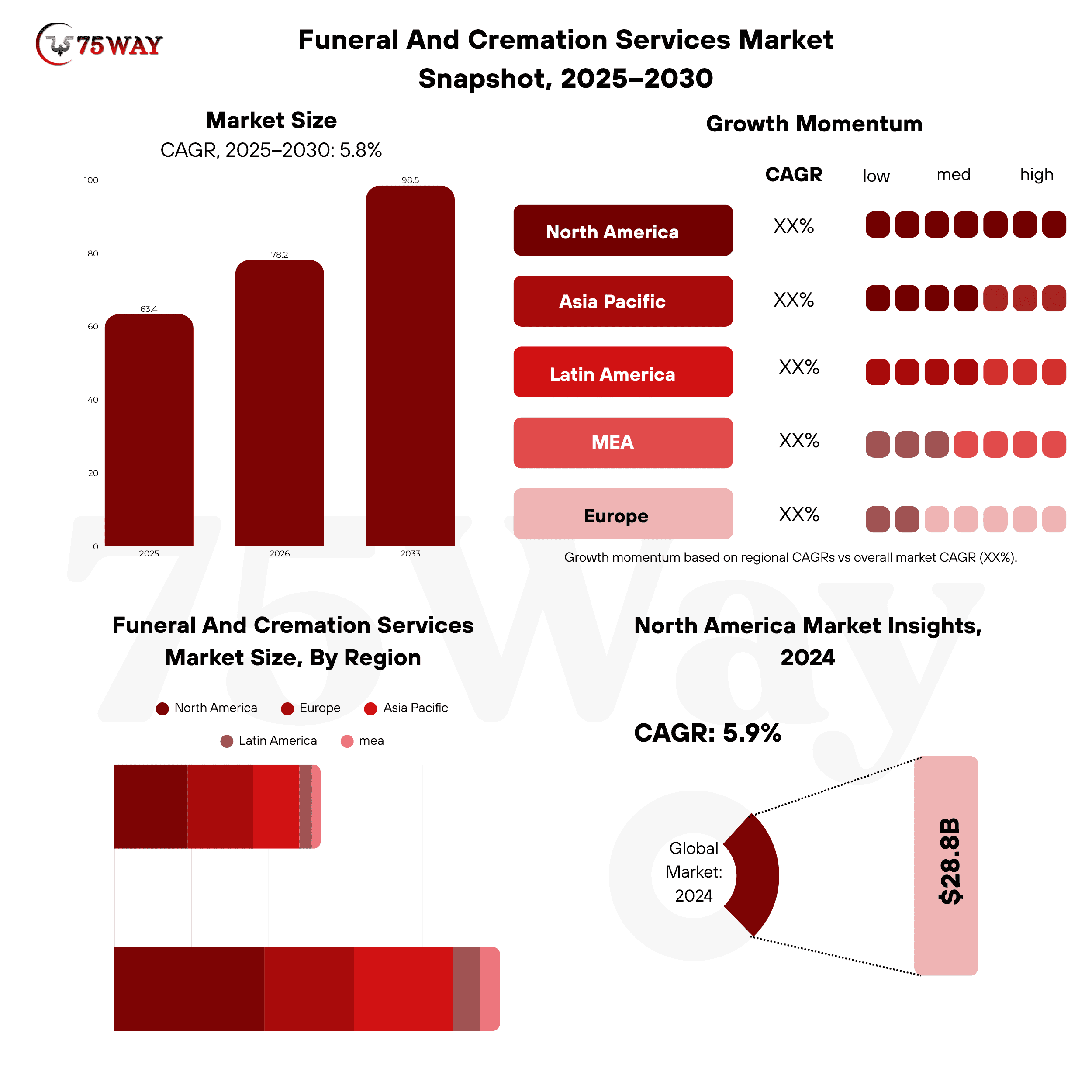
- Worldwide spending on funeral and cremation services is expected to increase from $78.2 billion in 2026 to $98.5 billion by 2030, reflecting a CAGR of 5.8%.
- Funeral planning emerged as the leading service category in 2023, contributing 33.19% of total global market revenue.
- The funeral home software industry is forecast to reach $3.03 billion by 2032, expanding at a CAGR of 9.20%.
- Digital adoption is gaining momentum, with mobile funeral applications recording a 42% increase in downloads worldwide.
- The shift toward online arrangements is also evident among service providers, as approximately 60% of urban funeral homes reported receiving more requests for digital services and arrangements.
- Technology adoption extends to artificial intelligence, with 47% of funeral service providers having integrated AI solutions into their operations.
- According to an AARP survey, 31% of grieving Americans aged 50 and above had turned to grief-support applications for assistance.
Why Are Funeral Businesses Exploring AI-Powered Applications?
Funeral services involve time-sensitive coordination, sensitive family interactions, and several administrative responsibilities. When information is scattered across phone calls, spreadsheets, emails, and paper documents, even routine tasks can become difficult to manage. Digital applications offer an opportunity to bring these activities together.
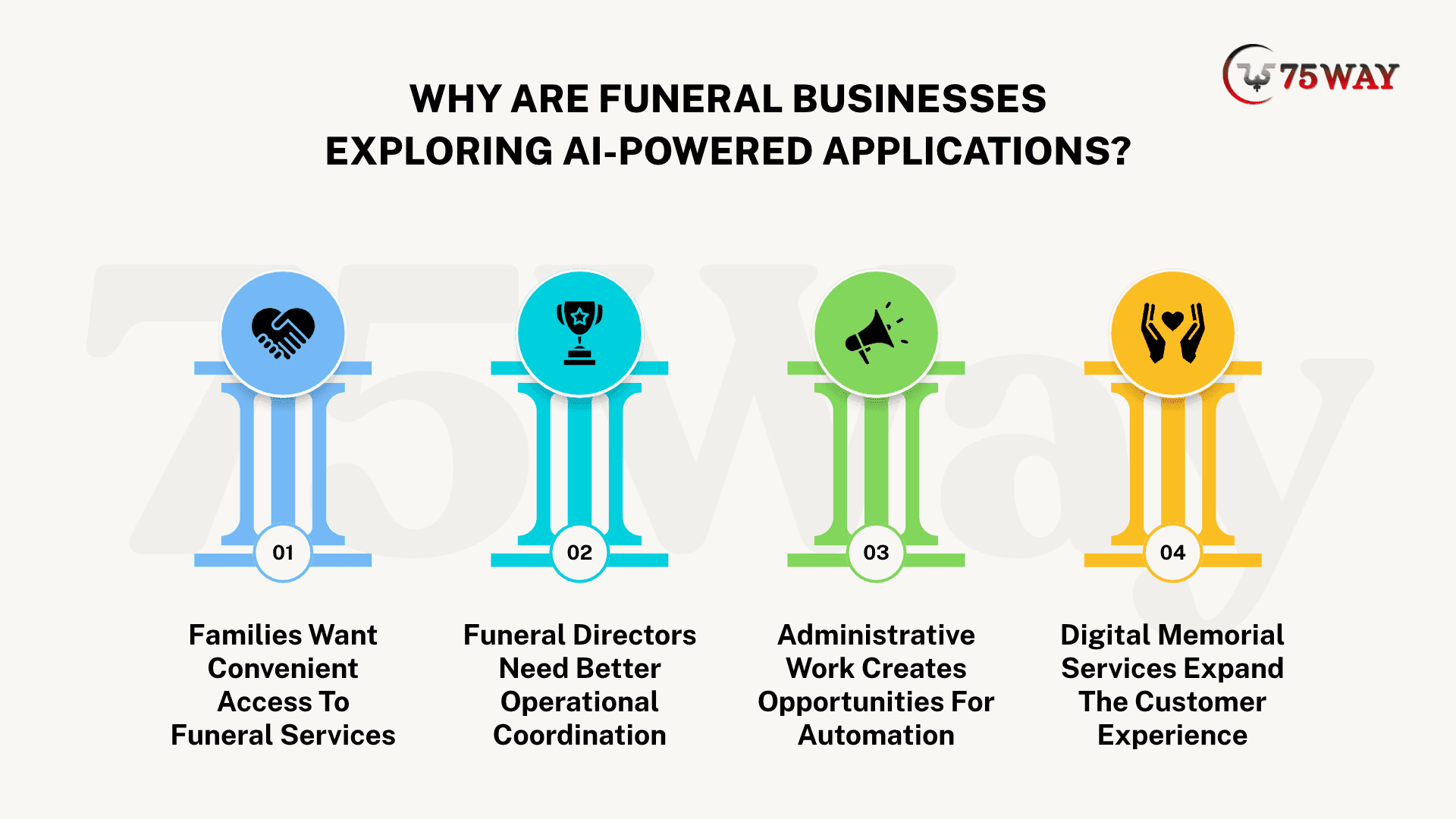
1. Families Want Convenient Access to Funeral Services
Families may want to understand available services, compare arrangements, check prices, or contact funeral professionals before visiting a funeral home.
A mobile application can provide access to these details in one place.
Instead of depending entirely on phone calls, users can explore service information, request consultations, submit documents, and receive updates through a digital interface.
2. Funeral Directors Need Better Operational Coordination
Funeral directors manage several responsibilities, including:
- Family communication.
- Funeral and cremation arrangements.
- Staff scheduling.
- Transportation coordination.
- Document preparation.
- Service provider management.
- Billing and payments.
A centralized funeral management application can organize these activities and give employees a clearer view of ongoing cases.
3. Administrative Work Creates Opportunities for Automation
Repeated inquiries, document organization, appointment reminders, and information retrieval consume staff time.
AI can assist with selected tasks, such as answering approved questions, extracting information from documents, preparing obituary drafts, and identifying scheduling conflicts.
This allows employees to spend more time on responsibilities that require personal attention and professional judgment.
4. Digital Memorial Services Expand the Customer Experience
Families may want to create online memorial pages, share photographs, publish obituaries, collect condolences, or organize virtual remembrance events.
A funeral application can bring these capabilities together instead of requiring families to use several disconnected platforms.
Read More: AI-Powered Daycare App Development: A Guide For US Businesses
How To Develop An AI-Driven Funeral Mobile App: A Comprehensive Process
A funeral app can lose families' trust if booking a service feels confusing or its AI assistant gives an insensitive response. For business owners, the challenge is to build technology that makes funeral arrangements easier without making a difficult time feel transactional. Here is how to approach development, from the first business decision to the final launch.
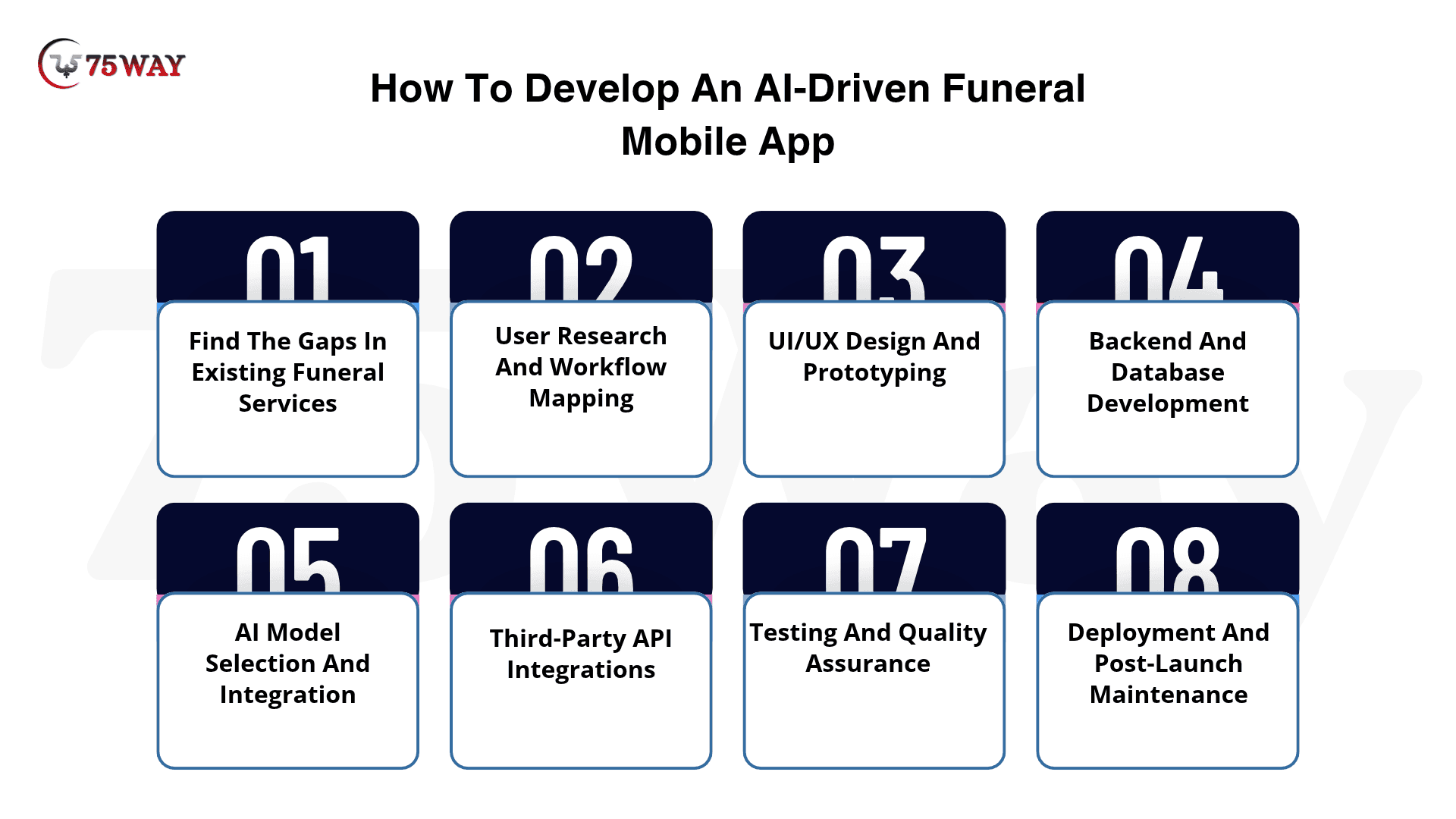
Step 1: Find The Gaps In Existing Funeral Services
Before thinking about features, look at where families and funeral staff struggle today.
- Are customers calling repeatedly to check availability?
- Do directors manage case details across spreadsheets, emails, and paper records?
Speak with funeral professionals and potential users to uncover these problems. Their experiences will help you decide what the app should actually improve.
Step 2: User Research and Workflow Mapping
A grieving family might appreciate an assistant that explains cremation options or helps prepare an obituary. However, an automated system making unverified promises about service availability or funeral costs can create serious problems.
This distinction should guide your AI strategy. Prioritize tasks involving information retrieval, drafting, and routine support, while keeping sensitive decisions under human supervision.
Step 3: UI/UX Design and Prototyping
Consider a family requesting a funeral service through the app. The request should reach the right funeral director. The director should be able to review the details, and the family should receive an update.
Similar journeys need to be mapped for payments, document submissions, vendor requests, and appointment changes. These connected workflows will determine how the family app, director dashboard, admin panel, and vendor portal work together.
Step 4: Backend and Database Development
A platform supporting AI conversations, online payments, document uploads, and multiple user accounts needs a carefully selected technical foundation.
Flutter or React Native may suit the mobile application, while Python or Node.js can support backend development. Database selection, cloud hosting, AI model integration, and third-party APIs should reflect the actual workload and expected business growth.
Step 5: AI Model Selection and Integration
A useful AI assistant should understand questions such as,
- "What documents do I need for cremation?" or
- "Can you help me write an obituary?"
It can retrieve approved service information, prepare an obituary draft, or extract details from uploaded documents. Business-specific information should come from verified records, and families should be able to review AI-generated content before using it.
Step 6: Third-Party API Integrations
Someone arranging a funeral may be using the app while managing family responsibilities and urgent decisions. Long registration forms, confusing service categories, and excessive notifications can quickly become frustrating.
A straightforward interface with clear prices, visible contact details, simple booking steps, and accessible human assistance makes the application more considerate and practical.
Step 7: Testing and Quality Assurance
- What happens when two families request the same service slot?
- Can a vendor update an unavailable product without leaving outdated information visible?
- Does the AI assistant recognize when a question needs a funeral director's response?
Scenarios like these deserve attention alongside payment testing, data protection, access permissions, and performance checks.
Step 8: Deployment and Post-Launch Maintenance
After launch, the most valuable feedback may come from unexpected places. Families might use obituary assistance frequently but ignore a complicated memorial feature.
Funeral directors may request better scheduling tools instead of additional AI capabilities. Booking patterns, support conversations, user feedback, and AI response reviews can help determine which improvements deserve priority.
Quick Read: Elderly Care App Development: A Smart Investment In The Ageing Population
How Much Does AI-Powered Funeral App Development Cost?
The cost of AI-powered funeral app development can range from $8,000–$120,000+, depending on the application scope, platform requirements, AI capabilities, integrations, and development complexity.
However, a single price range does not tell business owners what they will actually receive. The investment should be evaluated according to the functionality being developed.
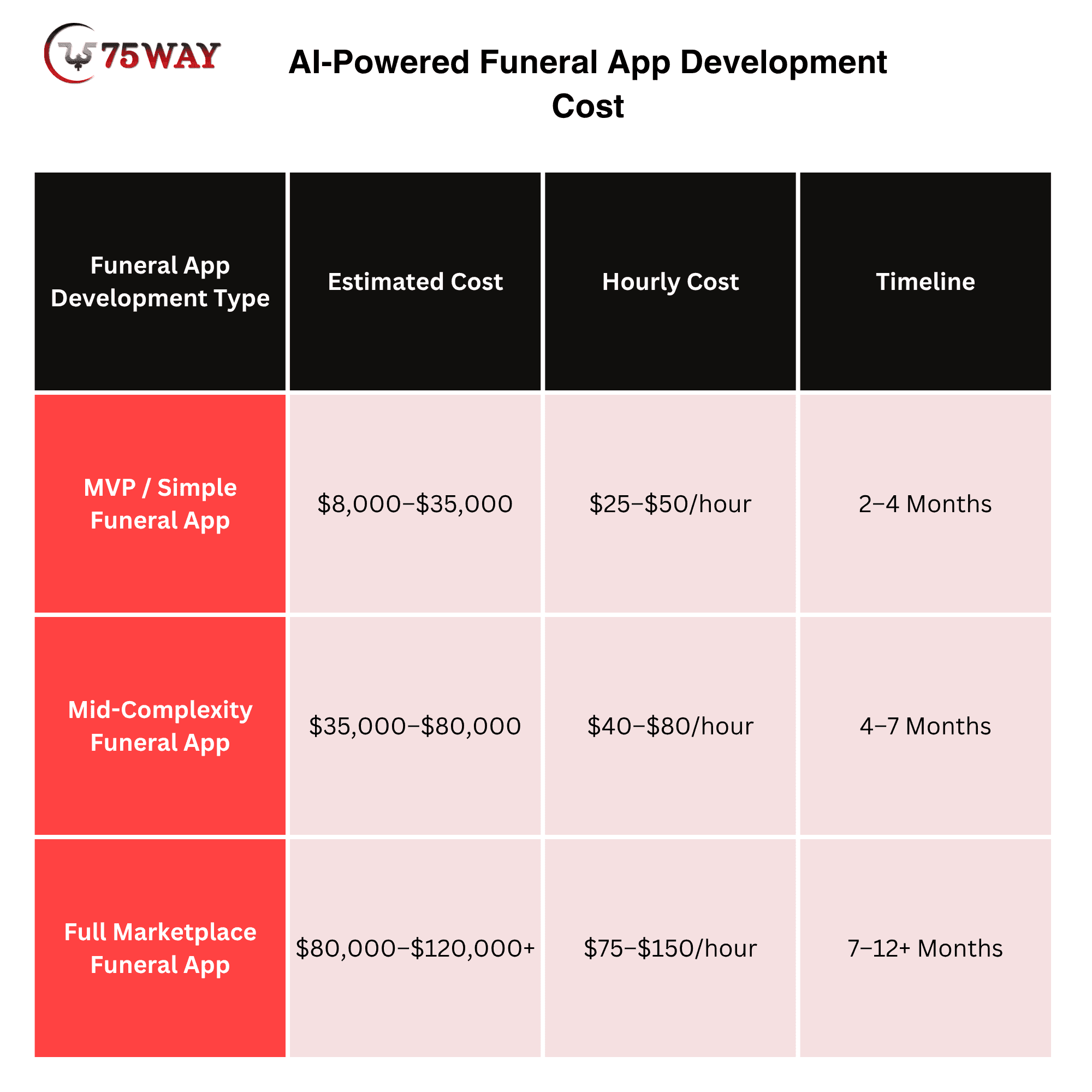
1. MVP/Simple Funeral App Cost: $8,000 – $35,000
A basic funeral app focuses on essential services that help families access information and coordinate arrangements. This budget generally covers a straightforward application with limited integrations and core functionality.
- Service listings, funeral schedules, and appointment booking.
- Digital obituaries, memorial pages, and tribute sharing.
- Basic user profiles, notifications, and admin management.
Timeline: 2–4 Months
2. Mid-Complexity Funeral App Cost: $35,000 – $80,000
A mid-complexity funeral app supports growing businesses that need more than basic booking and memorial features. This budget can accommodate advanced coordination tools, multiple business locations, and selected AI-powered capabilities.
- Multi-location management with centralized customer records.
- Automated scheduling, CRM integration, and workflow management.
- Livestreaming services, grief support, and family communication.
Timeline: 4–7 Months
3. Full Marketplace Funeral App Cost: $80,000-$120,000+
An enterprise-level funeral marketplace connects families with multiple providers while supporting complex business operations. The investment covers custom portals, vendor coordination, advanced integrations, and access controls for different user roles.
- Multi-vendor listings, bookings, payments, and commissions.
- Pre-need financial integrations and trust account management.
- Custom portals, advanced analytics, and role-based permissions.
Timeline: 7–12+ Months
Explore More: Childcare Management App Development: Cost, Features And Benefits
Different Types of Funeral Apps Businesses Can Develop
Think beyond a single platform for booking funeral services. You could create a marketplace connecting families with funeral providers, a digital space for sharing obituaries, or a dedicated app for managing funeral invitations. Each concept has its own audience, revenue possibilities, and operational requirements, which makes the choice important for your business plan.
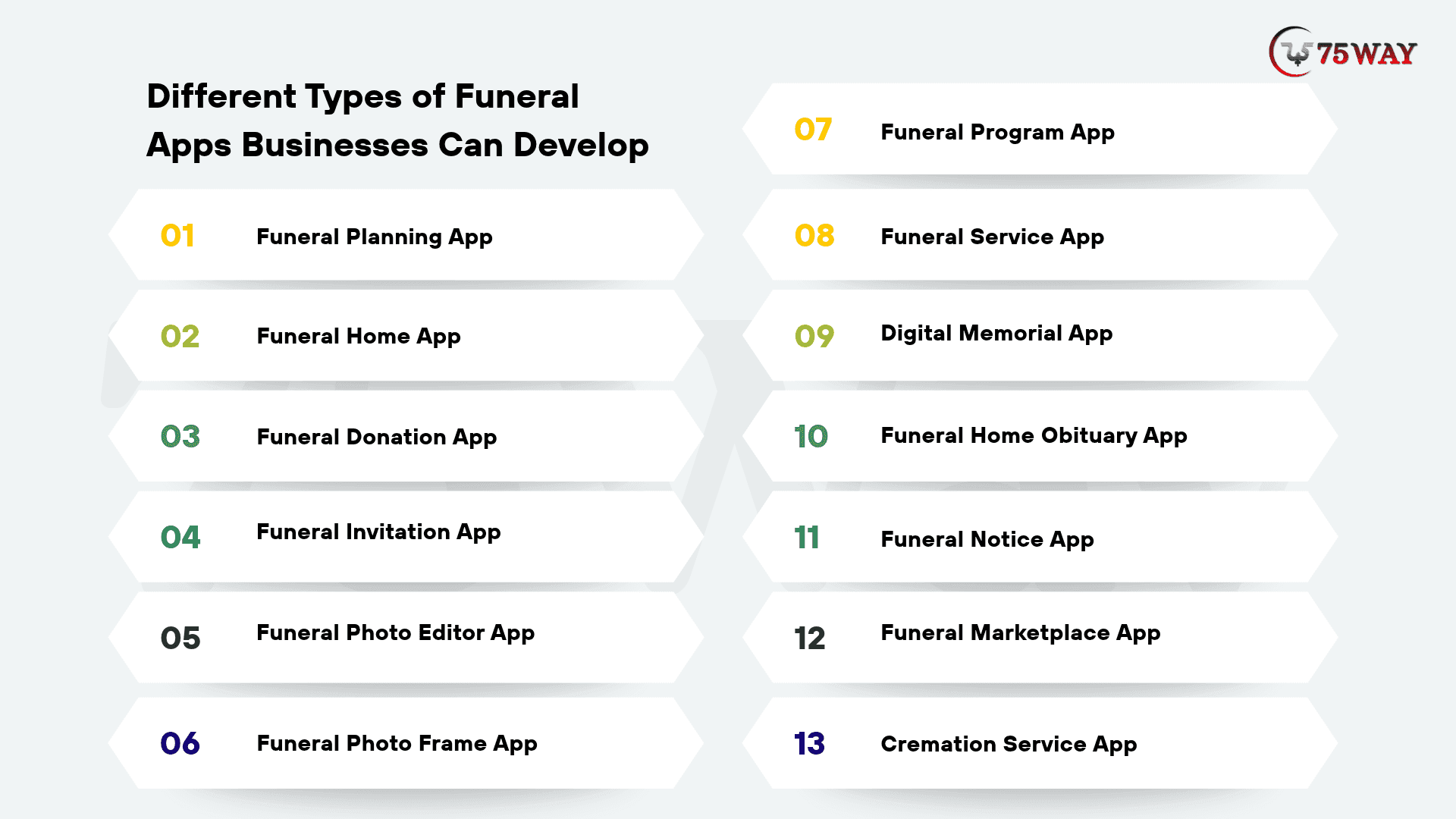
1. Funeral Planning App
A funeral planning app helps families organize funeral arrangements, manage essential tasks, and coordinate with service providers. Users can compare packages, select burial or cremation services, manage budgets, and schedule ceremonies. It also allows families to store important documents and share arrangements with relatives.
- Market Potential: High
- Suitable For: Funeral Homes, Startups, Planning Service Providers
Estimated Cost: $15,000–$60,000
2. Funeral Home App
A funeral home app helps funeral businesses manage daily operations and provide families with accessible service information. Customers can explore funeral packages, schedule consultations, make payments, and receive service updates. Funeral directors can use the app to manage bookings, customer records, staff schedules, and service requests.
- Market Potential: High
- Suitable For: Funeral Homes, Funeral Directors, Service Chains
Estimated Cost: $15,000–$65,000
3. Funeral Donation App
A funeral donation app allows people to contribute financially toward funeral expenses or support families dealing with a loss. Users can create fundraising campaigns, share donation links, track contributions, and receive payment confirmations. It can also support transparent fundraising through donation records and campaign updates.
- Market Potential: High
- Suitable For: Nonprofits, Fundraising Platforms, Community Organizations
Estimated Cost: $12,000–$45,000
4. Funeral Invitation App
A funeral invitation app helps families create and share invitations for funerals, memorial services, and remembrance gatherings. Users can customize invitation templates, add event details, and send invitations through messaging platforms or email. RSVP tracking helps families estimate attendance and coordinate arrangements.
- Market Potential: Medium
- Suitable For: Families, Funeral Homes, Event Service Providers
Estimated Cost: $8,000–$30,000
5. Funeral Photo Editor App
A funeral photo editor app allows users to prepare meaningful photographs for memorial services and remembrance materials. Families can crop images, adjust lighting, remove backgrounds, and create tribute collages. AI-powered editing can also help restore old photographs while preserving the person's original appearance.
- Market Potential: Medium
- Suitable For: Families, Memorial Businesses, Photo Editing Startups
Estimated Cost: $10,000–$40,000
6. Funeral Photo Frame App
A funeral photo frame app helps families create respectful framed portraits for memorial displays and remembrance ceremonies. Users can select designs, add names and dates, customize backgrounds, and download finished photographs. The app can offer traditional, minimal, and personalized frame collections.
- Market Potential: Medium
- Suitable For: Families, Photo Studios, Memorial Product Businesses
Estimated Cost: $8,000–$30,000
7. Funeral Program App
A funeral program app helps families design digital or printable programs for funeral and memorial services. Users can add the deceased person's biography, photographs, service schedules, readings, prayers, and acknowledgments. Ready-made templates make it easier to create organized programs without professional design experience.
- Market Potential: Medium
- Suitable For: Funeral Homes, Families, Memorial Printing Businesses
Estimated Cost: $8,000–$35,000
8. Funeral Service App
A funeral service app connects families with providers offering burial, cremation, transportation, floral arrangements, and memorial services. Users can explore available services, request quotations, schedule appointments, and manage bookings. Providers can receive inquiries, update service details, and coordinate customer requests through a dedicated dashboard.
- Market Potential: High
- Suitable For: Funeral Businesses, Service Aggregators, Startup Founders
Estimated Cost: $15,000–$60,000
9. Digital Memorial App
A digital memorial app creates an online space where families and friends can remember and celebrate someone's life. Users can share photographs, videos, biographies, personal stories, and messages of remembrance. Features such as virtual guestbooks, anniversary reminders, and tribute pages help preserve memories over time.
- Market Potential: High
- Suitable For: Memorial Startups, Funeral Homes, Tribute Platforms
Estimated Cost: $10,000–$50,000
10. Funeral Home Obituary App
A funeral home obituary app enables funeral businesses to publish and manage obituaries through a centralized digital platform. Families can submit personal details, photographs, life stories, and service information for publication. Visitors can read tributes, share condolences, and access memorial service details.
- Market Potential: High
- Suitable For: Funeral Homes, Memorial Platforms, Media Businesses
Estimated Cost: $10,000–$40,000
11. Funeral Notice App
A funeral notice app helps families and funeral homes share announcements about deaths, funeral schedules, and memorial gatherings. Users can publish notices with dates, venues, and service details, then share them with friends and relatives. Notifications help recipients stay informed about schedule changes and remembrance events.
- Market Potential: Medium
- Suitable For: Funeral Homes, Community Platforms, Local Publishers
Estimated Cost: $8,000–$35,000
12. Funeral Marketplace App
A funeral marketplace app connects families with multiple funeral service providers through one digital platform. Users can compare packages, request quotations, book services, and explore products such as caskets, urns, flowers, and memorial accessories. Providers can manage listings, receive inquiries, and handle customer bookings.
- Market Potential: High
- Suitable For: Entrepreneurs, Funeral Networks, Service Aggregators
Estimated Cost: $15,000–$90,000
13. Cremation Service App
A cremation service app helps families find and book cremation-related services without navigating multiple providers separately. Users can compare cremation packages, check availability, schedule appointments, arrange transportation, and select urns or memorial options. Service providers can manage bookings, customer communication, and operational updates.
- Market Potential: High
- Suitable For: Crematoriums, Funeral Homes, Cremation Startups
Estimated Cost: $15,000–$60,000
AI Features to Integrate Into a Funeral Service App Development
If you are investing in funeral service app development, AI integration deserves more thought than adding a few automated replies. Think about features that can help families create meaningful tributes, discover relevant services, and manage information with less manual effort. Here are the AI capabilities that can bring practical value to your platform.
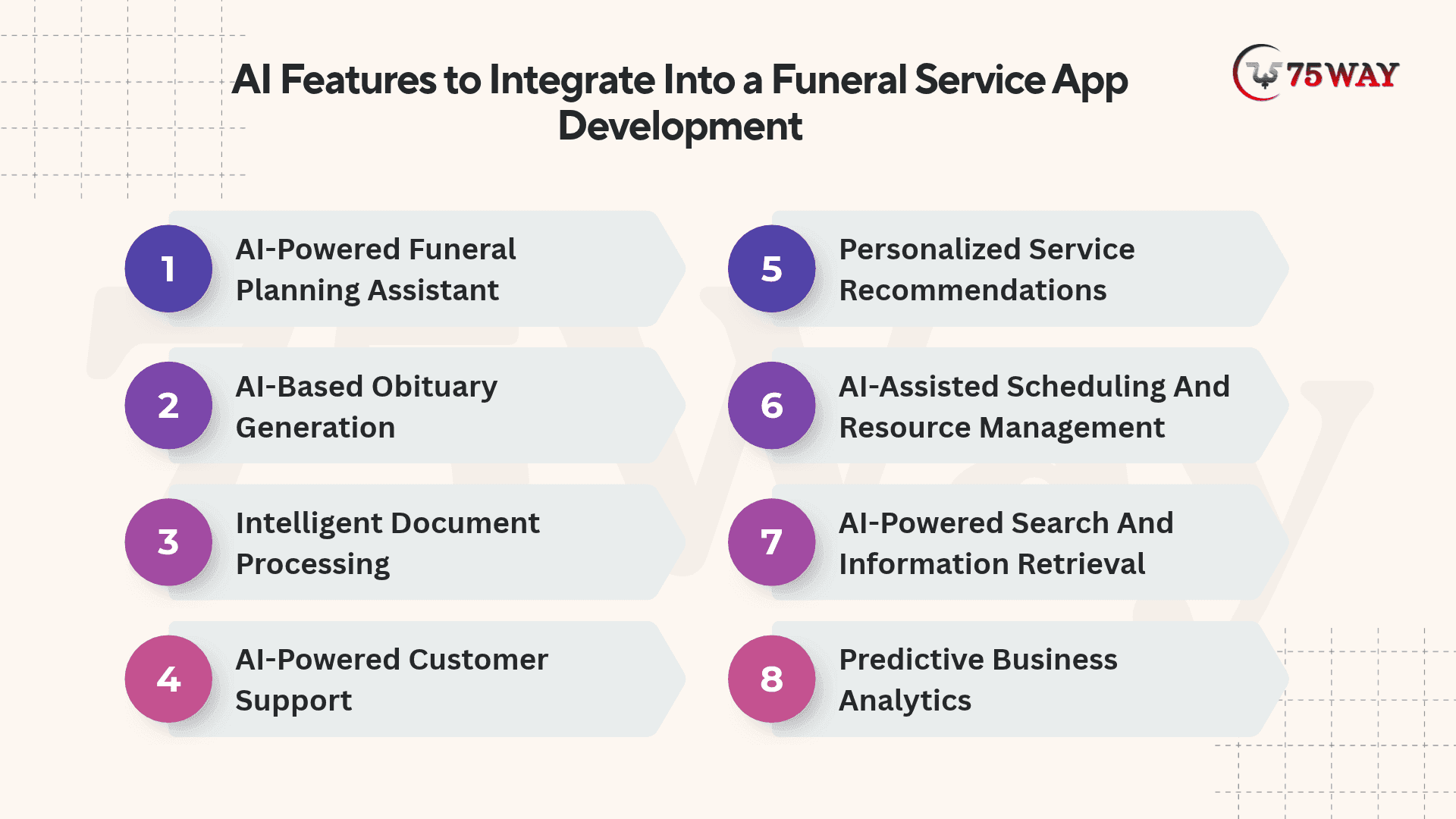
1. AI-Powered Funeral Planning Assistant
Families often have questions about funeral arrangements, available services, documentation, and appointment procedures.
An AI-powered assistant can retrieve approved information from the funeral home's knowledge base and respond to common inquiries.
2. AI-Based Obituary Generation
Writing an obituary can be emotionally challenging for families. An AI obituary generator can help transform family-provided information into a meaningful first draft.
3. Intelligent Document Processing
Funeral arrangements can involve authorization forms, service records, identification documents, and other paperwork.
AI-assisted document processing can extract information from uploaded files and organize it into relevant application fields.
For example, an authorized employee can upload a document, and the system can identify relevant information for staff review.
4. AI-Powered Customer Support
An AI support assistant can help funeral homes respond to routine inquiries outside regular office hours. The system can also categorize inquiries and forward sensitive or urgent requests to an appropriate employee.
5. Personalized Service Recommendations
Every family has different preferences, arrangements, and service requirements.
An AI recommendation engine can use voluntarily provided preferences, location, selected services, and budget information to present relevant options.
For example, someone exploring memorial services may receive information about available venues, packages, and related arrangements.
6. AI-Assisted Scheduling and Resource Management
Funeral homes coordinate staff, facilities, transportation, and service providers across multiple arrangements. AI-assisted scheduling can analyze availability and identify possible scheduling conflicts.
7. AI-Powered Search and Information Retrieval
As funeral businesses accumulate more records, finding specific information can become difficult.
Semantic search allows authorized employees to search using natural language instead of relying entirely on exact keywords.
For example:
Show me upcoming memorial services that require transportation coordination.
The application can identify relevant records using vector embeddings, metadata filters, and permission-aware retrieval.
8. Predictive Business Analytics
Business owners need visibility into service demand, revenue, resource utilization, and operational performance. AI-assisted analytics can identify patterns in historical business data.
Major Features To Consider While Building AI Funeral Application
Before finalizing your funeral app's feature list, consider what families and funeral service providers will expect from the platform. A family may want to manage an obituary, while a funeral director needs booking records and service management tools. Both sides need practical features that make the platform useful beyond its initial launch.
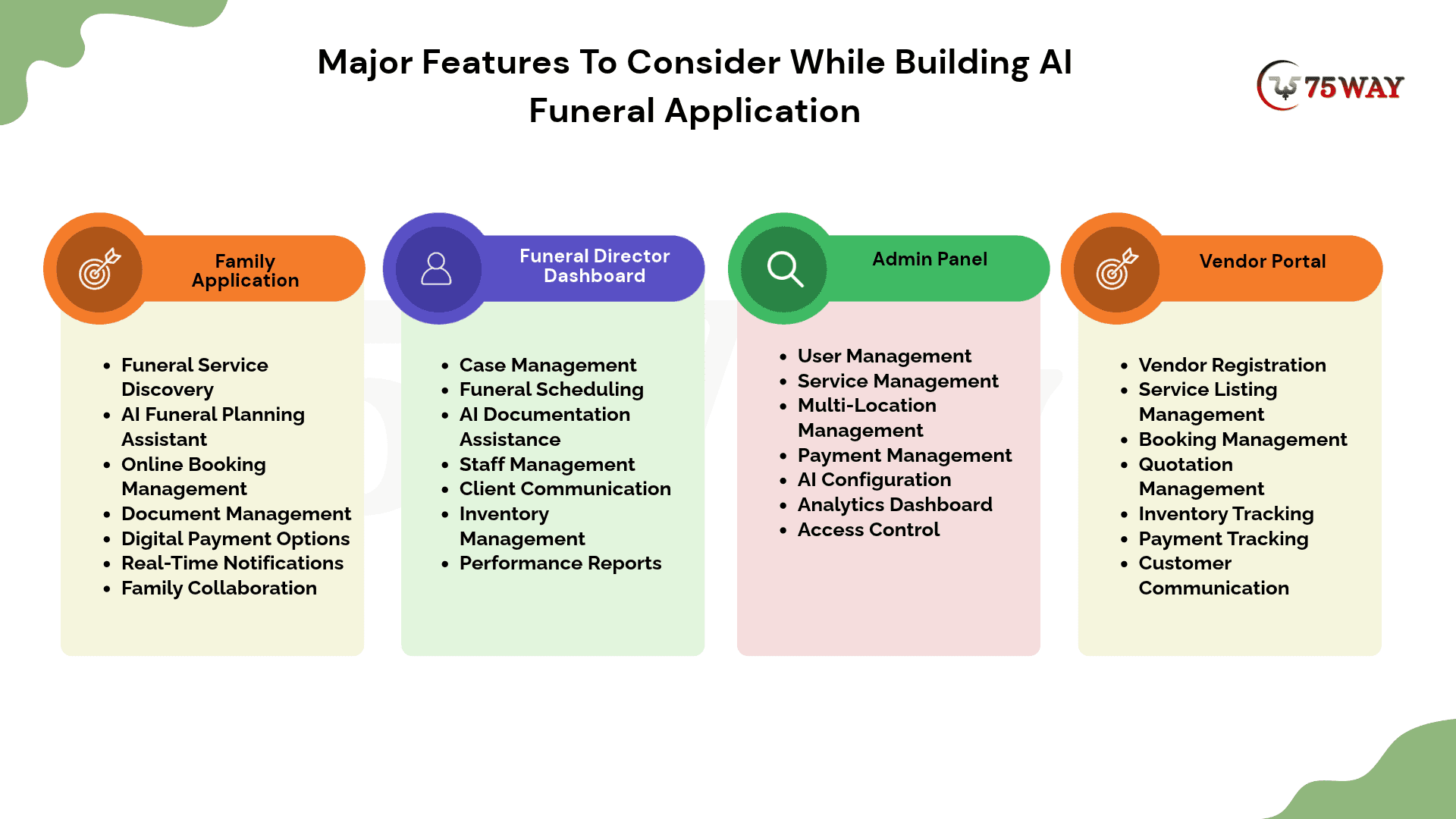
Module 1: Family App Features
The family application should prioritize clarity, accessibility, simplicity, and privacy.
- Funeral Service Discovery: Explore available funeral services, packages, cremation options, and nearby providers through one application.
- AI Funeral Planning Assistant: Receive personalized guidance for selecting services, organizing ceremonies, and managing important funeral arrangements.
- Online Booking Management: Request appointments, book funeral services, and receive confirmations directly through the application.
- Document Management: Upload, access, and securely store essential funeral documents, forms, and personal records.
- Digital Payment Options: Review service costs, pay invoices, and access transaction histories through integrated payment facilities.
- Real-Time Notifications: Receive booking confirmations, schedule changes, payment alerts, and important funeral arrangement updates.
- Family Collaboration: Share arrangements, coordinate responsibilities, and communicate with relatives throughout the funeral planning process.
Module 2: Funeral Director Dashboard Features
The funeral director dashboard should support the actual service delivery process.
- Case Management: Create funeral cases, maintain family records, and monitor arrangements from initial inquiry through completion.
- Funeral Scheduling: Organize funeral services, memorial ceremonies, staff assignments, and appointment calendars through centralized scheduling tools.
- AI Documentation Assistance: Generate document drafts, organize case information, and reduce repetitive administrative work for funeral directors.
- Staff Management: Assign responsibilities, manage employee availability, and monitor workloads across different funeral service operations.
- Client Communication: Manage family inquiries, respond to service requests, and maintain communication histories within one dashboard.
- Inventory Management: Track caskets, urns, memorial products, and other essential supplies across funeral home locations.
- Performance Reports: Review booking volumes, service revenue, operational expenses, and customer activity through detailed reports.
Module 3: Admin Panel Features
Business owners and administrators need centralized control over the application. The admin panel should include:
- User Management: Manage family accounts, funeral directors, employees, vendors, and their respective application permissions.
- Service Management: Add, update, categorize, and manage funeral packages, cremation services, and additional offerings.
- Multi-Location Management: Monitor multiple funeral home branches, manage location-specific services, and oversee business operations centrally.
- Payment Management: Track transactions, process refunds, monitor commissions, and manage payment-related records securely.
- AI Configuration: Configure AI assistants, manage automated responses, and review generated content before customer delivery.
- Analytics Dashboard: Monitor registrations, bookings, revenue trends, customer engagement, and overall platform performance.
- Access Control: Define administrative roles, assign permissions, and restrict access to sensitive business information.
Module 4: Vendor Portal Features
If the application follows a marketplace or multi-provider business model, a dedicated partner portal can simplify service coordination. It can include:
- Vendor Registration: Allow funeral service providers to register, submit business information, and create verified vendor profiles.
- Service Listing Management: Add service descriptions, product details, pricing information, and availability for customer discovery.
- Booking Management: Receive customer requests, confirm bookings, and manage upcoming service orders through one portal.
- Quotation Management: Prepare customized quotations, share service estimates, and respond to family pricing inquiries.
- Inventory Tracking: Update product availability, monitor stock levels, and manage funeral-related inventory across listings.
- Payment Tracking: Review completed transactions, monitor pending payments, and access vendor earnings and commission records.
- Customer Communication: Respond to inquiries, clarify service requirements, and coordinate arrangements with families and funeral directors.
How AI Works Inside a Funeral Application: A Practical Example
Understanding an actual user journey is more useful than simply listing AI features. Consider a family using a funeral planning application after contacting a funeral home.
Example: AI-Assisted Funeral Planning Workflow
Step 1: Family Submits a Request
The user shares basic arrangement requirements, contact information, and preferred consultation times.
Step 2: AI Assistant Understands the Inquiry
Natural language processing identifies the user's questions and retrieves relevant information from the funeral home's approved knowledge base.
Step 3: Funeral Director Receives the Request
The application creates a case, assigns it to an appropriate employee, and sends a notification.
Step 4: Documents Are Submitted
OCR and AI extraction organize information from uploaded documents for authorized staff verification.
Step 5: AI Prepares an Obituary Draft
The system uses family-provided information to create an editable obituary.
Step 6: Staff Reviews the Arrangements
Funeral professionals verify documents, selected services, schedules, and family preferences.
Step 7: Family Receives Updates
Approved notifications communicate relevant appointment details and arrangement updates.
This workflow demonstrates how AI can support different stages without replacing funeral professionals or taking control away from families.
Business Models for Custom Funeral Home App Development
Before finalizing your funeral app's feature list, consider what families and funeral service providers will expect from the platform. A family may want to manage an obituary, while a funeral director needs booking records and service management tools. Both sides need practical features that make the platform useful beyond its initial launch.
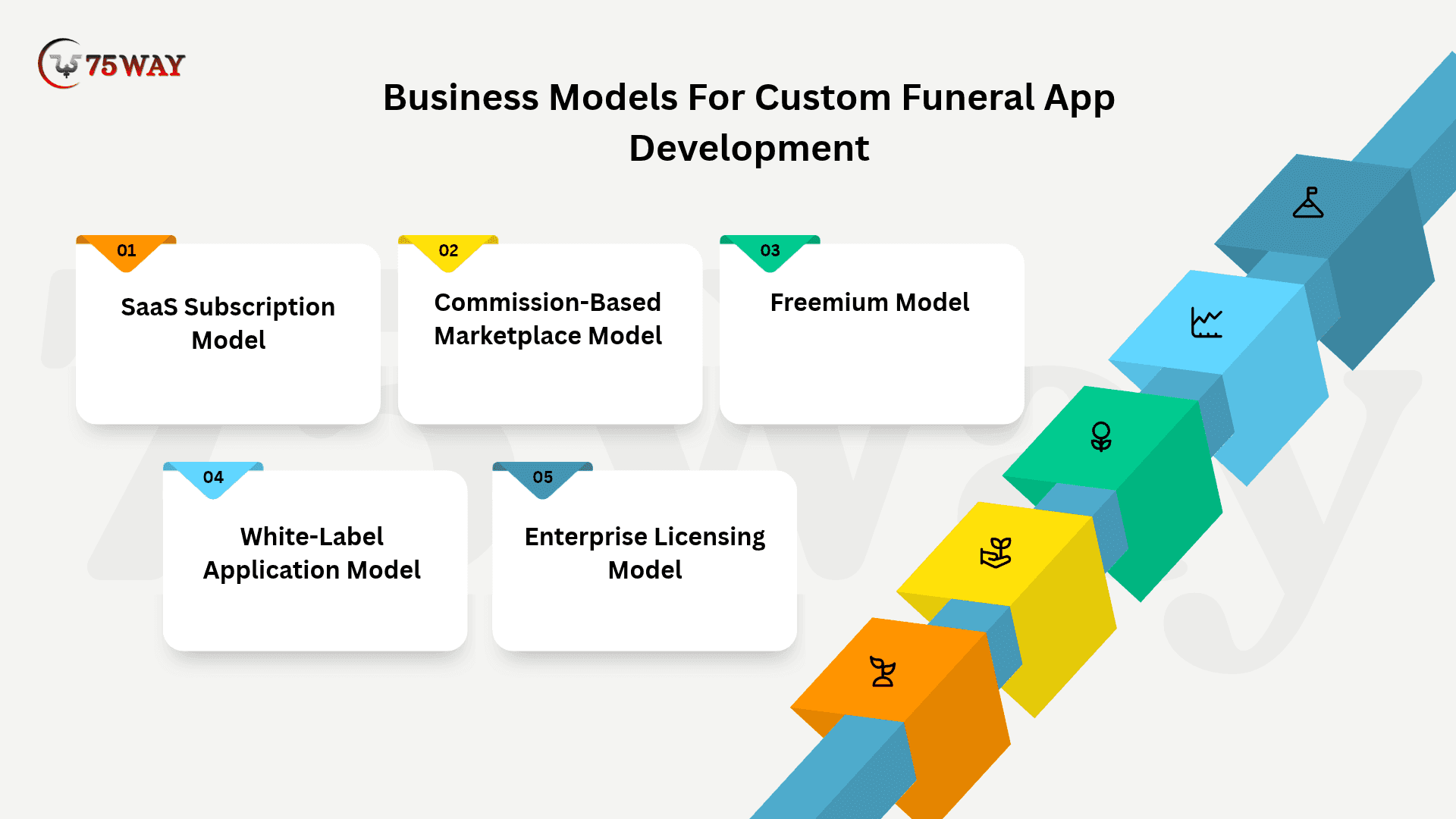
1. SaaS Subscription Model
You can offer funeral management software to funeral homes through monthly or annual subscriptions.
Possible pricing structures may depend on:
- Number of business locations.
- Employee accounts.
- Active funeral cases.
- Storage requirements.
- AI usage limits.
- Available integrations.
This model provides recurring revenue and works particularly well for business-focused software.
2. Commission-Based Marketplace Model
If your application connects families with funeral service providers, you can generate revenue through commissions on eligible transactions.
For example, a marketplace may connect users with florists, memorial product sellers, or other participating service providers.
The commission structure should be transparent and account for applicable consumer protection requirements.
3. Freemium Model
A freemium application offers basic services without charge while reserving advanced capabilities for paid users.
For example:
- Basic memorial page creation.
- Limited obituary editing assistance.
- Premium tribute customization.
- Additional storage.
- Extended family collaboration tools.
The free offering should provide genuine value without restricting access to essential information during a difficult time.
4. White-Label Application Model
A white-label model allows technology companies to provide customizable funeral applications to multiple funeral businesses.
Each business can use its own:
- Brand identity.
- Logo and color palette.
- Service catalog.
- Contact information.
- Branch details.
- User management settings.
The technology provider can generate revenue through implementation fees, recurring subscriptions, and optional customization services.
5. Enterprise Licensing Model
Larger funeral home groups may require centralized management, multiple branches, advanced reporting, and customized integrations.
An enterprise licensing model can provide access to these capabilities through negotiated contracts.
It may include implementation services, dedicated support, customized workflows, and enterprise-level service agreements.
Security, Privacy, and Compliance Considerations for Creating Funeral Home Management Apps in the United States
A funeral application may handle personal details, family relationships, identity documents, payment records, obituary information, and sensitive communications.
This makes privacy and security fundamental product requirements rather than optional development enhancements.
Businesses should evaluate applicable federal and state requirements before launching their applications.
1. Data Encryption
Sensitive information should be protected during transmission and storage.
Development teams should consider:
- TLS encryption for data in transit.
- Strong encryption for stored information.
- Secure encryption key management.
- Protected document storage.
- Secure API communication.
2. Role-Based Access Control
Not every application user should have access to every record.
For example, a family member should only access information they are authorized to view, while funeral directors should access records relevant to their responsibilities.
Implement:
- Role-Based Access Control (RBAC).
- Multi-factor authentication where appropriate.
- Session management.
- Permission-based document access.
- Administrative access restrictions.
- Audit logs.
3. Data Privacy and Consent Management
Users should understand what information the application collects, why it is required, how it is used, and who can access it.
The platform should provide:
- Clear privacy notices.
- Consent management.
- Data access restrictions.
- Retention policies.
- Secure deletion procedures.
- Appropriate data-sharing permissions.
Developers should also define how family members receive access to shared records and how that access can be revoked.
4. Does HIPAA Apply to Funeral App Development Solutions
This is an important distinction for funeral technology businesses.
HIPAA does not automatically apply to every funeral home or funeral application.
The HIPAA Privacy and Security Rules generally apply to covered entities, including qualifying healthcare providers, health plans, and healthcare clearinghouses, and certain business associates handling protected health information on their behalf.
If a funeral technology provider creates, receives, maintains, or transmits protected health information on behalf of a covered entity, business associate obligations may apply.
The specific relationship and activities must be evaluated before determining whether HIPAA applies.
Developers should not advertise every funeral application as HIPAA-compliant without a proper legal and technical assessment.
Depending on the application's functionality and business relationships, additional requirements may include:
- Applicable state privacy laws.
- FTC consumer protection requirements.
- Payment Card Industry Data Security Standard (PCI DSS) obligations where applicable.
- Contractual data protection requirements.
- Applicable breach notification obligations.
5. FTC Funeral Rule Considerations
The Federal Trade Commission's Funeral Rule is particularly relevant when developing applications that display or facilitate the purchase of funeral goods and services.
The rule requires funeral providers to disclose itemized prices and specific consumer rights. These include the right to select only the goods and services desired, subject to applicable requirements and permitted charges.
It also addresses disclosures concerning embalming, alternative containers for direct cremation, and the non-declinable basic services fee.
For developers, this means building pricing and service management functionality that supports:
- Itemized service pricing.
- Accurate product and service descriptions.
- Required consumer disclosures.
- Configurable service packages.
- Clear payment breakdowns.
- Appropriate authorization workflows.
The application should not hide required disclosures behind confusing interfaces or misleading package descriptions.
6. AI Safety and Human Oversight
AI systems should have clear limitations, especially when processing sensitive family information.
Developers should implement:
- Human review of generated obituaries.
- Source-grounded responses.
- Restricted access to private conversations.
- Safe handling of uploaded documents.
- AI output monitoring.
- Clear escalation to human employees.
- Data-sharing restrictions for external AI providers.
A funeral application should assist people, not make sensitive personal decisions on their behalf.
Challenges in Custom Funeral Service App Development & Solutions
Developing funeral technology involves challenges beyond ordinary mobile application engineering. The platform must accommodate sensitive information, complex service arrangements, different user roles, and AI-generated content that requires careful verification. Understanding these challenges early can help businesses avoid expensive redesigns and operational problems.
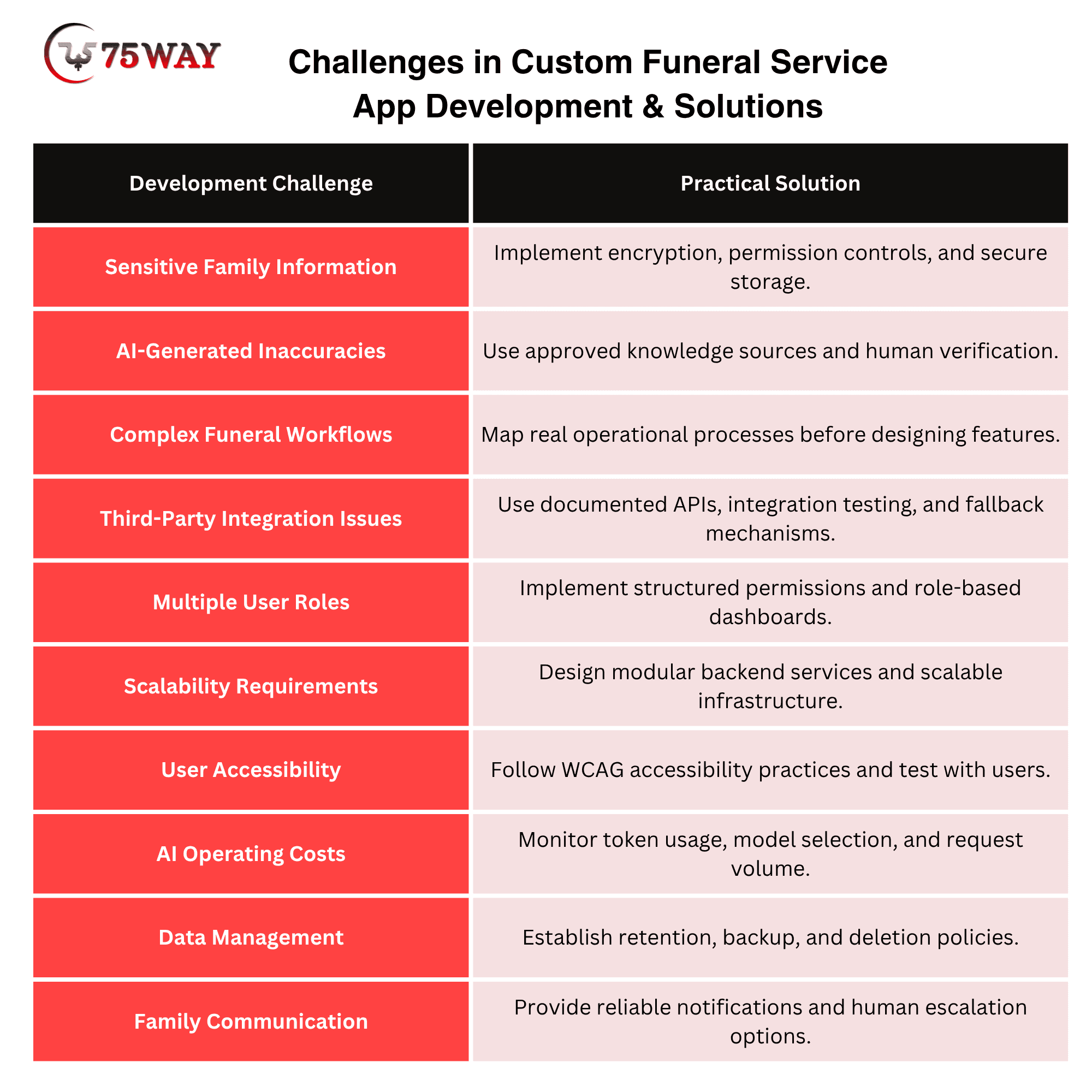
One Challenge Businesses Often Overlook: Emotional UX
A funeral application is not an ordinary service-booking platform.
A person using it may be dealing with grief, uncertainty, and time-sensitive responsibilities. This changes how the product should be designed.
For example, avoid:
- Aggressive promotional pop-ups.
- Unnecessary registration steps.
- Complicated payment journeys.
- Confusing service package descriptions.
- Excessive notifications.
- Pushy upselling.
- Unclear document requirements.
Instead, prioritize calm communication, clear instructions, accessible interfaces, and easy access to human assistance.
How to Choose the Right Funeral Home App Development Company in USA
Your funeral home app project deserves a development partner who understands the business behind the technology. From handling service inquiries to managing staff workflows, the company should be able to translate your operational requirements into a practical solution. Before signing a development agreement, evaluate the following factors.
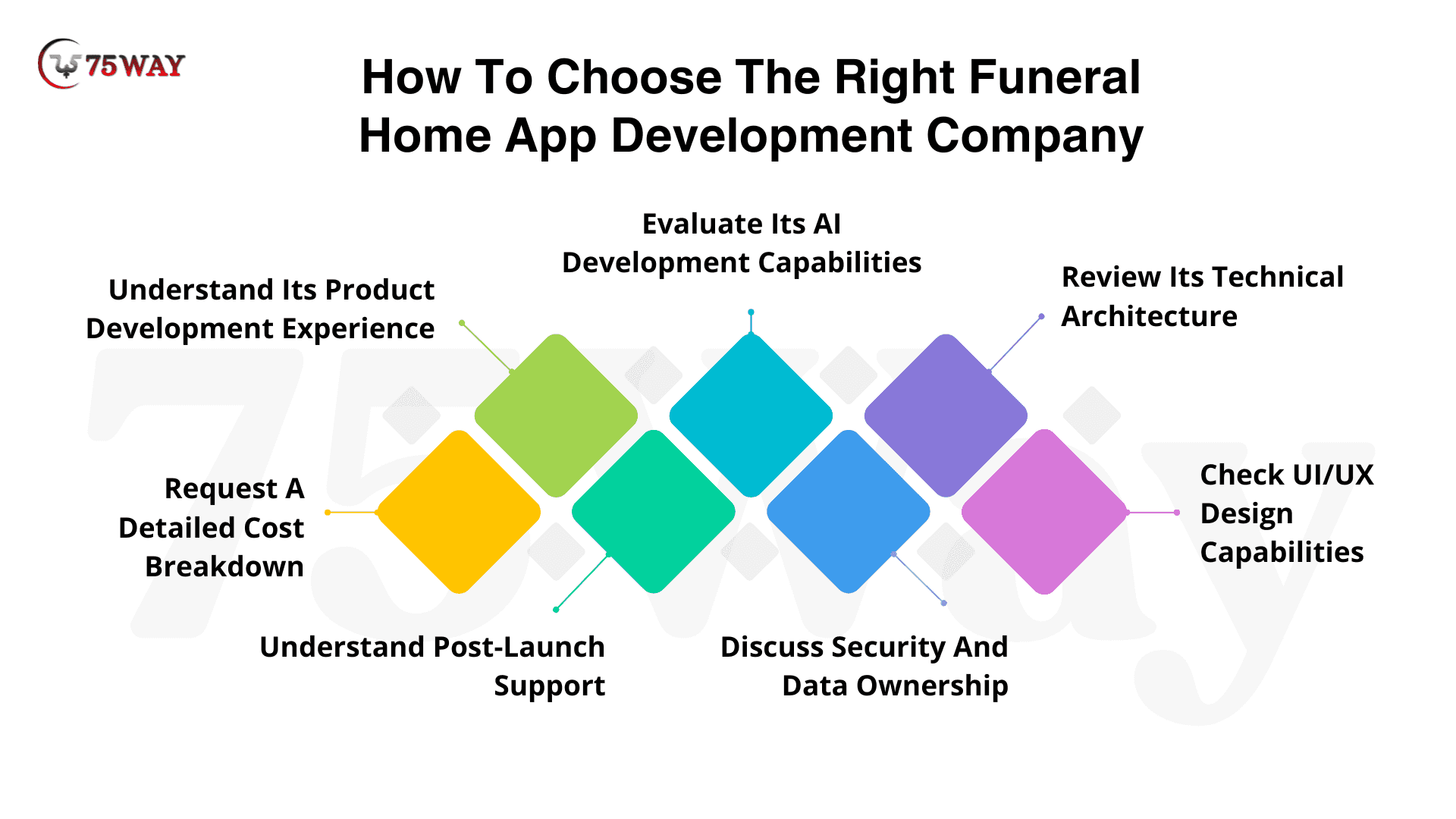
1. Understand Its Product Development Experience
Ask whether the company can handle the complete product lifecycle, including business analysis, UI/UX design, backend development, AI integration, testing, and deployment.
A team that understands the relationship between these stages can help identify technical dependencies before they become expensive problems.
2. Evaluate Its AI Development Capabilities
Ask how the team plans to implement the proposed AI features.
For example, an AI assistant may require an LLM API, RAG architecture, knowledge-base management, access controls, and output evaluation.
The development company should explain the implementation approach rather than simply promising an AI-powered application.
3. Review Its Technical Architecture
Ask the development team to explain:
- How user roles will be managed.
- How family records will be protected.
- How AI services will communicate with backend systems.
- How external APIs will be integrated.
- How the platform will support additional locations.
- How application performance will be monitored.
These discussions reveal whether the proposed solution is suitable for your business requirements.
4. Check UI/UX Design Capabilities
Request examples of dashboards, mobile interfaces, and complex user workflows.
Pay attention to navigation, accessibility, readability, and the number of steps required to complete important actions.
5. Discuss Security and Data Ownership
Before development begins, clarify:
- Who owns the source code?
- Who controls the production infrastructure?
- Where will application data be stored?
- How will user permissions work?
- What backup and recovery arrangements are included?
- What happens if the development agreement ends?
These questions are particularly important for startups investing in a long-term software product.
6. Understand Post-Launch Support
A development agreement should clearly explain maintenance responsibilities.
Discuss bug fixes, operating system updates, AI API changes, security patches, infrastructure monitoring, and future feature development.
7. Request a Detailed Cost Breakdown
Do not evaluate companies based only on their initial quotations.
Compare the scope of work, included features, technology stack, integrations, testing, deployment, and maintenance arrangements.
A lower quotation may exclude important functionality that you will need to purchase later.
Why Choose 75way Technologies for AI-Powered Funeral App Development in USA?
At 75way Technologies, the focus of the development engagement should begin with understanding what the business wants to achieve, who will use the application, and which operational problems the product needs to solve.
Whether you are a funeral home owner looking to digitize existing operations or a startup founder planning a new funeral technology platform, the development scope should reflect your actual business requirements.
The first step should be a detailed discussion of your product requirements, expected users, essential features, and long-term business goals.
This helps establish a realistic development roadmap instead of investing in unnecessary features from the beginning.
Conclusion
AI-powered funeral app development presents an opportunity for funeral home owners, technology entrepreneurs, and startup founders to improve how funeral services are organized and delivered.
From AI-assisted obituary creation and document processing to funeral scheduling, digital memorials, and centralized management, the technology can address several genuine business challenges.
However, a successful application requires more than intelligent features. Business owners should also evaluate development costs, monetization opportunities, integrations, and long-term maintenance before committing to a solution.
To build an AI-powered funeral application, you can connect with an expert app development company to discuss your requirements, explore the development approach, and plan a solution aligned with your business goals.
Frequently Asked Questions (FAQs)
Can AI Automate Funeral Home Management?
AI can assist with document extraction, inquiry classification, appointment coordination, information retrieval, and operational reporting. However, sensitive arrangements, family decisions, and important service approvals should remain under human supervision.
Is HIPAA Compliance Mandatory For Every Funeral Application?
No. HIPAA does not automatically apply to every funeral home or funeral application. Its requirements depend on whether the business qualifies as a covered entity or business associate and how protected health information is handled.
Can A Funeral App Support Multiple Funeral Home Locations?
Yes. Developers can implement multi-location management with centralized administration, branch-specific employees, service catalogs, scheduling, reporting, and permission controls.
Can AI Generate Obituaries Automatically?
Yes. AI can prepare obituary drafts using family-provided information, personal memories, and important life events. Families should review and approve the content before publication.