Summary
AI sales agents are transforming sales by automating tasks, improving lead engagement, and providing actionable insights. Startups and enterprises can scale efficiently, reduce operational costs, and make data-driven decisions. By integrating AI agents thoughtfully, businesses enhance productivity, forecast accurately, maintain customer relationships, and achieve measurable growth while empowering teams to focus on strategic initiatives.
Key Takeaways
- AI sales agents increase lead conversion rates by up to fifty percent.
- Automation allows sales teams to focus on high-value, strategic revenue tasks.
- Data-driven insights enable businesses to forecast revenue accurately and optimize workflows.
- Gradual AI deployment ensures smoother integration and minimizes operational disruption risks.
- Pre-built AI sales agents accelerate adoption and deliver measurable ROI instantly.
Artificial intelligence has evolved from a buzzword to a business necessity, and in 2026, AI sales agents are reshaping how startups and enterprises drive growth. These smart AI agents automate sales, lead generation, qualify prospects, manage follow-ups, and close deals faster, ensuring businesses scale without overburdening human teams.
From SaaS startups to large B2B enterprises, AI sales agents streamline workflows, improve customer engagement, and boost revenue predictably. Leveraging advanced analytics and machine learning, they deliver personalized interactions at scale, reduce operational costs, and provide actionable insights for smarter decision-making.
This guide explores the key benefits, real-world impact, and implementation strategies of AI sales agents for business growth in 2026. If you are a startup owner or business founder, this guide will show you how to accelerate business growth with sales AI agent development solutions.
What Are AI Sales Agents?
AI sales agents are advanced autonomous systems powered by large language models (LLMs) and machine learning. They are designed to automate, augment, and optimize a wide range of sales tasks, from engaging leads and qualifying prospects to managing follow-ups and closing deals. Unlike traditional chatbots, modern AI sales agents can think, learn, adapt, and act across multiple channels such as email, web chat, SMS, and CRM workflows, making them smarter and more efficient than conventional tools.
These AI sales agents act like a personal assistant in real life, someone who keeps track of all your appointments, reminds you when to follow up with friends, notes important details from conversations, and ensures nothing slips through the cracks. Similarly, AI-powered sales agents handle all the routine, detail-oriented work in your sales process, keeping everything on track while your human team focuses on strategic growth.
Core Advantages of AI Sales Agents in 2026
AI sales agents are no longer just automation tools. They are strategic growth enablers for startups and enterprises. In 2026, businesses that implement AI-driven sales systems gain speed, efficiency, accuracy, and scalability across their sales processes. Whether you are a startup founder looking to scale quickly or an enterprise executive aiming to maximize revenue per lead, AI sales agents provide measurable improvements in productivity, conversions, cost efficiency, insights, and customer satisfaction. Below, we detail the 10 key benefits of AI sales agents.

Boosts Sales Efficiency & Team Productivity
AI sales agents automate repetitive tasks such as data entry, scheduling, CRM updates, and follow-ups, allowing human teams to focus on strategic selling. By streamlining workflows, businesses can accelerate operations without adding extra staff or increasing workload, ensuring the sales process is faster and more efficient.
Think of a sales team manually updating client records and sending follow-ups. However, an AI agent handles these instantly, freeing the team to focus on high-value tasks. This results in higher productivity, faster deal closures, and more revenue opportunities, giving businesses a measurable advantage in competitive markets. It saves 10+ hours/week per sales rep, increases productivity up to 60%, shortens internal sales cycles, and frees up team bandwidth for impactful tasks.
Increases Lead Conversion & Pipeline Velocity
Every second counts when a lead expresses interest in your product. Many startups lose potential customers simply because human teams cannot respond fast enough. AI sales agents eliminate that gap by instantly engaging leads, scoring their intent, and following up with the right message at the right time.
Think of it like a restaurant where a server immediately greets every guest, remembers their preferences, and ensures their table is served without delay; a poor service experience would risk losing them.
AI sales agents do the same for your leads, keeping them engaged and moving smoothly through your sales funnel. Fast, personalized engagement keeps leads interested, increases conversion rates, and ensures fewer missed opportunities, which is especially critical in highly competitive markets.
24/7 Availability Across Time Zones
Business doesn’t stop when your team logs off. Prospects browse websites, send inquiries, or check emails at all hours, especially if you’re targeting international markets. AI sales agents work around the clock, responding immediately and providing a seamless customer experience.
Imagine owning a small coffee shop where someone answers every question, takes every order, and ensures every customer is satisfied, even while you sleep. That’s what AI sales agents do, handling global audiences without human fatigue.
Continuous availability captures more leads, ensures instant responses, and positions your business as reliable and customer-focused, giving you a distinct edge over competitors who rely solely on human teams.
Reduces Costs & Improves Scalability
Hiring and training a large sales team can drain a startup’s budget, slowing down growth. AI sales agents allow businesses to scale their outreach and operations without increasing headcount, handling thousands of interactions simultaneously.
You can think of it as a delivery company suddenly being able to serve twice as many customers without hiring extra drivers. AI agents manage multiple prospects effortlessly while your team focuses on strategic growth.
By reducing operational costs and expanding capacity without additional hires, businesses can scale faster, increase ROI, and invest savings into other growth initiatives.
Enhances Insight-Driven Decision-Making
AI sales agents turn raw data into actionable insights by analyzing customer behavior, interaction history, and pipeline trends. They highlight which leads to prioritize, what offers to present, and when to follow up, helping sales teams make smarter decisions quickly.
It’s like a coach observing a game and suggesting the best moves. Sales teams can focus on actions that generate revenue, avoid wasted effort, and detect risks early, such as potential churn or missed upsell opportunities. These agents offer improved lead prioritization, smarter campaigns, proactive risk management, more accurate revenue forecasting, and reduced human error. Making data-driven decisions ensures higher conversions, faster sales cycles, and more predictable growth, giving businesses a competitive edge.
Personalized Outreach At Scale
AI sales agents analyze customer behavior, past interactions, and purchase history to deliver messages that feel personal and relevant. This allows businesses to maintain a one-on-one experience for hundreds or thousands of leads simultaneously. It’s like a store clerk remembering each customer’s favorite items and suggesting new products that match their taste.
By consistently sending personalized communication, AI agents improve engagement, response rates, and conversions. Prospects feel recognized and valued, which strengthens trust in the brand and encourages them to take action faster. Startups and enterprises benefit from more meaningful connections without increasing the size of their sales teams.
Improves Forecasts & Revenue Predictions
AI sales agents provide actionable insights by identifying trends, patterns, and cycles in sales and customer data that humans might overlook. These insights help businesses prioritize high-potential leads, allocate resources effectively, and adjust campaigns proactively. For example, an AI system might detect that leads responding to certain emails convert faster or that a particular product peaks in demand during specific months.
Relying on these forecasts improves planning accuracy, reduces wasted effort, and helps teams hit revenue targets consistently. Sales leaders can make data-driven decisions with confidence, ensuring better budget allocation, smarter resource distribution, and predictable growth, which is especially valuable for startups looking to scale efficiently.
Scales Faster Than Human‑Centric Models
AI sales agents allow businesses to expand their sales operations quickly without recruiting and training additional staff. They can manage hundreds or thousands of interactions at once, enabling rapid market entry or new product launches. It is like opening multiple stores at the same time while maintaining the same quality of service.
This ability to scale efficiently helps startups and enterprises grow strategically while keeping costs low. By handling routine tasks and customer interactions autonomously, AI agents free human teams to focus on high-value activities, ensuring quality engagement even as the business expands into new regions or markets.
Enhance Customer Insights for Product Development
AI sales agents do not just help with sales. They gather valuable data about customer preferences, pain points, and buying behavior. By analyzing interactions, questions, and feedback, businesses can understand what features or products customers truly value. It’s like a café owner noticing which drinks sell fastest or which flavors get the most compliments, and then updating the menu accordingly.
These insights allow startups and enterprises to make informed product decisions, refine offerings, and create solutions that better match market demand. This reduces the risk of launching unpopular products and ensures development efforts focus on initiatives that drive real customer satisfaction and revenue growth.
Strengthens Multi-Channel Engagement
Modern customers interact with brands across multiple channels, such as social media, email, websites, and messaging apps. AI sales agents can manage engagement across all these touchpoints simultaneously, ensuring consistent communication and brand experience. It is like a personal assistant who seamlessly handles phone calls, messages, and in-person requests, making sure nothing falls through the cracks.
By maintaining a unified presence across channels, AI agents help businesses build stronger relationships with prospects and clients. Consistent engagement improves brand loyalty, increases response rates, and ensures that every interaction adds value, giving startups and enterprises a competitive advantage in crowded markets
Why AI Sales Agents Matter for Businesses in 2026?
In 2026, startups and enterprises face fierce competition, demanding customers, and shrinking attention spans. AI sales agents address these challenges by streamlining processes, improving engagement, and optimizing revenue generation. Studies show that businesses using AI sales agents experience up to 50% faster lead conversion and a 60% increase in sales productivity.
Accelerated Sales: AI agents respond instantly to leads, prioritize high-potential prospects, and guide them through the sales funnel efficiently. This results in faster deal closures, increased engagement, and measurable revenue growth without overloading your human team.
Operational Cost-Savings: Automating repetitive tasks like follow-ups, CRM updates, and outreach minimizes the need for additional hires. Businesses reduce hiring and training costs while maintaining scalable, lean, and efficient sales processes.
Reduced Errors: Manual data entry, missed follow-ups, and inconsistent messaging are minimized. AI agents ensure accurate records, consistent communications, and reliable follow-through, protecting revenue and strengthening client trust.
Scalable Processes: AI can manage thousands of interactions across multiple channels simultaneously. Startups and enterprises expand sales reach, enter new markets, and grow efficiently without proportional increases in human resources.
Team Productivity: Offloading repetitive tasks to AI allows human teams to focus on strategy, high-level decisions, and relationship building. This reduces burnout, improves efficiency, and cultivates a motivated, high-performing workforce.
How to Start With AI Sales Agents in 2026?
A structured approach is required to identify high-impact opportunities, select the right tools, and gradually integrate AI into their workflows. Startups and enterprises that plan carefully see faster lead engagement, higher conversion rates, and measurable ROI while minimizing disruption to their existing sales teams.
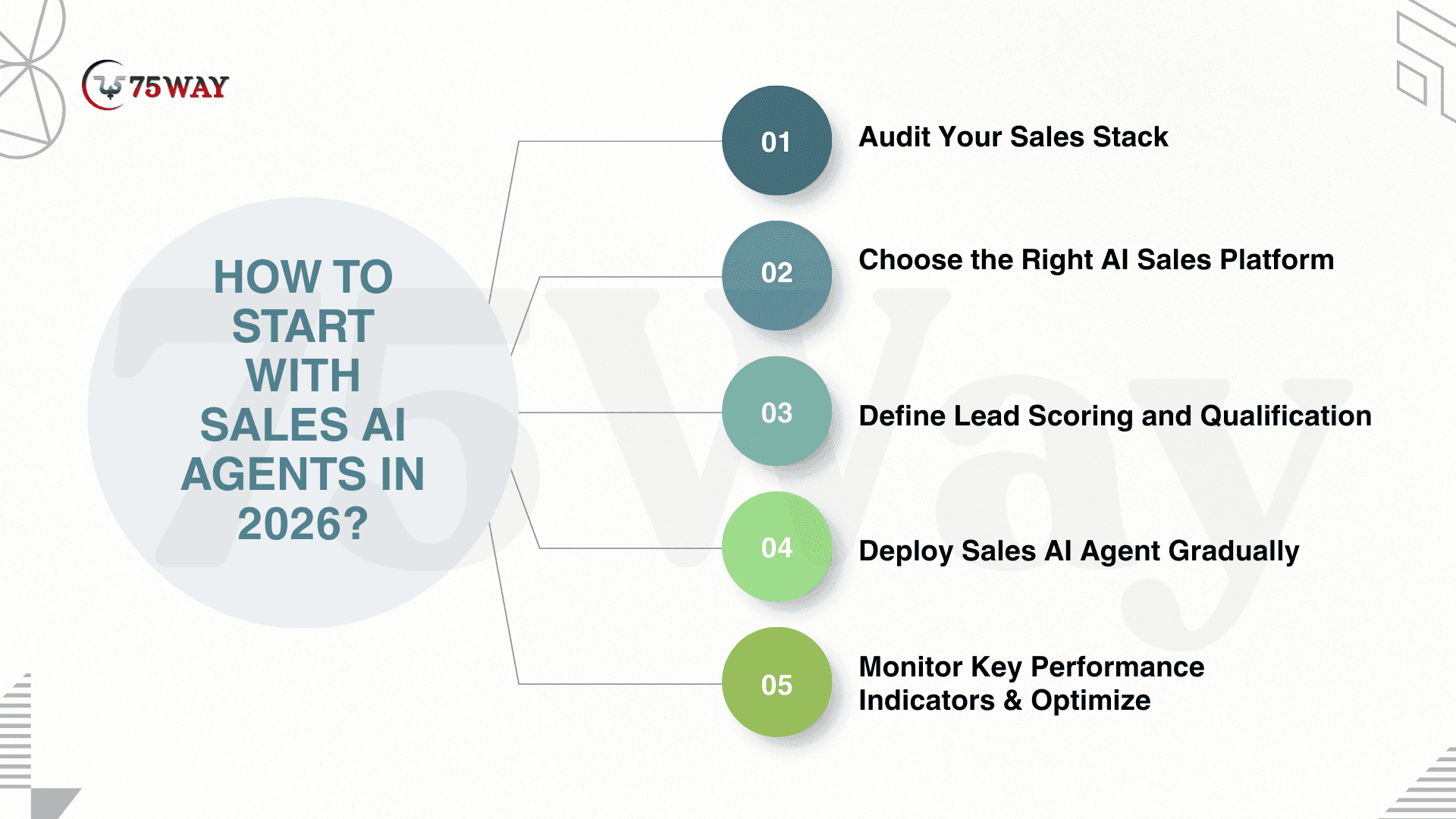
Audit Your Sales Stack
Begin by reviewing your current sales workflows and identifying repetitive, low-value tasks that consume time but do not directly drive revenue. Tasks such as manual data entry, scheduling follow-ups, and lead categorization are ideal for AI automation. By pinpointing these areas, you can focus AI efforts where they provide the most impact, streamline operations, and increase team productivity from the outset.
Choose the Right AI Sales Platform
Select an AI sales platform that integrates seamlessly with your CRM, supports multiple communication channels, and provides real-time analytics. The ideal solution should automatically handle lead management, adapt to your business processes, and deliver actionable insights. Choosing the right platform ensures faster adoption, reduces disruption, and allows your sales team to leverage AI capabilities effectively.
Define Lead Scoring and Qualification
Set clear and measurable criteria for what defines a high-quality lead. AI sales agents rely on these definitions to prioritize prospects, personalize outreach, and focus resources on opportunities most likely to convert. Establishing lead scoring and qualification rules upfront ensures the AI system operates efficiently, reduces wasted effort, and improves conversion rates throughout the sales funnel.
Deploy Sales AI Agent Gradually
When you define lead scoring parameters, the next step is to implement AI agents in phases, starting with simpler tasks such as inbound lead engagement. Once your team gains familiarity, expand AI usage to outbound outreach, automated follow-ups, and CRM maintenance. A gradual rollout allows performance monitoring, workflow adjustments, and ensures AI adoption complements your team rather than overwhelming them. This approach reduces risks while building confidence in the technology.
Monitor Key Performance Indicators and Optimize
The last stage is to track critical metrics such as conversion rate, response time, cost per acquisition, and revenue velocity to evaluate AI agent performance. Continuous monitoring helps identify areas for improvement, optimize workflows, and measure return on investment. Regular optimization ensures AI agents adapt to evolving market conditions, maintain efficiency, and continue driving measurable business growth.
Key Challenges and Mitigation Strategies for Sales AI Agents
Even the most advanced AI sales agents come with challenges that businesses must address to ensure successful implementation. Understanding limitations and planning mitigation strategies helps startups and enterprises maximize benefits while minimizing risks.
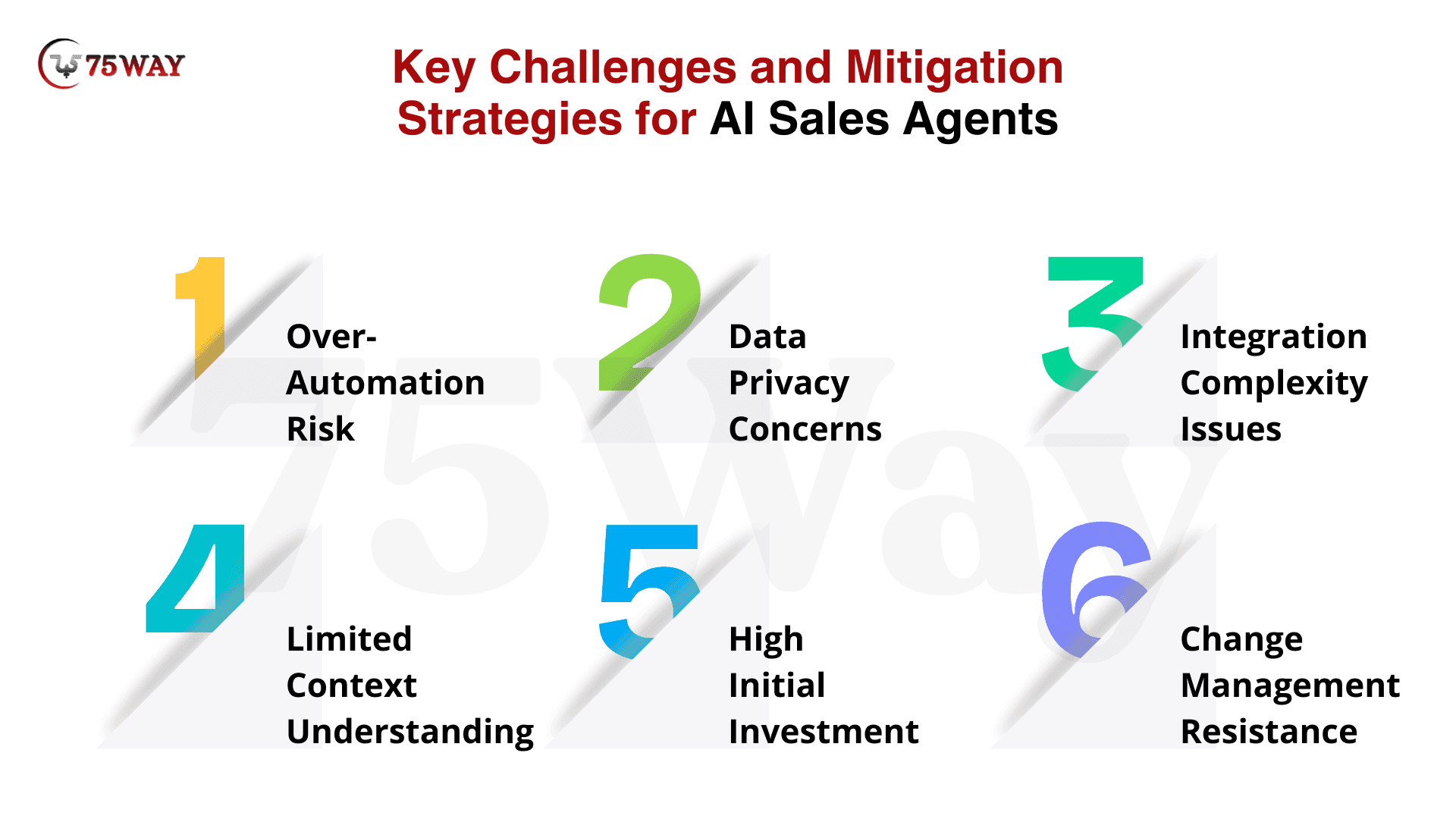
Over-Automation Risk: AI can sometimes handle too many tasks autonomously, leading to impersonal interactions or missed nuances in complex deals. Balancing automation with human oversight ensures critical judgment calls remain with experienced team members, maintaining relationship quality and customer trust.
Data Privacy Concerns: AI agents process sensitive customer data, making privacy and compliance crucial. Choosing platforms that adhere to regulations like GDPR or CCPA safeguards data, prevents legal risks, and ensures ethical handling of client information across all sales workflows.
Integration Complexity Issues: Connecting AI agents to existing CRMs, email systems, and communication platforms can be challenging. Starting with core integrations first, testing thoroughly, and expanding gradually ensures smooth implementation without disrupting current workflows or losing data accuracy.
Limited Context Understanding: AI may struggle with nuanced conversations or highly specialized industries. Human supervision and training with company-specific data help agents understand context better, ensuring interactions remain relevant, persuasive, and aligned with business objectives.
High Initial Investment: Implementing AI sales agents can require upfront costs for software, integration, and training. Planning a phased rollout, focusing on high-impact tasks first, allows businesses to see early ROI while managing budget constraints effectively.
Change Management Resistance: Teams may resist adopting AI due to fear of job replacement or workflow disruption. Clear communication, training, and demonstrating AI as a productivity tool rather than a replacement helps build acceptance and successful adoption.
Final Thoughts
AI sales agents are transforming how startups and enterprises engage leads, optimize workflows, and scale revenue in 2026. By automating repetitive tasks, providing insights, and delivering personalized interactions, these agents increase efficiency, boost conversions, and allow human teams to focus on strategic growth. While challenges such as data privacy, integration complexity, and over-automation exist, they can be mitigated with proper planning, phased deployment, and human oversight. For businesses looking to accelerate adoption and achieve immediate results, the easiest path is to launch pre-built AI sales agents with 75AI Agent Store, gaining access to ready-to-use solutions that integrate seamlessly, save time, and drive measurable ROI from day one.
Frequently Asked Questions (FAQs)
How Do AI Sales Agents Integrate With Existing CRMs?
AI sales agents can seamlessly integrate with most modern CRM systems through built-in connectors or APIs. Integration allows automatic lead capture, follow-up tracking, and data synchronization, ensuring a unified workflow without disrupting existing sales operations.
Can AI Sales Agents Handle Multilingual Communication?
Yes, many AI platforms support multiple languages, enabling businesses to engage prospects globally. Agents can automatically detect language preferences, translate messages accurately, and maintain natural, context-aware conversations across diverse markets.
Are AI Sales Agents Compliant With Data Privacy Regulations?
Reputable AI sales agent platforms adhere to GDPR, CCPA, and other regional data privacy laws. Businesses should choose providers with built-in compliance features, encryption, and secure data storage to protect customer information and reduce legal risk.
How Long Does It Take To Deploy Sales AI Agents?
Deployment time varies depending on complexity, integrations, and customization. Basic implementation for inbound lead engagement can take a few days to weeks, while fully customized workflows may require several weeks, including testing and training.
Can AI Sales Agents Learn From Human Sales Representatives?
Yes, AI sales agents improve over time by analyzing human sales interactions, feedback, and historical data. Continuous learning allows them to adapt to your sales style, refine responses, and provide more context-aware and accurate engagement.
What Support Is Available After AI Sales Agent Deployment?
Most platforms offer ongoing support, including technical assistance, system updates, workflow optimization, and AI model retraining. This ensures the AI agents continue performing effectively, adapting to business changes and evolving customer expectations.