AI Summary
AI sales agents help dealerships turn more inquiries into sales by handling conversations, qualification, follow-ups, and appointments automatically. They respond around the clock while keeping human teams involved when needed. This guide explains how the technology drives dealership conversions.
Key Takeaways
- AI sales agents respond instantly, helping dealerships capture high-intent buyers before competitors.
- Automated qualification identifies serious shoppers and prioritizes valuable dealership sales opportunities.
- AI-powered follow-ups keep prospects engaged without overwhelming dealership sales teams.
- Appointment automation moves qualified conversations toward showroom visits and test drives.
- Human handoffs preserve personal selling while AI handles repetitive conversations around-the-clock.
An automotive dealership can spend heavily on advertising and still lose valuable buyers before a salesperson ever speaks with them. High inquiry volumes, unanswered messages, and delayed follow-ups can quietly create gaps between customer interest and showroom visits.
AI sales agents for car dealerships provide a way to close some of those gaps. They can stay available when sales representatives are occupied, respond to buyer questions, and keep prospects engaged instead of allowing promising inquiries to disappear into an inbox.
The real business advantage comes from giving sales teams a better starting point. Conversations handled by AI-powered sales agents for dealerships can help move prospects forward while human representatives spend more time on discussions that require negotiation, product expertise, or personal attention.
For dealerships considering this approach, the important issue is not whether AI agent development solutions can chat with customers, but whether they can contribute to the sales process. The guide ahead examines how AI sales agents can fit into dealership operations and help improve buyer conversion.
What Is an AI Sales Agent for a Car Dealership?
An AI sales agent is an AI-powered system that communicates with automotive shoppers, understands their intent, answers questions, qualifies leads, follows up, and takes defined sales actions on behalf of a dealership.
Unlike a basic chatbot that mainly answers predefined questions, an AI sales agent can participate in a multi-step sales conversation.
For example: A shopper asks about a used SUV at 9:30 PM.
The sales AI agents for dealerships can identify the vehicle, answer questions about its available information, ask about the shopper's needs, determine whether they are ready to buy, offer available appointment times, and update the appropriate dealership system.
If the shopper asks something outside the agent's authority, such as negotiating a special price, the conversation can be handed off to a salesperson.
That makes the AI agent less like a website widget and more like a digital member of the dealership's sales operation.
Why Vehicle Retailers Are Investing In AI Sales Automation
Modern automotive shoppers do not necessarily follow dealership business hours. A customer might research vehicles during lunch, compare dealerships after work, submit a lead late at night, or ask questions over the weekend.
The problem is that dealership teams cannot manually respond with the same speed and persistence to every inquiry. Recent automotive AI deployments show why the category is attracting attention.
OpenAI reported that Cars24 uses AI-powered agents to handle more than 1 million monthly conversation minutes and recover previously lost seller leads, while automotive AI providers are increasingly positioning agents around lead engagement, qualification, and appointment generation.
- Capture Leads Before Competitors
AI sales agents respond instantly to dealership inquiries, keeping interested shoppers engaged when purchase intent remains highest.
- Automate Personalized Follow-Ups
Automated conversations maintain relevant communication with prospects, reducing missed opportunities caused by delayed or inconsistent dealership follow-ups.
- Qualify Buyers Around The Clock
AI agents identify buyer preferences, budgets, timelines, and vehicle interests, helping sales teams prioritize promising opportunities faster.
- Turn Conversations Into Appointments
AI sales agents guide qualified shoppers toward test drives and showroom visits without requiring constant salesperson involvement.
- Help Sales Teams Close More
By handling repetitive inquiries and administrative tasks, AI agents give salespeople more time for negotiations, relationships, and closing.
How Does a Sales AI Agent for a Car Dealership Work?
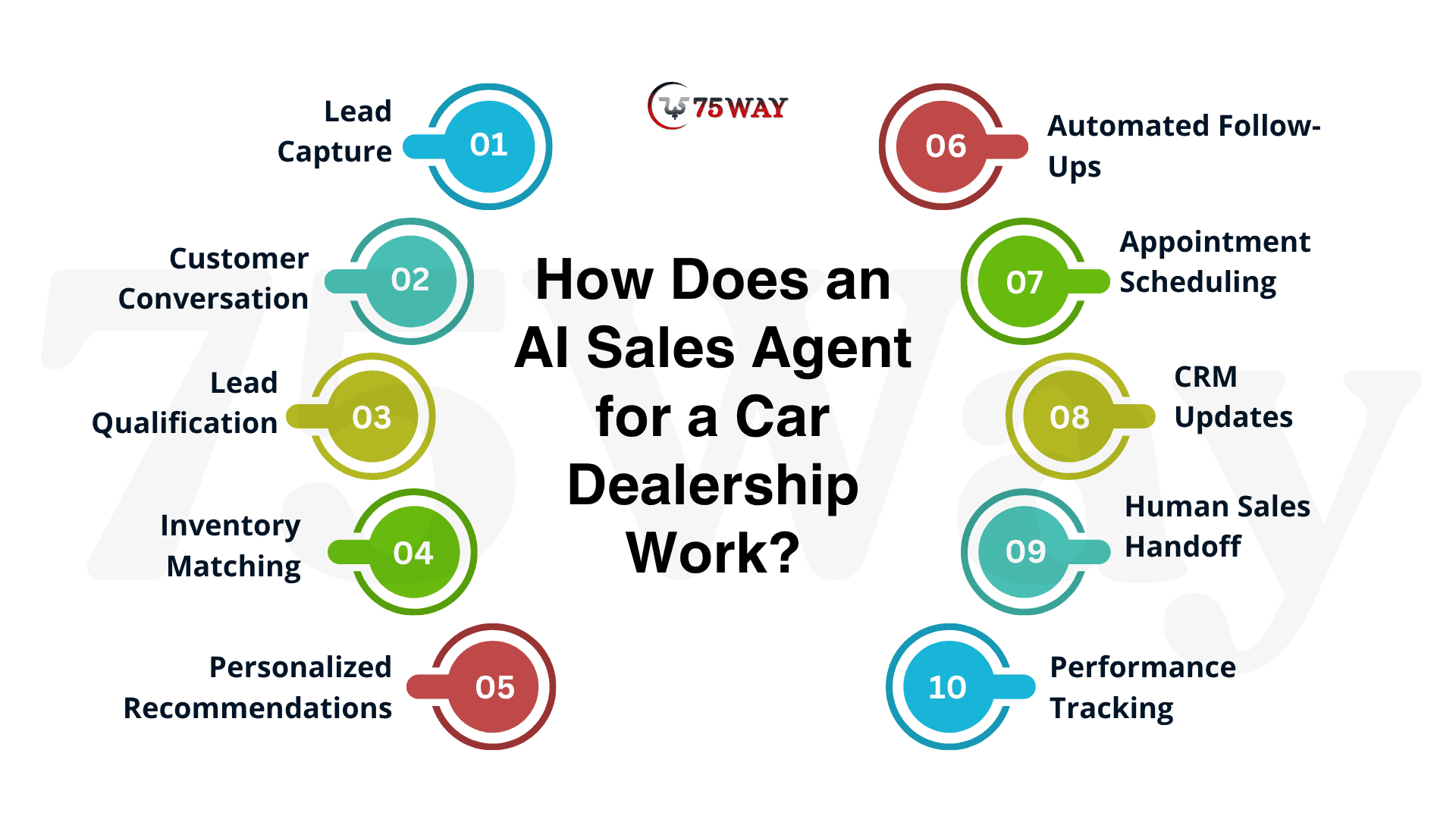
An AI sales agent works as a digital sales assistant that engages shoppers, understands their needs, accesses approved dealership information, and moves qualified prospects toward an appointment or salesperson handoff.
1. Lead Capture
The AI agent connects with the dealership website, messaging channels, lead forms, and other customer touchpoints to capture incoming inquiries immediately.
2. Customer Conversation
The agent starts a natural conversation, answers vehicle-related questions, understands the shopper’s preferences, and provides relevant information based on available dealership data.
3. Lead Qualification
The AI asks targeted questions about budget, preferred vehicle, purchase timeline, financing interest, trade-in plans, and appointment preferences to understand buying intent.
4. Inventory Matching
Connected inventory data allows the agent to identify vehicles that match the shopper’s requirements, helping customers discover relevant options without manually searching the dealership website.
5. Personalized Recommendations
The agent uses the information gathered during the conversation to suggest suitable vehicles, explain relevant features, and guide shoppers toward options matching their needs.
6. Automated Follow-Ups
When shoppers are not ready to buy immediately, the AI can continue personalized follow-ups based on approved dealership workflows instead of allowing promising leads to go cold.
7. Appointment Scheduling
When a shopper shows buying intent, the AI can help schedule a test drive, showroom visit, or conversation with a sales representative.
8. CRM Updates
The agent can integrate with the dealership’s CRM to record conversations, qualification details, lead status, appointment information, and other relevant customer data.
9. Human Sales Handoff
When a customer requests a salesperson, wants to negotiate, asks a complex question, or requires human judgment, the AI transfers the conversation with relevant context.
10. Performance Tracking
Dealership teams can monitor metrics such as response rates, qualified leads, appointments, follow-ups, conversions, and salesperson handoffs to understand the AI agent’s contribution to sales.
How AI Car Dealership Sales Agents Help Automotive Dealers Convert More Buyers
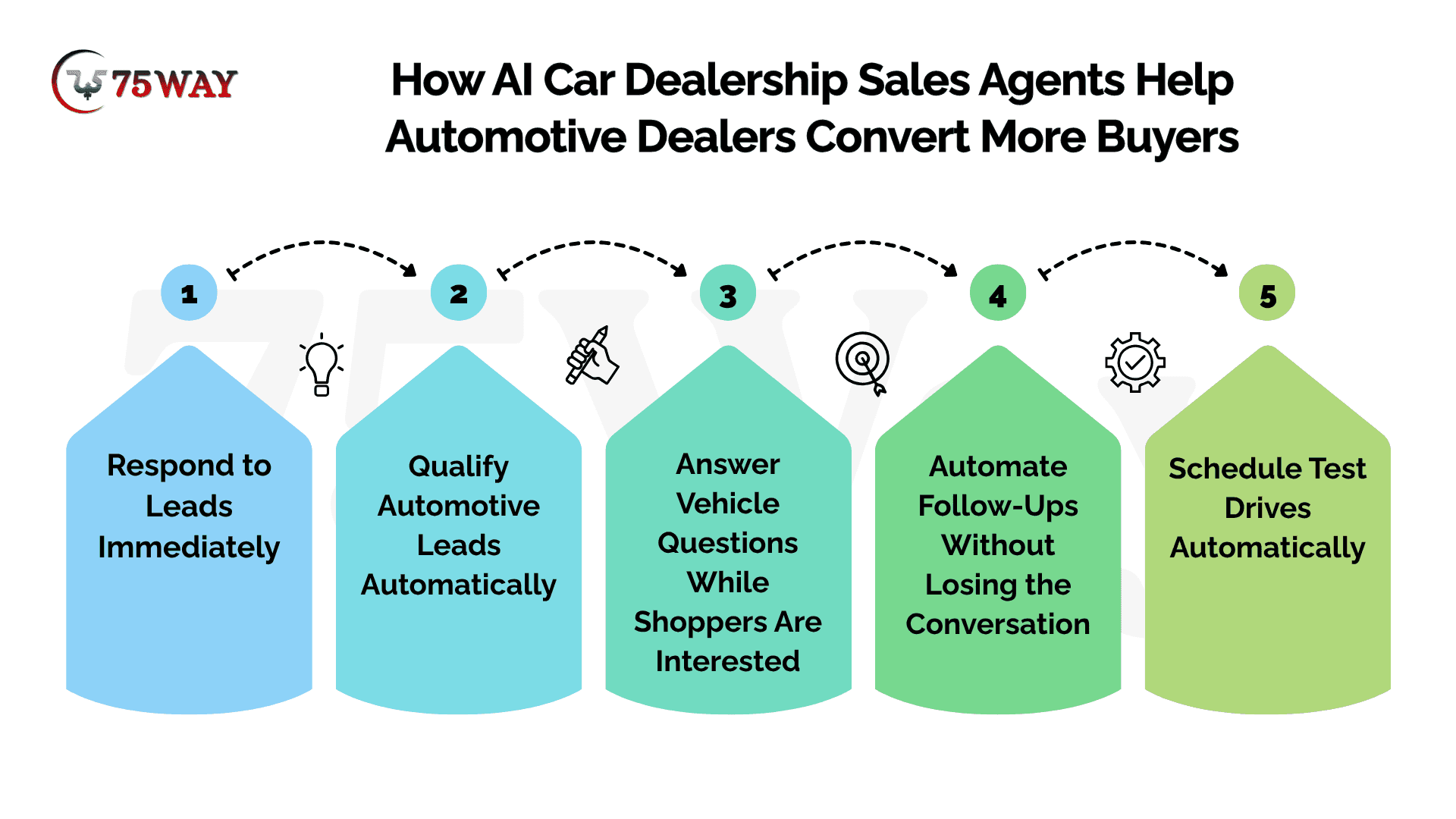
More dealership leads do not automatically mean more cars sold. The difference often comes from what happens after a prospect shows interest, and AI sales agents can help dealerships make those early interactions more productive. The role AI car dealership sales agents can play in turning dealership inquiries into buying opportunities is discussed below.
1. Respond to Leads Immediately
Speed matters when a shopper is actively considering multiple dealerships.
An AI sales agent can respond as soon as a prospect submits a website form, starts a chat, or sends a message through a supported channel.
Instead of:
Lead submitted → salesperson notices → salesperson calls → customer responds later
The experience can become:
Lead submitted → AI responds → shopper engages → lead is qualified → salesperson receives context
That reduces the amount of time between buyer intent and dealership engagement.
The important point is not simply that AI responds quickly. It can also continue the conversation when the shopper is available, including outside normal showroom hours.
2. Qualify Automotive Leads Automatically
Not every dealership lead deserves the same immediate sales attention. One shopper may be ready for a test drive tomorrow. Another may be researching SUVs for the next six months. Another may have a specific budget and trade-in requirement.
AI agents for car dealerships can ask structured questions to understand:
- Vehicle preferences
- New or used preference
- Budget range
- Financing interest
- Trade-in plans
- Purchase timeframe
- Preferred dealership location
- Desired features
- Appointment availability
- Current vehicle ownership
The resulting information can help the sales team distinguish between high-intent opportunities and early-stage shoppers.
AI lead scoring can take this further by ranking prospects according to behavioral and conversational signals. Automotive AI research increasingly highlights lead prioritization as a practical dealership use case.
3. Answer Vehicle Questions While Shoppers Are Interested
Car buyers often have detailed questions before they are ready to contact a salesperson.
They may want to know:
- Is this vehicle available?
- What is the mileage?
- Does it have all-wheel drive?
- How many seats does it have?
- What technology does it include?
- Is financing available?
- Can I schedule a test drive?
- Do you accept trade-ins?
- Is there a similar vehicle in stock?
An AI sales agent connected to reliable dealership data can answer appropriate questions without requiring a salesperson to manually handle every inquiry.
This is where inventory integration becomes critical.
An AI agent should not confidently invent vehicle details simply because a customer asks for them. Its responses need to be grounded in approved dealership information.
4. Automate Follow-Ups Without Losing the Conversation
One of the biggest opportunities for dealership AI is follow-up. A shopper may:
- Ask about a vehicle
- Request pricing
- Stop responding
- Say they are still comparing options
- Delay their purchase
- Miss an appointment
- Show interest but never visit
Traditional sales processes often struggle to maintain personalized follow-up across a large lead database.
An AI sales agent can continue appropriate conversations based on defined rules and customer context.
For example:
Day 1: Answer the shopper's vehicle question.
Day 3: Ask whether they are still considering the vehicle.
Day 7: Share a relevant inventory update.
Later: Re-engage the prospect based on the dealership's approved follow-up strategy.
The objective is not to send endless automated messages.
The objective is to stay relevant long enough for a real buyer to become ready.
5. Schedule Test Drives Automatically
Getting a shopper to schedule an appointment is one of the most valuable transitions in the dealership sales funnel.
An AI car dealership sales automation system can ask:
“Would you like to see the vehicle in person?”
If the shopper says yes, the system can potentially offer available appointment times based on dealership rules and connected scheduling data.
This eliminates unnecessary back-and-forth such as:
Customer: “Can I come Saturday?”
Salesperson: “What time?”
Customer: “Afternoon.”
Salesperson: “Would 2 PM work?”
Customer: “Can we do 3?”
AI can handle that administrative exchange while keeping the sales team informed.
Some current automotive AI deployments are already reporting appointment-focused outcomes; for example, Impel reported a 40% increase in showroom appointments in early dealer deployments of its AI sales solution. Such vendor-reported figures should be evaluated in context rather than treated as universal benchmarks.
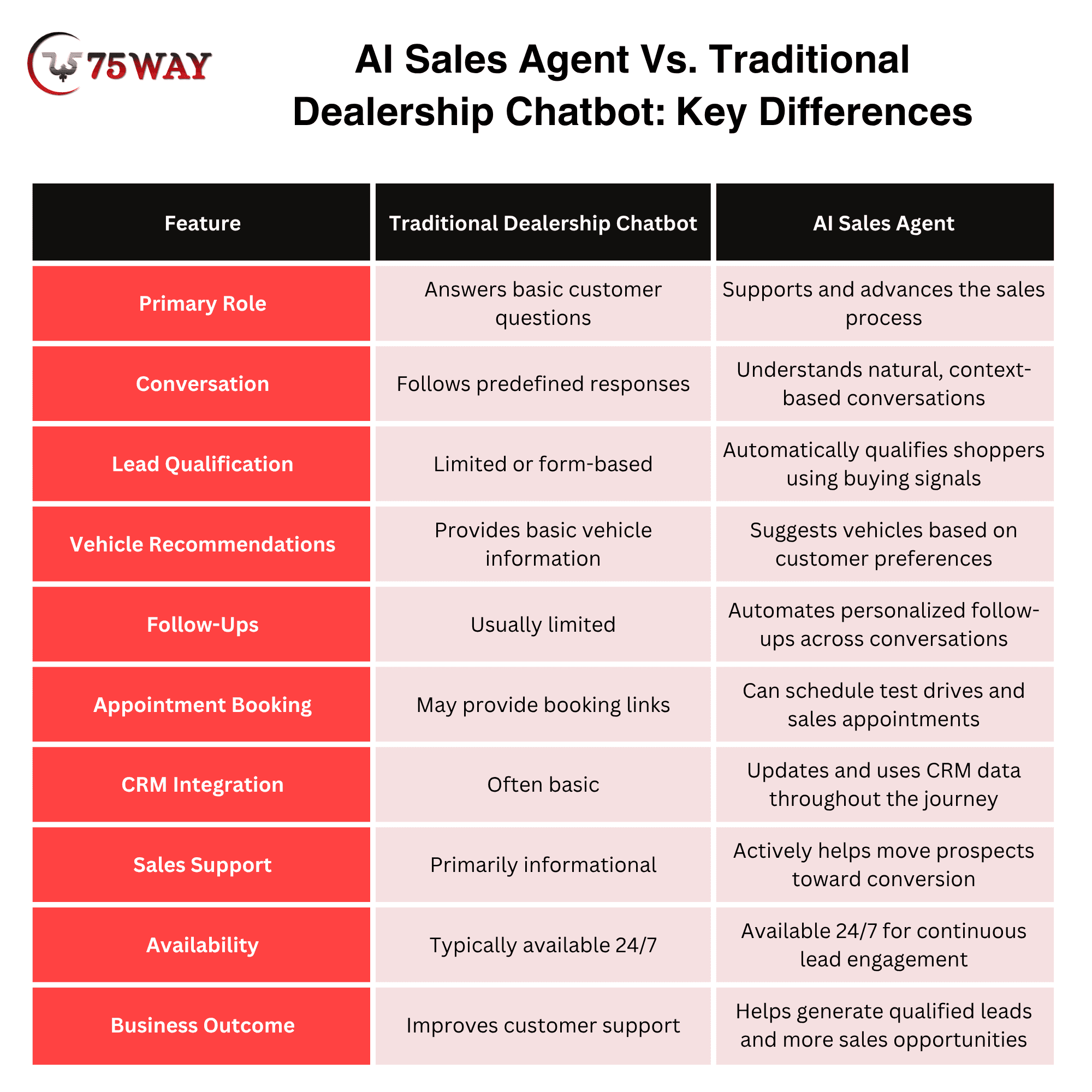
AI Sales Agent Vs. Traditional Dealership Chatbot: Key Differences
The difference between an AI sales agent and a traditional dealership chatbot lies in what they can do for the sales process. A traditional chatbot mainly answers common questions, while an AI sales agent can understand buyer intent, qualify leads, recommend vehicles, follow up, and help move shoppers toward a purchase.
A traditional dealership chatbot usually works with predefined questions and responses. It can provide information about dealership hours, locations, available services, financing options, or basic vehicle details. An AI sales agent goes further by understanding conversations, using dealership data, identifying serious buyers, collecting lead information, and responding based on each shopper’s needs.
The biggest difference is their role in converting leads. A chatbot provides information, while an AI sales agent actively supports the buyer journey. It can continue conversations, handle follow-ups, schedule test drives, update CRM records, and hand qualified prospects to salespeople when human involvement is needed.
A chatbot may answer:
“What are your dealership hours?”
An AI automotive sales agent should be able to support a larger workflow:
“I’m looking for a three-row SUV under $45,000. I have a trade-in and want to come in Saturday.”
The second interaction contains multiple sales signals. The value comes from understanding those signals and moving the buyer toward the next appropriate action.
Automated Sales Workflows For Modern Automotive Dealerships
Automated sales workflows help automotive dealerships capture leads, qualify buyers, manage follow-ups, and schedule appointments with less manual effort. Connected AI systems can keep prospects engaged while giving sales teams better opportunities to focus on serious buyers. These workflows show how modern dealerships can improve each stage of the sales journey.
- Capture And Route New Leads
AI automatically captures inquiries from websites, forms, messaging channels, and campaigns, then routes them to the appropriate sales team or workflow.
- Qualify Buyers Automatically
Automated conversations collect information about vehicle preferences, budget, financing needs, purchase timelines, and trade-ins to identify higher-intent prospects.
- Match Buyers With Vehicles
AI can use customer preferences and connected inventory data to suggest relevant vehicles, helping shoppers move from general interest toward specific options.
- Personalize Lead Follow-Ups
Automated follow-ups maintain conversations through timely messages based on previous interactions, helping dealerships reconnect with prospects who have not responded.
- Schedule Test Drives
Qualified shoppers can receive available appointment options and schedule test drives or showroom visits without waiting for salesperson availability.
- Update CRM Records
Sales workflows can capture conversation details, qualification data, appointment information, and follow-up activity while reducing repetitive manual CRM updates.
- Escalate High-Intent Buyers
AI can recognize strong purchase signals, complex questions, or requests requiring human assistance and transfer the conversation to the right salesperson.
How AI Sales Agents Personalize The Car Buying Journey?
A customer searching for a family SUV should not receive the same conversation as someone comparing performance cars or looking for an affordable commuter vehicle. AI sales agents can use each interaction to make the dealership experience feel more tailored to the individual buyer. The role of AI in creating a more personalized buying journey is discussed in detail below.
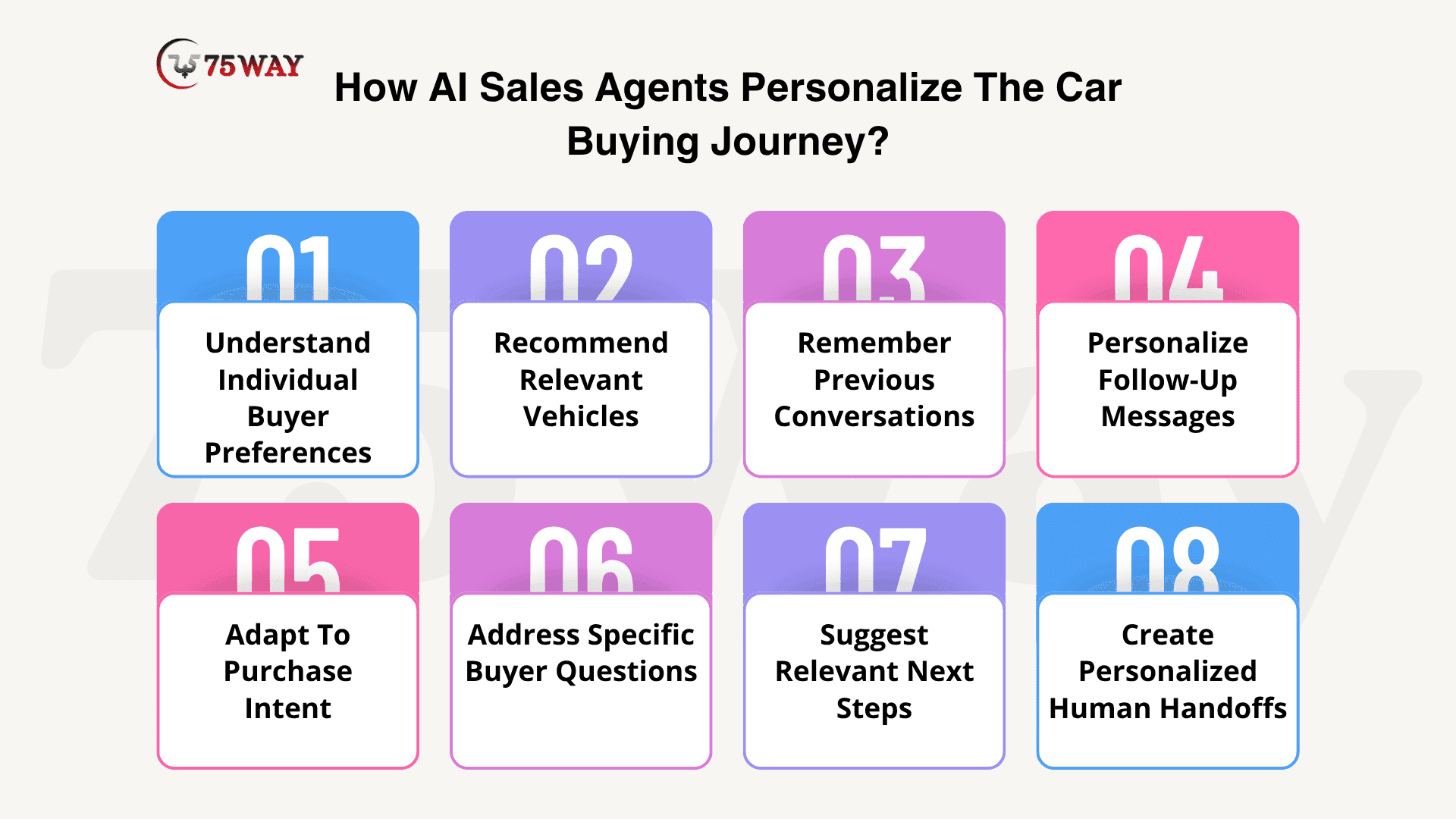
- Understand Individual Buyer Preferences
AI can identify preferences such as vehicle type, budget, features, fuel options, seating capacity, and intended usage during conversations.
- Recommend Relevant Vehicles
Connected inventory data allows AI agents to suggest vehicles that better match each shopper’s requirements, helping reduce unnecessary browsing.
- Remember Previous Conversations
AI can use conversation history to avoid repeating questions and continue discussions naturally when shoppers return later.
- Personalize Follow-Up Messages
Follow-ups can reflect a shopper’s previous interests, preferred vehicle, questions, and buying timeline instead of relying on generic messages.
- Adapt To Purchase Intent
AI can recognize signals showing whether someone is casually researching, comparing vehicles, preparing for a test drive, or ready to buy.
- Address Specific Buyer Questions
Responses can be tailored around individual concerns, including features, availability, pricing, financing, trade-ins, warranties, and dealership processes.
- Suggest Relevant Next Steps
Based on buyer intent, AI can recommend actions such as viewing inventory, requesting details, scheduling a test drive, or speaking with a salesperson.
- Create Personalized Human Handoffs
When a buyer needs personal assistance, the AI can provide salespeople with relevant conversation context, preferences, and questions before transferring the lead.
How AI Virtual Sales Agent For Dealerships Can Help Dealers Recover Lost Leads
Not every lost dealership lead is a lost customer. Some prospects simply lose momentum, get distracted, or move on because the conversation did not continue when they were ready to engage. The role an AI virtual sales agent can play in bringing these prospects back into the buying journey is covered below.
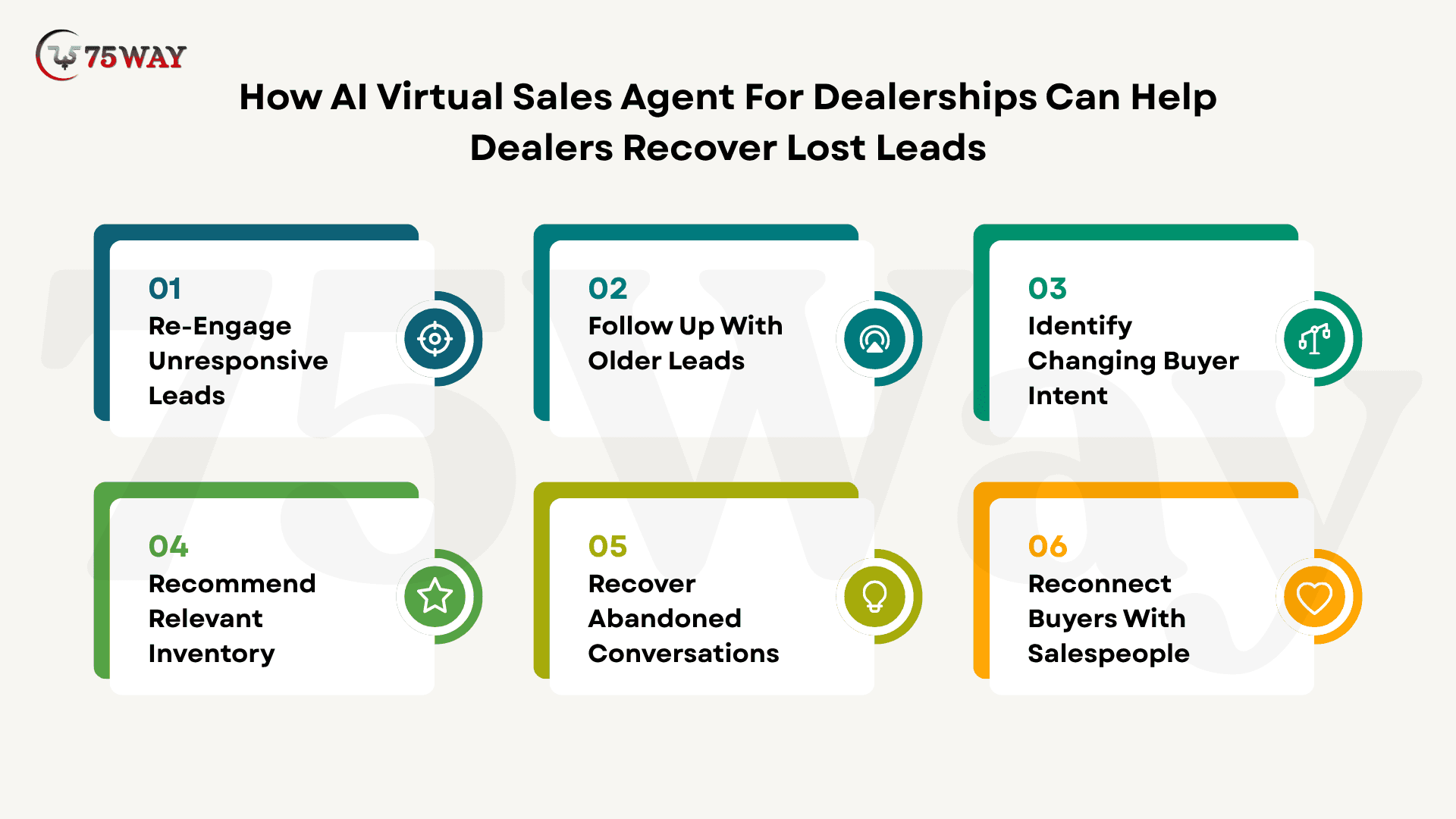
- Re-Engage Unresponsive Leads
AI sales agents can automatically reconnect with prospects who stopped responding, using timely messages based on their previous conversations and interests.
- Follow Up With Older Leads
Past inquiries can receive personalized follow-ups when their vehicle preferences, purchase timeline, or circumstances indicate renewed buying potential.
- Identify Changing Buyer Intent
AI can analyze conversations and responses to recognize when previously inactive shoppers become more interested in purchasing.
- Recommend Relevant Inventory
Updated inventory information allows AI agents to reconnect shoppers with vehicles matching their earlier preferences, budget, or requested features.
- Recover Abandoned Conversations
AI can continue conversations that ended before qualification, appointment booking, or vehicle selection, creating another opportunity to engage the prospect.
- Reconnect Buyers With Salespeople
When a recovered lead shows strong purchase intent, AI can provide conversation context and transfer the opportunity to the appropriate salesperson.
How To Build AI Sales Agent for Car Dealerships: A Complete Process
An AI sales agent can help car dealerships capture leads, qualify shoppers, automate follow-ups, and schedule appointments without relying on manual responses. Building one requires more than connecting an AI model to a chatbot. The process below explains how to create a dealership-ready sales agent.
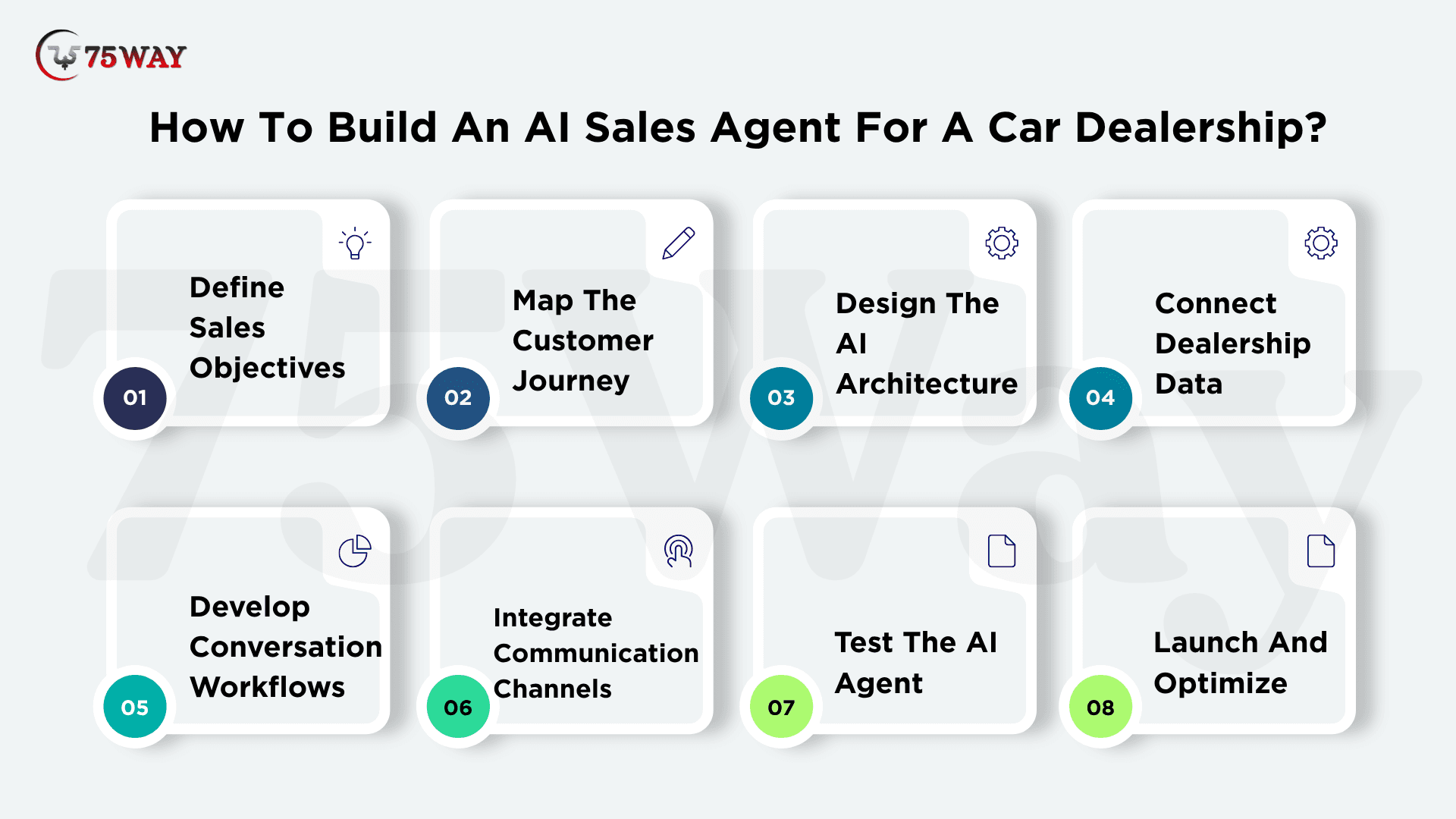
1. Define Sales Objectives
Define the dealership’s sales goals before selecting AI capabilities. Identify where leads are lost, such as delayed responses, weak qualification, missed follow-ups, or low appointment rates. Establish measurable objectives around response time, engagement, appointments, conversions, and revenue so the AI sales agent solves specific business problems effectively.
2. Map the Customer Journey
Map the customer journey across website inquiries, inventory searches, financing questions, trade-ins, appointments, and post-inquiry follow-ups. Document every interaction, decision point, escalation trigger, and salesperson handoff. This workflow map helps determine which conversations AI can automate and where human involvement remains necessary for successful outcomes.
3. Design the AI Architecture
Design the agent architecture around an AI model, knowledge layer, business logic, integrations, conversation management, and analytics. Choose technologies based on expected conversation volume, response requirements, privacy needs, and customization. A modular architecture makes it easier to expand capabilities without rebuilding the complete dealership platform later.
4. Connect Dealership Data
Connect the agent with trusted dealership data sources, including inventory, CRM records, appointment systems, vehicle specifications, pricing rules, and approved sales information. Establish synchronization and validation processes so responses reflect current information. Grounding the agent in reliable data reduces hallucinations and improves customer confidence during conversations.
5. Develop Conversation Workflows
Develop conversation flows that handle common buyer intents naturally. Build prompts, guardrails, qualification questions, recommendation logic, follow-up sequences, and escalation rules. The agent should understand context across conversations while avoiding unauthorized promises about pricing, financing, inventory availability, incentives, or other dealership commitments during customer interactions.
6. Integrate Communication Channels
Integrate communication channels where customers already engage, such as dealership websites, SMS, email, messaging platforms, or voice experiences. Connect these channels with centralized conversation records so shoppers receive coherent interactions. Channel selection should reflect customer preferences, dealership operations, compliance requirements, and available technical integrations for deployment.
7. Test the AI Agent
Test the AI sales agent using realistic dealership scenarios before launch. Evaluate accuracy, response quality, inventory information, lead qualification, appointment scheduling, CRM updates, escalation behavior, security, and performance. Include difficult questions, incomplete information, frustrated customers, unavailable vehicles, and unusual requests to identify potential failures.
8. Launch and Optimize
Launch gradually, monitor measurable sales outcomes, and continuously improve the agent using real conversation insights. Track response times, engagement, qualified leads, appointments, show rates, conversions, handoffs, and customer feedback. Regular optimization helps the AI remain useful as inventory, dealership processes, customer behavior, and business goals change.
How to Implement AI Sales Agents Without Disrupting Dealership Operations
A phased rollout is often more practical than automating the entire sales operation at once. Dealerships can begin with one specific workflow, measure its performance, and gradually expand AI across additional sales activities.
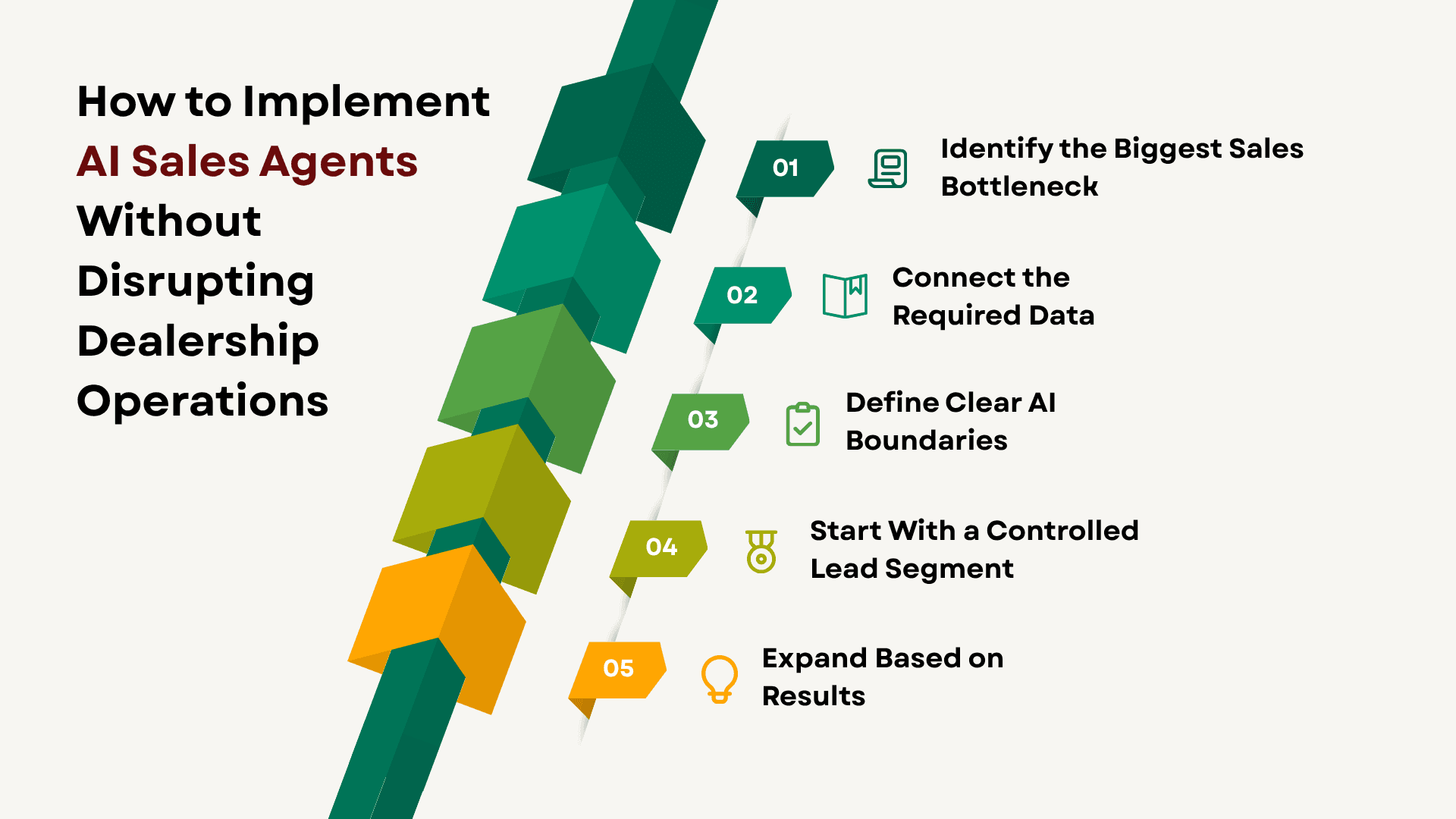
Phase 1: Identify the Biggest Sales Bottleneck
Start by identifying one measurable challenge that is affecting your dealership’s sales performance. Choosing a focused problem makes it easier to evaluate whether the AI sales agent is delivering meaningful results.
Common starting points include:
- Slow lead response times
- Inconsistent lead follow-ups
- Missed appointment opportunities
- Poor engagement with older leads
Phase 2: Connect the Required Data
Connect only the systems needed to support the selected workflow. Depending on the use case, this may include your CRM, inventory management system, website, messaging channels, and appointment scheduling platform.
A focused integration approach can reduce implementation complexity while giving the AI sales agent access to the information it needs.
Phase 3: Define Clear AI Boundaries
Set clear rules for what the AI sales agent can handle independently and when it should involve a salesperson. These boundaries help protect customer experience, dealership policies, and the accuracy of sales conversations.
Define what the agent can:
- Answer
- Recommend
- Schedule
- Update
- Escalate
- Never claim
Clear guidelines are especially important for pricing, discounts, financing information, vehicle availability, and other areas where inaccurate responses could create customer or operational issues.
Phase 4: Start With a Controlled Lead Segment
Avoid sending every dealership lead through the AI system immediately. Begin with a defined lead segment, such as website inquiries, after-hours leads, or older prospects requiring follow-up.
Track measurable outcomes such as:
- Response rates
- Engagement levels
- Qualified leads
- Appointments booked
- Human handoffs
- Customer feedback
- Sales outcomes
This controlled approach gives your team enough data to understand what works before expanding the workflow.
Phase 5: Expand Based on Results
Once the initial workflow demonstrates measurable value, gradually expand the AI sales agent to additional lead sources, communication channels, stores, and sales processes.
The expansion can include new workflows for lead qualification, inventory recommendations, appointment scheduling, follow-ups, and re-engagement. This gradual approach allows dealership teams to adapt while keeping the implementation aligned with actual business results.
How 75way Technologies Can Help Build AI Sales Agents for Car Dealerships
At 75way Technologies, AI sales agent development can be approached as a business automation project rather than simply an AI chatbot implementation.
The platform can be designed around your dealership's actual sales process, including customer conversations, lead qualification, inventory access, CRM integration, appointment scheduling, automated follow-ups, analytics, and human escalation.
Depending on the business requirements, a custom AI sales solution can support:
- Website conversations
- Lead qualification
- Inventory-based recommendations
- Automated follow-ups
- Appointment scheduling
- CRM integration
- Customer segmentation
- Lead prioritization
- Salesperson handoffs
- Conversation analytics
- Multi-location dealership operations
The goal is not to remove your sales team from the process.
It is to give your sales team an AI layer that keeps more opportunities moving until a human salesperson needs to take over.
Final Thoughts
AI sales agents can give car dealerships a faster and more scalable way to engage shoppers, qualify opportunities, maintain follow-up, and turn digital inquiries into appointments. Their strongest value does not come from replacing salespeople; it comes from making sure fewer promising leads are ignored, delayed, or forgotten.
For dealerships, the most practical starting point is a clearly defined sales problem such as slow lead response, inconsistent follow-up, poor lead qualification, or low appointment conversion. From there, AI can be connected to the dealership's inventory, CRM, scheduling, and communication systems and measured against real sales KPIs.
The dealerships that benefit most will not be those that simply add an AI chatbot. They will be the ones that build AI into the actual sales workflow, give the agent reliable business data, establish clear escalation rules, and continuously optimize the system around customer and revenue outcomes. To turn more dealership leads into buyers, you can partner with a trusted AI development company to build an AI sales agent tailored to your automotive sales workflow.
Frequently Asked Questions (FAQs)
What is An AI Sales Agent For A Car Dealership?
An AI sales agent is software that communicates with automotive shoppers, answers approved questions, qualifies prospects, follows up, schedules appointments, and transfers qualified opportunities to dealership salespeople.
Can AI Sales Agents Replace Dealership Salespeople?
No. AI is better suited to repetitive communication, qualification, follow-up, and scheduling, while salespeople remain valuable for negotiation, demonstrations, relationship building, and complex customer decisions.
How Can AI Increase Dealership Lead Conversion?
AI can engage leads quickly, qualify them, maintain follow-up, identify buying intent, schedule appointments, and route high-value opportunities to salespeople with relevant customer context.
Can an AI Sales Agent Access Dealership Inventory?
Yes, when properly integrated with an approved inventory system or data source. The agent should use current, verified inventory information rather than generate vehicle details independently.
Can AI Sales Agents Follow Up With Old Dealership Leads?
Yes. AI can be configured to re-engage appropriate inactive leads using approved messaging, customer history, and dealership-defined follow-up rules.
Can an AI Sales Agent Schedule Test Drives?
Yes. With access to an appropriate scheduling system, an AI agent can identify customer intent and guide qualified shoppers toward available test-drive or showroom appointments.
Should Dealerships Use AI For Every Customer Conversation?
No. AI should handle suitable repetitive and informational interactions while escalating negotiations, complaints, complex questions, and high-value conversations to human salespeople.