Summary
This guide explains AI development for startups, covering the lifecycle, types of AI services, real-world applications, costs, timelines, common mistakes, and benefits. It shows how founders can strategically leverage AI to automate workflows, generate insights, improve customer experience, and achieve measurable business impact.
Quick Overview
- AI solutions automate operations, predict trends, and support strategic business decisions.
- Machine learning, NLP, computer vision, and AI automation drive intelligent systems.
- High-quality data is critical for accurate, reliable, and scalable AI solutions.
- Startups must define clear problems to maximize the success and ROI of AI projects.
- Generative AI, chatbots, and RPA improve efficiency, personalization, and user engagement.
- Avoid overcomplicating MVPs and plan scalability for sustainable AI growth
Every startup today is under pressure to do more with fewer people, tighter budgets, faster growth expectations. And that’s exactly where AI changes the game.
Companies are using AI to automate operations, predict customer behavior, reduce support costs, personalize user experiences, and build smarter digital products. But while everyone talks about AI, very few founders clearly understand what AI development actually involves, or whether it’s right for their business. Is it expensive? Do you need massive data? How long does it take? What kind of ROI can you expect
This beginner-friendly guide answers all of that. You will learn what AI development really means, how it works step-by-step, the types of AI solutions available, estimated costs, timelines, and how startups can strategically use AI to scale faster and compete smarter
What Is Artificial Intelligence (AI) Development?
AI development is the process of designing, building, training, and deploying intelligent software systems that can analyze data, learn patterns, make predictions, and automate decision-making without constant human intervention.
In simple terms, imagine you run an online store and want to increase sales without hiring more staff. You build an enterprise AI system that studies customer behavior, predicts what they’re likely to buy, and automatically shows personalized product recommendations. Creating, training, and integrating that intelligent system into your website is AI development. Unlike traditional software, which follows fixed rules, AI-powered applications and software improve over time as they process more data
What Does AI Development Approach Include?
AI development is not a single technology. It is a combination of specialized disciplines that work together to build intelligent business systems. Each component solves different operational, analytical, or customer-focused challenges.
Machine Learning (ML): It involves building algorithms that learn patterns from historical data and improve performance over time without explicit programming. Businesses can use machine learning models to forecast sales, detect fraud, personalize recommendations, and predict customer behavior.
Natural Language Processing (NLP): It enables AI-powered software to understand, interpret, and respond to human language in both text and speech. It powers chatbots, sentiment analysis tools, email automation systems, AI voice assistants, and intelligent search engines.
Computer Vision: This technology allows systems to analyze and interpret visual information from images or videos. Businesses can deploy this technology for facial recognition, quality inspection, medical imaging analysis, inventory tracking, and security monitoring applications.
Predictive Analytics: Predictive Analytics uses statistical models and machine learning techniques to forecast future outcomes based on historical data. Companies apply advanced analytics to demand forecasting, risk assessment, customer churn prediction, and revenue planning.
Generative AI: Generative AI creates new content such as text, images, audio, video, or code based on learned patterns from large datasets. It supports content automation, product design, AI assistants, and software development acceleration.
AI Automation: AI Automation combines intelligent decision-making with workflow systems to reduce manual tasks. AI workflow automation tools improve operational efficiency by automating invoice processing, customer onboarding, HR screening, document classification, and repetitive back-office operations.
AI Chatbots & Virtual Assistants: AI chatbots and virtual assistants simulate human conversations to provide instant customer support and lead engagement. They reduce response time, lower support costs, and enhance user experience across websites and mobile apps
How AI Development Lifecycle Works?
AI development is a structured, multi-step process that enables startups and businesses to create intelligent systems capable of learning, prediction, automation, and improved decision-making. Each stage ensures AI solutions are aligned with strategic objectives, scalable, reliable, and deliver measurable business outcome
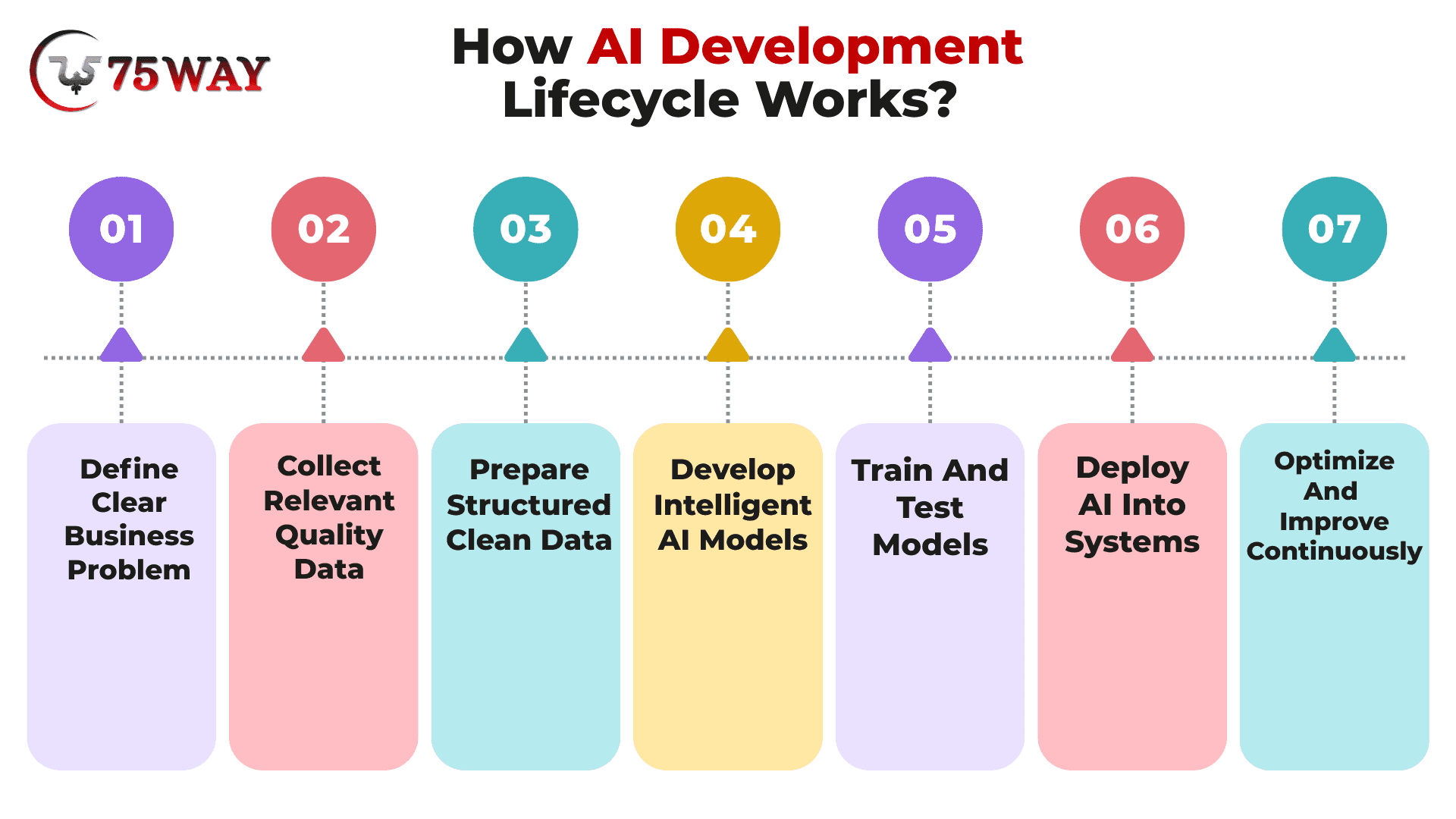
Define Clear Business Requirements
A clear business problem is the foundation of successful AI development. Without a specific goal, AI products often fail or deliver minimal impact. Startups must identify which operational challenges or strategic objectives AI will address, ensuring the solution aligns with measurable KPIs and provides tangible business value.
- Identify precise business goals and define measurable KPIs
- Analyze existing workflows and pinpoint inefficiencies to automate
- Evaluate customer challenges where AI can add value
- Align AI initiatives with strategic growth objectives
- Prioritize problems solvable with predictive intelligence and automation
- Confirm expected ROI before initiating process of building AI
Collect Relevant Quality Data
Data is the backbone of AI systems. High-quality, relevant, and sufficient datasets are critical for training accurate models. This step involves gathering both structured data, like spreadsheets and CRM records, and unstructured data, such as text, images, and audio. Proper collection ensures the AI can learn effectively and produce actionable insights for decision-making.
- Gather structured datasets from internal and external business sources
- Collect unstructured datasets like text, images, and audio records
- Ensure data accuracy, completeness, and consistency across sources
- Comply with data privacy and security regulations effectively
- Identify patterns and anomalies to improve model learning
- Verify datasets are relevant to the defined business problem
Prepare Structured Clean Data
Raw data is often inconsistent, incomplete, or unorganized. Data preparation ensures AI models can learn effectively by cleaning, normalizing, labeling, and structuring information. This step also involves splitting data into training, validation, and test sets. Proper data preparation directly impacts model accuracy, reliability, and the quality of AI predictions.
- Remove duplicates, inconsistencies, and irrelevant information from datasets
- Normalize numerical and categorical data for model compatibility
- Label data accurately for supervised machine learning tasks
- Split datasets into training, validation, and test portions
- Ensure data quality to enhance AI model performance
- Organize data for seamless integration with AI development pipelines
Develop Intelligent AI Models
AI model development involves designing machine learning, deep learning, or hybrid algorithms that learn from data. AI developers choose the appropriate model type, create neural network architectures if needed, and ensure the AI system can predict outcomes, automate processes, and solve the defined business problem.
- Select AI or ML algorithms aligned with business requirements
- Design model architecture, parameters, and neural network structures
- Build prototypes to evaluate early model feasibility and accuracy
- Integrate business rules into model development where necessary
- Test multiple approaches to identify optimal model performance
- Ensure models align with defined business objectives and KPIs
Train and Test AI Models
Training involves feeding the model with datasets to learn patterns, while testing ensures it performs accurately under real-world conditions. This iterative process improves precision, recall, and reliability. Proper training and testing for AI models are essential to deliver actionable, trustworthy insights and automate decision-making without errors.
- Train models using high-quality, structured datasets
- Validate model performance with unseen test data
- Optimize parameters to improve accuracy and reliability
- Evaluate performance using precision, recall, and other metrics
- Test the model under real-world scenarios for robustness
- Iterate and refine models for continuous improvement
Deploy AI Into Systems
Deployment integrates the trained AI model into business operations, such as web applications, mobile apps, SaaS platforms, or internal dashboards. Proper deployment ensures seamless operation, real-time data processing, and end-user interaction, delivering measurable business value and automation benefits.
- Integrate AI models into web, mobile, and SaaS platforms
- Ensure seamless data flow between AI and business systems
- Monitor performance for consistency and error-free operation
- Enable real-time predictions and decision-making automation
- Provide user-friendly interfaces for operational teams
- Document deployment processes for maintenance and scalability
Optimize and Improve Continuously
AI systems improve over time by learning from new data and user feedback. Continuous monitoring, retraining, and performance evaluation enhance accuracy, adapt to changing business needs, and ensure long-term value. Optimization ensures AI remains a scalable and sustainable solution.
- Monitor AI model performance using metrics and KPIs
- Retrain models with new or updated datasets regularly
- Adjust algorithms to reflect changing business environments
- Incorporate user feedback for improved accuracy and relevance
- Optimize resource usage for faster, cost-effective operations
- Scale AI solutions to handle larger datasets efficiently
Why AI Solutions Matter for Startups and Businesses?
Startups often face unique challenges: limited budgets, small teams, intense competition, and immense pressure to scale quickly. In this fast-paced environment, every decision must maximize efficiency and growth. AI development empowers startups to overcome these constraints by automating repetitive tasks, streamlining operations, and generating actionable insights from complex datasets. By leveraging intelligent systems, founders can focus on strategic initiatives rather than manual processes, making their teams more productive and their resources more impactful.
Moreover, AI allows businesses to make data-driven decisions, improve customer experiences, and gain a competitive edge. From predictive analytics to AI-powered automation, startups can personalize offerings, forecast trends, detect anomalies, and reduce operational costs without increasing headcount. Investing in AI development enables early-stage companies to scale faster, optimize workflows, and respond dynamically to market changes, ensuring long-term sustainability and measurable growth
Types of Artificial Intelligence Services
AI development encompasses a wide range of services tailored to meet diverse business needs. Startups and enterprises leverage AI to automate workflows, enhance decision-making, optimize operations, and deliver personalized experiences. From custom AI solutions to advanced agentic AI systems, each service addresses specific challenges, helping businesses scale efficiently, reduce operational costs, and gain a competitive advantage in a fast-evolving market
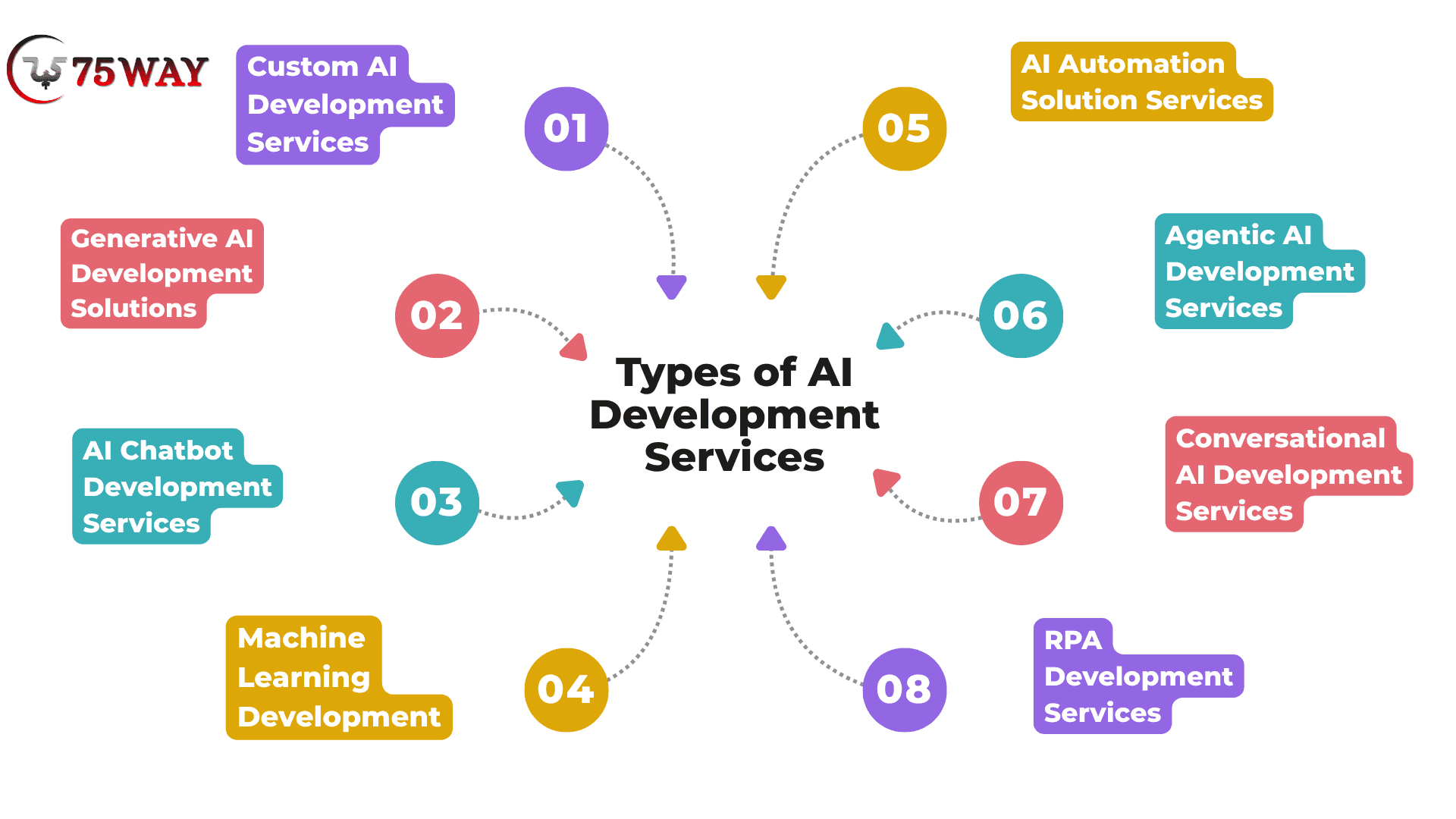
Custom AI Development Services
Custom AI development focuses on building tailored intelligent systems designed specifically for a business’s unique needs. These solutions integrate AI-powered analytics, automation, and machine learning to improve operational efficiency, optimize workflows, and support data-driven decision-making, delivering measurable ROI.
Generative AI Development Solutions
Generative AI solutions create content such as text, images, code, or reports by learning patterns from large datasets. Startups use generative AI to automate creative processes, improve productivity, enhance personalization, and accelerate product development while reducing manual workload.
AI Chatbot Development Services
AI chatbots streamline customer interactions by automating support, lead generation, and engagement. Leveraging natural language processing and machine learning, these chatbots understand queries, respond instantly, improve customer satisfaction, reduce operational costs, and provide consistent 24/7 service.
Machine Learning Development
Machine learning solutions build models that learn from data without explicit programming. Businesses use ML to predict customer behavior, detect fraud, forecast sales, optimize operations, and extract actionable insights from structured and unstructured datasets.
AI Automation Solution Services
AI automation solutions replace repetitive manual processes with intelligent systems. With AI integration into workflows such as invoice processing, HR screening, document classification, and operational routing, businesses save time, reduce errors, improve productivity, and scale efficiently.
Agentic AI Development Services
Agentic AI systems act autonomously to make decisions and perform tasks without continuous human intervention. Startups use agentic AI to manage complex processes, optimize resource allocation, and execute strategic workflows, enhancing operational efficiency and competitive advantage.
Conversational AI Development Services
Conversational AI solutions enable human-like interactions across multiple platforms, including AI chatbots, AI voice agents, and virtual assistants. These systems leverage NLP and machine learning to deliver personalized customer experiences, resolve queries efficiently, and improve engagement and brand loyalty.
RPA Development Services
Robotic Process Automation (RPA) development uses AI to automate repetitive, rule-based tasks. By integrating RPA with intelligent AI systems, businesses can handle high-volume operations, reduce human error, improve efficiency, and focus teams on strategic, value-driven activities.
Real-World Business Applications of AI
Artificial Intelligence is no longer a futuristic concept. It is actively transforming industries and helping businesses make smarter decisions, reduce operational costs, and improve customer experiences. Startups and enterprises are leveraging AI to automate workflows, extract actionable insights, and deliver highly personalized services, gaining a competitive edge in fast-paced markets.
E-commerce: AI analyzes customer behavior, browsing patterns, and purchase history to deliver personalized product suggestions. By predicting what customers are likely to buy, businesses can increase sales, improve engagement, and enhance the overall shopping experience.
Healthcare: AI assists healthcare providers by analyzing patient data to predict diseases, suggest diagnoses, and recommend treatments. Machine learning models can detect anomalies in medical imaging, improving early detection and supporting better clinical decisions.
Finance: AI-driven fraud detection systems analyze transactional patterns in real-time to identify suspicious activity. Financial institutions use these models to reduce risks, protect customers, and comply with regulatory requirements.
SaaS Industry: AI-powered analytics dashboards help SaaS companies visualize complex data, generate actionable insights, and make data-driven decisions faster. Predictive models and automation improve operational efficiency and customer satisfaction.
Marketing: AI helps marketers optimize campaigns by analyzing audience behavior, engagement metrics, and content performance. From generating personalized messaging to A/B testing, AI improves reach, engagement, and ROI.
Human Resources: AI streamlines recruitment by automatically analyzing resumes, identifying top candidates, and matching skills to job requirements. This reduces hiring time, improves candidate quality, and frees HR teams to focus on strategic tasks.
Common Mistakes Startups Make While Building AI
Many startups dive into AI without a clear strategy, risking wasted resources, delayed results, and ineffective solutions. Common pitfalls include undefined problems, poor data quality, inexperienced teams, overcomplicated MVPs, and a lack of scalability planning. Avoiding these mistakes ensures AI delivers measurable impact, improves efficiency, and supports long-term business growth.
Building AI Without A Defined Problem: Many startups start AI projects without a clear business problem, leading to wasted resources and ineffective solutions. Clearly defining the problem ensures AI delivers measurable value and aligns with strategic objectives.
Ignoring Data Quality: Poor-quality data produces inaccurate or biased AI models. Startups must collect, clean, label, and structure relevant datasets to ensure predictions are reliable and actionable for decision-making.
Hiring Freelancers Instead of Experienced Teams: Freelancers may lack the expertise to handle complex AI systems. Engaging experienced AI developers or dedicated teams ensures scalable, reliable solutions with long-term maintainability and higher ROI.
Overcomplicating MVP: Overloading a minimum viable AI product with too many features delays deployment and increases risk. Startups should focus on core functionality in MVP development and validate the model before scaling or adding complexity.
Not Planning Scalability: Failing to design AI systems for growth limits their future value. Startups should build flexible, robust architectures that can handle increasing data, users, and complexity without major rework
Final Thoughts
AI development is no longer optional. It is a strategic necessity for startups and businesses aiming to scale efficiently, reduce costs, and stay competitive. By understanding the AI lifecycle, choosing the right development services, and avoiding common mistakes, founders can leverage intelligent systems to make data-driven decisions, automate workflows, and deliver measurable business impact. Implementing AI strategically, rather than experimentally, ensures long-term growth, operational efficiency, and a sustainable competitive advantage in today’s fast-evolving market. Want to transform your business? Contact an expert AI development company to build intelligent solutions that drive growth and efficiency today.