AI Summary
Discover why AI Playgrounds have become an essential part of AI agent development. This guide explains their role in testing prompts, comparing AI models, validating workflows, reducing development risks, and accelerating deployment. You'll also explore key features, practical benefits, real-world applications, common challenges, and expert best practices for building reliable AI agents.
Quick Overview
- Understand AI Playground's role throughout the AI agent development lifecycle from testing to deployment.
- Explore practical benefits that improve agent accuracy, reliability, and overall development speed.
- Learn which AI Playground features simplify prompt engineering and workflow validation.
- Discover use cases across customer service, healthcare, finance, and enterprise automation.
- Avoid common development mistakes with proven AI Playground testing and optimization practices
Every successful AI agent starts with hundreds of experiments before it reaches users. That experimentation happens inside an AI Playground, a space where AI agent developers test prompts, compare models, refine workflows, and understand how an agent responds in different situations. This is exactly why the benefits of AI Playground in AI agent development have become a major talking point for businesses and AI teams building production-ready agents.
Without an AI Playground, improving an AI agent often becomes a slow process of trial and error. Teams spend more time debugging responses, adjusting prompts, and fixing unexpected behavior after deployment instead of identifying issues early during development.
This guide explores the benefits of AI Playground while creating an AI agent, explains how it accelerates testing and optimization, and shows why it has become an essential part of building reliable AI-powered agents in 2026.
What Is An AI Playground?
An AI Playground is an interactive testing environment where developers can experiment with large language models (LLMs), prompts, AI agent workflows, and model parameters before integrating them into a production application. Instead of writing code for every small change, teams can immediately test ideas, evaluate outputs, and refine agent behavior from a single interface.
Think of it as a laboratory for AI development. Just as software engineers use sandbox environments to test new features without affecting live systems, AI developers use Playgrounds to understand how models respond under different conditions.
Whether adjusting prompts, changing temperature settings, testing function calling, or comparing multiple models, every experiment happens in an isolated environment designed for rapid iteration.
Modern AI Playgrounds have evolved far beyond simple prompt-testing tools. Today, they support capabilities such as tool invocation, Retrieval-Augmented Generation (RAG) testing, structured outputs, memory validation, API integration, and multi-turn conversations. This makes them an essential component of building intelligent AI agents that can perform complex tasks reliably.
For organizations developing AI-powered applications, Playgrounds reduce uncertainty. Instead of guessing how an AI agent might respond in production, developers can validate behavior, identify weaknesses, and improve performance long before users interact with the final product.
Why AI Playgrounds Have Become Essential For Creating AI Agent?
A reliable AI agent depends on rapid experimentation, not endless trial and error. Every improvement demands quick testing, smarter comparisons, and faster decisions across different AI models. Key reasons behind this growing shift become clear through the insights ahead.
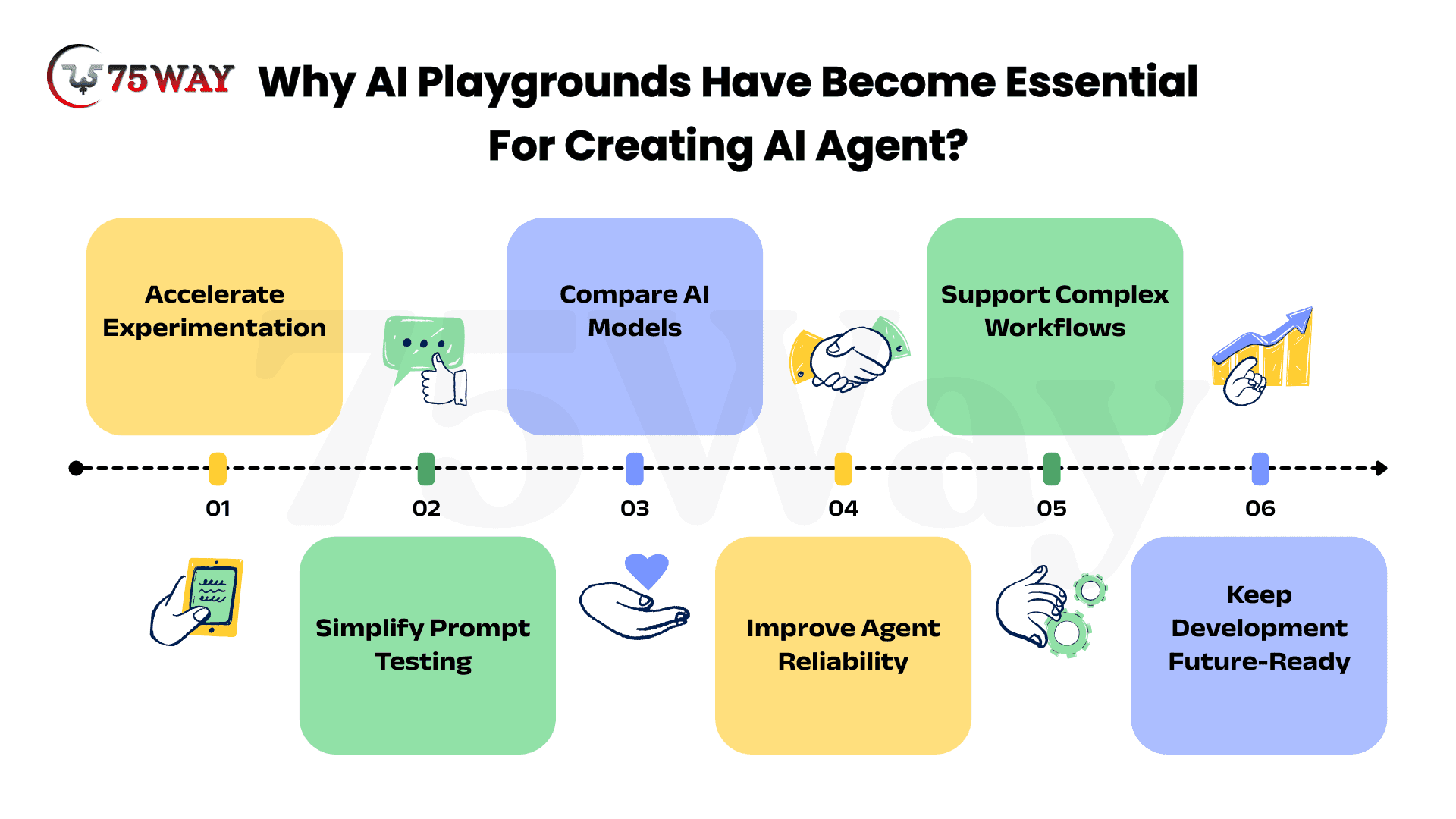
- Accelerate Experimentation: Every prompt adjustment produces immediate results without repeated deployments or lengthy testing cycles. Faster feedback allows developers to refine AI agent behavior with greater confidence and efficiency.
- Simplify Prompt Testing: Multiple prompt variations can be evaluated within minutes under identical conditions. Better comparisons help teams identify responses that align with business goals and user expectations.
- Compare AI Models: Different language models respond uniquely to identical instructions and scenarios. Side-by-side evaluation highlights strengths, weaknesses, costs, and performance before implementation begins.
- Improve Agent Reliability: Consistent testing reveals unexpected outputs before they affect real users or business processes. Early validation reduces errors while strengthening overall AI agent performance.
- Support Complex Workflows: Modern AI agents handle APIs, documents, memory, and multi-step automation simultaneously. Practical testing ensures every workflow functions smoothly before production deployment.
- Keep Development Future-Ready: New foundation models introduce changing capabilities, limitations, and response quality over time. Continuous evaluation helps teams adopt better models without disrupting existing AI solutions.
How AI Playgrounds Fit Into The AI Agent Creation Lifecycle?
Developing an AI agent involves much more than connecting an LLM through an API. Every stage requires testing, validation, and optimization to deliver reliable results. An AI Playground supports nearly every phase of this lifecycle.
1. Idea Validation
Development often begins by exploring whether an AI agent can realistically solve a business problem. Teams experiment with different prompts, user scenarios, and response formats to determine project feasibility before committing engineering resources.
2. Prompt Engineering
The quality of prompts directly influences agent performance. AI Playgrounds allow developers to rewrite instructions, refine system prompts, introduce contextual information, and compare outputs until the desired behavior is achieved.
3. Model Selection
Different models excel at different tasks. One may perform better in reasoning, another in coding, and another in summarization. AI Playgrounds allow developers to compare outputs using identical prompts, making model selection more informed and data-driven.
4. Workflow Testing
Modern AI agents frequently interact with external systems, databases, APIs, and business applications. Playgrounds help validate these workflows before integrating them into production environments, reducing implementation risks.
5. Performance Optimization
After identifying successful workflows, developers continue refining response quality, latency, token consumption, and conversational consistency. This optimization process significantly improves the final user experience.
Premium Benefits of AI Playground In Building AI Agent
From early experimentation to production readiness, AI Playgrounds help teams build more reliable and capable AI agents with greater confidence. Below are the most significant benefits they provide throughout the development process.
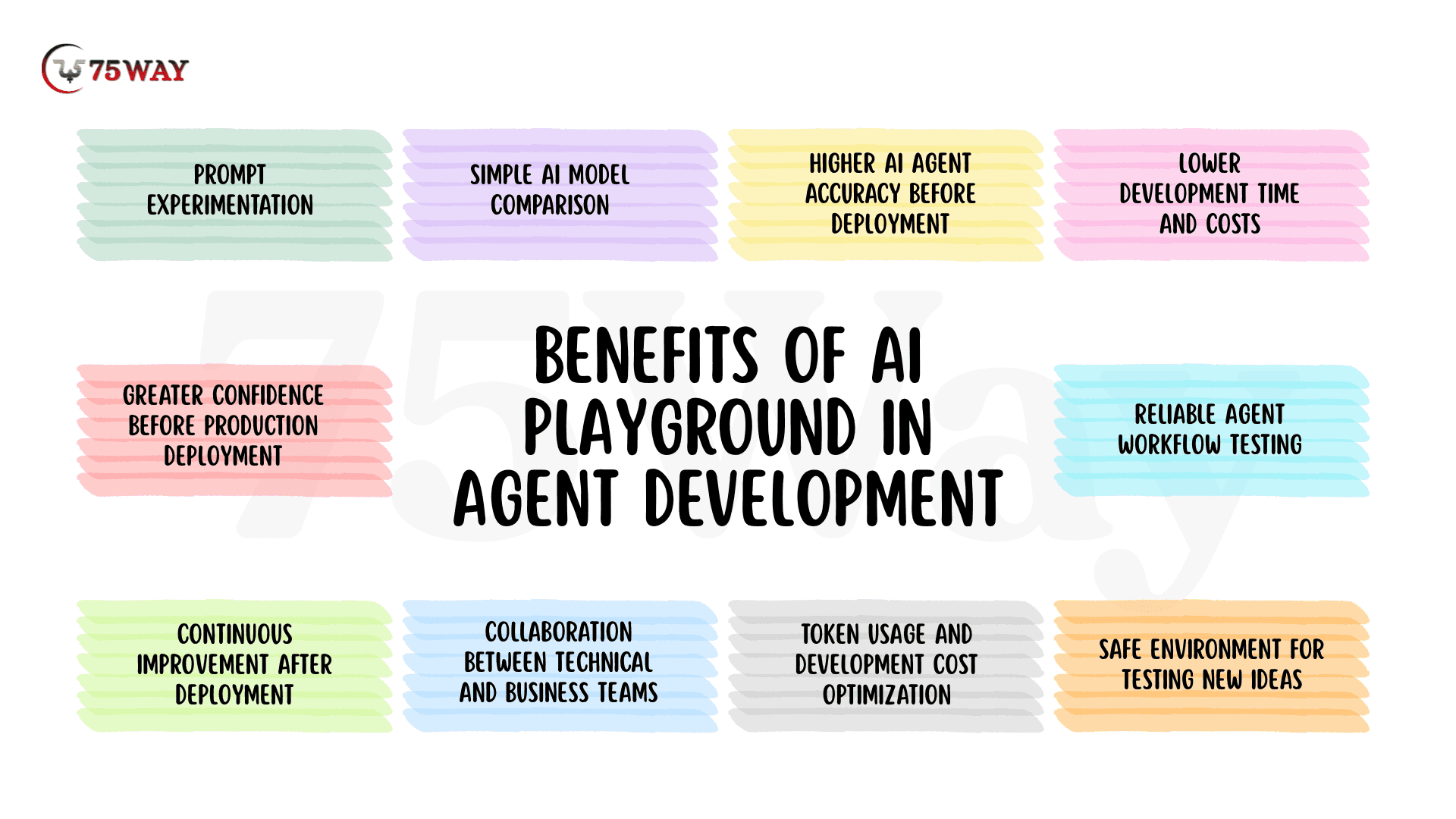
1. Prompt Experimentation
Prompt engineering is rarely a one-time activity. Even minor adjustments to wording, context, examples, or instructions can produce dramatically different responses from an AI model. Finding the most effective prompt often requires dozens, or even hundreds, of iterations.
An AI Playground makes this process significantly faster by allowing developers to edit prompts and receive immediate feedback without modifying application code or redeploying software. Teams can quickly compare multiple prompt variations, identify stronger outputs, and refine instructions until the AI agent consistently delivers the expected behavior.
This rapid feedback loop shortens development cycles and allows developers to focus on improving agent intelligence instead of repeatedly managing infrastructure changes.
2. Simple AI Model Comparison
Choosing the right language model has become increasingly challenging as organizations can now select from GPT, Claude, Gemini, Llama, Mistral, and many other alternatives. Each model differs in reasoning ability, response quality, speed, context window, pricing, and tool usage.
AI Playgrounds simplify this decision by allowing developers to test identical scenarios across multiple models. Rather than relying solely on benchmarks or vendor documentation, teams can evaluate how each model performs using their own datasets, workflows, and business requirements.
This hands-on evaluation leads to more informed technical decisions while reducing the likelihood of selecting a model that fails to meet long-term project expectations.
3. Higher AI Agent Accuracy Before Deployment
Launching an AI agent without extensive testing often results in inconsistent responses, misunderstood instructions, and poor user experiences. Once these issues reach production, resolving them becomes more time-consuming and expensive.
AI Playgrounds help identify weaknesses much earlier by providing a controlled environment where developers can simulate realistic user interactions, test edge cases, and evaluate responses under different conditions. This proactive approach allows teams to refine prompts, adjust workflows, and improve overall agent reliability before deployment.
As a result, businesses introduce AI agents that deliver more accurate, consistent, and dependable experiences from day one.
4. Lower Development Time And Costs
Traditional AI development involves frequent coding, deployment, testing, and debugging cycles. Every small modification may require rebuilding parts of the application, consuming valuable engineering time.
AI Playgrounds eliminate much of this overhead by enabling rapid experimentation without changing production code. Developers can validate ideas, compare outputs, and resolve issues directly within the testing environment before implementation begins.
Reducing unnecessary development cycles not only accelerates project delivery but also lowers engineering costs, allowing teams to allocate resources toward higher-value activities such as feature development and product innovation.
5. Reliable Agent Workflow Testing
Modern AI agents rarely operate in isolation. They interact with APIs, databases, search systems, document repositories, calendars, CRMs, and numerous third-party services to complete tasks. Every interaction introduces opportunities for unexpected behavior.
AI Playgrounds provide a safe environment to validate these workflows before they become part of a production system. Developers can observe how an agent handles different inputs, tool responses, missing information, and error scenarios without affecting live users or business operations.
Testing complete workflows early helps uncover integration issues, improve decision logic, and build AI agents that perform reliably under real-world conditions.
6. Safe Environment For Testing New Ideas
Innovation often begins with experimentation, but testing unfinished ideas directly in production can introduce unnecessary risks. AI Playgrounds remove this concern by providing an isolated environment where developers can freely explore new prompts, workflows, and agent behaviors without affecting live applications or user experiences.
Whether testing a different reasoning approach, introducing a new tool, or experimenting with autonomous task execution, teams can evaluate outcomes before committing development resources. This freedom encourages creativity while reducing the possibility of costly implementation mistakes.
For businesses, this means faster innovation with far less operational risk.
7. Token Usage And Development Cost Optimization
Every interaction with a large language model consumes tokens, making prompt design an important factor in both performance and operating costs. Poorly structured prompts often generate unnecessary responses, increasing token consumption without improving results.
AI Playgrounds allow developers to experiment with prompt length, context windows, response formats, and model parameters to identify more cost-effective approaches. By monitoring token usage during testing, teams can refine prompts that deliver better outputs while controlling long-term API expenses.
This optimization becomes increasingly valuable as AI agents handle thousands, or even millions, of interactions over time.
8. Collaboration Between Technical And Business Teams
Successful AI agents require more than technical expertise. Product managers, domain specialists, customer support teams, and business stakeholders all contribute valuable insights during development.
AI Playgrounds create a shared environment where non-technical stakeholders can review responses, validate business logic, suggest improvements, and participate in prompt refinement without navigating complex codebases. This collaborative approach reduces communication gaps and helps development teams align AI behavior with real business requirements.
As a result, projects move forward with clearer expectations and fewer revisions later in the development process.
9. Continuous Improvement After Deployment
Launching an AI agent is only the beginning of its lifecycle. User expectations evolve, business requirements change, and language models continue improving. Maintaining high-performing AI agents requires ongoing refinement rather than one-time optimization.
AI Playgrounds make continuous improvement more manageable by allowing developers to test updated prompts, evaluate new model versions, and validate workflow enhancements before applying changes to production systems. This iterative process helps organizations improve response quality while minimizing disruptions for existing users.
Continuous testing also enables businesses to adapt quickly as new AI capabilities become available.
10. Confidence Before Production Deployment
Deploying an AI agent without sufficient testing can create uncertainty for both developers and business leaders. Questions about reliability, consistency, and edge-case handling often remain unanswered until users begin interacting with the system.
AI Playgrounds reduce this uncertainty by allowing teams to simulate diverse user scenarios, evaluate responses under different conditions, and identify areas requiring further refinement. Developers gain greater confidence in prompt design, workflow logic, and model performance before moving into production.
This preparation leads to smoother deployments, fewer post-launch issues, and AI agents that are better equipped to deliver consistent, high-quality experiences from the very first interaction.
Features That Make AI Playgrounds Valuable To Build AI Assistant
The effectiveness of an AI Playground isn't determined by its interface alone. Its true value comes from the tools it provides throughout the development process. Below are the key features that make AI Playgrounds an essential part of modern agent development.
- Prompt Testing And Refinement
Prompt engineering remains one of the most important aspects of AI agent development. Even small changes to instructions, examples, or context can significantly influence how an agent understands requests and generates responses.
AI Playgrounds make prompt refinement straightforward by allowing developers to test multiple prompt variations instantly. Instead of updating application code for every experiment, teams can evaluate outputs in real time and quickly identify prompts that produce more accurate, relevant, and consistent responses.
- Multiple Model Comparison
Every language model has different strengths. Some excel at reasoning, while others perform better in coding, summarization, or structured output generation.
AI Playgrounds allow developers to compare responses from multiple models using identical prompts. This side-by-side evaluation highlights differences in accuracy, response style, latency, and cost, making it easier to choose the most suitable model for a particular AI agent.
- Adjustable Model Parameters
Large language models don't produce identical responses every time. Their behavior changes depending on settings such as temperature, maximum tokens, top-p sampling, and frequency penalties.
AI Playgrounds provide simple controls for adjusting these parameters without writing additional code. Developers can immediately observe how different configurations affect creativity, consistency, response length, and overall agent behavior, helping them fine-tune performance for specific business requirements.
- Multi-Turn Conversation Testing
Most AI agents are designed to handle ongoing conversations rather than isolated questions. They must remember previous interactions, maintain context, and respond naturally as discussions evolve.
AI Playgrounds allow developers to simulate realistic conversations by testing multiple exchanges within a single session. This helps identify situations where context is lost, instructions are misunderstood, or responses become inconsistent before deployment.
- Function Calling And Tool Integration
Modern AI agents often interact with external tools instead of relying solely on language generation. They may retrieve customer information, schedule meetings, search databases, send emails, or perform calculations.
Many AI Playgrounds support function calling and API testing, allowing developers to validate these integrations before incorporating them into production applications. Early testing helps reduce integration issues while improving workflow reliability.
Popular AI Playgrounds Used By AI Agent Developers In 2026
The rapid growth of AI agent development has led to the emergence of several powerful AI Playgrounds. While they all provide environments for experimentation, each platform offers unique capabilities suited to different development requirements.
Choosing the right Playground depends on the language models you plan to use, your development workflow, collaboration needs, and long-term deployment strategy.
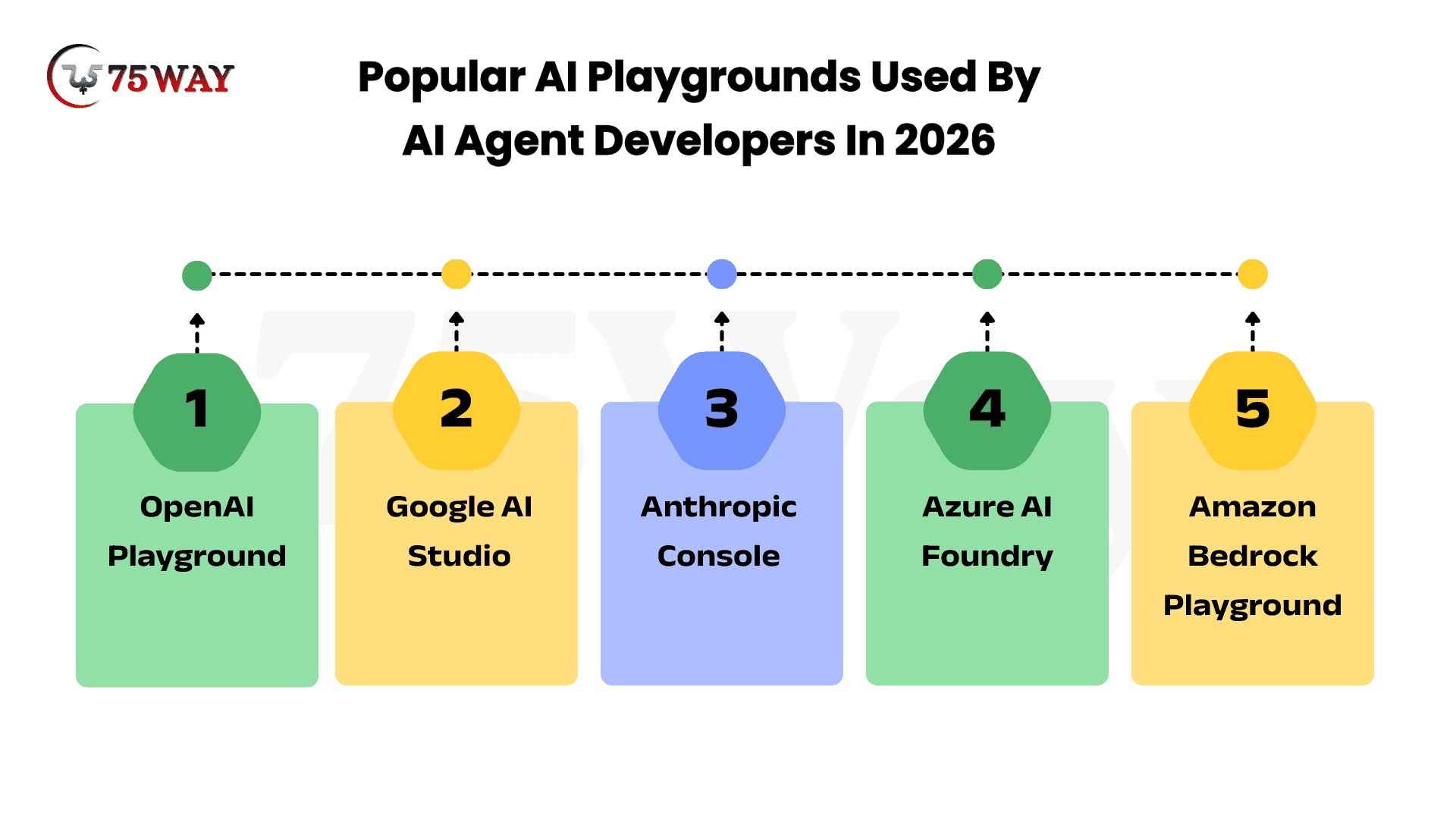
- OpenAI Playground: An intuitive interface makes prompt engineering much easier before integrating GPT models into a real application. Developers can test instructions, adjust parameters, evaluate structured outputs, and experiment with function calling, reducing development time during early AI agent creation.
- Google AI Studio: Teams working with Gemini models often prefer this environment because rapid experimentation feels simple and interactive. Multimodal prompts, code generation, and quick prototyping help developers validate ideas before moving them into production across Google's AI ecosystem.
- Anthropic Console: Complex reasoning and long-context conversations receive special attention through tools designed around Claude models. Prompt refinement, response evaluation, and safety testing allow developers to create dependable AI agents for knowledge-intensive business applications.
- Azure AI Foundry: Enterprise AI projects benefit from a unified workspace that combines experimentation with production readiness. Model evaluation, cloud integrations, governance features, security controls, and deployment capabilities help organizations scale AI solutions without disrupting existing infrastructure.
- Amazon Bedrock Playground: Access to multiple foundation models through AWS creates greater flexibility during model selection and evaluation. Secure cloud infrastructure, simplified comparisons, and seamless integration with AWS services support enterprise teams building scalable AI-powered applications.
Business Use Cases Of AI Playgrounds In Agent Development
The value of an AI Playground becomes much clearer when viewed through real development scenarios. Whether a team is building a customer support assistant or an enterprise automation agent, the Playground serves as the testing ground where ideas are validated before reaching production. Some of the most common ways organizations use AI Playgrounds are defined as:
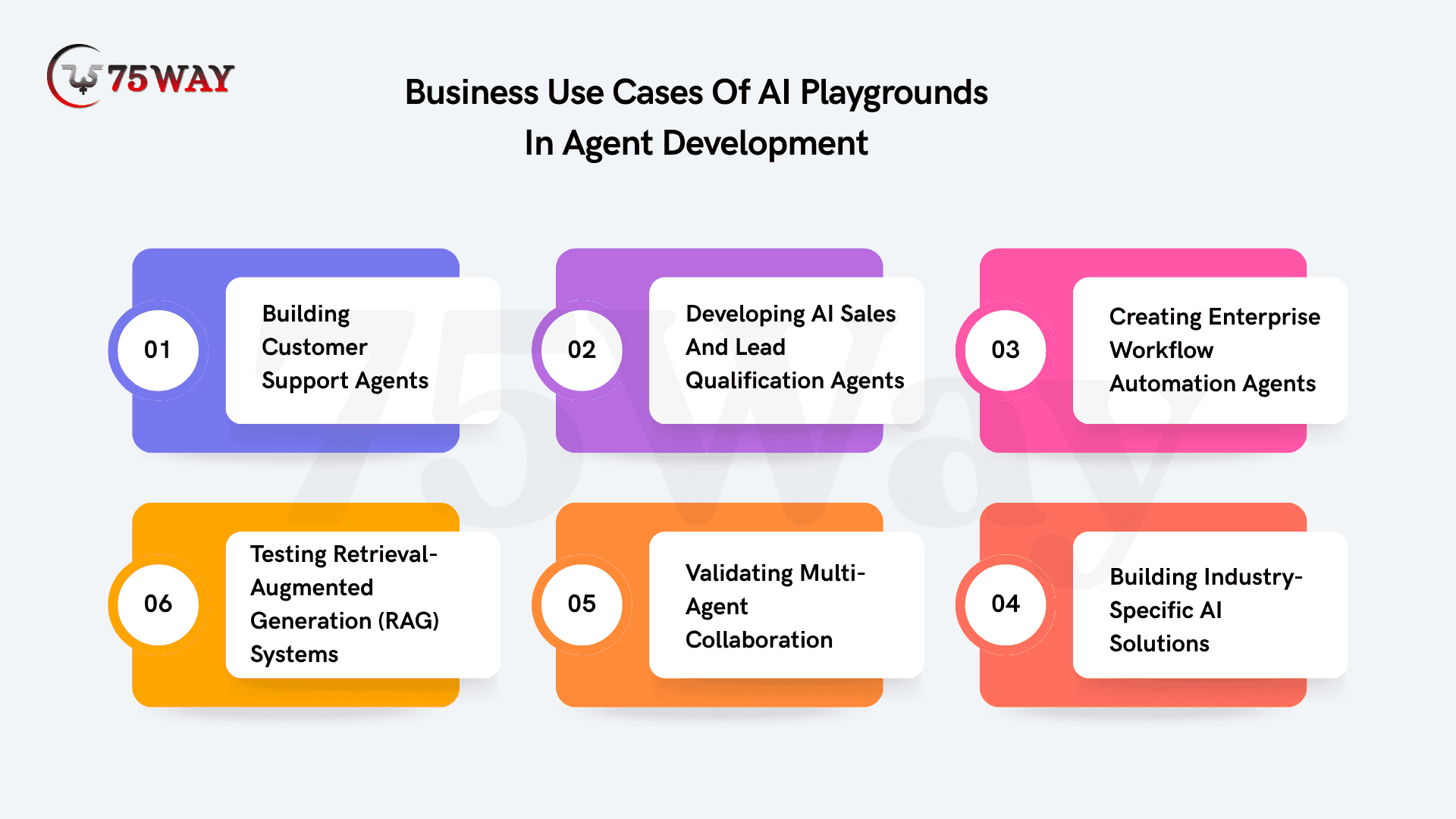
- Building Customer Support Agents: Customer support succeeds when conversations feel accurate, helpful, and consistent across every interaction. Extensive testing uncovers weak responses before customers encounter them. Better refinement creates support experiences that build trust instead of frustration.
- Developing AI Sales And Lead Qualification Agents: Every qualified lead begins with meaningful conversations rather than scripted responses. Different sales scenarios reveal opportunities to improve recommendations, objection handling, and qualification logic. Stronger interactions increase conversion potential before human teams step in.
- Creating Enterprise Workflow Automation Agents: Business processes demand dependable decisions because small errors can disrupt daily operations. Workflow validation exposes integration issues, decision gaps, and API failures early. Greater reliability reduces operational risks after deployment.
- Testing Retrieval-Augmented Generation (RAG) Systems: Accurate responses depend on retrieving the right information at the right moment. Document quality, citation accuracy, and contextual understanding improve through continuous evaluation. Higher precision builds confidence in knowledge-driven AI systems.
- Validating Multi-Agent Collaboration: Complex business tasks often require several AI agents to coordinate without confusion. Communication patterns reveal bottlenecks, missing information, and workflow inefficiencies during testing. Better collaboration delivers smoother execution across interconnected processes.
- Building Industry-Specific AI Solutions: Every industry follows unique terminology, regulations, and operational expectations. Domain-focused testing improves contextual understanding while reducing inaccurate responses. Greater precision makes specialized AI agents more valuable for real business environments.
Common Mistakes To Avoid When Using AI Playgrounds
Many teams focus heavily on generating impressive responses during testing while overlooking factors that determine production success. Recognizing these mistakes early can save valuable development time and reduce costly revisions later.
- Treating Prompt Testing As The Entire Development Process
A well-written prompt is only one component of a successful AI agent. Real-world performance also depends on memory management, tool integration, workflow logic, security, latency, and response consistency.
Teams that rely exclusively on prompt experimentation often discover production issues much later in development. AI Playgrounds should be used to validate the complete agent experience rather than isolated responses.
- Testing Only Ideal User Scenarios
Many developers evaluate AI agents using straightforward questions that naturally produce accurate answers. However, real users often provide incomplete instructions, ambiguous requests, spelling mistakes, and unexpected inputs.
Testing a wide variety of scenarios helps identify weaknesses before deployment and improves the agent's ability to respond effectively in real-world situations.
- Ignoring Cost And Token Consumption
An AI agent may deliver excellent responses but still become expensive to operate if prompts are unnecessarily long or workflows make excessive model calls.
AI Playgrounds provide an opportunity to monitor token usage while experimenting with prompt structures and response formats. Optimizing these areas during development helps reduce long-term operational expenses without compromising quality.
- Selecting A Model Without Practical Evaluation
Benchmarks and marketing materials provide useful information, but they rarely reflect the unique requirements of every AI application.
Developers should compare multiple models using realistic business scenarios, evaluating response quality, reasoning ability, latency, context handling, and cost before making a final decision. AI Playgrounds make this comparison much easier.
- Moving Directly From Playground To Production
Successful testing inside a Playground doesn't automatically guarantee production readiness. Live environments introduce additional challenges such as API failures, user concurrency, security requirements, monitoring, and infrastructure limitations.
Before deployment, teams should validate complete workflows, implement safeguards, and conduct end-to-end testing to confirm that the AI agent performs reliably under real operating conditions.
Best Practices For Getting The Most Value From An AI Playground
Organizations that achieve the best results treat AI Playgrounds as an ongoing development environment rather than a one-time testing tool. Following structured testing practices helps improve AI agent quality while reducing development risks.
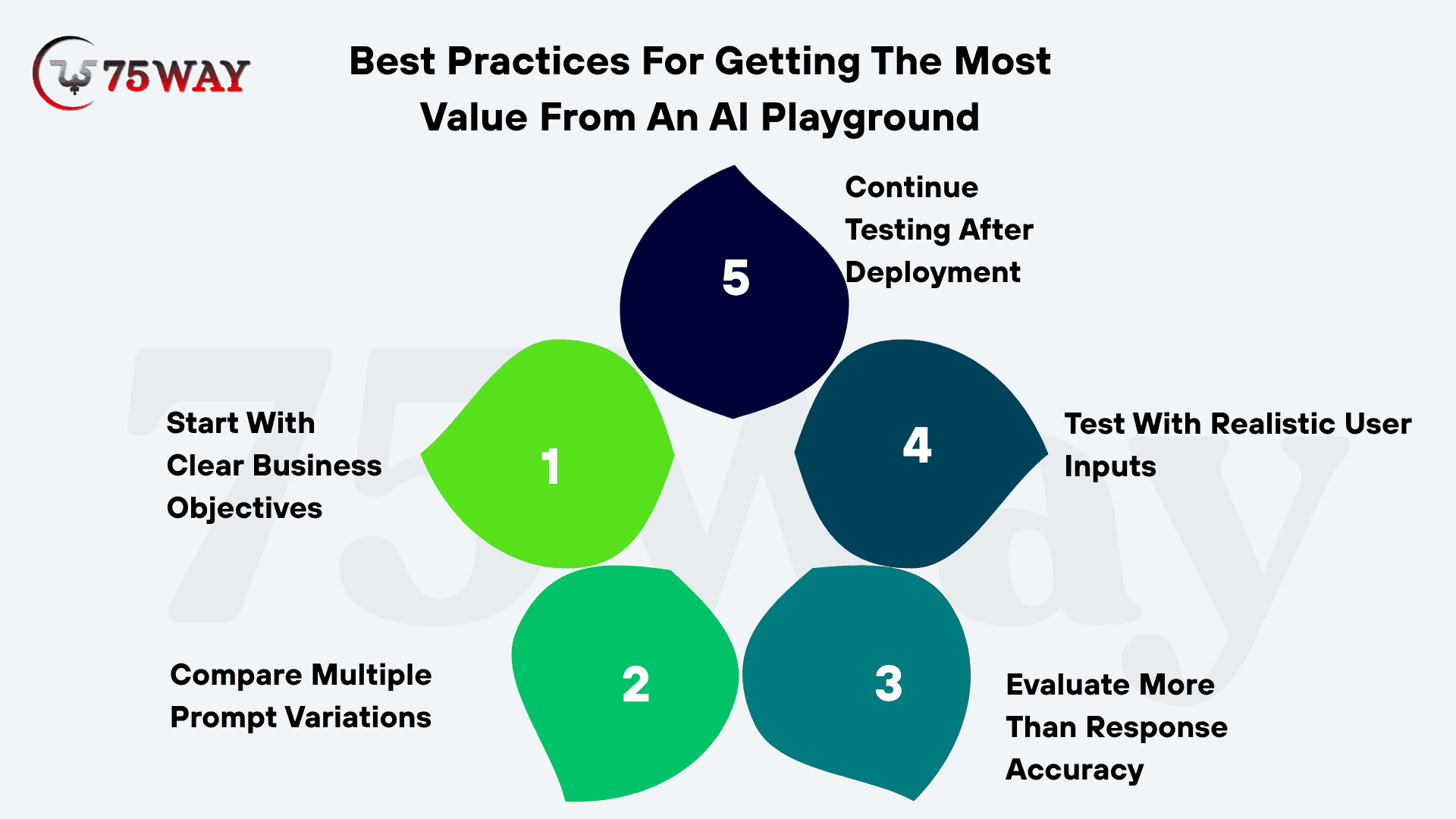
1. Start With Clear Business Objectives
Every experiment should support a measurable business goal. Whether the objective is improving customer support, automating workflows, or increasing productivity, clear success criteria help guide prompt design and model evaluation.
2. Compare Multiple Prompt Variations
Avoid settling on the first prompt that produces acceptable results. Testing different wording, examples, and contextual instructions often reveals significant improvements in response quality and consistency.
3. Evaluate More Than Response Accuracy
A strong AI agent should also demonstrate speed, reliability, contextual understanding, and cost-effectiveness. Measuring these factors together provides a more complete assessment of overall performance.
4. Test With Realistic User Inputs
Include incomplete requests, ambiguous questions, industry-specific terminology, and unexpected scenarios during testing. This helps prepare AI agents for real-world interactions rather than ideal demonstrations.
5. Continue Testing After Deployment
AI development doesn't end at launch. Regular experimentation with updated prompts, new language models, and evolving business requirements helps maintain performance and keeps AI agents aligned with changing user expectations.
Conclusion
As AI agents become more capable, building them requires far more than selecting a powerful language model. Success depends on continuous experimentation, thoughtful prompt engineering, workflow validation, and real-world testing. AI Playgrounds bring all these activities together in a controlled environment, allowing teams to identify issues early, optimize performance, and make informed technical decisions with greater confidence.
Whether you're developing a customer support assistant, an enterprise automation agent, or a sophisticated multi-agent system, using an AI Playground can improve the quality of the final product while reducing development time and implementation risks. Organizations that integrate AI Playgrounds into their development process are better equipped to deliver intelligent, scalable, and production-ready AI agents that create measurable business value. In case you want to launch an AI agent quickly or build a custom AI agent, you can contact a trusted AI agent development company.
Frequently Asked Questions (FAQs)
What Is The Primary Purpose Of An AI Playground In Agent Development?
An AI Playground enables developers to test prompts, compare models, and validate workflows before deployment. It reduces experimentation time while improving overall agent quality.
Can Beginners Use AI Playgrounds To Build AI Agents?
Yes, many AI Playgrounds provide intuitive interfaces without requiring advanced coding knowledge. Beginners can explore prompts, model behavior, and basic agent interactions confidently.
Do AI Playgrounds Support Multiple Large Language Models?
Many modern AI Playgrounds support multiple language models from different providers. This flexibility helps developers compare outputs and select suitable models.
Are AI Playgrounds Suitable For Enterprise AI Projects?
Yes, enterprises use AI Playgrounds to validate prompts, workflows, and integrations before production deployment. They also support collaboration between technical and business teams.
Can AI Playgrounds Improve AI Agent Accuracy?
AI Playgrounds help refine prompts and evaluate responses across different scenarios. Continuous testing improves consistency, reliability, and overall agent performance before launch.
Which Industries Benefit Most From AI Playgrounds?
Healthcare, finance, retail, education, logistics, and customer service widely use AI Playgrounds. They simplify testing while supporting industry-specific AI agent development.
When Should Developers Move From An AI Playground To Production?
Developers should transition after validating prompts, workflows, integrations, and edge cases thoroughly. Production deployment requires reliable performance under realistic user conditions.
Do AI Playgrounds Replace Traditional Development Environments?
No, AI Playgrounds complement traditional development rather than replacing it completely. They simplify experimentation before developers implement production-ready application code.