
CES 2026 Las Vegas feels less like a tech exhibition and more like a real-time decision stage for app innovation. Founders, product leaders, and enterprise buyers will walk into the CES 2026 from January 6–9 to read the room and sense where the market is quietly heading next. Every booth, demo, and closed-door conversation indicates what users will expect very soon.
The trends and highlights of CES event 2026 create app roadmaps before competitors even realize a shift has started. The app development strategies discussed here tend to move quickly because hesitation usually comes at a cost. This guide highlights the top 8 app development trends at CES Conference 2026 and explains how these trends help business owners make smarter product decisions, reduce risk, and build apps that stay relevant in a rapidly changing market.
What Is CES Event 2026? Why CES 2026 Matters for App Development?
CES 2026, Las Vegas, stands as a global stage where technology moves from concept to credibility. From January 6-9, visitors can gain instant exposure to new platforms, connected ecosystems, and digital products. They have opportunities to collaborate with investors, partners, and enterprise decision-makers. Unlike smaller tech events, CES event in 2026 focuses on market-ready innovation rather than ideas still searching for purpose. Your brand visibility here often determines which apps gain traction and which fade quietly.
The USA app market responds quickly to CES event trends. Adoption patterns, enterprise pilots, and funding interest often mirror what gains attention during the event. AI, Web3, IoT, and a privacy-first architecture now drive app development. CES event 2026 serves as an early signal detector to help visitors identify what truly matters before large-scale adoption begins.
Top 8 App Development Trends at CES 2026 Las Vegas
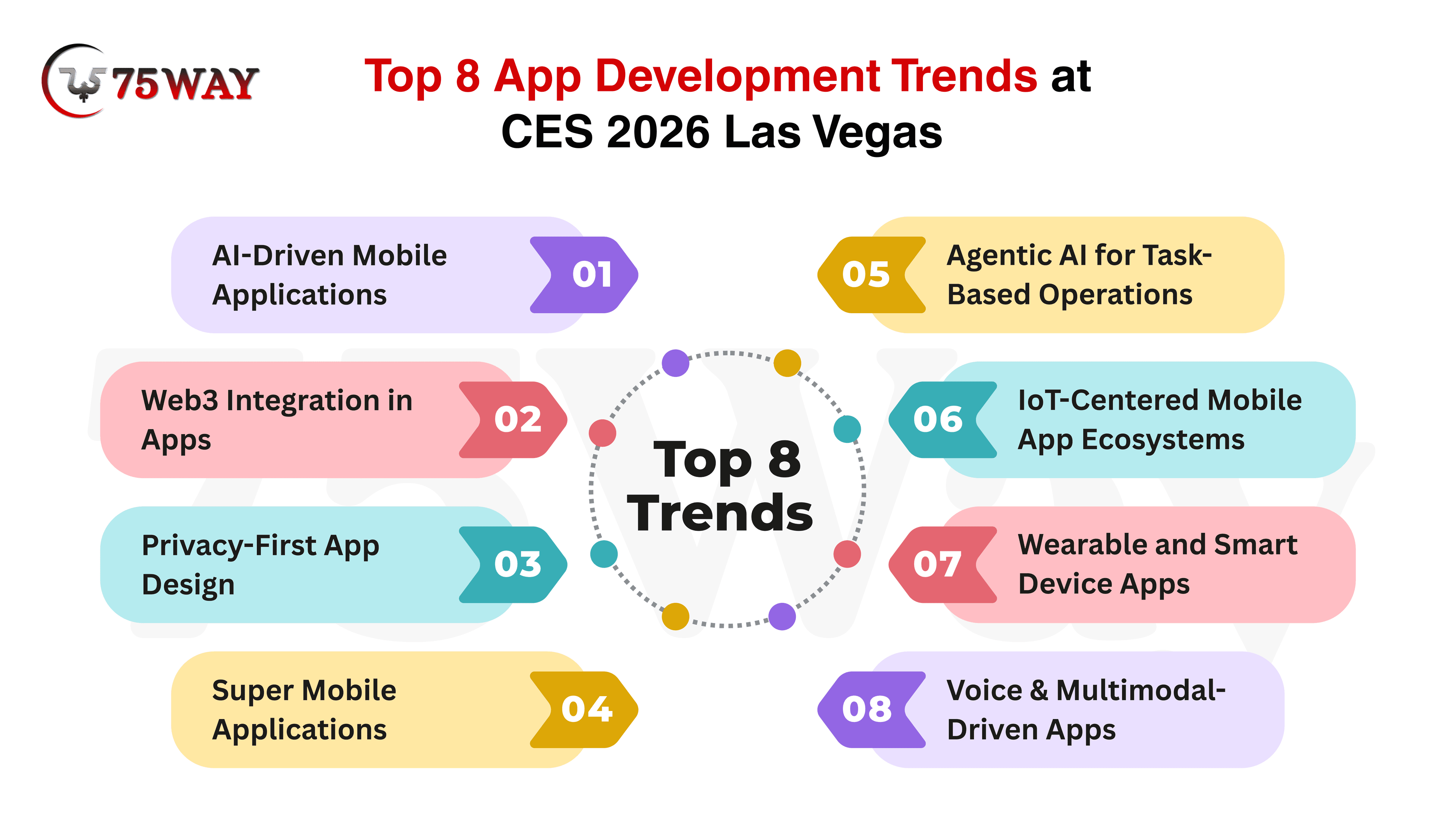
Now, you come to know why CES 2026 matters for your businesses. So, let's move further. The most influential app development trends at CES event 2026 in Las Vegas focus on intelligence, autonomy, connected ecosystems, and trust. Strategic alignment with these trends helps products stay relevant in a fast-moving landscape. Here are the major 8 app development trends at CES event 2026.
AI-Driven Mobile Applications: AI app development showcases at CES 2026 depict a shift toward intelligent experiences that feel natural to users. Mobile applications now predict intent, personalize flows, and adapt interfaces in real time. AI-based recommendation engines, behavioral analytics, Advanced data analytics, and automation sit quietly behind simple experiences. CES 2026 highlights apps where AI improves usability without overwhelming users. Enterprises favor solutions that reduce manual effort while improving engagement across customer journeys.
Agentic AI for Task-Based App Operations: Agentic AI redefines how apps handle complex operations. Task execution, workflow coordination, and system-level decisions happen with minimal human intervention. Agentic AI app solutions presented at CES 2026 demonstrate agents that manage scheduling, resource allocation, and multi-step processes independently. Productivity gains become measurable rather than theoretical. Internal tools and enterprise platforms benefit the most from this shift toward autonomous app behavior.
Web3 Integration in Apps: Web 3 applications reach mainstream adoption at CES 2026 as practical use cases finally take center stage. Blockchain apps integrate decentralized identity, wallet-based access, and token-driven engagement in ways that feel seamless rather than complex. Ownership and transparency matter more now than speculation or hype. The U.S. market shows stronger interest in loyalty programs, secure authentication, and the utility of digital assets. Web3 remains largely invisible behind the interface, while users experience smoother interactions built on trust, control, and long-term value.
IoT-Centered Mobile App Ecosystems: Internet of Things technology turns mobile apps into central control hubs for connected environments. Devices, sensors, and platforms communicate through unified ecosystems rather than isolated applications. CES 2026 highlights how IoT app development supports real-time monitoring, predictive alerts, and automated responses across industries. App success now depends on reliability, low latency, and smooth device orchestration. Smart infrastructure increasingly relies on these mobile ecosystems to maintain efficiency, visibility, and operational control.
Privacy-First App Design: Privacy-first design is no longer optional. It is a key competitive edge. Blockchain apps now make secure identity management, transparent consent, and tamper-proof data records standard rather than extra features. U.S. regulations are accelerating this shift, and users expect complete clarity on how their data is used. Apps that build privacy into their architecture earn trust quickly and keep users engaged longer. Today, security-focused design is not just a feature. It directly shapes adoption and buying decisions.
Wearable and Smart Device Apps: Wearable apps expand into healthcare, enterprise safety, and immersive experiences. CES 2026 highlights apps connected to smart glasses, medical wearables, and industrial devices, all designed to respond intelligently to movement, environment, and biometric data. Screenless, context-aware experiences feel seamless and natural, creating interactions that flow without interruption. Wearable app development teams are focusing on performance efficiency, real-time synchronization, and battery-friendly designs to make these apps practical, reliable, and ready for everyday use.
Super Mobile Applications: Super mobile applications are gaining momentum as users look for convenience through consolidation. Payments, communication, services, and commerce coexist on single platforms, and many now incorporate AI-powered app features to provide instant access. CES conference 2026 Las Vegas highlights growing enterprise interest in industry-specific super apps, where retention improves through ecosystem depth rather than feature overload. Modular architecture allows these platforms to expand seamlessly without sacrificing performance or usability.
Voice & Multimodal-Driven Apps: Voice and multimodal apps blend speech, text, visuals, and gestures into seamless interactions. Rigid commands are giving way to natural, intuitive conversations. CES event 2026 showcases AI chatbots and assistants that understand context across devices and platforms, making tasks such as customer support, onboarding, and navigation feel genuinely human. Multimodal experiences not only reduce friction but also improve accessibility, creating smoother, more engaging digital interactions for users worldwide.
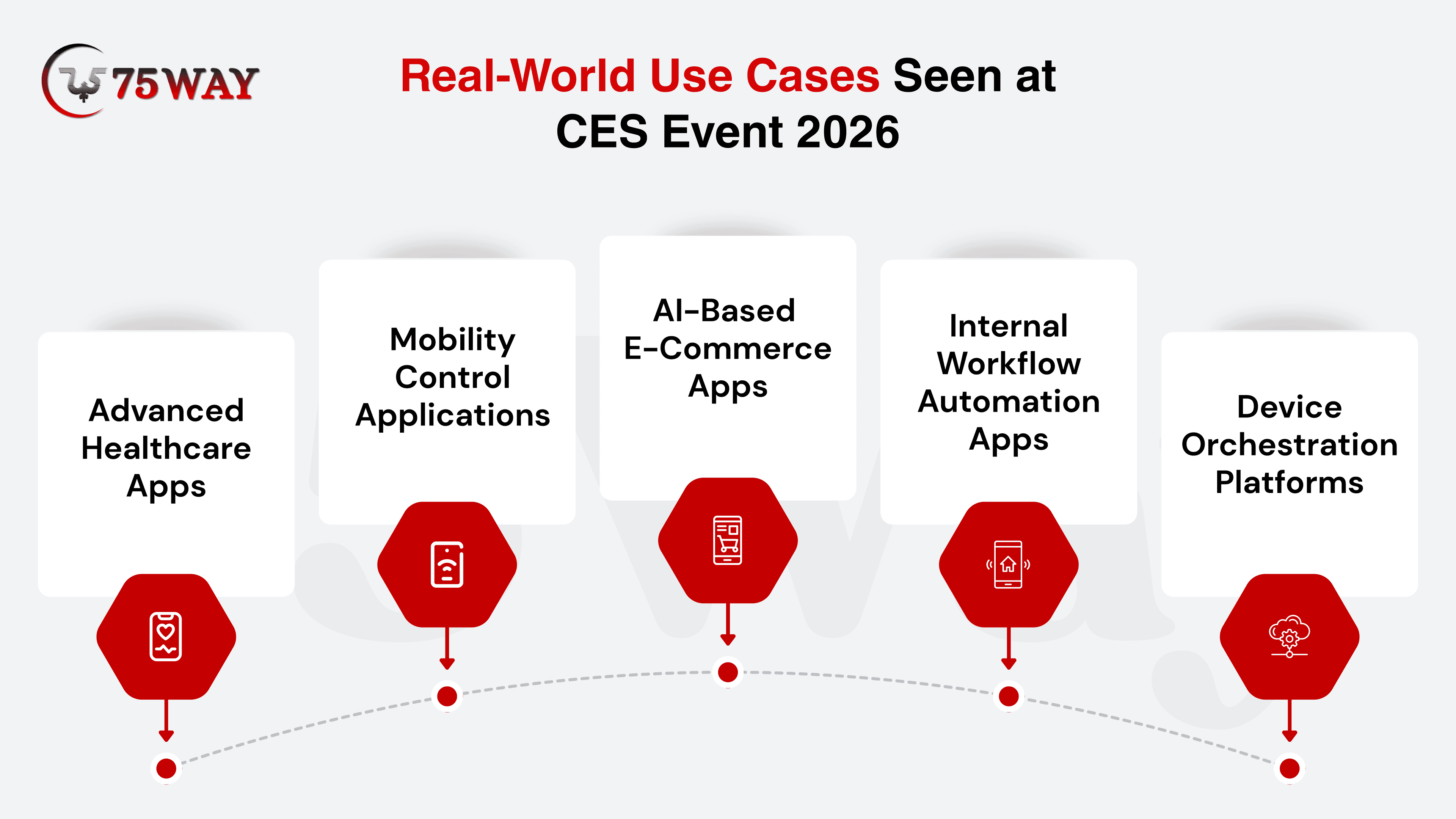
Real-World Use Cases Seen at CES Event 2026
When you walk on the CES 2026 floor and see apps you have only read about in headlines actually solving real problems. From healthcare monitoring to smart mobility and AI-powered commerce, these applications are not prototypes. They are production-ready solutions making an immediate impact. Across industries, adoption signals are clear: businesses are implementing these innovations, and users are already engaging with them. CES Vegas 2026 shows how trends leap off the page and into real-world execution, proving which technologies are ready to drive measurable results today.
Advanced Healthcare Apps: AI-powered healthcare and telemidicine apps at CES 2026 focus on remote monitoring, diagnostics, and patient engagement. Wearables, AI analysis, and secure data sharing in healthcare apps improve outcomes while reducing operational strain. Privacy-first architecture ensures compliance and trust. Hospitals and providers adopt platforms that integrate seamlessly into existing workflows.
Mobility Control Applications: At CES event, e-mobility solutions demonstrate how apps manage fleets, charging networks, and user experiences. Real-time tracking, predictive maintenance, and energy optimization appear as standard features. CES 2026 highlights platforms that connect vehicles, infrastructure, and users through unified control systems.
AI-Based E-Commerce Apps: E-commerce, retail, and shopping apps evolve through AI-driven personalization, inventory intelligence, and conversational shopping. CES 2026 showcases e-commerce apps that adapt pricing, recommendations, and experiences. Retailers can focus on apps that scale without sacrificing experience quality.
Internal Workflow Automation Apps: Internal workflow automation apps streamline operations across departments. The AI-powered apps enhance task routing, approval flows, and performance insights with intelligent logic. CES 2026 presents enterprise platforms that reduce manual coordination and enhance decision-making.
Device Orchestration Mobile Platforms: Device orchestration platforms unify control across hardware ecosystems. Apps manage configuration, updates, and real-time status across devices. CES 2026 demonstrates scalable solutions for industrial, consumer, and smart city environments. These mobile platforms become the operational backbone of connected systems.
Why Meet 75way at CES Conference 2026
CES 2026 brings together ideas, but execution separates vision from results. 75way enters CES 2026 in Las Vegas as a technology partner in the North Hall, Booth #8700, focused on building scalable, market-ready applications aligned with real business goals. Our 1:1 sessions and personalized guidance at the booth revolve around practical app development. You can watch live demos of our AI-powered platforms, Web3 integration, IoT app development, and privacy-first architecture designed for U.S. market compliance.
Product leaders and enterprises connect with 75way to explore how emerging CES trends translate into deployable solutions, not just concepts. From strategy and architecture to execution, the focus remains on reducing risk, accelerating time-to-market, and building apps that adapt to evolving ecosystems. CES 2026 offers the right moment to align innovation with action, and meaningful discussions often start face-to-face. Solutions we provide at the CES conference 2026 are:
AI-Powered Apps: We provide product demos, guidance, and startgeis for AI app development solutions. Our solutions are designed to deliver personalized experiences, predictive insights, automation, and smarter decision-making.
Agentic AI Solutions: Our Agentic AI solutions enable autonomous task execution, workflow orchestration, and system-level decisions that reduce manual intervention and improve operational efficiency.
Wearable Platforms: We showcase wearable apps that connect smart devices with real-time data. Our solutions enhance context-aware interactions and seamless synchronization for healthcare, safety, and immersive experiences.
On-Demand Apps: We present on-demand and white-label apps that provide instant access to services, real-time availability, secure payments, and scalable architectures that support fast-growing user demand.
E-Mobility Solutions: E-mobility solutions manage fleets, charging networks, vehicle data, and user experiences through intelligent, connected, and energy-efficient mobile platforms.
Web 3.0 Solutions: Our web 3.0 app solutions integrate decentralized identity, smart contracts, and wallets. You can get personalized sessions on blockchain ecosystems, DeFi apps, and NFT marketplaces to enable transparent digital experiences.
IoT Applications: You can explore our advanced IoT app solutions that connect devices, sensors, and platforms into unified ecosystems. These solutions enable real-time monitoring, automation, and operational control.
Conclusion
CES 2026 Las Vegas highlights that app development today revolves around intelligence, autonomy, privacy, and ecosystem-driven design. Market-ready solutions take center stage, while experimental concepts quickly fade into the background. Trends such as AI-powered app development, Web3 app development, IoT app development solutions, and blockchain apps are already seeing strong adoption across industries, from healthcare to mobility. Staying aware of these shifts now can prevent costly pivots later, and teams that align early gain a real competitive edge. Innovation moves fast when the signals are clear, so do not miss the chance to connect, meet 75way at CES 2026, booth 8700, North Hall.
FAQs
Which App Trends Dominate CES 2026?
AI-driven applications, agentic AI workflows, Web3 integration, IoT-centered ecosystems, and privacy-first app design are major trends at CES 2026. Super mobile applications and voice-enabled, multimodal apps also receive strong attention for their real-world usability and scalability.
Are AI Apps Production-Ready At CES Event 2026?
Most AI apps showcased at CES 2026 are production-ready rather than experimental. Many app development firms focus on automation, personalization, and operational efficiency, with clear deployment models already in place for enterprise and consumer use.
Which Industries Benefit Most From CES 2026 App Trends?
Sectors such as healthcare, smart mobility, digital commerce, manufacturing, fintech, and large enterprises experience the highest operational impact. These industries adopt AI, IoT, and privacy-focused apps to improve efficiency, user experience, and decision-making at scale.
What Are The Topics For CES 2026?
CES 2026 covers a wide range of tech themes that reflect where the industry is heading next. Digital health, wearables, and personalized healthcare tech will appear alongside auto and EV innovations that redefine mobility.
Artificial Intelligence (AI): Focus on AI-powered apps, on-device intelligence, agentic AI, automation, and real-world AI deployment.
Connected Devices & IoT Ecosystems: Smart homes, smart cities, industrial IoT, and mobile apps acting as control hubs for connected environments.
Digital Health & Wearables: Healthcare apps, remote monitoring, medical wearables, AI diagnostics, and personalized health technology.
Mobility & Transportation Tech: Electric vehicles, autonomous systems, e-mobility platforms, fleet management, and smart mobility apps.
Web3, Blockchain & Digital Trust: Decentralized identity, secure authentication, token-based ecosystems, and privacy-first applications.
Robotics & Automation: Service robots, industrial automation, AI-driven robotics, and human–machine collaboration.
Smart Infrastructure: Energy tech, climate solutions, smart grids, and sustainable digital platforms.
Enterprise Tech: Workflow automation, productivity apps, data platforms, and AI-powered enterprise solutions.
Do CES 22026 App Trends Suit Startups Or Enterprises?
CES app trends benefit both startups and enterprises in different ways. Startups benefit from faster experimentation, lean builds, and early adoption of AI-driven, on-demand models that enable rapid scaling. Enterprises focus more on stability, governance, and long-term ecosystem integration, using these trends to modernize operations and improve efficiency. While startups move faster, enterprises adopt at scale. In both cases, the trends seen at CES 2026 support growth, resilience, and competitive positioning when applied with a clear strategy.
Are CES 2026 Apps Compliant With U.S. Data Laws?
Most apps showcased at CES 2026 are built with compliance in mind, especially those targeting the U.S. market. Developers increasingly treat data protection and privacy as core design principles rather than afterthoughts. With tightening U.S. regulations around user data, including requirements for transparency, consent, and security, many solutions on display focus on secure identity management, clear consent flows, and encrypted data storage.