Summary
Make smarter AI investment decisions in 2026 with this guide on choosing the right AI agent for sales performance and automation. You will find valuation criteria, key features, integration needs, and common mistakes. This guide helps businesses improve lead conversion, sales efficiency, and decision-making while ensuring the selected AI sales agents align with long-term growth and operational goals.
Quick Overview
- Right AI sales agents significantly improve conversion rates and efficiency.
- Choosing based on features alone often leads to poor outcomes.
- Integration capability matters as much as AI intelligence itself.
- Clear sales goals are essential before selecting any AI solution.
- Future-ready scalability ensures long-term performance and business success.
Sales teams in 2026 are no longer surviving on manual effort, gut feeling, or disconnected tools. The pace has changed. Leads need to be qualified faster, conversations need to feel personal, and deals need to move without unnecessary delays.
That pressure has pushed almost every business toward AI sales agents. But here is where things get tricky. There are too many options in the market right now. Many teams end up picking tools based on hype, not real performance.
And that is where the real problem starts: wasted budget, low adoption, and no real movement in revenue.
Thus, you must select the right AI agent development solution for your sales team. It directly affects how fast you grow, how well your team performs, and how your customers experience your brand.
This guide breaks down a practical way to pick the right AI agent for sales in 2026 without confusion, guesswork, or costly trial and error. Because in sales, the wrong tool does not just slow you down. It quietly holds your revenue back.
What Is An AI Sales Agent?
An AI sales agent is an intelligent system designed to support or automate parts of the sales process. It can analyze leads, communicate with prospects, recommend actions, and help sales teams close deals more efficiently.
Unlike traditional CRM tools, AI sales agents actively think, learn, and respond based on data patterns. They don’t just store information. They interpret it. A strong AI sales agent can:
- Identify high-quality leads efficiently and accurately
- Personalize outreach messages for better engagement results
- Predict deal outcomes using data-driven insights
- Automate follow-ups without missing any opportunities
- Improve conversion decisions through real-time analysis
In simple terms, a sales AI agent is similar to a personal helper who keeps reminding you about important tasks, follows up on pending work, and suggests the right next step without getting tired. It acts like a smart assistant managing your daily schedule and priorities.
Why the Precise Sales AI Agent Is Crucial for Growth in 2026?
The sales environment has changed dramatically. Buyers are more informed, competition is higher, and response time expectations are shorter. In this situation, the right AI agent does not just support sales teams; it actively improves how they work, respond, and close deals.
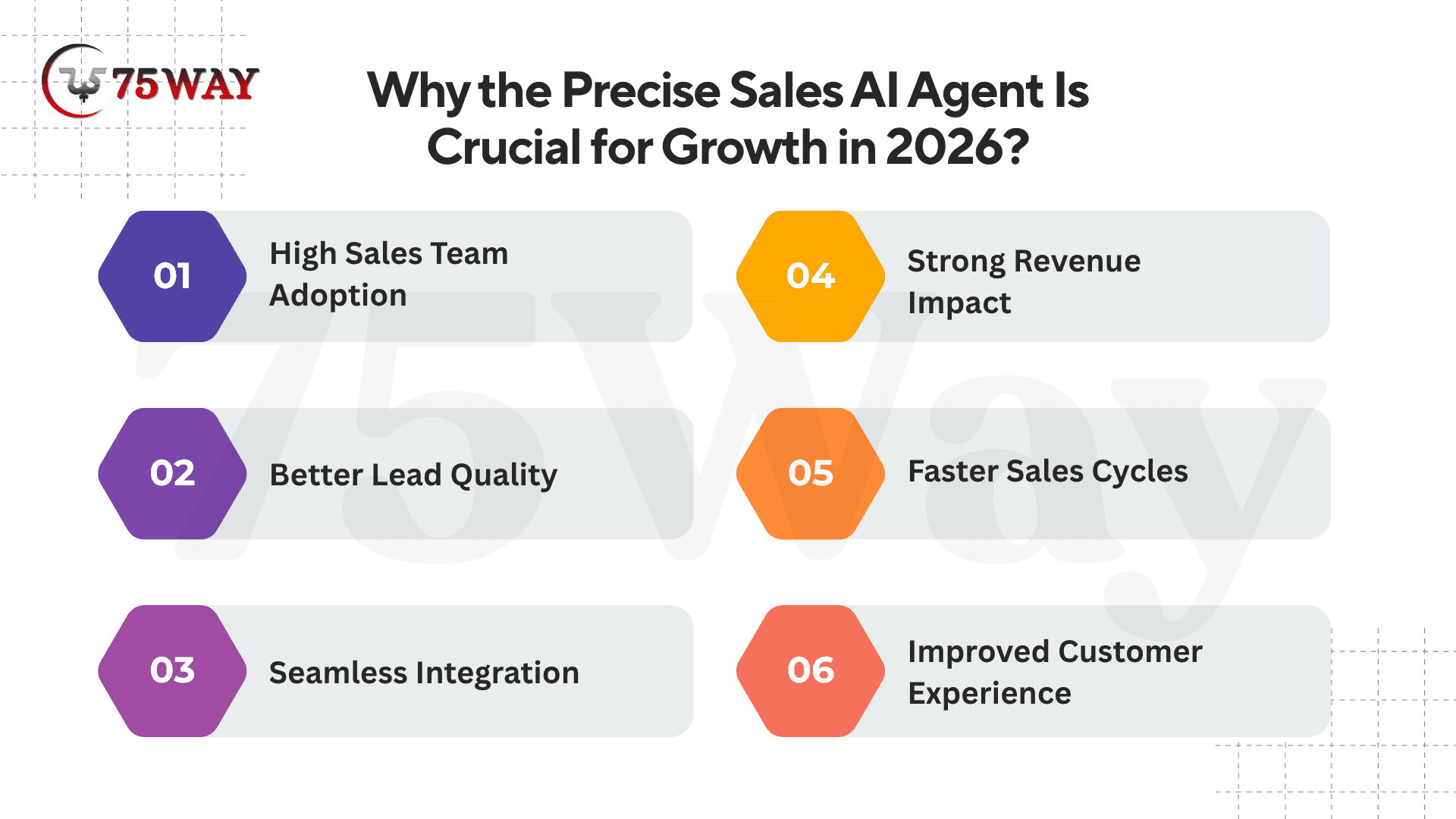
- High Sales Team Adoption: When an AI agent is simple, relevant, and built around real sales workflows, teams naturally start using it in daily operations. Instead of forcing adoption, it becomes part of their routine, helping them manage leads, follow-ups, and conversations without extra effort or confusion.
- Better Lead Quality: A well-designed AI agent improves lead scoring accuracy by analyzing behavior, intent, and engagement patterns. This means sales teams spend more time on qualified opportunities and less time guessing, which directly improves productivity and overall pipeline strength.
- Seamless Integration: The right AI agent connects smoothly with existing tools like CRM, email platforms, and sales dashboards. This creates a unified workflow where data flows automatically, reducing manual work and helping teams act faster with complete information at every stage.
- Strong Revenue Impact: When AI is aligned with sales goals, it directly supports higher conversions and faster deal closures. It helps teams prioritize better opportunities, respond at the right time, and improve decision-making, which ultimately leads to measurable revenue growth.
- Faster Sales Cycles: A good AI agent reduces delays in lead handling, follow-ups, and decision-making. With automation and real-time insights, deals move through the pipeline faster, helping businesses close opportunities in less time and stay ahead of the competition.
- Improved Customer Experience: Sales AI agents help personalize every interaction based on customer behavior and needs. This leads to more relevant conversations, better engagement, and stronger relationships, which increase trust and improve long-term customer satisfaction.
Important Criteria for Selecting AI Sales Agents With The Highest ROI
Choosing the right AI sales agent is not about features alone. It is about how well the system supports real sales performance, improves daily execution, and directly contributes to revenue outcomes. Every factor below helps you understand whether a solution is truly built for sales success or just surface-level automation.
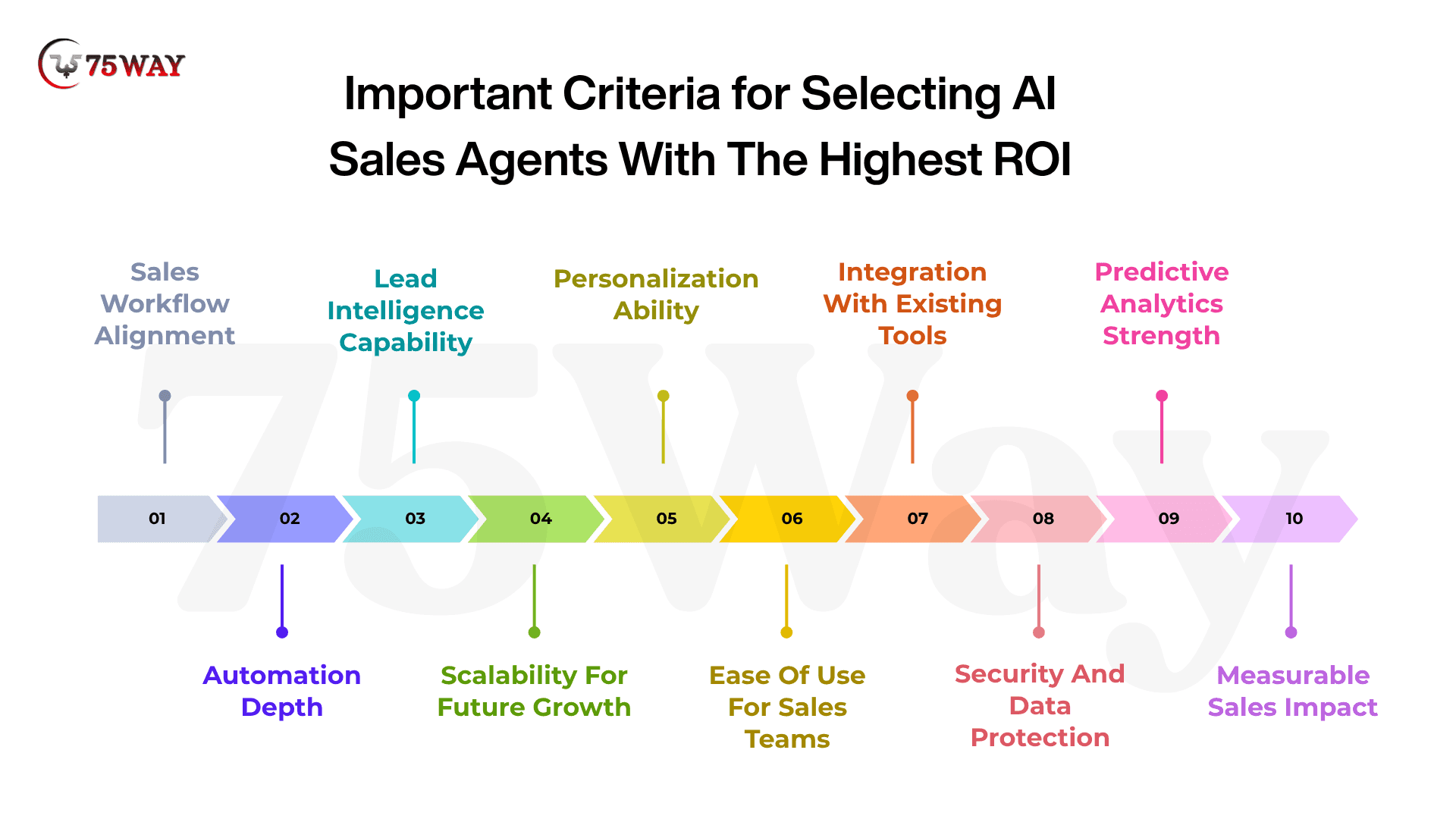
1. Sales Workflow Alignment
The AI agent must fit naturally into your existing sales process without forcing your team to change how they work. It should support real activities like lead handling, communication flow, and deal movement instead of creating extra complexity or confusion in daily operations.
- Qualifies leads accurately within your existing pipeline structure
- Supports prospect communication without disrupting the current workflow
- Helps manage deals through each stage smoothly
- Tracks performance metrics aligned with sales goals
2. Lead Intelligence Capability
A strong AI sales agent should analyze multiple data signals to understand which leads are worth pursuing. This improves focus and helps sales teams prioritize opportunities that have higher chances of conversion instead of wasting time on low-quality prospects.
- Behavioral signals from user activity and engagement patterns
- Historical interaction data across touchpoints
- Buyer intent indicators showing purchase readiness
- Demographic and firmographic profile analysis
- Website activity tracking, including page visits and time spent
- Engagement scoring based on email, calls, and response behavior
3. Personalization Ability
Sales success today depends heavily on personalized communication. The AI agent for sales and marketing should adjust messaging based on customer context, industry type, and behavior patterns so every interaction feels relevant instead of generic or automated.
- Creates customized outreach messages for different prospects
- Adjusts tone based on industry and buyer profile
- Modifies follow-up messages based on engagement behavior
- Maintains contextual relevance across communication stages
4. Integration With Existing Tools
Integration plays a major role in real productivity. If the AI sales agent does not connect with your current systems, it creates fragmented workflows. A strong solution should work smoothly with your existing sales and marketing ecosystem.
- Connects with CRM systems for real-time data sync
- Integrates with email platforms for outreach automation
- Works with marketing tools for campaign alignment
- Links with dashboards for unified reporting
5. Predictive Analytics Strength
Good sales AI agents do more than process data. They forecast outcomes. Predictive capabilities help sales teams understand future opportunities, risks, and deal movement, so decisions become faster and more informed.
- Predicts deal closure probability with data insights
- Identifies potential churn risks early
- Highlights high-value opportunities in the sales pipeline
- Supports faster and more confident decision-making
6. Automation Depth
Automation determines how much manual work is removed from your sales process. A strong AI agent should reduce repetitive tasks, so your team can focus more on actual selling and relationship building.
- Automates lead scoring and prioritization
- Handles follow-up scheduling and reminders
- Generates reports and performance summaries
- Manages data entry and updates
7. Scalability For Future Growth
Your sales operations will expand over time, and the AI sales agent must be able to handle that growth. Scalability ensures the system remains stable even as data volume, users, and complexity increase.
- Supports larger datasets without performance issues
- Handles a growing number of users and teams
- Adapts to complex sales workflows
- Maintains performance during business expansion
- Supports multi-region or multi-market operations without disruption
- Allows easy addition of new sales processes and automation layers
8. Ease Of Use For Sales Teams
If the system feels complicated, adoption will fail no matter how powerful it is. The sales AI agent for sales should be simple enough for sales teams to use daily without training difficulties or resistance.
- Clean and simple interface for daily use
- Fast navigation between features
- Action-oriented design for quick execution
- Minimal learning curve for sales teams
9. Security And Data Protection
Sales data is highly sensitive and must be protected at every level. A precise sales AI agent should follow strict security practices to maintain trust and prevent data risks.
- Uses strong encryption for data safety
- Controls access based on user roles
- Follows compliance and regulatory standards
- Protects customer and business information
10. Measurable Sales Impact
At the end of the day, results matter more than features. The sales AI agent should clearly improve key sales metrics and show a visible impact on business performance over time.
- Improves conversion rates across pipeline stages
- Reduces overall sales cycle time
- Enhances lead quality and qualification accuracy
- Drives measurable revenue growth
- Increases average deal size through better targeting and timing
- Improves sales team productivity by reducing manual workload
- Strengthens forecast accuracy for better planning decisions
Step-by-Step Roadmap To Evaluate An AI Agent for Sales
Evaluating an AI sales agent works best when you follow a clear, structured approach instead of rushing into a decision. Each step helps you reduce uncertainty and understand whether the tool truly fits your sales environment.
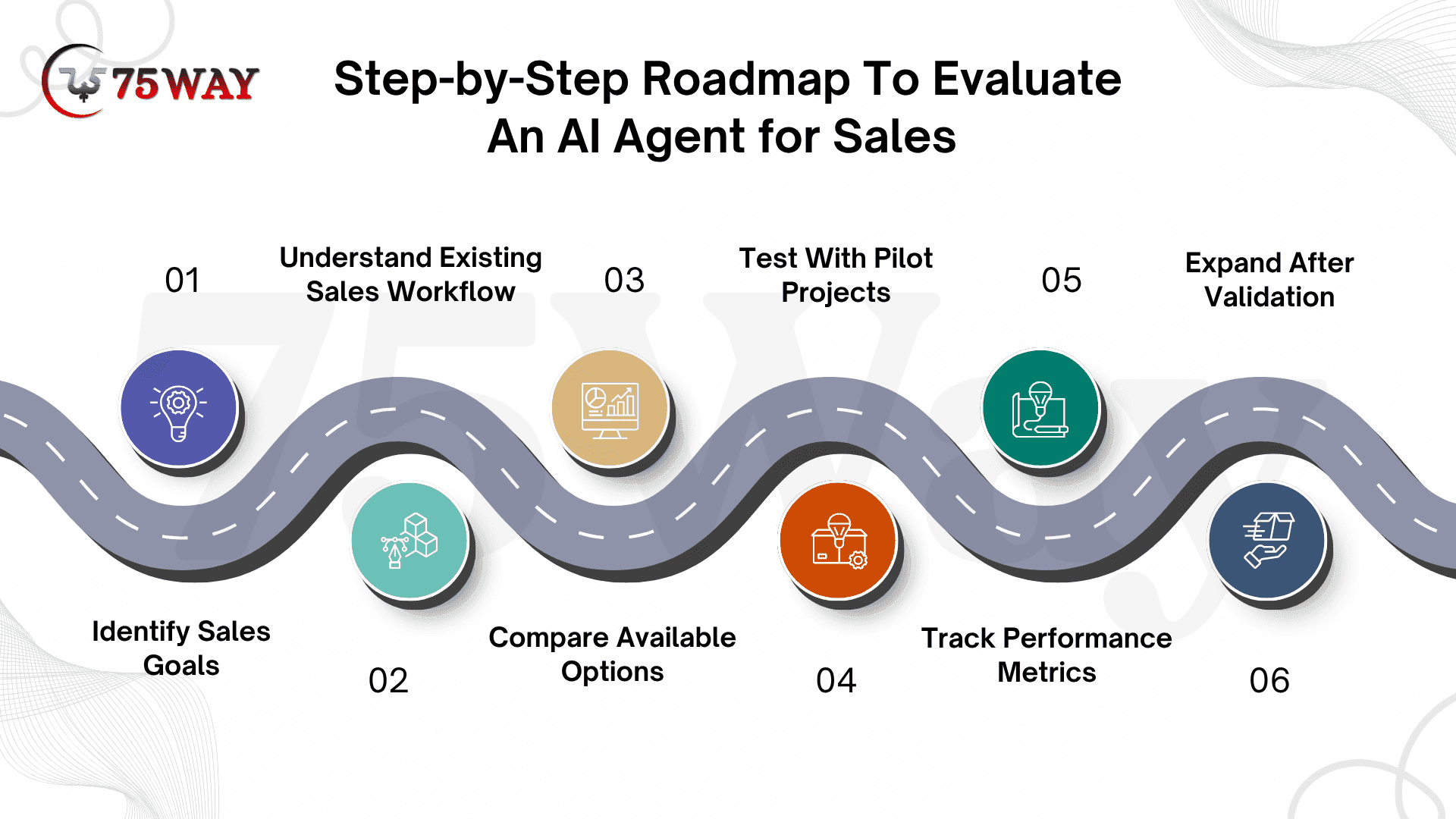
Step 1: Identify Sales Goals
Start by defining what you actually want to improve in your sales process. It could be lead quality, faster conversions, or reduced response time. Clear goals make it easier to judge whether the AI agent is delivering real value or just adding another layer of tools.
Step 2: Understand Existing Sales Workflow
Before selecting any AI solution, map how your current sales process works. Look at how leads move, how follow-ups happen, and where delays occur. This helps you choose an AI agent that fits naturally into your system instead of disrupting it.
Step 3: Compare Available Options
Do not settle for the first tool you find. Shortlist multiple AI sales agents and compare them based on real-world use cases, not just marketing claims. Focus on how each option solves your specific sales challenges.
Step 4: Test With Pilot Projects
Run a small-scale pilot before full deployment. This allows you to see how the AI performs in real conditions, how your team interacts with it, and whether it actually improves sales activities without risking full-scale disruption.
Step 5: Track Performance Metrics
Measure results using clear indicators like conversion rates, response time, lead quality, and engagement levels. This step helps you understand whether the AI agent is making a measurable difference in your sales performance or not.
Step 6: Expand After Validation
Only scale the AI agent once it has proven consistent results in pilot testing. Gradual expansion helps avoid operational risks and ensures smoother adoption across the entire sales team without unnecessary resistance or confusion.
Common Challenges in Adopting Agentic AI for Sales
Adopting agentic AI in sales sounds exciting, but many businesses rush the process and end up with poor results. The issue is not the technology itself, but how it is selected and implemented without proper thinking or real-world validation.
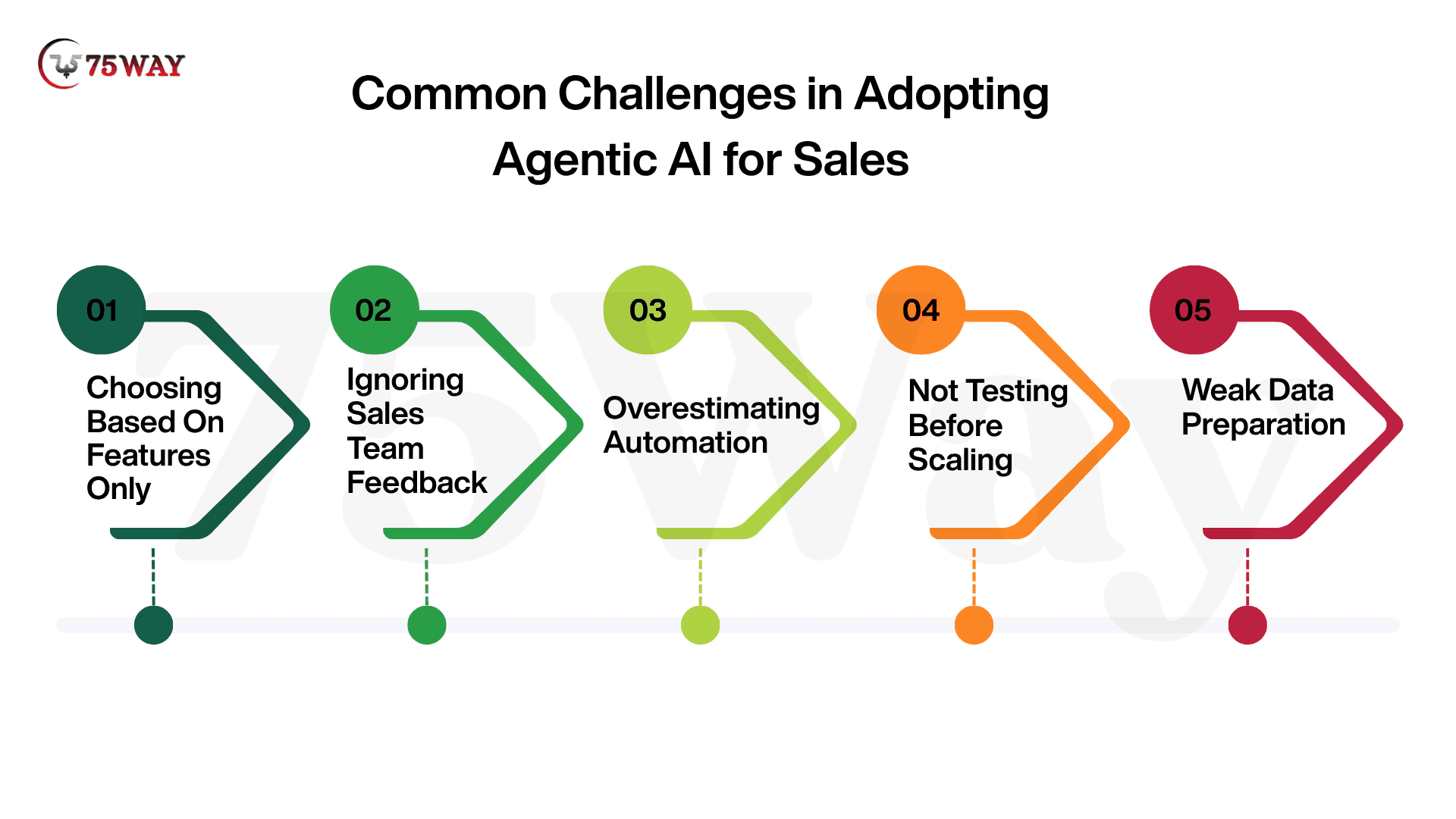
- Choosing Based On Features Only
Many companies get impressed by long feature lists and assume that more features automatically mean better performance. In reality, complexity without relevance often slows teams down. The right choice is the one that fits your sales workflow and actually improves day-to-day execution.
- Ignoring Sales Team Feedback
Sales teams are the ones using the system daily, yet their input is often ignored during adoption. If the tool does not feel practical or easy to use, adoption drops quickly. Involving them early helps ensure the AI agent supports real selling activities instead of creating friction.
- Overestimating Automation
AI can handle repetitive tasks, but it cannot replace sales thinking, relationship building, or strategy. Some businesses expect full automation and get disappointed. The smarter approach is to use AI as a support layer that enhances human decision-making rather than replacing it.
- Not Testing Before Scaling
Skipping pilot testing is a common mistake that leads to costly failures. Without testing, businesses miss gaps in performance, usability, and integration. Starting small helps validate results, improve accuracy, and build confidence before rolling out across the entire sales organization.
- Weak Data Preparation
Many AI initiatives fail because the underlying data is incomplete, outdated, or unstructured. Poor data leads to poor recommendations. Cleaning and organizing data before implementation is critical for meaningful and reliable AI performance in real sales environments.
Best Pre-Built AI Sales Agents For Boosting Revenue
Sales AI agents are changing team operations across leads, outreach, and deal closure processes. These pre-built AI sales agents improve targeting, speed, accuracy, and overall revenue performance by supporting every stage of the sales process through intelligent automation and data-driven decision-making.
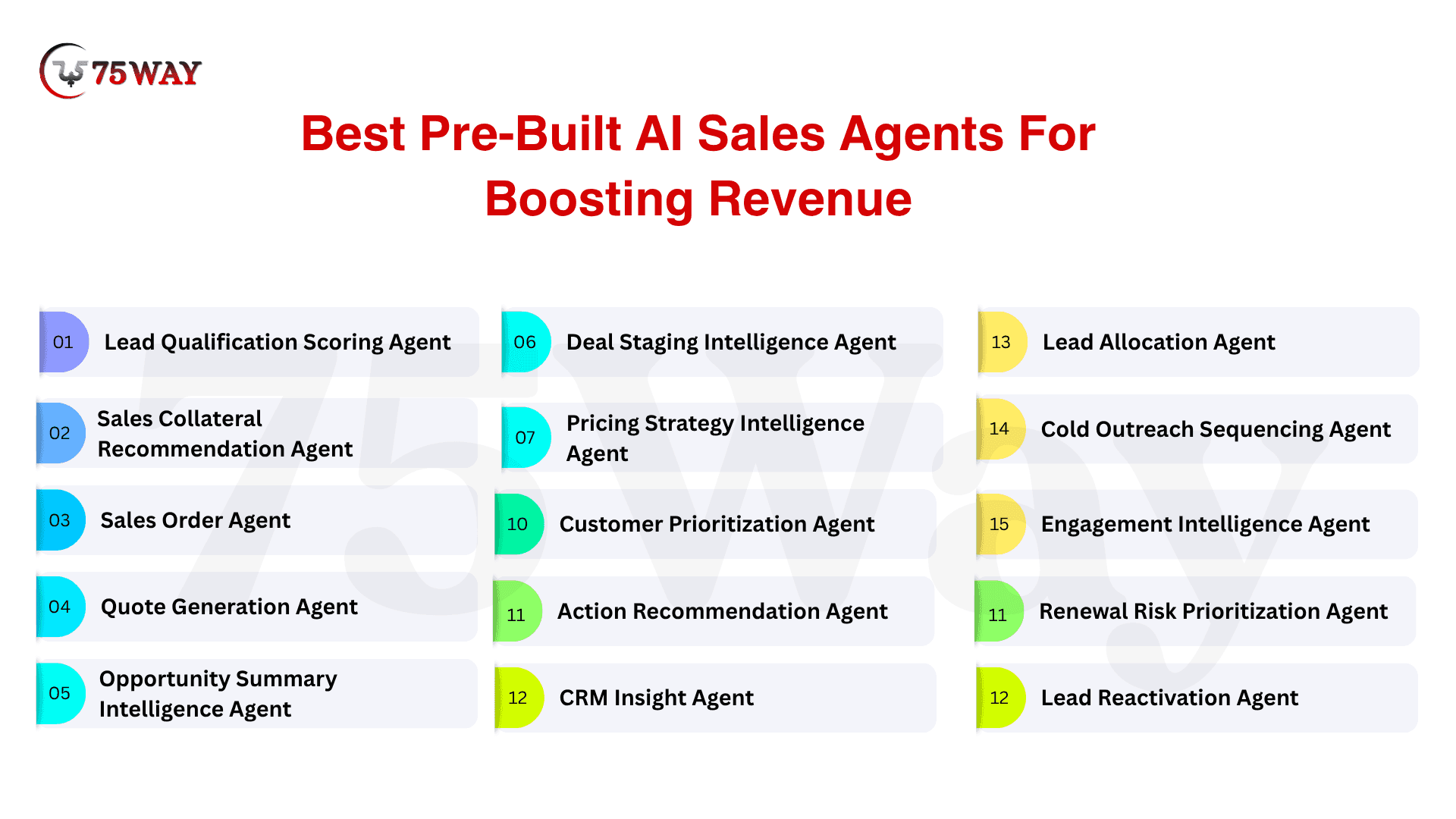
- Lead Qualification Scoring Agent:Lead qualification scoring agent evaluates prospects using behavioral, demographic, and engagement signals. It helps sales teams focus only on leads with higher conversion probability, improving productivity and reducing wasted effort on low-quality prospects.
- Sales Collateral Recommendation Agent: It suggests the most relevant brochures, case studies, and presentations based on buyer stage and industry. Sales collateral recommendation agent ensures sales teams always share the right material at the right moment, increasing engagement quality.
- Sales Order Agent:The sales order agent automates the entire order processing workflow from capture to fulfillment. It validates pricing, checks inventory availability, generates invoices, and updates connected systems like ERP platforms.
- Quote Generation Agent: The quote generation agent generates real-time pricing quotes based on products, discounts, and customer terms. This speeds up the quoting process and helps reduce delays in the sales cycle.
- Opportunity Summary Intelligence:Opportunity summary intelligence agent creates structured summaries of deals, including stakeholders, risks, and timelines. This helps sales teams quickly understand opportunity status without manual analysis.
- Deal Staging Intelligence Agent: This agent analyzes pipeline movement and automatically improves stage accuracy. Deal staging intelligence agent helps teams forecast better and track deal progression more clearly.
- Pricing Strategy Intelligence Agent: It analyzes market trends, competitor pricing, and customer behavior. Pricing strategy intelligence agent helps businesses optimize pricing strategies for higher margins and better competitiveness.
- Renewal Risk Prioritization Agent: It identifies accounts at risk of churn using engagement and contract signals. Sales teams can focus on retention efforts before customers are lost with the renewal risk prioritization agent.
- Customer Prioritization Agent:Customer prioritization agent ranks customers based on revenue potential, engagement, and lifetime value. It helps sales teams focus on high-impact accounts first.
- Action Recommendation Agent: It provides data-driven next-step suggestions across sales activities. Action recommendation agent helps teams make faster decisions and improve overall execution quality in real time.
- CRM Insight Agent: This agent analyzes CRM data to identify buying signals and customer behavior patterns. CRM insight agent helps sales teams make better engagement decisions based on real-time insights.
- Lead Allocation Agent:Lead allocation agent distributes incoming leads based on territory, workload, and expertise. This improves response time and ensures the right salesperson handles the right opportunity.
- Cold Outreach Sequencing Agent: This agent designs multi-step outreach sequences based on prospect behavior and engagement signals. Cold outreach sequencing agent increases response rates by sending messages at the right time.
- Engagement Intelligence Agent: The engagement intelligence agent analyzes multichannel interactions to detect buying intent and engagement quality. Sales teams can use these insights to improve timing and follow-up strategies.
- Lead Reactivation Agent: This agent identifies dormant leads and triggers personalized re-engagement campaigns. Lead reactivation agent helps recover lost opportunities that were previously inactive or ignored.
Future Of AI Agents For Sales & Marketing In 2026
AI sales agents in 2026 are evolving from simple automation tools into intelligent systems that actively support decision-making across the sales cycle. They are becoming more predictive, personalized, and autonomous, helping teams respond faster to changing buyer behavior and market conditions. Sales organizations will increasingly rely on them not just for execution, but for guiding smarter and more informed sales decisions at every stage. Future trends include:
- Real-time buyer behavior prediction
- Fully autonomous sales pipelines
- Hyper-personalized communication
- Voice-based AI sales assistants
- AI-driven sales forecasting accuracy improvement
- Emotion and sentiment analysis in buyer conversations
- Cross-channel engagement orchestration across platforms
Sales teams will increasingly rely on AI not just for support, but for decision intelligence.
Final Thoughts
To summarize, selecting an AI sales agent for your sales team is a strategic business decision that directly impacts revenue growth. The right AI agent for sales can improve lead quality, accelerate conversions, and enhance sales efficiency across every stage of the funnel. However, businesses must focus on alignment, integration, scalability, and real performance impact instead of just features or marketing claims. A structured evaluation process, combined with pilot testing and measurable outcomes, ensures better long-term results. If you are exploring ready-made AI sales agents, 75AI Agent Store offers pre-built solutions designed to support real revenue growth and practical sales execution. You can hire an AI development company to create an AI agent for sales based on your business requirements.
Frequently Asked Questions (FAQs)
How Do AI Sales Agents Improve Conversion Rates?
AI sales agents improve conversion rates by analyzing lead behavior, identifying high-intent prospects, and enabling personalized communication. They also automate follow-ups and prioritize opportunities, ensuring sales teams focus on the most promising leads, which increases efficiency and improves overall deal closure performance.
Can Small Businesses Use Sales AI Agents?
Yes, small businesses can benefit greatly from AI sales agents. They help automate repetitive tasks, improve lead management, and enhance customer engagement without requiring large teams. This allows smaller organizations to compete with larger players by improving efficiency and maximizing limited sales resources.
Are AI Sales Agents Secure For Handling Customer Data?
Most reliable AI sales agents include strong security features like encryption, access controls, and compliance standards. However, businesses must choose trusted providers and ensure proper data handling practices are followed to maintain confidentiality and protect sensitive customer and sales information.
Can AI Agents For Sales Work Without CRM Integration?
AI sales agents can function independently in limited scenarios, but CRM integration significantly improves their effectiveness. Without integration, data becomes fragmented, reducing visibility into customer journeys and limiting automation capabilities across lead tracking, follow-ups, and performance analysis processes.
How Do AI Sales Agents Help Sales Teams Prioritize Leads?
AI sales agents evaluate leads based on behavior, engagement history, and intent signals. This helps identify high-value prospects, allowing sales teams to focus efforts on leads most likely to convert, improving productivity and reducing time spent on low-quality opportunities.
How Often Should AI Sales Agents Be Updated Or Optimized?
AI sales agents should be reviewed and optimized regularly based on performance data and changing business needs. Continuous updates ensure improved accuracy, better predictions, and alignment with evolving sales strategies, customer behavior, and market conditions over time.