AI Summary
On-demand beauty service apps now compete through experiences, not convenience alone. The right features improve bookings, engagement, retention, and revenue. AI further personalizes every customer interaction. Businesses must prioritize scalable architecture alongside user experience. This guide explains every essential feature for long-term success.
Key Takeaways
- Beauty service apps require customer-focused features that improve retention and satisfaction.
- AI-powered capabilities personalize services to reduce operational costs.
- Provider management features directly influence service quality and business scalability.
- Secure payments, automation, analytics, and notifications strengthen daily platform operations.
- Choosing core features early minimizes the need for redevelopment for sustainable growth.
A beauty service app competes with every smooth digital experience your customers already use, from food delivery to ride booking. If your app feels slow, confusing, or incomplete, users rarely wait for improvements; they simply move to another platform.
The businesses leading this market are not winning because they offer more beauty services. They are winning because their apps remove friction, simplify booking, and make every interaction feel effortless for both customers and beauty professionals.
This guide highlights the essential features business owners should prioritise while developing an on-demand beauty service app that attracts users, encourages repeat bookings, and supports long-term business growth.
Core Features To Build An On-Demand Beauty Service App
A beauty service platform serves three different user groups, and each one expects a completely different experience. The features below are grouped by customer app, beauty professional app, and admin panel to show what each stakeholder needs for the platform to run smoothly.
1. Essential Customer App Features in An On-Demand Beauty Service App
The customer app is where first impressions are created, and repeat bookings are won. The following features ensure every stage of that journey feels fast, intuitive, and trustworthy, from signup to post-service feedback.
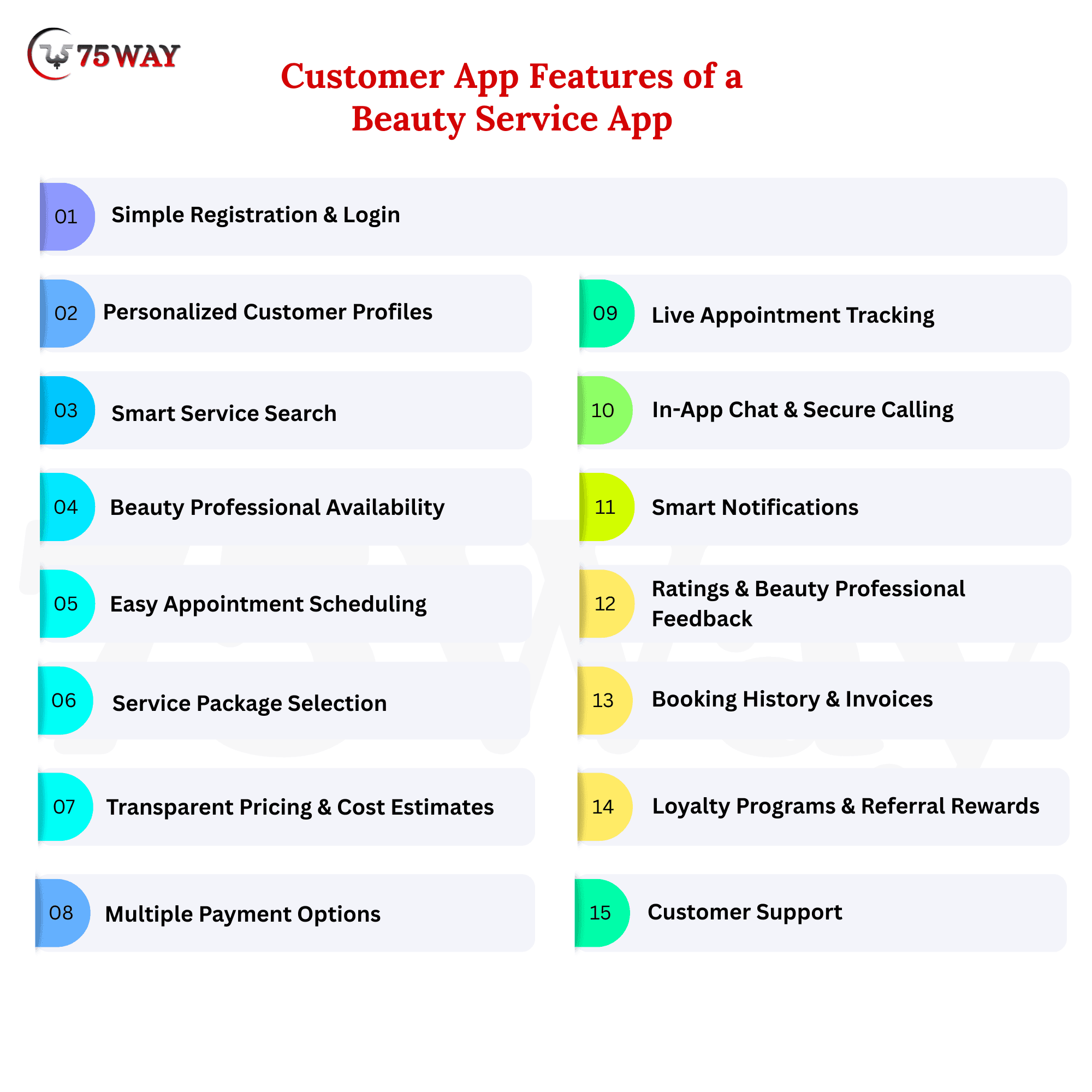
1. Simple Registration & Login
The customer journey begins long before a beauty professional arrives at the doorstep. A frictionless onboarding process determines whether potential customers complete registration or abandon the application. Modern on-demand beauty service app development should support multiple sign-in methods, including email, phone number, Google, Apple, and social authentication, while maintaining enterprise-grade security.
A streamlined registration experience reduces booking delays and encourages first-time users to explore available beauty services immediately. Secure authentication combined with encrypted customer data, password recovery, and multi-factor authentication builds trust and protects sensitive information.
2. Personalized Customer Profiles
Returning customers expect every booking to become easier than the previous one. A comprehensive customer profile stores preferred beauty professionals, favorite services, appointment history, saved addresses, payment methods, beauty preferences, allergies, skin sensitivities, and communication preferences to simplify future bookings.
These insights also improve service quality because beauty professionals can prepare before arriving at the customer's location. Personalized profiles reduce repetitive data entry, increase booking confidence, and support tailored recommendations that improve customer satisfaction and long-term platform retention.
3. Smart Service Search
As beauty service marketplaces expand, customers need efficient ways to locate the right professional without scrolling through hundreds of options. Intelligent search should allow filtering by service category, location, availability, ratings, experience, pricing, language, specialization, and home service availability.
Advanced filtering shortens the decision-making process while helping customers compare professionals that match their exact requirements. Faster discovery improves user experience, increases completed bookings, and ensures customers consistently find services aligned with their expectations.
4. Beauty Professional Availability
Customers prefer booking professionals who are genuinely available instead of requesting appointments that later require rescheduling. Live availability calendars synchronized with professionals' schedules eliminate unnecessary booking conflicts and improve appointment accuracy.
Displaying available time slots in real time creates transparency while reducing cancellations caused by scheduling overlaps. This feature enhances operational efficiency for beauty professionals and gives customers greater confidence when confirming appointments.
5. Easy Appointment Scheduling
Flexible appointment scheduling enables customers to choose convenient dates, preferred time slots, recurring appointments, and special service requests during booking. An intuitive scheduling interface minimizes booking friction and supports both immediate and future reservations.
A well-designed scheduling system also accommodates rescheduling, cancellations, buffer times, and service durations. This flexibility improves customer convenience while helping beauty professionals manage their workloads more efficiently.
6. Service Package Selection
Many customers prefer to combine multiple beauty treatments into a single appointment rather than booking each service separately. Allowing users to create customized service packages increases convenience while improving the platform's average order value.
Package selection also simplifies appointment planning because customers can review estimated service duration, pricing, and professional availability before completing their reservation. Bundled services encourage larger transactions and strengthen customer loyalty.
7. Transparent Pricing & Cost Estimates
Unexpected charges remain one of the leading reasons customers lose trust in service marketplaces. Every booking should display service pricing, taxes, platform fees, discounts, travel charges, and optional add-ons before payment confirmation.
Transparent pricing helps customers make informed decisions without confusion or hidden costs. Clear estimates reduce booking abandonment, minimize payment disputes, and strengthen confidence in the platform's pricing integrity.
8. Multiple Payment Options
Customers expect flexible payment experiences that match their preferences. Supporting credit cards, debit cards, digital wallets, UPI (where applicable), Apple Pay, Google Pay, and buy-now-pay-later solutions improves payment completion rates across different regions.
Secure payment gateways with encrypted transactions, tokenization, and fraud detection protect financial information while ensuring regulatory compliance. Reliable payment infrastructure strengthens trust and supports seamless checkout experiences.
9. Live Appointment Tracking
After confirming a booking, customers appreciate knowing when their beauty professional will arrive. GPS-enabled appointment tracking provides estimated arrival times, live location updates, route progress, and service status notifications, eliminating uncertainty throughout the appointment journey.
Real-time tracking improves transparency while reducing support inquiries about arrival delays. Customers can prepare for the appointment in advance, and beauty professionals can communicate unexpected traffic or schedule changes instantly, creating a smoother and more reliable on-demand beauty service experience.
10. In-App Chat & Secure Calling
Clear communication before an appointment prevents misunderstandings that often lead to cancellations or poor customer experiences. Built-in messaging and masked calling allow customers to discuss appointment details, parking instructions, preferred products, allergies, or special requests without exposing personal contact information.
Keeping every conversation inside the application also creates a documented communication history for future reference and dispute resolution. Encrypted messaging improves customer confidence, protects user privacy, and helps beauty professionals prepare more effectively before reaching the service location.
11. Smart Notifications
Busy customers frequently forget appointments, resulting in missed bookings and unnecessary revenue loss. Automated reminders through push notifications, SMS, and email keep customers informed about booking confirmations, upcoming appointments, payment updates, cancellations, promotional offers, and service completion.
Intelligent notification timing reduces no-shows while improving customer engagement throughout the booking journey. Personalized reminders based on appointment schedules and customer behavior also encourage repeat bookings without appearing intrusive.
12. Ratings & Beauty Professional Feedback
Trust plays a significant role when customers invite beauty professionals into their homes. A transparent review system enables users to rate services, leave detailed feedback, upload images, and share their experiences after every completed appointment.
Verified reviews help future customers make informed booking decisions while encouraging professionals to maintain consistently high service standards. Constructive feedback also provides valuable insights that businesses can use to improve overall marketplace quality.
13. Booking History & Invoices
Customers often prefer returning to professionals who delivered excellent experiences previously. A complete booking history allows users to review past appointments, reorder favorite services, download invoices, access payment receipts, and monitor their spending over time.
Digital records simplify expense tracking while eliminating the need to maintain paper invoices. Businesses also benefit from reduced customer support requests because users can independently retrieve historical booking information whenever needed.
14. Loyalty Programs & Referral Rewards
Acquiring new customers costs significantly more than retaining existing ones. Integrated loyalty programs reward users with redeemable points, exclusive discounts, membership benefits, birthday offers, and referral incentives that encourage continued platform engagement.
Well-designed reward systems increase booking frequency while strengthening customer relationships. Referral programs additionally reduce customer acquisition costs by encouraging satisfied users to recommend the platform to friends and family.
15. Customer Support
Even well-designed applications occasionally require customer assistance. An accessible support center should provide live chat, AI-powered assistance, FAQs, ticket management, emergency contact options, and issue escalation whenever booking problems arise.
Fast and reliable support improves customer confidence because users know help is available whenever required. Efficient issue resolution protects brand reputation, increases customer satisfaction, and contributes to stronger long-term retention within competitive beauty service marketplaces.
2. Beauty Professional App Features for On-Demand Beauty Service App Development
A beauty service platform performs only as well as the professionals delivering the services. The features below help beauty specialists manage appointments, communicate with customers, track earnings, and provide a seamless service experience.
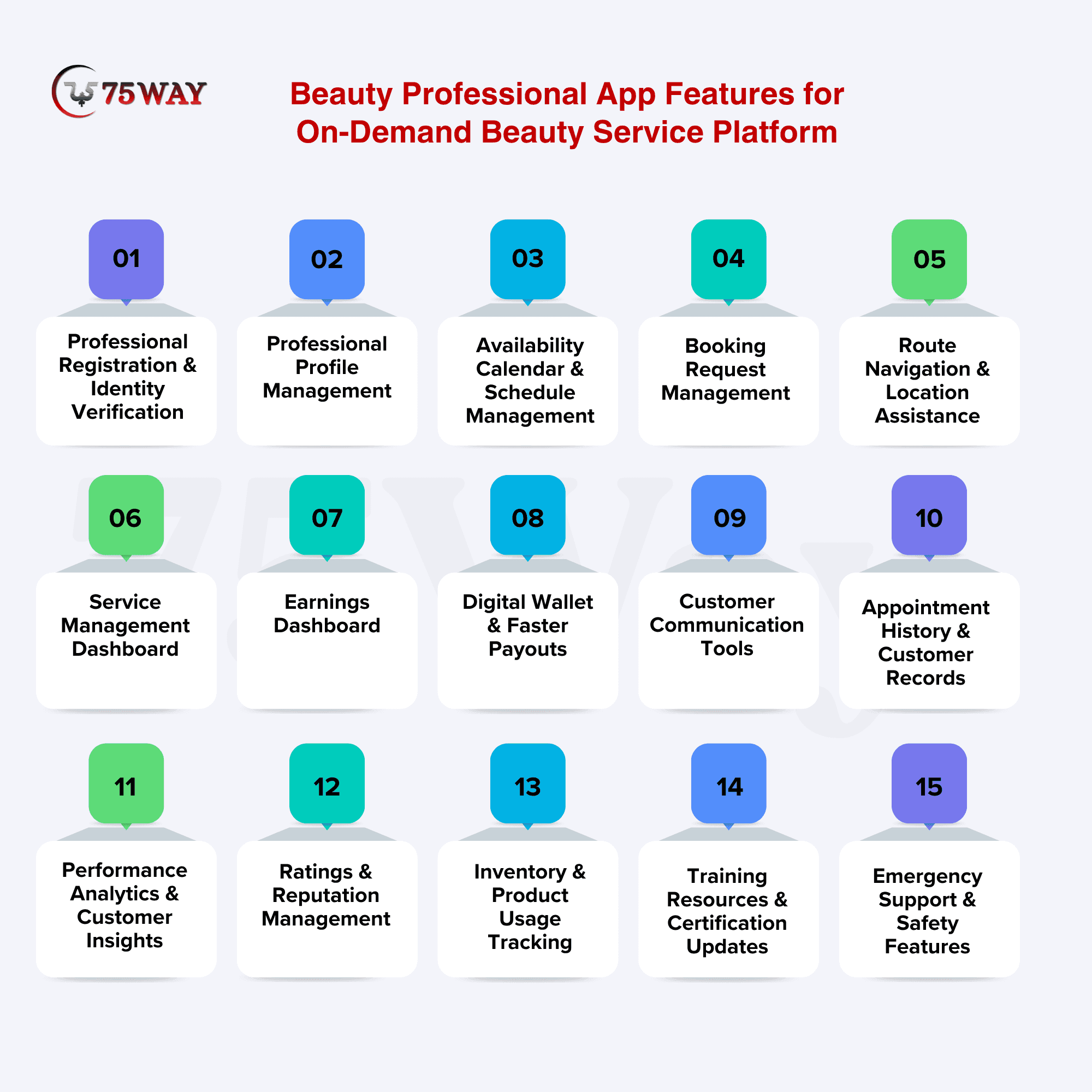
1. Professional Registration & Identity Verification
Every successful beauty service marketplace begins with trusted professionals. During onboarding, beauty experts should submit government identification, certifications, licenses where applicable, portfolio images, banking information, and professional experience for verification before accepting customer bookings.
A structured verification process protects customers from fraudulent providers while strengthening the platform's credibility. Verified professionals also build greater customer confidence, resulting in higher booking conversions and stronger long-term marketplace trust.
2. Professional Profile Management
Customers often compare professionals before making booking decisions. Every beauty professional should have a detailed profile showcasing expertise, certifications, years of experience, completed appointments, service categories, customer ratings, portfolio images, languages spoken, and a personal introduction.
A well-maintained profile increases visibility in search results while helping customers select professionals who best match their beauty needs. Detailed profiles also contribute to transparency and improve booking confidence across the marketplace.
3. Availability Calendar & Schedule Management
Beauty professionals require complete control over their working hours to avoid scheduling conflicts. A dynamic calendar allows them to define availability, block personal time, set vacation periods, adjust working hours, and automatically synchronize confirmed appointments.
Flexible schedule management minimizes double bookings while improving appointment accuracy. Automated availability updates also help customers view only genuine booking slots, reducing cancellations and improving operational efficiency.
4. Booking Request Management
Professionals should receive real-time booking requests containing complete appointment details, including customer location, requested services, appointment duration, preferred schedule, and special instructions before confirming assignments.
Instant booking management enables professionals to accept, reject, or reschedule appointments quickly. Faster responses improve customer satisfaction while ensuring service schedules remain organized throughout the day.
5. Route Navigation
Home beauty services depend heavily on timely arrivals. Integrated GPS navigation provides optimized travel routes, estimated arrival times, traffic updates, and customer directions to reduce travel delays and improve punctuality.
Efficient navigation minimizes missed appointments while allowing professionals to serve more customers within the same working hours. Businesses also benefit from improved operational efficiency and higher customer satisfaction.
6. Service Management Dashboard
Beauty professionals often provide multiple services with varying durations and pricing. A dedicated dashboard enables providers to manage available services, update pricing, define treatment durations, create service bundles, and temporarily pause unavailable offerings.
This flexibility allows professionals to adapt their service catalog according to seasonal demand, customer preferences, and business growth. Customers also receive accurate information before completing bookings.
7. Earnings Dashboard
Financial transparency motivates professionals to remain active on the platform. A comprehensive earnings dashboard displays completed appointments, daily income, weekly performance, bonuses, incentives, pending payouts, commissions, taxes, and downloadable financial reports.
Real-time income tracking helps professionals monitor business performance and plan future workloads. Transparent earnings also improve trust between providers and the platform.
8. Digital Wallet & Payouts
Delayed payments often discourage professionals from remaining active on marketplace platforms. A built-in wallet simplifies commission management, stores earnings securely, tracks payment history, and supports scheduled bank transfers.
Fast payout processing improves provider satisfaction while reducing payment-related support requests. Reliable financial operations encourage long-term professional retention and marketplace stability.
9. Customer Communication Tools
Professional communication significantly influences customer satisfaction before and during appointments. Secure in-app messaging and masked calling enable professionals to confirm addresses, discuss service requirements, clarify appointment details, and notify customers about arrival times.
Maintaining communication within the application protects customer privacy while creating a documented interaction history. Clear communication reduces misunderstandings and contributes to smoother service experiences.
10. Appointment History & Records
Professionals frequently serve repeat customers who expect personalized experiences. Access to previous appointment history, preferred services, allergies, skin sensitivities, beauty preferences, and customer notes enables professionals to deliver more consistent results.
Historical records eliminate repetitive consultations while helping professionals prepare appropriately before each visit. Personalized service strengthens customer loyalty and increases repeat bookings.
11. Performance Analytics
Professionals benefit from understanding how their services perform over time. Analytics dashboards should display booking trends, service popularity, customer retention, average ratings, cancellation rates, earnings growth, and productivity metrics.
Performance insights help professionals identify improvement opportunities while supporting better business decisions. Data-driven optimization ultimately enhances both customer satisfaction and provider profitability.
12. Ratings & Reputation Management
Customer feedback directly influences future booking opportunities. Professionals should receive detailed reviews, star ratings, customer comments, and service-specific feedback after each completed appointment.
Reputation management encourages continuous service improvement while helping businesses maintain marketplace quality. High-performing professionals gain greater visibility, creating healthy competition across the platform.
13. Inventory & Product Usage Tracking
Many mobile beauty professionals carry consumable products, tools, and equipment for appointments. Inventory management helps track product usage, monitor low-stock items, and estimate replenishment requirements before scheduled services.
Efficient inventory tracking prevents service interruptions while reducing unnecessary product waste. Professionals remain prepared for every appointment, improving operational consistency.
14. Training Resources
Continuous learning helps professionals remain competitive within the beauty industry. Integrated learning modules, certification updates, platform guidelines, and product training ensure providers stay informed about emerging techniques and quality standards.
Educational resources improve service consistency while encouraging professional growth. Businesses benefit from a highly skilled provider network capable of delivering premium customer experiences.
15. Emergency Support & Safety Features
Home beauty services involve professionals traveling to unfamiliar locations. Safety features such as emergency assistance, live location sharing, SOS alerts, customer verification, and incident reporting improve provider security throughout appointments.
A secure working environment increases professional confidence and strengthens trust in the platform. Safety-focused features also demonstrate the business's commitment to protecting both providers and customers.
3. Essential Admin Panel Features To Create On-Demand Beauty Service Platform
A powerful admin panel in an on-demand beauty service app centralizes all operations, enabling businesses to maintain quality, streamline workflows, and make informed strategic decisions. The following admin features provide the operational control necessary to scale a beauty service marketplace.
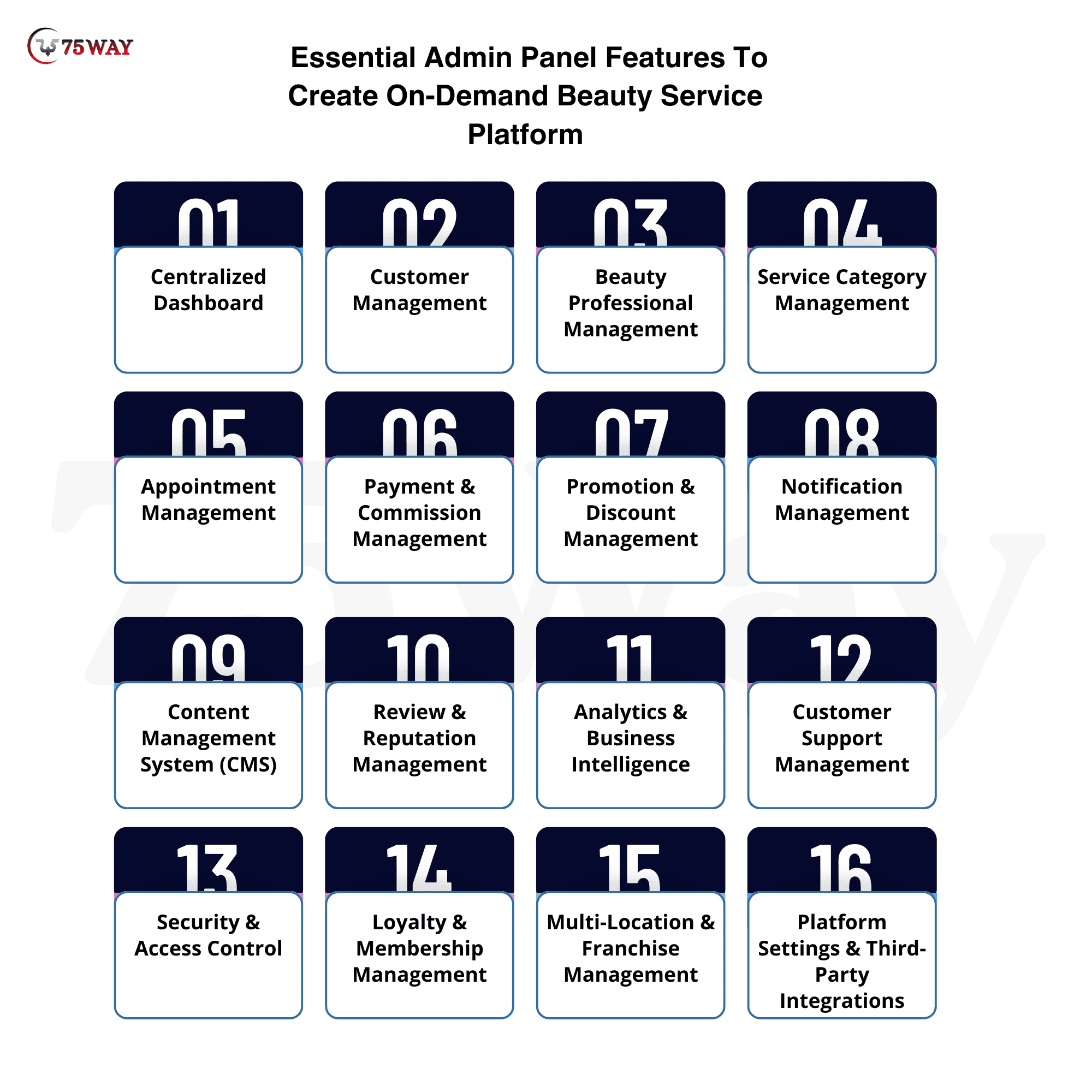
1. Centralized Dashboard
The admin dashboard serves as the command center of an on-demand beauty service platform by presenting every important business metric in one place. Administrators can monitor bookings, revenue, active customers, beauty professionals, cancellations, support tickets, and platform performance through real-time reports. A centralized dashboard enables faster decision-making while helping businesses identify operational issues before they impact customer satisfaction.
Key Capabilities
- Monitor live bookings across multiple service locations.
- Track revenue using real-time financial performance metrics.
- Review active customers and registered beauty professionals.
- Analyze daily, weekly, and monthly business growth.
- Identify pending approvals requiring immediate administrative attention.
- Monitor platform health through operational performance indicators.
2. Customer Management
An effective customer management module enables administrators to oversee all registered users while maintaining a secure, personalized platform experience. Admins can access customer profiles, booking history, support requests, payment activity, loyalty participation, and account status to resolve issues efficiently and improve customer retention.
Key Capabilities
- View complete customer profiles and booking records.
- Update customer information after safely verifying requests.
- Suspend fraudulent or policy-violating customer accounts instantly.
- Review customer complaints and service resolution history.
- Manage loyalty rewards and referral program participation.
- Export customer reports for marketing campaign analysis.
3. Beauty Professional Management
Managing beauty professionals is essential for maintaining service quality across the marketplace. The admin panel should simplify onboarding, profile verification, document approval, certification management, performance monitoring, and account administration to ensure only qualified professionals remain active on the platform.
Key Capabilities
- Verify professional identity and certification documents efficiently.
- Approve newly registered beauty professionals quickly online.
- Monitor provider ratings and customer satisfaction scores.
- Suspend inactive or policy-violating professional accounts immediately.
- Update provider categories and service specialization details.
- Review appointment completion and cancellation performance regularly.
4. Service Category Management
Beauty businesses regularly introduce new services while updating existing offerings based on customer demand. Administrators require flexible tools to create service categories, define pricing structures, organize treatment groups, and manage service visibility across the application without involving developers.
Key Capabilities
- Create new beauty service categories effortlessly anytime.
- Modify service descriptions and category visibility instantly.
- Organize treatments under structured service classifications.
- Enable seasonal or promotional service availability quickly.
- Manage bundled services with flexible pricing options.
- Archive discontinued services without deleting historical records.
5. Appointment Management
The admin panel should provide complete visibility into every scheduled appointment from booking confirmation through service completion. Administrators can resolve scheduling conflicts, manage cancellations, assist customers, reassign professionals, and ensure smooth marketplace operations without disrupting ongoing appointments.
Key Capabilities
- View upcoming and completed appointment schedules instantly.
- Reassign appointments during unexpected professional unavailability situations.
- Resolve booking conflicts using centralized scheduling controls.
- Track cancellations and identify recurring operational patterns.
- Monitor appointment completion across every service location.
- Generate appointment reports for business performance evaluation.
6. Payment & Commission Management
Financial management is one of the most important administrative responsibilities in an on-demand beauty service marketplace. The system should automate customer payments, provider commissions, refunds, payout schedules, invoices, and tax reporting while maintaining complete transparency for every financial transaction.
Key Capabilities
- Configure commission percentages for provider categories easily.
- Process customer refunds following approved business policies.
- Schedule provider payouts through automated payment workflows.
- Generate digital invoices for completed appointments automatically.
- Track payment failures requiring administrative intervention.
- Export financial statements for accounting and compliance purposes.
7. Promotion & Discount Management
Marketing campaigns become more effective when administrators can launch targeted offers without technical assistance. A promotion management system enables businesses to create coupons, referral campaigns, seasonal discounts, membership benefits, and location-specific promotional offers to increase bookings and customer retention.
Key Capabilities
- Create promotional coupons with flexible discount conditions.
- Schedule seasonal campaigns before peak demand periods.
- Configure referral rewards encouraging customer acquisition.
- Target offers using customer behavior segmentation insights.
- Monitor redemption performance across active promotional campaigns.
- Disable expired promotions without affecting existing bookings.
8. Notification Management
Timely communication improves customer satisfaction while reducing missed appointments. Administrators should control push notifications, emails, SMS campaigns, booking reminders, promotional announcements, and emergency alerts from a centralized notification management system.
Key Capabilities
- Send appointment reminders before scheduled service visits.
- Broadcast promotional offers to targeted customer groups.
- Notify professionals regarding policy or platform updates.
- Schedule automated messages for recurring customer engagement.
- Monitor notification delivery across multiple communication channels.
- Customize notification templates for brand messaging.
9. Content Management System (CMS)
A built-in CMS enables administrators to update banners, FAQs, policies, blogs, landing pages, service descriptions, and marketing content without relying on developers. Keeping content current improves user experience while supporting SEO and promotional initiatives.
Key Capabilities
- Update homepage banners promoting featured beauty services.
- Edit FAQs improving customer self-service experiences consistently.
- Publish blogs supporting organic search visibility growth.
- Modify privacy policies and platform terms anytime.
- Update promotional landing pages without developer assistance.
- Manage multimedia assets across application content efficiently.
10. Review & Reputation Management
Customer reviews significantly influence booking decisions. Administrators require tools to moderate reviews, investigate disputes, remove inappropriate content, and monitor platform reputation to maintain a trustworthy marketplace for both customers and beauty professionals.
Key Capabilities
- Flag customer feedback for review before it becomes publicly visible.
- Remove abusive reviews violating platform community guidelines.
- Investigate disputes between customers and professionals fairly.
- Highlight exceptional professionals using verified customer ratings.
- Monitor overall platform reputation through customer reviews.
- Generate satisfaction reports supporting quality improvement initiatives.
11. Analytics & Business Intelligence
Business growth depends on understanding customer behavior and operational performance. Advanced analytics provide insights into bookings, revenue, customer retention, provider productivity, marketing campaigns, and service demand, enabling administrators to make informed strategic decisions.
Key Capabilities
- Analyze booking trends across multiple reporting periods.
- Track customer retention using engagement performance metrics.
- Measure provider productivity through appointment completion statistics.
- Compare the effectiveness of marketing campaigns using conversion reports.
- Identify top-performing services generating maximum business revenue.
- Forecast future demand using historical platform analytics.
12. Customer Support Management
Administrators need complete oversight of customer support operations to ensure every issue receives timely resolution. Centralized ticket management improves communication between customers, professionals, and support teams while maintaining high service standards.
Key Capabilities
- Assign customer tickets to available support representatives.
- Track issue resolution from submission until closure.
- Escalate critical complaints requiring immediate administrative review.
- Monitor support response times for customer satisfaction.
- Maintain conversation history for future reference purposes.
- Generate support performance reports identifying improvement opportunities.
13. Security & Access Control
Protecting sensitive business and customer information is essential for every marketplace platform. The admin panel should enforce role-based permissions, authentication controls, audit logs, and data security policies to prevent unauthorized access.
Key Capabilities
- Assign role-based permissions for administrative team members.
- Enable multi-factor authentication for account security.
- Track administrator activities through detailed audit logs.
- Monitor suspicious login attempts across platform accounts.
- Protect sensitive customer information using encrypted storage.
- Restrict unauthorized access to confidential business resources.
14. Loyalty & Membership Management
Retaining customers requires more than occasional discounts. Administrators should manage loyalty points, memberships, referral incentives, exclusive rewards, and customer engagement programs from a unified interface.
Key Capabilities
- Configure loyalty point earning and redemption rules.
- Launch premium membership programs increasing customer retention.
- Reward referrals encouraging organic platform user growth.
- Offer exclusive benefits to repeat booking customers.
- Track membership performance through customer engagement analytics.
- Modify reward structures supporting changing business objectives.
15. Multi-Location & Franchise Management
Businesses expanding into multiple cities require centralized control over every operational location. The admin panel should support location-specific pricing, professionals, promotions, bookings, and reporting while maintaining consistent brand standards.
Key Capabilities
- Manage operations across multiple business service locations.
- Configure region-specific pricing for localized market conditions.
- Assign professionals to preferred operational coverage areas.
- Compare branch performance using centralized reporting dashboards.
- Launch localized promotions targeting regional customer segments.
- Monitor location-wise bookings supporting expansion planning.
16. Platform Settings & Third-Party Integrations
As the business grows, administrators need flexibility to configure platform settings and integrate external services without rebuilding the application. Payment gateways, CRM software, marketing tools, analytics platforms, communication APIs, and cloud services should connect seamlessly to support future scalability.
Key Capabilities
- Configure payment gateway integration settings securely.
- Connect CRM platforms for customer relationship management.
- Integrate marketing automation tools for campaign success.
- Enable analytics platforms for advanced business reporting.
- Connect communication APIs supporting automated customer notifications.
- Customize platform configurations supporting future business scalability.
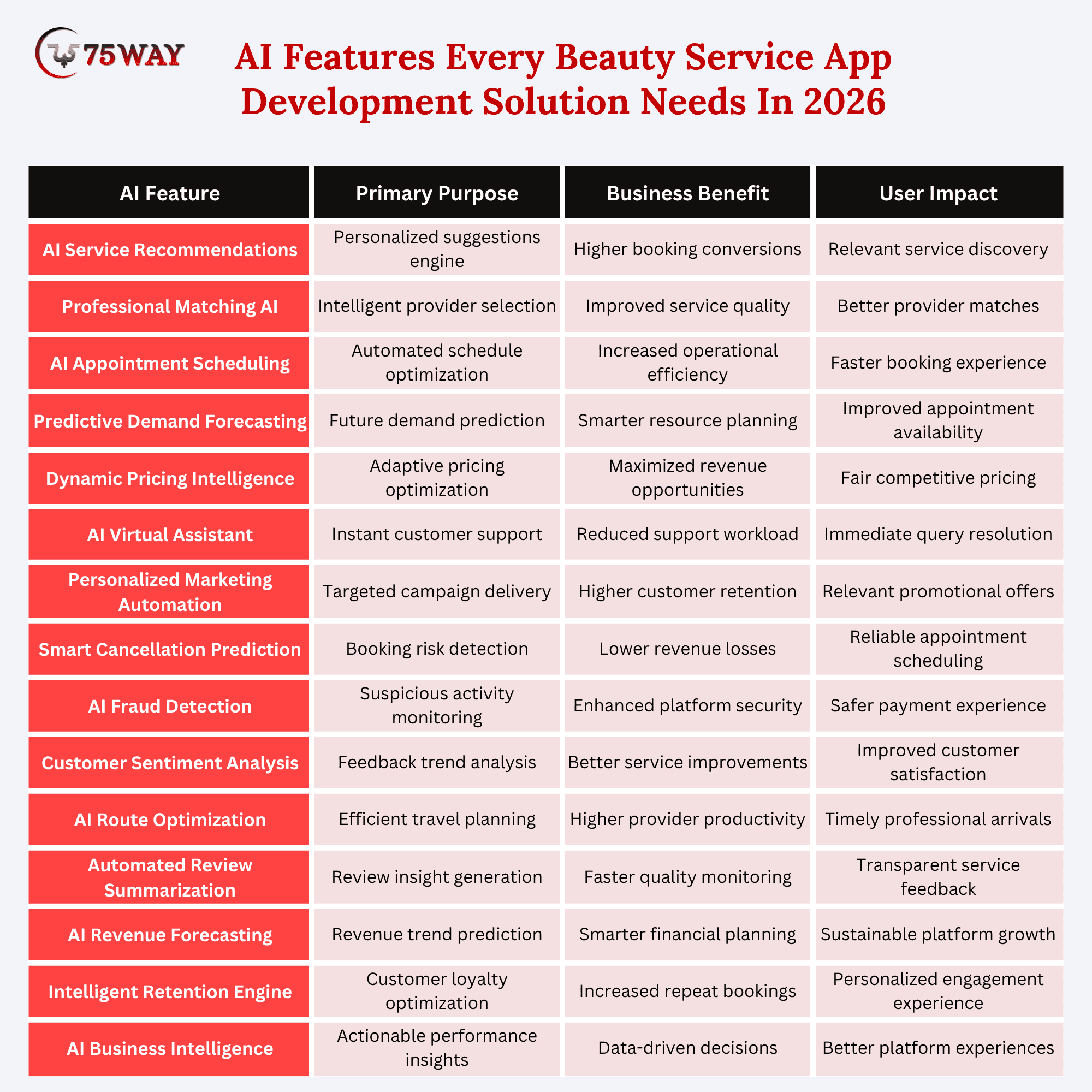
AI Features Every Beauty Service App Development Solution Needs In 2026
Smart and innovative beauty service apps don't rely on AI because it's a trend. They use it to solve problems that customers and businesses face every single day. Here are the AI capabilities that add measurable value to an on-demand beauty service platform instead of simply adding complexity.
1. AI-Powered Service Recommendations
Every customer has unique beauty preferences that evolve over time. AI-based beauty service app evaluates previous bookings, browsing behavior, favorite services, preferred professionals, seasonal interests, and spending habits to recommend treatments that align with individual expectations. Personalized suggestions make service discovery more engaging while increasing repeat bookings and average order value for the platform.
2. Intelligent Beauty Professional Matching
Selecting the right beauty professional involves much more than checking availability. AI compares customer preferences with provider expertise, ratings, experience, location, pricing, and appointment schedules to recommend professionals who best match specific service requirements. Smarter matching creates better customer experiences while improving successful booking completion rates.
3. AI-Based Appointment Scheduling
Booking appointments becomes faster when scheduling decisions are supported by intelligent automation. Voice AI agents and virtual agents analyze service duration, provider availability, travel distance, existing appointments, and customer preferences before suggesting the most efficient booking slots. Optimized scheduling improves productivity while reducing appointment conflicts across the marketplace.
4. Predictive Demand Forecasting
Business planning becomes more accurate when future demand can be anticipated with confidence. AI-driven on-demand beauty salon app processes historical bookings, seasonal trends, holidays, weather conditions, local events, and regional activity to estimate upcoming service demand. These insights help businesses allocate professionals efficiently while maintaining consistent service availability.
5. Dynamic Pricing Intelligence
Pricing strategies perform better when they respond to changing market conditions instead of remaining fixed throughout the year. AI-powered beauty service app evaluates booking demand, professional availability, location, customer behavior, promotional campaigns, and peak service hours to recommend optimized pricing. Businesses improve profitability while maintaining competitive pricing for customers.
6. AI Virtual Beauty Assistant
Customer support no longer depends entirely on human representatives for routine inquiries. AI-powered virtual assistants provide instant responses to booking questions, appointment modifications, payment guidance, cancellation policies, and service information throughout the day. Faster assistance improves customer satisfaction while allowing support teams to manage complex requests more efficiently.
7. Personalized Marketing Automation
Marketing campaigns generate stronger engagement when every customer receives offers aligned with individual interests. AI studies booking frequency, preferred services, inactive periods, seasonal behaviors, and purchase history to deliver personalized promotions automatically. Relevant campaigns encourage repeat appointments while improving overall marketing performance.
8. Smart Cancellation Prediction
Appointment data contains valuable patterns that reveal customer booking behavior over time. AI identifies indicators of potential cancellations and alerts businesses before appointments are missed unnecessarily. Early intervention supports better schedule management while helping reduce revenue losses caused by vacant booking slots.
9. AI Fraud Detection
Marketplace security benefits from continuous monitoring that operates beyond manual supervision. AI reviews payment activity, booking behavior, account access, transaction history, and unusual platform interactions to identify suspicious activities in real time. Automated protection strengthens trust while safeguarding customers, professionals, and business operations.
10. Customer Sentiment Analysis
Every customer review contains valuable feedback that extends beyond individual ratings. AI evaluates written comments, support conversations, surveys, and service reviews to identify recurring satisfaction trends and improvement opportunities. Businesses gain meaningful insights that support better service quality and stronger customer relationships.
11. AI Route Optimization
Travel efficiency directly influences appointment punctuality for home beauty services. AI calculates practical travel routes by considering live traffic, appointment schedules, customer locations, travel distance, and estimated arrival times before recommending the best route. Optimized journeys improve daily productivity while delivering more reliable service experiences.
12. Automated Review Summarization
Large beauty marketplaces receive thousands of customer reviews that are difficult to evaluate manually. AI summarizes recurring compliments, concerns, service quality trends, and professional performance into concise business insights. Faster analysis enables administrators to identify improvement opportunities without reviewing every individual comment.
13. AI Revenue Forecasting
Growth decisions become more strategic when financial planning is supported by reliable predictions. AI combines booking history, customer retention, seasonal demand, promotional performance, and marketplace activity to forecast future revenue trends. Better forecasting helps businesses plan expansion with greater financial confidence.
14. Intelligent Customer Retention Engine
Long-term platform growth depends heavily on retaining existing customers rather than relying only on new acquisitions. AI recognizes behavioral changes that indicate declining engagement and automatically recommends personalized offers, reminders, or loyalty incentives. Timely engagement strengthens customer relationships while increasing lifetime value.
15. AI Business Intelligence Dashboard
Operational data becomes significantly more valuable when transformed into actionable recommendations instead of static reports. AI continuously analyzes marketplace performance, customer behavior, provider productivity, booking trends, and revenue metrics to generate meaningful business insights. Decision-makers respond faster while building a more scalable beauty service marketplace.
How Features Determine the Success of On-Demand Beauty Service App?
Customers rarely remember every feature your app offers. They remember how easily they could book a service and complete their journey. The reasons below explain how the right functionality directly influences user satisfaction, retention, and business growth.
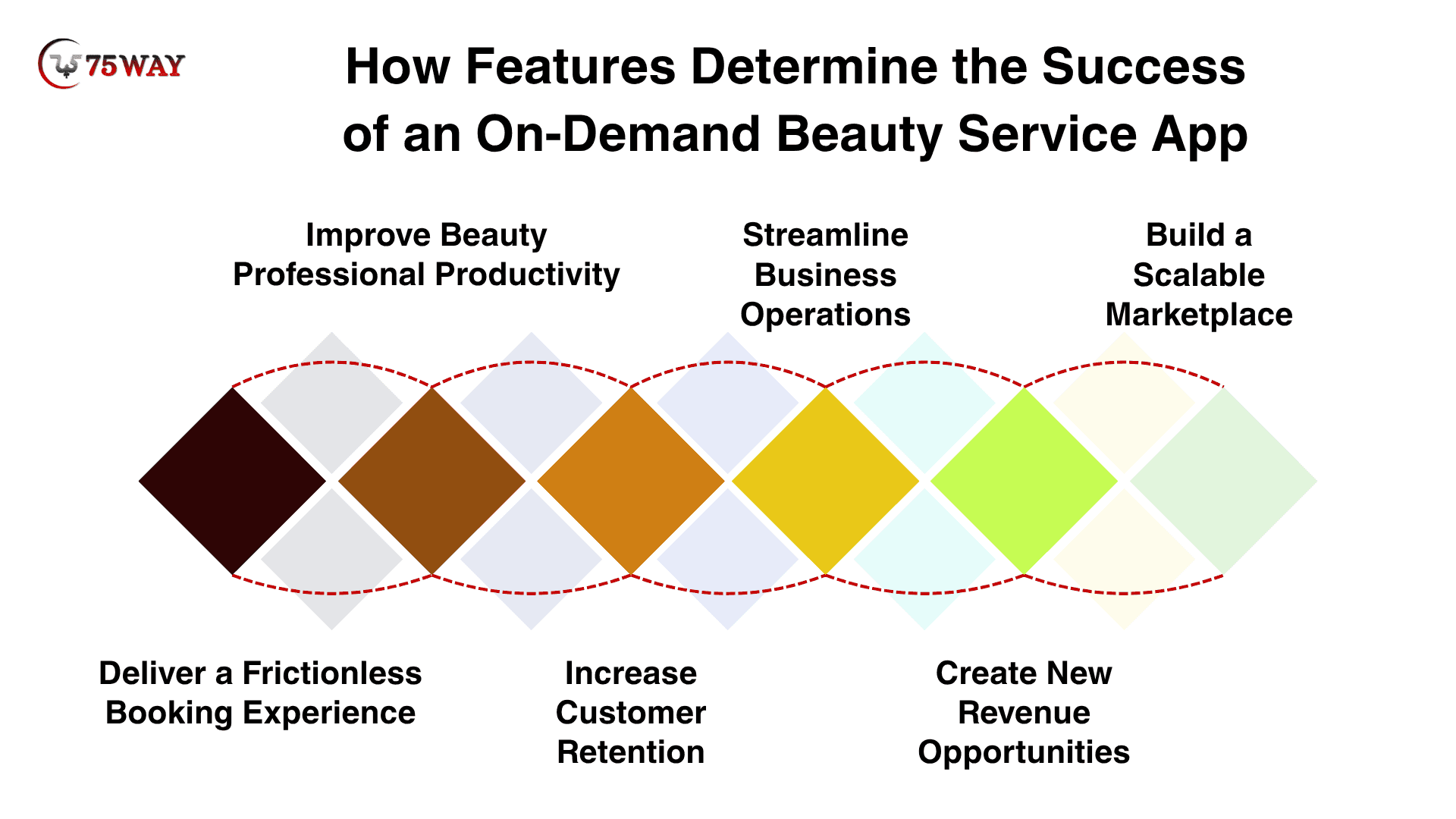
- Deliver a Frictionless Booking Experience: Customers expect to browse services, compare professionals, select time slots, and confirm appointments in just a few taps. A smooth booking journey reduces drop-offs and encourages repeat business.
- Improve Beauty Professional Productivity: Beauty professionals need tools that simplify their day, not add more work. Features like schedule management, booking notifications, earnings tracking, and client history help providers stay organized and deliver better service.
- Increase Customer Retention: Winning a customer is only half the battle. Personalized recommendations, loyalty rewards, exclusive offers, and timely notifications encourage repeat bookings and build long-term relationships.
- Streamline Business Operations: Managing hundreds of appointments manually isn't sustainable. Admin features, automated scheduling, payment management, promotions, and reporting help businesses operate more efficiently while reducing administrative workload.
- Create New Revenue Opportunities: The right features can increase average order value and overall revenue. Membership plans, service bundles, in-app product sales, premium listings, and referral programs create additional income beyond appointment bookings.
- Build a Scalable Marketplace: Growth becomes much easier when the beauty service marketplace app is designed for it. Scalable features, AI automation, analytics, provider management, and third-party integrations help your app support more customers, professionals, and locations without sacrificing performance.
How to Prioritize Features for Your Beauty Service App Development
Every feature for on-demand beauty service app may sound valuable, but not every feature belongs in your first release. The most successful beauty service apps don't launch with everything. They launch with the right features. This phased development strategy helps you control costs, shorten time to market, collect real user feedback, and expand the platform based on actual business needs instead of assumptions.
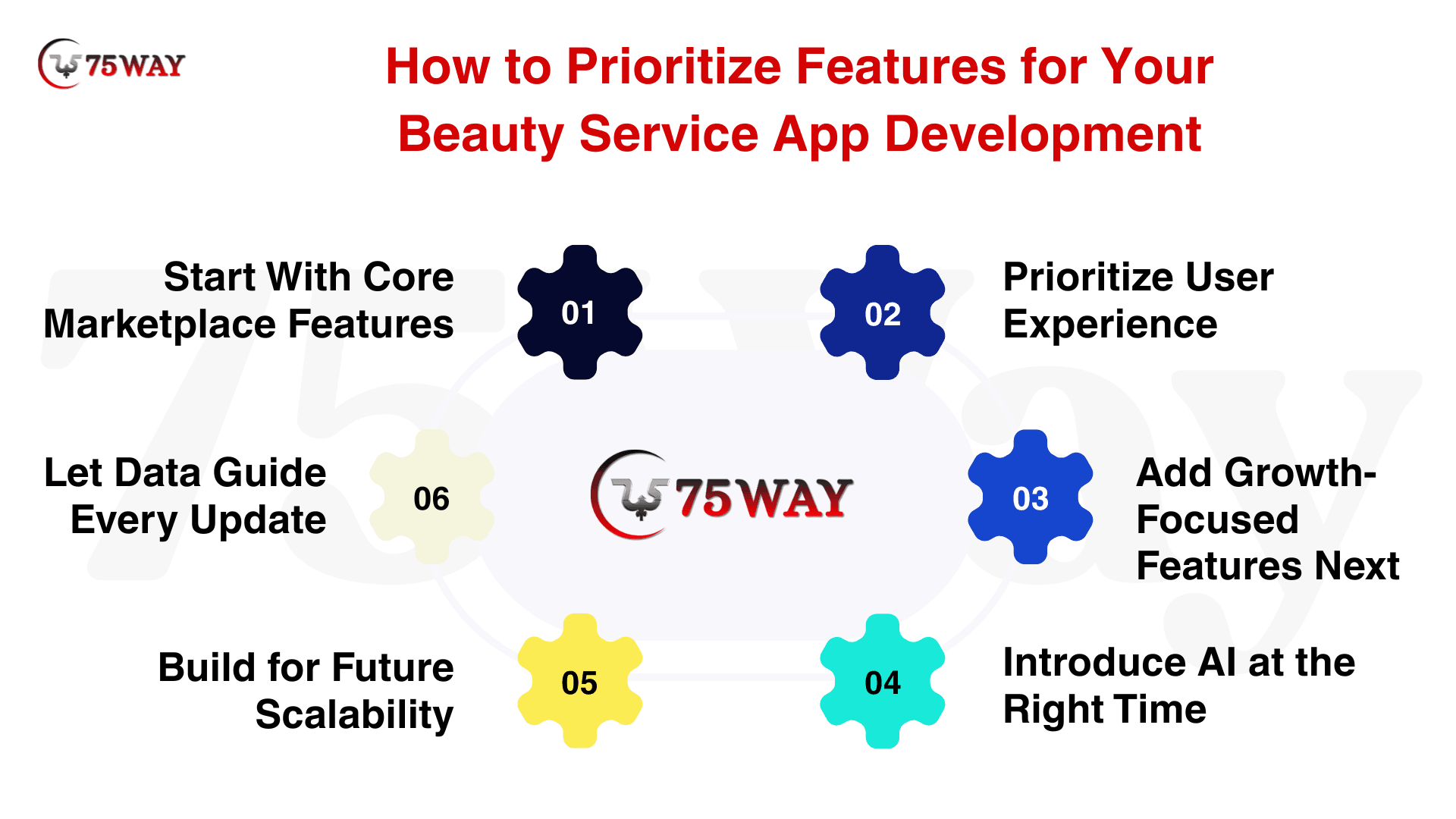
1. Start With Core Marketplace Features
Focus first on the capabilities that allow customers to book services, beauty professionals to manage appointments, and administrators to oversee daily operations. These essential features create a stable foundation for your MVP.
2. Prioritize User Experience
A fast, intuitive experience matters more than a long feature list. Simple navigation, quick booking, secure payments, and real-time updates make the app easier to use and encourage repeat bookings.
3. Add Growth-Focused Features Next
Once users begin actively using the platform, introduce loyalty programs, subscriptions, referral rewards, promotions, service bundles, and digital wallets. These features increase retention and create additional revenue opportunities.
4. Introduce AI at the Right Time
AI performs best when it has real customer data to analyze. Personalized recommendations, predictive scheduling, demand forecasting, and intelligent marketing become much more effective after your platform has established consistent booking activity.
5. Build for Future Scalability
Customer expectations will continue to evolve as your business grows. A scalable architecture allows developers to add new services, integrations, AI capabilities, and marketplace features without rebuilding the entire platform.
6. Let Data Guide Every Update
Don't guess which features users want next. Analyze booking trends, customer feedback, provider performance, and app analytics to prioritize future enhancements that deliver the greatest business impact.
Feature Roadmap: MVP vs Advanced vs AI Features To Create Beauty Service App
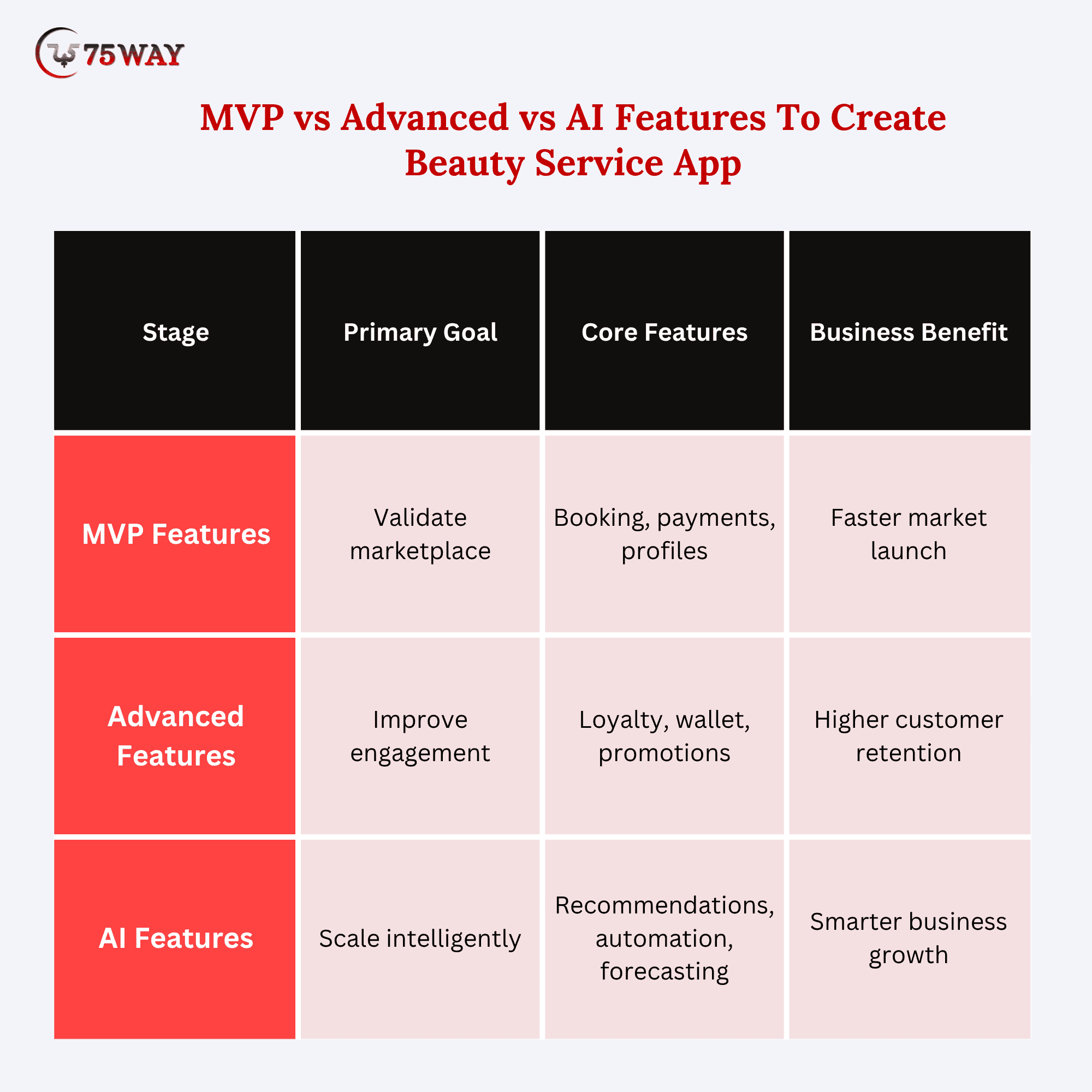
Not every feature needs to be developed before launching your on-demand beauty service app. Successful businesses usually follow a phased roadmap, adding new capabilities as their customer base and operational needs grow. This approach reduces development costs, shortens time-to-market, and creates opportunities to improve the platform using real customer feedback instead of assumptions.
MVP Features: Launch Phase
The MVP focuses on launching a fully functional marketplace with essential booking capabilities. At this stage, every feature should help customers book services, enable beauty professionals to manage appointments, and allow administrators to oversee daily platform operations.
Typical MVP features include user registration, beauty professional onboarding, service listings, appointment booking, secure payments, booking management, notifications, customer reviews, profile management, and an admin dashboard. These features establish a strong operational foundation without delaying product launch.
Advanced Features: Growth Phase
Once the platform gains users and bookings, businesses can introduce features that improve convenience, customer retention, and marketplace efficiency. These enhancements help differentiate the application while encouraging repeat business.
Popular advanced features include loyalty programs, memberships, referral rewards, digital wallets, multilingual support, promotional campaigns, inventory management, detailed analytics, bundled services, and personalized customer profiles. These additions create a better user experience while supporting business growth.
AI Features: Scale Phase
Artificial intelligence delivers the greatest value after the platform has accumulated enough customer and booking data. Instead of replacing existing features, AI makes them smarter through automation and predictive insights.
AI-powered recommendations, intelligent provider matching, smart scheduling, demand forecasting, dynamic pricing, virtual assistants, fraud detection, customer sentiment analysis, route optimization, and revenue forecasting help businesses improve efficiency while delivering more personalized customer experiences.
Essential Integrations That Support On-Demand Beauty Service App Features
Every feature within an on-demand beauty service application depends on technology integrations working behind the scenes. While customers interact with a polished interface, external services process payments, verify identities, deliver notifications, calculate navigation routes, analyze business data, and secure sensitive information. Choosing the right integrations during development improves reliability, scalability, and long-term platform performance.
- Payment Gateway Integration: Secure payment processing is essential for every beauty service marketplace. Integrating trusted payment gateways enables customers to complete transactions safely using credit cards, debit cards, digital wallets, and region-specific payment methods. Payment integrations also automate refunds, provider payouts, invoices, and commission settlements, creating a frictionless financial experience for both customers and beauty professionals.
- Maps and GPS Integration: Location services power several core marketplace features, including address selection, live appointment tracking, estimated arrival times, and navigation for beauty professionals. Accurate mapping integrations reduce travel delays, improve scheduling accuracy, and help customers monitor professional arrivals in real time, resulting in a more dependable booking experience.
- Push Notification Integration: Customer engagement depends heavily on timely communication throughout the booking lifecycle. Push notification services automatically deliver booking confirmations, appointment reminders, promotional offers, payment updates, cancellation alerts, and loyalty rewards. Consistent communication keeps customers informed while reducing missed appointments and increasing repeat bookings.
- SMS and Email Integration: Although mobile notifications are important, SMS and email remain essential communication channels for account verification, one-time passwords, invoices, booking confirmations, password recovery, and post-service follow-ups. These integrations provide dependable communication even when application notifications are disabled.
- Calendar Integration: Scheduling becomes more efficient when appointment calendars synchronize automatically across devices and platforms. Calendar integrations help beauty professionals manage availability, prevent scheduling conflicts, organize recurring appointments, and receive automatic reminders, improving productivity without requiring manual calendar updates.
- AI and Machine Learning Integration: Modern AI services enhance marketplace intelligence by supporting personalized recommendations, intelligent provider matching, predictive demand forecasting, fraud detection, automated customer support, and business analytics. Integrating AI through scalable APIs allows businesses to introduce intelligent capabilities without rebuilding their existing application architecture.
- Cloud Storage Integration: On-demand beauty service platforms manage thousands of images, customer documents, beauty professional certifications, invoices, and marketing assets. Cloud storage enables secure file management while maintaining high application performance, automatic backups, and flexible scalability as the business expands.
- Analytics Integration: Business growth depends on understanding customer behavior and marketplace performance. Analytics platforms track booking trends, conversion rates, customer acquisition, provider productivity, revenue performance, and user engagement, helping administrators make informed business decisions based on real operational data.
- CRM Integration: Customer relationship management systems centralize customer information, communication history, loyalty participation, and marketing activities. CRM integration enables personalized engagement, improves customer retention strategies, and helps businesses deliver more consistent experiences throughout the customer lifecycle.
- Identity Verification Integration: Building trust within a beauty service marketplace requires thorough verification of beauty professionals before they begin accepting appointments. Identity verification services authenticate government documents, certifications, and professional credentials, reducing fraud while strengthening marketplace credibility.
- In-App Communication Integration: Secure messaging and calling integrations allow customers and beauty professionals to discuss appointment details without exposing personal phone numbers. Keeping communication within the application improves privacy, maintains conversation history, and supports faster issue resolution whenever questions arise.
- Marketing Automation Integration: Marketing platforms automate personalized campaigns, loyalty rewards, abandoned booking reminders, referral programs, seasonal promotions, and customer re-engagement activities. Automated marketing improves retention while reducing the manual effort required to maintain customer relationships across a growing marketplace.
Final Thoughts
To wrap up, every feature in an on-demand beauty service app should support a measurable business objective, whether to improve booking convenience or strengthen administrative control. A structured development roadmap helps businesses launch faster, expand strategically, and introduce AI capabilities when they deliver maximum value. Prioritizing scalable features instead of unnecessary complexity creates a platform that adapts to changing customer expectations while supporting sustainable marketplace growth. You can hire a reliable on-demand app development firm so that every feature is designed to deliver performance, scalability, and long-term business success.
Frequently Asked Questions (FAQs)
Which Features Help Beauty Professionals Manage Appointments?
Availability calendars, booking management, navigation, earnings tracking, customer communication, and schedule management improve daily workflows. These tools help professionals serve more customers with greater efficiency.
What Admin Panel Features Are Most Important For Marketplace Management?
Customer management, provider verification, payment controls, analytics, appointment monitoring, and reporting simplify platform administration. These features improve operational visibility while supporting business growth.
Which AI Features Add The Most Value To Beauty Service Apps?
AI-powered recommendations, intelligent provider matching, smart scheduling, virtual assistants, fraud detection, and demand forecasting improve user experiences. They also help businesses automate operations and make better decisions.
Should Every Feature Be Included Before Launching The App?
No, businesses should launch with essential marketplace features first. Advanced and AI capabilities can be introduced later based on customer feedback and business growth.
Which Integrations Are Necessary To Support Beauty App Features?
Payment gateways, maps, notifications, cloud storage, analytics, CRM, identity verification, and AI services ensure features operate smoothly. These integrations improve scalability, security, and overall platform performance.
How Do The Right Features Improve Business Growth?
Well-planned features increase customer satisfaction, booking conversions, provider productivity, and operational efficiency. Together, they create a scalable marketplace that supports sustainable long-term revenue growth.