
AI Summary
AI interior design app development solutions turn room photos into personalized design experiences. This guide explores emerging market demand and opportunities. It explains core features, AI technologies, and development workflows. It covers costs, monetization, and launch planning for US businesses.
Key Takeaways
- AI interior design market could reach $37.7 billion by 2035.
- App development may cost $10,000–$250,000+, depending on overall scope.
- Core features include room scanning, redesign, style matching, and visualization.
- AI models, computer vision, and 3D tools shape user experiences.
Have you ever wanted to redesign a room but struggled to imagine how different furniture, colors, or layouts would look together? This is exactly the problem AI interior design apps are solving.
For businesses, AI interior design app development offers an opportunity to bring personalized design experiences to homeowners, interior designers, and furniture retailers.
With AI-powered tools, users can upload room photos, experiment with different interior styles, generate design suggestions, and visualize furniture arrangements without hiring a designer for every small change.
Features like virtual room makeovers, 3D visualization, AI design recommendations, and smart space planning make these apps more interactive and practical.
But how do you build an AI interior design app? What’s the exact AI interior design mobile app development cost?
From selecting the right AI technologies and features to understanding app development costs and revenue models, every decision matters. This guide covers the key steps for building AI-powered interior design applications that businesses should know before entering this growing market.
What Is AI Interior Design App Development?
AI interior design app development is the process of building software that uses artificial intelligence to analyze interior spaces, generate design concepts, recommend furniture, and visualize room transformations.
Users can upload room photos, select design preferences, and receive customized interior concepts without creating every design manually.
Unlike traditional interior design software, AI-powered applications can automate several creative tasks.
For example, a homeowner can upload a living room photograph, select a modern farmhouse style, and generate alternative layouts with different furniture, colors, and lighting arrangements.
For businesses, these applications offer opportunities beyond personal room makeovers. Furniture retailers can help customers visualize products in their homes, real estate companies can offer virtual staging, and interior design firms can speed up concept development.
An AI interior design application typically combines these capabilities:
- Image recognition to understand existing room conditions.
- Generative AI to produce alternative interior designs.
- Recommendation engines to suggest suitable furniture and décor.
- 3D visualization to represent spaces and design elements.
- User preference analysis to personalize design suggestions.
- Virtual Reality (VR) to provide immersive, interactive walkthroughs of redesigned interior spaces
The complexity depends on whether the product is a simple room redesign tool or a comprehensive interior design platform with measurements, product catalogs, AR experiences, and professional collaboration.
Quick Answer: How To Develop AI Interior Design Application?
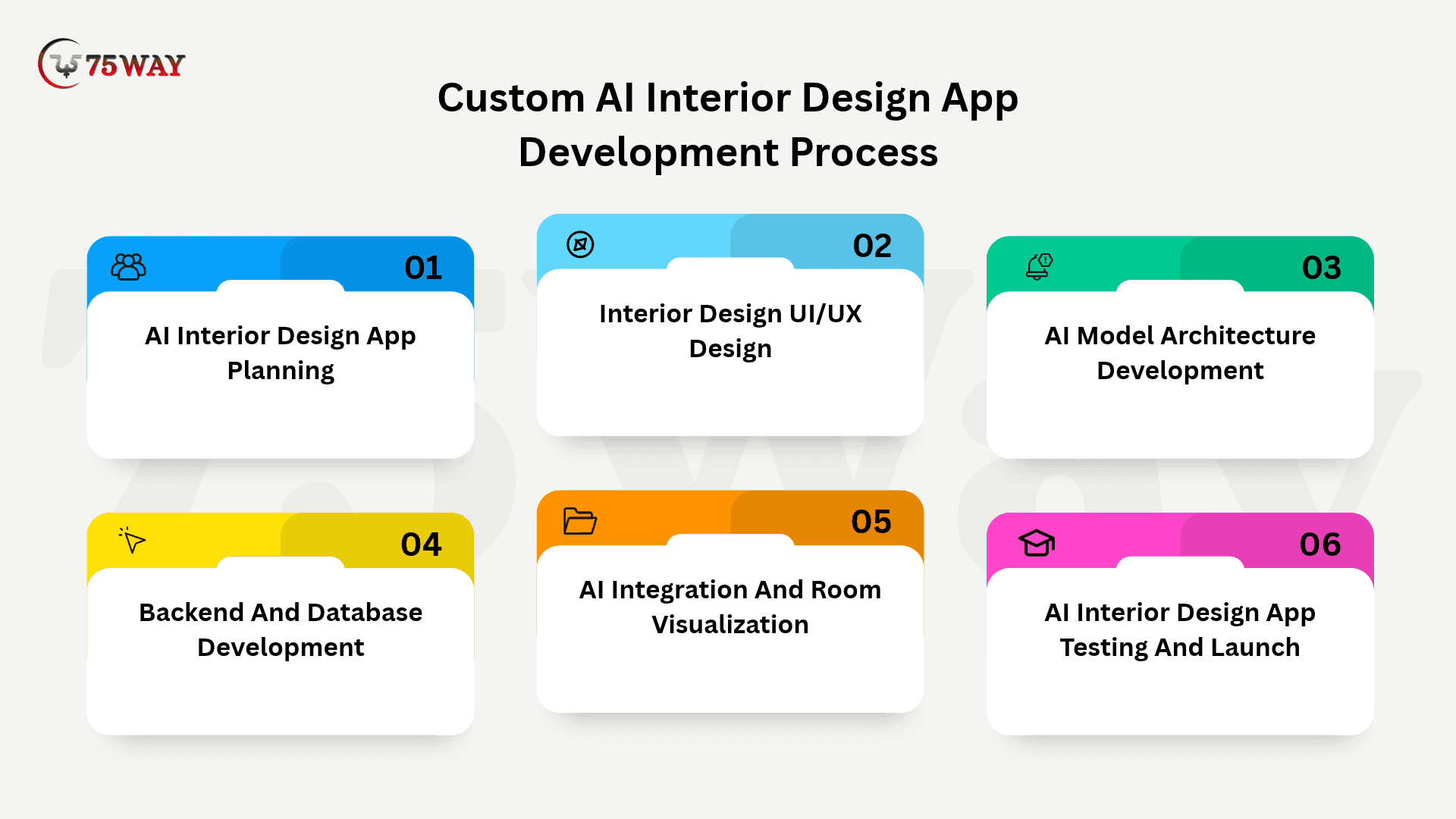
Step 1: AI Interior Design App Planning
Step 2: Interior Design UI/UX Design
Step 3: AI Model Architecture Development
Step 4: Backend And Database Development
Step 5: AI Integration And Room Visualization
Step 6: AI Interior Design App Testing And Launch
How does the AI interior design app development process move from initial planning to a market-ready application? The comprehensive process is defined below. But before knowing that, we must know the market potential of building an AI-powered home interior design app.
AI Interior Design App Market Size in USA and Global Outlook
AI interior design apps are gaining attention as homeowners and designers look for smarter ways to plan spaces and visualize decor. This growing interest in AI tools for designing interiors is creating new business opportunities in the US and global markets. Here's what the market size and growth projections reveal about this industry.
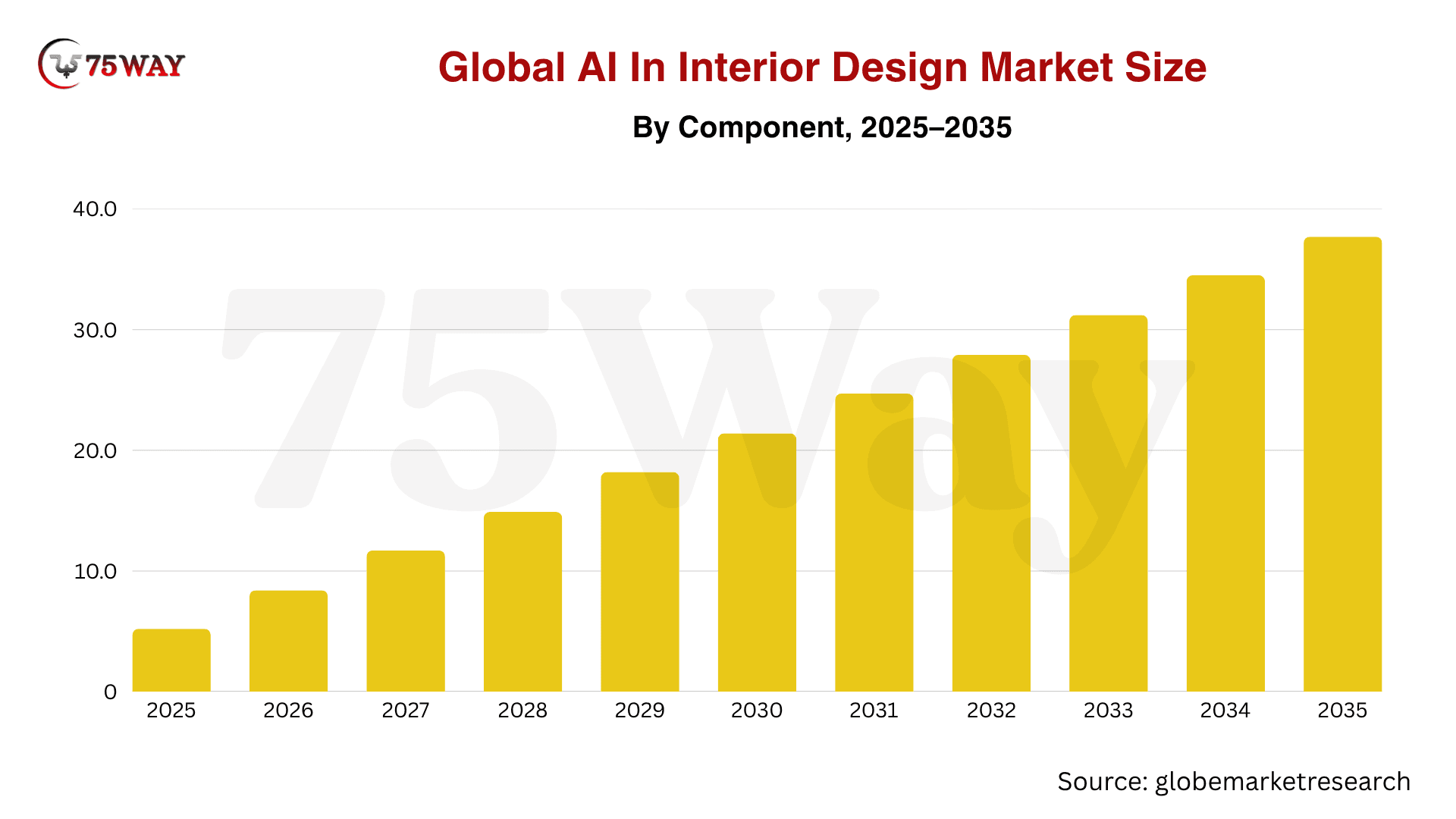
- Valued growth in the AI interior design sector is expected to push its worldwide market to $37.7 billion by 2035, with a 21.9% CAGR, as reported by Globe Market Research.
- From a valuation of $10.4 billion in 2026, the global virtual interior design platforms industry is forecast to add $14.6 billion in market value by 2034, reaching $25.0 billion at a CAGR of 11.6%.
- Homes and residential spaces represent the largest application segment, contributing 42.3% of overall market revenue.
- In 2025, cloud deployment generated $1.77 billion and accounted for 76.8% of the total market, making it the leading deployment model.
- AI adoption is gaining traction across the design industry, with 31% of design companies already incorporating these technologies into their operations, according to Houzz.
- Administrative processes are the primary AI use case among design firms, reported by 70% of AI adopters. Sales and marketing follow at 59%, while planning and design account for 34%.
- With an estimated revenue contribution ranging from 38% to 40.6%, North America holds the largest regional share of the global market.
Why Are US Startups & Enterprises Investing In AI Interior Design Apps?
The opportunity is not limited to making interior design more accessible. Businesses can use AI-powered visualization to improve product discovery, attract customers, and introduce new service models. Here are some business opportunities worth evaluating.
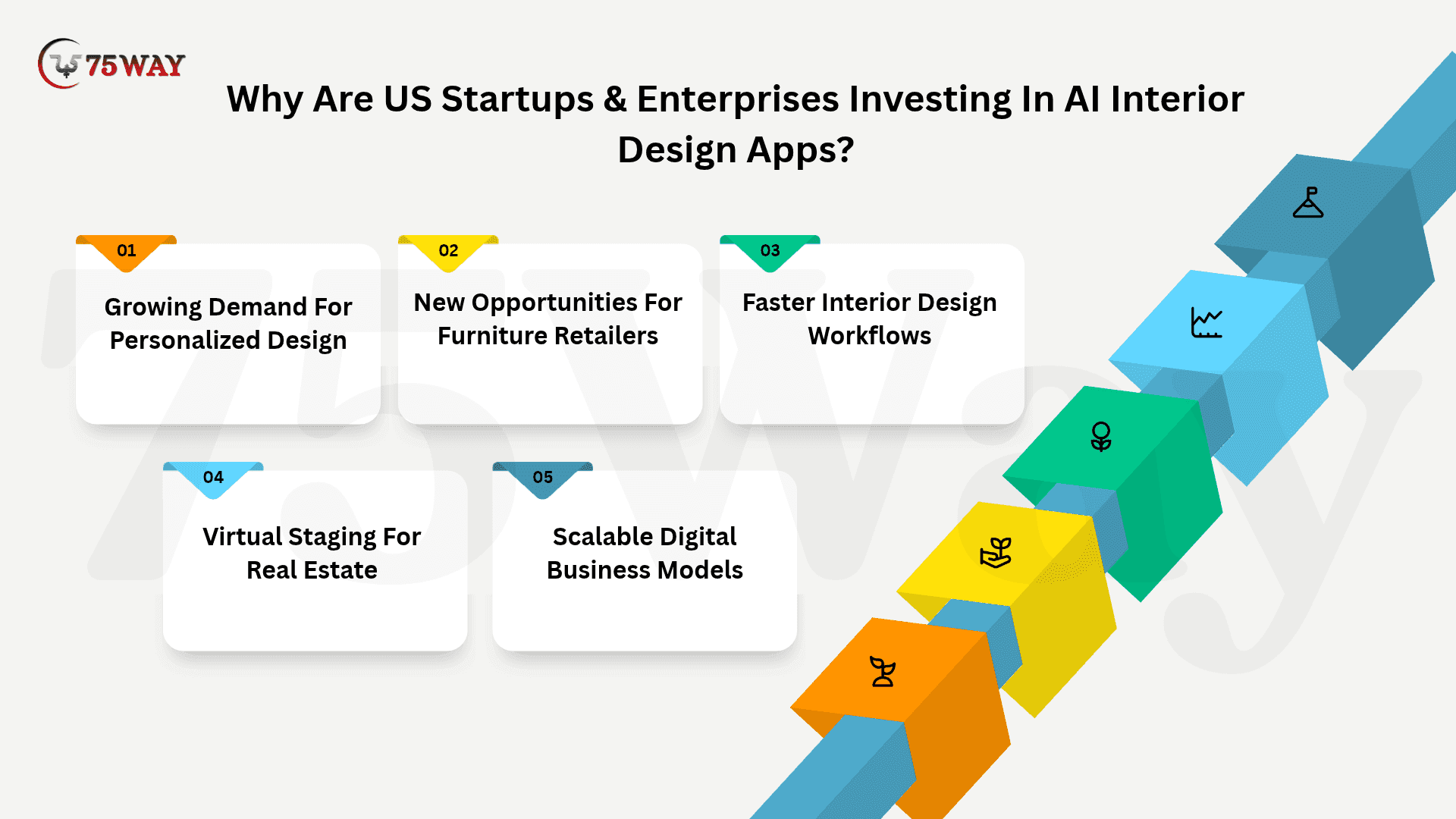
- Growing Demand For Personalized Design
Customers increasingly expect recommendations that reflect their preferences, budgets, room dimensions, and lifestyles. AI can use these inputs to generate relevant design concepts instead of showing identical inspiration galleries to everyone.
- New Opportunities For Furniture Retailers
Furniture brands can integrate room visualization into their shopping experiences. Customers can preview sofas, tables, lighting, and other products in their spaces before purchasing.
This creates opportunities for product discovery, cross-selling, and furniture catalog integration.
- Faster Interior Design Workflows
Interior design professionals can use AI-generated concepts as starting points for client discussions. Rather than creating every initial variation manually, designers can review multiple concepts and refine the most suitable options.
AI supports the creative process, but professional judgment remains important for accurate dimensions, building requirements, and final specifications.
- Virtual Staging For Real Estate
Real estate companies can use AI to furnish empty rooms digitally, helping prospective buyers and renters understand how a property could look.
This creates a potential revenue opportunity through subscription-based virtual staging tools or partnerships with property listing platforms.
- Scalable Digital Business Models
A well-designed application can serve homeowners, professional designers, furniture retailers, and real estate businesses through different subscription plans and services.
Businesses can expand their offerings without relying entirely on individual design consultations.
How Does An AI-Powered Interior Design App Work?
An AI-powered interior design solution combines computer vision, generative AI, and intelligent recommendations to transform room images into personalized design concepts. Here's how the process works:
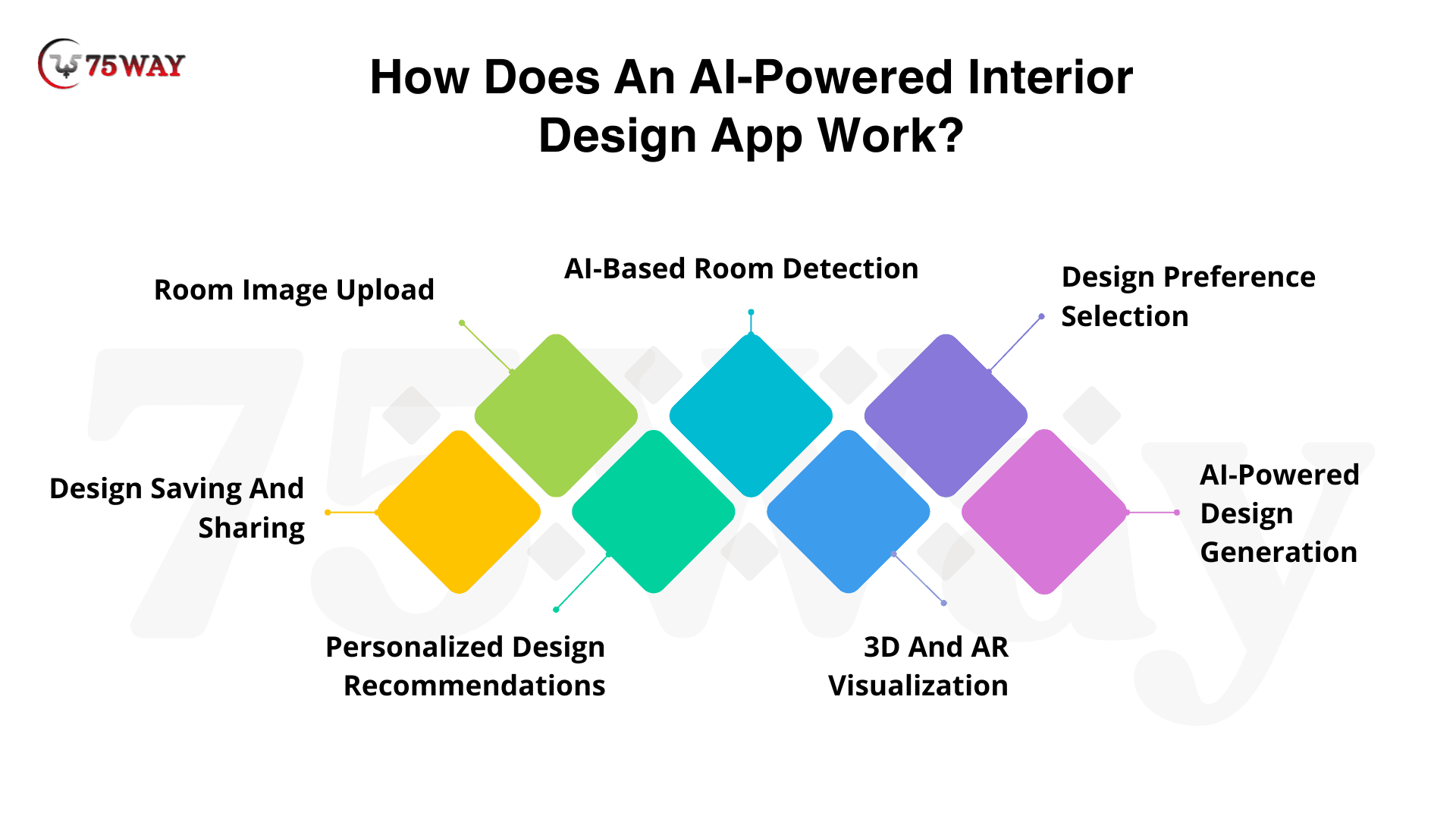
Step 1: Room Image Upload
Users upload photographs of their existing rooms to begin the design process.
Step 2: AI-Based Room Detection
Computer vision identifies walls, floors, windows, furniture, and other interior elements.
Step 3: Design Preference Selection
Users select preferred interior styles, color schemes, furniture types, and design themes.
Step 4: AI-Powered Design Generation
Generative AI processes room images and preferences to create redesigned interior concepts.
Step 5: 3D And AR Visualization
Users explore generated designs through 3D previews or augmented reality furniture placement.
Step 6: Personalized Design Recommendations
AI recommends suitable furniture, décor, materials, and products based on the selected design.
Step 7: Design Saving And Sharing
Users save, compare, download, or share their preferred interior design concepts.
Major Features To Consider In Interior Designing App Development
Users want more than pretty room pictures from an interior design app. They want tools that help bring their ideas to life. Features such as 3D room planning, virtual makeovers, and furniture recommendations can make that experience more practical. The following features provide a practical foundation for creating an interior design app.
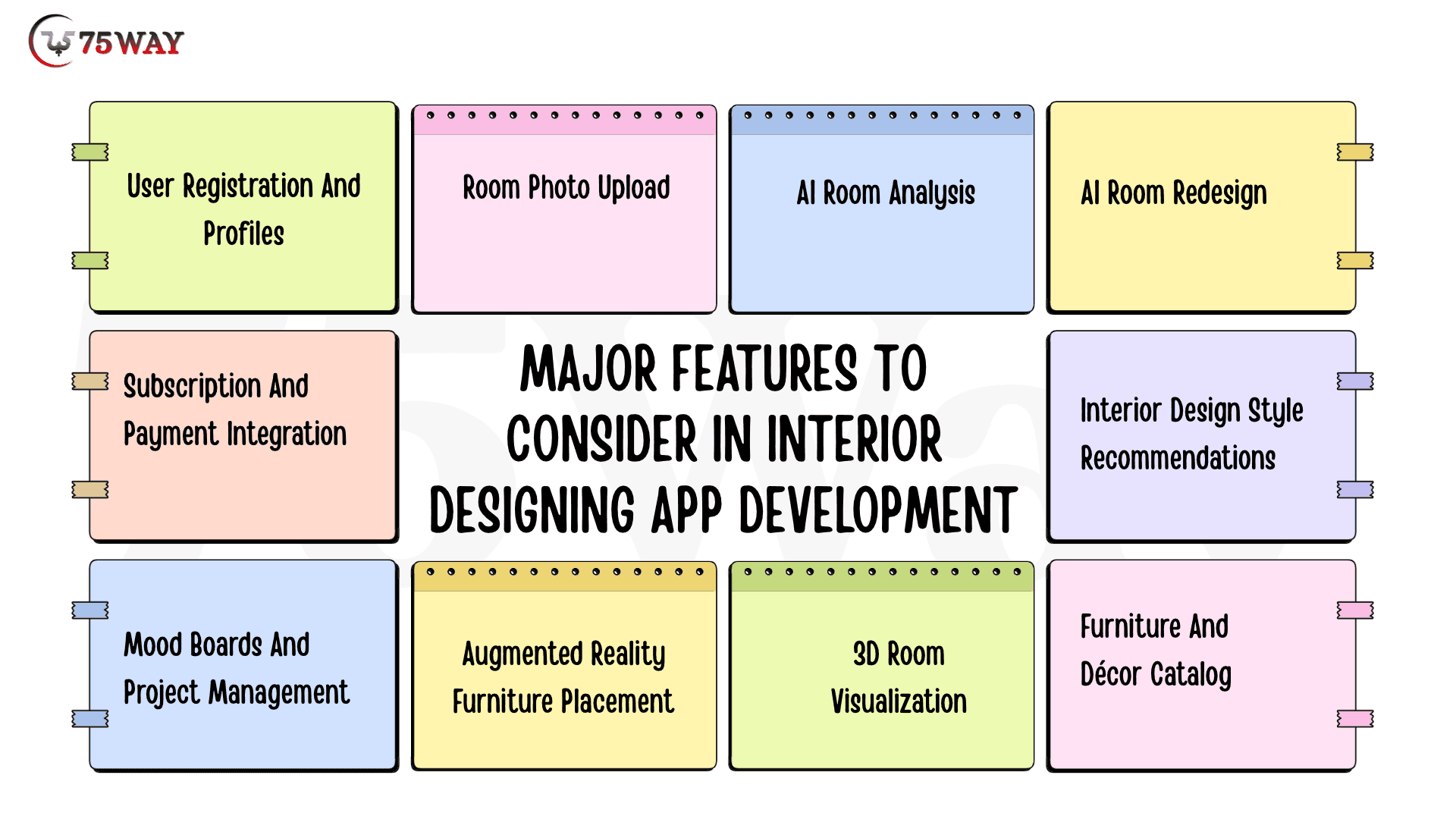
1. User Registration And Profiles
Registration allows users to create accounts, save design projects, and access their previous room transformations. Profiles can also store preferred design styles, color choices, and room categories.
2. Room Photo Upload
Users should be able to upload room photographs directly from their devices. The application can accept supported image formats and provide guidance on lighting, camera angles, and image quality.
Good input images help improve the quality of generated concepts.
3. AI Room Analysis
Computer vision models analyze uploaded photographs to identify important visual elements, including walls, floors, windows, doors, furniture, and other objects.
The system uses this information to understand the existing room before generating design recommendations.
4. AI Room Redesign
This is one of the most important features of an AI interior design application.
Users select a preferred style, such as contemporary, minimalist, industrial, Scandinavian, or traditional. The AI system then generates redesigned room images while attempting to preserve the original room structure.
5. Interior Design Style Recommendations
The recommendation engine suggests suitable design styles, furniture combinations, materials, and color palettes based on user preferences.
For example, a user with a small apartment might receive space-conscious furniture suggestions and lighter color combinations.
6. Furniture And Décor Catalog
A searchable product catalog allows users to explore furniture, lighting, rugs, wall art, and accessories.
For commercial applications, this feature can connect generated designs with actual product listings, prices, availability, and purchasing options.
7. 3D Room Visualization
Three-dimensional visualization helps users understand room layouts and furniture placement from different viewing angles.
It can also support professional workflows where users need to inspect spatial relationships before finalizing a design.
8. Augmented Reality Furniture Placement
AR allows users to view virtual furniture within their actual surroundings through a compatible device camera.
For example, a customer can preview a sofa in a living room before purchasing it. This feature requires attention to scale, placement, tracking, and device compatibility.
9. Mood Boards And Project Management
Users can save generated concepts, collect furniture selections, compare color palettes, and organize multiple room projects.
For professional applications, project management can also support client feedback and design approvals.
10. Subscription And Payment Integration
Subscription functionality supports recurring revenue through monthly or annual plans.
Businesses can offer different packages based on image generation limits, premium styles, advanced visualization, or professional collaboration features.
A Detailed Custom AI Interior Design App Development Process
A successful AI interior design app should make room planning easier, not add another layer of complexity. Careful planning, thoughtful design, and the right AI integrations help turn that goal into a working product. The development journey involves several important stages, each covered below.
Step 1: AI Interior Design App Planning
Start by identifying the application’s intended users and commercial purpose.
For example, a furniture retailer may prioritize product visualization, whereas an interior design startup may focus on AI room redesign and professional project management.
Define the initial scope, target platforms, monetization strategy, and measurable product goals.
Step 2: Design The UI/UX of Interior App
The design team creates wireframes, user journeys, and interactive prototypes.
The interface should make it easy to upload room images, select design preferences, review generated concepts, and save projects.
A useful design workflow might look like this:
- User uploads a room photograph.
- User selects a room category.
- User chooses an interior design style.
- AI generates alternative room concepts.
- User saves or compares the results.
The team should also consider accessibility, loading states, image-generation delays, and clear feedback when an uploaded photograph cannot be processed.
Step 3: Prepare The AI Architecture
This stage determines how the application understands rooms and generates new designs.
A typical architecture can include:
- Computer vision for room and object recognition.
- Image segmentation for separating furniture and surfaces.
- Generative models for producing redesigned images.
- Recommendation algorithms for suggesting suitable products.
- Backend orchestration for managing AI requests and results.
Businesses can begin with existing AI models and APIs rather than training a foundation model from scratch.
Step 4: Develop The Interior Application Backend
The backend manages user accounts, image uploads, project information, AI processing requests, subscriptions, and database operations.
It also connects the application with external services such as payment gateways, furniture catalogs, cloud storage, and AI inference providers.
A queue-based processing system can help manage image-generation requests when multiple users access the platform simultaneously.
Step 5: Integrate AI And Visualization
Developers connect the selected models with the application interface.
The integration should account for image quality, processing time, output consistency, and generation costs.
If the product includes AR or 3D capabilities, developers also integrate the required device frameworks, rendering engines, and spatial data processing.
Step 6: Test And Launch AI Interior Design App
Testing should cover more than whether the application opens and generates an image.
The team should evaluate room preservation, furniture placement, image quality, response times, device compatibility, payment workflows, and data security.
After testing, the application can be released through the relevant app stores or as a web-based platform.
Different Types of Interior Designing Apps To Develop And Invest In
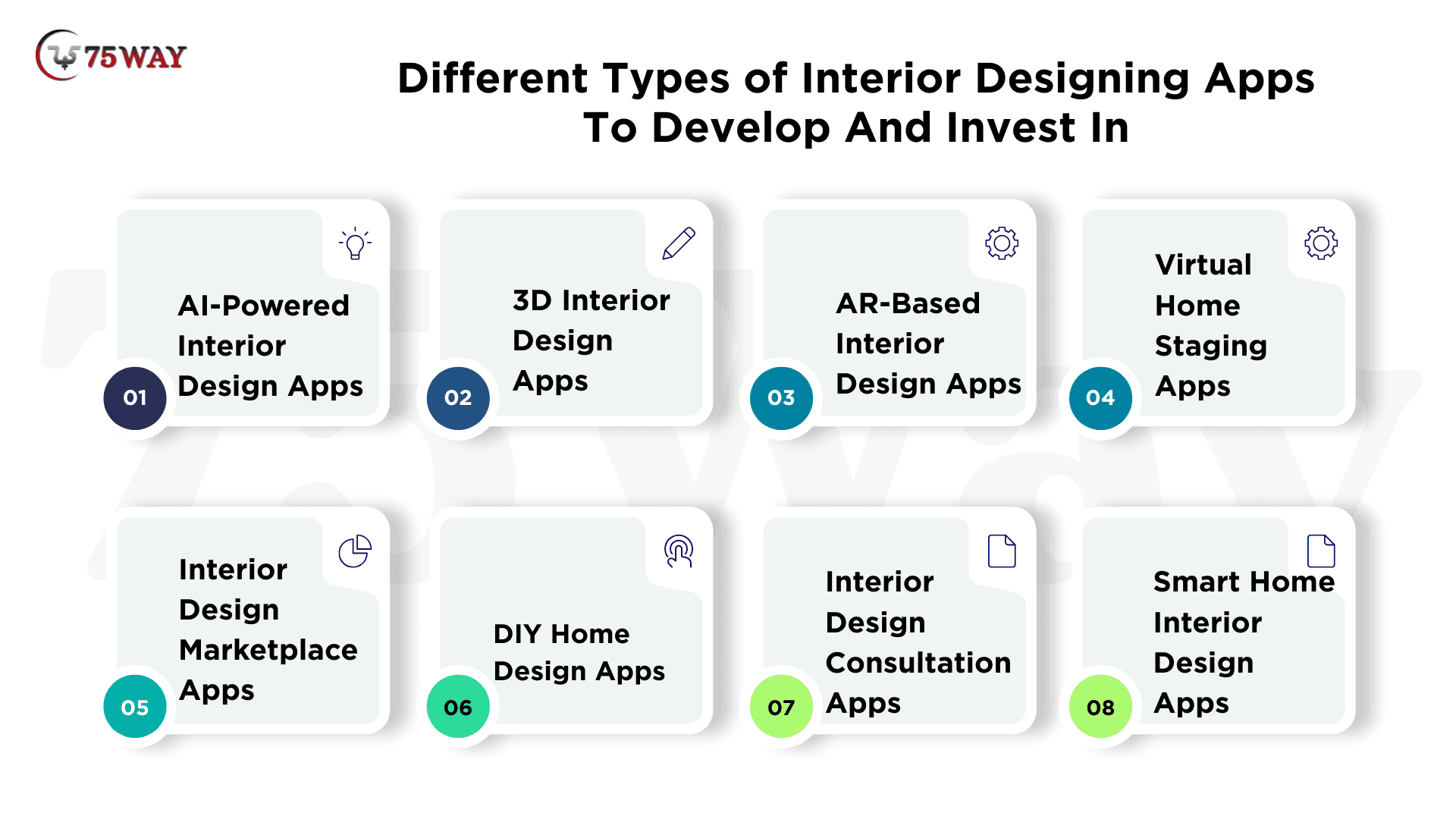
Interior design apps serve different customer needs, from visualizing furniture to planning complete room makeovers. Businesses can build specialized solutions around AI, 3D visualization, virtual staging, and personalized design recommendations. Here are some promising interior design app types worth developing and investing in.
1. AI-Powered Interior Design Apps
These apps use artificial intelligence to transform ordinary room photographs into customized interior design concepts. Businesses can develop AI-powered interior design applications that recommend furniture, suggest color combinations, and generate room makeovers based on user preferences. Advanced solutions can also integrate image recognition and generative AI to deliver personalized design experiences.
Market Potential: High
Target Audience: Homeowners, startups, interior designers, furniture retailers
Expected Cost: $15,000–$150,000+
2. 3D Interior Design Apps
3D interior design apps allow users to create virtual room layouts and explore spaces from different angles. Businesses can build these applications with interactive modeling, furniture placement, and realistic rendering capabilities. These solutions help customers understand spatial arrangements and visualize design ideas before making purchasing decisions.
Market Potential: High
Target Audience: Architects, homeowners, designers, real estate developers
Expected Cost: $15,000–$120,000+
3. AR-Based Interior Design Apps
Augmented reality interior design apps let users preview virtual furniture and décor inside their actual surroundings. Businesses can build AR-powered interior design apps using device cameras and spatial tracking to help customers evaluate product placement, size, and appearance. These apps are particularly valuable for furniture brands looking to improve online shopping experiences.
Market Potential: High
Target Audience: Furniture retailers, homeowners, interior designers, eCommerce businesses
Expected Cost: $15,000–$150,000+
4. Virtual Home Staging Apps
Virtual staging applications digitally furnish empty properties with realistic furniture, lighting, and decorative elements. Real estate businesses can invest in developing virtual home staging apps to present vacant properties more attractively without physically arranging furniture. AI-powered features can automate furniture placement and generate multiple staging styles.
Market Potential: High
Target Audience: Realtors, property developers, real estate agencies, homeowners
Expected Cost: $20,000–$100,000+
5. Interior Design Marketplace Apps
Interior design marketplace apps connect customers with professional designers, furniture retailers, and home décor suppliers through a single platform. Businesses can create interior design marketplace app solutions with designer profiles, product catalogs, appointment booking, and payment integrations. Additional AI recommendations can help customers discover suitable professionals and products based on their requirements.
Market Potential: High
Target Audience: Homeowners, interior designers, furniture brands, décor retailers
Expected Cost: $40,000–$180,000+
6. DIY Home Design Apps
DIY home design apps help users plan and execute interior improvements without depending entirely on professional designers. You can build DIY home design applications with room planning tools, color palette suggestions, furniture catalogs, and step-by-step renovation guidance. AI-powered recommendations can make design decisions easier for customers with different budgets and preferences.
Market Potential: Medium
Target Audience: DIY enthusiasts, homeowners, renters, home renovators
Expected Cost: $15,000–$75,000+
7. Interior Design Consultation Apps
These applications connect customers with interior design professionals for personalized guidance and project discussions. You can develop interior design consultation platforms featuring video calls, appointment scheduling, design sharing, and project collaboration. AI-based matching can further recommend designers according to project requirements, preferred styles, and available budgets.
Market Potential: Medium–High
Target Audience: Homeowners, professional designers, design studios, property owners
Expected Cost: $15,000–$90,000+
8. Smart Home Interior Design Apps
These apps combine home aesthetics with connected devices and automation features. You can invest in smart home interior design app development to help users plan lighting arrangements, smart furniture placement, connected appliances, and room environments. Integration with compatible IoT devices can create a more interactive experience that combines interior design with home functionality.
Market Potential: High
Target Audience: Smart homeowners, IoT companies, architects, property developers
Expected Cost: $20,000–$200,000+
Robust AI Technologies Powering Interior Design Application Development
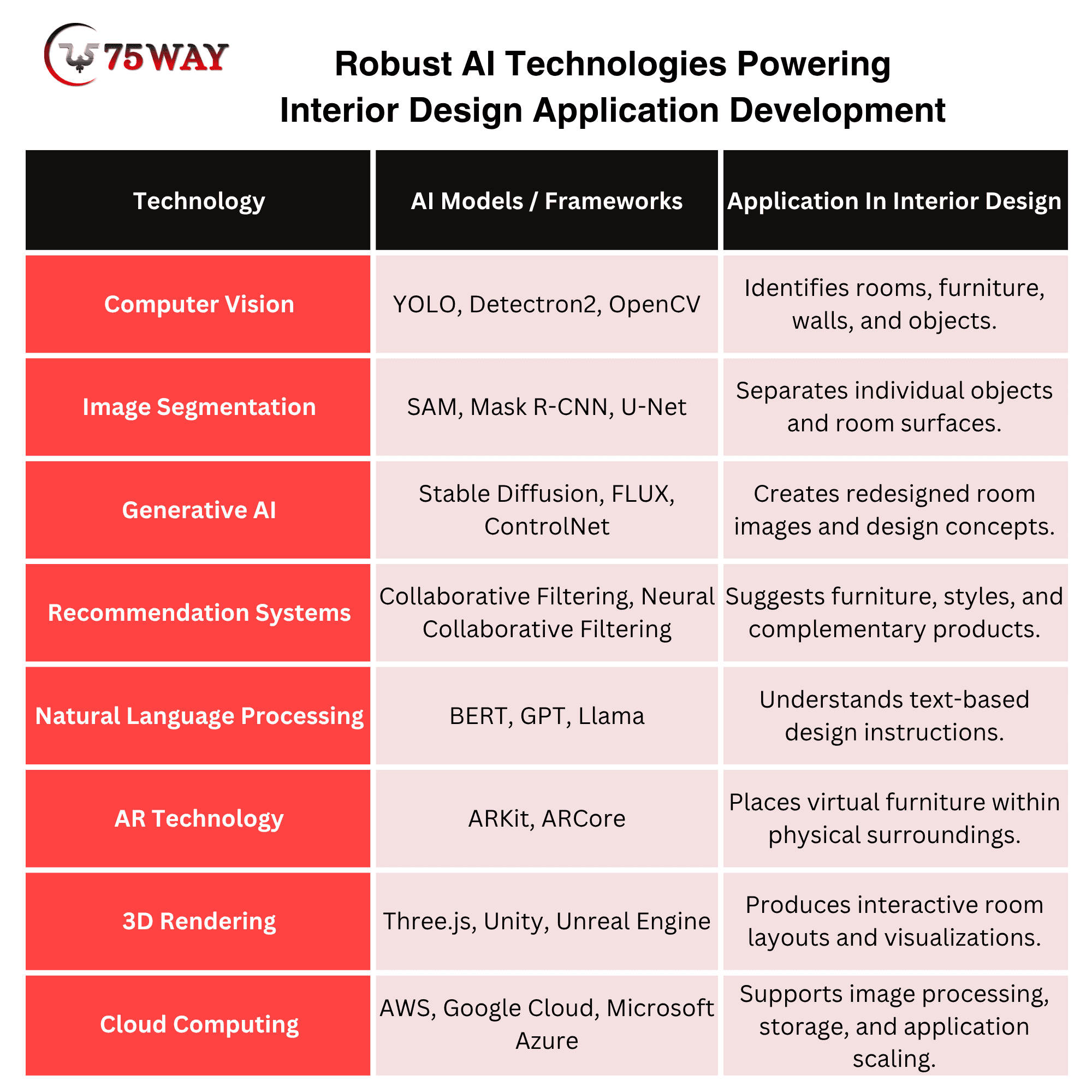
A user can upload a room photo and receive design ideas within minutes, but several AI technologies work behind that experience. Computer vision, natural language processing, and 3D modeling help turn simple inputs into useful design outputs. The major technologies behind AI interior design app development are worth understanding before choosing your tech stack.
- Generative AI And Image Models
Generative image models produce new room concepts based on photographs and text prompts.
Businesses can integrate suitable third-party image-generation APIs or deploy open-source models with custom workflows.
The important consideration is controlling how much of the original room changes. A simple text-to-image prompt may generate an attractive room but alter window positions, wall dimensions, or existing architectural details.
For applications requiring greater accuracy, developers may combine image generation with segmentation, structural guidance, and room-specific constraints.
- Computer Vision And Image Segmentation
Computer vision helps the application interpret the uploaded photograph.
Image segmentation identifies specific regions, such as floors, walls, ceilings, windows, and furniture. This allows the system to apply different transformations to different parts of a room.
For example, a user may want to change the wall color without replacing the existing furniture.
- AR And 3D Frameworks
Apple RoomPlan uses ARKit and LiDAR capabilities on supported devices to capture room layouts and create 3D floor plans. It can identify architectural elements and certain furniture types.
Developers can also evaluate ARCore for Android-based augmented reality experiences.
These frameworks are useful when a product requires room scanning or virtual furniture placement rather than image generation alone.
- Cloud Infrastructure And AI APIs
Cloud infrastructure supports model inference, image storage, database operations, and background processing.
The right infrastructure should account for GPU requirements, concurrent requests, data retention, and the cost of generating images at scale.
Technology Stack Used For Virtual Interior Design App Development
The technology stack for building virtual interior design app combines frontend frameworks, backend technologies, AI/ML tools, and 3D visualization engines to create interactive design experiences.
Technologies such as Swift, Kotlin, Flutter, and React help developers build responsive applications, while Python, Node.js, and FastAPI manage backend operations, APIs, and data processing. A practical technology stack can include the following tools.
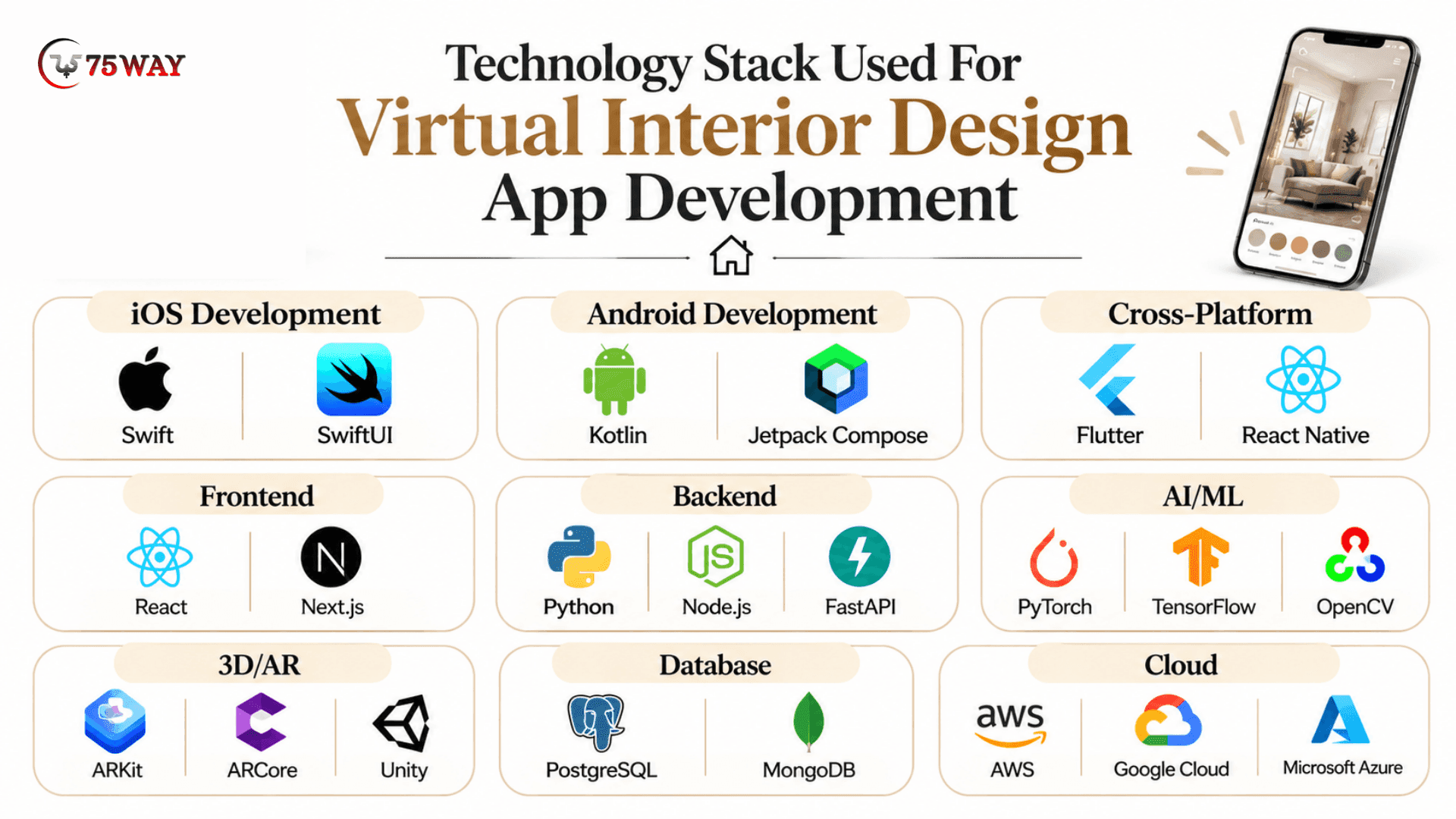
For realistic room visualization, developers can integrate Unity, ARKit, ARCore, and Three.js to support 3D modeling, augmented reality, and virtual furniture placement.
AI frameworks such as PyTorch, TensorFlow, and OpenCV power image recognition and design recommendations, while PostgreSQL, MongoDB, and cloud platforms like AWS and Google Cloud support data management, image storage, and application scalability.
The final stack should be selected after defining product requirements. Using every technology listed above is unnecessary for most MVPs.
How Much Does AI Interior Design App Development Cost?
AI interior design app development can cost between $10,000 and $250,000+, depending on application complexity, AI integration, platform coverage, visualization requirements, and development scope. The following estimates provide a practical planning framework, not fixed vendor quotations.
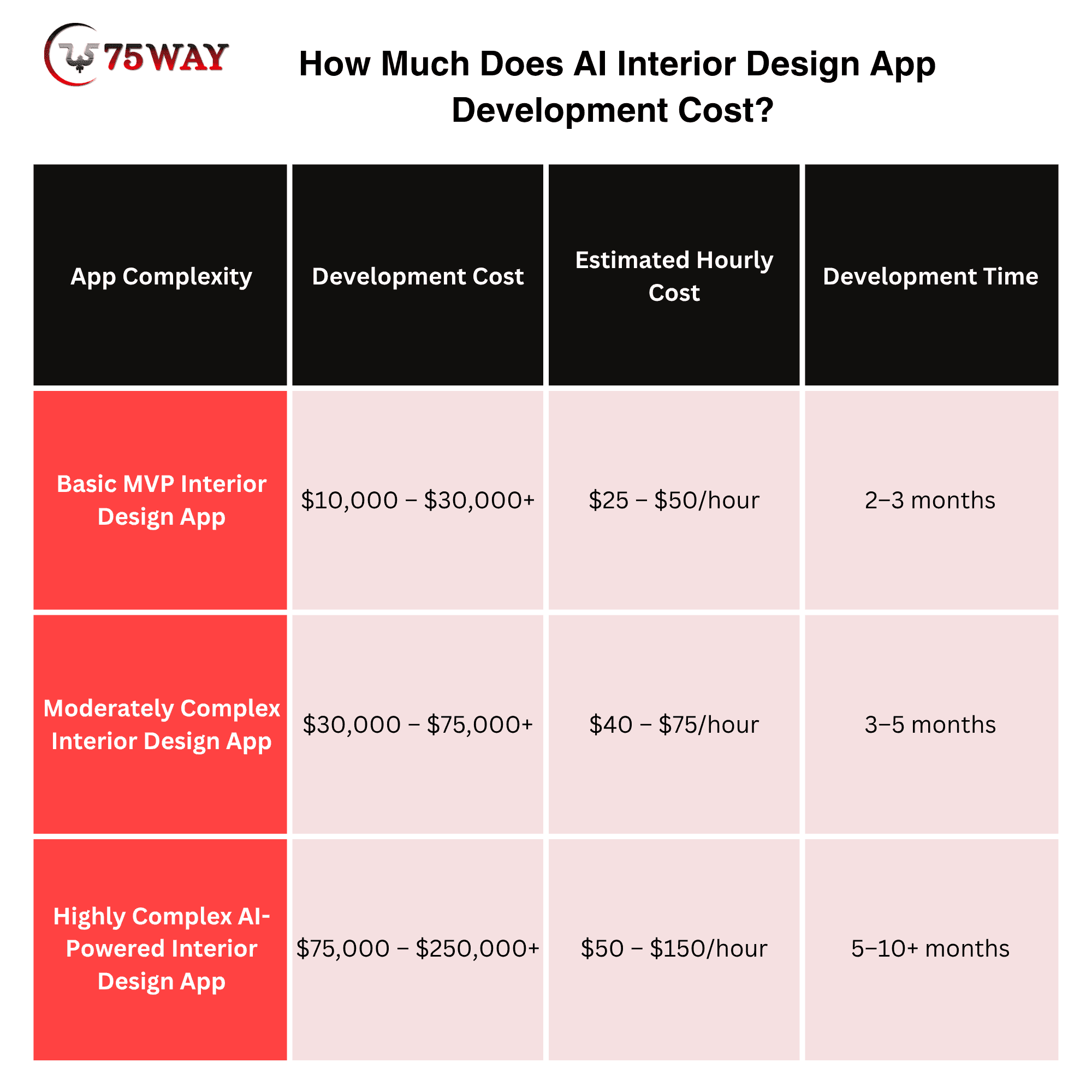
1. Basic MVP Interior Design App Cost: $10,000 – $30,000+
Timeline: 2–3 months
- Finalize essential features and user flows.
- Develop core interfaces and backend services.
- Test essential workflows before initial release.
Best Fit: Startups validating an interior design app concept.
2. Moderately Complex Interior Design App Cost: $30,000 – $75,000+
Timeline: 3–5 months
- Build advanced interfaces and application architecture.
- Integrate AI, AR, and payment services.
- Validate visualization quality across supported devices.
Best Fit: Growing businesses expanding digital design services.
3. Highly Complex AI-Powered Interior Design App Cost: $75,000 – $250,000+
Timeline: 5–10+ months
- Develop specialized AI processing and integrations.
- Build scalable infrastructure and advanced visualization.
- Conduct extensive performance and security testing.
Best Fit: Established businesses building scalable AI design platforms.
What Factors Influence AI-Powered Interior Design App Development Costs?
Several factors can increase or reduce the overall investment.
- AI Model Selection: Third-party APIs may reduce initial development expenses, while custom model development requires additional expertise and computing resources.
- Platform Coverage: Building separate native applications generally requires more work than developing a focused single-platform MVP.
- 3D And AR Complexity: Advanced spatial recognition, realistic rendering, and device compatibility increase development requirements.
- Third-Party Integrations: Furniture catalogs, payment gateways, and external services add integration and maintenance costs.
- Infrastructure: Image processing, GPU usage, storage, and application traffic influence recurring operating expenses.
- Maintenance: Model updates, security improvements, bug fixes, and new features require ongoing investment.
One important budgeting distinction: development costs are not the same as operating costs. AI inference, cloud hosting, image storage, and third-party subscriptions should be included in the long-term financial plan.
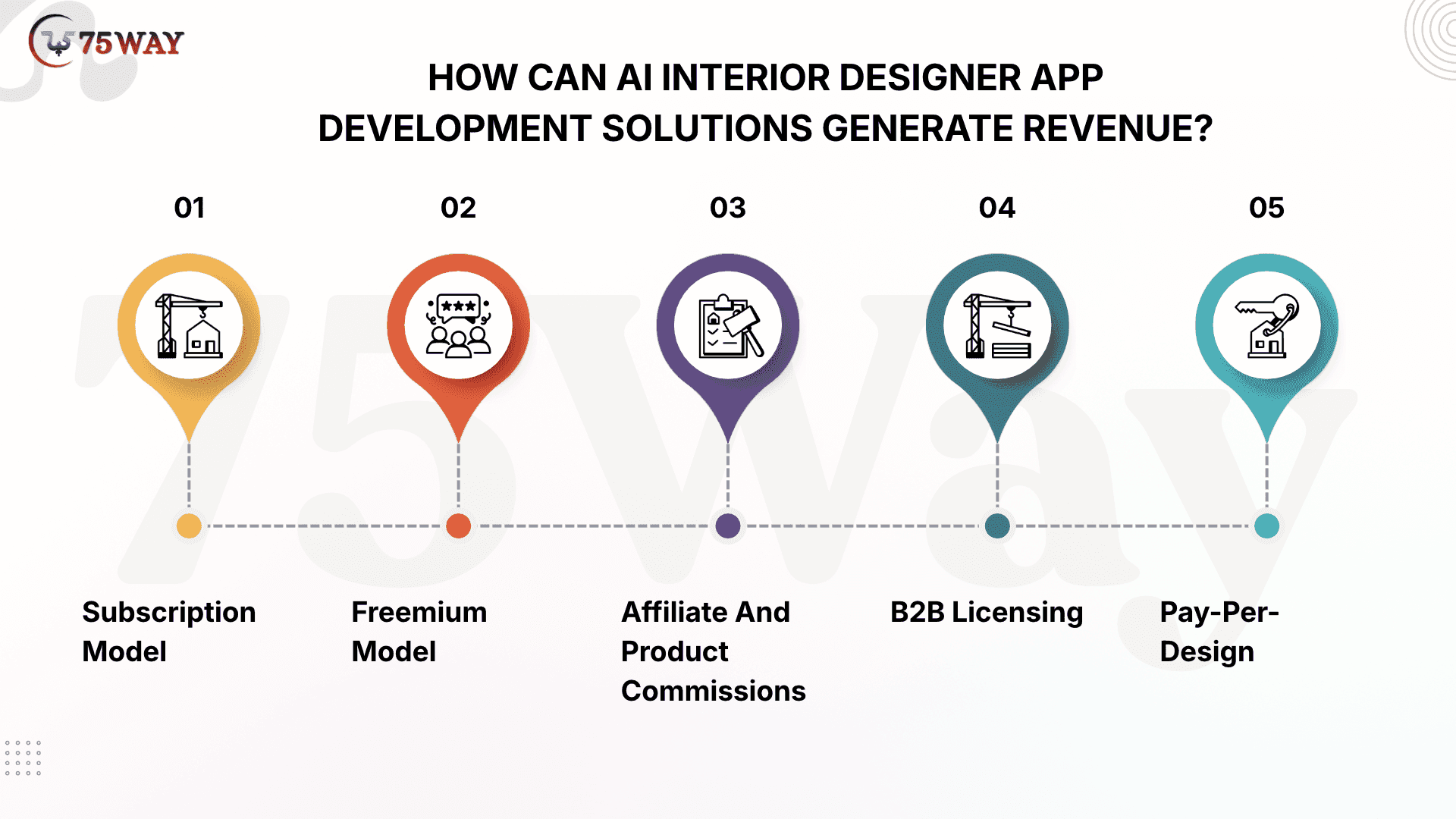
How Can AI Interior Designer App Development Solutions Generate Revenue?
The monetization strategy should match the target audience and the value the application provides. Revenue from an AI interior design app does not have to depend on subscriptions alone. Businesses can earn through personalized design services, virtual product placements, in-app purchases, and partnerships with furniture retailers. The following revenue models highlight different ways to build a profitable app business.
Challenges In AI Interior Design App Development & Solutions
A room design that looks perfect on screen may not always work in a real home. Inaccurate measurements, unsuitable furniture suggestions, and slow AI processing can weaken user trust. Understanding these challenges and their solutions can help businesses build more reliable interior design applications. Businesses should plan for the following challenges.
1. Maintaining Room Accuracy
AI-generated images can unintentionally change windows, doors, room dimensions, or furniture positions, making the final design impractical. Developers should use image segmentation, depth estimation, and structural guidance to preserve important architectural elements.
Solution: Integrate room segmentation models, depth maps, and edge detection to identify fixed structures. Use ControlNet or similar structural conditioning techniques to guide image generation and maintain the original room layout.
2. Generating Realistic Designs
Some AI outputs may contain distorted furniture, unrealistic shadows, incorrect proportions, or incompatible design elements. These inconsistencies can reduce customer confidence and make generated concepts difficult to implement.
Solution: Use high-quality generative models, reference images, and carefully designed prompts. Implement image-quality evaluation and human review workflows to identify visual errors and improve generated results.
3. Managing AI Processing Costs
Image generation can become expensive as application traffic increases, particularly when users repeatedly generate high-resolution room designs. Uncontrolled API usage and GPU requirements can also increase operational expenses.
Solution: Monitor cost per generation, optimize image resolution, introduce generation limits, and use caching for repeated requests. Select AI models according to task complexity and consider GPU optimization for high-volume workloads.
4. Protecting User Images
Room photographs can reveal personal living spaces, valuable belongings, and other private details. Inadequate data protection can expose users to privacy risks and damage business credibility.
Solution: Implement encryption, secure cloud storage, role-based access controls, and clear image-retention policies. Obtain appropriate user consent, restrict unnecessary data collection, and provide options to delete uploaded photographs.
5. Connecting Designs With Real Products
AI-generated furniture may not match products available in a retailer's catalog. Differences in dimensions, colors, pricing, and availability can create confusion when customers attempt to purchase recommended items.
Solution: Integrate verified furniture catalogs through product APIs or structured databases. Use product-matching algorithms to connect generated designs with actual inventory, specifications, pricing, and availability, updating catalog information regularly.
Who Can Invest In Interior Design Mobile App Development?
Interior design mobile apps offer business opportunities across multiple industries, from home décor retail to real estate and technology startups. Businesses can invest in these solutions to improve customer experiences, introduce digital services, and create additional revenue streams. Here are the key investor categories to consider.
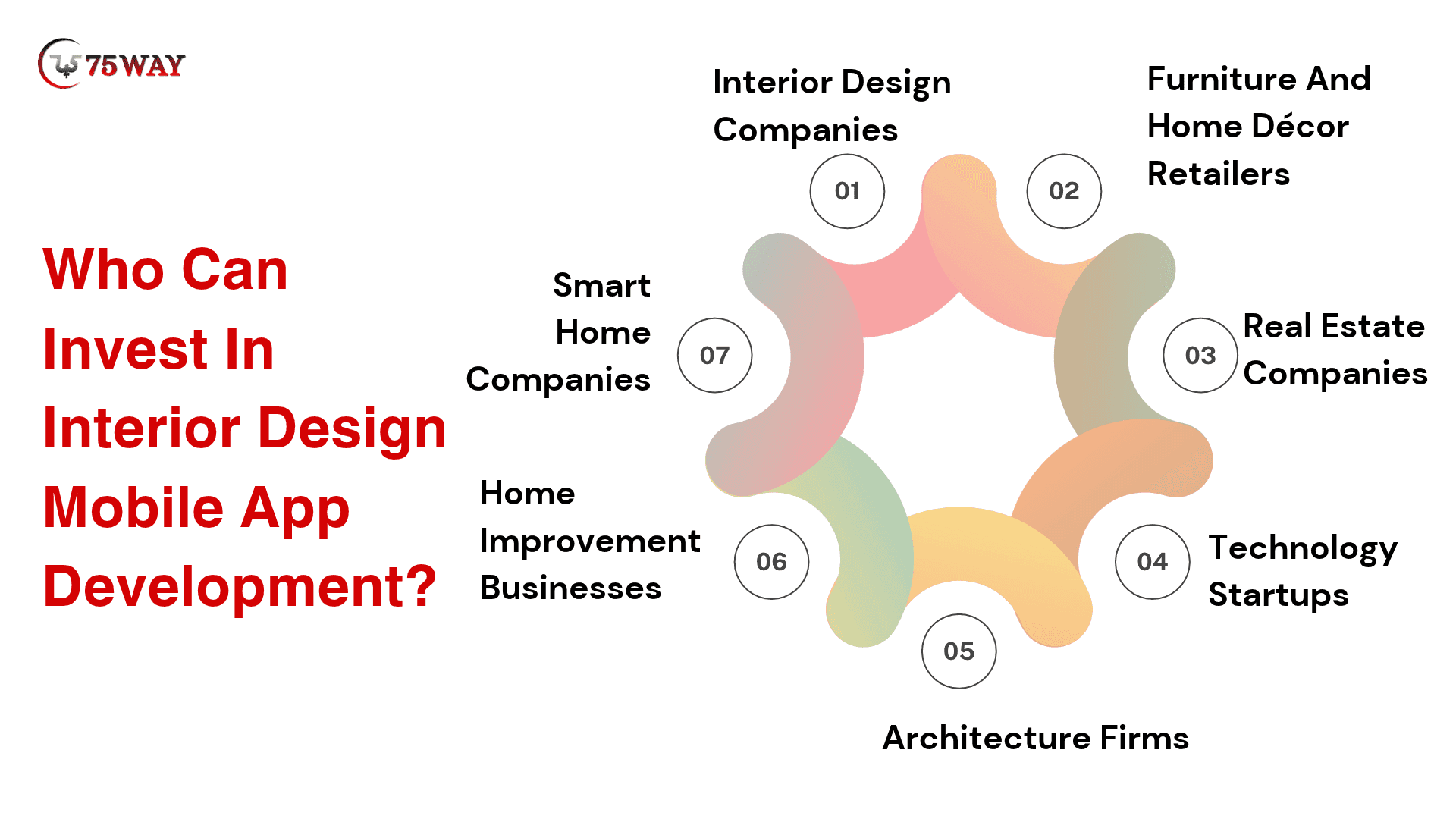
- Interior Design Companies
Interior design firms can invest in mobile apps to streamline client consultations, showcase concepts, and manage design projects.
- Furniture And Home Décor Retailers
Furniture retailers can build interior design apps to showcase products, enable virtual placement, and increase online sales.
- Real Estate Companies
Real estate businesses can develop virtual staging apps to showcase furnished properties and attract potential buyers.
- Technology Startups
Entrepreneurs can invest in AI-powered design platforms to introduce innovative services and subscription-based business models.
- Architecture Firms
Architecture companies can develop design apps to visualize layouts, explore concepts, and collaborate with clients.
- Home Improvement Businesses
Renovation companies can invest in design apps to help customers visualize remodeling projects and select materials.
- Smart Home Companies
Smart home providers can develop interior design apps connecting room aesthetics with lighting, appliances, and automation.
How To Choose The Right AI Interior Design App Development Company?
The interior design app partner can influence product quality, technical decisions, and long-term maintenance. Before selecting a trusted interior design app development company, evaluate these factors.
- AI Development Experience: Review its experience with computer vision, generative AI, image processing, and recommendation systems.
- 3D And AR Capabilities: Ask whether the team has built room visualization, spatial scanning, or virtual product placement features.
- UI/UX Expertise: Evaluate whether its design process accounts for real customer journeys and usability.
- Technical Architecture: Understand how the company plans to manage AI processing, databases, cloud infrastructure, and third-party integrations.
- Development Transparency: Request a clear scope, milestone plan, deliverables, and cost breakdown.
- Post-Launch Support: Confirm how maintenance, model updates, infrastructure monitoring, and future enhancements will be handled.
Ask potential partners to explain how they would approach a specific use case, such as redesigning a living room while preserving its original architectural structure. This will reveal more about their technical thinking than a generic portfolio presentation.
How 75way Helps You Build An AI Interior Design App
Building an AI interior design app requires more than integrating image generation technology. It involves combining AI models, room recognition, 3D visualization, product recommendations, and scalable backend infrastructure into one reliable platform. 75way Technologies, as a recognized AI interior design app development firm in USA, helps businesses turn these requirements into a customized AI interior design solution aligned with their target audience and business goals.
1. Business Analysis And App Planning
We understand your business model, target users, core requirements, and monetization goals to define a clear development roadmap.
2. Custom UI/UX Design
Our team creates intuitive interfaces that make room uploads, design customization, style selection, and furniture exploration simple for users.
3. AI Model Integration
We integrate suitable AI technologies for room recognition, image segmentation, generative design, and personalized recommendations based on your app's requirements.
4. 3D, AR, And VR Development
We develop immersive visualization capabilities that let users explore redesigned spaces, preview virtual furniture, and experience interior concepts before making decisions.
5. Backend And Product Integration
We build secure backend systems and connect furniture catalogs, product databases, payment gateways, and third-party APIs to support essential app operations.
6. Testing & Post-Launch Support
We test AI outputs, room accuracy, application performance, and security before deployment, followed by ongoing maintenance and technical support.
Whether you are launching an AI-powered room design platform, a virtual staging application, or a furniture visualization solution, our AI interior designer app team can help you plan and develop a product around your business objectives. Let's discuss your AI interior design app idea and turn it into a market-ready solution.
Final Remarks
To conclude, AI interior design app development presents opportunities for startups, furniture retailers, real estate businesses, and professional design companies. However, a commercially viable application needs more than attractive AI-generated images.
It requires accurate room analysis, useful design recommendations, reliable visualization, and a business model that supports long-term growth.
The right development approach starts with a focused MVP, validates the customer experience, and introduces advanced AI, AR, and 3D capabilities as business requirements grow.
To launch an AI interior design application, you can partner with an on-demand app development firm in USA to evaluate your idea, define the right technology stack, and build a scalable product aligned with your business goals.
Frequently Asked Questions (FAQs)
How Long Does It Take To Build An AI Interior Design App?
A basic MVP may take 8–12 weeks, a moderately complex application around 12–20 weeks, and an advanced AI-powered platform approximately 20–40+ weeks. Actual timelines depend on requirements, integrations, testing, and development resources.
Can I Build An AI Interior Design App Without Training My Own AI Model?
Yes. Businesses can integrate existing generative AI APIs and computer vision models. Custom model training may become necessary when the application requires specialized design outputs, proprietary datasets, or greater control over model behavior.
Can An AI Interior Design App Generate Revenue?
Yes. Revenue models include subscriptions, freemium upgrades, pay-per-design services, affiliate commissions, and B2B licensing. The most suitable approach depends on the target audience and the application's core value proposition.
Is It Better To Build A Native Or Cross-Platform Interior Design App?
Native development offers greater control over platform-specific capabilities, while cross-platform development can reduce duplicated development work. The decision should consider AR requirements, device compatibility, performance, budget, and long-term maintenance.
Can AI Interior Design Apps Support AR Furniture Placement?
Yes. Developers can integrate technologies such as Apple ARKit and Google ARCore to support augmented reality experiences. These capabilities allow users to preview virtual furniture in physical environments on compatible devices.