AI Summary
Choosing a government software development partner in Australia requires more than comparing proposals. Discover how to assess technical expertise, security, procurement readiness, delivery processes, and long-term support. Understand project costs before committing. Use practical checks to make a confident, informed decision.
Key Takeaways
- Verify government-sector experience through references, outcomes, and delivery evidence.
- Assess security, privacy, accessibility, and applicable Australian government standards.
- Check procurement eligibility, contract terms, intellectual property, and ownership.
- Compare proposals using scope, milestones, team composition, and support commitments.
- Budget AUD $25,000–$700,000+ according to project complexity and requirements.
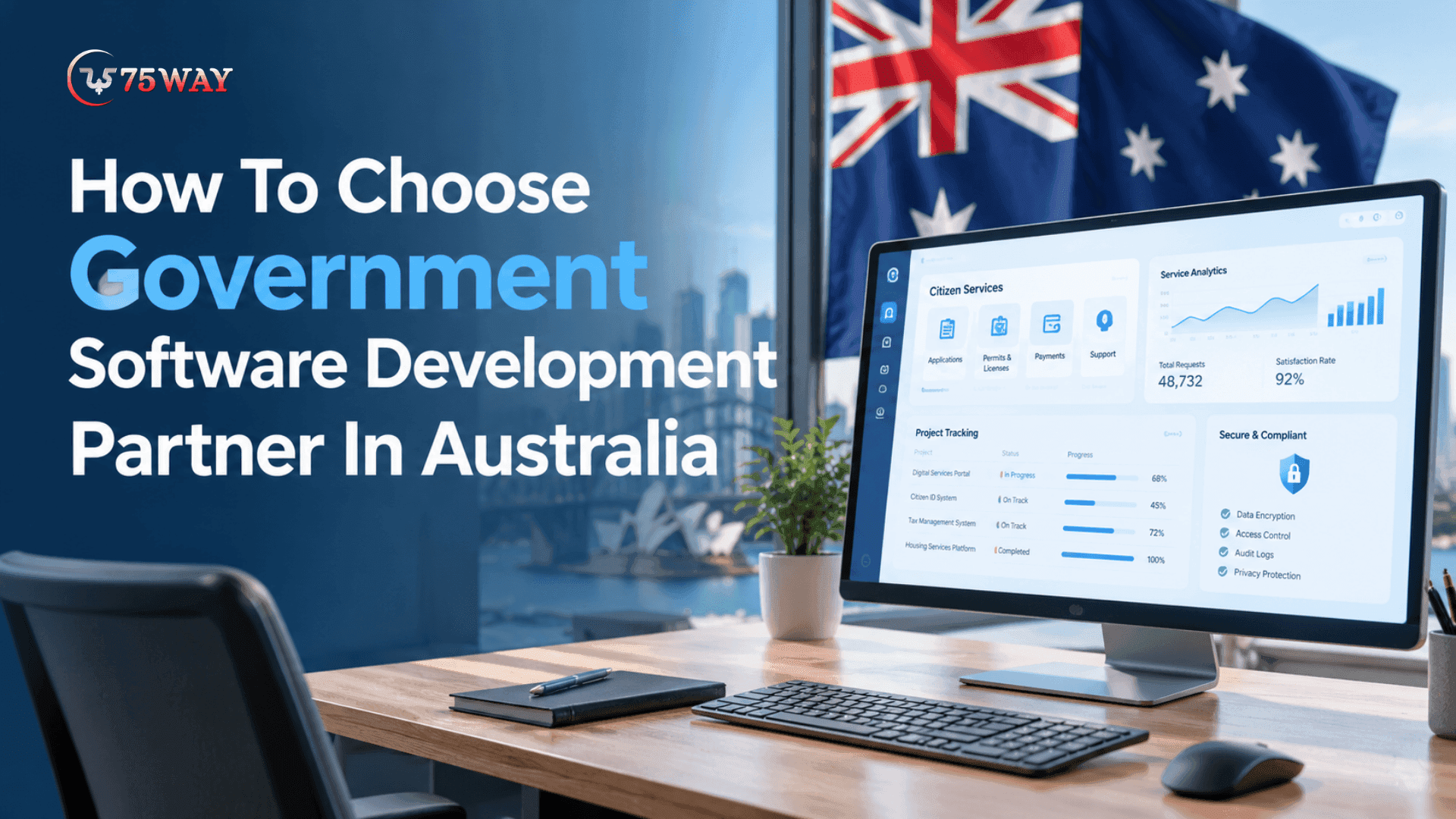
A government software project can look promising at the proposal stage and still run into trouble when security checks, integrations, or compliance requirements come into play. The government software development partner you choose needs to understand these challenges before the project begins, not discover them halfway through delivery.
For Australian government agencies, the decision involves more than comparing prices and technical skills. You need a team that can work within public sector requirements, communicate openly, protect sensitive information, and provide support after launch.
So, how do you know which company is genuinely prepared for the job? This guide covers the practical questions, capabilities, and warning signs to consider when choosing a government software development partner in Australia.
What Makes Government Software Development Different In Australia?
Government software in Australia must work for the public, not just meet an agency’s technical requirements. Privacy, cybersecurity, accessibility, and compliance with government standards all influence development decisions. Understanding these differences helps businesses build software that public sector organizations can trust.
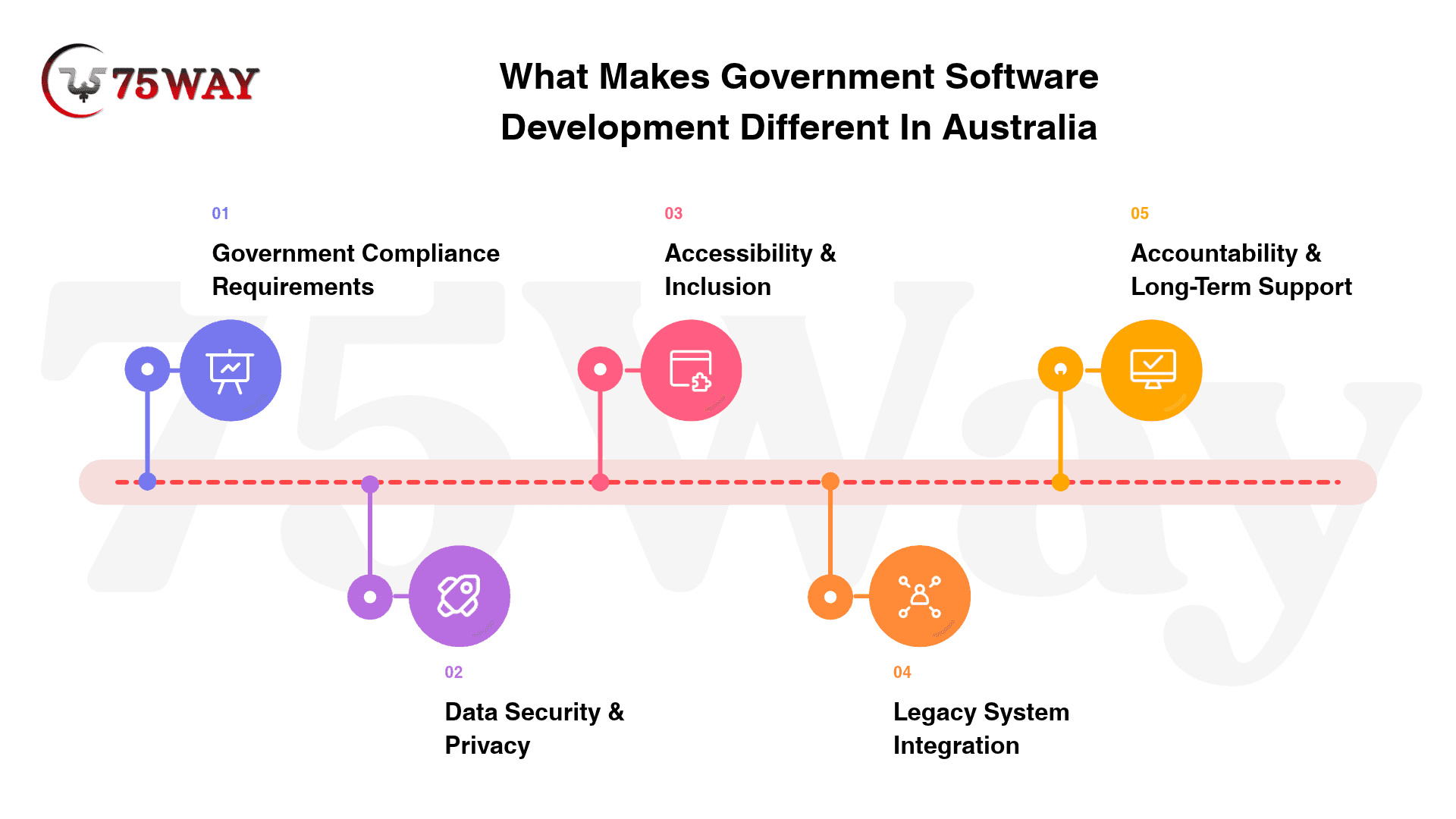
- Government Compliance Requirements: Projects may need to meet applicable government policies, procurement conditions, privacy laws, and security standards.
- Data Security & Privacy: Software must protect sensitive information through suitable access controls, secure data handling, and risk management.
- Accessibility & Inclusion: Public-facing applications should accommodate diverse users and address relevant accessibility requirements from the design stage.
- Legacy System Integration: Government platforms often need to connect with existing databases, identity services, and established operational systems.
- Accountability & Long-Term Support: Clear documentation, audit trails, maintenance plans, and defined responsibilities help keep public services reliable after launch.
Software Market Size In Australia: Growth Trends And Future Outlook
Software is becoming a bigger part of how Australian businesses compete, serve customers, and manage daily operations. This growing reliance on technology is creating fresh demand across enterprise software, cloud services, and AI solutions. Here’s a closer look at its current size, growth drivers, and future outlook.
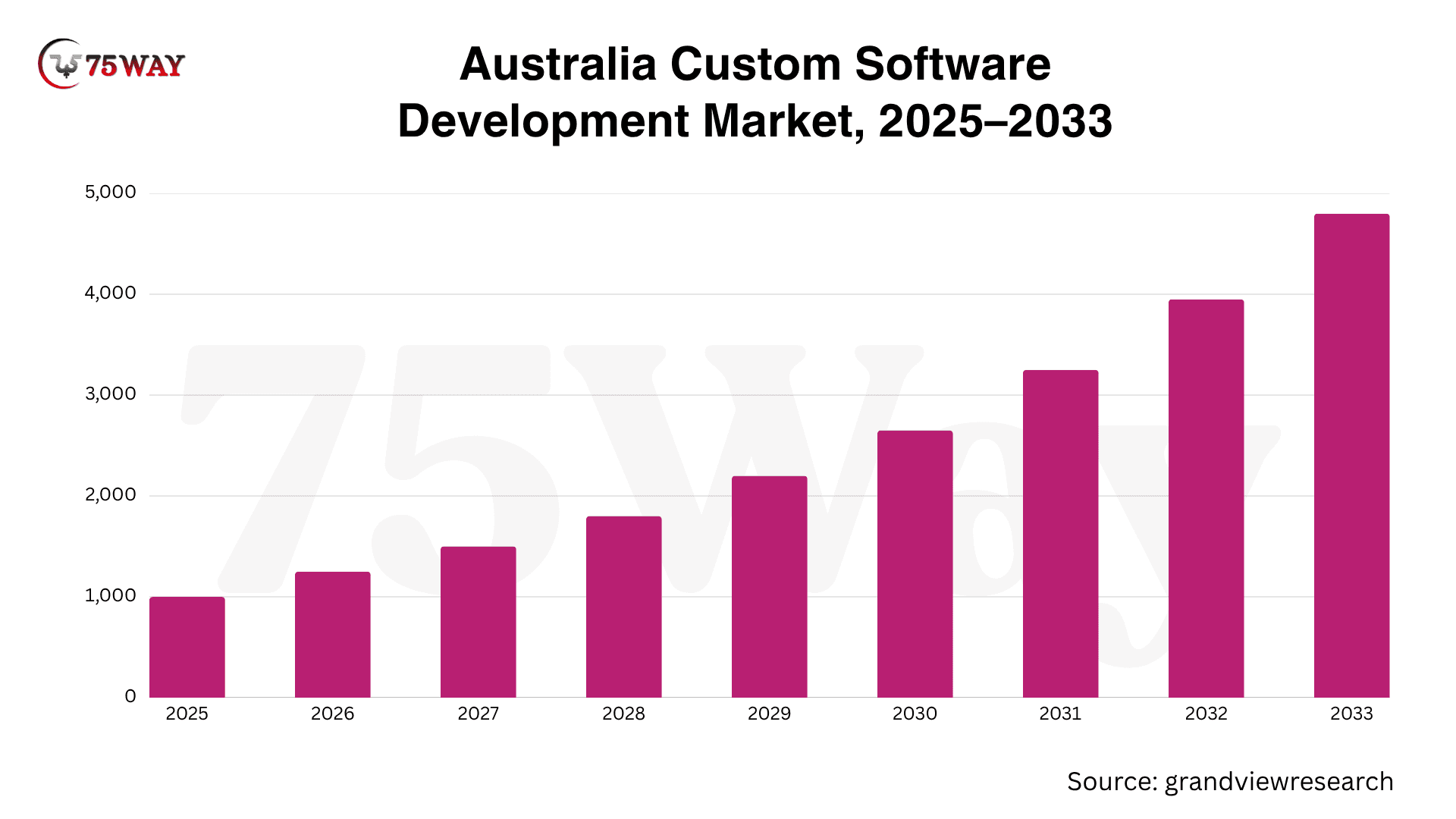
- Australia’s custom software development market generated $1,039.4 million in 2025 and is projected to reach $4,820.6 million by 2033.
- The Australian custom software development market is forecast to expand at a 21.3% CAGR from 2026 to 2033.
- Australia represented 2.3% of the global custom software development market revenue.
- Another report estimates that Australia’s software market will reach $17.33 billion by 2034, growing at an 18.14% CAGR from 2026 to 2034.
What To Examine Before Shortlisting A Partner for Government Software Project
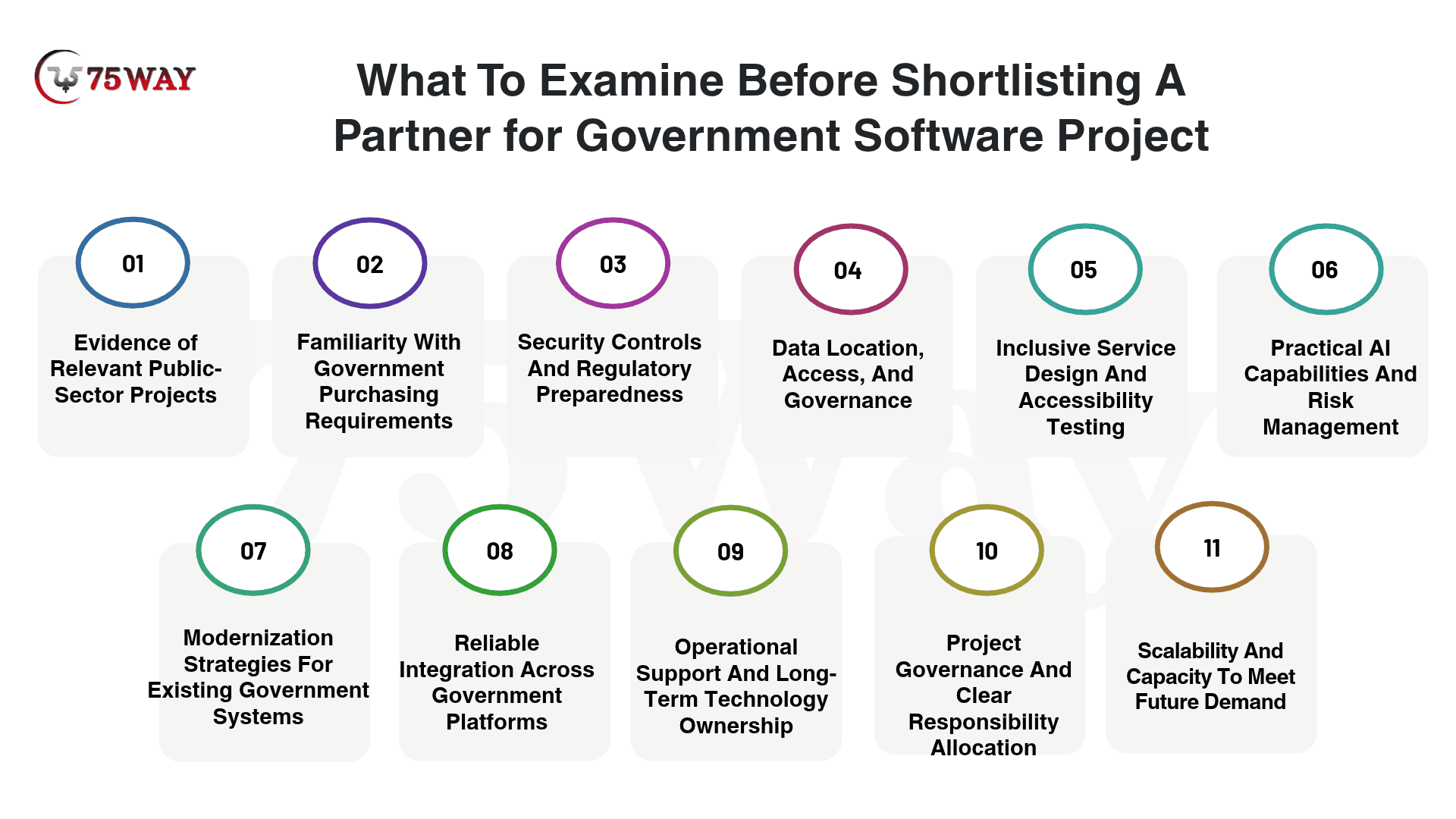
A polished portfolio is a good start, but government software projects demand more than impressive screenshots. You need a tech partner who understands Australian public sector requirements, data security, accessibility, and the realities of working with existing government systems. Here are the key factors to check before making your decision.
1. Evidence of Relevant Public-Sector Projects
A vendor's experience should be assessed against the technical and operational demands of your project, not simply the number of applications it has delivered.
Ask potential partners to explain comparable projects, their responsibilities, the challenges they encountered, and how they measured delivery outcomes.
Evaluate evidence covering:
- Business problems and project objectives.
- Existing systems and integration dependencies.
- Security and privacy considerations.
- Architecture and technology decisions.
- Delivery methodology and stakeholder governance.
- Testing, migration, and deployment.
- Measurable outcomes and post-launch support.
Where confidentiality permits, request client references. If the vendor cannot disclose client identities, ask for anonymized case studies or supporting technical evidence.
2. Familiarity With Government Purchasing Requirements
Procurement experience helps a vendor understand tender requirements, supplier eligibility, statements of work, commercial terms, and evaluation processes.
For Commonwealth procurement, consult the current Commonwealth Procurement Rules. State, territory, and local government projects may follow different procurement arrangements.
Before proceeding, establish whether the supplier meets the relevant conditions and can provide the required documentation.
Assess the vendor's experience with:
- Applicable government panels or marketplaces.
- Tender responses and evaluation criteria.
- Commercial terms and insurance requirements.
- Subcontracting and supplier management.
- Procurement reporting and contract governance.
- Transparent pricing and documented assumptions.
Do not assume that a single registration or panel appointment establishes eligibility for every government engagement.
3. Security Controls And Regulatory Preparedness
Security should be demonstrated through engineering practices, testing, and documented responsibilities rather than a list of certifications.
The Australian Signals Directorate's Information Security Manual provides cybersecurity guidance for relevant information technology and operational technology environments. Whether specific controls are mandatory depends on the project's obligations and risk profile.
Ask how the partner handles:
- Threat modeling and secure architecture.
- Code reviews and dependency scanning.
- Authentication and privileged access.
- Encryption and secrets management.
- Security testing and vulnerability remediation.
- Incident response and audit logging.
- Third-party software and supply-chain risks.
Verify any claimed certification, including its scope and relevance to the proposed delivery arrangement.
4. Data Location, Access, And Governance
Data sovereignty involves more than choosing an Australian cloud region. Organizations must understand where data is stored, processed, backed up, accessed, and transferred.
Ask the vendor to explain the proposed data flows and identify the responsibilities of cloud providers, subcontractors, support teams, and other third parties.
The assessment should cover:
- Production data and backup locations.
- Administrative access and personnel locations.
- Cross-border processing and access arrangements.
- Retention, deletion, and archival requirements.
- Data classification and access permissions.
- Contractual obligations for incident notification.
Privacy obligations vary across Australian jurisdictions. Confirm which federal, state, or territory requirements apply instead of assuming that one privacy framework covers every government organization.
5. Inclusive Service Design And Accessibility Testing
Government software should enable people to complete tasks without unnecessary complexity or exclusion.
Ask the vendor to demonstrate its approach to user research, service design, accessible interfaces, and usability testing. For public-facing services, identify the accessibility standards and government policies applicable to the project.
Review how the team will test keyboard navigation, screen readers, form validation, error messages, readable content, and mobile usability.
Accessibility should be included in acceptance criteria so that it can be assessed before launch.
6. Practical AI Capabilities And Risk Management
Artificial intelligence can support document processing, information retrieval, workflow assistance, and citizen-facing services. However, it also introduces risks involving accuracy, privacy, bias, explainability, and human oversight.
A capable partner should first establish whether AI is necessary to solve the business problem.
If AI is appropriate, evaluate the vendor's ability to manage data quality, model evaluation, access controls, output monitoring, and escalation when the system produces unreliable results.
A practical AI delivery process may follow these stages:
- Use-Case Definition: Establish the business need, intended users, and expected outcomes.
- Data And Risk Review: Assess data suitability, privacy implications, security exposure, and potential bias.
- Solution Design: Select an appropriate model and define how it will interact with existing systems.
- Model Evaluation: Test accuracy, reliability, security, and relevant fairness considerations.
- Human Oversight: Establish approval controls and escalation procedures for sensitive decisions.
- Deployment And Monitoring: Introduce suitable safeguards and monitor performance in operation.
- Ongoing Review: Reassess results, risks, and suitability as requirements change.
For Commonwealth entities, review the applicable Australian Government policy on responsible AI use. Requirements should be verified against the current policy and the agency's obligations.
7. Modernization Strategies For Existing Government Systems
Government agencies often operate a combination of older applications, databases, custom interfaces, and newer cloud services. Replacing every legacy component at once may be expensive and operationally risky.
A suitable technology partner should assess the existing environment before recommending a modernization strategy.
Ask how the team will identify dependencies, map data flows, prioritize applications, plan migrations, and manage coexistence between old and new systems.
A modernization approach may involve retaining stable components, replacing unsupported systems, introducing integration layers, or migrating selected workloads incrementally.
8. Reliable Integration Across Government Platforms
The success of a government platform often depends on how well it exchanges information with other systems.
Assess the partner's experience with APIs, identity services, event-driven integration, databases, payment platforms, reporting tools, and third-party applications.
The proposed design should explain system boundaries, data ownership, interface security, error handling, and monitoring.
A vendor that postpones integration planning until after the main application is developed may create avoidable rework and technical debt.
9. Operational Support And Long-Term Technology Ownership
A government software platform needs ongoing maintenance, security updates, monitoring, and operational support after deployment.
Confirm how the partner will handle incidents, defects, platform upgrades, integration changes, and future enhancements.
The contract should also clarify source code access, intellectual property rights, infrastructure ownership, technical documentation, knowledge transfer, and supplier exit arrangements.
A successful engagement should leave the organization with the information and access required to operate, maintain, or transition the platform.
10. Project Governance And Clear Responsibility Allocation
A vendor's delivery model should make responsibilities visible throughout the project.
Agree on who owns business requirements, architecture decisions, security controls, testing, deployment approvals, operational support, and risk escalation.
A responsibility matrix can help clarify the arrangement.
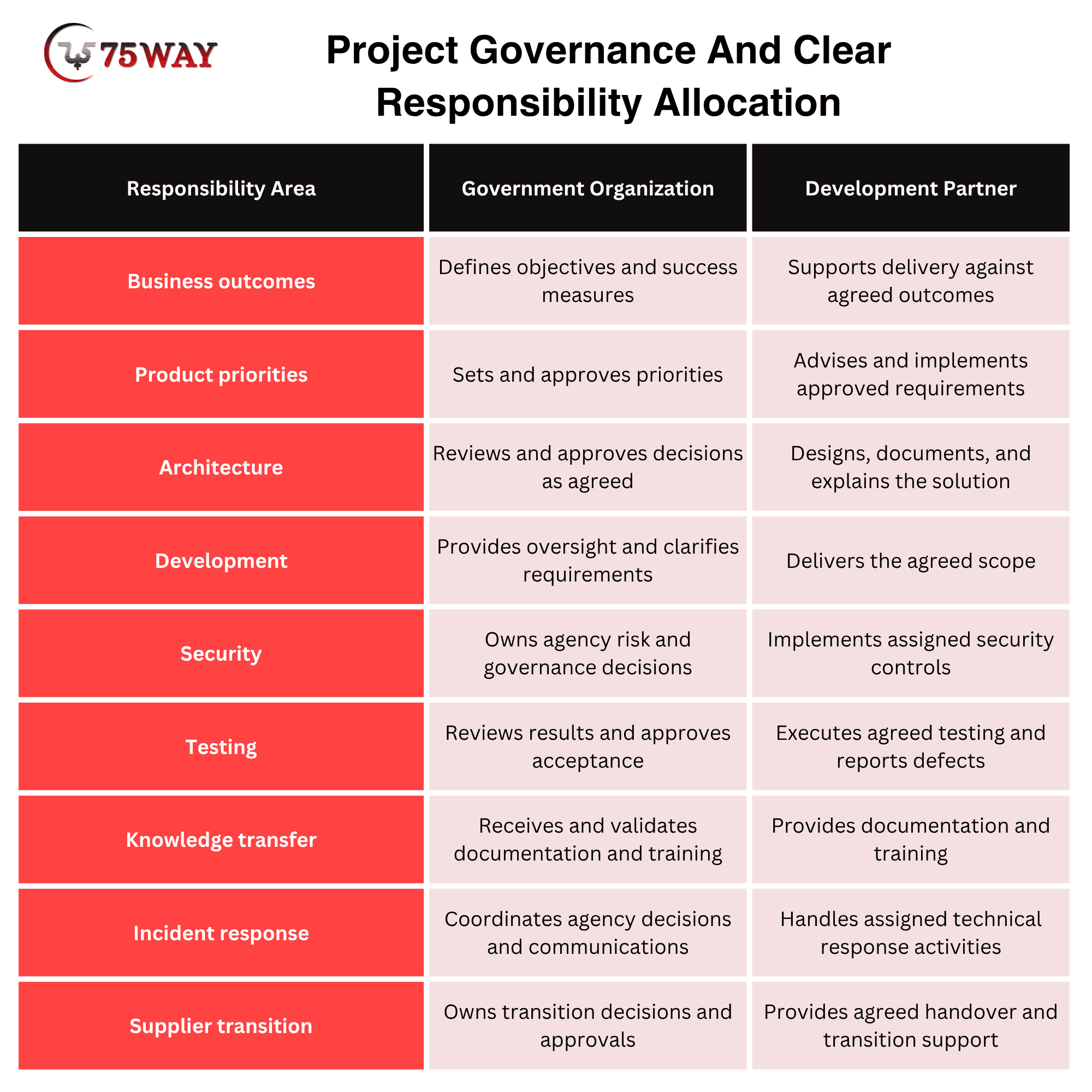
The final allocation of responsibility should reflect the contract, the agency's governance arrangements, and the delivery model.
11. Scalability And Capacity To Meet Future Demand
Government software should accommodate changing service demand, new policies, growing datasets, and additional users without requiring a complete redesign. Assess whether the development partner can plan for future growth while maintaining performance, security, and manageable operating costs.
Ask the vendor to explain how it will handle:
- Increasing numbers of users and transactions.
- Changes in data volume and storage requirements.
- New integrations and digital services.
- Performance testing during peak demand.
- Infrastructure scaling and capacity monitoring.
- Future upgrades without major service disruption.
Request a scalability plan based on realistic usage forecasts and measurable performance targets. This helps ensure the solution can support evolving government needs without creating unnecessary technical complexity or escalating maintenance costs.
A Step-By-Step Method For Assessing Government Software Vendors
Government software vendor assessment starts with one practical question: can the company meet your agency’s actual project requirements? A detailed review of its past projects, technical expertise, security practices, pricing, and support arrangements gives you a clearer basis for comparison. The steps below explain how to assess vendors against your project needs rather than their sales promises.
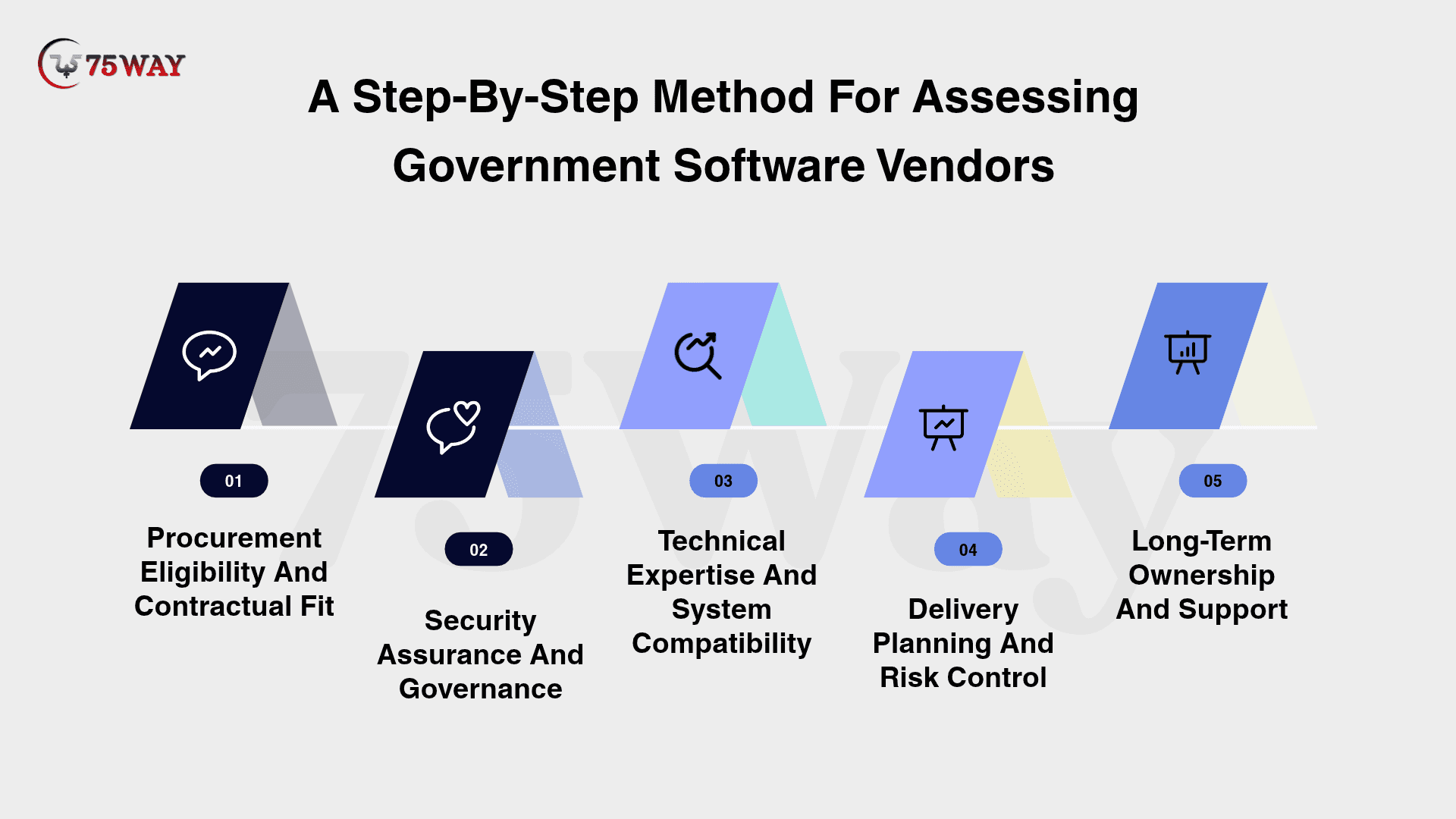
1. Procurement Eligibility And Contractual Fit
A supplier's procurement readiness depends on its ability to meet the eligibility, documentation, insurance, and commercial requirements of the agency's purchasing process. Relevant panel or marketplace arrangements, subcontracting conditions, and contract obligations also require verification before shortlisting.
2. Security Assurance And Governance
The security maturity is reflected in its privacy controls, accessibility practices, security testing, and understanding of applicable government obligations. Supporting policies, control responsibilities, incident procedures, and testing evidence help establish whether the proposed approach addresses project-specific risks.
3. Technical Expertise And System Compatibility
Their engineering capability determines how well the proposed architecture, integration strategy, migration plan, and technology choices fit the agency's requirements. Comparable project examples and technical documentation can demonstrate the supplier's ability to manage existing systems and future enhancements.
4. Delivery Planning And Risk Control
A credible delivery plan includes an appropriately skilled team, realistic milestones, clear communication methods, documented risks, and a defined change-management process. Decision-making responsibilities, progress measures, and procedures for handling delays or additional requirements should be established before development begins.
5. Long-Term Ownership And Support
A sustainable ownership arrangement gives the agency clarity about maintenance, documentation, source code access, intellectual property, knowledge transfer, and supplier transition. Defined support commitments, ongoing costs, and exit provisions help reduce future disruption and dependency on a single provider.
Prioritize Criteria According To Project Risk
The project's risk profile should determine which evaluation criteria receive the greatest attention. Service criticality, data sensitivity, technical complexity, and expected lifespan can all influence the assessment.
- Citizen-Facing Services: Accessibility, usability, availability, and service performance deserve close attention.
- Sensitive Data Platforms: Information handling, access controls, security architecture, and hosting arrangements require detailed scrutiny.
- Legacy Modernization Projects: Dependency mapping, migration planning, integration expertise, and rollback procedures are essential considerations.
- AI-Enabled Systems: Model performance, privacy, human oversight, and operational monitoring need careful evaluation.
- Large Transformation Programs: Governance, delivery sequencing, whole-of-life costs, and organizational change require greater emphasis.
A risk-based assessment provides a clear rationale for selecting a suitable partner while maintaining alignment with the agency's approved procurement process.
Key Areas To Examine During A Government Software Architecture Review
A thorough architecture review establishes whether a proposed solution can meet business requirements, connect with existing systems, protect information, and remain maintainable throughout its lifecycle.
Before development begins, ask shortlisted vendors to explain their target architecture, major technology decisions, dependencies, and operational assumptions.
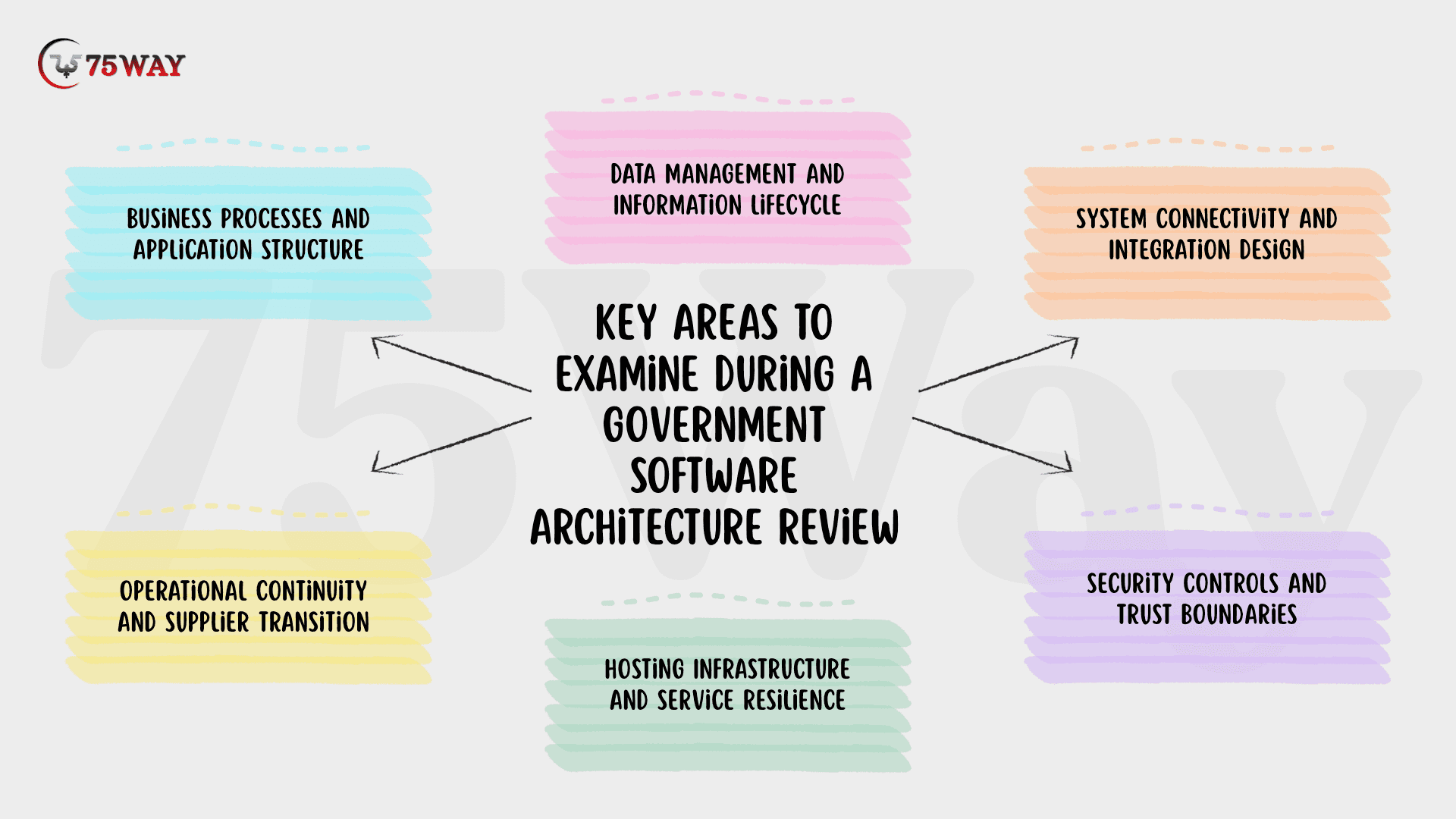
- Business Processes And Application Structure
The application design should support business processes, user roles, permissions, workflows, and service requirements without introducing unnecessary complexity.
Review whether the architecture separates business rules from user interfaces and external integrations where appropriate. The design should also accommodate foreseeable policy changes, new features, and evolving service requirements.
- Data Management And Information Lifecycle
The data architecture should define how information is collected, stored, processed, validated, shared, and retained.
The vendor should explain data ownership, classification, migration, access permissions, backup arrangements, and deletion procedures. For migration projects, request a plan covering reconciliation, validation, cutover, and rollback.
- System Connectivity And Integration Design
The integration architecture should identify the APIs, middleware, identity services, external platforms, and legacy systems required to support the application.
Ask how the proposed solution will handle unavailable services, failed transactions, duplicate requests, authentication failures, and changes to external interfaces. Clear integration contracts and monitoring arrangements can reduce disruption when connected systems behave unexpectedly.
- Security Controls And Trust Boundaries
The security architecture should define trust boundaries, identity management, authorization, encryption, secrets management, logging, and vulnerability controls.
The vendor should map security responsibilities to the proposed design and explain how risks will be tested, monitored, and addressed throughout development and operation.
- Hosting Infrastructure And Service Resilience
The infrastructure design should address hosting choices, configuration, scalability, deployment environments, monitoring, backup, and disaster recovery.
Ask the vendor to explain why the proposed infrastructure meets the service's availability, performance, security, and cost requirements. Recovery objectives and continuity arrangements should reflect the consequences of service disruption.
- Operational Continuity And Supplier Transition
The operational architecture should establish how the application will be monitored, patched, supported, and upgraded after deployment.
The review should also explain how source code, data, configurations, credentials, documentation, and operational knowledge can be transferred if the supplier changes. Clear transition arrangements help protect service continuity and reduce long-term vendor dependency.
How To Calculate The Full Cost of Hiring Software Partner for Government Project
The initial development quote rarely reflects the complete financial commitment of a government software project. A reliable cost assessment should account for implementation, infrastructure, licensing, integration, assurance, ongoing maintenance, and eventual transition.
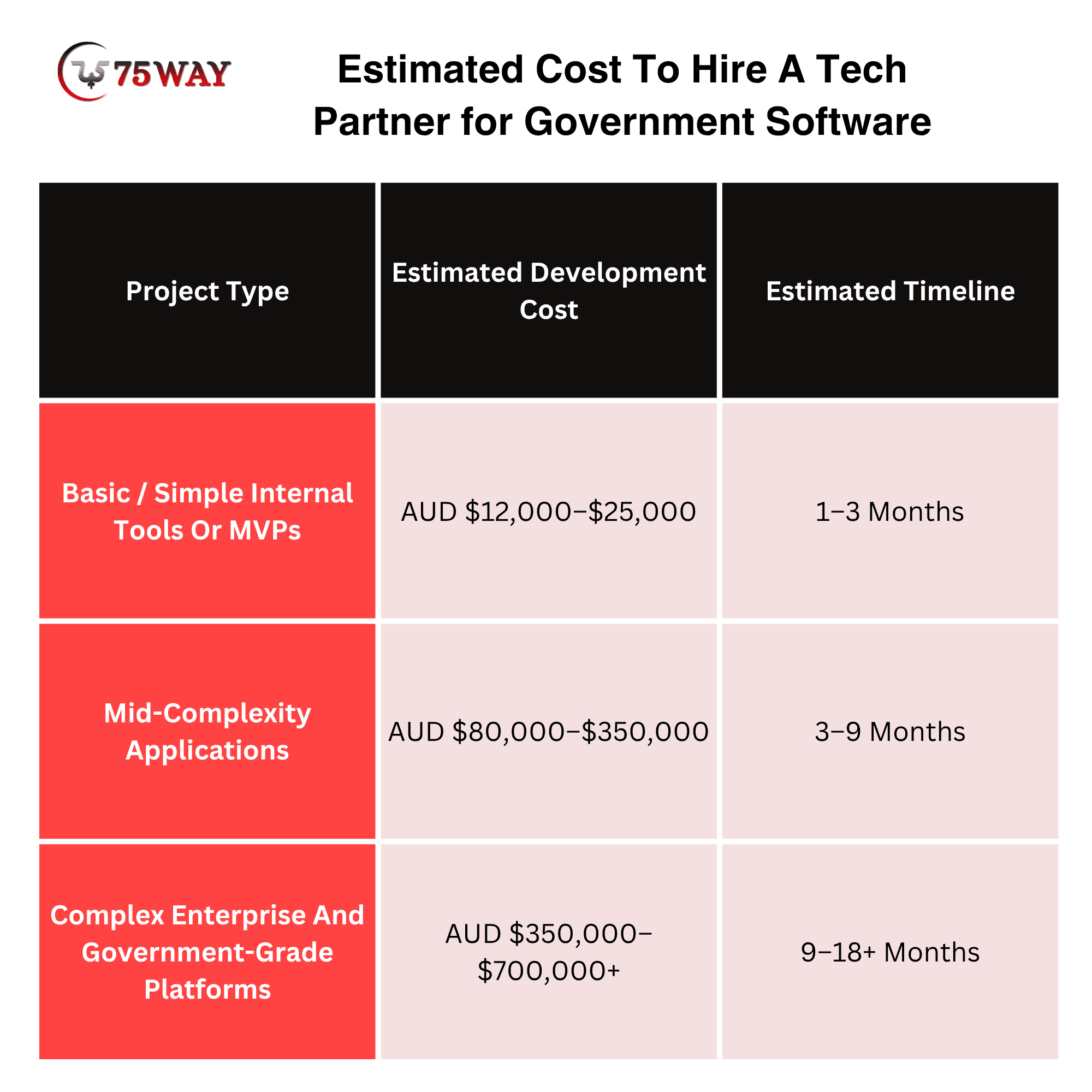
Estimated Cost To Hire A Tech Partner for Government Software
The cost of government software development in Australia ranges from AUD $12,000 to $700,000+, based on project scope and technical requirements. Simple applications need fewer resources, while advanced government platforms require larger budgets for security, compliance, system integration, data migration, and ongoing maintenance.
1. Basic / Simple Internal Tools Or MVPs: AUD $12,000–$25,000
- Internal dashboards, basic reporting tools, and simple workflows.
- Limited user roles, features, and system integrations.
- Minimal infrastructure requirements with straightforward security controls.
2. Mid-Complexity Software: AUD $80,000–$350,000
- Custom business logic, user accounts, and role-based access.
- Multiple integrations, automated workflows, and reporting capabilities.
- More extensive testing, security reviews, and deployment planning.
3. Complex Enterprise And Government-Grade Platforms: AUD $350,000–$700,000+
- Advanced security controls and complex compliance requirements.
- Legacy system modernization, data migration, and deep integrations.
- High availability, scalability, and comprehensive operational support.
Major Factors Affecting Cost Across The Software Lifecycle
A whole-of-life cost assessment helps agencies compare proposals using the same financial assumptions and identify expenses that may arise after launch.
- Discovery And Solution Design
Requirements gathering, stakeholder workshops, user research, prototypes, and architecture planning establish the project's scope and technical direction.
- Development And Quality Assurance
Software engineering, code reviews, functional testing, performance validation, and user acceptance testing contribute to the cost of delivering a reliable application.
- Cloud Infrastructure And Hosting
Hosting, storage, networking, monitoring, backup services, and disaster recovery infrastructure create recurring expenses that may change as demand grows.
- Software Licenses And Subscriptions
Third-party software, database licenses, development tools, APIs, and subscription services can introduce recurring fees or usage-based charges.
- Integration And Data Migration
API development, middleware, legacy connectivity, data cleansing, migration testing, and reconciliation can require significant effort, particularly when existing information is incomplete or inconsistent.
- Security And Independent Assurance
Security assessments, penetration testing, vulnerability remediation, compliance reviews, and ongoing monitoring contribute to the assurance budget. The exact requirements depend on the system and applicable obligations.
- Operations And Maintenance
Technical support, incident response, defect correction, software updates, infrastructure maintenance, and platform upgrades affect the cost of operating the system after launch.
- Artificial Intelligence Services
For AI-enabled applications, model usage, data preparation, evaluation, monitoring, and retraining where applicable may create additional costs.
- Enhancements And Policy Changes
New features, legislative changes, updated business processes, and technology upgrades may require additional development and testing throughout the software's lifespan.
- Exit And Supplier Transition
Data exports, documentation, knowledge transfer, infrastructure handover, and support for a replacement supplier should be considered before the original contract is signed.
Compare Three To Five Years of Costs
Request a three-to-five-year total cost of ownership estimate when that period reflects the expected service life.
Ask vendors to document the assumptions behind recurring costs, expected usage, support levels, licensing changes, and potential infrastructure growth.
For example, a low-cost application may become expensive if it relies on costly proprietary services or requires extensive manual support. A higher initial investment may be justified if it reduces operational effort or simplifies future maintenance.
However, these benefits should be supported by realistic estimates rather than assumed savings.
Final Checks Before Starting A Government Software Project
Once you have shortlisted potential partners, focus on validating their capabilities, confirming delivery expectations, and preparing for implementation.
1. Start With Discovery And Requirements Validation
A discovery engagement clarifies user needs, technical dependencies, security requirements, delivery assumptions, and budget constraints.
Where appropriate, use a paid discovery phase to evaluate the vendor’s approach before committing to full implementation.
2. Validate The Proposed Architecture
Ask the shortlisted partner to present its proposed architecture and explain the major technical decisions.
Review how the design handles integrations, data management, security, operational requirements, and future changes. Involve relevant technical and security stakeholders before approving the approach.
3. Confirm Procurement And Contractual Readiness
Verify the applicable procurement pathway, supplier eligibility, contract conditions, and required documentation.
Agree on project scope, milestones, acceptance criteria, payment terms, change control, intellectual property, and responsibilities before development begins.
4. Establish Delivery Governance
Set up regular progress reviews, risk reporting, technical demonstrations, and release approvals.
Define who can approve scope changes, accept deliverables, escalate risks, and authorize production deployment.
5. Plan For Long-Term Operations
Agree on support responsibilities, service levels, monitoring, security updates, documentation, and knowledge transfer.
The transition from implementation to operations should be included in the delivery plan rather than postponed until launch.
6. Define Measurable Project Success Criteria
Establish measurable indicators for delivery progress, system performance, accessibility, security, and user satisfaction.
Set clear acceptance thresholds and reporting intervals so stakeholders can assess whether the solution meets agreed business and public service objectives.
7. Prepare For Deployment And Change Management
Plan user training, communication, deployment scheduling, data migration, and rollback procedures before launch.
Coordinate operational teams and service owners to minimize disruption and ensure users are prepared for the new system.
How A Government Software Development Agency Should Approach Your Project
A capable technology partner should connect business requirements, technical architecture, security, delivery governance, and operational ownership throughout the software lifecycle. Its approach should be tailored to the project's risks rather than based on a standard development package.
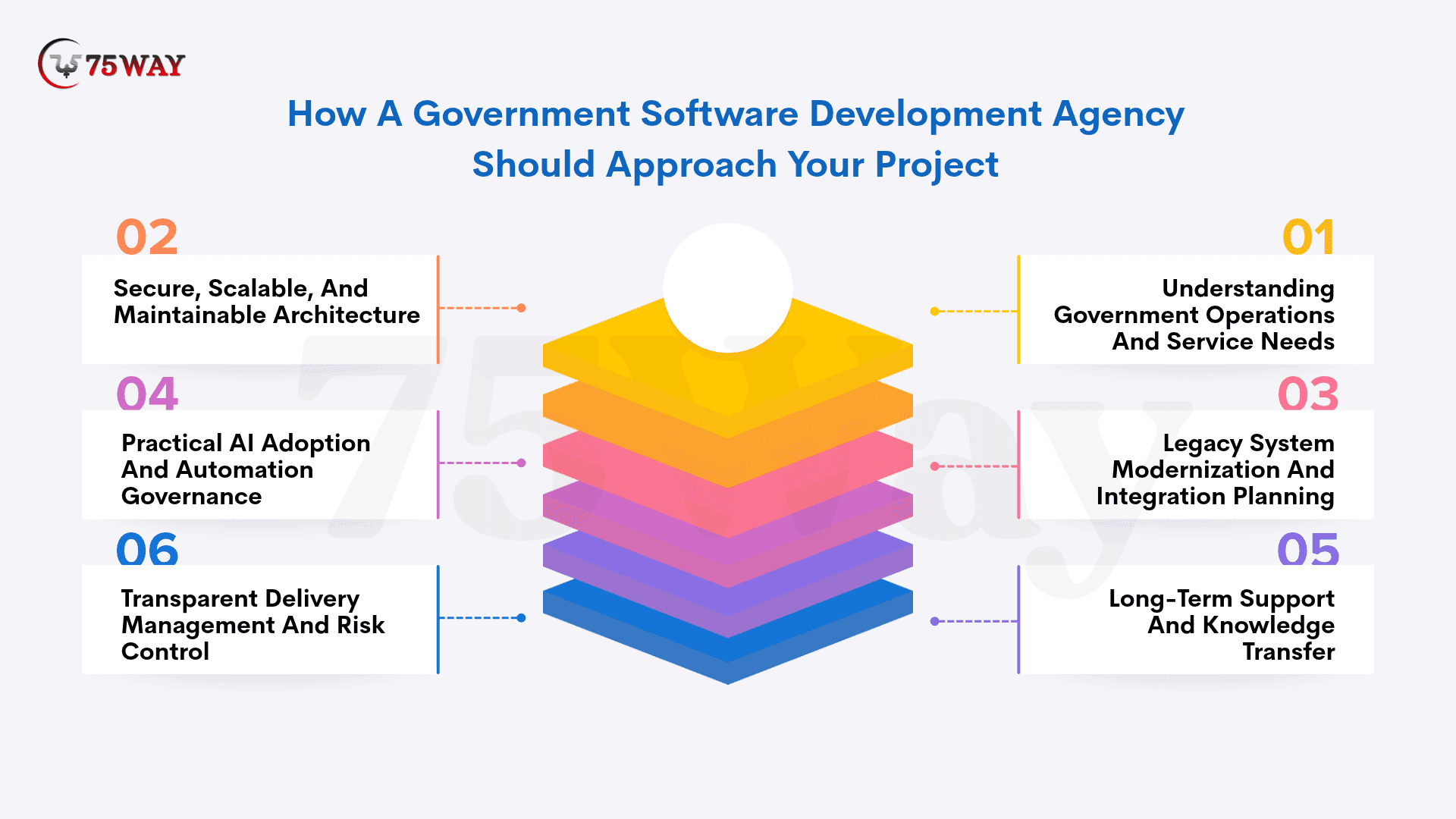
1. Understanding Government Operations And Service Needs
The team should understand the agency's operating environment, stakeholder responsibilities, procurement constraints, and service objectives.
This includes documenting requirements, validating assumptions, identifying dependencies, and establishing measurable acceptance criteria before development begins.
2. Secure And Maintainable Architecture
Security, privacy, scalability, and operational requirements should influence architecture decisions from the outset.
The partner should explain its approach to access controls, data handling, integrations, testing, deployment, monitoring, and ongoing maintenance. It should also identify the controls that remain the agency's responsibility.
3. Legacy System Modernization And Integration Planning
For existing systems, the partner should evaluate dependencies and identify a practical migration path.
Incremental modernization may reduce disruption when critical applications cannot be replaced immediately. The proposed approach should explain migration sequencing, data validation, rollback, and the management of old and new systems during transition.
4. Transparent Delivery Management And Risk Control
The partner should establish clear project milestones, reporting procedures, risk ownership, and escalation paths before development begins.
Regular progress reviews, documented decisions, change management, and measurable performance indicators help the agency monitor delivery, address emerging issues, and maintain accountability throughout the project.
5. Practical AI Adoption And Automation Governance
AI should be introduced where it provides a clear benefit over conventional software or automation.
The partner should establish the use case, assess data suitability, evaluate performance, define human oversight, and monitor the system after deployment.
6. Long-Term Support And Knowledge Transfer
A strong partnership extends beyond implementation. The development team should provide documentation, knowledge transfer, operational guidance, and an agreed support model.
The organization should retain the contractual rights and practical access required to maintain or transition the software throughout its useful life.
Key Factors To Identify Before Hiring A Government Software Vendor
A government software project needs a vendor who can turn your agency’s requirements into a working solution without overlooking security, compliance, or budget limits. A polished portfolio alone cannot tell you how a company handles real project challenges. A closer look at its experience, technical skills, pricing, and support can help you make a more informed hiring decision.
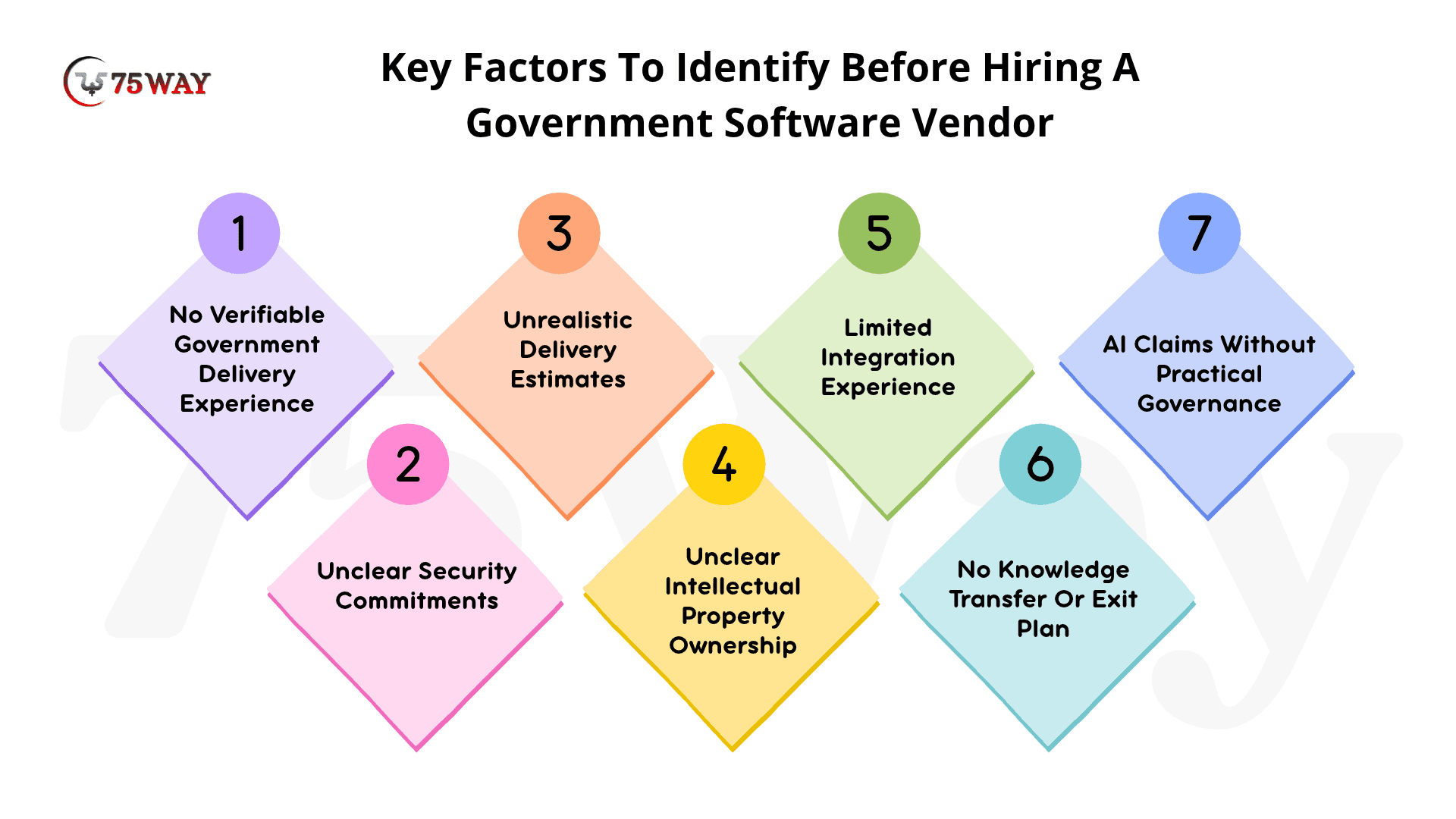
- No Verifiable Government Delivery Experience
A portfolio filled with client logos does not prove that a vendor delivered comparable systems.
Ask for evidence of its responsibilities, technical decisions, governance processes, and project outcomes.
- Unclear Security Commitments
Claims of secure or compliant software should be supported by a defined control framework, testing approach, and remediation process.
Request evidence that demonstrates how security will be implemented for your particular project.
- Unrealistic Delivery Estimates
A supplier that promises a fixed price and timeline without understanding requirements, integrations, and dependencies may be underestimating the work.
Ask what assumptions support the estimate and which circumstances could change the schedule or cost.
- Unclear Intellectual Property Ownership
Contracts should define ownership of newly developed code, pre-existing components, third-party licenses, documentation, and deployment assets.
Unresolved ownership terms can create problems when maintaining or transferring the software.
- Limited Integration Experience
A vendor may be strong at interface development but inexperienced in legacy integration, data migration, or complex business workflows.
Ask how it will discover dependencies, validate data, handle failures, and test the complete system.
- No Knowledge Transfer Or Exit Plan
The absence of a handover plan can leave an organization dependent on one supplier.
Require clear arrangements for code access, documentation, infrastructure ownership, training, and transition support.
- AI Claims Without Practical Governance
If a vendor promotes AI capabilities without explaining evaluation, data protection, human oversight, and monitoring, investigate further.
Technology claims should be supported by a credible implementation and risk-management approach.
Essential Questions For Evaluating A Public-Sector Software Development Firm
A software firm’s answers can reveal more about its public-sector experience than its portfolio ever will. Your agency needs clear evidence of how the team handles government requirements, security concerns, complex integrations, and project delays. The right questions can help you uncover these details before committing public resources to a development partner.
Software Architecture And Integration
- Why does your proposed architecture fit our requirements?
- How will you integrate with legacy systems and external platforms?
- How will you validate and migrate existing data?
- How will you manage scalability, resilience, and system failures?
- How will you minimize unnecessary vendor lock-in?
Security, Privacy, And Compliance
- Which security controls apply to our proposed system?
- How will vulnerabilities be identified, prioritized, and remediated?
- Who is responsible for application and infrastructure security?
- How will personal and sensitive information be protected during testing?
- What incident response and escalation procedures will apply?
Project Delivery And Accountability
- Who will be assigned to the project?
- Which responsibilities will be subcontracted?
- How will progress, risks, and dependencies be reported?
- How will scope changes affect cost and delivery dates?
- What happens if a milestone is delayed?
Pricing, Contracts, And Intellectual Property
- What is included in the quoted scope?
- Which costs and third-party services are excluded?
- What are the expected ongoing maintenance and hosting costs?
- Who owns the source code and newly developed intellectual property?
- What happens if we change suppliers?
AI Governance And Risk Management
- Why is AI necessary for this use case?
- How will accuracy, privacy, and bias risks be evaluated?
- Which decisions require human oversight?
- How will unreliable outputs be detected and handled?
- Can the AI component be replaced without rebuilding the wider application?
The strongest answers explain the reasoning behind the proposed approach and identify risks openly. Request supporting documentation wherever possible.
Conclusion
To summarize, hiring a government software development partner in Australia requires more than comparing technical skills and implementation prices. The decision should account for procurement eligibility, architecture, security, integration complexity, delivery governance, total cost of ownership, and long-term operational support.
Use a structured evaluation framework, request verifiable evidence, and involve the appropriate stakeholders before committing to a supplier. A partner that explains its decisions, identifies risks early, and plans for long-term ownership can help your organization make a more informed and defensible investment.
If you want to launch a government software project in Australia, contact a trusted software development company to discuss your requirements, assess technical risks, and develop a practical delivery roadmap.
Frequently Asked Questions (FAQs)
How Much Does Government Software Development Cost In Australia?
A broad indicative planning range is AUD $25,000–$700,000+, depending on scope, integrations, security requirements, and operational complexity. Request an itemized proposal that includes implementation, licensing, hosting, maintenance, and other applicable costs.
Do Software Development Companies Need Government Certifications To Get Public-Sector Projects?
There is no single certification requirement for every government software project. Supplier eligibility and assurance requirements depend on the procurement pathway, contract, agency policies, information sensitivity, and applicable standards. Verify the actual requirements for your engagement.
What Is The Australian Government Digital Service Standard?
The Digital Service Standard provides criteria for designing and delivering government digital services around user needs, inclusion, trust, and continuous improvement. Check the official guidance to establish how it applies to your service and agency.
What Security Requirements Should A Partner Meet?
The partner should implement the security controls required for the project, including appropriate access management, vulnerability testing, incident response, and information protection. Applicable obligations may draw on the Australian Signals Directorate's Information Security Manual and relevant agency policies.
Should I Choose Australian Software Development Company or An Offshore Team?
Compare technical expertise, communication, delivery governance, costs, and contractual responsibilities. Check where data will be processed, who can access it, and whether the delivery arrangement meets the project's security, privacy, and procurement requirements.
How Can I Reduce The Risk of Government Software Project Delays?
Define requirements and acceptance criteria early, validate integration dependencies, document delivery assumptions, and establish clear change-control procedures. Regular technical reviews and transparent risk reporting can help identify problems before they affect major milestones.
What Should A Government Software Development Contract Include?
The contract should define scope, deliverables, acceptance criteria, payment terms, change control, security responsibilities, intellectual property, warranties, and support arrangements. It should also address source code access, documentation, knowledge transfer, and supplier exit assistance.