James Carter

“Connecting risk data across financial systems and compliance records used to require manual analysis. The risk data orchestration agent unified those signals, giving leadership clear oversight of enterprise exposure patterns.”
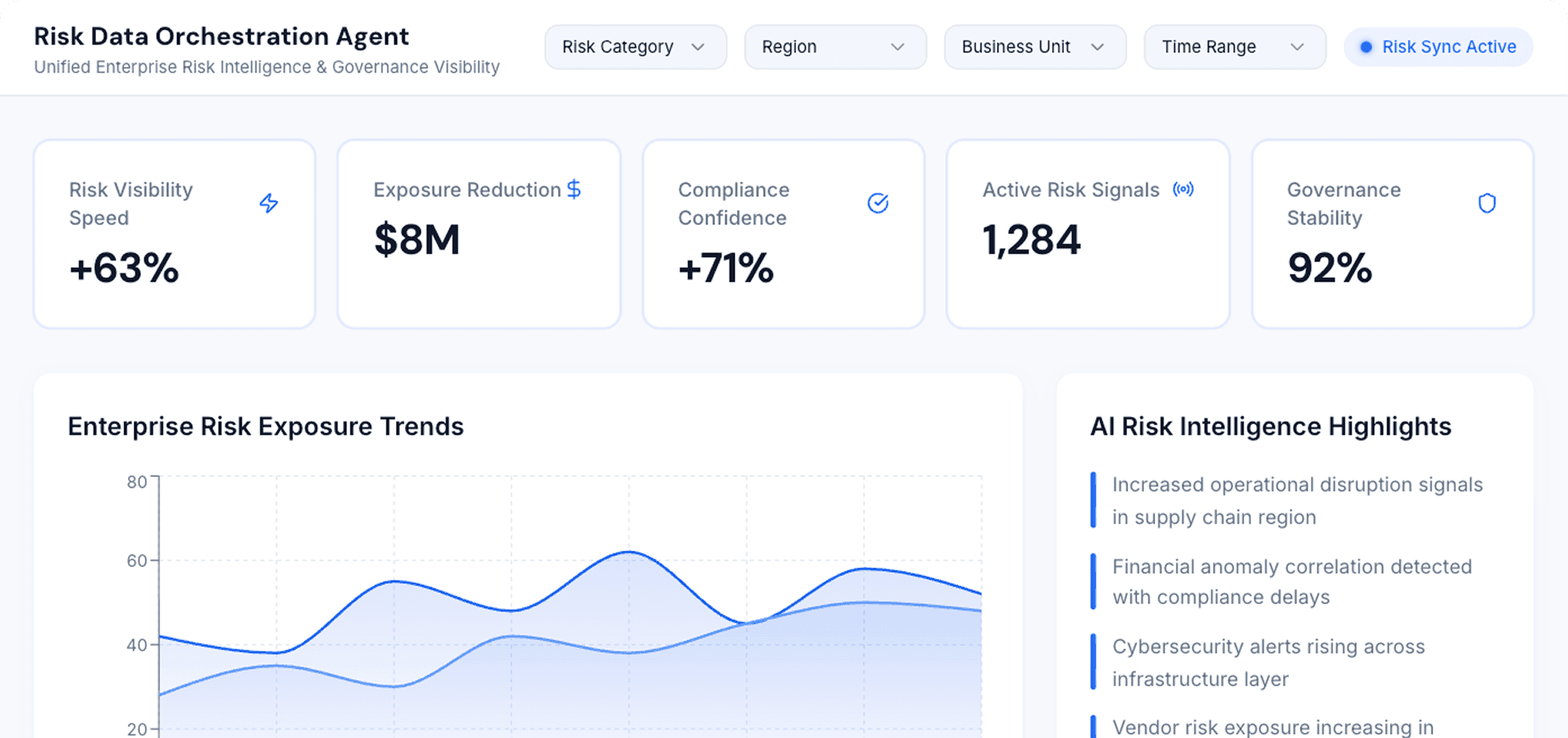
Modern enterprises struggle to unify fragmented risk data across systems. The risk data orchestration agent connects scattered risk signals, structures intelligence, and delivers reliable visibility so leaders detect exposure early and strengthen regulatory confidence across operations.
Bring Business Innovation With AI Automation, AI Agents, Apps, IoT, & Software Solutions. Connect Now!
Bring Business Innovation With AI Automation, AI Agents, Apps, IoT, & Software Solutions. Connect Now!
Bring Business Innovation With AI Automation, AI Agents, Apps, IoT, & Software Solutions. Connect Now!
Risk signals often remain scattered across systems, hiding exposure patterns. The risk data orchestration agent unifies fragmented datasets, enabling leadership to detect vulnerabilities earlier and strengthen risk governance decisions.
Faster Risk Visibility
Data Coordination Speed
Risk Exposure Reduction
Stronger Compliance Confidence
The risk data orchestration agent is an intelligent system designed to connect, structure, and manage risk-related data across multiple enterprise platforms. It gathers signals from compliance tools, operational systems, financial records, and external intelligence sources to create unified visibility across risk environments.
By transforming fragmented risk datasets into structured intelligence, the agent reveals exposure patterns, regulatory gaps, and operational vulnerabilities. Business leaders gain clearer oversight of enterprise risk conditions, enabling informed governance decisions and stronger strategic planning.
Understanding enterprise risk requires connected intelligence across multiple systems. Explore how the risk data orchestration agent organizes fragmented risk data streams and converts them into structured insights, guiding stronger governance and operational resilience.
Risk information often lives in isolated platforms such as compliance tools, financial systems, cybersecurity dashboards, and operational records. Leadership receives fragmented insights rather than complete visibility. When risk signals remain disconnected, exposure patterns stay hidden. Decision-makers struggle to understand the real scale of operational vulnerabilities, regulatory pressure, or financial threats. Without unified risk intelligence, governance becomes reactive, slowing response to emerging risk conditions.
The risk data orchestration agent connects fragmented risk datasets across enterprise systems and external intelligence sources. It structures risk signals into a unified analytical layer that reveals relationships between operational events, financial exposure, and compliance indicators. Leadership gains a comprehensive view of enterprise risk conditions, enabling proactive monitoring, strategic mitigation planning, and stronger regulatory readiness across business operations.
Enterprise leaders require clear oversight of evolving risk environments. The risk data orchestration agent converts scattered risk signals into unified intelligence, enabling leadership to interpret exposure patterns, strengthen governance oversight, and guide confident strategic decisions.
Connects fragmented risk datasets across systems, revealing exposure relationships that leadership previously could not identify across operational environments.
Structures compliance data signals into unified intelligence supporting regulatory transparency and informed governance oversight.
Identifies emerging risk patterns across operational, financial, and compliance signals before vulnerabilities escalate into larger enterprise threats.
Connects multiple enterprise systems and risk databases, enabling structured orchestration of information previously isolated across platforms.
Provides leadership with clear intelligence guiding risk mitigation priorities and governance decisions across complex operational landscapes.
Reveals hidden relationships between operational disruptions, financial indicators, and compliance signals influencing enterprise stability.
The risk data orchestration agent operates through an intelligent coordination framework that gathers risk signals across enterprise environments and structures them into unified analytical intelligence. It connects operational records, compliance datasets, financial indicators, cybersecurity alerts, and external risk feeds into a consolidated orchestration layer. Advanced data models interpret relationships across these sources, revealing exposure patterns that fragmented systems cannot detect independently. Structured intelligence dashboards present unified visibility describing enterprise risk conditions. Leadership gains a clear understanding of vulnerabilities, regulatory signals, and operational threats, enabling proactive governance decisions that strengthen enterprise resilience and long-term risk management strategies.
The agent gathers risk-related information from enterprise systems, including compliance tools, operational records, financial indicators, and cybersecurity monitoring platforms, to create the foundation for coordinated risk intelligence analysis.
The discovery stage establishes a unified risk dataset describing enterprise exposure conditions. Leadership gains consolidated visibility of risk signals previously scattered across systems, enabling accurate analysis and informed governance decisions.
Collects risk datasets from operational platforms, financial systems, regulatory documentation, and cybersecurity monitoring environments across enterprise infrastructure.
Connects risk signals from diverse sources, identifying relationships between operational disruptions, compliance indicators, and financial anomalies.
Structures risk datasets within consistent analytical frameworks to interpret enterprise risk conditions across departments and operational processes.
Reviews incoming risk information to confirm reliability before advanced orchestration processes begin.
Modern enterprises operate within complex risk environments shaped by regulatory pressure, operational complexity, and financial volatility. The risk data orchestration agent transforms fragmented risk signals into unified intelligence supporting strategic oversight across industries.
Integrates financial indicators and compliance datasets to reveal exposure patterns influencing institutional risk stability.
Connects compliance documentation, audit signals, and operational records to strengthen regulatory visibility.
Aligns cybersecurity alerts with operational activity data to reveal broader enterprise exposure conditions.
Analyzes operational disruptions and system anomalies, revealing vulnerabilities affecting business continuity.
Provides leadership with unified intelligence guiding risk governance strategy.
Integrates vendor signals and external intelligence sources, revealing external exposure patterns.
“Connecting risk data across financial systems and compliance records used to require manual analysis. The risk data orchestration agent unified those signals, giving leadership clear oversight of enterprise exposure patterns.”

“Before implementing this system, our risk intelligence remained scattered across departments. Now we see relationships between operational disruptions and financial indicators that previously stayed hidden.”

“The most valuable improvement is clarity. Instead of fragmented dashboards, we now view enterprise risk conditions through unified intelligence.”

“This agent helped leadership understand how compliance signals connect with operational activity. That visibility strengthened governance discussions significantly.”

“Risk oversight became far more structured after introducing orchestration intelligence. Leadership finally sees exposure patterns across the entire enterprise environment.”
“Connecting risk data across financial systems and compliance records used to require manual analysis. The risk data orchestration agent unified those signals, giving leadership clear oversight of enterprise exposure patterns.”
“Before implementing this system, our risk intelligence remained scattered across departments. Now we see relationships between operational disruptions and financial indicators that previously stayed hidden.”
“The most valuable improvement is clarity. Instead of fragmented dashboards, we now view enterprise risk conditions through unified intelligence.”
“This agent helped leadership understand how compliance signals connect with operational activity. That visibility strengthened governance discussions significantly.”
“Risk oversight became far more structured after introducing orchestration intelligence. Leadership finally sees exposure patterns across the entire enterprise environment.”
“Connecting risk data across financial systems and compliance records used to require manual analysis. The risk data orchestration agent unified those signals, giving leadership clear oversight of enterprise exposure patterns.”
“Before implementing this system, our risk intelligence remained scattered across departments. Now we see relationships between operational disruptions and financial indicators that previously stayed hidden.”
“Connecting risk data across financial systems and compliance records used to require manual analysis. The risk data orchestration agent unified those signals, giving leadership clear oversight of enterprise exposure patterns.”
“Before implementing this system, our risk intelligence remained scattered across departments. Now we see relationships between operational disruptions and financial indicators that previously stayed hidden.”
“The most valuable improvement is clarity. Instead of fragmented dashboards, we now view enterprise risk conditions through unified intelligence.”
“This agent helped leadership understand how compliance signals connect with operational activity. That visibility strengthened governance discussions significantly.”
“The most valuable improvement is clarity. Instead of fragmented dashboards, we now view enterprise risk conditions through unified intelligence.”
“This agent helped leadership understand how compliance signals connect with operational activity. That visibility strengthened governance discussions significantly.”
“Risk oversight became far more structured after introducing orchestration intelligence. Leadership finally sees exposure patterns across the entire enterprise environment.”
“Risk oversight became far more structured after introducing orchestration intelligence. Leadership finally sees exposure patterns across the entire enterprise environment.”
Unify fragmented risk signals and gain clear enterprise visibility that guides stronger governance decisions and proactive exposure management.