David Anderson

Before implementing this system, our risk evaluations across departments produced conflicting conclusions. Synchronization created a single reliable intelligence view guiding leadership discussions.
Risk evaluations often occur across multiple systems, creating fragmented insights that weaken governance clarity. The risk assessment synchronization agent unifies risk evaluations across platforms, aligning assessment signals into reliable intelligence supporting confident strategic oversight.
Bring Business Innovation With AI Automation, AI Agents, Apps, IoT, & Software Solutions. Connect Now!
Bring Business Innovation With AI Automation, AI Agents, Apps, IoT, & Software Solutions. Connect Now!
Bring Business Innovation With AI Automation, AI Agents, Apps, IoT, & Software Solutions. Connect Now!
Disconnected risk assessments often generate conflicting signals across governance systems. The risk assessment synchronization agent aligns evaluation outputs across platforms, transforming fragmented insights into consistent intelligence supporting leadership interpretation.
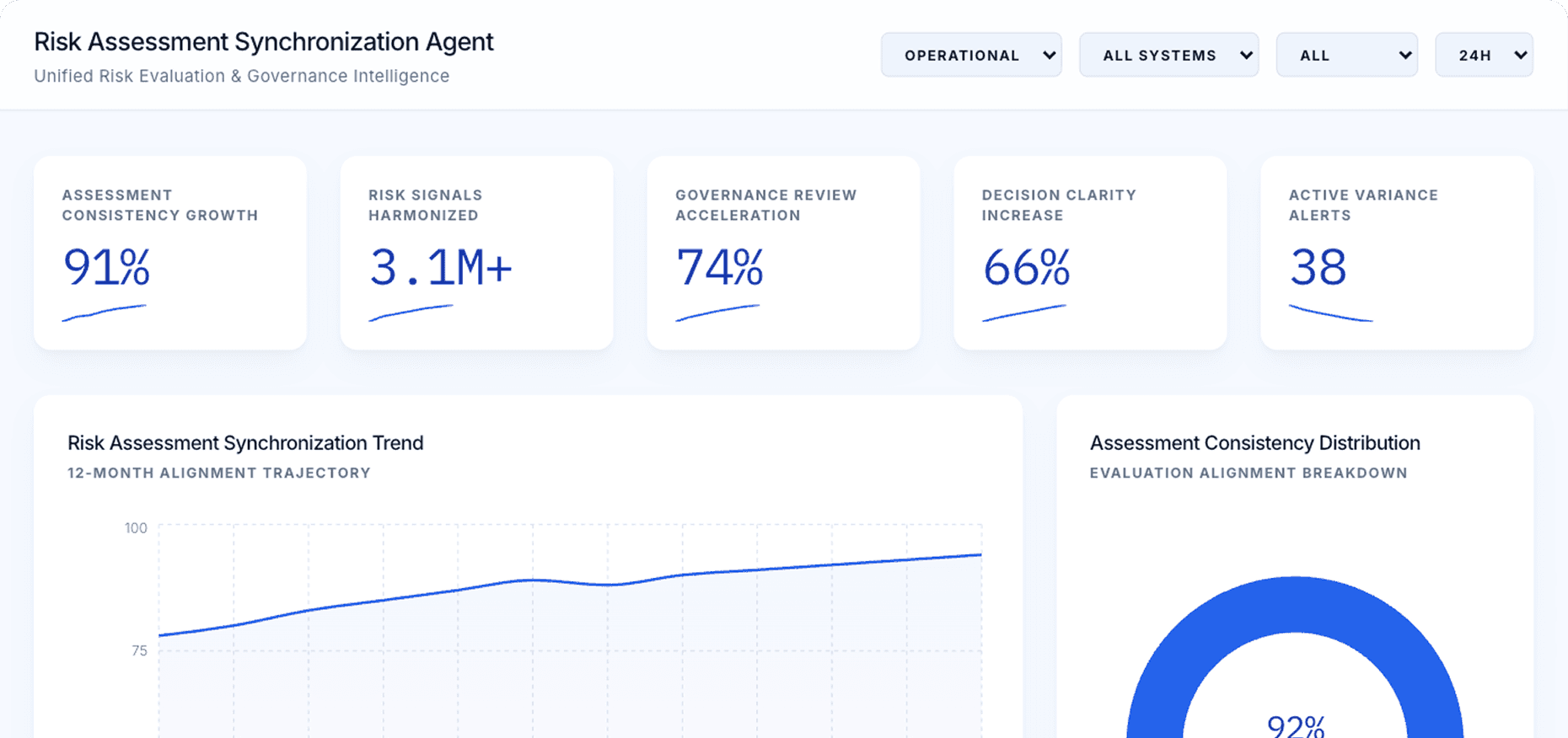
Assessment Consistency Growth
Risk Signals Aligned
Faster Governance Reviews
Decision Clarity Increase
The risk assessment synchronization agent is an intelligent governance system designed to align risk evaluations originating from multiple enterprise platforms. It compares analytical outputs, detects inconsistencies between assessment frameworks, and transforms fragmented evaluation signals into unified risk intelligence.
Through continuous synchronization of risk signals, the agent harmonizes evaluation methodologies and scoring models across systems. Leadership receives a consistent understanding of exposure conditions, allowing clearer governance interpretation across operational monitoring, compliance reviews, and enterprise risk analysis environments.
Understanding how the risk assessment synchronization agent harmonizes fragmented evaluations becomes clearer through direct exploration. Leaders can observe how disconnected risk assessments transform into synchronized intelligence supporting governance visibility.
Risk evaluations frequently originate from operational monitoring platforms, compliance systems, financial analysis tools, and departmental reporting frameworks. Each environment may apply different scoring approaches or evaluation methodologies. When those assessments remain disconnected, leadership encounters conflicting signals that complicate governance interpretation and strategic planning.
The risk assessment synchronization agent compares evaluation outputs across systems and aligns assessment methodologies through structured analytical models. Risk scores, exposure classifications, and analytical signals become harmonized, transforming fragmented evaluation environments into unified intelligence supporting leadership oversight and enterprise governance clarity.
Consistent governance insight requires alignment between risk assessments generated across analytical systems. The risk assessment synchronization agent synchronizes evaluation signals, allowing leadership to interpret enterprise exposure conditions through unified intelligence.
Risk evaluations across analytical systems become synchronized, allowing leadership to interpret exposure conditions using consistent governance intelligence.
Governance dashboards display harmonized assessment signals across operational monitoring, compliance reporting, and strategic risk analysis platforms.
Conflicting analytical outputs are detected early, preventing misinterpretation of enterprise exposure conditions during governance reviews.
Fragmented risk scoring approaches become harmonized, allowing reliable interpretation of enterprise exposure patterns.
Leadership discussions rely on synchronized evaluation insights rather than disconnected analytical signals.
Harmonized risk intelligence reveals patterns influencing long-term governance planning and oversight priorities.
The risk assessment synchronization agent follows a structured workflow designed to align risk evaluations generated across enterprise systems. It gathers assessment outputs from governance platforms, operational monitoring environments, compliance frameworks, and analytical tools before initiating comparison analysis. Synchronization models evaluate scoring approaches, methodologies, and classification structures to identify inconsistencies affecting governance interpretation. Detected differences are harmonized through alignment frameworks that standardize evaluation logic across systems. Continuous synchronization monitoring then tracks new assessment signals as they emerge. Leadership receives unified risk intelligence reflecting consistent exposure evaluations supporting confident governance oversight, strategic planning discussions, and enterprise risk visibility.
Risk evaluations originate from operational monitoring tools, governance platforms, compliance systems, and analytical risk engines. This stage gathers those fragmented assessment outputs into a centralized synchronization environment where alignment preparation begins before deeper comparison and harmonization processes evaluate differences.
Risk assessments previously scattered across multiple systems become consolidated into a unified analytical environment. Leadership gains clear visibility across evaluation sources, establishing the foundation for accurate comparison and synchronization of enterprise risk intelligence.
Risk evaluation systems across governance platforms, operational monitoring environments, and compliance frameworks are identified for synchronization analysis.
Risk scoring outputs and evaluation reports are collected while preserving timestamps, scoring logic references, and contextual metadata.
Gathered assessments are categorized by risk domain, evaluation methodology, and operational relevance for structured comparison.
Collected risk signals are normalized into consistent structures allowing synchronization engines to compare analytical outputs.
Enterprise governance depends on aligned risk intelligence across monitoring platforms, compliance frameworks, and analytical environments that evaluate operational exposure conditions.
Risk evaluations generated across departments become synchronized, enabling leadership to interpret exposure conditions through unified governance intelligence.
Compliance assessments originating from multiple regulatory frameworks align into consistent intelligence supporting governance visibility.
Risk evaluations across operational monitoring platforms become harmonized, strengthening the interpretation of exposure conditions.
Leadership receives synchronized evaluation signals supporting long-term governance strategy and enterprise stability planning.
Risk assessments used during governance audits remain consistent across reporting environments.
Enterprises operating multiple analytical platforms gain synchronized exposure intelligence supporting governance clarity.
Before implementing this system, our risk evaluations across departments produced conflicting conclusions. Synchronization created a single reliable intelligence view guiding leadership discussions.

Risk dashboards previously displayed inconsistent scores across analytical platforms. The synchronization agent aligned everything into one clear governance perspective.

Our compliance and operational assessments rarely matched. Synchronization finally gave executives a consistent understanding of enterprise exposure.

Strategic planning improved once risk intelligence became aligned across our monitoring systems. Leadership discussions now rely on synchronized evaluation signals.

Fragmented risk analysis complicated governance meetings for years. This platform unified intelligence across our analytical environments.
Before implementing this system, our risk evaluations across departments produced conflicting conclusions. Synchronization created a single reliable intelligence view guiding leadership discussions.
Risk dashboards previously displayed inconsistent scores across analytical platforms. The synchronization agent aligned everything into one clear governance perspective.
Our compliance and operational assessments rarely matched. Synchronization finally gave executives a consistent understanding of enterprise exposure.
Strategic planning improved once risk intelligence became aligned across our monitoring systems. Leadership discussions now rely on synchronized evaluation signals.
Fragmented risk analysis complicated governance meetings for years. This platform unified intelligence across our analytical environments.
Before implementing this system, our risk evaluations across departments produced conflicting conclusions. Synchronization created a single reliable intelligence view guiding leadership discussions.
Risk dashboards previously displayed inconsistent scores across analytical platforms. The synchronization agent aligned everything into one clear governance perspective.
Before implementing this system, our risk evaluations across departments produced conflicting conclusions. Synchronization created a single reliable intelligence view guiding leadership discussions.
Risk dashboards previously displayed inconsistent scores across analytical platforms. The synchronization agent aligned everything into one clear governance perspective.
Our compliance and operational assessments rarely matched. Synchronization finally gave executives a consistent understanding of enterprise exposure.
Strategic planning improved once risk intelligence became aligned across our monitoring systems. Leadership discussions now rely on synchronized evaluation signals.
Our compliance and operational assessments rarely matched. Synchronization finally gave executives a consistent understanding of enterprise exposure.
Strategic planning improved once risk intelligence became aligned across our monitoring systems. Leadership discussions now rely on synchronized evaluation signals.
Fragmented risk analysis complicated governance meetings for years. This platform unified intelligence across our analytical environments.
Fragmented risk analysis complicated governance meetings for years. This platform unified intelligence across our analytical environments.
Discover how the risk assessment synchronization agent unifies fragmented evaluations into consistent governance intelligence across enterprise platforms.