Andrew Peterson

“Pipeline reviews used to rely heavily on assumptions. The deal health intelligence agent revealed clear engagement signals explaining opportunity progress, allowing leadership to intervene earlier.”
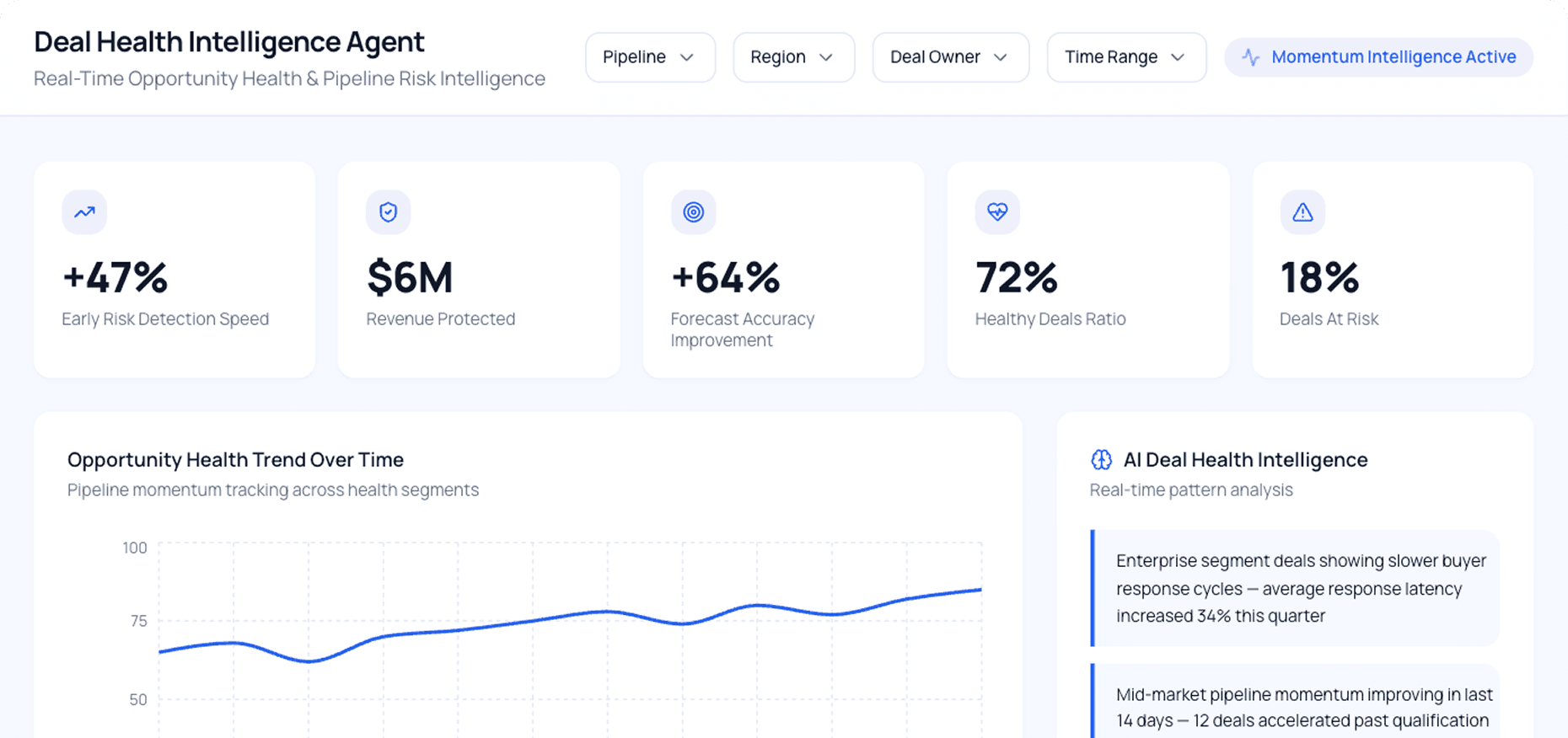
Revenue leaders need early visibility into deal progress and risk signals. The deal health intelligence agent analyzes engagement patterns, pipeline movement, and buyer interactions to reveal opportunity health and guide stronger sales decisions.
Bring Business Innovation With AI Automation, AI Agents, Apps, IoT, & Software Solutions. Connect Now!
Bring Business Innovation With AI Automation, AI Agents, Apps, IoT, & Software Solutions. Connect Now!
Bring Business Innovation With AI Automation, AI Agents, Apps, IoT, & Software Solutions. Connect Now!
Unclear opportunity progress often leads to unexpected revenue gaps. Our customizable deal health intelligence agent analyzes engagement patterns and pipeline movement to reveal early warning signals.
Faster Risk Detection
Pipeline Visibility
Revenue Protection
Stronger Forecast Accuracy
The deal health intelligence agent is an analytical system that evaluates opportunity activity, engagement signals, and buyer interactions across the sales pipeline. It interprets deal behavior patterns to determine opportunity momentum, revealing whether deals are progressing normally, accelerating, or showing early risk indicators.
By converting scattered engagement data into structured intelligence, the agent highlights deal momentum patterns and engagement gaps influencing opportunity progress. Revenue leaders gain deeper visibility into pipeline conditions, enabling earlier intervention, stronger forecasting confidence, and more informed strategic decisions.
Understanding opportunity health requires deeper visibility beyond surface pipeline metrics. Explore how the deal health intelligence agent analyzes engagement signals and opportunity activity to uncover deal momentum patterns guiding confident revenue decisions.
Sales pipelines frequently appear healthy at the surface level, yet hidden warning signals often exist inside engagement activity and buyer communication patterns. Opportunities may remain open while buyer interest declines, decision cycles stall, or competitors quietly influence purchasing choices. Without deeper analytical insight, leadership discovers pipeline weaknesses only after opportunities collapse, creating unexpected revenue gaps and unstable forecasting conditions.
The deal health intelligence agent continuously analyzes engagement signals, activity timelines, buyer communication patterns, and proposal interactions across pipeline stages. Artificial intelligence models detect momentum shifts, stalled engagement signals, and declining buyer interest early. Leadership receives structured intelligence describing opportunity health conditions, enabling proactive intervention, improved pipeline oversight, and stronger revenue predictability.
Revenue leaders often rely on surface pipeline metrics that hide deeper opportunity signals. The deal health intelligence agent converts engagement activity, opportunity timelines, and buyer interaction data into structured intelligence that reveals momentum patterns and emerging risks across revenue pipelines.
Reveals engagement patterns, communication signals, and activity timelines that describe real opportunity progress throughout pipeline stages clearly.
Identifies declining buyer engagement signals and stalled interactions that indicate weakening opportunity momentum early.
Provides leadership with clearer intelligence explaining opportunity conditions that influence revenue forecasting accuracy.
Analyzes communication frequency, response timing, and participation signals to interpret buyer interest patterns.
Evaluates activity progression across pipeline stages to determine whether opportunities accelerate or stall.
Enables leadership to interpret opportunity health intelligence supporting stronger pipeline evaluation and revenue planning decisions.
The deal health intelligence agent operates through an analytical workflow designed to evaluate opportunity engagement, activity patterns, and deal progression signals throughout the sales pipeline. It gathers opportunity interactions, communication timelines, meeting activity, and proposal engagement signals from revenue systems. Analytical models evaluate these signals to interpret deal momentum and buyer engagement intensity. Opportunity behaviors are compared with historical deal outcomes to identify patterns associated with healthy progression or emerging risk indicators. Structured intelligence dashboards then present leadership with clear explanations describing opportunity health conditions across pipeline stages.
The process begins by gathering opportunity activity signals, engagement records, and buyer interaction timelines across revenue systems. These signals establish the analytical foundation required to interpret deal momentum and understand opportunity conditions within the sales pipeline accurately.
The discovery stage produces a structured dataset describing opportunity engagement patterns and activity timelines across the pipeline. Leadership gains consolidated visibility into buyer interaction signals, creating the analytical foundation required for deeper deal health interpretation and accurate opportunity condition evaluation.
Captures opportunity activity signals, communication timelines, meeting records, and engagement interactions from CRM and revenue systems across pipeline stages.
Connects buyer responses, meeting participation, and proposal engagement activity with specific opportunity stages within the sales pipeline.
Structures opportunity timelines so engagement signals clearly represent how deal conversations progressed during the evaluation cycle.
Reviews engagement data completeness and removes inconsistent activity signals before analytical interpretation begins.
Sales pipelines generate large volumes of engagement activity and opportunity signals. The deal health intelligence agent converts these signals into structured intelligence that helps leadership understand deal momentum, interpret opportunity conditions, and guide stronger pipeline oversight decisions.
Evaluates engagement signals and opportunity activity patterns, revealing deal momentum conditions across pipeline stages for leadership visibility.
Interprets opportunity health patterns influencing revenue projections, helping leadership understand pipeline stability and forecast reliability.
Analyzes communication frequency, meeting participation, and response behavior, revealing shifts in buyer interest across active opportunities.
Identifies stalled negotiations, declining engagement activity, and delayed responses signaling potential deal deterioration within pipeline stages.
Provides structured intelligence describing opportunity conditions that guide executive pipeline reviews and strategic revenue planning discussions.
Examines opportunity timelines and engagement interactions to interpret deal momentum patterns across pipeline stages.
“Pipeline reviews used to rely heavily on assumptions. The deal health intelligence agent revealed clear engagement signals explaining opportunity progress, allowing leadership to intervene earlier.”

“This intelligence changed how we evaluate deal momentum. Instead of waiting for deals to collapse, we now recognize risk signals much earlier.”

“Visibility into buyer engagement patterns transformed our pipeline reviews. Leadership finally understands which opportunities are truly progressing.”

“The clarity around opportunity health helped us improve forecasting conversations with executives.”

“Understanding deal momentum across pipeline stages made our revenue planning significantly more accurate.”
“Pipeline reviews used to rely heavily on assumptions. The deal health intelligence agent revealed clear engagement signals explaining opportunity progress, allowing leadership to intervene earlier.”
“This intelligence changed how we evaluate deal momentum. Instead of waiting for deals to collapse, we now recognize risk signals much earlier.”
“Visibility into buyer engagement patterns transformed our pipeline reviews. Leadership finally understands which opportunities are truly progressing.”
“The clarity around opportunity health helped us improve forecasting conversations with executives.”
“Understanding deal momentum across pipeline stages made our revenue planning significantly more accurate.”
“Pipeline reviews used to rely heavily on assumptions. The deal health intelligence agent revealed clear engagement signals explaining opportunity progress, allowing leadership to intervene earlier.”
“This intelligence changed how we evaluate deal momentum. Instead of waiting for deals to collapse, we now recognize risk signals much earlier.”
“Pipeline reviews used to rely heavily on assumptions. The deal health intelligence agent revealed clear engagement signals explaining opportunity progress, allowing leadership to intervene earlier.”
“This intelligence changed how we evaluate deal momentum. Instead of waiting for deals to collapse, we now recognize risk signals much earlier.”
“Visibility into buyer engagement patterns transformed our pipeline reviews. Leadership finally understands which opportunities are truly progressing.”
“The clarity around opportunity health helped us improve forecasting conversations with executives.”
“Visibility into buyer engagement patterns transformed our pipeline reviews. Leadership finally understands which opportunities are truly progressing.”
“The clarity around opportunity health helped us improve forecasting conversations with executives.”
“Understanding deal momentum across pipeline stages made our revenue planning significantly more accurate.”
“Understanding deal momentum across pipeline stages made our revenue planning significantly more accurate.”
Discover hidden opportunity signals and gain deeper visibility into pipeline conditions, guiding confident revenue forecasting and stronger deal strategy.